The extensible no-(k(n)+1)-in-line problem
Pith reviewed 2026-06-28 13:31 UTC · model grok-4.3
The pith
Any configuration achieving liminf S_n/(n k(n)) at least 0.897 must have k(n) grow as Omega(n^c) for some c>0.
A machine-rendered reading of the paper's core claim, the machinery that carries it, and where it could break.
Core claim
The central claim is that any point configuration satisfying liminf S_n / (n k(n)) >= 0.897 in the extensible no-(k(n)+1)-in-line problem must satisfy k(n) = Omega(n^c) for some constant c>0, so the problem admits no such high-density configurations when k is constant. Optimal sets are constructed for linear k(n), positive-density sets for power k(n), and the problem is reduced to the constant-k case by proving that positive density for constant k yields positive density for any sufficiently regular k(n).
What carries the argument
The liminf density ratio S_n/(n k(n)) combined with a combinatorial counting argument that derives a polynomial lower bound on k(n) from any sufficiently high value of the ratio.
If this is right
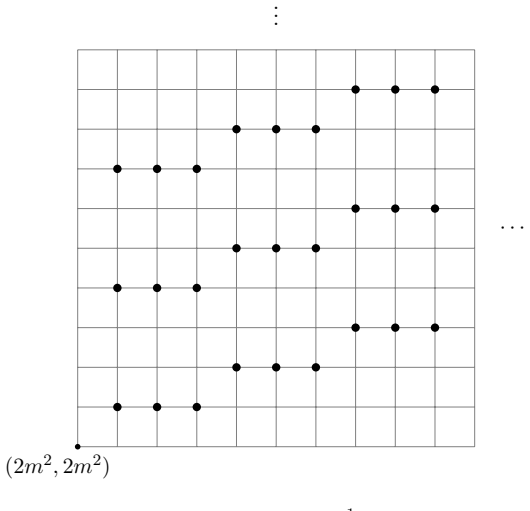
- Optimal point sets exist for linear functions k(n).
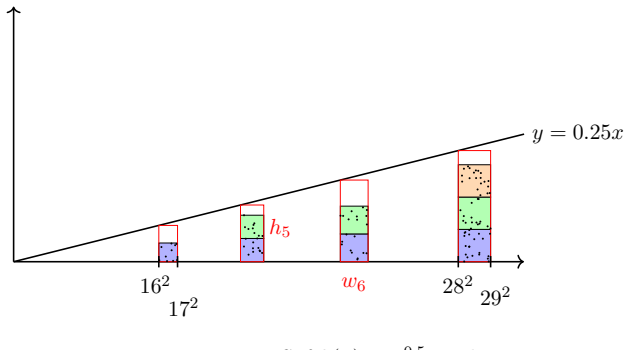
- Positive-density point sets exist for power functions k(n).
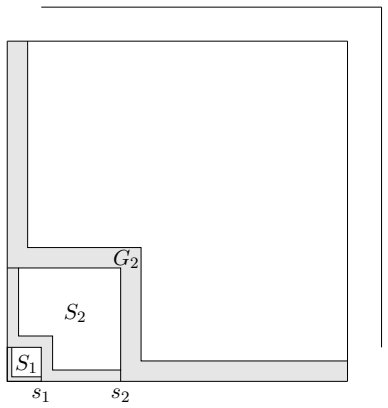
- Existence of a positive-density set for constant k implies existence for any sufficiently regular k(n).
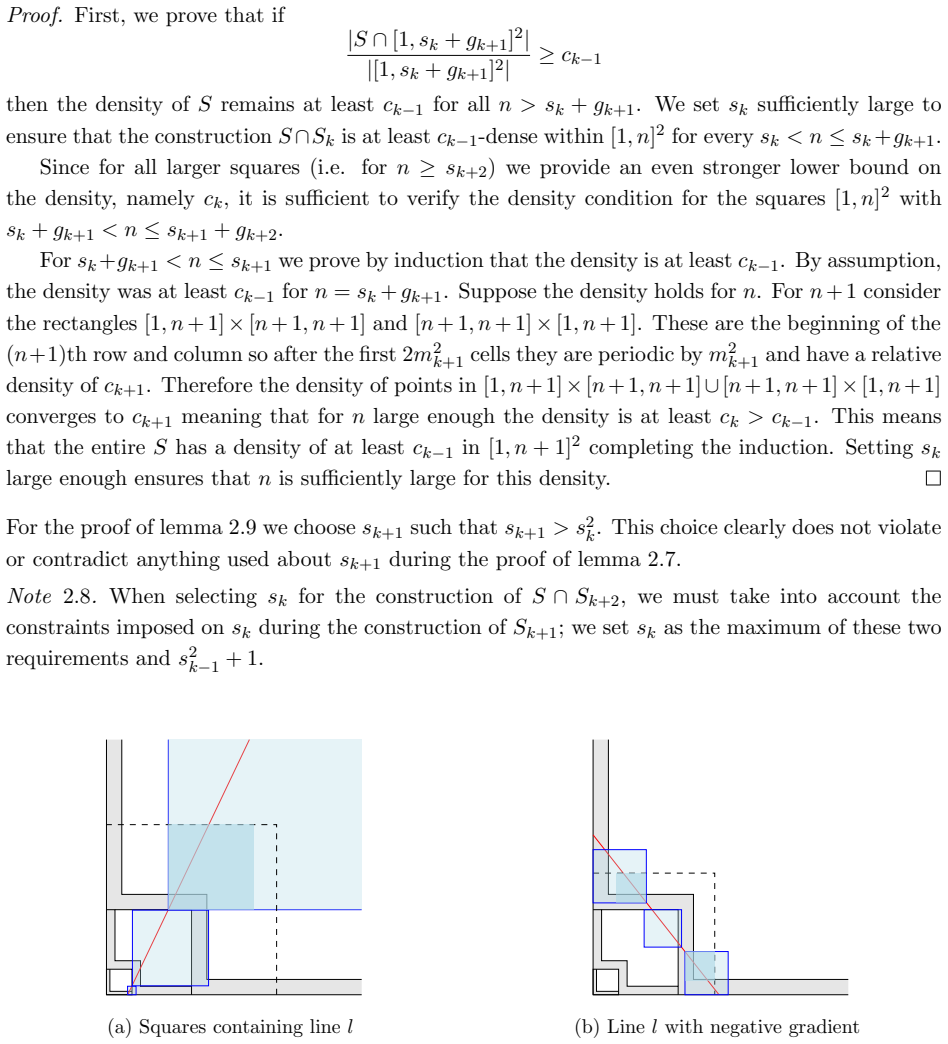
- No configuration with constant k can achieve the 0.897 density threshold.
Where Pith is reading between the lines
- For constant k the maximal achievable density must be o(n), even if superlinear in k.
- The reduction implies the constant-k instance is the core hard case for the whole family of extensible problems.
- Small-n computational enumeration could check whether densities approach 0.897 before any polynomial growth in k(n) becomes necessary.
- Analogous density thresholds might separate feasible and infeasible regimes in other grid-avoidance problems.
Load-bearing premise
The combinatorial counting argument that extracts a polynomial growth lower bound on k(n) from the density assumption applies without additional regularity conditions on the point set.
What would settle it
An explicit point-set construction with constant k that achieves liminf S_n/(n k(n)) >= 0.897, or a counterexample showing the polynomial lower bound does not follow from the density assumption alone.
Figures
read the original abstract
The classical no-$k$-in-line problem asks for the largest number of points that can be placed on an $n \times n$ grid without having $k$ of them collinear. A natural extension, motivated by the analogous question by Erde for $k\in \mathbb{Z}$, is the \emph{extensible no-$(k(n)+1)$-in-line problem}, which seeks a subset of points in $\mathbb{Z}^2$ with maximal possible density such that at most $k(n)$ points are collinear within the subgrid $[1,n]^2$. We construct optimal sets for linear functions and positive-density sets for power functions. We prove that any configuration achieving $\liminf\frac{S_n}{n k(n)} \ge 0.897$ must satisfy $k(n) = \Omega( n^c)$ for some $c>0$ constant; therefore, the extensible no-$k$-in-line problem has no configuration with this property when $k$ is a constant. Finally, we reduce the problem to the extensible no-$k$-in-line problem, showing that if a positive-density point-set exists for a constant limiter function, then one also exists for any sufficiently regular function $k(n)$.
Editorial analysis
A structured set of objections, weighed in public.
Referee Report
Summary. The manuscript introduces the extensible no-(k(n)+1)-in-line problem on Z^2, seeking maximal-density point sets where at most k(n) points are collinear inside any [1,n]^2 subgrid. It constructs optimal sets for linear k(n) and positive-density sets for power functions k(n), proves that any configuration with liminf S_n/(n k(n)) >= 0.897 requires k(n) = Omega(n^c) for some c>0 (hence constant k is impossible), and reduces the general case to the constant-limiter problem under regularity assumptions on k(n).
Significance. If the impossibility result and constructions hold, the work supplies both positive-density examples for growing k(n) and a density threshold that forces super-constant growth, sharpening the boundary between achievable and impossible densities in variable-limiter collinearity problems.
major comments (2)
- [Abstract] Abstract: the central negative claim that liminf S_n/(n k(n)) >= 0.897 forces k(n) = Omega(n^c) rests on an unspecified combinatorial counting argument that extracts polynomial growth from the density hypothesis; no sketch, double-counting identity, or extremal tool is supplied, so the implication cannot be verified for arbitrary point sets.
- [Abstract] Abstract: the numerical threshold 0.897 is stated without derivation, error analysis, or indication of how it arises from the underlying counting argument, leaving the precise cutoff uncheckable.
minor comments (1)
- [Abstract] Abstract: the reduction statement mentions 'sufficiently regular' k(n) but supplies no definition of regularity; add the precise conditions (e.g., monotonicity, growth rate) under which the implication holds.
Simulated Author's Rebuttal
We thank the referee for their detailed reading of the manuscript. Below we respond point-by-point to the two major comments, both of which concern the presentation of the negative result in the abstract. We agree that additional clarity is warranted and will revise accordingly.
read point-by-point responses
-
Referee: [Abstract] Abstract: the central negative claim that liminf S_n/(n k(n)) >= 0.897 forces k(n) = Omega(n^c) rests on an unspecified combinatorial counting argument that extracts polynomial growth from the density hypothesis; no sketch, double-counting identity, or extremal tool is supplied, so the implication cannot be verified for arbitrary point sets.
Authors: The full proof of the negative result is contained in Section 3. It proceeds by a double-counting argument that bounds the total number of point-line incidences under the density hypothesis, then applies a simple extremal estimate (a variant of the Szemerédi–Trotter incidence bound specialized to axis-aligned grids) to extract the required polynomial lower bound on k(n). We will add a concise one-sentence sketch of this counting argument to the abstract in the revised version. revision: yes
-
Referee: [Abstract] Abstract: the numerical threshold 0.897 is stated without derivation, error analysis, or indication of how it arises from the underlying counting argument, leaving the precise cutoff uncheckable.
Authors: The constant 0.897 is the explicit numerical value obtained by optimizing the leading coefficient in the incidence bound of Section 3 (specifically, the maximum of a quadratic function arising from the double-counting identity when the growth of k(n) is assumed sub-polynomial). We will append a short parenthetical clause to the abstract indicating that the threshold is the optimum of this coefficient. revision: yes
Circularity Check
No circularity: claims rest on combinatorial constructions and counting arguments from definitions
full rationale
The paper states constructions for linear and power functions, a density-based impossibility result via combinatorial counting, and a reduction between constant and regular k(n). No equations or steps are shown to reduce by construction to fitted inputs, self-definitions, or load-bearing self-citations. The liminf implication is presented as following from standard density and collinearity definitions rather than any ansatz or renaming that loops back to the target result. The derivation is therefore self-contained against external combinatorial benchmarks.
Axiom & Free-Parameter Ledger
axioms (1)
- standard math Collinearity is the standard geometric notion on Z^2; density is the usual liminf of points inside [1,n]^2 divided by n^2.
Reference graph
Works this paper leans on
-
[1]
arXiv preprint arXiv:2105.11431 , year=
A lower bound for the n -queens problem , author=. arXiv preprint arXiv:2105.11431 , year=
-
[2]
Guy, Richard K. and Kelly, Patrick A. , TITLE =. Canadian Mathematical Bulletin , VOLUME =. 1968 , PAGES =. doi:10.4153/CMB-1968-062-3 , URL =
-
[3]
arXiv preprint arXiv:2109.08083 , year=
The n -queens problem , author=. arXiv preprint arXiv:2109.08083 , year=
-
[4]
Advances in Mathematics , volume=
The number of n-queens configurations , author=. Advances in Mathematics , volume=. 2023 , publisher=
2023
-
[5]
Note on the existence of large minimal blocking sets in
Sz. Note on the existence of large minimal blocking sets in. Combinatorica , volume=. 1992 , publisher=
1992
-
[6]
Finite Fields and Their Applications , volume=
Bounds on (n, r)-arcs and their application to linear codes , author=. Finite Fields and Their Applications , volume=. 2005 , publisher=
2005
-
[7]
arXiv preprint arXiv:1403.7739 , year=
Chernoff's Inequality-A very elementary proof , author=. arXiv preprint arXiv:1403.7739 , year=
-
[8]
arXiv preprint arXiv:2502.00176 , year=
Settling the no- (k+ 1) -in-line problem when k is not small , author=. arXiv preprint arXiv:2502.00176 , year=
-
[9]
2025 , eprint=
Randomised algebraic constructions for the no- (k+1) -in-line problem , author=. 2025 , eprint=
2025
-
[10]
Combinatorica , volume=
Graphs drawn with few crossings per edge , author=. Combinatorica , volume=. 1997 , publisher=
1997
-
[11]
Combinatorica , volume=
Extremal problems in discrete geometry , author=. Combinatorica , volume=. 1983 , publisher=
1983
-
[12]
An extension of the Ruzsa-Szemer
S. An extension of the Ruzsa-Szemer. Combinatorica , volume=. 2004 , publisher=
2004
-
[13]
Roth, Karl F. , TITLE =. The Journal of the London Mathematical Society , VOLUME =. 1951 , PAGES =. doi:10.1112/jlms/s1-26.3.198 , URL =
-
[14]
P\'. No-three-in-line-in-3. Algorithmica , FJOURNAL =. 2007 , NUMBER =. doi:10.1007/s00453-006-0158-9 , URL =
-
[15]
Computational Geometry , VOLUME =
Aichholzer, Oswin and Eppstein, David and Hainzl, Eva-Maria , TITLE =. Computational Geometry , VOLUME =. 2023 , DOI =
2023
-
[16]
2018 , publisher=
Forbidden configurations in discrete geometry , author=. 2018 , publisher=
2018
-
[17]
1917 , publisher=
Amusements in mathematics , author=. 1917 , publisher=
1917
-
[18]
Ovals in a finite projective plane , volume =
Segre, Beniamino , journal =. Ovals in a finite projective plane , volume =
-
[19]
Curve razionali normali e
Segre, Beniamino , journal =. Curve razionali normali e
-
[20]
Mathematical theory of the symmetrical factorial design , author=. Sankhy. 1947 , publisher=
1947
-
[21]
Towards mechanized mathematical assistants , pages=
The on-line encyclopedia of integer sequences , author=. Towards mechanized mathematical assistants , pages=. 2007 , publisher=
2007
-
[22]
Brass, Peter and Moser, William O. J. and Pach, János. Lattice Point Problems. Research Problems in Discrete Geometry. 2005. doi:10.1007/0-387-29929-7_11
-
[23]
1998 , publisher=
Flammenkamp, Achim , journal=. 1998 , publisher=
1998
-
[24]
Journal of Combinatorial Theory, Series A , volume=
Update on the no-three-in-line problem , author=. Journal of Combinatorial Theory, Series A , volume=. 1979 , publisher=
1979
-
[25]
Journal of Combinatorial Theory, Series A , volume=
Some advances in the no-three-in-line problem , author=. Journal of Combinatorial Theory, Series A , volume=. 1975 , publisher=
1975
-
[26]
No-Three-in-Line-in-3
P. No-Three-in-Line-in-3. Algorithmica , volume=
-
[27]
Finite Fields and Their Applications , volume=
Bounds on (n, r) -arcs and their application to linear codes , author=. Finite Fields and Their Applications , volume=. 2005 , publisher=
2005
-
[28]
EMS Surveys in Mathematical Sciences , volume=
Arcs in finite projective spaces , author=. EMS Surveys in Mathematical Sciences , volume=
-
[29]
Combinatorica , volume=
Small Complete Arcs in Projective Planes , author=. Combinatorica , volume=
-
[30]
and Wood, David R
Payne, Michael S. and Wood, David R. , journal =. On the general position subset selection problem , volume =
-
[31]
Mathematical games: combinatorial problems, some old, some new and all newly attacked by computer , volume =
Gardner, Martin , journal =. Mathematical games: combinatorial problems, some old, some new and all newly attacked by computer , volume =
-
[32]
, journal =
Wood, David R. , journal =. Grid drawings of
-
[33]
and Holton, Derek A
Adena, Michael A. and Holton, Derek A. and Kelly, Patrick A. , booktitle =. Some thoughts on the no-three-in-line problem , year =
-
[34]
, howpublished =
OEIS Foundation Inc. , howpublished =. The
-
[35]
Advances in Mathematics , volume=
Sandwiching random graphs: universality between random graph models , author=. Advances in Mathematics , volume=. 2004 , publisher=
2004
-
[36]
Combinatorics, Probability and Computing , volume=
Sandwiching biregular random graphs , author=. Combinatorics, Probability and Computing , volume=. 2023 , publisher=
2023
-
[37]
Baker, R. C. and Harman, G. and Pintz, J. , journal =. The difference between consecutive primes
-
[38]
Gao, Pu and Isaev, Mikhail and McKay, Brendan , journal=. Kim-
-
[39]
International Workshop on Randomization and Approximation Techniques in Computer Science , pages=
Constructive proofs of concentration bounds , author=. International Workshop on Randomization and Approximation Techniques in Computer Science , pages=. 2010 , organization=
2010
-
[40]
2023 , publisher=
Random graphs and networks: a first course , author=. 2023 , publisher=
2023
-
[41]
SIAM Journal on Computing , volume=
Randomized distributed edge coloring via an extension of the Chernoff--Hoeffding bounds , author=. SIAM Journal on Computing , volume=. 1997 , publisher=
1997
-
[42]
Journal of Graph Theory , volume=
Perfect matchings in random subgraphs of regular bipartite graphs , author=. Journal of Graph Theory , volume=. 2021 , publisher=
2021
-
[43]
European Journal of Combinatorics , volume=
The extensible No-Three-In-Line problem , author=. European Journal of Combinatorics , volume=. 2023 , publisher=
2023
-
[44]
manuscript , url=
100 open problems , author=. manuscript , url=
-
[45]
2005 , publisher=
Research problems in discrete geometry , author=. 2005 , publisher=
2005
-
[46]
The American Mathematical Monthly , volume=
Martin Gardner's minimum no-3-in-a-line problem , author=. The American Mathematical Monthly , volume=. 2014 , publisher=
2014
-
[47]
arXiv e-prints , pages=
Repeatedly applying the Combinatorial Nullstellensatz for Zero-sum Grids to Martin Gardner's minimum no-3-in-a-line problem , author=. arXiv e-prints , pages=
-
[48]
preprint , year=
Extensions of the no-three-in-line problem , author=. preprint , year=
-
[49]
Combinatorica , volume=
Maximal arcs in Desarguesian planes of odd order do not exist , author=. Combinatorica , volume=. 1997 , publisher=
1997
-
[50]
Journal of Combinatorial Theory , volume=
Some maximal arcs in finite projective planes , author=. Journal of Combinatorial Theory , volume=. 1969 , publisher=
1969
-
[51]
, publisher=
Pu Gao , journal=. , publisher=
-
[52]
No l Grid-Points in Spaces of Small Dimension
Lefmann, Hanno. No l Grid-Points in Spaces of Small Dimension. Algorithmic Aspects in Information and Management. 2008
2008
-
[53]
Random Structures & Algorithms , volume=
Asymptotic enumeration of digraphs and bipartite graphs by degree sequence , author=. Random Structures & Algorithms , volume=. 2023 , publisher=
2023
-
[54]
Advances in Mathematics , volume=
On the number of matrices and a random matrix with prescribed row and column sums and 0--1 entries , author=. Advances in Mathematics , volume=. 2010 , publisher=
2010
-
[55]
Maximal independent subsets in
F. Maximal independent subsets in. SIAM Journal on Discrete Mathematics , volume=. 1991 , publisher=
1991
-
[56]
Random Structures & Algorithms , volume=
Random dense bipartite graphs and directed graphs with specified degrees , author=. Random Structures & Algorithms , volume=. 2009 , publisher=
2009
-
[57]
Proceedings of the International Congress of Mathematicians 2010 , pages=
Subgraphs of random graphs with specified degrees , author=. Proceedings of the International Congress of Mathematicians 2010 , pages=. 2010 , organization=
2010
-
[58]
ACM Transactions on Algorithms (TALG) , volume=
Perfect matchings via uniform sampling in regular bipartite graphs , author=. ACM Transactions on Algorithms (TALG) , volume=. 2010 , publisher=
2010
-
[59]
Random Structures & Algorithms , volume=
Complex martingales and asymptotic enumeration , author=. Random Structures & Algorithms , volume=. 2018 , publisher=
2018
-
[60]
A collection of open problems in celebration of
Rahil Baber and Natalie Behague and Asier Calbet and David Ellis and Joshua Erde and Ron Gray and Maria-Romina Ivan and Barnabás Janzer and Robert Johnson and Luka Milićević and John Talbot and Ta Sheng Tan and Belinda Wickes , year=. A collection of open problems in celebration of. 2310.18163 , archivePrefix=
-
[61]
arXiv preprint arXiv:2510.17743 , year=
No- (k+ 1) -in-line problem for large constant k , author=. arXiv preprint arXiv:2510.17743 , year=
-
[62]
1900 , howpublished =
Dudeney, Henry , title =. 1900 , howpublished =
1900
-
[63]
A272651: The no-3-in-line problem , howpublished =
-
[64]
2025 , journal =
Extensible no- (k(n)+1) -in-line when k(n)=cn^ , author=. 2025 , journal =
2025
-
[65]
Extensible no- (k(n)+1) -in-line when k(n)=cn , author=
-
[66]
arXiv preprint arXiv:2605.07000 , year=
A note on the extensible no-three-in-line problem , author=. arXiv preprint arXiv:2605.07000 , year=
discussion (0)
Sign in with ORCID, Apple, or X to comment. Anyone can read and Pith papers without signing in.