REVIEW 4 major objections 6 minor 37 references
GTRSS: Graph-based Top-$k$ Representative Similar Subtrajectory Query
T0 review · 4 major / 6 minor · reviewed 2026-08-06 · deepseek-v4-flash
Pith's one-line read The paper claims that top-k similar subtrajectory search can be answered by navigating a dual-layer graph index, achieving over 90% accuracy and up to two orders of magnitude speedup.
desk verdict A genuinely new graph-based approach to subtrajectory search, but the core DTSM metric and the evaluation protocol need major repair before the reported results can be trusted. read the letter →
The pith
A machine-rendered reading of the paper's core claim, the machinery that carries it, and where it could break.
The reading
What carries the argument
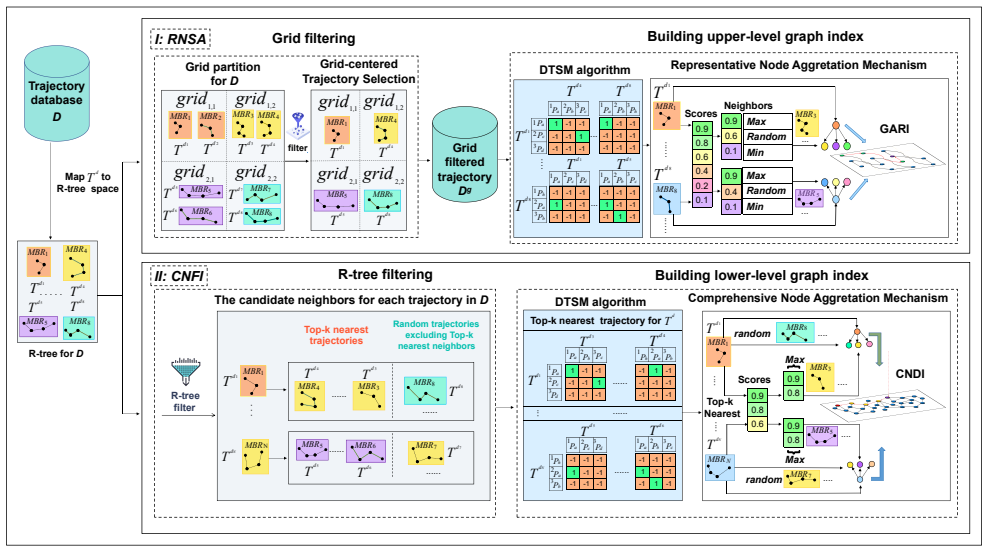
The load-bearing objects are the DTSM scoring scheme and the two-layer graph. DTSM (Data Trajectory Similarity Metric) is a dynamic program over a binary similarity matrix A in which A_{i,j}=1 if point p_i of one trajectory and p_j of the other are within distance α, and -1 otherwise; its recurrence Θ_s selects among six alignment conditions (C1–C6) to maximize the matched-point score of any subtrajectory pair, and a pruning step drops all pairs whose starting points are dissimilar. GARI (Global Aggregated Representative Index) is a sparse upper-level graph over one representative trajectory per grid cell, each node linked to its most similar, a random, and its least similar representative, to give both local fidelity and global reach. CNDI (Comprehensive Node Detail Index) is the lower-level graph over all trajectories, linking each trajectory to a chosen proportion of its top-ξ DTSM-similar spatially close neighbors plus random trajectories. Online search uses greedy hill-climbing on both layers, with the GARI result serving as the CNDI entry point, and records every node visited so the final top-k can be selected from the accumulated candidates.
What would settle it
Run Algorithm 1 against an exhaustive enumeration of all subtrajectory pairs (using the stated Θs scoring) on many small random trajectory pairs; if the DP ever returns less than the exhaustive maximum, or if the S≤0 early break discards a continuation that would have raised the score, the metric underlying all graph edges is not computing what the framework requires.
Extended reading notes
Core claim
The central discovery is that the TRSSQ problem has a graph structure worth exploiting: trajectories that contain top-k representative subtrajectories for the same query tend to be similar to one another, so a graph whose edges connect such trajectories can route a query directly to the relevant clusters. To build that graph, the paper introduces the Data Trajectory Similarity Metric (DTSM), a dynamic-programming score that returns the maximum similarity over all subtrajectory pairs of two trajectories, together with a pruning rule that skips dissimilar starting point pairs. The offline index has two layers: the Global Aggregated Representative Index (GARI), a sparse graph over spatially selected representative trajectories, and the Comprehensive Node Detail Index (CNDI), a graph over every trajectory with a mix of high-similarity and random neighbors. Online, the query first climbs GARI to find a good entry node, then climbs CNDI greedily and records the nodes it visits; the top-k subtrajectories are drawn from that recorded candidate set. The paper argues that this is the first graph-based solution to top-k subtrajectory search, and its experiments on two real datasets report retrieval accuracy above 90% and query speedups of up to two orders of magnitude compared with the previous TRSSQ method and other filtering baselines.
Load-bearing premise
The load-bearing premise is that the DTSM dynamic program always returns the true maximum similarity over all subtrajectory pairs, because every graph edge is built from that score; this correctness is only partially proved in the paper, with the early-termination rule and boundary conditions left unproven.
Editorial extensions
If this is right
- If GTRSS is right, query time stops growing with database size: doubling the trajectory count no longer doubles query cost, because the search visits only a constant-degree neighbourhood of the graph rather than scanning the data.
- The dual-layer design separates the two failure modes of approximate search: GARI supplies a reliable starting point (avoiding poor local optima), while CNDI's random edges provide an escape mechanism when the deterministic neighbours lead to a dead end.
- Because online scoring is pluggable (the paper instantiates it with ExactS, CMA, PSS, and POS), the graph index works with DTW, EDR, and ERP alike, so the speedup transfers across similarity measures.
- Accuracy degrades gracefully rather than sharply as k grows, since recording intermediate nodes makes the candidate set larger than the final answer set; the ablation study attributes measurable gains to this node tracking.
- Offline construction cost, dominated by DTSM pairwise scoring, is what limits the approach in practice; the paper's reported 12–30 hour build times for hundreds of thousands of trajectories define the current scalability frontier.
Reading between the lines
- A testable extension is to isolate DTSM by comparing its output against exhaustive enumeration on small random trajectory pairs; the paper's pruning theorem only covers dissimilar starting points, so the early-break rule at S≤0 is the part most worth probing.
- The graph-index recipe may transfer to other top-k retrieval problems where each database object has many sub-objects and one representative per object is wanted, such as similar video segments or time series motifs.
- The reported 'over 90 percent' accuracy is measured with HR/RR metrics against a filtered ground truth; an independent check against exact top-k on a random sample would clarify how much of the gap comes from graph approximation versus the underlying similarity measures.
- Because δ tunes the fraction of similarity-guided versus random neighbours in CNDI, the same framework spans a continuum from a pure kNN graph to a random graph; the paper does not explore this trade-off surface beyond its default setting.
Signed reviews
Editorial analysis
A structured set of objections, weighed in public.
Referee Report
Summary. The paper proposes GTRSS, a graph-based framework for the Top-k Representative Similar Subtrajectory Query (TRSSQ). The method builds a dual-layer graph index (an upper global aggregated representative index GARI and a lower comprehensive node detail index CNDI), where edges are determined by a newly introduced Data Trajectory Similarity Metric (DTSM) computed via a dynamic program with pruning, and answers queries by greedy hill-climbing on the graph. The authors claim that GTRSS is the first graph-based solution to TRSSQ and that it achieves retrieval accuracy over 90% with up to two orders of magnitude speedup.
Significance. If the technical content were correct, the framework would be a meaningful contribution to trajectory similarity search, as it replaces the filter-validate full-database scan with a graph-navigation approach and is evaluated on two real-world datasets. The paper also proposes a new similarity primitive (DTSM) that could be of independent interest. However, the correctness of the entire index and online search pipeline rests on the DTSM score, and the manuscript's definition and computation of DTSM are not sound. The load-bearing flaws described below make the central efficiency and accuracy claims unsupported as published.
major comments (4)
- [§IV-B, Definition 6 and Eqs. (5)–(6)] The DTSM recurrence is not well-defined. The scoring function Θs has no base case for empty subtrajectories and no stated domain for the recursive term R, so the recursion in Eq. (5) has no well-defined value at the boundary. Moreover, the 'otherwise' branch of Eq. (5) explicitly adds subcost(p_{i+1}^{d1}, p_{j+1}^{d2}) and then invokes R(T_{i+1:k}, T_{j+1:l}), whose conditions C1–C6 also evaluate the pair (i+1,j+1); this double-counts the same point pair. In addition, Definition 6 and the prose describe a +1/−1 counting scheme, while Eq. (5) uses subcost values +2/−2 with Δ=1; these different weights change the score and the claimed cancellation behavior. Consequently, ϕ(T^{d1}, T^{d2}) in Eq. (2) is not a well-defined quantity, and the graph edges in GARI and CNDI are built from scores that are not formally defined.
- [§IV-B, Pruning Rule and Algorithm 1, lines 15–16] The proof of the pruning theorem is invalid, and the early break used in Algorithm 1 is unsound. The induction step in the theorem merely asserts that the right-hand side 'may be nonzero' and does not establish the needed nonnegativity of Θs(T_{i+1:k}, T_{j+1:l}); in fact, the recurrence with subcost +2/−2 can produce negative intermediate values. More importantly, the early break when S ≤ 0 is false: because the recurrence can produce score sequences that go from positive to non-positive and back to positive (e.g., a matched pair contributing +2, a mismatched pair contributing −2, and another matched pair contributing +2), a prefix with S ≤ 0 can be extended to a higher score. Algorithm 1 therefore can discard the true maximum subtrajectory pair, so DTSM does not compute the maximum asserted in Eq. (2).
- [§IV-B and §IV-E, Complexity statements] The paper gives two incompatible complexity statements for DTSM. Section IV-B claims O(n1^2·n2^2) with memoization, while Section IV-E assumes 'DTSM has time complexity O(L^2) per pair' to derive the offline costs O(M^4·L^2) for GARI and O(N·ξ·L^2) for CNDI; these differ by orders of magnitude. Moreover, Algorithm 1 does not exhibit a memoization structure: line 11 recomputes Θs(T_{i:k}, T_{j:l}) from the recurrence inside fresh nested loops, so the stated O(n1^2·n2^2) bound is not substantiated by the pseudocode as written.
- [§V-B and §V-D, Experimental protocol] The baseline and ground-truth setup is not fully independent. The main competitor [14] is authored by overlapping authors (K. Wang and X. Lin appear on both papers), and the authors modify it with an additional OSF filter, so the reported improvement over [14] is not a direct comparison with the published method. The 'Grid' baseline applies a spatial filter similar to the one used inside GTRSS's own pipeline, and the ground-truth top-k is computed by ExactS after a Grid filter, which may bias the accuracy numbers in favor of the proposed system. The abstract's claim of 'retrieval accuracy of over 90 percent' is also inconsistent with the reported results; for example, Table I shows GTRSS(CMA) on Chengdu with HR20=0.5482 and HR50=0.5939 for DTW, and Table II shows HR50 values below 0.8 for several GTRSS variants.
minor comments (6)
- [Author contact information] The email address 'kmwamg24@m.fudan.edu.cn' appears to contain a typo (likely 'kmwang24').
- [Figure 8] The axis labels in Fig. 8 contain garbled '/uni000000...' strings and must be regenerated with a proper font.
- [References] Reference [19] (M. Herlihy, 'A methodology for implementing highly concurrent data objects') appears unrelated to trajectory similarity; please verify the citation or replace it with the intended work.
- [§V-B, Metrics] The definitions of 'Relative Rank' and 'HR-10' are informal; precise formulas are needed to interpret the reported numbers.
- [Algorithm 1] The pseudocode in Algorithm 1 does not fully align with the notation of Eq. (5): the recurrence is defined for fixed start and end indices, but the loop variables in lines 9–11 update S without explicitly showing how the subtrajectory endpoints are passed to Θs.
- [§IV-E, Space complexity] The statement 'M^2 ≪ N' is asserted without justification; since M is a user-specified grid parameter, this inequality is not guaranteed and should be discussed or demonstrated in the experimental settings.
Circularity Check
Ground-truth reference is computed after a Grid filter that also underpins GTRSS's own index, making the reported accuracy partly self-referential; the efficiency claim is not circular.
-
other
[Section V-D (Effectiveness and Efficiency Evaluation), with grid-filter description in Section V-B baseline 2 and Section IV-A overview]
"A Grid filter first preprocesses each query trajectory to retain spatially similar data trajectories, reducing inefficient searches. ExactS then computes ground-truth similarity scores between filtered trajectories and the query, serving as the reference standard."
The accuracy reference is not the true top-k over the full database: it is ExactS applied only after a Grid filter. GTRSS's own index construction starts from the same filtering idea: 'we first build an R-tree on the trajectory dataset D to facilitate spatial filtering. The resulting filtered dataset is denoted as Dg, which serves as the input for constructing the upper-layer graph index.' Thus the candidate universe of the ground truth and the candidate universe of GTRSS's representative index coincide at the filter stage; high HR/R10@50 values are partly inherited from sharing this filter rather than earned by graph navigation. The reported 'over 90%' accuracy is therefore a partially self-referential benchmark, though not an equation-level reduction.
full rationale
The main derivation chain is not circular: DTSM computes a parameter-free dynamic-programming score, graph edges are constructed from that score, and the online search is evaluated against independent exact-similarity computations (ExactS/CMA/PSS/POS). No fitted parameter is renamed as a prediction, and no uniqueness theorem is imported from the authors' prior work to force the graph choice. The self-citation of [14] establishes the TRSSQ problem and the RSSE baseline; it is background and not load-bearing for the graph construction. The evaluation-level concern is real: the reference standard for accuracy is computed over Grid-filtered trajectories while GTRSS's own RNSA phase uses R-tree/grid filtering to form Dg, so the accuracy metrics are partially self-referential. The DTSM recurrence issues (undefined base cases, conflicting +1/-1 vs +2/-2 weights, unproven early break at S<=0 in Algorithm 1) are correctness and omitted-proof problems, not circularity; they would reduce the validity of the similarity primitive but do not make the derivation equivalent to its inputs. Overall, central efficiency claims remain independent of fitted values, so the circularity burden is moderate rather than a derivation-from-input collapse.
Assumptions & free parameters
free parameters (5)
- alpha (point matching distance threshold)
- Grid granularity M
- Neighbor count xi per node (CNDI)
- Random-neighbor ratio delta
- Subcost weights (+2/-2) and correction terms Delta=1
assumptions (6)
- domain assumption Data trajectories containing the top-k representative subtrajectories for the same query are mutually similar.
- ad hoc to paper DTSM similarity scores predict whether two trajectories appear together in a query's top-k result set.
- ad hoc to paper Greedy hill-climbing on GARI and CNDI, with random neighbors, converges to a node close to the global optimum.
- ad hoc to paper The early break in Algorithm 1 (lines 15-16) does not discard an optimal subtrajectory pair.
- ad hoc to paper The recursive definitions in Eqs. (5)-(6) have well-defined boundary conditions.
- domain assumption ExactS over a Grid-filtered candidate set equals the true top-k over the full database.
invented entities (2)
-
DTSM (Data Trajectory Similarity Metric)
-
Dual-layer graph index (GARI and CNDI)
Cite this review
Pith. "Pith review of GTRSS: Graph-based Top-$k$ Representative Similar Subtrajectory Query." pith.science (2026). https://pith.science/paper/4NESH2WA
@misc{pith2026250705542,
  author       = {Pith},
  title        = {Pith review of: GTRSS: Graph-based Top-$k$ Representative Similar Subtrajectory Query},
  year         = {2026},
  howpublished = {\url{https://pith.science/paper/4NESH2WA}},
  note         = {Machine review of arXiv:2507.05542}
}
read the original abstract
Trajectory mining has attracted significant attention. This paper addresses the Top-k Representative Similar Subtrajectory Query (TRSSQ) problem, which aims to find the k most representative subtrajectories similar to a query. Existing methods rely on costly filtering-validation frameworks, resulting in slow response times. Addressing this, we propose GTRSS, a novel Graph-based Top-k Representative Similar Subtrajectory Query framework. During the offline phase, GTRSS builds a dual-layer graph index that clusters trajectories containing similar representative subtrajectories. In the online phase, it efficiently retrieves results by navigating the graph toward query-relevant clusters, bypassing full-dataset scanning and heavy computation. To support this, we introduce the Data Trajectory Similarity Metric (DTSM) to measure the most similar subtrajectory pair. We further combine R-tree and grid filtering with DTSM pruning rules to speed up index building. To the best of our knowledge, GTRSS is the first graph-based solution for top-k subtrajectory search. Experiments on real datasets demonstrate that GTRSS significantly enhances both efficiency and accuracy, achieving a retrieval accuracy of over 90 percent and up to two orders of magnitude speedup in query performance.
Figures


Figures from the paper (6 more)


Reference graph
Works this paper leans on
-
[14]
Efficient learning-based top-k representative similar subtrajectory query,
K. Wang, S. Yang, J. Jin, P. Cheng, J. Yang, and X. Lin, “Efficient learning-based top-k representative similar subtrajectory query,” in 2024 IEEE 40th In- ternational Conference on Data Engineering (ICDE) , pp. 4396–4408, IEEE, 2024
work page 2024
-
[1]
P. Zhang, J. Zheng, H. Lin, C. Liu, Z. Zhao, and C. Li, “Vehicle trajectory data mining for artificial intelligence and real-time traffic information extraction,” IEEE Trans- actions on Intelligent Transportation Systems , vol. 24, no. 11, pp. 13088–13098, 2023
work page 2023
-
[2]
Travel-time prediction using gaus- sian process regression: A trajectory-based approach,
T. Id ´e and S. Kato, “Travel-time prediction using gaus- sian process regression: A trajectory-based approach,” in Proceedings of the 2009 SIAM International Conference on Data Mining , pp. 1185–1196, SIAM, 2009
work page 2009
-
[3]
Chalkboarding: A new spatiotemporal query paradigm for sports play retrieval,
L. Sha, P. Lucey, Y . Yue, P. Carr, C. Rohlf, and I. Matthews, “Chalkboarding: A new spatiotemporal query paradigm for sports play retrieval,” in Proceedings of the 21st International Conference on Intelligent User Interfaces, pp. 336–347, 2016
work page 2016
-
[4]
Efficient retrieval of similar time sequences under time warping,
B.-K. Yi, H. V . Jagadish, and C. Faloutsos, “Efficient retrieval of similar time sequences under time warping,” in Proceedings 14th International Conference on Data Engineering, pp. 201–208, IEEE, 1998
work page 1998
-
[5]
Robust and fast sim- ilarity search for moving object trajectories,
L. Chen, M. T. ¨Ozsu, and V . Oria, “Robust and fast sim- ilarity search for moving object trajectories,” in Proceed- ings of the 2005 ACM SIGMOD international conference on Management of data , pp. 491–502, 2005
work page 2005
-
[6]
On the marriage of lp-norms and edit distance,
L. Chen and R. Ng, “On the marriage of lp-norms and edit distance,” in Proceedings of the Thirtieth interna- tional conference on Very large data bases-Volume 30 , pp. 792–803, 2004
work page 2004
-
[7]
Trass: Efficient trajectory similarity search based on key-value data stores,
H. He, R. Li, S. Ruan, T. He, J. Bao, T. Li, and Y . Zheng, “Trass: Efficient trajectory similarity search based on key-value data stores,” in 2022 IEEE 38th International conference on data engineering (ICDE) , pp. 2306–2318, IEEE, 2022
work page 2022
Show all 37 references
-
[8]
Distributed in-memory trajectory similarity search and join on road network,
H. Yuan and G. Li, “Distributed in-memory trajectory similarity search and join on road network,” in 2019 IEEE 35th international conference on data engineering (ICDE), pp. 1262–1273, IEEE, 2019
2019
-
[9]
Efficient and effective similar subtrajectory search with deep reinforce- ment learning,
Z. Wang, C. Long, G. Cong, and Y . Liu, “Efficient and effective similar subtrajectory search with deep reinforce- ment learning,” arXiv preprint arXiv:2003.02542 , 2020
2003 arXiv
-
[10]
Fast subtrajec- tory similarity search in road networks under weighted edit distance constraints,
S. Koide, C. Xiao, and Y . Ishikawa, “Fast subtrajec- tory similarity search in road networks under weighted edit distance constraints,” Proc. VLDB Endow. , vol. 13, p. 2188–2201, July 2020
2020
-
[11]
Distributed subtrajectory join on massive datasets,
P. Tampakis, C. Doulkeridis, N. Pelekis, and Y . Theodor- idis, “Distributed subtrajectory join on massive datasets,” ACM Transactions on Spatial Algorithms and Systems (TSAS), vol. 6, no. 2, pp. 1–29, 2020
2020
-
[12]
Efficient and effective similar subtrajectory search: A spatial- aware comprehension approach,
L. Deng, H. Sun, R. Sun, Y . Zhao, and H. Su, “Efficient and effective similar subtrajectory search: A spatial- aware comprehension approach,” ACM Trans. Intell. Syst. Technol., vol. 13, no. 3, pp. 35:1–35:22, 2022
2022
-
[13]
Exact and efficient similar subtrajectory search: Integrating constraints and simplification,
L. Deng, F. Wang, T. Wang, Y . Zhao, Y . Xia, and K. Zheng, “Exact and efficient similar subtrajectory search: Integrating constraints and simplification,” in 2025 IEEE 41st International Conference on Data Engi- neering (ICDE) , pp. 1056–1069, IEEE Computer Soci- ety, 2025
2025
-
[15]
Efficient and robust approximate nearest neighbor search using hierarchical navigable small world graphs,
Y . A. Malkov and D. A. Yashunin, “Efficient and robust approximate nearest neighbor search using hierarchical navigable small world graphs,” IEEE transactions on pattern analysis and machine intelligence , vol. 42, no. 4, pp. 824–836, 2018
2018
-
[16]
Efficient and effective similar subtrajectory search with deep reinforce- ment learning,
Z. Wang, C. Long, G. Cong, and Y . Liu, “Efficient and effective similar subtrajectory search with deep reinforce- ment learning,” Proc. VLDB Endow. , vol. 13, no. 11, pp. 2312–2325, 2020
2020
-
[17]
Ef- ficient non-learning similar subtrajectory search,
J. Jin, P. Cheng, L. Chen, X. Lin, and W. Zhang, “Ef- ficient non-learning similar subtrajectory search,” Proc. VLDB Endow., vol. 16, p. 3111–3123, July 2023
2023
-
[18]
Efficient and effective similar subtrajectory search with deep reinforcement learning,
Z. Wang, C. Long, G. Cong, and Y . Liu, “Efficient and effective similar subtrajectory search with deep reinforcement learning,” Proc. VLDB Endow. , vol. 13, p. 2312–2325, July 2020
2020
-
[19]
A methodology for implementing highly concurrent data objects (abstract),
M. Herlihy, “A methodology for implementing highly concurrent data objects (abstract),” ACM SIGOPS Oper. Syst. Rev., vol. 26, no. 2, p. 12, 1992
1992
-
[20]
KSQ: top-(k) similarity query on uncertain trajectories,
C. Ma, H. Lu, L. Shou, and G. Chen, “KSQ: top-(k) similarity query on uncertain trajectories,” IEEE Trans. Knowl. Data Eng. , vol. 25, no. 9, pp. 2049–2062, 2013
2013
-
[21]
REPOSE: distributed top-k trajectory similarity search with local reference point tries,
B. Zheng, L. Weng, X. Zhao, K. Zeng, X. Zhou, and C. S. Jensen, “REPOSE: distributed top-k trajectory similarity search with local reference point tries,” in 37th IEEE International Conference on Data Engineering, ICDE 2021, Chania, Greece, April 19-22, 2021 , pp. 708–719, IEEE, 2021
2021
-
[22]
Garden: a real-time processing framework for continu- ous top-k trajectory similarity search,
Z. Pan, P. Chao, J. Fang, W. Chen, J. Xu, and L. Zhao, “Garden: a real-time processing framework for continu- ous top-k trajectory similarity search,” Knowl. Inf. Syst. , vol. 65, no. 9, pp. 3777–3805, 2023
2023
-
[23]
Stkst-i: An efficient semantic trajectory search by temporal and semantic keywords,
X. Wu, Y . Liu, X. Zhao, and J. Chen, “Stkst-i: An efficient semantic trajectory search by temporal and semantic keywords,” Expert Systems with Applications , vol. 225, p. 120064, 2023
2023
-
[24]
An effectiveness study on trajectory similarity measures,
H. Wang, H. Su, K. Zheng, S. Sadiq, and X. Zhou, “An effectiveness study on trajectory similarity measures,” in Proceedings of the Twenty-Fourth Australasian Database Conference-Volume 137, pp. 13–22, 2013
2013
-
[25]
Top- k community similarity search over large-scale road networks,
N. Rai and X. Lian, “Top- k community similarity search over large-scale road networks,” IEEE Transactions on Knowledge and Data Engineering , vol. 35, no. 10, pp. 10710–10721, 2023
2023
-
[26]
Rndlp: A distributed framework for supporting continuous k- similarity trajectories search over road network,
H. Jiang, S. Tong, R. Zhu, and B. Wei, “Rndlp: A distributed framework for supporting continuous k- similarity trajectories search over road network,” Mathe- matics, vol. 12, no. 2, p. 270, 2024
2024
-
[27]
Towards efficient privacy-preserving top-k trajectory similarity query,
K. Yi, Y . Chen, Y . Su, X. Li, H. Liu, H. Dai, X. Guo, and Y . Chen, “Towards efficient privacy-preserving top-k trajectory similarity query,” in 2023 IEEE 20th Interna- tional Conference on Mobile Ad Hoc and Smart Systems (MASS), pp. 512–520, IEEE, 2023
2023
-
[28]
Continuous trajectory similarity search with result diversification,
X. Yu, S. Zhu, and Y . Ren, “Continuous trajectory similarity search with result diversification,” Future Gen- eration Computer Systems, vol. 143, pp. 392–400, 2023
2023
-
[29]
Vehicle trajectory similarity: Models, methods, and ap- plications,
R. S. D. Sousa, A. Boukerche, and A. A. Loureiro, “Vehicle trajectory similarity: Models, methods, and ap- plications,” ACM Computing Surveys (CSUR) , vol. 53, no. 5, pp. 1–32, 2020
2020
-
[30]
Trajectory similarity mea- sures,
K. Toohey and M. Duckham, “Trajectory similarity mea- sures,” Sigspatial Special, vol. 7, no. 1, pp. 43–50, 2015
2015
-
[31]
The definition and com- putation of trajectory and subtrajectory similarity,
M. Van Kreveld and J. Luo, “The definition and com- putation of trajectory and subtrajectory similarity,” in Proceedings of the 15th annual ACM international sym- posium on Advances in geographic information systems , pp. 1–4, 2007
2007
-
[32]
Similarity measurement of moving object trajectories,
H. Liu and M. Schneider, “Similarity measurement of moving object trajectories,” in Proceedings of the 3rd ACM SIGSPATIAL International Workshop on GeoStreaming, pp. 19–22, 2012
2012
-
[33]
A survey of trajectory distance measures and performance evaluation,
H. Su, S. Liu, B. Zheng, X. Zhou, and K. Zheng, “A survey of trajectory distance measures and performance evaluation,” The VLDB Journal, vol. 29, pp. 3–32, 2020
2020
-
[34]
Gaia open dataset,
D. Chuxing, “Gaia open dataset,” Internet Link: https://outreach. didichuxing. com/research/open- data/en/(Accessed on August 18, 2019) , 2019
2019
-
[35]
Tmn: Trajectory matching networks for predicting similarity,
P. Yang, H. Wang, D. Lian, Y . Zhang, L. Qin, and W. Zhang, “Tmn: Trajectory matching networks for predicting similarity,” in 2022 IEEE 38th International Conference on Data Engineering (ICDE) , pp. 1700– 1713, IEEE, 2022
2022
-
[36]
Computing trajectory similarity in linear time: A generic seed-guided neural metric learning approach,
D. Yao, G. Cong, C. Zhang, and J. Bi, “Computing trajectory similarity in linear time: A generic seed-guided neural metric learning approach,” in 2019 IEEE 35th international conference on data engineering (ICDE) , pp. 1358–1369, IEEE, 2019
2019
-
[37]
T3s: Effective representation learning for tra- jectory similarity computation,
P. Yang, H. Wang, Y . Zhang, L. Qin, W. Zhang, and X. Lin, “T3s: Effective representation learning for tra- jectory similarity computation,” in 2021 IEEE 37th In- ternational Conference on Data Engineering (ICDE) , pp. 2183–2188, IEEE, 2021
2021
Reviewed August 6, 2026 · model on record in the stance chip above.
Discussion (0). Continue with ORCID to comment.