REVIEW 3 major objections 4 minor 126 references
The Co-Evolution of Stellar Wind-blown Bubbles and Photoionized Gas II: 3D RMHD Simulations and Tests of Semi-Analytic Models
T0 review · 3 major / 4 minor · reviewed 2026-08-07 · deepseek-v4-flash
Pith's one-line read Photoionized gas makes wind bubbles hit harder
desk verdict Careful simulation study of joint wind+LyC feedback; the qualitative result that ionized gas boosts WBB momentum is plausible and well-motivated, but the alpha_p contrast is partly numerical and the CEM agreement is partly calibrated rather than predicted. read the letter →
The pith
A machine-rendered reading of the paper's core claim, the machinery that carries it, and where it could break.
The reading
What carries the argument
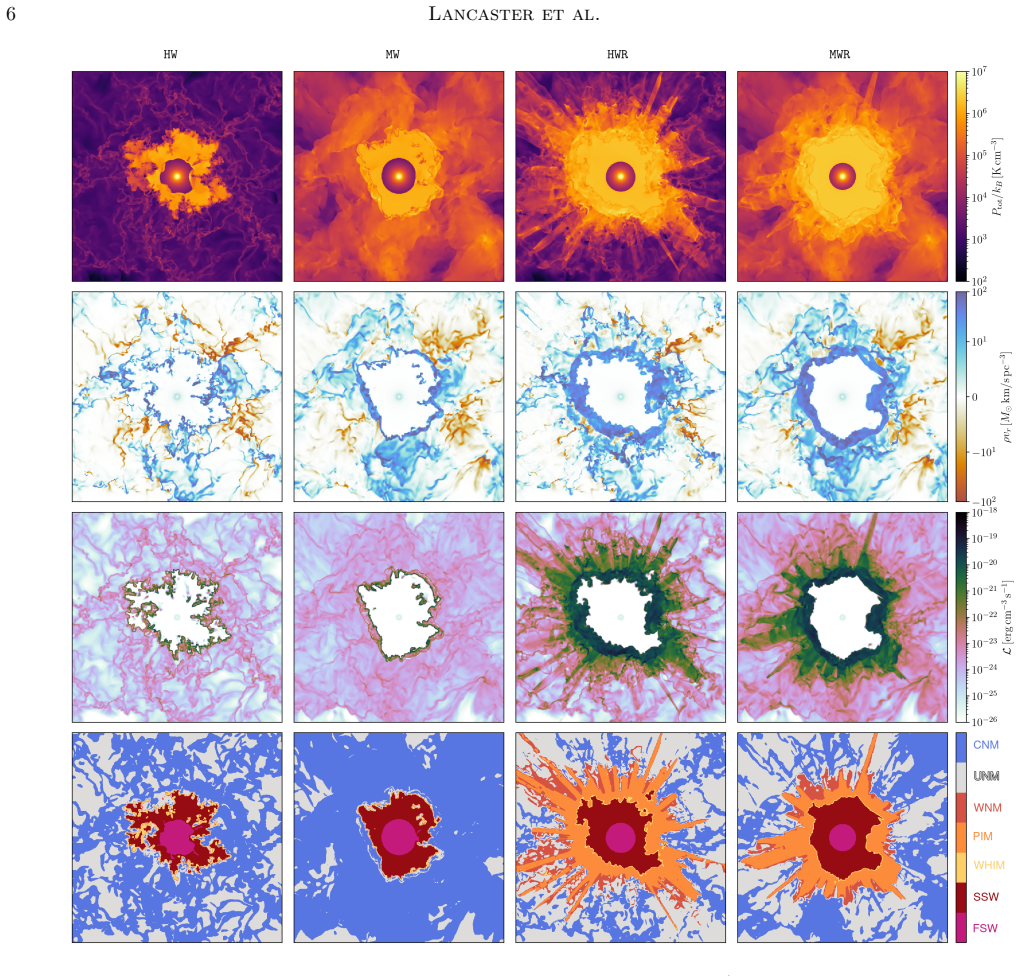
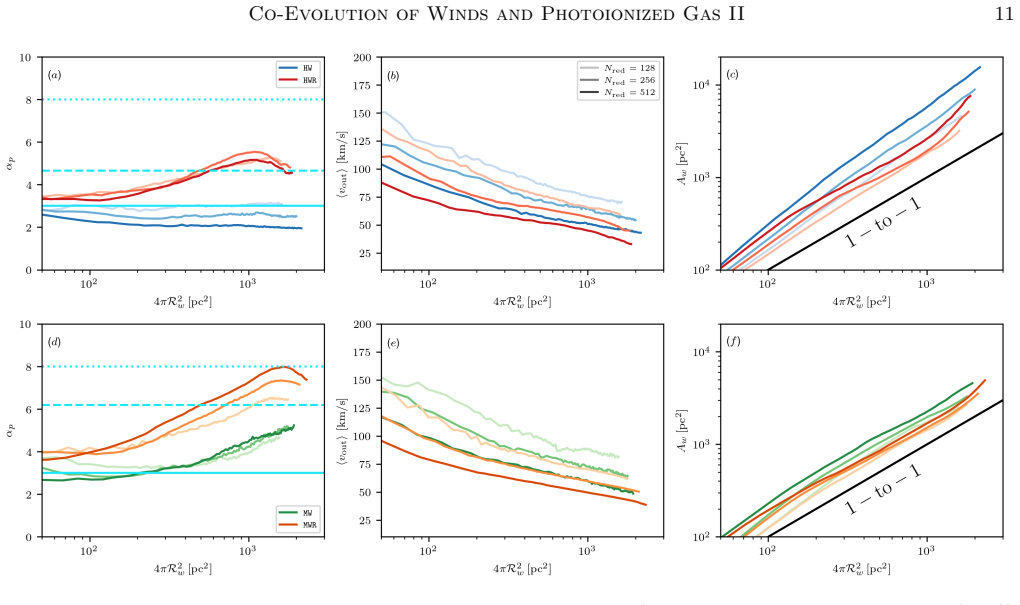
The momentum enhancement factor, $\alpha_p = \frac{3}{4} \frac{V_w/4}{\langle v_{\rm out}\rangle} \frac{4\pi R_w^2}{A_w}$, is the central diagnostic: it converts a measurement of the wind bubble's interface area $A_w$ and its average outflow velocity $\langle v_{\rm out}\rangle$ into the momentum the bubble actually deposits in its surroundings. Because $\alpha_p$ depends on how much interface is available and how fast energy is moved across it, comparing runs with and without LyC radiation isolates whether radiation changes dynamics through geometry (area) or through dissipation (velocity). The same measurement framework, with the same surface definitions, was used to show that magnetic fields shrink the bubble's surface; this paper applies it to show that photoionized gas acts through the same geometric suppression of cooling.
What would settle it
Run a matched pair of wind-only and wind-plus-LyC simulations at high enough resolution, or with a sub-grid interface-mixing model, to resolve the thin mixing layer at the $10^6$ K surface and re-measure $A_w$ and $\langle v_{\rm out}\rangle$; if the surface-area reduction disappears or $\langle v_{\rm out}\rangle$ does not drop, the inferred enhancement of $\alpha_p$ is a numerical artifact rather than a physical effect.
Extended reading notes
Core claim
The central claim is that Lyman-continuum radiation increases the dynamical impact of wind-blown bubbles rather than simply competing with them. Measured momentum enhancement factors are larger when radiation is included: $\alpha_p = 4.66$ versus $2.55$ in the hydrodynamic runs, and $6.20$ versus $4.09$ in the magnetohydrodynamic runs. The enhancement comes from two coupled effects: the photoionized medium has a higher sound speed and a smoother density structure, which suppresses thin-shell instabilities and lowers the bubble's interface area $A_w$; meanwhile, the wind no longer abuts neutral gas, removing collisional Ly$\alpha$ excitation as a cooling channel at that interface. With less surface and weaker cooling, less energy is dissipated and the bubble carries more momentum. The paper further shows that the semi-analytic Co-Evolution Model reproduces simulated wind radius, ionized radius, and total momentum to within about 25 percent, and that the residual deviations trace to the model's assumption of a constant $\alpha_p$ and its neglect of background inhomogeneity.
Load-bearing premise
The load-bearing premise is that the simulated interface area and outflow velocity faithfully capture how cooling works at the wind bubble's edge; the paper states outright that the exact values, and therefore $\alpha_p$, would differ in reality because diffusion and cooling at the interface are not resolved.
Editorial extensions
If this is right
- Simulations that include both winds and ionizing radiation will see wind-blown bubbles carry more momentum than wind-only runs predict, so feedback models that treat winds as purely momentum-driven will understate their effect.
- Semi-analytic feedback models must allow $\alpha_p$ to vary in time and must account for clumpy backgrounds; a constant-$\alpha_p$ co-evolution model is accurate to roughly 25 percent but systematically misses late-time expansion.
- The relative importance of winds versus radiation depends on whether the feedback source is a single star or a cluster inside a giant molecular cloud; single-star simulations have mostly probed the regime where winds are expected to be subdominant.
- Higher-resolution runs with clumpier backgrounds produce larger ionized volumes and larger total momentum, so turbulent inhomogeneity is a first-order ingredient rather than a small correction.
- Because photoionized gas smooths background density contrasts, the same mechanism by which magnetic fields suppress wind-bubble cooling also operates through radiation, pointing to a common geometric control on feedback efficiency.
Reading between the lines
- If this mechanism operates in real HII regions, the shells of wind bubbles embedded in photoionized gas should look smoother and carry more momentum at a given radius than bubbles expanding into neutral gas; such a difference is testable with resolved observations of young clusters.
- The numerical values of $\alpha_p$ likely depend on how interface mixing is treated, and until sub-grid models calibrated to resolved interface simulations are developed, the quoted factors should be read as resolution-dependent estimates rather than exact physical constants.
- The Co-Evolution Model's success despite a uniform background suggests a natural extension: replacing the uniform density with a clumping-factor-weighted effective density could capture both the larger ionized volume and the rocket effect in a semi-analytic model.
- Varying the ratio $\zeta = R_{\rm eq}/R_{\rm St}$ from cluster-like to single-star-like values should flip the conclusion; in regimes where the wind bubble overruns the ionization front, the protective photoionized shell is absent and the enhancement should shrink or vanish.
Editorial analysis
A structured set of objections, weighed in public.
Referee Report
Summary. This paper presents 3D radiation-magnetohydrodynamical simulations of cluster-scale feedback bubbles driven by both stellar winds and ionizing radiation, using a turbulent, inhomogeneous background representative of Milky Way GMCs. The authors run HD and MHD cases at three resolutions, with wind-only, radiation-only, wind+radiation, and no-feedback reference runs, and use them to test the semi-analytic Co-Evolution Model (CEM) developed in Paper I. They report that the CEM reproduces the simulated wind-bubble radius and total momentum to within about 25% and the ionized-gas radius to within about 30%, with residual discrepancies attributed to time-variable momentum enhancement factors and background inhomogeneity. They further argue that photoionized gas enhances the dynamical impact of the wind-blown bubble by reducing its surface area and suppressing cooling at its interface, supported by larger measured values of the momentum enhancement factor alpha_p in runs with Lyman-continuum radiation.
Significance. If the central result holds, this is a valuable step forward: it is, to the authors' knowledge, the first simulation of cluster-driven feedback in the regime where winds and photoionization are both dynamically important, and it provides a systematic resolution study with careful HD/MHD and feedback-on/off controls. The decomposition of the WBB's dynamical impact into geometric (Aw) and dissipative (<v_out>) factors, following Lancaster et al. (2024), is a useful framework, and the paper's placement of previous simulations in the Req/RSt parameter space is a helpful synthesis. The main quantitative claim, that LyC radiation enhances WBB momentum feedback, is physically plausible and internally grounded in a with/without-LyC comparison, but as discussed below it is weakened by an asymmetry in unresolved interface cooling between the two sets of runs.
major comments (3)
- [4.2 and 3.2] The central quantitative evidence for the abstract claim is the larger time- and resolution-averaged alpha_p in HWR (4.66) and MWR (6.20) versus HW (2.55) and MW (4.09), shown in Figure 3 and derived from Equation (14) using grid-scale measurements of Aw and <v_out>. However, Section 3.2 states explicitly that in the wind-only runs, numerical diffusion of neutral hydrogen into hot gas produces an excess of Ly-alpha cooling at the WBB interface, and that this cooling is not properly resolved and is absent in the runs with LyC radiation. Because the claimed enhancement is specifically attributed to a decrease in cooling at the WBB interface, part of the measured alpha_p contrast may simply be the removal of this numerical artifact. I ask the authors to quantify this effect, for example by rerunning or post-processing the wind-only runs with the xH-based cooling cuts used in Kim et al. (2023b), or by performing a controlled resolution study of the interface cooling. Without such a test, the statement that LyC radiation 'results in an enhanced WBB dynamical impact' is not cleanly separated from a resolution-dependent numerical effect.
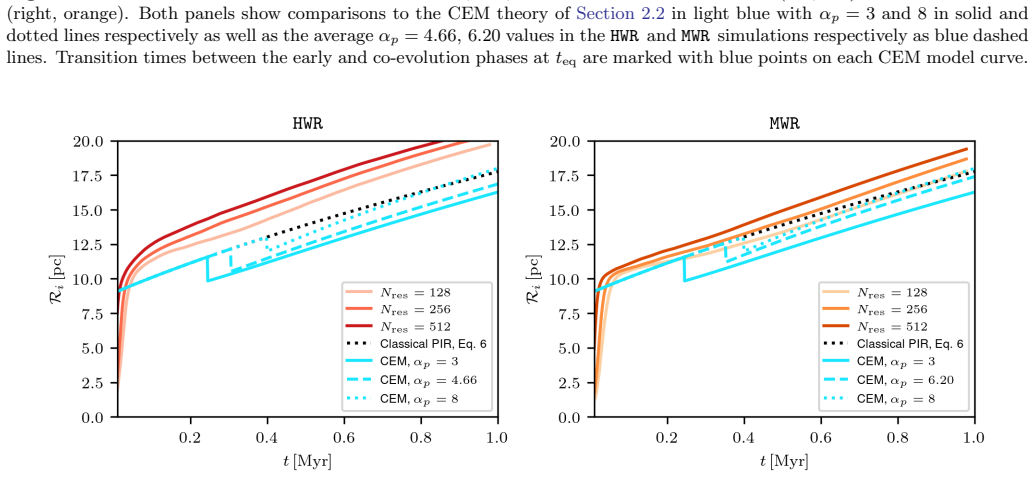
- [4.3 and Table 3] The reported agreement of the CEM with the simulations 'to within 25%' (abstract and Section 4.3.4) is obtained using alpha_p values that are measured from the same simulations being compared: the second column of Table 3 lists mean alpha_p per resolution, and the text says 'we compare the models at a given resolution to the CEM with an alpha_p value chosen to match the average value realized in that simulation.' This is a posterior calibration rather than an independent test of the model's predictive power. The paper should either explicitly label this as a consistency test of the CEM's functional form, or provide a sensitivity analysis showing how the CEM predictions change when alpha_p is fixed a priori (e.g., at the bracketing values alpha_p = 3 and 8 already used in Figures 4-6). As written, the 'agreement within 25%' claim overstates the degree of validation.
- [5.3 and Appendix B] The paper acknowledges in Section 5.3 that the scales relevant to the diffusive and cooling processes at the WBB interface are far below the resolution of global simulations, and Appendix B.2 shows (Figure 11) that the shell thickness in the HW runs approaches the grid scale. This means that the measured Aw and <v_out>, and therefore the inferred alpha_p, are resolution-dependent diagnostics of unresolved physics. The qualitative trends in Figure 3 may be robust, but the quantitative claim that the LyC runs have alpha_p enhanced by factors of ~1.5-1.8 relative to the no-LyC runs needs a more careful statement of the systematic uncertainty. I recommend adding a quantitative estimate of how much of the Aw and <v_out> differences could be numerical, or at minimum repositioning the abstract claim as a trend in the simulations rather than a calibrated physical result.
minor comments (4)
- [Throughout] There are several typographical issues: 'T able' appears in place of 'Table' at the start of sections (e.g., 'T able 1', 'T able 3', 'T able 4'), and Equation (B2) is labeled (B2) when no (B1) appears in Appendix B; the clumping-factor definition should be renumbered.
- [References] The citation 'Lancaster 2025, ApJ, XXX, XXX' is incomplete and should be updated to the published or arXiv reference for Paper I.
- [Figure 2] The dashed colored lines in panels (c), (d), (g), and (h) are described as identical in the caption, but it would improve readability to state explicitly that the wind-only momentum input is the same in the top and bottom rows by construction; as printed, the reader must infer this from the text.
- [Table 3] The table header uses '⌈∆⌉' without defining it in the caption; the definition is given only in the text of Section 4.3.4. Please add the definition to the table caption.
Circularity Check
CEM validation is partly circular: alpha_p is measured from each simulation (Eq. 14) and then fed back into the CEM, so the claimed within-25% agreement is a consistency check; the LyC-enhancement result is a separate non-circular comparison.
-
fitted input called prediction
[Section 4.3.4 (Summary Model Comparison), Table 3; abstract 'within 25%' claim]
"In order to provide the fairest comparison for the models, we use the average αp values calculated at each resolution in each simulation; these are given in the second column of Table 3."
The CEM 'prediction' is not independent of the simulations it is tested against: αp is measured from the same run via Eq. 14, which uses that run's Rw, Aw, and <vout>. Feeding the measured average αp into the CEM and then reporting ΔCEM for Rw, Ri, and pr in Table 3/Figure 7 makes the headline 'CEM agrees with the simulations to within 25%' a consistency check of the diagnostic and model equations, not an out-of-sample prediction. The time-variability and inhomogeneity conclusions retain content, and the with/without-LyC αp comparison is separate, but the stated agreement is partly forced by the fitted input.
full rationale
The paper's primary new physical claim—photoionized gas raises WBB dynamical impact, seen in larger time/resolution-averaged αp in HWR (4.66) and MWR (6.20) than HW (2.55) and MW (4.09)—is a controlled with/without-LyC comparison using identical feedback, resolution, and turbulent backgrounds, with αp inferred by the same Eq. 14 in both cases; this is not circular. The circularity is confined to the CEM validation: αp is not predicted by the model but is measured from each simulation and then inserted as the CEM input, so the reported agreement (within ~25% in Table 3/Figure 7) is partly by construction. I treat the numerical Lyα-cooling excess in wind-only runs admitted in Section 3.2, and the unresolved interface diffusion noted in Sections 4.2 and 5.3, as robustness limitations rather than circularity: they make the with/without comparison asymmetric and the absolute αp values uncertain, but they do not make any claim equivalent to its input. The self-citations to Lancaster et al. (2021b, 2024) for the αp diagnostic are load-bearing but not circular, since that prior framework did not already contain the LyC result claimed here. Overall score 6: one central model-comparison prediction reduces partly by construction, while the main LyC-enhancement comparison remains independent.
Assumptions & free parameters
free parameters (1)
- alpha_p (momentum enhancement factor) =
2.55 (HW), 4.09 (MW), 4.66 (HWR), 6.20 (MWR), with resolution-specific values in Table 3
assumptions (4)
- domain assumption The background medium is statistically homogeneous and isotropic, with no stratification or self-gravity, and cluster-driven feedback percolates quickly from individual stars.
- domain assumption Wind and LyC luminosities are constant in time, fixed to SB99 IMF-averaged values for a 5e3 Msun cluster over the first 2 Myr.
- ad hoc to paper The momentum-driven co-evolution model assumes a fixed alpha_p and enforces pressure equilibrium across the WBB/PIR interface after teq.
- domain assumption Absorption of LyC radiation by dust, radiation pressure, and thermal conduction are neglected.
Cite this review
Pith. "Pith review of The Co-Evolution of Stellar Wind-blown Bubbles and Photoionized Gas II: 3D RMHD Simulations and Tests of Semi-Analytic Models." pith.science (2026). https://pith.science/paper/4OCULDFA
@misc{pith2026250522733,
  author       = {Pith},
  title        = {Pith review of: The Co-Evolution of Stellar Wind-blown Bubbles and Photoionized Gas II: 3D RMHD Simulations and Tests of Semi-Analytic Models},
  year         = {2026},
  howpublished = {\url{https://pith.science/paper/4OCULDFA}},
  note         = {Machine review of arXiv:2505.22733}
}
read the original abstract
In a companion paper (Paper I) we presented a Co-Evolution Model (CEM) in which to consider the evolution of feedback bubbles driven by massive stars through both stellar winds and ionizing radiation, outlining when either of these effects is dominant and providing a model for how they evolve together. Here we present results from three-dimensional radiation magneto-hydrodynamical (RMHD) simulations of this scenario for parameters typical of massive star-forming clouds in the Milky Way: precisely the regime where we expect both feedback mechanisms to matter. While we find that the CEM agrees with the simulations to within 25% for key parameters and modestly outperforms previous idealized models, disagreements remain. We show that these deviations originate mainly from the CEM's lack of (i) background inhomogeneity caused by turbulence and (ii) time-variable momentum enhancements in the wind-blown bubble (WBB). Additionally, we find that photoionized gas acts similarly to magnetic fields ([as in Lancaster et al. 2024a) by decreasing the WBB's surface area. This causes a decrease in the amount of cooling at the WBB's interface, resulting in an enhanced WBB dynamical impact.
Figures

Figures from the paper (8 more)



Reference graph
Works this paper leans on
-
[1]
Abel, T., & Wandelt, B. D. 2002, MNRAS, 330, L53, doi: 10.1046/j.1365-8711.2002.05206.x
arXiv 2002
-
[2]
Wiebe, D. S. 2017, MNRAS, 469, 630, doi: 10.1093/mnras/stx797
-
[3]
Ali, A. A., Bending, T. J. R., & Dobbs, C. L. 2022, MNRAS, 510, 5592, doi: 10.1093/mnras/stac025
-
[4]
P., Mac Low, M.-M., Agertz, O., Renaud, F., & Li, H
Andersson, E. P., Mac Low, M.-M., Agertz, O., Renaud, F., & Li, H. 2024, A&A, 681, A28, doi: 10.1051/0004-6361/202347792
-
[5]
Balser, D. S., & Wenger, T. V. 2024, ApJ, 964, 47, doi: 10.3847/1538-4357/ad2458
-
[6]
1989, ApJ, 346, 735, doi: 10.1086/168055
Bertoldi, F. 1989, ApJ, 346, 735, doi: 10.1086/168055
doi:10.1086/168055 1989
-
[7]
Bertoldi, F., & McKee, C. F. 1990, ApJ, 354, 529, doi: 10.1086/168713
doi:10.1086/168713 1990
-
[8]
2022, ApJ, 935, 171, doi: 10.3847/1538-4357/ac8052
Bonne, L., Schneider, N., Garc ´ ıa, P., et al. 2022, ApJ, 935, 171, doi: 10.3847/1538-4357/ac8052
Show all 126 references
-
[9]
S., Hummels, C
Butsky, I. S., Hummels, C. B., Hopkins, P. F., Quinn, T. R., & Werk, J. K. 2024, arXiv e-prints, arXiv:2402.03419. https://arxiv.org/abs/2402.03419
2024 arXiv
-
[10]
G., Romano, D., & D’Ercole, A
Calura, F., Few, C. G., Romano, D., & D’Ercole, A. 2015, ApJL, 814, L14, doi: 10.1088/2041-8205/814/1/L14
2015 doi
-
[11]
2022, MNRAS, 516, 5914, doi: 10.1093/mnras/stac2387
Calura, F., Lupi, A., Rosdahl, J., et al. 2022, MNRAS, 516, 5914, doi: 10.1093/mnras/stac2387
2022 doi
-
[12]
2024, arXiv e-prints, arXiv:2411.02502, doi: 10.48550/arXiv.2411.02502
Calura, F., Pascale, R., Agertz, O., et al. 2024, arXiv e-prints, arXiv:2411.02502, doi: 10.48550/arXiv.2411.02502
2024 doi
-
[13]
I., Abbott, D
Castor, J. I., Abbott, D. C., & Klein, R. I. 1975, ApJ, 195, 157, doi: 10.1086/153315
1975 doi
-
[14]
R., McLeod, A
Chevance, M., Krumholz, M. R., McLeod, A. F., et al. 2023, in Astronomical Society of the Pacific Conference
2023
- [15]
-
[16]
E., et al
Cournoyer-Cloutier, C., Sills, A., Harris, W. E., et al. 2023, MNRAS, 521, 1338, doi: 10.1093/mnras/stad568
2023 doi
-
[17]
McKee, C. F. 2011, ApJ, 740, 107, doi: 10.1088/0004-637X/740/2/107
2011 doi
-
[18]
Klein, R. I. 2018, MNRAS, 476, 771, doi: 10.1093/mnras/sty154
2018 doi
-
[19]
E., Ngoumou, J., Ercolano, B., & Bonnell, I
Dale, J. E., Ngoumou, J., Ercolano, B., & Bonnell, I. A. 2013, MNRAS, 436, 3430, doi: 10.1093/mnras/stt1822 —. 2014, MNRAS, 442, 694, doi: 10.1093/mnras/stu816
2013 doi
-
[20]
2024, MNRAS, 527, 478, doi: 10.1093/mnras/stad3202
Deng, Y., Li, H., Kannan, R., et al. 2024, MNRAS, 527, 478, doi: 10.1093/mnras/stad3202
2024 doi
-
[21]
Draine, B. T. 1978, ApJS, 36, 595, doi: 10.1086/190513 —. 2011a, ApJ, 732, 100, doi: 10.1088/0004-637X/732/2/100 —. 2011b, Physics of the Interstellar and Intergalactic Medium
1978 doi
-
[22]
A., Kreckel, K., et al
Drory, N., Blanc, G. A., Kreckel, K., et al. 2024, AJ, 168, 198, doi: 10.3847/1538-3881/ad6de9 Co-Evolution of Winds and Photoionized Gas II 31
2024 doi
-
[23]
C., Chu, Y.-H., Chen, C
Dunne, B. C., Chu, Y.-H., Chen, C. H. R., et al. 2003, ApJ, 590, 306, doi: 10.1086/375010
2003 doi
-
[24]
Dwarkadas, V. V. 2022, Galaxies, 10, 37, doi: 10.3390/galaxies10010037
2022 doi
-
[25]
V., Kreckel, K., Sandstrom, K
Egorov, O. V., Kreckel, K., Sandstrom, K. M., et al. 2023, ApJL, 944, L16, doi: 10.3847/2041-8213/acac92 Ekstr¨ om, S., Georgy, C., Eggenberger, P., et al. 2012, A&A, 537, A146, doi: 10.1051/0004-6361/201117751
2023 doi
-
[26]
Weisz, D. R. 2019, MNRAS, 490, 1961, doi: 10.1093/mnras/stz2773
2019 doi
-
[27]
M., Krumholz, M
Fall, S. M., Krumholz, M. R., & Matzner, C. D. 2010, ApJL, 710, L142, doi: 10.1088/2041-8205/710/2/L142
2010 doi
-
[28]
1990, ApJ, 349, 126, doi: 10.1086/168300
Franco, J., Tenorio-Tagle, G., & Bodenheimer, P. 1990, ApJ, 349, 126, doi: 10.1086/168300
1990 doi
-
[29]
Freyer, T., Hensler, G., & Yorke, H. W. 2003, ApJ, 594, 888, doi: 10.1086/376937 —. 2006, ApJ, 638, 262, doi: 10.1086/498734
2003 doi
-
[30]
2020, MNRAS, 497, 3830, doi: 10.1093/mnras/staa2062
Fukushima, H., Yajima, H., Sugimura, K., et al. 2020, MNRAS, 497, 3830, doi: 10.1093/mnras/staa2062
2020 doi
-
[31]
1996, ApJ, 469, 171, doi: 10.1086/177769
Garcia-Segura, G., & Franco, J. 1996, ApJ, 469, 171, doi: 10.1086/177769
1996 doi
-
[32]
1995a, ApJ, 455, 145, doi: 10.1086/176563 —
Garcia-Segura, G., & Mac Low, M.-M. 1995a, ApJ, 455, 145, doi: 10.1086/176563 —. 1995b, ApJ, 455, 160, doi: 10.1086/176564
-
[33]
2017, MNRAS, 466, 1903, doi: 10.1093/mnras/stw3209
Gatto, A., Walch, S., Naab, T., et al. 2017, MNRAS, 466, 1903, doi: 10.1093/mnras/stw3209
2017 doi
-
[34]
2023, MNRAS, 526, 1832, doi: 10.1093/mnras/stad2667
Geen, S., Bieri, R., de Koter, A., Kimm, T., & Rosdahl, J. 2023, MNRAS, 526, 1832, doi: 10.1093/mnras/stad2667
2023 doi
-
[35]
2021, MNRAS, 501, 1352, doi: 10.1093/mnras/staa3705
Geen, S., Bieri, R., Rosdahl, J., & de Koter, A. 2021, MNRAS, 501, 1352, doi: 10.1093/mnras/staa3705
2021 doi
-
[36]
2022, MNRAS, 509, 4498, doi: 10.1093/mnras/stab3245
Geen, S., & de Koter, A. 2022, MNRAS, 509, 4498, doi: 10.1093/mnras/stab3245
2022 doi
-
[37]
2016, MNRAS, 463, 3129, doi: 10.1093/mnras/stw2235
Geen, S., Hennebelle, P., Tremblin, P., & Rosdahl, J. 2016, MNRAS, 463, 3129, doi: 10.1093/mnras/stw2235
2016 doi
-
[38]
2020, MNRAS, 492, 915, doi: 10.1093/mnras/stz3491
Geen, S., Pellegrini, E., Bieri, R., & Klessen, R. 2020, MNRAS, 492, 915, doi: 10.1093/mnras/stz3491
2020 doi
-
[39]
2015, MNRAS, 448, 3248, doi: 10.1093/mnras/stv251
Geen, S., Rosdahl, J., Blaizot, J., Devriendt, J., & Slyz, A. 2015, MNRAS, 448, 3248, doi: 10.1093/mnras/stv251
2015 doi
-
[40]
D., & Hennebelle, P
Geen, S., Soler, J. D., & Hennebelle, P. 2017, 471, 4844, doi: 10.1093/mnras/stx1765
2017 doi
-
[41]
Gnat, O., & Ferland, G. J. 2012, ApJS, 199, 20, doi: 10.1088/0067-0049/199/1/20
2012 doi
-
[42]
C., & Wolfire, M
Gong, M., Ostriker, E. C., & Wolfire, M. G. 2017, ApJ, 843, 38, doi: 10.3847/1538-4357/aa7561 Grudi´ c, M. Y., Guszejnov, D., Hopkins, P. F., Offner, S. S. R., & Faucher-Gigu` ere, C.-A. 2021, MNRAS, 506, 2199, doi: 10.1093/mnras/stab1347
2017 doi
-
[43]
Y., Offner, S
Guszejnov, D., Grudi´ c, M. Y., Offner, S. S. R., et al. 2022, MNRAS, 515, 4929, doi: 10.1093/mnras/stac2060
2022 doi
-
[44]
2018, MNRAS, 478, 4799, doi: 10.1093/mnras/sty1315
Haid, S., Walch, S., Seifried, D., et al. 2018, MNRAS, 478, 4799, doi: 10.1093/mnras/sty1315
2018 doi
-
[45]
2009, ApJ, 693, 1696, doi: 10.1088/0004-637X/693/2/1696
Harper-Clark, E., & Murray, N. 2009, ApJ, 693, 1696, doi: 10.1088/0004-637X/693/2/1696
2009 doi
-
[46]
R., Jarrod Millman, K., van der Walt, S
Harris, C. R., Jarrod Millman, K., van der Walt, S. J., et al. 2020, arXiv e-prints, arXiv:2006.10256. https://arxiv.org/abs/2006.10256
2020 arXiv
-
[47]
2011, ApJL, 743, L29, doi: 10.1088/2041-8205/743/2/L29
Hennebelle, P., & Chabrier, G. 2011, ApJL, 743, L29, doi: 10.1088/2041-8205/743/2/L29
2011 doi
-
[48]
S., & Draine, B
Hensley, B. S., & Draine, B. T. 2023, ApJ, 948, 55, doi: 10.3847/1538-4357/acc4c2
2023 doi
-
[49]
2006, ApJ, 646, 240, doi: 10.1086/504789
Hosokawa, T., & Inutsuka, S.-i. 2006, ApJ, 646, 240, doi: 10.1086/504789
2006 doi
-
[50]
Hunter, J. D. 2007, Computing in Science and Engineering, 9, 90, doi: 10.1109/MCSE.2007.55
2007 doi
-
[51]
2015, A&A, 576, A95, doi: 10.1051/0004-6361/201424556
Iffrig, O., & Hennebelle, P. 2015, A&A, 576, A95, doi: 10.1051/0004-6361/201424556
2015 doi
-
[52]
Jeffreson, S. M. R., Semenov, V. A., & Krumholz, M. R. 2024, MNRAS, 527, 7093, doi: 10.1093/mnras/stad3550
2024 doi
-
[53]
Kim, C.-G., Kim, J.-G., Gong, M., & Ostriker, E. C. 2023a, ApJ, 946, 3, doi: 10.3847/1538-4357/acbd3a
-
[54]
Kim, C.-G., & Ostriker, E. C. 2015, ApJ, 802, 99, doi: 10.1088/0004-637X/802/2/99 —. 2017, ApJ, 846, 133, doi: 10.3847/1538-4357/aa8599
2015 doi
-
[55]
C., & Raileanu, R
Kim, C.-G., Ostriker, E. C., & Raileanu, R. 2017a, ApJ, 834, 25, doi: 10.3847/1538-4357/834/1/25
-
[56]
C., Kim, J.-G., et al
Kim, C.-G., Ostriker, E. C., Kim, J.-G., et al. 2024, ApJ, 972, 67, doi: 10.3847/1538-4357/ad59ab
2024 doi
-
[57]
Kim, J.-G., Gong, M., Kim, C.-G., & Ostriker, E. C. 2023b, ApJS, 264, 10, doi: 10.3847/1538-4365/ac9b1d
-
[58]
Kim, J.-G., Kim, W.-T., & Ostriker, E. C. 2016, ApJ, 819, 137, doi: 10.3847/0004-637X/819/2/137 —. 2018, ApJ, 859, 68, doi: 10.3847/1538-4357/aabe27 —. 2019, ApJ, 883, 102, doi: 10.3847/1538-4357/ab3d3d
2016 doi
-
[59]
C., & Skinner, M
Kim, J.-G., Kim, W.-T., Ostriker, E. C., & Skinner, M. A. 2017b, ApJ, 851, 93, doi: 10.3847/1538-4357/aa9b80
-
[60]
C., & Filippova, N
Kim, J.-G., Ostriker, E. C., & Filippova, N. 2021, ApJ, 911, 128, doi: 10.3847/1538-4357/abe934
2021 doi
-
[61]
V., Egorova, E., et al
Kreckel, K., Egorov, O. V., Egorova, E., et al. 2024, A&A, 689, A352, doi: 10.1051/0004-6361/202449943
2024 doi
-
[62]
2001, MNRAS, 322, 231, doi: 10.1046/j.1365-8711.2001.04022.x
Kroupa, P. 2001, MNRAS, 322, 231, doi: 10.1046/j.1365-8711.2001.04022.x
2001
-
[63]
Krumholz, M. R. 2014, PhR, 539, 49, doi: 10.1016/j.physrep.2014.02.001 32 Lancaster et al
2014 doi
-
[64]
R., & Matzner, C
Krumholz, M. R., & Matzner, C. D. 2009, ApJ, 703, 1352, doi: 10.1088/0004-637X/703/2/1352
2009 doi
-
[65]
R., McKee, C
Krumholz, M. R., McKee, C. F., & Bland -Hawthorn, J. 2019, ARA&A, 57, 227, doi: 10.1146/annurev-astro-091918-104430 Lah´ en, N., Naab, T., Kauffmann, G., et al. 2023, MNRAS, 522, 3092, doi: 10.1093/mnras/stad1147
2019 doi
-
[66]
2025, ApJ, XXX, XXX
Lancaster, L. 2025, ApJ, XXX, XXX
2025
- [67]
-
[68]
C., Kim, J.-G., & Kim, C.-G
Lancaster, L., Ostriker, E. C., Kim, J.-G., & Kim, C.-G. 2021a, ApJ, 914, 89, doi: 10.3847/1538-4357/abf8ab —. 2021b, ApJ, 914, 90, doi: 10.3847/1538-4357/abf8ac —. 2021c, ApJL, 922, L3, doi: 10.3847/2041-8213/ac3333
-
[69]
2014, ApJS, 212, 14, doi: 10.1088/0067-0049/212/1/14
Leitherer, C., Ekstr¨ om, S., Meynet, G., et al. 2014, ApJS, 212, 14, doi: 10.1088/0067-0049/212/1/14
2014 doi
-
[70]
D., et al
Leitherer, C., Schaerer, D., Goldader, J. D., et al. 1999, ApJS, 123, 3, doi: 10.1086/313233
1999 doi
-
[71]
C., McMillan, S
Lewis, S. C., McMillan, S. L. W., Mac Low, M.-M., et al. 2023, ApJ, 944, 211, doi: 10.3847/1538-4357/acb0c5
2023 doi
- [72]
-
[73]
2004, Journal of Computational Physics, 195, 17, doi: 10.1016/j.jcp.2003.09.016
Londrillo, P., & Del Zanna, L. 2004, Journal of Computational Physics, 195, 17, doi: 10.1016/j.jcp.2003.09.016
2004 doi
-
[74]
A., Krumholz, M
Lopez, L. A., Krumholz, M. R., Bolatto, A. D., Prochaska, J. X., & Ramirez-Ruiz, E. 2011, ApJ, 731, 91, doi: 10.1088/0004-637X/731/2/91
2011 doi
-
[75]
A., Krumholz, M
Lopez, L. A., Krumholz, M. R., Bolatto, A. D., et al. 2014, ApJ, 795, 121, doi: 10.1088/0004-637X/795/2/121 Mac Low, M.-M., & McCray, R. 1988, ApJ, 324, 776, doi: 10.1086/165936
2014 doi
-
[76]
Matzner, C. D. 2002, ApJ, 566, 302, doi: 10.1086/338030
2002 doi
- [77]
-
[78]
F., & Ostriker, E
McKee, C. F., & Ostriker, E. C. 2007, ARA&A, 45, 565, doi: 10.1146/annurev.astro.45.051806.110602 M´ endez-Delgado, J. E., Skillman, E. D., Aver, E., et al. 2024, arXiv e-prints, arXiv:2410.17381, doi: 10.48550/arXiv.2410.17381
2007 arXiv
-
[79]
H., Federrath, C., & Krumholz, M
Menon, S. H., Federrath, C., & Krumholz, M. R. 2022, MNRAS, 517, 1313, doi: 10.1093/mnras/stac2702
2022 doi
-
[80]
2021, Journal of Computational Physics, 424, 109748, doi: 10.1016/j.jcp.2020.109748
Mignone, A., & Del Zanna, L. 2021, Journal of Computational Physics, 424, 109748, doi: 10.1016/j.jcp.2020.109748
2021
-
[81]
Murray, N., Quataert, E., & Thompson, T. A. 2010, ApJ, 709, 191, doi: 10.1088/0004-637X/709/1/191
2010 doi
-
[82]
Naab, T., & Ostriker, J. P. 2017, ARA&A, 55, 59, doi: 10.1146/annurev-astro-081913-040019
2017 doi
-
[83]
2007, ApJ, 662, 395, doi: 10.1086/517515
Nakamura, F., & Li, Z.-Y. 2007, ApJ, 662, 395, doi: 10.1086/517515
2007 doi
- [84]
- [85]
-
[86]
E., & Burkert, A
Ngoumou, J., Hubber, D., Dale, J. E., & Burkert, A. 2015, ApJ, 798, 32, doi: 10.1088/0004-637X/798/1/32
2015 doi
-
[87]
Offner, S. S. R., & Liu, Y. 2018, Nature Astronomy, 2, 896, doi: 10.1038/s41550-018-0566-1
2018 doi
-
[88]
2011, ApJ, 730, 40, doi: 10.1088/0004-637X/730/1/40
Padoan, P., & Nordlund, ˚A. 2011, ApJ, 730, 40, doi: 10.1088/0004-637X/730/1/40
2011 doi
-
[89]
W., Rahner, D., Reissl, S., et al
Pellegrini, E. W., Rahner, D., Reissl, S., et al. 2020a, MNRAS, 496, 339, doi: 10.1093/mnras/staa1473
-
[90]
W., Reissl, S., Rahner, D., et al
Pellegrini, E. W., Reissl, S., Rahner, D., et al. 2020b, MNRAS, 498, 3193, doi: 10.1093/mnras/staa2555
-
[91]
W., Baldwin, J
Pellegrini, E. W., Baldwin, J. A., Brogan, C. L., et al. 2007, ApJ, 658, 1119, doi: 10.1086/511258
2007 doi
-
[92]
2017, MNRAS, 466, 3293, doi: 10.1093/mnras/stw3216
Peters, T., Naab, T., Walch, S., et al. 2017, MNRAS, 466, 3293, doi: 10.1093/mnras/stw3216
2017 doi
-
[93]
M., Kupilas, M
Pittard, J. M., Kupilas, M. M., & Wareing, C. J. 2022, MNRAS, 510, 2797, doi: 10.1093/mnras/stab3707
2022 doi
-
[94]
M., Wareing, C
Pittard, J. M., Wareing, C. J., & Kupilas, M. M. 2021, MNRAS, 508, 1768, doi: 10.1093/mnras/stab2712
2021 doi
-
[95]
S., et al
Polak, B., Mac Low, M.-M., Klessen, R. S., et al. 2024, A&A, 690, A94, doi: 10.1051/0004-6361/202348840
2024 doi
-
[96]
C., Cant´ o, J., & Rodr ´ ıguez, L
Raga, A. C., Cant´ o, J., & Rodr ´ ıguez, L. F. 2012, RMxAA, 48, 199
2012
-
[97]
C., & Skinner, M
Raskutti, S., Ostriker, E. C., & Skinner, M. A. 2016, ApJ, 829, 130, doi: 10.3847/0004-637X/829/2/130 —. 2017, ApJ, 850, 112, doi: 10.3847/1538-4357/aa965e
2016 doi
-
[98]
2021, MNRAS, 504, 1039, doi: 10.1093/mnras/stab900
Rathjen, T.-E., Naab, T., Girichidis, P., et al. 2021, MNRAS, 504, 1039, doi: 10.1093/mnras/stab900
2021 doi
-
[99]
S., Goodman, A
Rice, T. S., Goodman, A. A., Bergin, E. A., Beaumont, C., & Dame, T. M. 2016, ApJ, 822, 52, doi: 10.3847/0004-637X/822/1/52
2016 doi
-
[100]
Roe, P. L. 1981, Journal of Computational Physics, 43, 357, doi: 10.1016/0021-9991(81)90128-5
1981 doi
-
[101]
Rogers, H., & Pittard, J. M. 2013, MNRAS, 431, 1337, doi: 10.1093/mnras/stt255
2013 doi
-
[102]
2014, MNRAS, 442, 2701, doi: 10.1093/mnras/stu1037
Ramirez-Ruiz, E. 2014, MNRAS, 442, 2701, doi: 10.1093/mnras/stu1037
2014 doi
-
[103]
P., Robert, C., et al
Rousseau-Nepton, L., Martin, R. P., Robert, C., et al. 2019, MNRAS, 489, 5530, doi: 10.1093/mnras/stz2455 Co-Evolution of Winds and Photoionized Gas II 33
2019 doi
-
[104]
2020, PASP, 132, 104301, doi: 10.1088/1538-3873/aba840
Schneider, N., Simon, R., Guevara, C., et al. 2020, PASP, 132, 104301, doi: 10.1088/1538-3873/aba840
2020 doi
-
[105]
A., Kravtsov, A
Semenov, V. A., Kravtsov, A. V., & Gnedin, N. Y. 2017, ApJ, 845, 133, doi: 10.3847/1538-4357/aa8096
2017 doi
-
[106]
A., & Ostriker, E
Skinner, M. A., & Ostriker, E. C. 2015, ApJ, 809, 187, doi: 10.1088/0004-637X/809/2/187
2015 doi
- [107]
-
[108]
2006, MNRAS, 367, 763, doi: 10.1111/j.1365-2966.2006.10007.x
Smith, N. 2006, MNRAS, 367, 763, doi: 10.1111/j.1365-2966.2006.10007.x
2006
-
[109]
S., & Dav´ e, R
Somerville, R. S., & Dav´ e, R. 2015, ARA&A, 53, 51, doi: 10.1146/annurev-astro-082812-140951
2015 doi
-
[110]
1978, Physical processes in the interstellar medium, doi: 10.1002/9783527617722
Spitzer, L. 1978, Physical processes in the interstellar medium, doi: 10.1002/9783527617722
1978 doi
-
[111]
A., & Williams, R
Steigman, G., Strittmatter, P. A., & Williams, R. E. 1975, ApJ, 198, 575, doi: 10.1086/153636
1975 doi
-
[112]
M., & Gardiner, T
Stone, J. M., & Gardiner, T. 2009, NewA, 14, 139, doi: 10.1016/j.newast.2008.06.003
2009 doi
-
[113]
Simon, J. B. 2008, ApJS, 178, 137, doi: 10.1086/588755
2008 doi
-
[114]
1979, A&A, 71, 59 Toal´ a, J
Tenorio-Tagle, G. 1979, A&A, 71, 59 Toal´ a, J. A., & Arthur, S. J. 2011, ApJ, 737, 100, doi: 10.1088/0004-637X/737/2/100
1979 doi
-
[115]
2017, PASJ, 69, 18, doi: 10.1093/pasj/psw122
Tosaki, T., Kohno, K., Harada, N., et al. 2017, PASJ, 69, 18, doi: 10.1093/pasj/psw122
2017 doi
-
[116]
K., Broos, P
Townsley, L. K., Broos, P. S., Chu, Y.-H., et al. 2011, ApJS, 194, 16, doi: 10.1088/0067-0049/194/1/16
2011 doi
-
[117]
K., Broos, P
Townsley, L. K., Broos, P. S., Feigelson, E. D., et al. 2006, AJ, 131, 2140, doi: 10.1086/500532
2006 doi
-
[118]
K., Feigelson, E
Townsley, L. K., Feigelson, E. D., Montmerle, T., et al. 2003, ApJ, 593, 874, doi: 10.1086/376692 van Marle, A. J., Langer, N., & Garc ´ ıa-Segura, G. 2005, A&A, 444, 837, doi: 10.1051/0004-6361:20053520
2003 doi
-
[119]
2018, Astronomy and Computing, 23, 40, doi: 10.1016/j.ascom.2018.02.005
Vandenbroucke, B., & Wood, K. 2018, Astronomy and Computing, 23, 40, doi: 10.1016/j.ascom.2018.02.005
2018 doi
-
[120]
E., et al
Virtanen, P., Gommers, R., Oliphant, T. E., et al. 2020, Nature Methods, 17, 261, doi: 10.1038/s41592-019-0686-2
2020 doi
-
[121]
Vishniac, E. T. 1983, ApJ, 274, 152, doi: 10.1086/161433
1983 doi
-
[122]
1977, ApJ, 218, 377, doi: 10.1086/155692
Weaver, R., McCray, R., Castor, J., Shapiro, P., & Moore, R. 1977, ApJ, 218, 377, doi: 10.1086/155692
1977 doi
-
[123]
2023, MNRAS, 519, 3011, doi: 10.1093/mnras/stac3708
Weinberger, R., & Hernquist, L. 2023, MNRAS, 519, 3011, doi: 10.1093/mnras/stac3708
2023 doi
-
[124]
C., & Draine, B
Weingartner, J. C., & Draine, B. T. 2001, ApJ, 548, 296, doi: 10.1086/318651
2001 doi
-
[125]
1979, MNRAS, 186, 59, doi: 10.1093/mnras/186.1.59
Whitworth, A. 1979, MNRAS, 186, 59, doi: 10.1093/mnras/186.1.59
1979 doi
- [126]
Reviewed August 7, 2026 · model on record in the stance chip above.
Discussion (0). Sign in to comment.