One-Loop Renormalization of the Improved Energy-Momentum Tensor in Lattice QCD
Pith reviewed 2026-06-25 22:01 UTC · model grok-4.3
The pith
The improved lattice energy-momentum tensor preserves the Yang-Mills trace anomaly structure independently of the spin-2 renormalization factor.
A machine-rendered reading of the paper's core claim, the machinery that carries it, and where it could break.
Core claim
The one-loop calculation demonstrates that the improved lattice energy-momentum tensor maintains the correct continuum anomaly structure, with the trace determined by the scalar operator F_{\rho\sigma}F_{\rho\sigma} and the Yang-Mills beta function, rather than by the spin-2 renormalization factor Z_T.
What carries the argument
Separation of the energy-momentum tensor into a traceless spin-2 component renormalized by Z_T and a scalar trace sector whose normalization is fixed by the continuum anomaly relation.
If this is right
- The renormalized tensor changes both the overall normalization and the short-distance behavior of Euclidean energy-density correlators.
- The operator reproduces the temperature dependence of the trace anomaly seen in existing lattice thermodynamic data.
- It supplies a systematically improvable starting point for lattice calculations of the equation of state, gluon condensate, and transport coefficients.
Where Pith is reading between the lines
- The same separation may allow cleaner extraction of the anomaly in simulations that include dynamical quarks.
- Extending the matching beyond one loop would test whether the distinction between sectors remains stable at higher orders.
- The construction could be used to define improved operators for studies of hydrodynamic response in the quark-gluon plasma.
Load-bearing premise
The one-loop perturbative matching in Landau gauge using the amputated two-gluon matrix element fully captures the renormalization without significant higher-order or non-perturbative contributions that would mix the spin-2 and trace sectors.
What would settle it
A higher-loop or non-perturbative computation in which the trace anomaly receives a contribution proportional to the spin-2 factor Z_T would show that the separation does not hold.
Figures
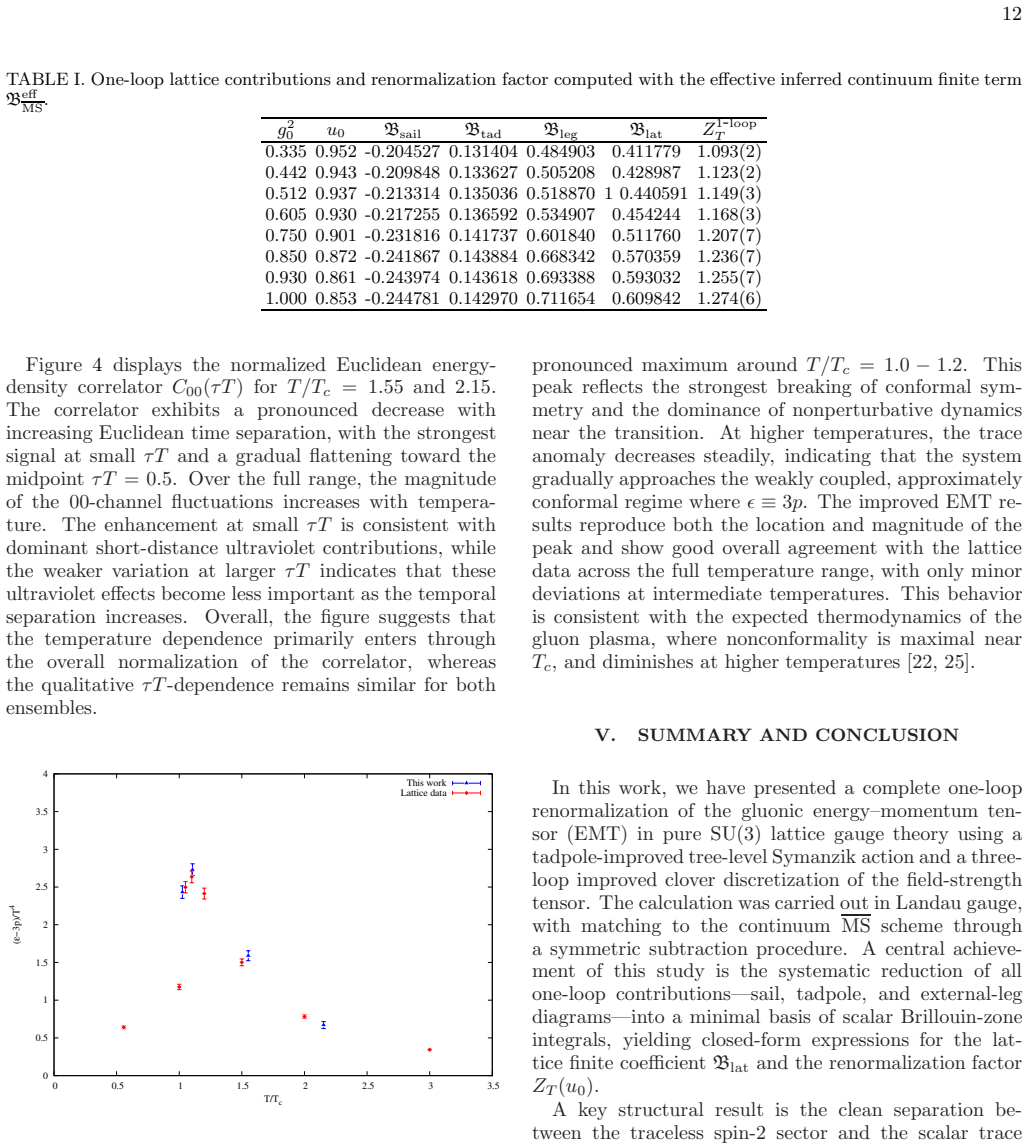
read the original abstract
We present a one-loop renormalization analysis of the improved gluonic energy-momentum tensor in pure SU(3) lattice gauge theory, employing a tadpole-improved tree-level Symanzik gauge action and a three-loop-improved clover discretization of the field-strength tensor. The calculation is conducted in Landau gauge by matching the amputated two-gluon matrix element of the lattice energy-momentum tensor to the continuum MSbar scheme. The one-loop correction is separated into sail, operator-tadpole, and external-leg contributions, each expressed in terms of a minimal set of scalar Brillouin-zone integrals. This approach yields explicit expressions for the finite lattice coefficient B_lat(u0) and the multiplicative renormalization factor Z_T(u0) associated with the traceless spin-2 component of the energy-momentum tensor. A key result is the clear distinction between the spin-2 sector, governed by Z_T, and the scalar trace sector, which encodes the Yang-Mills trace anomaly. We demonstrate that the improved lattice construction maintains the correct continuum anomaly structure, with the trace determined by the scalar operator F_{rho sigma}F_{rho sigma} and the Yang-Mills beta function, rather than by the spin-2 renormalization factor. The resulting renormalized energy-momentum tensor alters the normalization and short-distance behavior of Euclidean energy-density correlators through both traceless and scalar-channel contributions. Comparison with existing lattice thermodynamic data indicates that the improved operator accurately reproduces the expected temperature dependence of the trace anomaly and provides a systematically improvable framework for studying the equation of state, gluon condensate, and transport coefficients in lattice QCD.
Editorial analysis
A structured set of objections, weighed in public.
Referee Report
Summary. The paper presents a one-loop renormalization analysis of an improved gluonic energy-momentum tensor in pure SU(3) lattice gauge theory, using a tadpole-improved Symanzik action and three-loop-improved clover field-strength discretization. Matching the amputated two-gluon matrix element in Landau gauge to the continuum MSbar scheme, the one-loop correction is decomposed into sail, operator-tadpole, and external-leg contributions expressed via Brillouin-zone integrals. This yields explicit forms for the finite coefficient B_lat(u0) and the multiplicative factor Z_T(u0) for the traceless spin-2 component, while arguing that the scalar trace sector encodes the Yang-Mills anomaly via the operator F_{\rho\sigma}F_{\rho\sigma} and the beta function rather than Z_T, thereby preserving the continuum anomaly structure. The renormalized EMT is shown to affect energy-density correlators, with comparison to thermodynamic data supporting its use for the equation of state and transport coefficients.
Significance. If the one-loop results and sector separation hold, the work supplies a concrete, systematically improvable operator for lattice studies of QCD thermodynamics, gluon condensate, and transport, with explicit u0 dependence and direct comparison to existing data strengthening its applicability to energy-density correlators and the trace anomaly.
major comments (1)
- [Abstract and one-loop matching procedure] The central claim that the improved EMT preserves the continuum anomaly structure (with the trace fixed by the scalar operator and beta function, independent of Z_T) rests on the one-loop decomposition of the amputated two-gluon matrix element into sail, operator-tadpole, and external-leg pieces. This decomposition is performed only in Landau gauge at one loop; any O(g^4) or non-perturbative mixing between traceless and trace channels in physical matrix elements would undermine the asserted separation. An explicit verification that the trace part of the matched matrix element reproduces the expected beta-function times F^2 form (independent of the spin-2 renormalization) is needed to support the claim.
Simulated Author's Rebuttal
We thank the referee for their careful reading and constructive feedback on our manuscript. We respond to the major comment below.
read point-by-point responses
-
Referee: [Abstract and one-loop matching procedure] The central claim that the improved EMT preserves the continuum anomaly structure (with the trace fixed by the scalar operator and beta function, independent of Z_T) rests on the one-loop decomposition of the amputated two-gluon matrix element into sail, operator-tadpole, and external-leg pieces. This decomposition is performed only in Landau gauge at one loop; any O(g^4) or non-perturbative mixing between traceless and trace channels in physical matrix elements would undermine the asserted separation. An explicit verification that the trace part of the matched matrix element reproduces the expected beta-function times F^2 form (independent of the spin-2 renormalization) is needed to support the claim.
Authors: The one-loop matching procedure is performed specifically for the traceless spin-2 component, with the decomposition into sail, operator-tadpole, and external-leg contributions yielding B_lat(u0) and Z_T(u0). By construction, the scalar trace sector is defined separately via the operator F_{\rho\sigma}F_{\rho\sigma} multiplied by the Yang-Mills beta function, which encodes the anomaly independently of Z_T. This separation follows from the continuum structure and is preserved at the perturbative order of the calculation. While the matching is performed in Landau gauge, the gauge-invariant nature of the operator supports the result. We agree that an explicit statement clarifying the independence of the trace sector would strengthen the presentation and will add this in revision. revision: partial
- Verification of the absence of mixing between traceless and trace channels at O(g^4) or non-perturbatively lies beyond the scope of this one-loop perturbative study.
Circularity Check
No significant circularity; renormalization obtained by explicit one-loop matching to external continuum scheme
full rationale
The paper computes the renormalization factor Z_T(u0) and finite coefficient B_lat(u0) via direct one-loop perturbative matching of the amputated two-gluon matrix element to the continuum MSbar scheme, with contributions decomposed into sail, operator-tadpole, and external-leg pieces expressed as Brillouin-zone integrals. The separation between the traceless spin-2 sector (governed by Z_T) and the scalar trace sector (fixed by the operator F_{\rho\sigma}F_{\rho\sigma} and the Yang-Mills beta function) follows from the algebraic structure of the operator and the known continuum anomaly, without any fitting to lattice data, self-referential definitions, or load-bearing self-citations. The derivation is self-contained against external benchmarks.
Axiom & Free-Parameter Ledger
free parameters (1)
- u0
axioms (2)
- domain assumption One-loop perturbation theory in Landau gauge is sufficient to determine the renormalization factors via two-gluon matrix element matching.
- domain assumption The decomposition into sail, operator-tadpole, and external-leg contributions exhausts the one-loop diagrams for the chosen operator.
Reference graph
Works this paper leans on
-
[1]
These rep- resent the one-loop correction to the external gluon wave functions
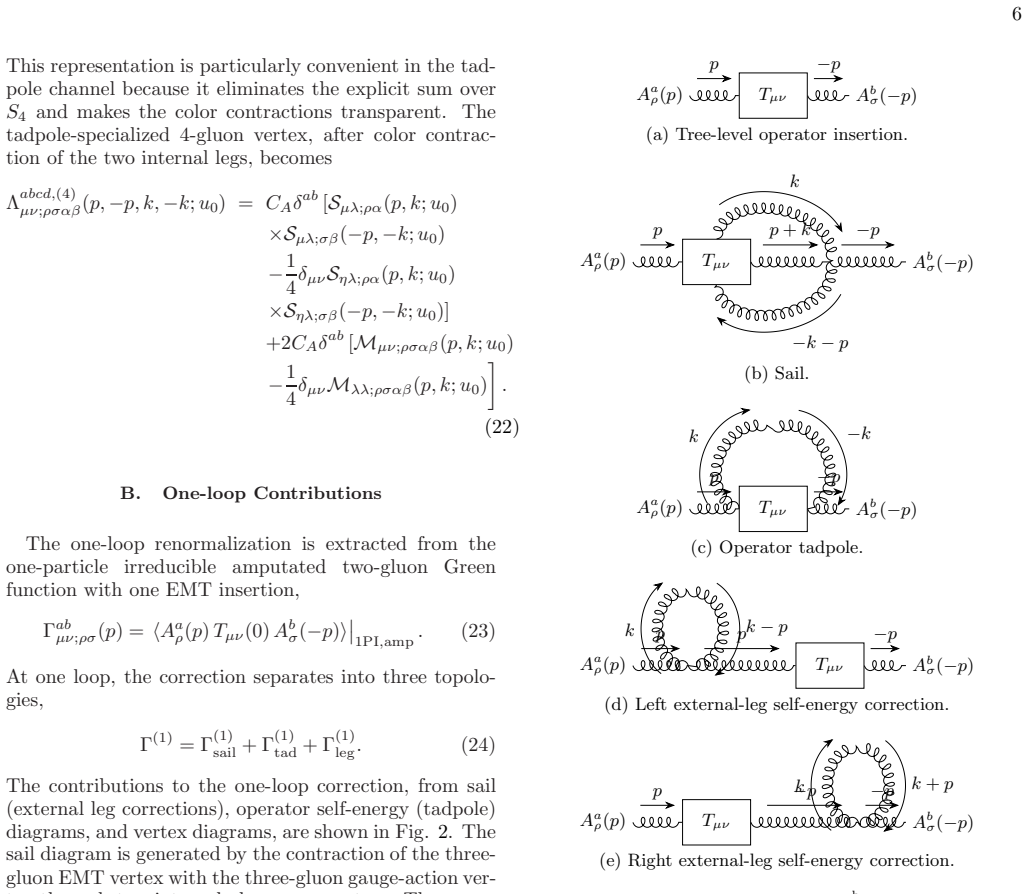
The sail diagram is generated by the contraction of the three- gluon EMT vertex with the three-gluon gauge-action ver- tex through two internal gluon propagators. These rep- resent the one-loop correction to the external gluon wave functions. The virtual gluon loop dresses the incom- ing or outgoing gluon before it interacts with the EMT operator. These a...
-
[2]
into the above equation gives F (1) sail(p; u0) = 2 CA ∫ BZ d4k (2π )4 × Pµν ;γδ tργ (p)tσδ (p)N sail µν ;ρσ (p, k ; u0) ˆ(p + k) 2 KT (p + k; u0) ˆk2KT (k; u0) . (36) Expanding the projected integrand for small external mo- mentum and retaining the coefficient of the p2 tensor structure, the sail diagram contributes to the finite one- loop matching coefficien...
-
[3]
[13]; Beff MS = Blat(u0) + 16π 2 g2 0CA [ Z curve T (g2
-
[4]
Applying this point by point to the available ( g2 0, u 0) val- ues yielded a nearly constant result, from which the ef- fective value Beff MS = 15
− 1 ] . Applying this point by point to the available ( g2 0, u 0) val- ues yielded a nearly constant result, from which the ef- fective value Beff MS = 15. 04 was extracted and is approxi- mately constant across the relevant coupling range. Thus
-
[5]
Thus the one-loop renormalization factor is computed as Z 1-loop T (u0, g 2
04 should be understood as the effective continuum fi- nite matching coefficient that reproduces the published perturbative one-loop normalization in the same projec- tor convention, rather than as a universal constant of the theory. Thus the one-loop renormalization factor is computed as Z 1-loop T (u0, g 2
-
[6]
= 1 + g2 0CA 16π 2 [
-
[7]
(68) By contrast, the pointwise values Beff MS(g2
04 − Blat(u0) ] . (68) By contrast, the pointwise values Beff MS(g2
-
[8]
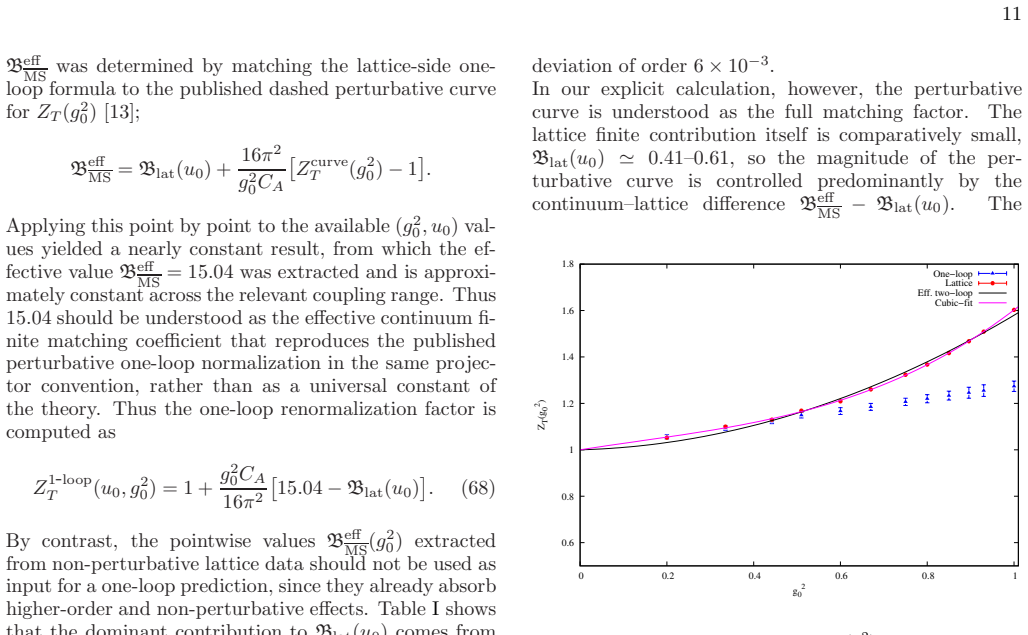
extracted from non-perturbative lattice data should not be used as input for a one-loop prediction, since they already absorb higher-order and non-perturbative effects. Table I shows that the dominant contribution to Blat(u0) comes from the external-leg term, while the tadpole contribution is positive but much smaller, and the sail contribution is negative...
-
[9]
(69) and obtain the effective two-loop and cubic fits using the lattice data from Ref
= a0 + a1g2 0 + a2(g2 0)2 + a3(g2 0)3. (69) and obtain the effective two-loop and cubic fits using the lattice data from Ref. [13] to provide a phenomenolog- ical estimate of higher-loop effects beyond the one-loop calculation. These fits reproduce the lattice curve accurately over the interval 0 ≤ g2 0 ≤ 1, with an rms deviation of order 6 × 10− 3. In our ex...
-
[10]
core” terms and lattice-specific “trans- port
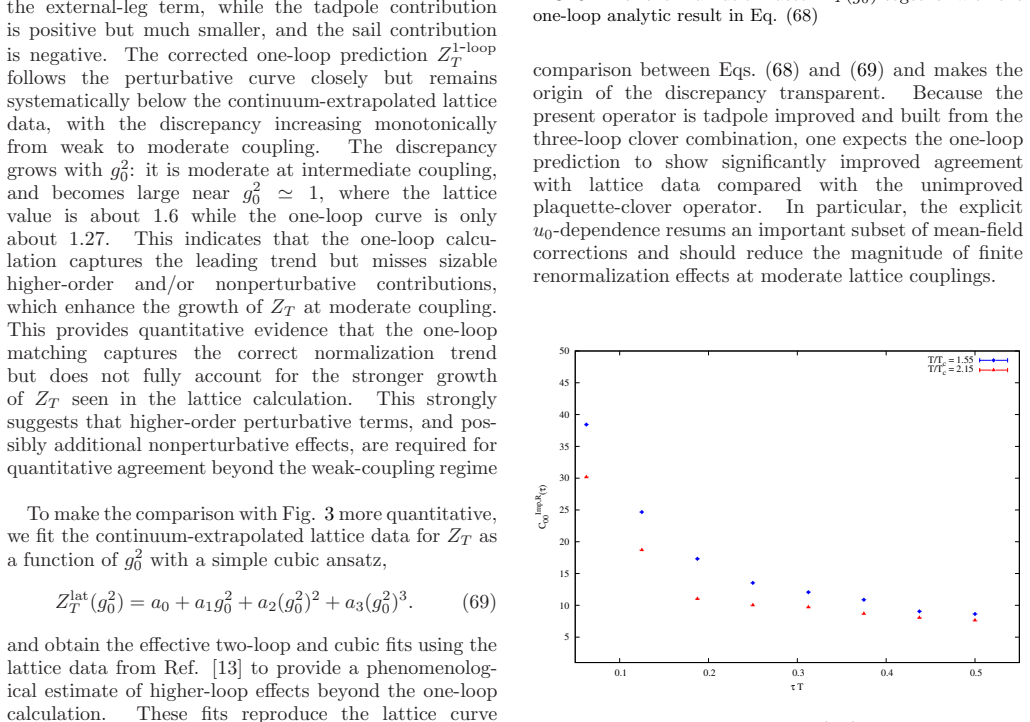
together with the one-loop analytic result in Eq. (68) comparison between Eqs. ( 68) and ( 69) and makes the origin of the discrepancy transparent. Because the present operator is tadpole improved and built from the three-loop clover combination, one expects the one-loop prediction to show significantly improved agreement with lattice data compared with th...
-
[11]
Freese, Noether’s theorems and the energy-momentum tensor in quantum gauge theories
A. Freese, Noether’s theorems and the energy-momentum tensor in quantum gauge theories. , Phys. Rev. D, 106(12), 125012 (2020)
2020
-
[12]
Freese, Reflections on Noether’s second theorem and the energy-momentum tensor , Phys
A. Freese, Reflections on Noether’s second theorem and the energy-momentum tensor , Phys. Rev. D, 113(1), 016011 (2026)
2026
-
[13]
Y, Yang, et al ., Nonperturbatively renormalized glue mo- mentum fraction at the physical pion mass from lattice QCD. Phys. Rev. D, 98(7), 074506 (2018)
2018
-
[14]
Alexandrou et al ., Complete flavor decomposition of the spin and momentum fraction of the proton using lat- tice QCD simulations at physical pion mass
C. Alexandrou et al ., Complete flavor decomposition of the spin and momentum fraction of the proton using lat- tice QCD simulations at physical pion mass . Phy. Rev. D, 101(9), 094513 (2020)
2020
-
[15]
Harko, The first variation of the mat- ter energy-momentum tensor with respect to the metric, and its implications on modified gravity theories
Z, Haghani and T. Harko, The first variation of the mat- ter energy-momentum tensor with respect to the metric, and its implications on modified gravity theories . Physics of the Dark Universe, 44, 101462 (2024)
2024
-
[16]
Asakawa et al ., Thermodynamics of SU(3) gauge the- ory from gradient flow on the lattice
M. Asakawa et al ., Thermodynamics of SU(3) gauge the- ory from gradient flow on the lattice . Phys. Rev. D, 90(1), 011501(R) (2014)
2014
-
[18]
Cao, et al ., Energy momentum tensor on and off the light cone: exposition with scalar Yukawa theory
X. Cao, et al ., Energy momentum tensor on and off the light cone: exposition with scalar Yukawa theory . JHEP, 2024(7), 95 (2024)
2024
-
[19]
L¨ uscher and P
M. L¨ uscher and P. Weisz,On-shell improved lattice gauge theories, Commun. Math. Phys. 97, 59 (1985); Erratum: Commun. Math. Phys. 98, 433 (1985)
1985
-
[20]
Caracciolo, G
S. Caracciolo, G. Curci, P. Menotti and A. Pelissetto, The energy-momentum tensor for lattice gauge theories , Ann. Phys. 197, 119 (1990)
1990
-
[21]
Capitani and G
S. Capitani and G. Rossi, Deep inelastic scattering in improved lattice QCD (I). The first moment of structure functions, Nucl. Phys. B 433, 351 (1995)],
1995
-
[22]
Giusti and H
L. Giusti and H. Meyer, Thermal Momentum Distribu- tion from Path Integrals with Shifted Boundary Condi- tions, Phys. Rev. Lett. 106, 131601 (2011)
2011
-
[23]
Giusti and M
L. Giusti and M. Pepe, Energy-momentum tensor on the lattice: Nonperturbative renormalization in Yang-Mills theory, Phys. Rev. D 91, 114504 (2015)
2015
-
[24]
Brida, L
M. Brida, L. Giusti, and M. Pepe, Non-perturbative def- inition of the QCD energy-momentum tensor on the lat- tice, JHEP, 04, 043 (2020)
2020
-
[25]
Suzuki, Energy–momentum tensor from the Yang–Mills gradient flow , Prog
H. Suzuki, Energy–momentum tensor from the Yang–Mills gradient flow , Prog. Theor. Exp. Phys. 2013, 083B03 (2013)
2013
-
[26]
Makino and H
H. Makino and H. Suzuki, Lattice energy–momentum tensor from the Yang–Mills gradient flow—inclusion of fermion fields , Prog. Theor. Exp. Phys. 2014, 063B02 (2014)
2014
-
[27]
G. P. Lepage and P. B. Mackenzie, Viability of lattice perturbation theory, Phys. Rev. D 48, 2250 (1993)
1993
-
[28]
Caracciolo, P
S. Caracciolo, P. Menotti and A. Pelissetto, One-loop an- alytic computation of the energy-momentum tensor for lattice gauge theories , Nucl. Phys. B 375, 195 (1992)
1992
-
[29]
Capitani, Lattice perturbation theory, Phys
S. Capitani, Lattice perturbation theory, Phys. Rept. 382, 113 (2003)
2003
-
[30]
M Costa et al ., Gauge-invariant renormalization scheme in QCD: Application to fermion bilinears and the energy- momentum tensor , Phys. Rev. D 103, 094509 (2021). 14
2021
-
[31]
Lepage and P
G. Lepage and P. Mackenzie, On the viability of lattice perturbation theory, Phys. Rev D 48, 2250 (1993)
1993
-
[32]
Bors´ anyiet al ., High-precision scale setting in lattice QCD, JHEP 09, 10 (2012)
S. Bors´ anyiet al ., High-precision scale setting in lattice QCD, JHEP 09, 10 (2012)
2012
-
[33]
Bors´ anyiet al ., Full result for the QCD equation of state with 2+1 flavors , Phys
S. Bors´ anyiet al ., Full result for the QCD equation of state with 2+1 flavors , Phys. Lett. B 730, 99 (2014)
2014
-
[34]
Meyer, Transport properties of the quark–gluon plasma: A lattice QCD perspective , Eur
H. Meyer, Transport properties of the quark–gluon plasma: A lattice QCD perspective , Eur. Phys. J. A 47, 86 (2011)
2011
-
[35]
Giusti and M
L. Giusti and M. Pepe, Equation of state of the SU(3) Yang-Mills theory: a precise determination from a mov- ing frame , Phys. Letts. B 769, 385 (2017)
2017
discussion (0)
Sign in with ORCID, Apple, or X to comment. Anyone can read and Pith papers without signing in.