REVIEW 3 major objections 5 minor 25 references
Disturbance Estimation and Rejection for High-Precision Multirotor Position Control
T0 review · 3 major / 5 minor · reviewed 2026-08-14 · deepseek-v4-flash
Pith's one-line read This paper claims that an EKF disturbance estimate plus a soft-constrained nonlinear MPC cuts maximum horizontal position drift in 10-12 m/s wind gusts by 71-78% versus a PID baseline, with the EKF matching a UKF at 2.5x lower cost.
desk verdict A useful experimental comparison whose headline wind-gust numbers need run-to-run statistics before you trust them. read the letter →
The pith
A machine-rendered reading of the paper's core claim, the machinery that carries it, and where it could break.
The reading
What carries the argument
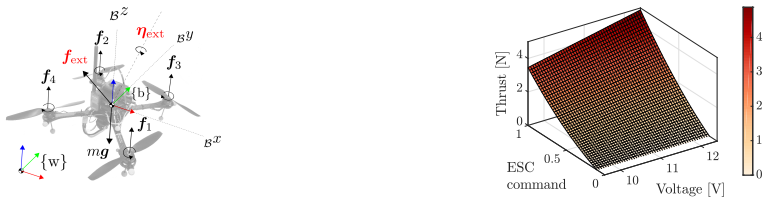
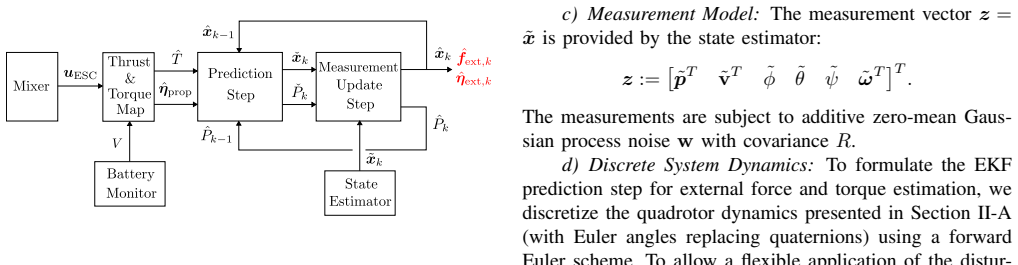
The central object is the disturbance-augmented estimation loop. An EKF (and, for comparison, a UKF) appends the external force vector $f_{\mathrm{ext}}$ and external torque vector $\eta_{\mathrm{ext}}$ to the quadrotor state, models their time evolution as a Gaussian random walk, and corrects them with the onboard state estimator's position, velocity, and attitude measurements. The resulting force estimate enters the position controller as a feedforward acceleration term, while the MPC also uses the estimated disturbance inside its prediction model. The control law that carries the best results in the paper is the soft-constrained nonlinear MPC: a receding-horizon optimal control problem with a 2 s horizon, thrust and roll/pitch input constraints, a slack variable $\epsilon$ that relaxes the cross-track error bound, and path-following guidance that steers the vehicle to the closest point on the reference path.
What would settle it
Repeat the 10 and 12 m/s gust landing experiments many times with randomized entry states and a measured wind field, then compare the distributions of maximum horizontal deviation; if the confidence intervals for the soft-constrained MPC with compensation and the PID with compensation overlap, the claimed 71-78% improvement over the PID baseline does not hold.
Extended reading notes
Core claim
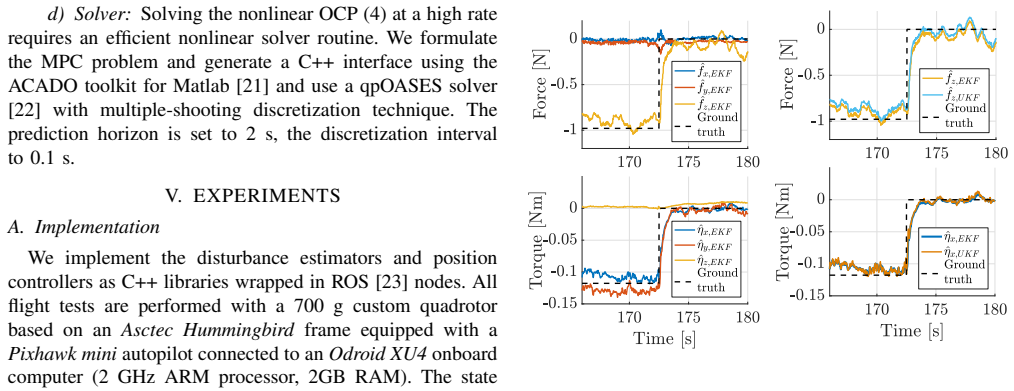
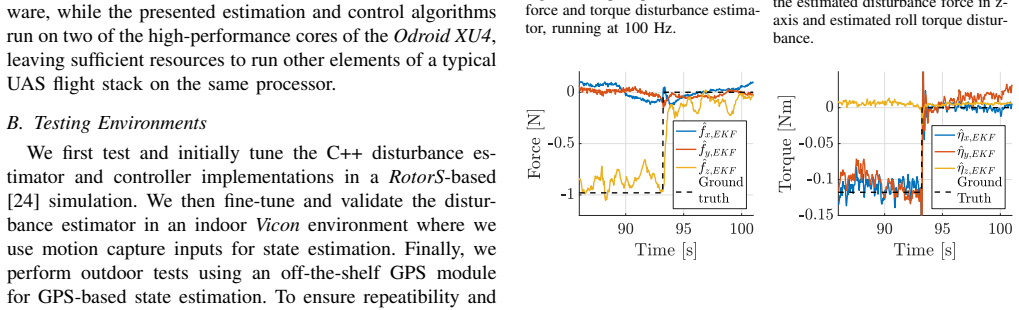
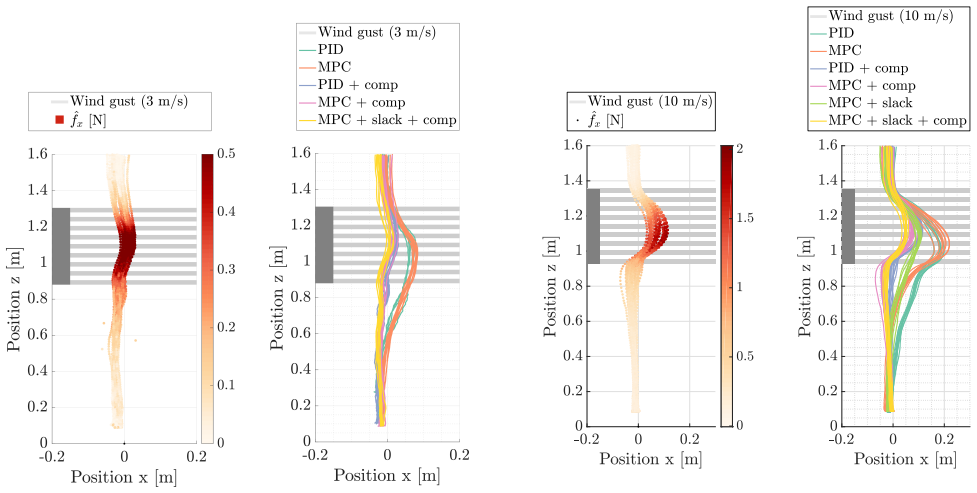
On the paper's own terms, the central discovery is that disturbance rejection, not the controller class, dominates performance once wind gusts become strong. At 3 m/s, PID with disturbance compensation and MPC with disturbance compensation both nearly eliminate the position error and no clear difference appears between them. At 10 and 12 m/s, uncompensated MPC performs about the same as uncompensated PID (19 vs 17 cm and 39 vs 45 cm maximum horizontal deviation), while the EKF feedforward improves both; the soft-constrained MPC with the slack cross-track constraint and disturbance compensation reaches 5 cm and 10 cm, respectively, which is a 71% and 78% reduction from the PID baseline's 17 cm and 45 cm. The paper also reports that the EKF and UKF produce nearly identical disturbance estimates, with the EKF averaging 8 ms per iteration versus 20 ms for the UKF, and that the EKF remains usable outdoors with degraded GPS-based state estimation, though the torque estimate becomes noisier. In the ground-effect experiment, the PID with disturbance compensation stayed within 2.5 cm of the reference, whereas without compensation the vehicle overshot and undershot by 5-10 cm and showed integrator wind-up.
Load-bearing premise
The 71-78% improvement is computed from maximum deviations over repeated landings, but the paper reports no run count, variance, or statistical test and only a qualitative manual tuning rule for both controllers, so if wind or entry conditions differed between runs the ranking could change.
Editorial extensions
If this is right
- Precision maneuvers such as docking, perching, and precision landing can tolerate 10-12 m/s gusts while holding horizontal deviation around 5-10 cm, instead of the 17-45 cm of an uncompensated PID controller.
- On small, payload-limited drones, the EKF is a better choice than the UKF: it runs at 100 Hz versus 40 Hz and gives essentially the same force and torque estimates.
- Even without MPC, a PID controller with a disturbance feedforward term gets most of the benefit in moderate gusts, so the added complexity of MPC pays off mainly in extreme conditions or when a hazard corridor must be respected.
- The soft-constrained MPC's slack variable gives a practical way to enforce an accuracy bound on cross-track error without risking infeasible optimization problems.
Reading between the lines
- A testable extension the authors do not run is to replace the single-gust protocol with many randomized passes through a measured wind field and report per-run maxima; this would show whether the 71-78% margin is stable under run-to-run variability.
- Because the torque estimate is not used in control, the paper leaves implicit that feeding estimated disturbance torque into the attitude loop might further reduce the residual position error during gust onset; this is an empirical question the experiments do not answer.
- The paper's explanation that estimator convergence time limits rejection suggests an adaptive process-noise schedule—raising the random-walk variance right after a detected gust—could shorten the 1.1 s rise time without inducing roll/pitch oscillations.
- The MPC treats the disturbance as constant over its 2 s horizon; extending the estimator to a time-varying or learned disturbance model inside the horizon could shrink the remaining 5-10 cm residual, though it would add computation the paper is explicitly trying to avoid.
Signed reviews
Editorial analysis
A structured set of objections, weighed in public.
Referee Report
Summary. The paper presents an experimental comparison of PID and nonlinear MPC position controllers for a small quadrotor, both augmented with an Extended or Unscented Kalman Filter disturbance estimator. The authors model rotor thrust and drag maps with a voltage dependence, formulate an EKF and a UKF for external force and torque estimation, and integrate the resulting disturbance estimate as feedforward compensation in both PID and MPC architectures. They evaluate the system in three ways: ground-effect rejection during horizontal flights over a table edge, wind-gust rejection during vertical landings under 3, 10, and 12 m/s fan-generated wind, and computational cost on an Odroid XU4 companion computer. The main reported results are that the EKF achieves nearly the same estimation quality as the UKF at about 2.5x lower computational cost, and that a soft-constrained MPC with disturbance compensation reduces maximum horizontal deviation during strong wind gusts by 71-78% relative to an uncompensated PID baseline. The paper also includes an outdoor GPS-based validation of the EKF disturbance estimator and reports timing measurements for all controllers.
Significance. If the reported numbers are statistically sound, the paper provides useful experimental evidence on a question that is often addressed only in simulation: whether the added complexity of MPC and of UKF over EKF pays off on a computationally constrained multirotor. The strengths of the paper include the repeated ground-effect experiments with mean and 2-sigma bounds, the computational benchmarking on real hardware, the extension of disturbance estimation to GPS-grade state estimation outdoors, and the inclusion of a conventional PID baseline rather than only an MPC-versus-MPC comparison. The EKF/UKF comparison is empirical rather than derivation-based, and I see no circularity in the claims. The main weakness is that the central wind-gust result is reported as point maxima from an unspecified number of runs, with no variance or inferential statistics, which currently leaves the headline improvement unsupported.
major comments (3)
- [Section V-F, Table I] The central quantitative claim, a 71-78% reduction in maximum horizontal deviation, is reported as a point maximum for each controller, with no run counts, per-run values, variance, or statistical test. Section V-F-a only says 'repeated vertical landings,' and the experiment is described as involving 'turbulent wind,' so the maximum deviation is a high-variance statistic. The ground-effect experiment in Section V-E-b reports mean and 2-sigma bounds, demonstrating that such statistics are computable on this platform; their absence in the wind-gust experiment is conspicuous. Please report the number of runs per condition, per-run deviations, mean plus/minus standard deviation (or median and range), and state whether the order of controllers was randomized or the wind conditions were otherwise matched across runs.
- [Section V-F-a] The claim that 'both the MPC and PID controllers were tuned to achieve an overdamped position step response with minimum rise time' is too underspecified to establish that the two controllers are at comparable tuning levels, which is important because the headline improvement is relative to a PID baseline. The tuning procedure should be described precisely: what step input was used, what rise time and overshoot were measured, how the gains were chosen, and whether the disturbance-estimator noise variance (identified as a tuning parameter in Section III-A-d) was set identically for all compensated controllers. Without this information, the comparison cannot be independently reproduced or assessed for fairness.
- [Section V-F-b and Table I] The metric underlying Table I is not unambiguously defined. The text says the controllers are compared by 'maximum deviations from the position reference,' Figures 12-14 show position error in the Z-X plane, and Table I reports 'Max. horizontal deviation.' Please define the metric precisely, including the coordinate frame, whether the maximum is over the two-dimensional horizontal error or the in-plane error shown in the figures, and whether it is taken over the full maneuver or only over the wind-affected segment. In addition, the wind speed is reported only as a single anemometer measurement in the center of the stream; because the deviation likely depends on the vehicle's distance from the fan and on turbulence, the paper should state the sensor placement relative to the flight path and, ideally, provide a wind profile or repeated wind-speed measurements.
minor comments (5)
- [Section I-B] There is a typo in 'whethe the choice of MPC' that should be corrected.
- [Section III] The word 'preferrable' should be 'preferable.'
- [Section V-B] The word 'repeatibility' should be 'repeatability.'
- [Section V-F-b] The statement that without disturbance compensation 'both the PID and the MPC controllers experience an identical deviation' is made without supporting repeated-run data; adding the per-controller traces or statistics would make this claim verifiable.
- [Figures 12-14] The figures would be clearer if the wind-affected region and the maximum deviation used in Table I were marked explicitly on the position-error plots.
Circularity Check
No significant circularity: the paper's central claims are empirical comparisons whose outcomes are not encoded in the models or estimators.
full rationale
This paper is an experimental comparison, not a derivation chain, so there is no equation-level reduction of a predicted quantity to a fitted input. The EKF and UKF disturbance estimators use standard filtering equations, the vehicle dynamics of Section II-A, and the identified thrust/drag maps of Section II-B; their outputs are compared against measured position errors, not reused as inputs to the same comparison. The headline 71-78% wind-gust improvement and the EKF/UKF equivalence are reported from flight tests (Section V-F, Figures 12-14, Table I), not derived from the controller definitions. Self-citations appear: [4] is used to justify the choice of nonlinear MPC and the first-order attitude simplification, [14] for the UKF multiplicative quaternion approach, and [1],[6] for application motivation and robust-control background. These citations support implementation choices and prior art, but the paper's load-bearing claims—MPC with disturbance compensation outperforms PID, and EKF matches UKF at lower cost—are tested experimentally on the same platform and are not forced by those citations. The absence of repeated-run statistics and fully specified tuning is a legitimate statistical-support concern, but it is not circularity: the maximum-deviation measurements are not equivalent by construction to the controller parameters or estimator covariances. Hence no circular step can be exhibited from the paper's own equations or citations.
Assumptions & free parameters
free parameters (4)
- Process noise variance v for disturbance random walk (EKF/UKF)
- MPC weight matrices Q, R, and terminal cost P_N
- Soft-constraint slack bound e_max =
5 cm
- Voltage-dependent thrust and drag map coefficients
assumptions (7)
- standard math Newton-Euler rigid body dynamics and quaternion kinematics
- standard math Kalman filter and unscented transform equations
- domain assumption External disturbance force and torque obey a Gaussian random walk
- domain assumption Disturbance force is constant over the 2 s MPC horizon
- domain assumption Attitude dynamics can be modeled as a first-order system
- domain assumption All unmodeled dynamics, including aerodynamic drag, are lumped into the disturbance force
- domain assumption The ESC-to-thrust/drag map remains valid during flight
Cite this review
Pith. "Pith review of Disturbance Estimation and Rejection for High-Precision Multirotor Position Control." pith.science (2026). https://pith.science/paper/4OP2QPJP
@misc{pith2026190803166,
  author       = {Pith},
  title        = {Pith review of: Disturbance Estimation and Rejection for High-Precision Multirotor Position Control},
  year         = {2026},
  howpublished = {\url{https://pith.science/paper/4OP2QPJP}},
  note         = {Machine review of arXiv:1908.03166}
}
read the original abstract
Many multirotor Unmanned Aerial Systems applications have a critical need for precise position control in environments with strong dynamic external disturbances such as wind gusts or ground and wall effects. Moreover, to maximize flight time, small multirotor platforms have to operate within strict constraints on payload and thus computational performance. In this paper, we present the design and experimental comparison of Model Predictive and PID multirotor position controllers augmented with a disturbance estimator to reject strong wind gusts up to 12 m/s and ground effect. For disturbance estimation, we compare Extended and Unscented Kalman filtering. In extensive in- and outdoor flight tests, we evaluate the suitability of the developed control and estimation algorithms to run on a computationally constrained platform. This allows to draw a conclusion on whether potential performance improvements justify the increased computational complexity of MPC for multirotor position control and UKF for disturbance estimation.
Figures

Figures from the paper (7 more)




Reference graph
Works this paper leans on
-
[1]
Long- Duration Autonomy for Small Rotorcraft UAS including Recharging,
C. Brommer, D. Malyuta, D. Hentzen, and R. Brockers, “Long- Duration Autonomy for Small Rotorcraft UAS including Recharging,” in IEEE Intell. Robot. Syst. , Madrid, Spain, 2018
work page 2018
-
[2]
Visual industrial inspection using aerial robots,
S. Omari, P. Gohl, M. Burri, M. Achtelik, and R. Siegwart, “Visual industrial inspection using aerial robots,” Proc. 3rd Int. Conf. Appl. Robot. Power Ind. CARPI 2014 , no. 1, pp. 1–5, 2015
work page 2014
-
[3]
R. D’Andrea, “Can drones deliver?” IEEE Trans. Autom. Sci. Eng. , vol. 11, no. 3, pp. 647–648, 2014
work page 2014
-
[4]
Linear vs Nonlinear MPC for Trajectory Tracking Applied to Rotary Wing Micro Aerial Vehicles,
M. Kamel, M. Burri, and R. Siegwart, “Linear vs Nonlinear MPC for Trajectory Tracking Applied to Rotary Wing Micro Aerial Vehicles,” IFAC-PapersOnLine, vol. 50, no. 1, pp. 3463–3469, 2017
work page 2017
-
[5]
An integral predic- tive/nonlinear H control structure for a quadrotor helicopter,
G. V . Raffo, M. G. Ortega, and F. R. Rubio, “An integral predic- tive/nonlinear H control structure for a quadrotor helicopter,” Auto- matica, vol. 46, no. 1, pp. 29–39, 2010
work page 2010
-
[6]
Robust Model Predictive Flight Control of Unmanned Rotorcrafts,
K. Alexis, C. Papachristos, R. Siegwart, and A. Tzes, “Robust Model Predictive Flight Control of Unmanned Rotorcrafts,” J. Intell. Robot. Syst., vol. 81, no. 3-4, pp. 443–469, 2016
work page 2016
-
[7]
Adaptive Control of a Quadcopter in the Presence of large/complete Parameter Uncertainties,
M. Achtelik, T. Bierling, J. Wang, L. H ¨ocht, and F. Holzapfel, “Adaptive Control of a Quadcopter in the Presence of large/complete Parameter Uncertainties,” in Infotech@aerosp. 2011, St. Louis, 2011, pp. 1–15
work page 2011
-
[8]
K. Pereida, R. R. P. R. Duivenvoorden, and A. P. Schoellig, “High- Precision Trajectory Tracking in Changing Environments Through L 1 Adaptive Feedback and Iterative Learning,” IEEE Int. Conf. Robot. Autom., pp. 344–350, 2017
work page 2017
Show all 25 references
-
[9]
Impedance Control of VTOL UA Vs with a Momentum-based External General- ized Forces Estimator,
F. Ruggiero, J. Cacace, H. Sadeghian, and V . Lippiello, “Impedance Control of VTOL UA Vs with a Momentum-based External General- ized Forces Estimator,” in IEEE Int. Conf. Robot. Autom. , 2014, pp. 2093–2099
2014
-
[10]
Cascaded incremental nonlinear dynamic inversion for MA V disturbance rejection,
E. J. J. Smeur, G. de Croon, and Q. Chu, “Cascaded incremental nonlinear dynamic inversion for MA V disturbance rejection,” Control Eng. Pract., vol. 73, pp. 79–90, 2018
2018
-
[11]
A unified framework for external wrench estimation, interaction control and collision reflexes for flying robots,
T. Tomic and S. Haddadin, “A unified framework for external wrench estimation, interaction control and collision reflexes for flying robots,” IEEE Int. Conf. Intell. Robot. Syst. , pp. 4197–4204, 2014
2014
-
[12]
Robust Accel- eration Control of a Hexarotor UA V with a Disturbance Observer,
S. J. Lee, S. Kim, K. H. Johansson, and H. J. Kim, “Robust Accel- eration Control of a Hexarotor UA V with a Disturbance Observer,” in IEEE Conf. Decis. Control , 2016, pp. 4166–4171
2016
-
[13]
Unscented external force and torque estimation for quadrotors,
C. D. McKinnon and A. P. Schoellig, “Unscented external force and torque estimation for quadrotors,” IEEE Int. Conf. Intell. Robot. Syst. , pp. 5651–5657, 2016
2016
-
[14]
Collaborative transportation using MA Vs via passive force control,
A. Tagliabue, M. Kamel, S. Verling, R. Siegwart, and J. Nieto, “Collaborative transportation using MA Vs via passive force control,” in IEEE Int. Conf. Robot. Autom. , 2017, pp. 5766–5773
2017
-
[15]
Thrust Mixing , Saturation , and Body-Rate Control for Accurate Aggressive Quadrotor Flight,
M. Faessler, D. Falanga, and D. Scaramuzza, “Thrust Mixing , Saturation , and Body-Rate Control for Accurate Aggressive Quadrotor Flight,” IEEE Robot. Autom. Lett. , vol. 2, no. 2, pp. 476–482, 2017
2017
-
[16]
Pose Estimation using Lin- earized Rotations and Quaternion Algebra,
T. Barfoot, J. R. Forbes, and P. T. Furgale, “Pose Estimation using Lin- earized Rotations and Quaternion Algebra,” Acta Astronaut., vol. 68, no. 1-2, pp. 101–112, 2011
2011
-
[17]
Simon, Optimal State Estimation: Kalman, H Infinity, and Nonlin- ear Approaches
D. Simon, Optimal State Estimation: Kalman, H Infinity, and Nonlin- ear Approaches. New York, NY , USA: Wiley-Interscience, 2006
2006
-
[18]
Unscented Filtering for Spacecraft Attitude Estimation,
J. L. Crassidis and F. Markley, “Unscented Filtering for Spacecraft Attitude Estimation,” J. Guid. Control. Dyn. , vol. 26, no. 4, pp. 536– 542, 2003
2003
-
[19]
Dynamic Map Building and Localization: New Theoret- ical Foundations,
J. Uhlmann, “Dynamic Map Building and Localization: New Theoret- ical Foundations,” Ph.D. dissertation, University of Oxford, 1995
1995
-
[20]
Nonlinear Quadrocopter Attitude Control,
D. Brescianini, M. Hehn, and R. D’Andrea, “Nonlinear Quadrocopter Attitude Control,” Tech. Rep., 2013
2013
-
[21]
{ACADO} { T}oolkit – {A}n {O}pen {S}ource {F}ramework for {A}utomatic {C}ontrol and {D}ynamic {O}ptimization,
B. Houska, H. J. Ferreau, and M. Diehl, “ {ACADO} { T}oolkit – {A}n {O}pen {S}ource {F}ramework for {A}utomatic {C}ontrol and {D}ynamic {O}ptimization,” Optim. Control Appl. Methods , vol. 32, no. 3, pp. 298–312, 2011
2011
-
[22]
qpOASES: a parametric active-set algorithm for quadratic program- ming,
H. J. Ferreau, C. Kirches, A. Potschka, H. G. Bock, and M. Diehl, “qpOASES: a parametric active-set algorithm for quadratic program- ming,” Math. Program. Comput. , vol. 6, no. 4, pp. 327–363, 2014
2014
-
[23]
ROS: an open-source Robot Operating System,
M. Quigley, K. Conley, B. P. Gerkey, J. Faust, T. Foote, J. Leibs, R. Wheeler, and A. Y . Ng, “ROS: an open-source Robot Operating System,” in ICRA Work. Open Source Softw. , 2009
2009
-
[24]
Furrer, M
F. Furrer, M. Burri, M. Achtelik, and R. Siegwart, Robot Operating System (ROS): The Complete Reference (Volume 1) . Cham: Springer International Publishing, 2016, pp. 595–625
2016
-
[25]
Leveraging Experience for Computa- tionally Efficient Adaptive Nonlinear Model Predictive Control,
V . R. Desaraju and N. Michael, “Leveraging Experience for Computa- tionally Efficient Adaptive Nonlinear Model Predictive Control,” Intl. Conf. Rob. Autom. , pp. 5314–5320, 2017
2017
Reviewed August 14, 2026 · model on record in the stance chip above.
Discussion (0). Continue with ORCID to comment.