REVIEW 4 major objections 7 minor 31 references
EvoOMG: An Evolution-Oriented Multi-Agent Guidance Framework for Heterogeneous Legacy-and-MLO Wi-Fi Networks
T0 review · 4 major / 7 minor · reviewed 2026-07-09 · glm-5.2
Pith's one-line read Splitting Wi-Fi MAC decisions into stages yields 29% throughput gain
desk verdict EvoOMG: staged Wi-Fi MAC decomposition that its own ablation shows barely matters read the letter →
The pith
A machine-rendered reading of the paper's core claim, the machinery that carries it, and where it could break.
The reading
What carries the argument
The autoregressive staged policy factorization pi_i(a_i | O_i, d_i) = pi_i^cw(c_i | O_i, d_i) * pi_i^tr(u_i | c_i, O_i, d_i), which splits the MAC action into a contention-window stage and a transmission stage, conditioned on a device descriptor d_i that encodes whether the station is legacy single-link or MLO-capable. A Transformer-based history encoder processes recent channel, queue, contention, and transmission states, and standard-aware feasibility projection masks invalid actions for each device type.
What would settle it
If a flat one-shot policy with sufficient capacity and standard-aware action masking matched or exceeded the staged autoregressive policy in NS-3 throughput under identical mixed-standard deployments, the central claim that staged decomposition is structurally superior would be undermined
Extended reading notes
Core claim
The performance gap in mixed legacy-and-MLO Wi-Fi networks stems not from function approximation difficulty alone but from a structural mismatch between flat one-shot MAC policies and the sequential, standard-constrained nature of Wi-Fi MAC operations. Decomposing the joint MAC action into a contention stage followed by a transmission stage—conditioned on the preceding access outcome and device-specific feasibility constraints—is provably lossless under the exact value function and empirically yields substantial throughput gains over flat baselines.
Load-bearing premise
The theoretical performance bound relies on the optimal action-value function being Lipschitz continuous, which is a standard assumption in approximate reinforcement learning but is not verified for the discrete, threshold-based dynamics of the NS-3 Wi-Fi MAC stack. If the protocol's transition dynamics produce discontinuous value functions, which is plausible given discrete contention windows and hard NSTR constraints, the bound does not hold, though the empirical results do
Editorial extensions
If this is right
- Mixed-standard Wi-Fi deployments can be optimized within a single multi-agent framework without sacrificing protocol compliance for either legacy or MLO devices
- The staged decomposition principle could extend to other protocol-layer optimization problems where decisions have natural temporal ordering and device-specific feasibility constraints
- The performance gap bound suggests that improving history encoding, staged generation, and standard-aware masking each independently contribute to closing the heterogeneity gap
- The federated aggregation extension indicates the framework can scale across multiple Wi-Fi domains with different legacy/MLO ratios without cross-standard drift
Editorial analysis
A structured set of objections, weighed in public.
Referee Report
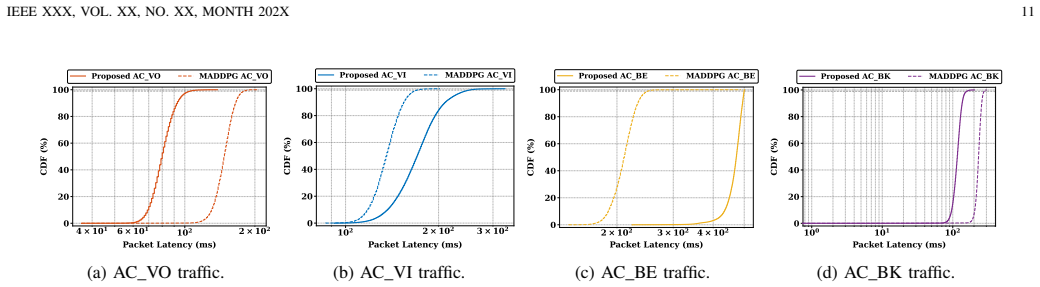
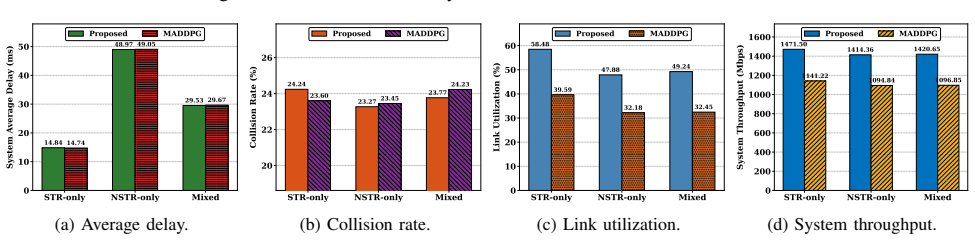
Summary. The paper proposes EvoOMG, a multi-agent deep reinforcement learning framework for optimizing MAC-layer throughput in heterogeneous Wi-Fi networks where legacy (non-MLO) STAs and MLO-capable (Wi-Fi 7/8) STAs coexist. The core methodological contribution is an autoregressive, staged action generation process: agents first produce contention-window guidance, then produce aggregation-length guidance conditioned on the contention output, subject to standard-specific feasibility constraints (Eqs. 22-24). The system is evaluated in NS-3 against MADDPG, IDDPG, and static baselines across various legacy/MLO deployment ratios, traffic classes, and STR/NSTR PHY constraints, showing approximately 29% throughput gains. A theoretical analysis provides a performance gap bound (Theorem 3) under Lipschitz continuity assumptions.
Significance. The problem of heterogeneous legacy/MLO coexistence is timely and practically important for Wi-Fi 7/8 deployments. The NS-3 evaluation is commendably thorough, covering multiple deployment ratios, AC-level traffic differentiation, STR/NSTR constraints, latency CDFs, and an ablation study. The formulation of the MAC action space to respect protocol causality and device heterogeneity is a reasonable architectural choice. The inclusion of a theoretical performance bound, while relying on standard assumptions, adds analytical depth.
major comments (4)
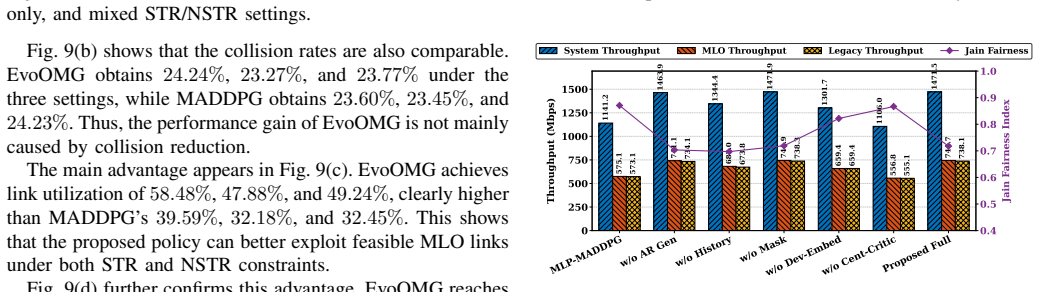
- The central claim of the paper is that the autoregressive staged decomposition (contention-then-aggregation) is structurally superior to flat one-shot action mappings. However, the ablation study in Fig. 10 directly contradicts the magnitude of this claim. The 'w/o AR Gen' variant, which removes the staged decomposition and uses a flat joint action while retaining all other components, achieves 1463.9 Mbps compared to 1471.5 Mbps for the full model—a difference of only 0.5%. The paper states that fairness is 'lower' for w/o AR Gen but does not quantify this, and the Jain fairness bars in Fig. 10 appear nearly identical. Meanwhile, the components driving the ~29% gain over MADDPG are the centralized critic (w/o Cent-Critic: 1106.0 Mbps), device embedding (w/o Dev-Embed: 1301.7 Mbps), and history encoding (w/o History: 1344.4 Mbps). The baseline MADDPG lacks all of these, making the headto
- head-to-head comparison confounded. The paper's title, abstract, and theoretical framework (Theorem 2) all center on the staged decomposition, but the empirical evidence shows it is not the load-bearing mechanism. The authors must either (i) provide a fair comparison where the baseline MADDPG is augmented with the Transformer encoder, device embedding, and centralized critic (leaving only the staged decomposition as the variable), or (ii) reframe the paper's central contribution to accurately reflect that the performance gains stem primarily from the combination of history encoding, device-aware heads, and centralized training, rather than the autoregressive decomposition. As it stands, the empirical evidence does not support the paper's central thesis.
- The evaluation lacks confidence intervals or multiple-seed runs. All results in Figs. 4-10 appear to be from single-run NS-3 evaluations. Given that the difference between the full model and the 'w/o AR Gen' ablation is only 0.5% (7.6 Mbps), and that Wi-Fi MAC dynamics are inherently stochastic, it is impossible to determine whether this difference is statistically significant. The 29% gain over MADDPG is likely significant, but the relative contributions of individual components (especially the staged decomposition) cannot be assessed without variance estimates. Please provide results averaged over multiple seeds with confidence intervals or standard deviations.
- The theoretical analysis (Theorem 3, Eq. 48) provides a performance gap bound under Assumption 1 (Lipschitz continuity of Q*) and Assumption 2 (bounded approximation errors). While these are standard in approximate RL theory, they are not verified for the specific NS-3 Wi-Fi MAC dynamics. The protocol-induced transition kernel P (Eq. 13) involves discrete CW sets, hard NSTR constraints, and threshold-based backoff, which can plausibly produce discontinuous value functions, violating the Lipschitz assumption. The bound is therefore not guaranteed to hold. The authors should either verify the Lipschitz property empirically (e.g., by measuring the sensitivity of Q* to perturbations in actions/states) or explicitly acknowledge this limitation and clarify that the theoretical analysis is motivational rather than guaranteeing the bound in practice.
minor comments (7)
- Fig. 5: The throughput numbers in the text do not match the bar chart values. For the MLO-dominant case, the text states EvoOMG reaches 1111 Mbps, but the figure shows 1117 Mbps. Please reconcile.
- Fig. 6(a): The text states EvoOMG achieves 1482.7 Mbps, but the figure label shows 1482.8 Mbps. Minor inconsistency.
- The paper mentions 'optional federated aggregation' (Section III-D) but does not evaluate it. If it is not evaluated, consider removing the detailed federated training equations (Eqs. 26-31) or moving them to an appendix to streamline the presentation.
- Eq. (14): The notation for the previous MAC-action vector ψ_{i,a,k}(t-1) includes ρ, z, c, and l, but the text later says ρ and z are determined by feasibility projection rather than being learned. Clarify whether ψ includes the projected or raw values.
- The paper uses 'EvoOMG' and 'Proposed' interchangeably in figures. Consistency would improve readability.
- Reference [25] is cited for the path loss model, but the parameters (η, X_σ, d_0) are not specified in Table I or the text. Please provide these values for reproducibility.
- The paper claims EvoOMG 'improves convergence stability' (abstract), but Fig. 4(a) shows the reward oscillating between 2.9 and 3.1, which is not particularly stable. Please clarify what 'stability' means here relative to the baselines.
Circularity Check
No significant circularity: the theoretical bounds are standard approximate-RL results and the empirical claims rest on NS-3 simulations against external baselines.
full rationale
The paper's derivation chain is self-contained and does not exhibit circularity. Theorem 1 (STR/NSTR feasible-set envelope) follows from feasible-set inclusion: NSTR restricts simultaneous link activation, so the feasible set is a subset of STR's, and since goodput contributions are nonnegative, the optimal objective cannot decrease under STR. This is a straightforward monotonicity argument, not a self-definitional reduction. Theorem 2 (staged optimal factorization) proves that the optimal joint action (c*, u*) can be found by nested maximization: max_{c,u} Q*(x,c,u) = max_c [max_u Q*(x,c,u)], which is a standard exact decomposition of a joint argmax into sequential argmaxes. The paper does not define Q* in terms of the staged policy and then 'derive' the staged policy from Q*; rather, it shows that any joint optimum can be represented in staged form. Theorem 3 (performance gap bound) is a standard approximate policy improvement bound: under Lipschitz continuity (Assumption 1) and bounded approximation errors (Assumption 2), the performance gap J(π*) - J(π_EvoOMG) is bounded by (2δ/(1-δ)²)ε_Q where ε_Q = L_c ε_c + L_u ε_u + L_x ε_x. This is a well-known result in approximate RL theory and does not circularly assume the conclusion. The empirical claims rest on NS-3 simulations comparing against external baselines (EDCA, MADDPG, IDDPG). Self-citations [7], [16], [25] are used for system model parameters and prior MLO work but are not load-bearing for the central staged-decomposition claim. The ablation result showing minimal throughput difference between the full model and the w/o AR Gen variant is an empirical weakness (the central claimed mechanism appears not to be the primary driver of gains), but this is a correctness/evidence concern, not circularity. No step in the derivation chain reduces to its inputs by construction.
Assumptions & free parameters
free parameters (7)
- History length S =
5
- Transformer dimension / heads =
16 / 2
- Actor / critic learning rates =
3e-4 / 1e-3
- Discount factor δ =
0.99
- Soft update coefficient =
0.005
- Interaction interval =
500 ms
- AC weights w_a =
Not specified numerically
assumptions (4)
- ad hoc to paper Lipschitz continuity of optimal action-value function Q*
- ad hoc to paper Stage-wise approximation errors are bounded by constants ε_c, ε_u, ε_x
- domain assumption Scheduled goodput contributions are nonnegative
- domain assumption NSTR feasible link-activation set is a subset of STR feasible set
invented entities (1)
-
None
Cite this review
Pith. "Pith review of EvoOMG: An Evolution-Oriented Multi-Agent Guidance Framework for Heterogeneous Legacy-and-MLO Wi-Fi Networks." pith.science (2026). https://pith.science/paper/4OTQMHYA
@misc{pith2026260707045,
  author       = {Pith},
  title        = {Pith review of: EvoOMG: An Evolution-Oriented Multi-Agent Guidance Framework for Heterogeneous Legacy-and-MLO Wi-Fi Networks},
  year         = {2026},
  howpublished = {\url{https://pith.science/paper/4OTQMHYA}},
  note         = {Machine review of arXiv:2607.07045}
}
read the original abstract
The gradual deployment of Wi-Fi 7/8 multi-link operation (MLO) will lead to long-term coexistence between legacy non-MLO stations (STAs) and MLO-capable STAs in WLANs. This mixed deployment makes throughput optimization challenging because legacy STAs follow single-link contention and transmission, whereas MLO-capable STAs can exploit multiple links with richer access opportunities. Existing learning-based methods usually treat such networks as homogeneous systems and directly map the current observation to a complete MAC action, which cannot faithfully represent both legacy single-link and MLO multi-link behaviors. To address this issue, we propose EvoOMG, an evolution-oriented multi-agent guidance framework for heterogeneous legacy-and-MLO Wi-Fi networks. EvoOMG reformulates throughput optimization as a standard-constrained staged multi-agent decision problem. Each agent encodes recent channel, queue, contention, and transmission histories, first generates contention guidance, and then produces aggregation guidance conditioned on the preceding access stage and standard-specific feasibility constraints. This autoregressive design follows the Wi-Fi MAC order of ``contention before transmission'' while preserving distinct protocol behaviors of legacy and MLO-capable STAs. NS-3 evaluations show that EvoOMG improves scheduled goodput, convergence stability, and MLO link utilization over static enhanced distributed channel access (EDCA), one-step MADDPG, and independent-learning baselines, achieving substantial performance gains in representative mixed-standard scenarios.
Figures


Figures from the paper (7 more)


Reference graph
Works this paper leans on
-
[1]
Ieee 802.11be wi-fi 7: New challenges and opportunities,
C. Deng, X. Fang, X. Han, X. Wang, L. Yan, R. He, Y . Long, and Y . Guo, “Ieee 802.11be wi-fi 7: New challenges and opportunities,” IEEE Communications Surveys & Tutorials, vol. 22, no. 4, pp. 2136– 2166, 2020
work page 2020
-
[2]
Survey, design and evaluation of tgt-hc: A time-aware shaper mac for wireless tsn,
R. J. Jayabal, D. T. C. Wong, L. K. Goh, X. Zhang, C. M. Pang, and S. Sun, “Survey, design and evaluation of tgt-hc: A time-aware shaper mac for wireless tsn,”IEEE Transactions on Mobile Computing, vol. 24, no. 6, pp. 5433–5445, 2025
work page 2025
-
[3]
Modeling and Analysis of Coexistence Between MLO NSTR-based Wi-Fi 7 and Legacy Wi-Fi
S. Jung, S. Choi, Y . Yoon, H.-k. Son, and H. Kim, “Modeling and analysis of coexistence between mlo nstr-based wi-fi 7 and legacy wi- fi,”arXiv preprint arXiv:2509.01201, 2025
work page Pith review arXiv 2025
-
[4]
Hybrid access mac protocol in wi-fi: Analysis and optimal resource allocation policy design,
S. Arthi, N. B. Mehta, and C. Singh, “Hybrid access mac protocol in wi-fi: Analysis and optimal resource allocation policy design,”IEEE Transactions on Mobile Computing, vol. 25, no. 4, pp. 5742–5757, 2026
work page 2026
-
[5]
Contention window optimization in ieee 802.11ax networks with deep reinforcement learning,
W. Wydma’nski and S. Szott, “Contention window optimization in ieee 802.11ax networks with deep reinforcement learning,” inProc. IEEE Wireless Communications and Networking Conference (WCNC), 2021, pp. 1–6
work page 2021
-
[6]
ReinWiFi: Application-Layer QoS Optimization of WiFi Networks with Reinforcement Learning
Q. Li, B. Lv, Y . Hong, and R. Wang, “Reinwifi: A reinforcement- learning-based framework for the application-layer qos optimization of wifi networks,”arXiv preprint arXiv:2405.03526, 2024
work page Pith review arXiv 2024
-
[7]
J. Wu, X. Fang, and G. Min, “Deep reinforcement learning based multi- link frame aggregation length optimization in next generation wi-fi networks,”IEEE Transactions on Wireless Communications, vol. 23, no. 10, pp. 14 482–14 497, 2024
work page 2024
-
[8]
What will wi-fi 8 be? a primer on ieee 802.11bn ultra high reliability,
L. Galati-Giordano, G. Geraci, M. Carrascosa, and B. Bellalta, “What will wi-fi 8 be? a primer on ieee 802.11bn ultra high reliability,”IEEE Communications Magazine, vol. 62, no. 8, pp. 126–132, 2024
work page 2024
Show all 31 references
-
[9]
Multi-device experience with peer-to-peer connectivity in ieee 802.11bn (wi-fi 8),
R. Shafin, I. Val, Y . Qi, P. Nayak, V . V . Ratnam, B. Sadiq, S. Schelstraete, M. Martinez, and B. L. Ng, “Multi-device experience with peer-to-peer connectivity in ieee 802.11bn (wi-fi 8),”IEEE Journal on Selected Areas in Communications, vol. 43, no. 11, pp. 3695–3707, 2025
2025
-
[10]
Optimized non- primary channel access design in ieee 802.11bn,
D. Wei, L. Cao, L. Zhang, X. Gao, and H. Yin, “Optimized non- primary channel access design in ieee 802.11bn,”arXiv preprint arXiv:2405.00227, 2024
2024 arXiv
-
[11]
Multi-link operation in ieee 802.11be wlans,
A. L’opez-Ravent’os and B. Bellalta, “Multi-link operation in ieee 802.11be wlans,”IEEE Wireless Communications, vol. 29, no. 4, pp. 94–100, Aug. 2022
2022
-
[12]
An experimental study of latency for ieee 802.11be multi-link operation,
M. Carrascosa, G. Geraci, E. Knightly, and B. Bellalta, “An experimental study of latency for ieee 802.11be multi-link operation,” inICC 2022 - IEEE International Conference on Communications, 2022, pp. 2507– 2512
2022
-
[13]
Delay analysis of ieee 802.11be multi-link operation under finite load,
B. Bellalta, M. Carrascosa, L. Galati-Giordano, and G. Geraci, “Delay analysis of ieee 802.11be multi-link operation under finite load,”IEEE Wireless Communications Letters, vol. 12, no. 4, pp. 595–599, 2023
2023
-
[14]
Ieee 802.11be network throughput optimization with multi-link operation and ap controller,
L. Zhang, H. Yin, S. Roy, L. Cao, X. Gao, and V . Sathya, “Ieee 802.11be network throughput optimization with multi-link operation and ap controller,”IEEE Internet of Things Journal, vol. 11, no. 13, pp. 23 850–23 861, 2024
2024
-
[15]
Understanding the new enhanced multi- link single radio feature of ieee 802.11be wlans,
S. Avallone and P. Imputato, “Understanding the new enhanced multi- link single radio feature of ieee 802.11be wlans,”IEEE Journal on Selected Areas in Communications, vol. 43, no. 11, pp. 3683–3694, 2025
2025
-
[16]
Service-differentiated joint distributed communication and computing resource allocation for wi-fi networks based on federated learning and madrl,
J. Wu, X. Fang, and X. Wang, “Service-differentiated joint distributed communication and computing resource allocation for wi-fi networks based on federated learning and madrl,”IEEE Internet of Things Journal, vol. 12, no. 17, pp. 36 302–36 317, 2025
2025
-
[17]
Numerical pruning for efficient autoregressive models,
X. Shen, Z. Song, Y . Zhou, B. Chen, J. Liu, R. Zhang, R. A. Rossi, H. Tan, T. Yu, X. Chen, Y . Zhou, T. Sun, P. Zhao, Y . Wang, and J. Gu, “Numerical pruning for efficient autoregressive models,” inProceedings of the AAAI Conference on Artificial Intelligence, vol. 39, no. 19...
2025
-
[18]
Infinity: Scaling bitwise autoregressive modeling for high-resolution image synthesis,
J. Han, J. Liu, Y . Jiang, B. Yan, Y . Zhang, Z. Yuan, B. Peng, and X. Liu, “Infinity: Scaling bitwise autoregressive modeling for high-resolution image synthesis,” inProceedings of the IEEE/CVF Conference on Computer Vision and Pattern Recognition (CVPR), June 2025, pp. 15 733–15 744
2025
-
[19]
The surprising effectiveness of ppo in cooperative multi-agent games,
C. Yu, A. Velu, E. Vinitsky, J. Gao, Y . Wang, A. Bayen, and Y . Wu, “The surprising effectiveness of ppo in cooperative multi-agent games,” inAdvances in Neural Information Processing Systems, vol. 35, 2022, pp. 24 611–24 624
2022
-
[20]
Patient- level anatomy meets scanning-level physics: Personalized federated low- dose ct denoising empowered by large language model,
Z. Yang, Y . Chen, Z. Wang, H. Shan, Y . Chen, and Y . Zhang, “Patient- level anatomy meets scanning-level physics: Personalized federated low- dose ct denoising empowered by large language model,” inProceedings of the IEEE/CVF Conference on Computer Vision and Pattern Recogni...
2025
-
[21]
Hypernetwork- based physics-driven personalized federated learning for ct imaging,
Z. Yang, W. Xia, Z. Lu, Y . Chen, X. Li, and Y . Zhang, “Hypernetwork- based physics-driven personalized federated learning for ct imaging,” IEEE Transactions on Neural Networks and Learning Systems, vol. 36, no. 2, pp. 3136–3150, 2025
2025
-
[22]
Low-latency federated learning over wireless channels with differential privacy,
K. Wei, J. Li, M. Ding, and H. V . Poor, “Low-latency federated learning over wireless channels with differential privacy,”IEEE Journal on Selected Areas in Communications, vol. 40, no. 1, pp. 290–307, 2022
2022
-
[23]
Delay analysis of multi-link devices coexisting with single-link devices in wi-fi 7,
Y . Zou, M. Shen, H. Yin, and Y . Gao, “Delay analysis of multi-link devices coexisting with single-link devices in wi-fi 7,” inProc. IEEE INFOCOM, 2025, pp. 1–10
2025
-
[24]
Latency optimal traffic- to-link allocation for mlo/slo coexistence in wi-fi 7,
Y . Gao, M. Shen, Y . Zou, H. Yin, and S. Roy, “Latency optimal traffic- to-link allocation for mlo/slo coexistence in wi-fi 7,”IEEE Journal on Selected Areas in Communications, vol. 43, no. 11, pp. 3633–3649, 2025
2025
-
[25]
Topology-aware dynamic offloading for mec-enabled mapc wi-fi networks: A multi-agent hierar- chical drl framework,
J. Wu, X. Fang, J. Wang, B. Yin, and T. Li, “Topology-aware dynamic offloading for mec-enabled mapc wi-fi networks: A multi-agent hierar- chical drl framework,”IEEE Transactions on Vehicular Technology, pp. 1–16, 2026
2026
-
[26]
Intelligent channel allocation for ieee 802.11be multi-link operation: When mab meets llm,
S. Lian, J. Tong, J. Zhang, and L. Fu, “Intelligent channel allocation for ieee 802.11be multi-link operation: When mab meets llm,”IEEE Journal on Selected Areas in Communications, 2025, early access
2025
-
[27]
Otop: Optimized transmission power controlled obss pd-based spatial reuse for high throughput in ieee 802.11be wlans,
J. Jung, J. Baik, Y . Kim, H.-S. Park, and J.-M. Chung, “Otop: Optimized transmission power controlled obss pd-based spatial reuse for high throughput in ieee 802.11be wlans,”IEEE Internet of Things Journal, vol. 10, no. 19, pp. 17 110–17 123, 2023
2023
-
[28]
Real-time performance of industrial iot com- munication technologies: A review,
I. Behnke and H. Austad, “Real-time performance of industrial iot com- munication technologies: A review,”IEEE Internet of Things Journal, vol. 11, no. 5, pp. 7399–7410, 2024
2024
-
[29]
Rl meets multi-link operation in ieee 802.11be: Multi- headed recurrent soft-actor critic-based traffic allocation,
P. E. Iturria-Rivera, M. Chenier, B. Herscovici, B. Kantarci, and M. Erol- Kantarci, “Rl meets multi-link operation in ieee 802.11be: Multi- headed recurrent soft-actor critic-based traffic allocation,” inProc. IEEE International Conference on Communications (ICC), 2023, pp. 1–6
2023
-
[30]
Machine learning and wi-fi: Unveiling the path toward ai/ml-native ieee 802.11 networks,
F. Wilhelmi, S. Szott, K. Kosek-Szott, and B. Bellalta, “Machine learning and wi-fi: Unveiling the path toward ai/ml-native ieee 802.11 networks,” IEEE Communications Magazine, vol. 63, no. 7, pp. 114–120, Jul. 2025
2025
-
[31]
Towards an ai/ml-defined radio for wi-fi: Overview, challenges, and roadmap,
B. Bellalta, K. Kosek-Szott, S. Szott, and F. Wilhelmi, “Towards an ai/ml-defined radio for wi-fi: Overview, challenges, and roadmap,”arXiv preprint arXiv:2405.12675, 2024
2024 arXiv
Reviewed July 9, 2026 · model on record in the stance chip above.
Discussion (0). Continue with ORCID to comment.