Weddle schemes
Pith reviewed 2026-06-25 22:06 UTC · model grok-4.3
The pith
For a general set of binom(d+n,n) points in P^n the d-Weddle scheme is a hypersurface whose degree is computed explicitly.
A machine-rendered reading of the paper's core claim, the machinery that carries it, and where it could break.
Core claim
For a general set Z subset P^n of binom(d+n,n) points, the d-Weddle scheme is a hypersurface and we compute its degree.
What carries the argument
Macaulay duality applied to powers of linear forms, yielding a multiplication map in an Artinian algebra whose non-Lefschetz locus coincides with the d-Weddle scheme defined by the projection condition.
If this is right
- When the cardinality equals binom(d+n,n) the scheme has codimension one.
- For cardinalities near binom(d+n,n) the scheme has higher codimension.
- For six points not in linear general position the appropriate Weddle scheme can be reducible or nonreduced.
Where Pith is reading between the lines
- The equivalence between the projection definition and the non-Lefschetz locus supplies a geometric test for when multiplication maps fail to be Lefschetz.
- The explicit degree can be checked directly in low-dimensional cases such as the classical Weddle surface.
- The same duality technique may apply to other classical loci defined by projection conditions.
Load-bearing premise
The Macaulay duality construction produces a multiplication map whose non-Lefschetz locus exactly coincides with the geometric projection condition defining the d-Weddle scheme.
What would settle it
For d=2 and n=3 with six general points, compute the 2-Weddle scheme explicitly and check whether it is a surface whose degree and support match the classical Weddle surface.
Figures
read the original abstract
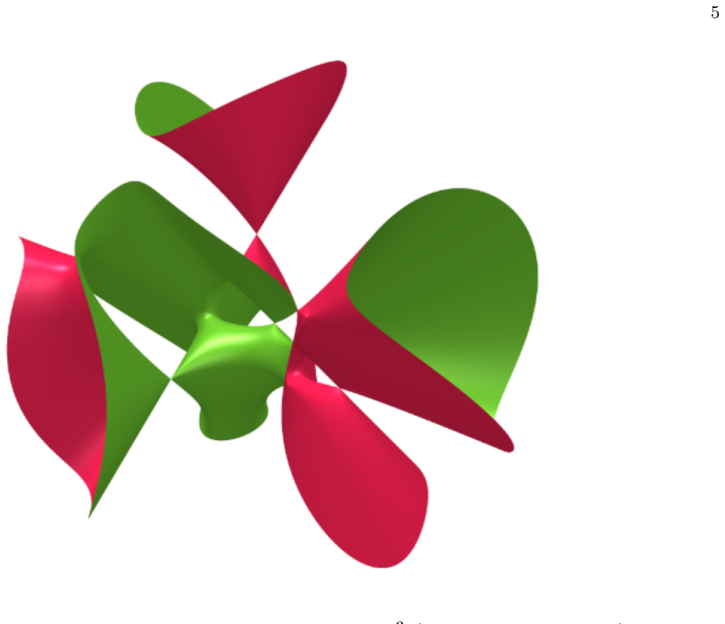
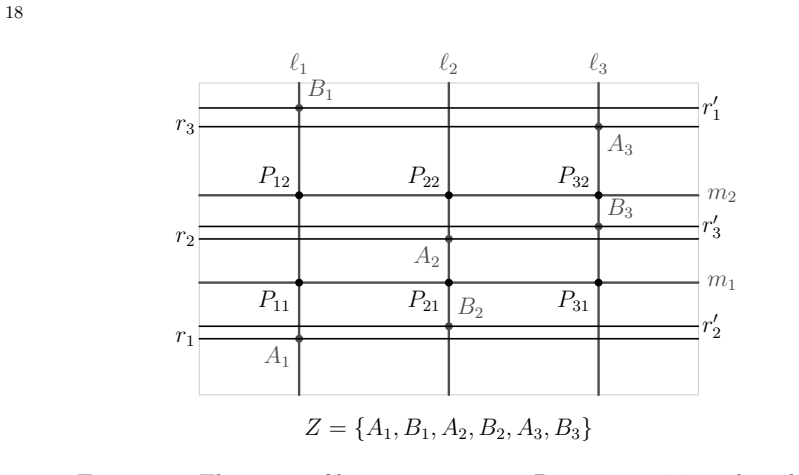
The classical Weddle surface is the locus of vertices of quadric cones through six points in $\mathbb{P}^3$ in linear general position. Equivalently, it is the closure of the locus of centers of projection from which those six points map to six points on a plane conic. Motivated by this 1850 construction of T. Weddle, we introduce $d$-Weddle schemes for finite point sets $Z\subset \mathbb{P}^n$, defined by an analogous projection-to-degree-$d$ condition. Our main tool is Macaulay duality, which yields a natural multiplication map in an Artinian algebra defined by powers of linear forms. This viewpoint connects $d$-Weddle schemes to unexpected cones and interprets them as non-Lefschetz loci for these multiplication maps. Parallel to this, we give an analysis from the point of view of interpolation matrices, and we explain the connections between these approaches. For a general set $Z\subset \mathbb{P}^n$ of $\binom{d+n}{n}$ points, we show that the $d$-Weddle scheme is a hypersurface and we compute its degree. We also study general sets whose cardinalities are "near" such a binomial coefficient, where the Weddle scheme has higher codimension. Returning to sets of six points (not always in linear general position), we discuss special configurations in which the appropriate Weddle scheme is reducible, or even nonreduced.
Editorial analysis
A structured set of objections, weighed in public.
Referee Report
Summary. The paper introduces d-Weddle schemes for a finite set Z of points in P^n, defined geometrically as the locus of centers of projection such that the images of Z lie on a degree-d hypersurface. Using Macaulay duality applied to the ideal of powers of linear forms vanishing on Z, the authors interpret these schemes as non-Lefschetz loci of a natural multiplication map on the associated Artinian algebra. The central result states that when |Z| equals binom(d+n,n) and Z is general, the d-Weddle scheme is a hypersurface whose degree is computed explicitly; the paper also treats nearby cardinalities (higher codimension) and special six-point configurations in P^3 where the scheme may be reducible or nonreduced.
Significance. If the identification between the geometric projection locus and the algebraic non-Lefschetz locus holds with matching scheme structure, the work supplies an explicit degree formula and a new algebraic framework for classical Weddle-type constructions, extending them uniformly to higher d and n. The Macaulay-duality approach and the interpolation-matrix analysis provide two independent viewpoints whose agreement would strengthen the result; the treatment of near-binomial cardinalities and reducible cases adds concrete examples.
major comments (1)
- [Main theorem on hypersurface property (likely §3 or the statement following the Macaulay-duality construction)] The equality of the geometric projection locus with the non-Lefschetz locus of the multiplication map (including scheme structure and multiplicities) is invoked to obtain both the hypersurface property and the degree formula. The abstract states that the algebraic viewpoint 'interprets' the geometric condition, but the manuscript must contain an explicit proposition or lemma establishing that a point lies in one locus if and only if it lies in the other, with identical ideal sheaves or at least the same support and multiplicity. Without this, the degree computation applies to a possibly different scheme.
minor comments (2)
- [Macaulay duality subsection] Notation for the Artinian algebra and the multiplication map should be fixed once at the beginning of the Macaulay-duality section and used consistently; currently the same symbol appears to be reused for the dual space and the quotient ring.
- [Degree computation paragraph] The degree formula is stated for general Z; an explicit example with small d and n (e.g., d=2, n=3, six points) would help verify that the computed degree matches the classical Weddle surface degree.
Simulated Author's Rebuttal
We thank the referee for the careful reading and the precise observation regarding the identification of loci. We address the major comment below and will revise the manuscript accordingly.
read point-by-point responses
-
Referee: The equality of the geometric projection locus with the non-Lefschetz locus of the multiplication map (including scheme structure and multiplicities) is invoked to obtain both the hypersurface property and the degree formula. The abstract states that the algebraic viewpoint 'interprets' the geometric condition, but the manuscript must contain an explicit proposition or lemma establishing that a point lies in one locus if and only if it lies in the other, with identical ideal sheaves or at least the same support and multiplicity. Without this, the degree computation applies to a possibly different scheme.
Authors: We agree that an explicit statement is needed. The current manuscript derives the identification from the Macaulay duality construction and the definition of the projection condition (see the paragraph following the definition of the Artinian algebra and the subsequent discussion of the multiplication map), but does not isolate it as a standalone proposition with a full proof of scheme-theoretic equality. We will add a new lemma (likely in §3) that proves the geometric projection locus coincides with the non-Lefschetz locus of the multiplication map as schemes, including matching support and multiplicities. The proof will use the explicit correspondence between the vanishing of the relevant minors in the interpolation matrix and the kernel dimension of the multiplication map, together with the fact that both loci are defined by the same Fitting ideals. This will make the invocation of the identification fully rigorous and justify the degree formula. revision: yes
Circularity Check
No circularity; derivation applies standard Macaulay duality to independent geometric definition
full rationale
The paper defines d-Weddle schemes directly via the geometric projection-to-degree-d condition on point sets Z. It then invokes Macaulay duality as an external tool to produce a multiplication map whose non-Lefschetz locus is shown to interpret the same scheme. The hypersurface claim and degree computation for |Z|=binom(d+n,n) follow from this identification plus interpolation-matrix analysis, without any quoted step that reduces the output to a fitted parameter, self-citation chain, or definitional tautology. No uniqueness theorems, ansatzes, or renamings are imported from the authors' prior work in a load-bearing way. The derivation remains self-contained against standard commutative-algebra benchmarks.
Axiom & Free-Parameter Ledger
axioms (1)
- domain assumption Macaulay duality yields a natural multiplication map in the Artinian algebra defined by powers of linear forms whose non-surjectivity locus coincides with the geometric d-Weddle condition.
Reference graph
Works this paper leans on
-
[1]
Abbott, A
J. Abbott, A. M. Bigatti, and L. Robbiano , CoCoA : a system for doing C omputations in C ommutative A lgebra . Available at http://cocoa.dima.unige.it
-
[2]
Arbarello, M
E. Arbarello, M. Cornalba, P. Griffiths, and J. Harris , Geometry of Algebraic Curves , Springer Grundlehren der mathematischen Wissenschaften 267, 1985
1985
-
[3]
H. F. Baker , Elementary Note on the Weddle Quartic Surface , Proceedings of the London Mathematical Society, s2-1 (1904), pp. 247--261
1904
-
[4]
Bateman , The Weddle quartic surface , Proceedings of the London Mathematical Society (2) 3 (1905), pp
H. Bateman , The Weddle quartic surface , Proceedings of the London Mathematical Society (2) 3 (1905), pp. 225--238
1905
-
[5]
M. Boij, J. Migliore, R. M. Miró-Roig, and U. Nagel , The non- L efschetz locus , Journal of Algebra, 505 (2018), pp. 288--320
2018
-
[6]
Bolognesi , On Weddle surfaces and their moduli , Adv
M. Bolognesi , On Weddle surfaces and their moduli , Adv. Geom. 7, No. 1, (2007), pp. 113--144
2007
-
[7]
Bruns and U
W. Bruns and U. Vetter , Determinantal Rings , Springer Lecture Notes in Mathematics 1327, 1988
1988
-
[8]
J. W. S. Cassels, E. V. Flynn , ``Weddle’s Surface”, Chapter. In Prolegomena to a Middlebrow Arithmetic of Curves of Genus 2, pp. 40--46. London Mathematical Society Lecture Note Series, Cambridge: Cambridge University Press, 1996
1996
-
[9]
Cayley , Sur les cônes du second ordre qui passent par six points donnés , Comptes rendus hebdomadaires des séances de l’Académie des sciences (Paris), tome 52 (1861), pp
A. Cayley , Sur les cônes du second ordre qui passent par six points donnés , Comptes rendus hebdomadaires des séances de l’Académie des sciences (Paris), tome 52 (1861), pp. 1216--1218
-
[10]
Chiantini and J
L. Chiantini and J. Migliore , Sets of points which project to complete intersections, and unexpected cones , Trans. Amer. Math. Soc., 374 (2021), pp. 2581--2607. With an appendix by A. Bernardi, L. Chiantini, G. Denham, G. Favacchio, B. Harbourne, J. Migliore, T. Szemberg and J. Szpond
2021
-
[11]
M. Chasles , Aperçu historique sur l'origine et le développement des m\'ethodes en g\'eom\'etrie, particuli\`erement de celles qui se rapportent \`a la g\'eom\'etrie moderne , M\'emoires couronn\'es par l’Acad\'emie royale des sciences et belles-lettres de Bruxelles, Tome 11, 1837, pp. 1--572
-
[12]
Chasles , Rapport sur les progrès de la géométrie
M. Chasles , Rapport sur les progrès de la géométrie . Paris: Imprimerie nationale, 1870. 388 pp
-
[13]
C. H. Clemens , Double solids , Adv. Math. 47 (1983), pp. 107--230
1983
-
[14]
D. Cook, B. Harbourne, J. Migliore, and U. Nagel , Line arrangements and configurations of points with an unexpected geometric property , Compositio Mathematica, 154 (2018), pp. 2150--2194
2018
-
[15]
H. S. M. Coxeter , Projective Geometry , Springer, 2nd edition (1987)
1987
-
[16]
Decker, G.-M
W. Decker, G.-M. Greuel, G. Pfister, and H. Sch\"onemann , Singular 4-3-0 --- A computer algebra system for polynomial computations . http://www.singular.uni-kl.de, 2022
2022
-
[17]
Di Gennaro, G
R. Di Gennaro, G. Ilardi, and J. Vall\'es , Singular hypersurfaces characterizing the L efschetz properties , Journal of the London Mathematical Society, 89 (2014), pp. 194--212
2014
-
[18]
Eagon and D
J. Eagon and D. Northcott , Ideals defined by matrices and a certain complex associated with them , Proceedings of the Royal Society of London. Series A, Mathematical and Physical Sciences, 269 (1962), pp. 188--204
1962
-
[19]
W. L. Edge , Non-singular models of specialized Weddle surfaces. Mathematical Proceedings of the Cambridge Philosophical Society. Vol. 80. No. 3. Cambridge University Press, 1976
1976
-
[20]
Emch , On the W eddle surface and analogous loci , Transactions of the American Mathematical Society, 27 (1925), pp
A. Emch , On the W eddle surface and analogous loci , Transactions of the American Mathematical Society, 27 (1925), pp. 270--278
1925
-
[21]
Emsalem and A
J. Emsalem and A. Iarrobino , Inverse system of a symbolic power, I , Journal of Algebra, 174 (1995), pp. 1080--1090
1995
-
[22]
Favacchio, and J
G. Favacchio, and J. Migliore , On the Weak Lefschetz Property for certain ideals generated by powers of linear forms . To appear in Kyoto Journal of Mathematics (2025)
2025
-
[23]
I. M. Gelfand, M. M. Kapranov, and A. V. Zelevinsky , Discriminants, Resultants and Multidimensional Determinants Birkh\"auser, Boston, 1994
1994
-
[24]
D. R. Grayson and M. E. Stillman , Macaulay2, a software system for research in algebraic geometry . Available at http://www.math.uiuc.edu/Macaulay2/
-
[25]
Harbourne, J
B. Harbourne, J. Migliore, U. Nagel, and Z. Teitler , Unexpected hypersurfaces and where to find them , Michigan Mathematical Journal, 70 (2021), pp. 301--339
2021
-
[26]
Harbourne, H
B. Harbourne, H. Schenck, and A. Seceleanu , Inverse systems, G elfand- T setlin patterns and the weak L efschetz property , Journal of the London Mathematical Society, 84 (2011), pp. 712--730
2011
-
[27]
Harris , Algebraic Geometry , Graduate Texts in Mathematics 133, Springer, New York, 1995
J. Harris , Algebraic Geometry , Graduate Texts in Mathematics 133, Springer, New York, 1995
1995
-
[28]
Hochster and J
M. Hochster and J. A. Eagon , Cohen- M acaulay rings, invariant theory, and the generic perfection of determinantal loci , American J. Math., 93 (1971), pp. 1020--1058
1971
-
[29]
Available at https://www.imaginary.org/program/surfer
IMAGINARY , SURFER (Version 1.7.0) [Software], 2025. Available at https://www.imaginary.org/program/surfer. Accessed 2026--02--09
2025
-
[30]
Manivel , Prehomogeneous spaces and projective geometry , Rend
L. Manivel , Prehomogeneous spaces and projective geometry , Rend. Sem. Mat. Univ. Politec. Torino 71, 1 (2013), 35--118
2013
-
[31]
Maroscia , Some problems and results on finite sets of points in ^n , Algebraic geometry—open problems, LNM, (1983), pp
P. Maroscia , Some problems and results on finite sets of points in ^n , Algebraic geometry—open problems, LNM, (1983), pp. 290--314
1983
-
[32]
Migliore , Geometric invariants for liaison of space curves , Journal of Algebra, 99 (1986), pp
J. Migliore , Geometric invariants for liaison of space curves , Journal of Algebra, 99 (1986), pp. 548--572
1986
-
[33]
Migliore and R
J. Migliore and R. M. Mir\'o-Roig , On the S trong L efschetz P roblem for uniform powers of general linear forms in k[x,y,z] , Proceedings of the American Mathematical Society, 146:2 (2018), pp. 507--523
2018
-
[34]
Migliore, R
J. Migliore, R. M. Mir\'o-Roig, and U. Nagel , On the weak L efschetz property for powers of linear forms , Algebra and Number Theory, 6 (2012), pp. 487--526
2012
-
[35]
329--358
height 2pt depth -1.6pt width 23pt, Survey article: a tour of the weak and strong L efschetz P roperties , Journal of Commutative Algebra, 5 (2013), pp. 329--358
2013
-
[36]
381--405
height 2pt depth -1.6pt width 23pt, The L efschetz question for ideals generated by powers of linear forms in few variables , Journal of Commutative Algebra, 13 (2021), pp. 381--405
2021
-
[37]
W. L. Moore , On the geometry of the W eddle surface , Annals of Mathematics, (1928), pp. 492--498
1928
-
[38]
Ottaviani , An introduction to the hyperdeterminant and to the rank of multidimensional matrices , in I
G. Ottaviani , An introduction to the hyperdeterminant and to the rank of multidimensional matrices , in I. Peeva (ed.), Commutative Algebra, Expository Papers Dedicated to David Eisenbud on the Occasion of His 65th Birthday, 609--638, Springer, New York 2013
2013
-
[39]
G. Ottaviani and Rekha R. Thomas , When is one pinhole camera image equal to some other pinhole camera image? , arXiv:2603.14172
-
[40]
Royal Astronomical Society, Thomas Weddle , Database of Obituaries , http://articles.adsabs.harvard.edu/full/seri/MNRAS/0014/0000116.000.html
-
[41]
Schenck and A
H. Schenck and A. Seceleanu , The W eak L efschetz P roperty and powers of linear forms in K [x,y,z] , Proceedings of the American Mathematical Society, 138:7 (2010), pp. 2335--2339
2010
-
[42]
Schottky , Ueber die Beziehungen zwischen den sechzehn Thetafuncktionen von zwei Variablen , J
F. Schottky , Ueber die Beziehungen zwischen den sechzehn Thetafuncktionen von zwei Variablen , J. Reine Angew. Math. 105 (1889), 233–244
-
[43]
Veniani , The maximum number of lines lying on a K3 quartic surface , Math
D.C. Veniani , The maximum number of lines lying on a K3 quartic surface , Math. Z. 285 (2017), pp. 1141--1166
2017
-
[44]
Weddle , On the theorems in space analogous to those of Pascal and Brianchon in a plane
T. Weddle , On the theorems in space analogous to those of Pascal and Brianchon in a plane. -- Part II , Cambridge and Dublin Mathematical Journal, 5 (1850), pp. 58--69
discussion (0)
Sign in with ORCID, Apple, or X to comment. Anyone can read and Pith papers without signing in.