Detachment dynamics and disturbance rejection in the TCV X-Point Target divertor
Pith reviewed 2026-06-26 06:17 UTC · model grok-4.3
The pith
The X-Point Target divertor shows inherent disturbance rejection at its secondary X-point compared to single-null for all tested perturbations.
A machine-rendered reading of the paper's core claim, the machinery that carries it, and where it could break.
Core claim
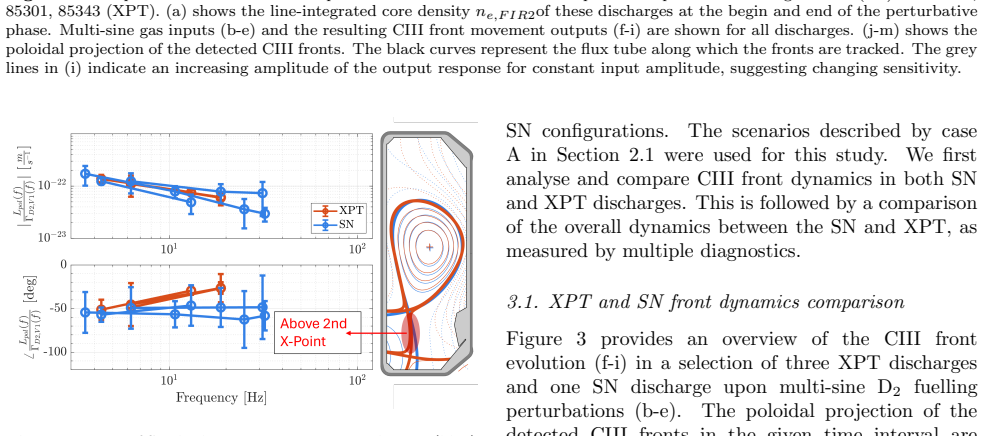
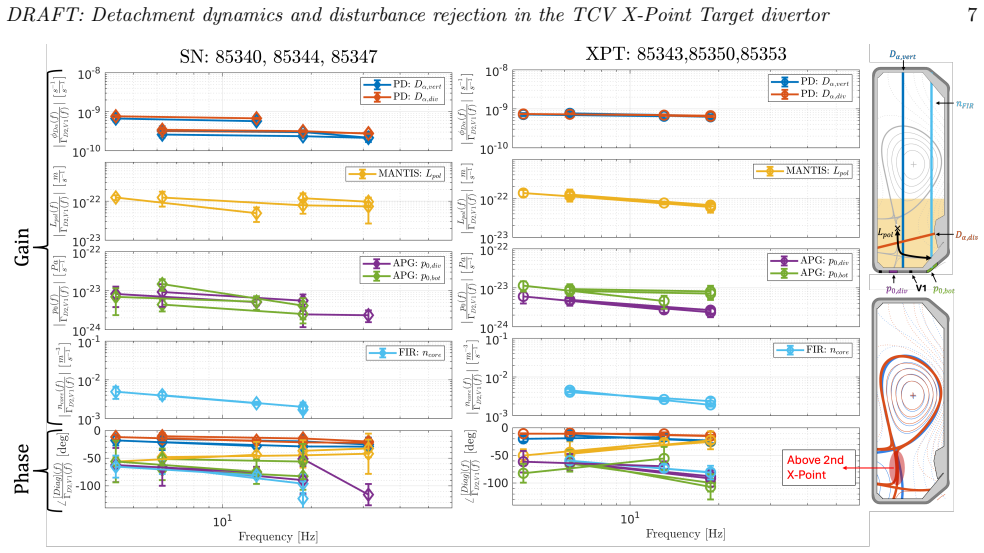
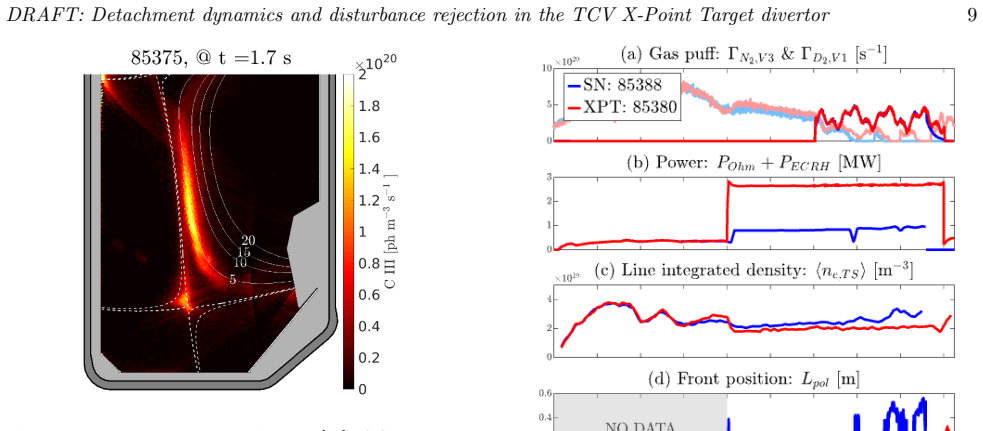
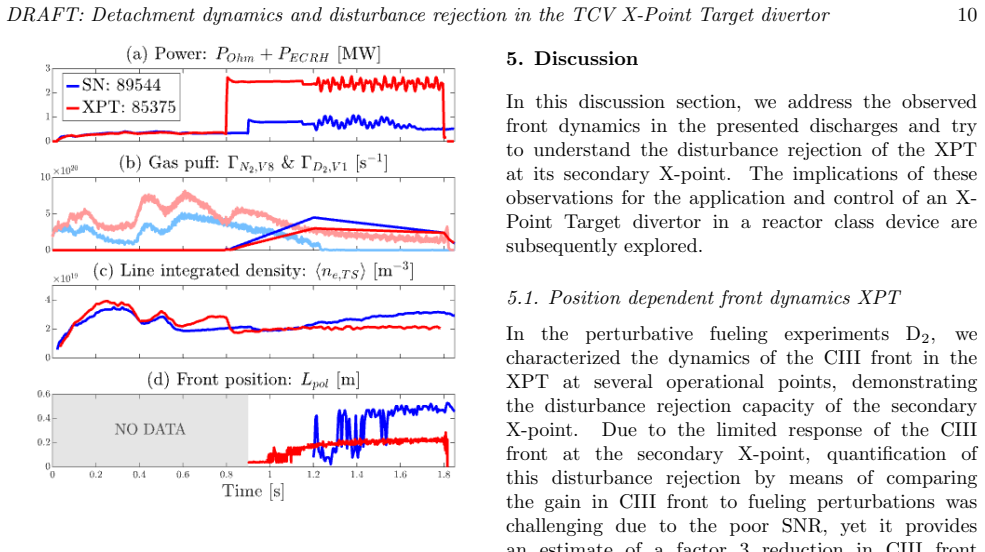
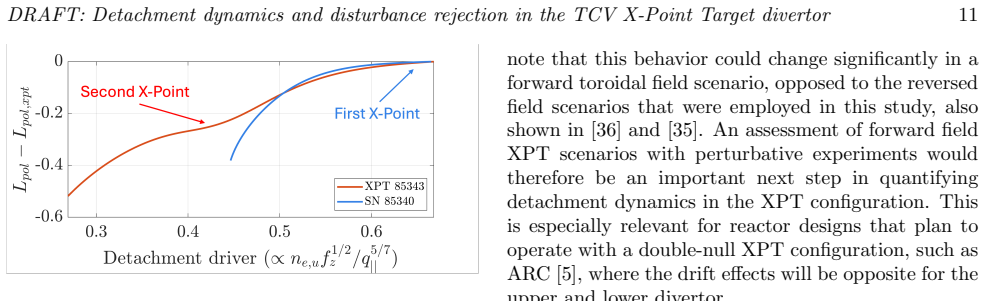
The XPT configuration demonstrates an inherent disturbance rejection capacity at its secondary X-point compared to a SN configuration for all perturbation scenarios. Upstream of its secondary X-point, the dynamic response of the detached state between the XPT and SN appears similar. The disturbance rejection capacity of the XPT could be highly beneficial for passively buffering disturbances that cannot be effectively managed by power exhaust controllers. At the same time, it presents a challenge for monitoring the detached state close to the secondary x-point.
What carries the argument
The secondary X-point located in the divertor volume of the XPT configuration, which produces the observed disturbance rejection in the detached state.
Load-bearing premise
The multi-sine perturbations applied via D2 fuelling, N2 seeding, and ECRH power modulations produce dynamic responses representative of real operational disturbances in the detached state.
What would settle it
A measurement showing that the amplitude or settling time of the response at the secondary X-point in XPT equals or exceeds that in SN under actual operational disturbances would falsify the inherent rejection claim.
Figures
read the original abstract
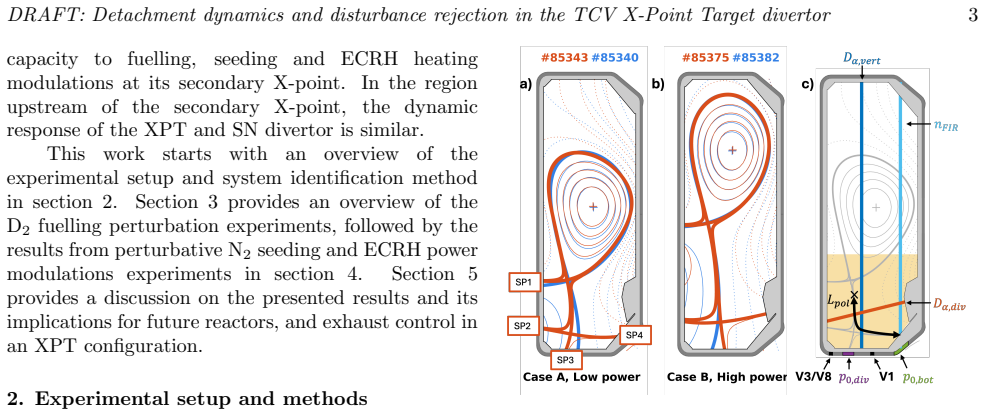
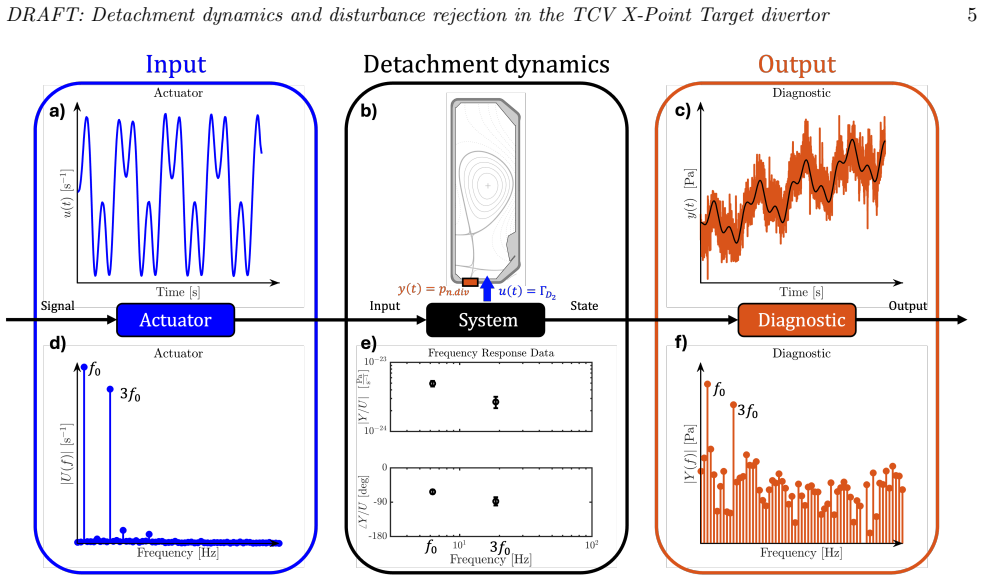
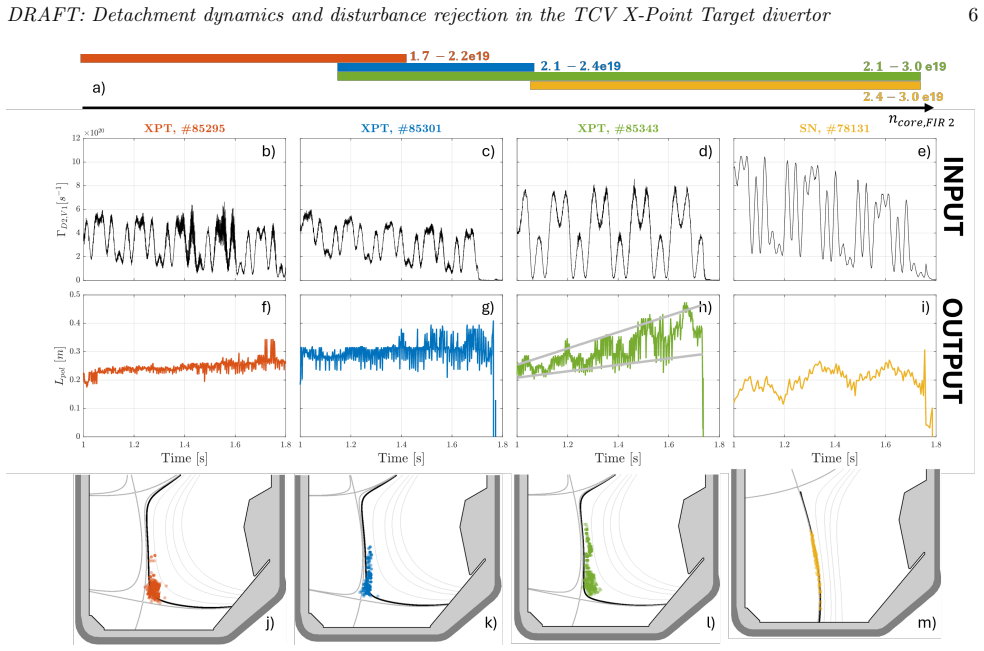
The X-Point Target divertor is an alternative divertor configuration with a secondary X-point in its divertor volume. In this work, we investigate the dynamic response and disturbance rejection capacity of the XPT configuration on the TCV tokamak, comparing it to a single null (SN) divertor. We employ a system identification approach using multi-sine perturbations to measure the dynamic response of the detached state in both Ohmic and auxiliary-heated L-mode scenarios upon D$_2$ fuelling, N$_2$ seeding and Electron Resonance Cyclotron Heating (ECRH) power modulations. We demonstrate an inherent disturbance rejection capacity of the XPT at its secondary X-point compared to a SN configuration for all perturbation scenarios. Upstream of its secondary X-point, the dynamic response of the detached state between the XPT and SN appears similar. The disturbance rejection capacity of the XPT could be highly beneficial for passively buffering disturbances that cannot be effectively managed by power exhaust controllers. At the same time, it presents a challenge for monitoring the detached state close to the secondary x-point.
Editorial analysis
A structured set of objections, weighed in public.
Referee Report
Summary. The manuscript reports an experimental comparison of detachment dynamics in the X-Point Target (XPT) divertor versus single-null (SN) on TCV, using multi-sine perturbations in D2 fuelling, N2 seeding and ECRH power to identify transfer functions in Ohmic and auxiliary-heated L-mode detached plasmas. It claims an inherent disturbance-rejection advantage of the XPT at the secondary X-point for all tested perturbation scenarios, while noting similar upstream responses and potential monitoring challenges near the secondary X-point.
Significance. If the central claim holds, the result would indicate a passive buffering mechanism that could reduce the burden on active power-exhaust controllers in future devices; the work also supplies concrete system-identification data that could be used for controller design. The experimental approach is a strength, but the significance is tempered by the need to confirm that the linearised responses generalise to realistic finite-amplitude disturbances.
major comments (2)
- [Abstract and §3] Abstract and §3 (system-identification method): the claim of an 'inherent disturbance rejection capacity ... for all perturbation scenarios' is load-bearing on the assumption that small-amplitude multi-sine responses are representative of real detached-plasma disturbances. The manuscript does not present step-response data or explicit checks for threshold nonlinearities (MARFE formation, recombination-front motion, radiation collapse) that routinely appear in detachment; if these nonlinearities reverse or eliminate the reported XPT advantage, the 'all perturbation scenarios' statement does not follow from the linear transfer functions alone.
- [§4] §4 (results on transfer functions): the reported rejection advantage is stated qualitatively ('lower dynamic response') without tabulated gain ratios, coherence values, or uncertainty bands that would allow a reader to judge the magnitude and statistical significance of the XPT–SN difference at the secondary X-point. This quantitative gap directly affects the strength of the central claim.
minor comments (2)
- [Figures] Figure captions should explicitly state the frequency range, amplitude of the multi-sine signals, and the number of averaged periods used for each transfer-function estimate.
- [§2] The text refers to 'upstream of its secondary X-point' without a clear definition or diagnostic location; a schematic or table of measurement positions would remove ambiguity.
Simulated Author's Rebuttal
We thank the referee for the constructive comments, which help clarify the scope and presentation of our results. We address each major point below.
read point-by-point responses
-
Referee: [Abstract and §3] Abstract and §3 (system-identification method): the claim of an 'inherent disturbance rejection capacity ... for all perturbation scenarios' is load-bearing on the assumption that small-amplitude multi-sine responses are representative of real detached-plasma disturbances. The manuscript does not present step-response data or explicit checks for threshold nonlinearities (MARFE formation, recombination-front motion, radiation collapse) that routinely appear in detachment; if these nonlinearities reverse or eliminate the reported XPT advantage, the 'all perturbation scenarios' statement does not follow from the linear transfer functions alone.
Authors: We agree that the multi-sine perturbations probe the linear regime and that the manuscript does not include step-response data or explicit nonlinearity checks. The system-identification method was chosen to extract transfer functions for control-relevant analysis in detached L-mode. We will revise the abstract and §3 to qualify the claim as applying to the small-amplitude linear responses measured, and add a brief discussion of the limitations for large disturbances or threshold nonlinearities. Step-response experiments would require new dedicated runs and are outside the present scope. revision: partial
-
Referee: [§4] §4 (results on transfer functions): the reported rejection advantage is stated qualitatively ('lower dynamic response') without tabulated gain ratios, coherence values, or uncertainty bands that would allow a reader to judge the magnitude and statistical significance of the XPT–SN difference at the secondary X-point. This quantitative gap directly affects the strength of the central claim.
Authors: We accept this point. The revised §4 will include tables reporting gain ratios (XPT vs SN at the secondary X-point), coherence values, and uncertainty bands for each perturbation scenario (D2, N2, ECRH) in both Ohmic and auxiliary-heated cases. This will enable quantitative assessment of the differences. revision: yes
Circularity Check
No significant circularity; experimental comparison is self-contained
full rationale
The paper reports an experimental system-identification study that applies multi-sine perturbations (D2 fuelling, N2 seeding, ECRH) and directly compares measured transfer functions between XPT and SN configurations. The claimed disturbance-rejection advantage is presented as an observed empirical outcome, not as a derived quantity obtained by fitting parameters to the same data or by reducing equations to self-citations. No load-bearing step equates a prediction to its own inputs by construction; the work therefore remains independent of the circularity patterns listed in the instructions.
Axiom & Free-Parameter Ledger
axioms (1)
- domain assumption Standard tokamak plasma detachment and magnetic geometry assumptions hold for the compared configurations.
Reference graph
Works this paper leans on
-
[1]
Des.166 112307
Zohm H, Militello F, Morgan T W, Morris W, Reimerdes H and Siccinio M 2021Fusion Eng. Des.166 112307
-
[2]
Fusion65016033
Henderson S Set al.2025Nucl. Fusion65016033
-
[3]
Plasma Phys.86865860502
Creely Aet al.2020J. Plasma Phys.86865860502
-
[4]
Des.100378–405
Sorbom B Net al.2015Fusion Eng. Des.100378–405
-
[5]
Plasma Phys.92E66
Eich Tet al.2026J. Plasma Phys.92E66
-
[6]
Fusion63036006
Gao J Met al.2023Nucl. Fusion63036006
-
[7]
Fusion57034004
Reinke M L 2017Nucl. Fusion57034004
-
[8]
Lipschultz B, Terry J, Boswell C, Hubbard A, LaBombard B and Pappas D 1998Phys. Rev. Lett.81 1007–1010
-
[9]
Plasma Phys.83155830501
Krasheninnikov S and Kukushkin S 2017J. Plasma Phys.83155830501
-
[10]
Fusion59126038
Verhaegh Ket al.2019Nucl. Fusion59126038
-
[11]
Verhaegh Ket al.2021Plasma. Phys. Control. Fusion63126038
-
[12]
Technol.51369–389
Lipschultz B, LaBombard B, Terry J L, Boswell C and Hutchinson I H 2007Fusion Sci. Technol.51369–389
-
[13]
Commun.121105
Ravensbergen Tet al.2021Nat. Commun.121105
-
[14]
Fusion57072008
Theiler Cet al.2017Nucl. Fusion57072008
-
[15]
Wesson J 2004Tokamaks3rd ed (Oxford, UK: Oxford University Press)
-
[16]
Fusion392251
ITER Physics Expert Group on Disruptions, Plasma Control, and MHD and ITER Physics Basis Editors 1999Nucl. Fusion392251
-
[17]
Fusion47S128
Hender T a o 2007Nucl. Fusion47S128
-
[18]
Plasmas19058101
Boozer A H 2012Phys. Plasmas19058101
-
[19]
Wagner Fet al.1982Phys. Rev. Lett.491408–1412
-
[20]
Fusion57076020
Wiesen S, K¨ ochl F, Belo P, Kotov V, Loarte A, Parail V, Corrigan G, Garzotti L and Harting D 2017Nucl. Fusion57076020
-
[21]
Des.224115602
Kool Bet al.2026Fusion Eng. Des.224115602
-
[22]
Fusion66036017
Van Berkel Met al.2026Nucl. Fusion66036017
-
[23]
Phys.8215
Verhaegh Ket al.2025Commun. Phys.8215
-
[24]
Lee Ket al.2025Phys. Rev. Lett.134185102
-
[25]
Fusion62066025
Koenders J T W, Wensing M, Ravensbergen T, F´ evrier O, Perek A, Van Berkel M, The TCV Team and The EUROfusion Mst1 Team 2022Nucl. Fusion62066025
-
[26]
Fusion65016057
Bosman Tet al.2025Nucl. Fusion65016057
-
[27]
Energy101116 – 1131
Kool Bet al.2025Nat. Energy101116 – 1131
-
[28]
Fusion65106032
Kool Bet al.2025Nucl. Fusion65106032
-
[29]
Fusion66016008
Ceelen Let al.2025Nucl. Fusion66016008
-
[30]
Fusion64112023
Duval B Pet al.2024Nucl. Fusion64112023
-
[31]
Mele Aet al.2025Plasma Phys. Control. Fusion67065035
-
[32]
Perek Aet al.2019Review of Scientific Instruments90123514
-
[33]
Barry S 1999 The extension of the FIR interferometer of TCV to a polarimeter and measurements of the Faraday rotation caused by the poloidal magnetic field
1999
-
[34]
Sun G, Reimerdes H, Elaian H, Baquero-Ruiz M, Brown B, Gospodarczyk M, No¨ el M and Tonello E 2025 Review of Scientific Instruments96083502
2025
-
[35]
Carpita Met al.2026 Physics basis of stationary power exhaust in the X-point target divertor configuration invited talk at the 27th International Conference on Plasma Surface Interactions in Controlled Fusion Devices (PSI)
2026
-
[36]
Lee Ket al.Detachment of high power discharges in TCV X-point target divertor Poster presented at the 27th International Conference on Plasma Surface Interactions in Controlled Fusion Devices (PSI) REFERENCES 26
-
[37]
Fusion56056007
Lipschultz B, Parra F I and Hutchinson I H 2016Nucl. Fusion56056007
-
[38]
Fusion63096018
Myatra O, Lipschultz B, Moulton D, Verhaegh K, Dudson B, Orchard S, Fil A and Cowley C 2023Nucl. Fusion63096018
-
[39]
Van Berkel Met al.2020Plasma Phys. Control. Fusion62094001
-
[40]
Perek Aet al.2021Nucl. Mater. Energy26100858
-
[41]
Des.911–15
Moret J M, Duval B P, Le H B, Coda S, Felici F and Reimerdes H 2015Fusion Eng. Des.911–15
-
[42]
thesis EPFL Lausanne, Switzerland
Martinelli L 2023Spectroscopic characterisation of TCV divertor towards a detached regimePh.D. thesis EPFL Lausanne, Switzerland
-
[43]
F´ evrier Oet al.2020Plasma Phys. Control. Fusion62035017
-
[44]
Fusion60066017
Ravensbergen Tet al.2020Nucl. Fusion60066017
-
[45]
Verhaegh K, Lipschultz B, Duval B, Harrison J, Reimerdes H, Theiler C, Labit B, Maurizio R, Marini C, Nespoli F, Sheikh U, Tsui C, Vianello N and Vijvers W 2017Nucl. Mater. Energy121112–1117
-
[46]
Potzel S, Wischmeier M, Bernert M, Dux R, M¨ uller H, Scarabosio A and the ASDEX Upgrade Team 2014 Nucl.Fusion54013001
2014
-
[47]
Harrison J Ret al.2017Nucl. Mater. Energy121071–1076
-
[48]
Verhaegh Ket al.2021Nucl. Mater. Energy26100922
-
[49]
thesis Eindhoven University of Technology
Van Berkel M 2015Estimation of heat transport coefficients in fusion plasmasPh.D. thesis Eindhoven University of Technology
-
[50]
Fusion66(1) 066010
Derks Get al.2026Nucl. Fusion66(1) 066010
-
[51]
Plasma Sci.176–11
Matsuda K 1989IEEE Trans. Plasma Sci.176–11
-
[52]
Instrum.14C10038–C10038
Blanchard Pet al.2019J. Instrum.14C10038–C10038
-
[53]
Fusion63026006
Koenders J T W, Perek A, Kool B, F´ evrier O, Ravensbergen T, Galperti C, Duval B P, Theiler C and Van Berkel M 2023Nucl. Fusion63026006
-
[54]
Des.201114271
Raukema Jet al.2024Fusion Eng. Des.201114271
-
[55]
Fusion53093031
Eich Tet al.2013Nucl. Fusion53093031
-
[56]
Piscataway, NJ: Wiley IEEE Press)
Pintelon R and Schoukens J 2012System identification: a frequency domain approach2nd ed (Hoboken, N.J. Piscataway, NJ: Wiley IEEE Press)
-
[57]
Fusion63106007
Koenders J T W, Perek A, Galperti C, Duval B P, F´ evrier O, Theiler C, Van Berkel M and the TCV Team 2023Nucl. Fusion63106007
-
[58]
Lengyel L 1981 Analysis of radiating plasma boundary layers (Available athttps://inis.iaea.org/ search/search.aspxorig_q=RN:13657893)
1981
discussion (0)
Sign in with ORCID, Apple, or X to comment. Anyone can read and Pith papers without signing in.