Half-vortex soliton lattices in spin-orbit-coupled Bose-Einstein condensates with a quasi-flat band
Pith reviewed 2026-05-22 12:27 UTC · model grok-4.3
The pith
Half-vortex soliton lattices form near quasi-flat bands in spin-orbit-coupled condensates with minimal atoms.
A machine-rendered reading of the paper's core claim, the machinery that carries it, and where it could break.
Core claim
Near the quasi-flat band, half-vortex solitons and their arrays can be excited with a nearly negligible number of atoms and are constrained by their local symmetries, which are isomorphic to a dihedral group of order 8. This allows observation of the respective field patterns in the nearly linear regime where they exhibit enhanced stability. The constructed lattices may have diverse geometric profiles, and in particular create a composite super-half-vortex soliton with nonlinear symmetry breaking.
What carries the argument
Quasi-flat lowest band realized in a spin-orbit-coupled Bose-Einstein condensate loaded in a Zeeman lattice, which confines half-vortex solitons within a single lattice cell.
If this is right
- Half-vortex solitons and their arrays become confined within single lattice cells.
- Arrays can be arranged in various spatial geometries while respecting local symmetries.
- Field patterns can be observed in the nearly linear regime with enhanced stability.
- Diverse geometric profiles are possible, including composite super-half-vortex solitons via nonlinear symmetry breaking.
Where Pith is reading between the lines
- The narrow-band confinement approach might extend to other continuous nonlinear systems for creating stable localized structures without perfectly flat bands.
- Symmetry constraints equivalent to a dihedral group of order 8 could provide a template for predicting pattern formation in related quantum fluid experiments.
- Varying lattice depth or spin-orbit strength offers a direct experimental route to tune soliton stability across linear and nonlinear regimes.
Load-bearing premise
A spin-orbit-coupled Bose-Einstein condensate loaded in a Zeeman lattice can realize a quasi-flat lowest band with an extremely narrow bandwidth in a continuous system.
What would settle it
If measurements show that half-vortex solitons require substantially more than a negligible number of atoms near the quasi-flat band or fail to remain confined within single lattice cells, the central claim would be falsified.
Figures



read the original abstract
Periodic potentials with flat bands in their spectra support strongly localized nonlinear excitations. Although a perfectly flat band cannot exist in a continuous system, a spin-orbit-coupled Bose-Einstein condensate loaded in a Zeeman lattice can realize the quasi-flat lowest band with an extremely narrow bandwidth. In such a quasi flat band, half vortex solitons become confined within a single lattice cell, enabling the formation of arrays of coupled half vortex solitons arranged of various spatial geometries. In this work, we study the existence and stability of these lattices within the framework of the two-component Gross-Pitaevskii equation. We demonstrate that, near the quasi-flat band, half-vortex solitons and their arrays can be excited with a nearly negligible number of atoms and are constrained by their local symmetries, which are isomorphic to a dihedral group of order 8. This allows observation of the respective field patterns in the nearly linear regime where they exhibit enhanced stability. The constructed lattices may have diverse geometric profiles, and in particular create a composite super-half-vortex soliton with nonlinear symmetry breaking.
Editorial analysis
A structured set of objections, weighed in public.
Referee Report
Summary. The paper claims that spin-orbit-coupled Bose-Einstein condensates in a Zeeman lattice can realize a quasi-flat lowest band with extremely narrow bandwidth in a continuous system. Within the two-component Gross-Pitaevskii framework, half-vortex solitons become confined to single lattice cells, enabling the formation of lattices of such solitons in various geometries. These are constrained by local symmetries isomorphic to the dihedral group of order 8, allowing excitation with nearly negligible atom numbers in the near-linear regime where they show enhanced stability. A composite super-half-vortex soliton with nonlinear symmetry breaking is also constructed.
Significance. If the quasi-flat band condition holds with sufficient scale separation, this work offers a novel way to study localized nonlinear modes and their symmetry constraints in continuous media, which is significant for both theoretical understanding and potential experimental realization in ultracold gases. The near-linear regime stability is a key strength.
major comments (2)
- The assertion of an 'extremely narrow bandwidth' enabling single-cell confinement is central but lacks explicit quantitative comparison between the bandwidth, the gap to higher bands, and the nonlinear interaction energy scale for the parameters in the soliton calculations. This scale separation is load-bearing for the confinement and stability claims.
- The stability analysis section does not specify the discretization scheme, basis functions, or convergence criteria used for the Bogoliubov-de Gennes equations. Given the low atom numbers and near-linear regime, small numerical errors could affect the reported stability.
Simulated Author's Rebuttal
We thank the referee for their careful reading of the manuscript and for the constructive comments, which have helped us improve the presentation of our results. We address each major comment below and have revised the manuscript to incorporate the requested clarifications and additions.
read point-by-point responses
-
Referee: The assertion of an 'extremely narrow bandwidth' enabling single-cell confinement is central but lacks explicit quantitative comparison between the bandwidth, the gap to higher bands, and the nonlinear interaction energy scale for the parameters in the soliton calculations. This scale separation is load-bearing for the confinement and stability claims.
Authors: We agree that an explicit quantitative comparison of the relevant energy scales is necessary to fully substantiate the claims regarding single-cell confinement and stability. In the revised manuscript we have added a new paragraph in the section discussing the quasi-flat band (immediately following the band-structure calculation) that reports the computed bandwidth, the gap to the next band, and the nonlinear interaction energy scale evaluated at the atom numbers used for the soliton lattices. These values confirm the required scale separation for the chosen parameters. revision: yes
-
Referee: The stability analysis section does not specify the discretization scheme, basis functions, or convergence criteria used for the Bogoliubov-de Gennes equations. Given the low atom numbers and near-linear regime, small numerical errors could affect the reported stability.
Authors: We thank the referee for highlighting the need for greater numerical transparency. In the revised manuscript we have expanded the stability-analysis subsection to describe the discretization scheme (second-order finite differences on a uniform Cartesian grid with spacing chosen to resolve the lattice period), the absence of an auxiliary basis expansion (direct real-space discretization of the BdG operator), and the convergence criteria (eigenvalue solver tolerance of 10^{-10} together with grid-refinement checks). Additional tests confirming that the reported stability eigenvalues remain unchanged under moderate variations of these parameters have also been included. revision: yes
Circularity Check
No significant circularity; derivation self-contained in GPE analysis
full rationale
The paper derives half-vortex soliton lattices by first computing the linear band structure of the spin-orbit-coupled two-component system in a Zeeman lattice to identify parameters yielding a quasi-flat lowest band, then solving the nonlinear Gross-Pitaevskii equation for localized solutions and their stability near that band. Existence, symmetry constraints (dihedral group of order 8), and enhanced stability in the near-linear regime follow directly from the model equations without reducing to fitted inputs, self-citations, or definitional loops. The narrow-bandwidth claim is a parameter choice verified by the linear eigenvalue problem rather than assumed by construction, and no load-bearing step renames a known result or imports uniqueness via author overlap.
Axiom & Free-Parameter Ledger
axioms (1)
- domain assumption The two-component Gross-Pitaevskii equation accurately describes the dynamics of spin-orbit-coupled Bose-Einstein condensates in a Zeeman lattice.
Lean theorems connected to this paper
-
IndisputableMonolith/Foundation/AlexanderDuality.leanalexander_duality_circle_linking echoes?
echoesECHOES: this paper passage has the same mathematical shape or conceptual pattern as the Recognition theorem, but is not a direct formal dependency.
local symmetries ... isomorphic to a dihedral group of order 8 ... 𝔇_loc = {1, α̂1, α̂2, α̂3, r̂, r̂α̂1, r̂α̂2, r̂α̂3}
-
IndisputableMonolith/Foundation/RealityFromDistinction.leanreality_from_one_distinction unclear?
unclearRelation between the paper passage and the cited Recognition theorem.
two-dimensional ... Zeeman lattice ... quasi-flat lowest band ... Gross-Pitaevskii equation
What do these tags mean?
- matches
- The paper's claim is directly supported by a theorem in the formal canon.
- supports
- The theorem supports part of the paper's argument, but the paper may add assumptions or extra steps.
- extends
- The paper goes beyond the formal theorem; the theorem is a base layer rather than the whole result.
- uses
- The paper appears to rely on the theorem as machinery.
- contradicts
- The paper's claim conflicts with a theorem or certificate in the canon.
- unclear
- Pith found a possible connection, but the passage is too broad, indirect, or ambiguous to say the theorem truly supports the claim.
Reference graph
Works this paper leans on
-
[1]
Malomed,B.A.,2024.Multidimensionalsolitonsystems.Advances in Physics: X 9, 2301592
work page 2024
-
[2]
Mihalache, D., 2024. Localized structures in optical media and Bose-Einstein condensates: An overview of recent theoretical and experimental results. Rom. Rep. Phys. 76, 402
work page 2024
-
[3]
Han, W., Zhang, S., Jin, J., Liu, W.M., 2012. Half-vortex sheets and domain-wall trains of rotating two-component Bose-Einstein condensates in spin-dependent optical lattices, Phys. Rev. A 85, 043626
work page 2012
-
[4]
Vortices on demand in multicomponent Bose-Einstein condensates, Phys
Zamora-Zamora, R., Lozada-Hidalgo, M., Caballero-Benítez, S.F., Romero-Rochín, V., 2012. Vortices on demand in multicomponent Bose-Einstein condensates, Phys. Rev. A 86, 053624
work page 2012
-
[5]
Wall- vortexcompositesolitonsintwo-componentBose-Einsteinconden- sates, Phys
Kasamatsu, K., Takeuchi, H., Tsubota, M., Nitta, M., 2013. Wall- vortexcompositesolitonsintwo-componentBose-Einsteinconden- sates, Phys. Rev. A 88, 013620
work page 2013
-
[6]
Wen, L., Qiao, Y., Xu, Y., Mao, L., 2013. Structure of two- component Bose-Einstein condensates with respective vortex- antivortex superposition states, Phys. Rev. A 87, 033604
work page 2013
-
[7]
Zhang,X.F.,Dua,Z.J.,Tanb,R.B.,Donga,R.F.,Changa,H.,Zhang, S.G., 2014. Vortices in a rotating two-component Bose–Einstein condensatewithtunableinteractionsandharmonicpotential,Annals of Physics 346, 154-163 (2014)
work page 2014
-
[8]
Multicolor vortex solitons in two-dimensional photonic lattices, Phys
Xu, Z., Kartashov, Y.V., Crasovan, L.C., Mihalache, D., Torner, L., 2005. Multicolor vortex solitons in two-dimensional photonic lattices, Phys. Rev. E 71, 016616
work page 2005
-
[9]
Families of vortex solitons in periodic media, Phys
Wang, J., Yang, J., 2008. Families of vortex solitons in periodic media, Phys. Rev. A 77, 033834
work page 2008
-
[10]
Stable Vortex–Bright-SolitonStructuresinTwo-ComponentBose-Einstein Condensates, Phys
Law, K.J.H., Kevrekidis, P.G., Tuckerman, L.S., 2010. Stable Vortex–Bright-SolitonStructuresinTwo-ComponentBose-Einstein Condensates, Phys. Rev. Lett. 105, 160405
work page 2010
-
[11]
Stockhofe, J., Kevrekidis, P.G., Frantzeskakis, D.J., Schmelcher, P.,
-
[12]
Dark–bright ring solitons in Bose–Einstein condensates J. Phys. B: At. Mol. Opt. Phys. 44, 191003
-
[13]
Pola, M., Stockhofe, J., Schmelcher, P., Kevrekidis, P.G., 2012. Vortex–bright-soliton dipoles: Bifurcations, symmetry breaking, and soliton tunneling in a vortex-induced double well, Phys. Rev. A 86, 053601
work page 2012
-
[14]
Chaos, Solitons & Fractals, 197, 116441
Sanjay S., Saravana V.S., Malomed, B.A., 2025, Vortex droplets andlatticepatternsintwo-dimensionaltraps:Aphotonicspin–orbit- coupling perspective. Chaos, Solitons & Fractals, 197, 116441
work page 2025
-
[15]
Deekshita,S.,Sanjay,S.,Veni,S.S.,Tabi,C.B.,Kofane,T.C.,2025. Synergistic Effects of Spin-Orbit Coupling and Intercomponent Interactions in Two-Component (2+1) D Photonic Fields. Chaos, Solitons & Fractals, 199, 116806
work page 2025
-
[16]
Spin–orbit- coupled Bose–Einstein condensates
Lin, Y.J., Jiménez-Garcí, K., Spielman, I.B., 2011. Spin–orbit- coupled Bose–Einstein condensates. Nature 471, 83–8. C. Wang et al.:Preprint submitted to ElsevierPage 5 of 6 Half-vortex solitons
work page 2011
-
[17]
Wu,Z.,Zhang,L.,Sun,W.,Xu,X.T.,Wang,B.Z.,Ji,S.C.,Deng,Y., Chen,S.,Liu,X.J.,Pan,J.W.,2016.Realizationoftwo-dimensional spin-orbit coupling for Bose-Einstein condensates. Science 354, 83–88
work page 2016
-
[18]
Highly controllable and robust 2D spin-orbit coupling for quantum gases
Sun, W., Wang, B.Z., Xu, X.T., Yi, C.R., Zhang, L., Wu, Z., Deng, Y., Liu, X.J., Chen, S., Pan, J.W., 2018. Highly controllable and robust 2D spin-orbit coupling for quantum gases. Phys. Rev. Lett. 121, 150401
work page 2018
-
[19]
Nature Reviews Physics 1, 185–197
Kartashov, Y.V., Astrakharchik, G.E., Malomed, B.A., Torner, L., 2019.Frontiersinmultidimensionalself-trappingofnonlinearfields and matter. Nature Reviews Physics 1, 185–197
work page 2019
-
[20]
Physica D: Nonlinear Phenomena, 399, 108-137
Malomed,B.A.,2019.Vortexsolitons:Oldresultsandnewperspec- tives. Physica D: Nonlinear Phenomena, 399, 108-137
work page 2019
-
[21]
Sakaguchi,H.,Malomed,B.A.,2014.Discreteandcontinuumcom- posite solitons in Bose-Einstein condensates with the Rashba spin- orbit coupling in one and two dimensions. Phys. Rev. E 90, 062922
work page 2014
-
[22]
Sakaguchi, H., Sherman, E.Y., Malomed, B.A., 2016. Vortex soli- tons in two-dimensional spin-orbit coupled Bose-Einstein conden- sates: effects of the Rashba-Dresselhaus coupling and the Zeeman splitting. Phys. Rev. E 94, 032202
work page 2016
-
[23]
Lobanov,V.E.,Kartashov,Y.V.,Konotop,V.V.,2014.Fundamental, multipole, and half-vortex gap solitons in spin-orbit coupled Bose- Einstein condensates. Phys. Rev. Lett. 112, 180403
work page 2014
-
[24]
Anisotropic semivortices in dipolar spinor condensates controlled by Zeeman splitting
Liao, B.; Li, S.; Huang, C.; Luo, Z.; Pang, W.; Tan, H.; Malomed, B.A.; Li, Y. Anisotropic semivortices in dipolar spinor condensates controlled by Zeeman splitting. Phy. Rev. A 96, 043613 (2017)
work page 2017
-
[25]
Liu, S.; Liao, B.; Kong, J.; Chen, P.; Lü, J.; Li, Y.; Huang, C.; Li, Y. Anisotropic Semi Vortices in Spinor Dipolar Bose Einstein Condensates Induced by Mixture of Rashba Dresselhaus Coupling. J. Phys. Soc. Jpn. 87, 094005 (2018)
work page 2018
-
[26]
Kartashov, Y.V., Sherman E.Ya., Malomed, B.A., Konotop V.V., 2020, Stable two-dimensional soliton complexes in Bose–Einstein condensates with helicoidal spin–orbit coupling. New J. Phys. 22, 103014
work page 2020
-
[27]
Transfer of solitons and half-vortex solitons via adiabatic passage
Wang, C., Zhang, Y., Konotop, V.V., 2024. Transfer of solitons and half-vortex solitons via adiabatic passage. Phys. Rev. Research 6, 043089
work page 2024
-
[28]
Wave collapse in physics: principles and applica- tions to light and plasma waves
Bergé, L., 1998. Wave collapse in physics: principles and applica- tions to light and plasma waves. Physics reports 303, 259–37
work page 1998
-
[29]
Fibich, G. 2015 The Nonlinear Schrödinger Equation: Singular Solutions and Optical Collapse (Springer, Heidelberg)
work page 2015
-
[30]
Fu, Q., Wang, P., Huang, C., Kartashov, Y.V., Torner, L., Konotop, V.V. Ye, F., 2020. Optical soliton formation controlled by angle twisting in photonic moiré lattices, Nature Photonics 14, 663
work page 2020
-
[31]
Vortex solitons in moiré optical lattices, Optics Letters 48, 3797- 3800
Ivanov, S.K., Konotop, V.V., Kartashov, Y.V., Torner, L., 2023. Vortex solitons in moiré optical lattices, Optics Letters 48, 3797- 3800
work page 2023
-
[32]
Wang, P., Fu, Q., Konotop, V.V., Kartashov, Y.V., Ye, F. 2024. Observation of localization of light in linear photonic quasicrystals with diverse rotational symmetries, Nature Photonics, 18, 224-229
work page 2024
-
[33]
V., Torner, L., Modugno, M., Sherman, E
Kartashov, Y. V., Torner, L., Modugno, M., Sherman, E. Ya., Malomed, B. A. Konotop V. V. 2020, Multidimensional hybrid Bose-Einstein condensates stabilized by lower-dimensional spin- orbit coupling. Phys. Rev. Research, 2, 013036
work page 2020
-
[34]
Discrete flat-band solitons in the Kagome lattice
Vicencio, R.A., Johansson, M., 2013. Discrete flat-band solitons in the Kagome lattice. Phys. Rev. A 87, 061803
work page 2013
-
[35]
Artificial flat band systems: From lattice models to experiment
Leykam, D., Andreanov, A., Flach, S., 2018. Artificial flat band systems: From lattice models to experiment. Advances in physics: X 3, 1473052
work page 2018
-
[36]
General method to constructflatbandsintwo-dimensionallattices.Phys.Rev.Lett.134, 076402
Li, H.T., Ji, T.Z., Yan, R.G., Fan, W.L., Zhang, Z.X., Sun, L., Miao, B.F., Chen, G., Wan, X.G., Ding, H.F., 2025. General method to constructflatbandsintwo-dimensionallattices.Phys.Rev.Lett.134, 076402
work page 2025
-
[37]
Two-dimensional flat-band solitons in superhoneycomb lattices, Nanophotonics, 13, 4047-4056
Shen, S., Zhang, Y., Kartashov, Y.V., Li, Y., Konotop, V.V., 2024. Two-dimensional flat-band solitons in superhoneycomb lattices, Nanophotonics, 13, 4047-4056
work page 2024
-
[38]
Zhang,Y.,Zhang,C.,2013.Bose-Einsteincondensatesinspin-orbit- coupledopticallattices:flatbandsandsuperfluidity.Phys.Rev.A87, 023611
work page 2013
-
[39]
Bloch oscillations in optical and Zeeman lattices in the presence of spin-orbit coupling
Kartashov, Y.V., Konotop, V.V., Zezyulin, D.A., Torner, L., 2016. Bloch oscillations in optical and Zeeman lattices in the presence of spin-orbit coupling. Phys. Rev. Lett. 117, 215301
work page 2016
-
[40]
Hui,H., Zhang,Y., Zhang,C.,Scarola, V.W.,2017.Superfluidity in the absence of kinetics in spin-orbit-coupled optical lattices. Phys. Rev. A 95, 033603
work page 2017
-
[41]
Wang,C.,Zhang,Y.,Konotop,V.V.,2023.Wanniersolitonsinspin- orbit-coupled Bose-Einstein condensates in optical lattices with a flat band. Phys. Rev. A 108, 013307
work page 2023
-
[42]
Generation of arbitrarily structured optical vortex arrays based on the epicycle model
Tai,Y.,Fan,H.,Ma,X.,Wei,W.,Zhang,H.,Tang,M.,Li,X.,2024. Generation of arbitrarily structured optical vortex arrays based on the epicycle model. Optics Express 32, 10577–10586
work page 2024
-
[43]
Oscillatory effects and the mag- netic susceptibility of carriers in inversion layers
Bychkov, Y.A., Rashba, E.I., 1984. Oscillatory effects and the mag- netic susceptibility of carriers in inversion layers. The Journal of Physical Chemistry C 17, 6039
work page 1984
-
[44]
Tunable spin- orbit coupling via strong driving in ultracold-atom systems
Jiménez-García, K., LeBlanc, L.J., Williams, R.A., Beeler, M.C., Qu, C., Gong, M., Zhang, C., Spielman, I.B., 2015. Tunable spin- orbit coupling via strong driving in ultracold-atom systems. Phys. Rev. Lett. 114, 125301
work page 2015
-
[45]
Tunable spin-orbit coupling andquantumphasetransitioninatrappedBose-Einsteincondensate
Zhang, Y., Chen, G., Zhang, C., 2013. Tunable spin-orbit coupling andquantumphasetransitioninatrappedBose-Einsteincondensate. Science Report 3, 1937
work page 2013
-
[46]
Sakaguchi, H., Li, B., 2013. Vortex lattice solutions to the Gross- Pitaevskiiequationwithspin-orbitcouplinginopticallattices.Phys. Rev. A 87, 015602
work page 2013
-
[47]
Marzari, N., Mostofi, A.A., Yates, J.R., Souza, I., Vanderbilt, D.,
-
[48]
Maximally localized Wannier functions: Theory and applica- tions. Rev. Mod. Phys. 84, 1419–1475
-
[49]
Nonlinear waves in integrable and nonintegrable systems
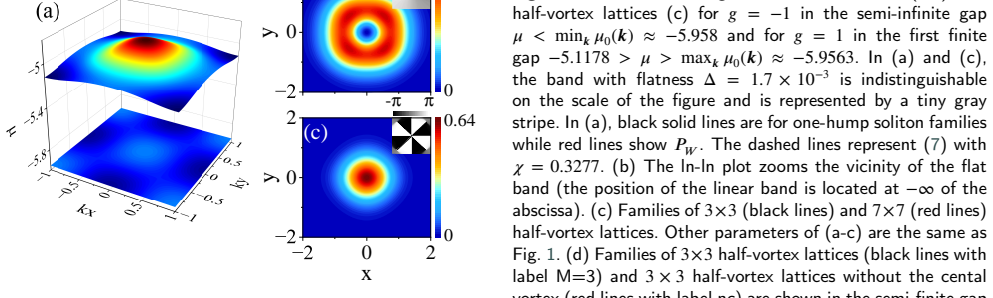
Yang, J., 2010. Nonlinear waves in integrable and nonintegrable systems. Society for Industrial and Applied Mathematics. C. Wang et al.:Preprint submitted to ElsevierPage 6 of 6 Half-vortex solitons /s8722 /s500 2 y0 0 .01(b)/s8722 /s500 2 /s8722/s500 2 yx 0 0 .64(c)- π π - π π Figure 1:(a) Two lowest bands of the Hamiltonian (2). The lowestbandatmax 𝒌 𝜇0...
work page 2010
discussion (0)
Sign in with ORCID, Apple, or X to comment. Anyone can read and Pith papers without signing in.