REVIEW 1 major objections 6 minor 6 references
The volume of marginally trapped submanifolds in a Lorentzian manifold satisfying the null energy condition
T0 review · 1 major / 6 minor · reviewed 2026-08-07 · deepseek-v4-flash
Pith's one-line read Every marginally trapped submanifold in a Lorentzian manifold satisfying the null energy condition is a local volume maximizer inside its canonically associated null-space.
desk verdict A clean, honestly-scoped extension of the author's earlier null-space volume result to NEC Lorentzian manifolds; the main theorem is very likely correct once a sign error in the Introduction is fixed. read the letter →
The pith
A machine-rendered reading of the paper's core claim, the machinery that carries it, and where it could break.
The reading
What carries the argument
The load-bearing object is the null-space $\mathcal{N}_f^{n+1}$ with map $\Phi_f(t,x)=\exp_{f(x)}(t\ell_+(x))$, inside which $f$ sits as $\{0\}\times\Sigma^n$. The argument runs through the second-variation identity for characteristic variations $X=\varphi\ell_+$: $$\frac{$d^{2}$}{$dt^{2}$}\mathrm{Vol}(t)\big|_{t=0}=-\int_\Sigma \$varphi^{2}$\left(\mathrm{tr}(A_+^2)+\mathrm{Ric}(\ell_+,\ell_+)\right)dV_0,$$ where $A_+$ is the shape operator in the $\ell_+$ direction. Marginal trappage gives $\mathrm{tr}(A_+)=0$, so $\mathrm{tr}(A_+^2)\ge 0$, and the null energy condition gives $\mathrm{Ric}(\ell_+,\ell_+)\ge 0$, forcing the second variation to be non-positive.
What would settle it
In Minkowski spacetime, take a compact piece of a non-flat minimal hypersurface with boundary, embed it as in Example 1.3(a), choose a nonzero bump function $\varphi$ vanishing on the boundary, and compute the second variation of volume for the null variation $X=\varphi(1,\nu)$; the theorem forces this to be $-\int_\Sigma\varphi^2\,\mathrm{tr}(A_+^2)\,dV\le 0$, so any direct computation yielding a positive value would refute Proposition 2.4.
Extended reading notes
Core claim
The paper's central claim is that if $M^{n+2}_1$ is light-like geodesically complete and satisfies $\mathrm{Ric}(X,X)\ge 0$ for light-like $X$, and if $f:\Sigma^n\to M^{n+2}_1$ is marginally trapped with respect to a global null normal $\ell_+$, then $f$ is a locally volume-maximizing hypersurface inside the null-space $\mathcal{N}_f^{n+1}=\mathbb{R}\times\Sigma^n$ obtained by exponentiating $\ell_+$. For every compactly supported variation of $f$ within $\mathcal{N}_f^{n+1}$, the first variation of volume is zero and the second variation is non-positive. The proof derives the second-variation identity for characteristic variations and then shows that every null-space variation can be reparametrized as a characteristic variation with the same volume function.
Load-bearing premise
The global theorem assumes a well-defined transverse pair of lightlike normal directions on the whole submanifold, but the definition of marginally trapped only guarantees one of them, so a twisted normal bundle could block the construction.
Editorial extensions
If this is right
- If the main theorem is correct, every marginally trapped surface in a four-dimensional NEC spacetime is a local volume maximizer inside its null-space, not only in the flat Minkowski examples.
- The second-variation operator for null-space variations is of order zero, so the stability condition is pointwise rather than a spectral problem.
- The theorem provides a variational characterization of marginally trapped submanifolds in arbitrary NEC Lorentzian manifolds, parallel to the classical theory of minimal and maximal submanifolds.
- The examples built from minimal hypersurfaces in Euclidean space, zero-mean-curvature hypersurfaces in Minkowski space, and mean-curvature-one hypersurfaces in hyperbolic and de Sitter spaces all fall under the theorem.
- Under NEC the null-space may have singular points away from the initial slice, but near $\{0\}\times\Sigma^n$ it is an immersion, so the local volume comparison is well defined.
Reading between the lines
- An extension left implicit is that the theorem is local in character: even when a global transverse null partner $\ell_-$ does not exist, the same argument should apply on any open set where a transverse null frame exists, making the volume-maximizing property a microlocal stability statement.
- Because the stability condition is pointwise, one could test whether marginally trapped submanifolds are isolated volume maxima among nearby variations that leave the null-space; extra terms in the full second-variation formula would then control whether maximality persists outside $\mathcal{N}_f$.
- The same formula offers a physical route to instability: if quantum or effective effects allow violations of the null energy condition, then $\mathrm{Ric}(\ell_+,\ell_+)$ can become negative at some points, and the second variation can turn positive, turning a marginally trapped surface into an unstable saddle of the volume functional.
Editorial analysis
A structured set of objections, weighed in public.
Referee Report
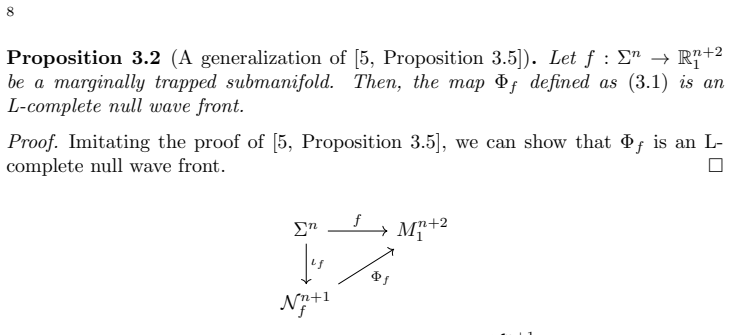
Summary. The paper studies marginally trapped spacelike submanifolds f: Σ^n → M^{n+2}_1 in Lorentzian manifolds. It constructs a null-space N_f^{n+1} = R × Σ via the exponential map along the null normal ℓ+, and claims that if M satisfies the null energy condition, then every compactly supported variation of f inside N_f has vanishing first variation and non-positive second variation, so f is locally volume-maximizing in N_f. The key analytic step is Proposition 2.4, which derives the formula d²/dt² Vol(t)|_{t=0} = −∫_Σ φ²(tr(A₊²) + Ric(ℓ+,ℓ+)) dV₀ for characteristic variations. Proposition 3.3 then identifies variations of f in N_f, up to equality of volume functions, with characteristic variations, and the main theorem follows from Propositions 2.2, 2.5, and 3.3.
Significance. If correct, the paper gives a genuine generalization of the author's earlier light-cone result to arbitrary Lorentzian manifolds satisfying the null energy condition. Proposition 2.4 is a substantial and clean result in itself: the second variation operator for characteristic variations of a marginally trapped submanifold is an operator of order zero, and the curvature contraction to Ric(ℓ+,ℓ+) is derived explicitly and checks out. The proof of the reduction Proposition 3.3 is mostly spelled out and the reliance on the published result [5, Proposition 3.8] is legitimate. The main theorem is falsifiable through the explicit formula (2.2). These strengths make the paper worth publishing once the statement-level sign error discussed below is corrected.
major comments (1)
- [Theorem in Introduction / Definition 1.5 / Proposition 2.5] The parenthetical definition of NEC in the theorem statement is inconsistent with Definition 1.5 and with Proposition 2.5. It says the Ricci tensor is 'non-positive along light-like directions', but Definition 1.5 correctly defines NEC by Ric(X,X) ≥ 0 for every null X. Formula (2.2) gives d²/dt² Vol(t)|_{t=0} = −∫_Σ φ²(tr(A₊²) + Ric(ℓ+,ℓ+)) dV₀, so the asserted non-positivity of the second variation follows only from Ric(ℓ+,ℓ+) ≥ 0. If the theorem were read literally with Ric ≤ 0, a Lorentzian metric with negative null Ricci would make the second variation positive, directly contradicting the theorem. This is a sign error in the statement, not in the computation; replace 'non-positive' with 'non-negative' or delete the parenthetical and refer to Definition 1.5.
minor comments (6)
- [Section 1.1, after Definition 1.1] The sentence 'Given a marginally trapped submanifold... we can take two global sections ℓ+, ℓ− satisfying (1.1)' is true, but it should be justified: once a global null ℓ+ is fixed, the complementary null direction in each normal fiber is unique, and normalizing it by ⟨ℓ+,ℓ−⟩ = −2 yields a smooth global section. The possible worry about a topological obstruction does not arise, but the text currently gives no explanation.
- [Proposition 2.4, proof] The two identities Σ_{i,j=1}^n ⟨∇_{e_i} X, e_j⟩⟨∇_{e_j} X, e_i⟩ = φ² tr(A₊²) and Σ_{i,j=1}^n ⟨∇_{e_i} X, e_i⟩⟨∇_{e_j} X, e_j⟩ = 0 are delegated to [5, Section 2]; a one-line derivation for each would make Proposition 2.4 fully self-contained.
- [Proposition 3.3, proof] The existence of δ such that α(t,·) is a diffeomorphism is attributed to '[5, Proposition 3.8]', but it follows immediately from α(0,·) = id and the inverse function theorem; adding this one-line justification would remove the only abbreviated step in an otherwise correct transfer.
- [Proposition 3.2] The proof of Proposition 3.2 consists only of 'imitating the proof of [5, Proposition 3.5]'. Since this proposition is not used in the proof of the main theorem, either give a complete argument or label it as an observation with a reference.
- [Theorem in Introduction / Section 3] The theorem speaks of compactly supported variations, while Proposition 3.3 is stated for a compact manifold with boundary and fixed boundary. The standard reduction, restricting a compactly supported variation to a compact submanifold with boundary and using a sufficiently small time interval, should be stated explicitly.
- [Throughout] There are minor language issues, e.g. 'vector filed' in Definition 1.1 and 'caluculate' in the first sentence of Section 2; a careful proofreading pass is recommended.
Circularity Check
No significant circularity: the central second-variation computation is performed in the paper itself, and the self-citations to [5] are independent technical lemmas rather than reductions.
full rationale
The paper's main claim is a generalization of the author's earlier light-cone result [5], but the derivation is not circular. Proposition 2.4 is a direct computation from the standard second-variation formula (2.1), using the explicit frame {(ℓ+ + ℓ−)/2, (ℓ+ − ℓ−)/2, e1, ..., en} and the definition of A+; the curvature-term calculation and the trace identities are shown in the text. Proposition 2.5 then follows immediately from (2.2) and Definition 1.5. Proposition 3.3 is initially stated as a generalization of [5, Proposition 3.8], but the paper provides its own proof sketch using the reparametrization α(t, ·) and the variation F(t, x) = exp_{f(x)}(τ(t, β(t, x))ℓ+(x)), so the cited prior work is not the only justification. The cited [5, Proposition 3.8] is an independent published result with its own proof, so this is not a circular reliance. The null-space N_f is defined independently of the volume-maximality conclusion, and the theorem is a genuine consequence of the computed formula and NEC. A separate, non-circular correctness issue is that the Introduction's parenthetical definition of NEC says 'non-positive along light-like directions,' which contradicts Definition 1.5 ('Ric(X,X) ≥ 0') and would reverse the sign in Proposition 2.5 if read literally; the theorem should say Ric ≥ 0. The concern about the global existence of ℓ− is also not an obstacle: once a global null ℓ+ is fixed, the null vector ℓ− is determined fiberwise by ⟨ℓ−, ℓ−⟩ = 0 and ⟨ℓ+, ℓ−⟩ = −2, so the frame used in Proposition 2.4 exists globally without extra topological assumptions. Overall, the derivation is self-contained apart from routine geometric algebra and an abbreviated but present proof of Proposition 3.3.
Assumptions & free parameters
assumptions (3)
- standard math First and second variation formulas for volume of a space-like submanifold under general variations (Proposition 2.3).
- standard math Reparametrization lemma from [5, Proposition 3.8]: variations in the null-space of a light-cone hypersurface can be rewritten as characteristic variations with equal volume.
- domain assumption Fact 1.6 (Akamine-Honda-Umehara-Yamada): a proper light-like immersion in a NEC Lorentzian manifold is totally geodesic.
invented entities (1)
-
The null-space N_f (an (n+1)-dimensional hypersurface with degenerate metric) associated to a marginally trapped submanifold f.
independent evidence
Cite this review
Pith. "Pith review of The volume of marginally trapped submanifolds in a Lorentzian manifold satisfying the null energy condition." pith.science (2026). https://pith.science/paper/4R6U4E4C
@misc{pith2026250607093,
  author       = {Pith},
  title        = {Pith review of: The volume of marginally trapped submanifolds in a Lorentzian manifold satisfying the null energy condition},
  year         = {2026},
  howpublished = {\url{https://pith.science/paper/4R6U4E4C}},
  note         = {Machine review of arXiv:2506.07093}
}
abstract
In this paper, we focus on a marginally trapped submanifold $f:\Sigma^n\to M^{n+2}_1$ in a Lorentzian manifold $M^{n+2}_1$. We show that $f$ lies in a certain null hypersurface $\mathcal{N}_f^{n+1}$ in $M^{n+2}_1$ and $f$ has a locally volume-maximizing property in $\mathcal{N}^{n+1}_f$ if $M^{n+2}_1$ satisfies the null energy condition.
Figures

Reference graph
Works this paper leans on
-
[5]
R. Kishida, The volume of conformally flat manifolds as hypersurfaces in the light-cone , Differential Geom. Appl. 96 (2024), 102173
work page 2024
-
[1]
S. Akamine, A. Honda, M. Umehara, and K. Yamada, Null hypersurfaces in Lorentzian manifolds with the null energy condition , J. Geom. Phys. 155 (2020), 103751, 6pp
work page 2020
-
[2]
S. Akamine, A. Honda, M. Umehara, and K. Yamada, Null hypersurfaces as wave fronts in Lorentz-Minkowski space, J. Math. Soc. Japan. 77 (2025), 1–30
work page 2025
-
[3]
L. Andersson and J. Metzger, Curvature estimates for stable marginally trapped surfaces , J. Differential Geom. 84 (2010), 231–265
work page 2010
-
[4]
A. Honda and S. Izumiya, The light-like geometry of marginally trapped surfaces in Minkowski space-time, J. Geom. 106 (2015), 185–210
work page 2015
-
[6]
R. Schoen and J. Wolfson, Minimizing area among Lagrangian surfaces: the mapping prob- lem, J. Differential Geom. 58 (2001), 1–86. (Riku Kishida) Department of Mathematical and Computing Sciences, Institute of Science Tokyo, Tokyo 152-8552, Japan Email address : kishida.r.1632@m.isct.ac.jp
work page 2001
Reviewed August 7, 2026 · model on record in the stance chip above.
Discussion (0). Sign in to comment.