REVIEW 3 major objections 5 minor 86 references
Ro-vibrational quenching calculations of C$_2^-$ in collision with H$_2$
T0 review · 3 major / 5 minor · reviewed 2026-08-12 · deepseek-v4-flash
Pith's one-line read A new five-dimensional potential surface for C2- + H2 changes the predicted quenching rates by one to two orders of magnitude and brings theory into agreement with experiment only when the final anion is in its lowest rotational state.
desk verdict A genuinely new 5D PES and state-resolved quenching rates for C2- + H2, but the paper's only agreement with the 20 K experiment comes from a final-state filter the authors themselves call nonphysical. read the letter →
The pith
A machine-rendered reading of the paper's core claim, the machinery that carries it, and where it could break.
The reading
What carries the argument
The load-bearing object is a new five-dimensional ab initio potential energy surface for C2-($X\,^2\Sigma_g^+$) + H2, built from 76,474 RCCSD(T)-F12 points and fitted by a (50,50,50) artificial neural network, with H2 frozen as a rigid rotor and C2- treated as a rotating-vibrating diatomic. The dynamics are run with close-coupled scattering using the vibrationally averaged coupling matrix elements $V_{\nu\nu'}(R)$ expanded in bispherical harmonics; the off-diagonal $V_{01}$ term is what drives the $\nu=1\to 0$ transition. What this machinery does is turn the question of how fast H2 quenches C2- vibration into a state-resolved statement about which final rotational states of the anion and of H2 are populated, which is exactly the information needed to compare with and interpret the trap experiment.
What would settle it
Measure the final rotational state distribution of C2-($\nu=0$) produced by H2 quenching in the trap, for example by state-selective photodetachment or photoelectron imaging after the quenching step. If a substantial population appears in $j_1'>0$ states, especially around $j_1'=6$, then the $j_1'=0$-only comparison is not the experimental channel and the claimed agreement would collapse; if the population is overwhelmingly $j_1'=0$, the agreement stands.
Extended reading notes
Core claim
On the paper's own terms, the central discovery is that realistic 5D dynamics reverses the earlier comparison with experiment: with H2 treated as a rigid rotor and the C2- bond allowed to vibrate, every rotationally summed quenching rate coefficient becomes larger than the earlier 3D results and larger than the measured 20 K point, often by one to two orders of magnitude. The purely vibrational channel that leaves C2- in $j_1'=0$ is the slowest of all the quenching paths, yet it is the one whose Boltzmann-averaged, ortho/para-weighted rate, about $5.0\times 10^{-13}$ cm$^3$ molecule$^{-1}$ s$^{-1}$ at 20 K, sits close to the experimental $4.0\times 10^{-13}$. The paper therefore claims that the state-resolved rates are trustworthy enough to identify which final rotational states are being populated, and that the experimental rate likely corresponds to a subset of final states rather than to the full rotationally summed rate.
Load-bearing premise
The whole agreement with experiment rests on assuming that the measured quenching rate counts only collisions that leave the C2- anion in its lowest rotational state $j_1'=0$, with no rotational excitation; the paper itself calls this choice nonphysical, and if the experiment actually collects anions in all final rotational states the computed rates overshoot the data by one to two orders of magnitude.
Editorial extensions
If this is right
- The full 5D rate coefficients for C2-($\nu=1$) quenching by H2 are one to two orders of magnitude larger than the earlier 3D values, so any future cooling model that uses the 3D rates will underestimate the vibrational quenching efficiency.
- para-H2 is a more efficient buffer-gas partner than ortho-H2 for cooling C2- vibration, whether or not the H2 rotor is excited during the collision.
- The state-resolved calculations identify which final rotational states of the anion are populated after quenching; the distribution peaks at $j_1'=6$ for initial $j_1=0$ and shifts to higher $j_1'$ for hotter initial states.
- If the experimental signal really comes from anions that end in $j_1'=0$, the computed 20 K rate of about $5.0\times 10^{-13}$ cm$^3$ molecule$^{-1}$ s$^{-1}$ matches the measured value, supporting the 5D surface and the close-coupling dynamics.
Reading between the lines
- If the final-state restriction turns out to be wrong and the experiment sums over all $j_1'$, then the paper's own numbers imply the measured 20 K rate should be one to two orders of magnitude larger than observed; that would point to a missing loss or detection channel in the experiment rather than to a failure of the surface.
- A direct test would be rotationally resolved detection of C2-($\nu=0$) after the quenching pulse; the computed state-to-state distributions predict specific peak final states, such as $j_1'=6$ for cold initial states, which a photoelectron or action spectrum could look for.
- The same 5D machinery, with C2- vibrational states extended beyond $\nu=1$, could supply the repumping-cycle rates needed to design closed laser-cooling schemes, since the bottleneck is knowing how fast each excited vibrational level is quenched by the buffer gas.
Editorial analysis
A structured set of objections, weighed in public.
Referee Report
Summary. The paper constructs a new five-dimensional ab initio potential energy surface for C2-(X2Σg+) + H2, treating H2 as a rigid rotor and C2- as a vibrating-rotating diatomic, and solves the quantum close-coupling scattering problem to obtain state-resolved ro-vibrational quenching cross sections and rate coefficients for both para- and ortho-H2. The authors compare the resulting vibrational de-excitation rates with the single experimental datum at 20 K from their earlier work. They report that the full 5D rates, summed over final anion rotational states, are one to two orders of magnitude larger than the measured value, and that agreement with experiment is recovered only when the final C2- is restricted to its ground rotational state j1'=0, an option they later label as nonphysical.
Significance. The new 5D PES and the state-to-state close-coupling results are a substantial step beyond the earlier 3D treatment and provide a useful resource for buffer-gas cooling and possibly astrochemical modeling of C2-. The paper is transparent about the numerical setup, reports convergence checks, and makes the fitting data available in the Supplementary Information. The state-resolved rate distributions in Figures 14-16 are potentially valuable for planning state-specific experiments. However, the central claim of quantitative agreement with the measured 20 K quenching rate is not supported, because it rests on a post hoc restriction of the final anion rotational state that the authors themselves call nonphysical and for which the experimental detection scheme provides no justification.
major comments (3)
- [Section IV.C, Figure 15, Section V] The only point of agreement with experiment is the dashed red curve in Figure 15, constructed by summing vibrationally quenched final states with j1'=0 only. The authors state in Section IV.B that the experiments of Ref. [52] were not observing which rotational states are populated after the anion decays to its nu=0 level, and in Section V they call the j1'=0 restriction 'a nonphysical option.' The measured vibrational quenching rate is therefore an inclusive observable over all final C2- rotational states. When the fully summed 5D rate coefficients are used, as shown by the solid curves in Figure 15, they exceed the measured 20 K point by one to two orders of magnitude. The closeness of the reported 5.0e-13 cm3 molecule-1 s-1 to the experimental 4.0e-13 cm3 molecule-1 s-1 is thus a consequence of selecting the one final channel that matches the measurement. This is a load-bearing issue for the central claim of the paper, and it needs to be resolved either by providing an experimental or physical justification for why the detection is blind to j1'>0 final states, or by removing the agreement claim and reporting the computed state-resolved and summed rates without claiming validation by the experiment.
- [Section III, vibrational convergence discussion] The manuscript states that 'the vibrationally inelastic cross sections remained reasonably consistent and thus our R range is sufficiently large to obtain cross sections which are to the correct order of magnitude.' This convergence criterion is insufficient for the quantitative comparison made in Section IV.C, where the claimed agreement is a factor of about 1.25 (5.0e-13 versus 4.0e-13 cm3 molecule-1 s-1). The authors should provide quantitative convergence tests for the specific nu=1, j1=0 to nu'=0, j1'=0 channel, including convergence with respect to the number of propagator steps, R_max, and the size of the angular basis, rather than an order-of-magnitude consistency statement.
- [Section IV.C, unnumbered equation after Eq. (16)] The equation defining k_{nu->nu'}(T) appears malformed: it begins with '1P' and contains unbalanced parentheses and unclear placement of the degeneracy and Boltzmann factors. Since this equation underlies the construction of the thermally averaged and state-restricted curves in Figure 15, the authors must rewrite it clearly so that the averaging procedure is unambiguous and reproducible.
minor comments (5)
- [Section II.A and Section III] The maximum radial distance for the ab initio points is given as 25.0 Å in Section II but as 41 Å in Section III; please clarify which value is correct and how this affects the long-range switching at R0 = 20.5 Å.
- [Section II.B] In the text following Eq. (5), references to 'eq.(2)' and 'eq.(4)' appear to be misnumbered; the potential expansion is Eq. (5) and the bi-spherical harmonics are defined in Eq. (6). Please correct the cross-references.
- [Figure 15 caption and main text] The caption of Figure 15 and the discussion in Section IV.C describe the red and purple curves in opposite ways: the caption attributes the j2'=2 para-H2 excitation to the purple curve and the anion-only rotational channels to the red curve, while the main text says the red curve involves concurrent para-H2 rotational excitation and the purple curve involves only anion rotational states. These statements need to be reconciled.
- [Section IV.C, Figure 15] The experimental point is shown without an uncertainty estimate; because the claimed agreement is quantitative, the authors should report the experimental error bar and state explicitly whether the agreement is within that uncertainty.
- [Section IV.C] The numerical values of the fully summed 5D rate coefficients and of the j1'=0-restricted rate at 20 K are only given in the text for the restricted case; a small table listing the summed rates for para-, ortho-, and the 3:1 weighted average at 20 K would make the comparison transparent.
Circularity Check
No circular derivation: the 5D rates are obtained from a new ab initio PES and coupled-channel scattering, while the experiment-matching j1'=0 comparison is a transparent post-selection rather than a fitted input.
full rationale
The derivation is self-contained: the 5D PES is computed from new RCCSD(T)-F12 ab initio points, fitted by a neural network, and the ro-vibrational quenching rates follow from coupled-channel scattering with no parameter adjusted to the experimental point. The vibrational coupling matrix elements, basis-set convergence, and long-range extrapolation are checked internally and against the authors' earlier 3D surface, so the self-citations to Refs. [49], [51], and [52] provide benchmarks rather than load-bearing circular support; no uniqueness theorem or ansatz is imported from the authors' prior work. The one concerning comparison step is the dashed red curve of Fig. 15, which is obtained by restricting the final anion to j1'=0; the paper itself states this is 'deemed to be a nonphysical option' and that the fully summed 5D rates are one to two orders of magnitude above the single 20 K experimental point. This is a post-hoc selection effect that weakens the claimed agreement, but it is not a circular derivation: the numerical rates are computed independently, the restriction is not fitted to the data, and the paper explicitly reports the inclusive rates as well. Hence there is no significant circularity; the main risk is the validity of the comparison, not self-referential reasoning.
Assumptions & free parameters
free parameters (3)
- ANN switching parameters for long-range merge =
R0 = 20.5 Å, Δx = 0.5 Å
- Angular constraint conditions for large r1 =
e.g., if r>=1.38 Å and θ<=25° then θ=25°; if r>1.4 Å and θ<=50° then θ=50°; if R<=3.0 Å then R=3.0 Å
- Final-state channel selection for experimental comparison =
Only final j1'=0 states; weighted sum 3/4 ortho + 1/4 para
assumptions (6)
- standard math Coupled-channel Schrödinger equation with the interaction potential defines the scattering dynamics
- standard math Born-Oppenheimer separation and a single electronic PES for the ground states of C2- and H2
- domain assumption The H2 vibrational coordinate is frozen (rigid rotor approximation for H2)
- domain assumption C2- is treated as a pseudo-singlet, ignoring fine-structure/spin-rotation coupling
- domain assumption The initial ν=1 rotational distribution of C2- in the trap is Boltzmann at 20 K
- ad hoc to paper The experimental quenching signal corresponds to final anions in j1'=0 only
Cite this review
Pith. "Pith review of Ro-vibrational quenching calculations of C$_2^-$ in collision with H$_2$." pith.science (2026). https://pith.science/paper/4R7JATJV
@misc{pith2026241116137,
  author       = {Pith},
  title        = {Pith review of: Ro-vibrational quenching calculations of C$_2^-$ in collision with H$_2$},
  year         = {2026},
  howpublished = {\url{https://pith.science/paper/4R7JATJV}},
  note         = {Machine review of arXiv:2411.16137}
}
abstract
The molecular anion C$_2^-$ has been of interest in the last few years as a candidate for laser cooling due to its electronic structure and favourable branching ratios to the ground electronic and vibrational state. Molecular hydrogen has been used by the Wester group in Innsbruck as a buffer gas to cool the molecule's internal ro-vibrational motion. In the present work, we generate a new, five dimensional (5D) interaction potential for the system by considering the H$_2$ as a rigid rotor and the C$_2^-$ as a rotating-vibrating diatomic molecule. We thereafter calculate the cross sections and rate coefficients for ro-vibrational inelastic collisions of C$_2^-$ with both para- and ortho-H$_2$ on this new 5D \textit{ab initio} potential energy surface using quantum scattering theory for the dynamics. The rates for vibrational quenching are obtained over the range of temperatures which covers the single value measured by the experiments. A comparison is also made with the earlier results using a simpler 3D interaction potential. Furthermore, para-H$_2$ is found to be more efficient than ortho-H$_2$ (with or without undergoing rotational excitation) in cooling C$_2^-$. The rate coefficients for cooling the anions has been computed by appropriately weighting the ortho- and para-H$_2$ and compared with the available experimental result at 20 K. When the vibrational de-excitation rate coefficients are taken to be the ones not causing any concurrent rotational excitations in the final C$_2^-$ anions, the properly averaged results are found to get smaller and to become very close to the experimental measurements. The implications of these new results for laser cooling of C$_2^-$ are analyzed and discussed.
Figures


Figures from the paper (12 more)




Reference graph
Works this paper leans on
-
[52]
The labeling within each panel refers only to the initial and final rotational states of the molecular anion before and after its vibrational cooling
(green curves).The collision partner is the para-H 2 neu- tral molecule. The labeling within each panel refers only to the initial and final rotational states of the molecular anion before and after its vibrational cooling. The upper set in- volves transitions between the lowest four levels, while the lower set shows transitions to four higher levels. See...
-
[1]
On the other hand, we have included the dynamics of concurrent rotational excitations of the H 2 partner in some of our calculations. The potential energy values for the system were calcu- lated using the restricted coupled clusters singles, dou- bles and perturbative triples (RCCSD(T)-F12) method [55, 56], including relativistic corrections [57]. An aug-...
-
[2]
Additionally, all three multi-polar coefficients of the V λ 01(R) matrix element are steeply re- pulsive as R decreases
We notice, first of all, that all the terms in the lower panel quickly approach zero as R is increased, indicating the essentially short-range na- ture of the vibrational coupling matrix elements between the two lower levels. Additionally, all three multi-polar coefficients of the V λ 01(R) matrix element are steeply re- pulsive as R decreases. The solid ...
-
[3]
H. Loh, K. C. Cossel, M. C. Grau, K. K. Ni, E. R. Meyer, J. L. Bohn, J. Ye, and E. A. Cornell, Precision spec- troscopy of polarized molecules in an ion trap, Science 342, 1220 (2013)
work page 2013
-
[4]
+ H2(j’ 2 = 0) Cross section (Å2) 5D 3D 0 → 2 10−4 10−3 10−2 10−1 100 101 10−1 100 101 102 103 0 → 4 100 101 102 103 0 → 6 Collision Energy/cm−1 10−4 10−3 10−2 10−1 100 101 102 0 → 8 Cross section (Å2) 5D 3D 0 → 10 10−4 10−3 10−2 10−1 100 101 10−1 100 101 102 103 0 → 12 100 101 102 103 0 → 14 Collision Energy/cm−1 FIG. 6. Comparison of computed rotational...
-
[5]
P. Yzombard, M. Hamamda, S. Gerber, M. Doser, and D. Comparat, Laser cooling of molecular anions, Phys. Rev. Lett. 114, 213001 (2015)
work page 2015
-
[6]
Finally, the lower set of panels indicates j1 = 4 as the initial state of all the transitions shown. The following comments can be made from a perusal of these results: (i) the cross sections in the upper panels are all uni- formly larger than those where the initial state of the anion becomes higher: j1 = 2 and 4 in the middle and lower panels, respectiv...
-
[7]
+ H2(j’ 2 = 0) 0 0.5 1 0 2 4 6 8 10 12 14 16 18 20 Ecoll=20 cm−1 Cross section (Å2) 0 0.25 0.5 0 2 4 6 8 10 12 14 16 18 20 Ecoll=30 cm−1 j’ 1 0.5 1.5 2.5 0 2 4 6 8 10 12 14 16 18 20 Ecoll=10 cm−1 C− 2(v1 = 1, j1 = 2) + H2(j2 = 0)→ C2 − (v’ 1 = 0, j’
Show all 86 references
-
[8]
+ H2(j’ 2 = 0) 0 0.5 1 0 2 4 6 8 10 12 14 16 18 20 Ecoll=20 cm−1 Cross section (Å2) 0 0.25 0.5 0 2 4 6 8 10 12 14 16 18 20 Ecoll=30 cm−1 j’ 1 0.5 1.5 2.5 0 2 4 6 8 10 12 14 16 18 20 Ecoll=10 cm−1 C− 2(v1 = 1, j1 = 4) + H2(j2 = 0)→ C2 − (v’ 1 = 0, j’
-
[9]
+ H2(j’ 2 = 0) 0 0.5 1 0 2 4 6 8 10 12 14 16 18 20 Ecoll=20 cm−1 Cross section (Å2) 0 0.25 0.5 0 2 4 6 8 10 12 14 16 18 20 Ecoll=30 cm−1 j’ 1 FIG. 7. Computed inelastic cross sections as those given in Figure 6, but here presented as vertical bars for each final rotational sta...
-
[10]
+ H2(j’ 2 = 0/1) Cross section (Å2) ortho para 0 → 2 10−4 10−3 10−2 10−1 100 101 10−1 100 101 102 103 0 → 4 100 101 102 103 0 → 6 Collision Energy/cm−1 10−4 10−3 10−2 10−1 100 101 102 0 → 8 Cross section (Å2) ortho para 0 → 10 10−4 10−3 10−2 10−1 100 101 10−1 100 101 102 103 0...
-
[11]
+ H2(j’ 2 = 0) k(cm3 molecule−1 s−1) 5D 3D 0 → 2 0x100 3x10⁻¹² 6x10⁻¹² 9x10⁻¹² 5 20 40 60 80 0 → 4 5 20 40 60 80 100 0 → 6 T(K) 3x10⁻¹² 6x10⁻¹² 9x10⁻¹² 0 → 8 k(cm3 molecule−1 s−1) 5D 3D 0 → 10 0x100 3x10⁻¹² 6x10⁻¹² 9x10⁻¹² 5 20 40 60 80 0 → 12 5 20 40 60 80 100 0 → 14 T(K) FIG...
-
[12]
+ H2(j’ 2 = 0) k(cm3 molecule−1 s−1) T(K) 0 2 4 6 8 10 12 14 16 18 20 10−13 10−12 10−11 5 20 40 60 80 100 C− 2(v1 = 1, j1 = 0) + H2(j2 = 1) → C2 − (v’ 1 = 0, j’
-
[13]
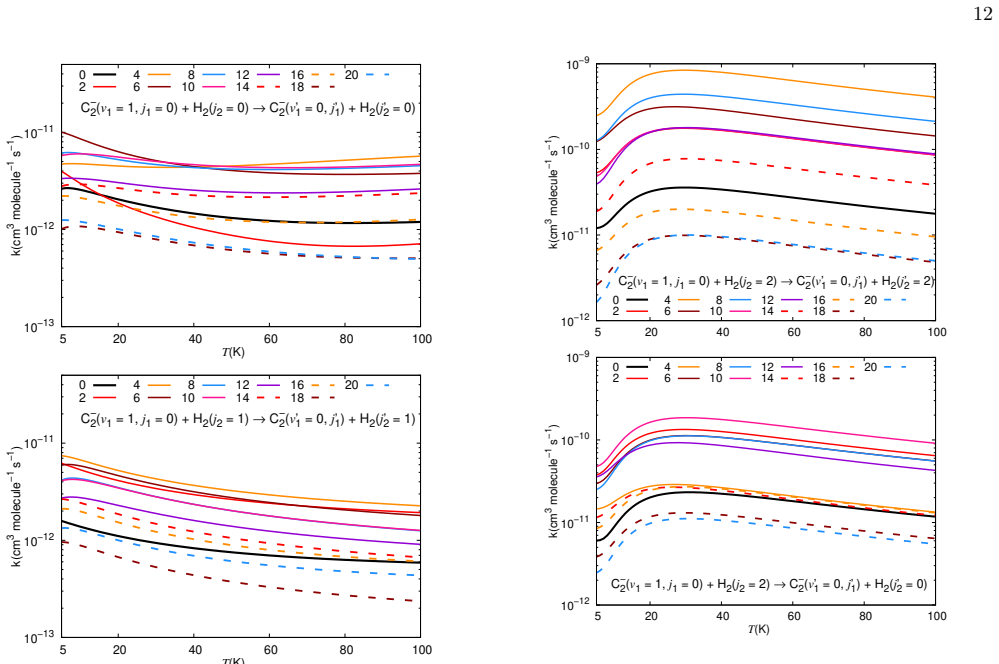
+ H2(j’ 2 = 1) k(cm3 molecule−1 s−1) T(K) 0 2 4 6 8 10 12 14 16 18 20 FIG. 10. The upper panel reports (5D) computed rate co- efficients for inelastic processes involving only the molecular anion and with the para-H2 as a partner, while the lower panel reports the same process...
-
[14]
+ H2(j’ 2 = 2) k(cm3 molecule−1 s−1) 0 2 4 6 8 10 12 14 16 18 20 10−12 10−11 10−10 10−9 5 20 40 60 80 100 C− 2(v1 = 1, j1 = 0) + H2(j2 = 2) → C2 − (v’ 1 = 0, j’
-
[15]
+ H2(j’ 2 = 0) k(cm3 molecule−1 s−1) T(K) 0 2 4 6 8 10 12 14 16 18 20 FIG. 11. The upper panel reports (5D) computed rate coef- ficients for inelastic processes involving the molecular anion, with the rotational states changing up to j′ 1 = 20, while the para-H2 partner remain...
-
[16]
+ H2(j’ 2 = 3) k(cm3 molecule−1 s−1) T(K) 0 2 4 6 8 10 12 14 16 18 20 10−13 10−12 10−11 5 20 40 60 80 100 C− 2(v1 = 1, j1 = 0) + H2(j2 = 0) → C2 − (v’ 1 = 0, j’
-
[17]
+ H2(j’ 2 = 2) k(cm3 molecule−1 s−1) T(K) 0 2 4 6 8 10 12 14 16 18 20 FIG. 12. The upper panel reports (5D) computed rate coef- ficients for inelastic processes involving the molecular anion with the concurrent rotational excitation of the ortho-H2 as a partner, while the lowe...
-
[18]
+ H2(j’ 2 = 0/1) k(cm3 molecule−1 s−1) ortho para 0 → 2 0x100 3x10⁻¹² 6x10⁻¹² 9x10⁻¹² 5 20 40 60 80 0 → 4 5 20 40 60 80 100 0 → 6 T(K) 3x10⁻¹² 6x10⁻¹² 9x10⁻¹² 0 → 8 k(cm3 molecule−1 s−1) ortho para 0 → 10 0x100 3x10⁻¹² 6x10⁻¹² 9x10⁻¹² 5 20 40 60 80 0 → 12 5 20 40 60 80 100 0 →...
-
[19]
10−14 10−13 10−12 10−11 10−10 5 20 40 60 80 100 C− 2(v1 = 1, j1) + H2(j2 = 0/1) → C2 − (v’ 1 = 0, j’
and reported with the present computed findings by the curves given by Figure 15. 10−14 10−13 10−12 10−11 10−10 5 20 40 60 80 100 C− 2(v1 = 1, j1) + H2(j2 = 0/1) → C2 − (v’ 1 = 0, j’
-
[20]
+ H2(j’ 2) k(cm3 molecule−1 s−1) T(K) 5D(j1=0−8, j2=0, j’ 1 ≥ 0, j’ 2=0) 5D(j1=0−8, j2=0, j’ 1 ≥ 0, j’ 2=2) 5D(j1=0−8, j2=1, j’ 1 ≥ 0, j’ 2=1) 5D(j1=0−8, j2=1, j’ 1 ≥ 0, j’ 2=3) 3D(j1=0−8, j’ 1 ≥ 0) 5D(j1=0,2,4; j2=0,1; j’ 1=0, j’ 2=0,1; avg) Experiment FIG. 15. Computed rate ...
-
[21]
Tarbutt, Laser cooling of molecules, Contemp
M. Tarbutt, Laser cooling of molecules, Contemp. Phys. 59, 356 (2018)
2018
-
[22]
Barry, D
J. Barry, D. McCarron, E. Norrgard, M. Steinecker, and D. DeMille, Magneto-optical trapping of a diatomic 18 molecule, Nature 512, 286 (2014)
2014
-
[23]
E. d. Beer, Y. Zhao, I. Yourshaw, and D. M. Neumark, Stimulated raman pumping of C− 2 probed via two-photon detachment, Chem. Phys. Lett. 244, 400 (1995)
1995
-
[24]
A. D. D¨ orfler, P. Eberle, D. Koner, M. Tomza, M. Meuwly, and S. Willitsch, Long-range versus short- range effects in cold molecular ion-neutral collisions, Nat. Commun. 10, 5429 (2019)
2019
-
[25]
A. E. Bragg, R. Wester, A. V. Davis, A. Kammrath, and D. M. Neumark, Excited-state detachment dynamics and rotational coherences of C − 2 via time-resolved photoelec- tron imaging, Chem. Phys. Lett. 376, 767 (2003)
2003
-
[26]
Shan-Shan, Y
Y. Shan-Shan, Y. Xiao-Hua, L. Ben-Xi, K. Kakule, W. Sheng-Hai, G. Ying-Chun, L. Yu-Yan, and C. Yang- Qin, Study of hot bands in the B2Σ+ u -X 2Σ+ g system of C− 2 anion, Chinese Phys. 12, 745 (2003)
2003
-
[27]
da Silva, Ramon, Transition probabilities and radia- tive lifetimes of C− 2 :a high level theoretical investigation, J.Quant
S. da Silva, Ramon, Transition probabilities and radia- tive lifetimes of C− 2 :a high level theoretical investigation, J.Quant. Spectr. Rad. Trans. 321, 109000 (2024)
2024
-
[28]
W. Shi, C. Li, H. Meng, J. Wei, L. Deng, and C. Yang, Ab initio study of the low-lying electronic states of the C− 2 anion, Comput. Theor. Chem. 1079, 57 (2016)
2016
-
[29]
Fesel, S
J. Fesel, S. Gerber, M. Doser, and D. Comparat, Optical dipole-force cooling of anions in a penning trap, Phys. Rev. A 96, 031401(R) (2017)
2017
-
[30]
Gerber, J
S. Gerber, J. Fesel, M. Doser, and D. Comparat, Photodetachment and doppler laser cooling of anionic molecules, New J. Phys. 20, 023024 (2018)
2018
-
[31]
Ahmadi et al., Observation of the 1s-2s transition in trapped antihydrogen, Nature 541, 506 (2017)
M. Ahmadi et al., Observation of the 1s-2s transition in trapped antihydrogen, Nature 541, 506 (2017)
2017
-
[32]
Perez and Y
P. Perez and Y. Sacquin, The gbar experi- ment:gravitational behaviour of antihydrogen at rest, Class. Quantum. Grav. 29, 184008 (2012)
2012
-
[33]
Herzberg and A
G. Herzberg and A. Lagerqvist, A new spectrum associ- ated with diatomic carbon, Can. J. Phys.46, 2363 (1968)
1968
-
[34]
E. D. Milligan and M. E. Jacox, Studies of the Photo- production of the Electrons in Inert Solid Matrices. The Electronic Spectrum of the Species C − 2 , J. Chem. Phys 51, 1952 (1969)
1969
-
[35]
R. P. Frosch, C 2 and C − 2 Spectra Produced by the X Irradiation of Acetylene in Rare-Gas Matrices, J. Chem. Phys. 54, 2660 (1971)
1971
-
[36]
W. C. Lineberger and T. A. Patterson, Two Photon Photdetachment Spectroscopy: The C − 2 Σ States, Chem. Phys. Lett. 13, 40 (1972)
1972
-
[37]
P. L. Jones, R. D. Mead, B. E. Kohler, S. D. Rosner, and W. C. Lineberger, Photodetachment spectroscopy of C− 2 autodetaching resonances, J. Chem. Phys. 73, 4419 (1980)
1980
-
[38]
Leutwyler, J
S. Leutwyler, J. P. Maier, and L. Misev, Lifetimes of C − 2 in rotational levels of the B2Σ+ u state in the gas phase, Chem. Phys. Lett. 91, 206 (1982)
1982
-
[39]
R. D. Mead, U. Hefter, P. A. Schulz, and W. C. Lineberger, Ultrahigh resolution spectroscopy of C − 2 : The A2Πu state characterized by deperturbation meth- ods, J. Chem. Phys. 82, 1723 (1985)
1985
-
[40]
B. D. Rehfuss, D.-J. Liu, B. M. Dinelli, M.-F. Jagod, W. C. Ho, M. W. Crofton, and T. Oka, Infrared spec- troscopy of carbo-ions, IV. The A2Πu − X 2Σ+ g electronic transition of C − 2 , J. Chem. Phys 89, 129 (1988)
1988
-
[41]
K. M. Ervin and W. C. Lineberger, Photoelectron Spec- tra of C − 2 and C2H−, J. Phys. Chem. 95, 1167 (1991)
1991
-
[42]
Royen and M
P. Royen and M. Zackrisson, Spin-Splitting Analysis of the B2Σ+ u (ν = 0) State of C− 2 , Using Velocity Modulation Laster Spectroscopy, J. Mol. Spectrosc. 155, 427 (1992)
1992
-
[43]
Wallerstein, A Search for C − 2 in the Hydrogen-poor Carbon Star HD 182040, Astron
G. Wallerstein, A Search for C − 2 in the Hydrogen-poor Carbon Star HD 182040, Astron. Astrophys. 105, 219 (1982)
1982
-
[44]
H. B. Pedersen, C. Brink, A. L. H, N. Bjerre, P. Hvelplund, D. Kella, and H. Shen, Experimental in- vestigation of radiative lifetimes of vibrational levels at the electronic ground state of C − 2 , J. Chem. Phys. 464, 5849 (1998)
1998
-
[45]
Wester, Radiofrequency multipole traps: Tools for spectroscopy and dynamics of cold molecular ions, J
R. Wester, Radiofrequency multipole traps: Tools for spectroscopy and dynamics of cold molecular ions, J. Phys. B 42, 154001 (2009)
2009
-
[46]
Nakajima, Observation of the X 2Σ+ g (ν = 4 − 6) levels of C− 2 , J
M. Nakajima, Observation of the X 2Σ+ g (ν = 4 − 6) levels of C− 2 , J. Mol. Spectrosc. 331, 106 (2017)
2017
-
[47]
E. S. Endres, O. Lakhmanskaya, D. Hauser, S. E. Huber, T. Best, S. S. Kumar, M. Probst, and R. Wester, Upper Limits to the Reaction Rate Coefficients of C− n and CnH− (n = 2, 4, 6) with Molecular Hydrogen, J. Phys. Chem. A 118, 6705 (2014)
2014
-
[48]
Barsuhn, Nonempirical calculations on the electronic spectrum of the molecular ion C − 2 , J
J. Barsuhn, Nonempirical calculations on the electronic spectrum of the molecular ion C − 2 , J. Phys. B: At., Mol. Opt. Phys 7, 155 (1974)
1974
-
[49]
Zeitz, S
M. Zeitz, S. D. Peyerimhoff, and R. J. Buenker, A The- oretical Study of the Bound Electronic States of the C − 2 Negative Ion, Chem. Phys. Lett. 64, 243 (1979)
1979
-
[50]
Dupuis and B
M. Dupuis and B. Liu, Theoretical study of C 2 and C− 2 , J. Chem. Phys. 73, 337 (1980)
1980
-
[51]
Rosmus and H.-J
P. Rosmus and H.-J. Werner, Multireference-CI calcula- tions of radiative transition probabilities in C− 2 , J. Chem. Phys. 80, 5085 (1984)
1984
-
[53]
J. A. Nichols and J. Simons, Theoretical study of c 2 and c− 2 :X 1Σ+ g , a3Πu, X2Σ+ g , and B2Σ+ u potentials, J. Chem. Phys. 86, 6972 (1987)
1987
-
[54]
J. D. Watts and R. J. Bartlett, Coupled-cluster calcual- tions on the C 2 molecule and the C + 2 and C − 2 molecular ions, J. Chem. Phys. 96, 6073 (1992)
1992
-
[55]
˘Sedivcov´ a and V.˘Spirko, Potential energy and tran- sition dipole moment functions of C − 2 , Mol
T. ˘Sedivcov´ a and V.˘Spirko, Potential energy and tran- sition dipole moment functions of C − 2 , Mol. Phys. 104, 1999 (2006)
2006
-
[56]
M. Kas, J. Loreau, J. Li´ evin, and N. Vaeck, Cold reactive and nonreactive collisions of Li and Rb with C − 2 : Impli- cations for hybrid-trap experiments, Phys. Rev. A 99, 042702 (2019)
2019
-
[57]
Gulania, T.-C
S. Gulania, T.-C. Jagau, and A. I. Krylov, EOM-CC guide to Fock-space travel: the C 2 edition, Farady Dis- cuss. 217, 514 (2019)
2019
-
[58]
D. L. Lambert, Y. Sheffer, and S. R. Federman, Hubble Space Telescope Observations of C2 Molecules in Diffuse Interstellar Clouds, Astrophys J. 438, 740 (1995)
1995
-
[59]
D. L. Lambert, Y. Sheffer, A. C. Danks, C. Arpigny, and P. Magain, High-Resolution Spectroscopy of the C2 Swan 0-0 Band from Comet P/Halley, Astrophys J. 353, 640 (1990)
1990
-
[60]
S. P. Souza and B. L. Lutz, Detection of C 2 in the Inter- stellar Spectrum of Cygnus OB2 Number 12 (VI Cygni Number 12), Astrophys J. 216, L49 (1977)
1977
-
[61]
D. L. Lambert, B. Gustafsson, K. Eriksson, and K. H. Hinkle, The Chemical Composition of Carbon Stars. 1. Carbon, Nitrogen and Oxygen in 30 Cool Carbon Stars in the Galactic Disk, Astrophys J. Suppl. Ser. 62, 373 19 (1986)
1986
-
[62]
M. S. Vardya and K. S. Krishna Swamy, Can Lines of C− 2 be Observed in Carbon Stars?, Chem. Phys. Lett. 73, 616 (1980)
1980
-
[63]
Fa¨ y and H
T. Fa¨ y and H. R. Johnson, A Search For C− 2 in Spectra of HD201626 and the Sun, PASP 84, 284 (1972)
1972
-
[64]
Civi˘ s, Y
S. Civi˘ s, Y. Hosaki, E. Kagi, H. Izumiura, K. Yanagisawa, T. ˘Sedivcov´ a, and K. Kawaguchi, Search for C− 2 in Diffuse Clouds, Publ. Astron. Soc. Japan 57, 605 (2005)
2005
-
[65]
L´ opez-Dur´ ann, E
D. L´ opez-Dur´ ann, E. Bodo, and F. A. Gianturco, Aspin: An all spin scattering code for atom-molecule rovibra- tionally inelastic cross sections, Comput. Phys. Commun. 179, 821 (2008)
2008
-
[66]
The potential energy was calculated to generate the V λ1,λ2,λ νν ′ (R) values using our long-range correction dis- cussed earlier and then employed directly as such within the TwoBC code employed in our calculations [63]. Our ab initio calculated interaction energies were comp...
-
[67]
F. A. Gianturco, L. Gonz´ alez-S´ anchez, B. P. Mant, and R. Wester, Modelling state-selective photodetachment in cold ion traps: Rotational state ”crowding” in small an- ions, J. Chem. Phys. 151, 144304 (2019)
2019
-
[68]
Hinterberger, S
A. Hinterberger, S. Gerber, E. Oswald, C. Zimmer, J. Fe- sel, and M. Doser, Trapping of C − 2 in a digital ion trap, J. Phys. B: At. Mol. Opt. Phys. 52, 225003 (2019)
2019
-
[69]
A. K. Hansen, O. O. Versolato, L. K losowski, S. B. Kris- tensen, A. Gingell, M. Schwarz, K. Windberer, K. Ull- rich, J. R. Crespo L´ opez-Urrutia, and M. Drewsen, Effi- cient rotational cooling of coulomb-crystallized molecular ions by a helium buffer gas, Nature 508, 76 (2014)
2014
-
[70]
B. P. Mant, F. A. Gianturco, L. Gonz´ alez-S´ anchez, E. Yurtsever, and R. Wester, Rotationally inelastic processes of C − 2 (2Σ+ g ) colliding with He( 1S) at low- temperatures: Ab Initio interaction potential, state- changing rates and kinetic modelling, J. Phys. B: At. Mol....
2020
-
[71]
B. P. Mant, F. A. Gianturco, R. Wester, E. Yurtsever, and L. Gonz´ alez-S´ anchez, Thermalization of C− 2 with no- ble gases in cold ion traps, Int. J. Mass Spectrom. 457, 116426 (2020)
2020
-
[72]
B. P. Mant, F. A. Gianturco, L. Gonz´ alez-S´ anchez, E. Yurtsever, and R. Wester, Rovibrational quenching of C − 2 anions in collisions with He, Ne and Ar atoms., Phys. Rev.A 102, 062810 (2020)
2020
-
[73]
Noetzold, R
M. Noetzold, R. Wild, C. Lochmann, T. Rahim, S. P. Melath, K. Dulity, B. Mant, J. Franz, F. Gianturco, and R. Wester, Vibrational quenching of optically pumped carbon dimer anions, Phys.Rev.Lett. 131, 183002 (2023)
2023
-
[74]
Werner, P
H.-J. Werner, P. J. Knowles, G. Knizia, F. R. Manby, and M. Sch¨ utz, Molpro: a general-purpose quantum chem- istry program package, WIREs Comput. Mol. Sci. 2, 242 (2012)
2012
-
[75]
Werner, P
H.-J. Werner, P. J. Knowles, G. Knizia, F. R. Manby, M. Sch¨ utz,et al. , Molpro, version 2019.2, a package of ab initio programs (2019), see https://www.molpro.net
2019
-
[76]
H. J. Werner and P. J. Knowles, A second order multi- configuration scf procedure with optimum convergence, J. Chem. Phys. 82, 5053 (1985)
1985
-
[77]
P. J. Knowles and H. J. Werner, An efficient second-order mc scf method for long configuration expansions, Chem. Phys. Lett. 115, 259 (1985)
1985
-
[78]
K. R. Shamasundar, G. Knizia, and H.-J. Werner, A new internally contracted multi-reference configuration inter- action method, J. Chem. Phys. 135, 053101 (2011)
2011
-
[79]
R. A. Kendall, T. H. Dunning Jr, and R. J. Harrison, Electron affinities of the first-row atoms revisited. sys- tematic basis sets and wave functions, J. Chem. Phys. 96, 6796 (1992)
1992
-
[80]
Behler, Four generations of high-dimensional neural network potentials, Chem
J. Behler, Four generations of high-dimensional neural network potentials, Chem. Rev. 121, 10037 (2021)
2021
-
[81]
K¨ aser, L
S. K¨ aser, L. I. Vazquez-Salazar, M. Meuwly, and K. T¨ opfer, Neural network potentials for chemistry: con- cepts, applications and prospects, Digital Discovery 2, 28 (2023)
2023
-
[82]
Fu and D
B. Fu and D. H. Zhang, Accurate fundamental invariant- neural network representation of ab initio potential en- ergy surfaces, Natl. Sci. Rev. 10, 321 (2023)
2023
-
[83]
Gonz´ alez-S´ anchez, A
L. Gonz´ alez-S´ anchez, A. M. Veselinova, M. Santa Dar ´ ıa, E. Yurtsever, R. Biwas, K. Giri, N. Sathyamurthy, U. Lourderaj, R. Wester, and F. A. Gianturco, Computed rotational rate coefficients for recently detected anionic cyanopolyynes, ApJ 960, 40 (2024)
2024
-
[84]
R. V. Krems, Twobc:a quantum scattering program, Uni- versity of British Columbia V ancouver, Canada (2006)
2006
-
[85]
A. M. Arthurs and A. Dalgarno, The theory of scattering by a rigid rotator, Proc. R. Soc. A 256, 540 (1960)
1960
-
[86]
D. E. Manolopoulos, An improved log derivative method for inelastic scattering, J. Chem. Phys. 85, 6425 (1986). 20 Supplementary Information for Ro-vibrational quenching calculations of C2- in collision with H2 Kousik Giri Department of Computational Sciences, Central Universi...
1986
Reviewed August 12, 2026 · model on record in the stance chip above.
Discussion (0). Continue with ORCID to comment.