REVIEW 3 major objections 5 minor 1 cited by
Energy Efficient Federated Learning with Hyperdimensional Computing over Wireless Communication Networks
T0 review · 3 major / 5 minor · reviewed 2026-08-02 · deepseek-v4-flash
Pith's one-line read The paper claims that replacing neural-network local models with hyperdimensional computing in wireless federated learning, and jointly optimizing the hypervector dimension with bandwidth, transmit power, transmission time, and CPU frequenc
desk verdict The resource-allocation core is mostly sound, but the headline numbers (d=4000, 83.3%) rest on an unvalidated curve fit and a dimension subproblem that drops the rate constraint; keep the framework, don't quote the savings. read the letter →
The pith
A machine-rendered reading of the paper's core claim, the machinery that carries it, and where it could break.
The reading
What carries the argument
The load-bearing object is the empirical sigmoid-variant function J_d(d)=μ+ν/(1+e^{β(log d−α)}), which connects the hypervector dimension to the number of communication rounds needed to hit a target accuracy. The paper uses it to make the discrete round count a continuous function of d, so that the energy objective can be differentiated and dimension can be searched by solving a one-dimensional stationarity equation and projecting onto the discrete candidate set. Around this sit the energy model (per-dimension CPU cycles for encoding, aggregation, and retraining, plus transmission energy J·t_i·p_i), zCDP noise calibration from sensitivity κ and √2κ, and the alternating optimization that deri
What would settle it
Run the proposed joint optimization with empirically measured convergence-round counts for each candidate dimension (rather than substituting the fitted curve): simulate FL-HDC-DP on MNIST for d=3000,4000,...,10000 with ε=25, δ=10^-5, measuring the rounds to reach 88% accuracy, and plug those measured J_d values into the energy objective. If the measured J_d values differ materially from Eq. (26) with the stated coefficients, the predicted interior optimum d=4,000 and the 83.3% energy saving will not reproduce.
Extended reading notes
Core claim
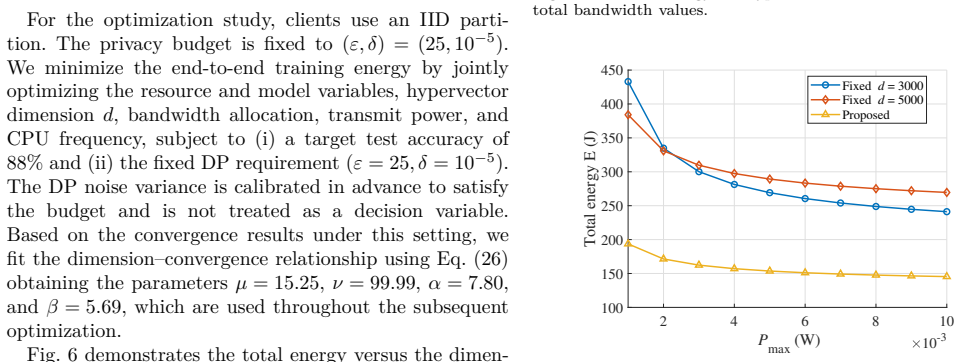
On its own terms, the paper's central claim is that FL-HDC-DP, a federated learning framework using HDC for local training and Gaussian DP noise for privacy, admits a jointly optimal allocation of HDC dimension d, uplink transmission time, system bandwidth, transmit power, and CPU frequency that minimizes total user energy subject to latency and privacy constraints. The key empirical discovery is that total energy is non-monotonic in d, with a minimum at d=4,000 under the tested settings: raising d from 3,000 to 4,000 cuts required rounds enough to lower energy, while further increases add per-round computation and transmission cost without enough convergence benefit. The paper also claims t
Load-bearing premise
The entire energy-saving claim rests on the four-parameter sigmoid fit J_d(d)=μ+ν/(1+e^{β(log d−α)}) accurately predicting convergence rounds for all candidate dimensions and privacy budgets, yet the fit is against the authors' own MNIST simulations with no error bars or held-out settings; if the true rounds-vs-dimension curve deviates from the fit, the optimal d=4,000 and the 83.3% saving shift.
Editorial extensions
If this is right
- Energy optimization should treat model dimension as a radio-style resource: a moderate dimension (≈4,000) beats both too-small and too-large dimensions, so dimension and resource allocation should be co-designed rather than fixed a priori.
- Formal privacy is achievable at low overhead: calibrating Gaussian noise from HDC's sensitivity (κ, then √2κ) under zCDP gives an end-to-end (ε,δ) guarantee without backpropagation.
- Convergence speed translates directly into energy: reaching about 90% accuracy in roughly 3.5× fewer rounds than a neural baseline reduces both computation and transmission energy.
- The resource allocation pattern is systematic: as channel quality degrades, users receive more bandwidth and higher transmit power, with CPU frequency rising to fit computation into the remaining time budget.
- Wireless bandwidth acts as a substitute for transmit power and dimension: the energy curves flatten at high bandwidth, so operators can trade spectrum against computation.
Reading between the lines
- The interior optimum d≈4,000 is likely a structural consequence of saturating convergence gains: any setting where per-round cost grows linearly with d while rounds plateau at high d will have an interior minimum, so the same machinery could be reused after estimating a fresh J_d curve.
- Because J_d(d) is fitted to MNIST with fixed privacy budgets, the 83.3% figure should be read as conditional; a testable extension is to refit Eq. (26) on non-IID data, other datasets, and other ε values, and check whether the qualitative interior optimum and savings persist.
- The framework suggests a broader design principle: in federated learning, the right model size depends on the wireless environment, so model-radio co-design may matter more than optimizing either layer alone.
- A natural extension is to allow the dimension to vary per round or per user, rather than using a single global d for all rounds and all users.
Editorial analysis
A structured set of objections, weighed in public.
Referee Report
Summary. The paper proposes FL-HDC-DP, a federated learning framework in which edge users train hyperdimensional computing (HDC) models with differential privacy and upload their class hypervectors to a base station over a wireless FDMA network. The authors formulate a joint optimization problem that minimizes total computation and transmission energy by choosing the HDC dimension, transmission time, bandwidth, transmit power, and CPU frequency, subject to a completion-time constraint, a privacy budget, and per-user hardware limits. Because the number of convergence rounds J_d depends on the dimension d, they introduce an empirical sigmoid-variant model J_d(d) = μ + ν/(1 + e^{β(log d − α)}), and they solve the original problem by alternating between a one-dimensional d-update and a convex resource-allocation subproblem. A feasibility initialization procedure is also given. Simulation results on MNIST show about 90% accuracy in roughly 3.5× fewer rounds than an NN baseline and an energy reduction of up to 83.3%, with an interior energy-minimizing dimension around d=4000.
Significance. If the claims hold, the paper makes a useful contribution: it is, to my knowledge, the first attempt to co-optimize the HDC model dimension together with wireless transmission resources under a DP constraint, and it provides a complete solvable formulation with closed-form updates. The core mathematical pieces that I checked are sound: Lemma 1's zCDP calibration is correct; Theorem 1 and Proposition 1's tight-rate arguments are valid; the convexity and monotonicity claims in Eqs. (40)–(41) are correct; and Proposition 2 gives a genuine feasibility certificate. The main weakness is that the central quantitative results—the interior optimum at d≈4000 and the 83.3% energy saving—are outputs of an optimization whose only learning-dependent input is an unvalidated four-parameter empirical fit (Eq. (26)). The paper also leaves the dependence of the DP noise calibration on the unknown total number of rounds implicit, which affects the privacy guarantee as stated. These issues are fixable with additional robustness analysis and a clarified privacy accounting, but they are load-bearing for the paper's headline claims.
major comments (3)
- [Sec. V-A, Eq. (26); Sec. VII-D] The central quantitative claims—the interior optimum d≈4000, the energy profile in Fig. 6, and the 83.3% saving—are all computed from the four-parameter sigmoid J_d(d)=μ+ν/(1+e^{β(log d−α)}) fitted to the authors' own simulation outputs. The paper reports no residuals, confidence intervals, held-out settings, or robustness checks, and the functional form is a hand-chosen Ansatz. Since the energy objective (23) and the stationarity condition (29) depend on J_d and J'_d, any bias in α or β shifts the predicted optimum and the magnitude of the savings. The paper itself states that the coefficients depend on the selected Acc_target and ε, yet the optimization in Sec. VII-D uses a single fitted instance (μ=15.25, ν=99.99, α=7.80, β=5.69). Please add uncertainty quantification or at least a sensitivity analysis over the fit parameters, or explicitly reframe the headline numbers as conditional
- [Sec. III-A, Lemma 1/Eq. (13); Sec. V-A/Eq. (26)] The per-round Gaussian noise in Lemma 1 is calibrated as σ_j = Δ_j√(J/(2ρ_max)), which depends on the total number of rounds J. But in the optimization, J is exactly the convergence-round count J_d(d) that varies with the dimension, and J_d is itself an output of the training dynamics under privacy noise. The paper does not state what J is used to pre-calibrate the noise in the experiments of Sec. VII-B or Sec. VII-D, nor does it explain how the privacy guarantee is maintained when the optimized J_d differs from the calibrated J. If the noise is calibrated for a fixed J_max larger than every possible J_d, that bound must be explicit and the fitted J_d(d) must be measured under that same noise. As written, the privacy accounting and the convergence model are mutually dependent, so the reported (ε,δ) guarantee for the optimized solution is not well-defined.
- [Sec. V-B, Eqs. (27)–(29); Algorithm 2] The text claims that the alternating scheme 'efficiently converges to the globally optimal solution', but no global convergence proof is provided. Subproblem 1 minimizes a nonconvex function: J_d is a decreasing sigmoid, the derivative equation (29) may have multiple roots, a single bisection root is not a certificate of global optimality, and the 'boundary values determined by (27a)' are not characterized. Since the admissible set D_HDC is discrete and small (eight values in the simulations), a global solution can be obtained by enumerating d and solving the convex resource-allocation subproblem for each d. Please either prove the needed monotonicity/convexity or revise the algorithm and the global-optimality claim.
minor comments (5)
- [Fig. 5] Axis labels contain typos: 'con erge' should be 'converge', 'true alue' should be 'true value', and 'fitting cur e' should be 'fitting curve'.
- [Table II and Eq. (25)] The number of users is denoted U in the model but K in Table II and in constraint (25c). Please unify the notation.
- [Sec. V-B, Eq. (35)] The closed form for f_i^* does not explicitly enforce the upper bound f_i ≤ f_i^max. Feasibility may be preserved by the initialization certificate, but the paper should state this or include the min(·, f_i^max) operation; otherwise constraint (34b) is not enforced in the closed form.
- [Eqs. (17) and (23)] The payload is modeled as N_i d bits, i.e., one bit per dimension per class. After averaging and DP noise, class hypervectors are real-valued; the bit depth or quantization assumption should be stated, since it directly scales transmission energy.
- [Sec. VII-D] The statement 'DP noise variance is calibrated in advance' should give the specific J used for calibration in the optimization setting. Without this, the reader cannot reproduce the simulation or verify the privacy guarantee.
Circularity Check
No significant circularity: the energy-optimal dimension and headline savings are conditional on an openly fitted empirical convergence-round curve, but the optimization itself is not a by-construction restatement of that fit.
full rationale
The paper's central derivation chain is self-contained: the energy model (Eq. 23), the joint optimization problem (Eq. 25), and the alternating resource-allocation algorithms are derived in-paper from explicit computation and communication models. The only learning-dependent input is the convergence-round function J_d(d) in Eq. (26), which the paper transparently introduces as an empirical sigmoid-variant model: 'Since deriving an analytical relationship among dimension, privacy, and convergence remains challenging, we develop an empirical model to precisely estimate J_d.' The coefficients are obtained by nonlinear least squares against the authors' own MNIST simulations and are explicitly reported in Sec. VII-D (mu=15.25, nu=99.99, alpha=7.80, beta=5.69). This is a modeling input rather than a disguised derivation: the paper does not claim Eq. (26) follows from first principles, and the energy-minimizing dimension d=4000 is not a by-construction identity of the fitted curve—it emerges from the full energy objective (23) and constraints, including computation costs, transmission costs, and the product R_i J_d d. The 83.3% energy saving is therefore conditional on the fitted curve being representative; if the fit is inaccurate, the quantitative results shift. That is a robustness/validation risk, not circularity. Self-citations ([4], [5], [11]) appear only as related-work context and do not carry the load of any theorem, lemma, or numerical claim. The convergence and accuracy comparisons against FL-NN-DP are direct simulation results rather than renamed outputs of the fitted model. No load-bearing step reduces, by the paper's own equations or by a self-citation chain, to an input that was already assumed.
Assumptions & free parameters
free parameters (3)
- Sigmoid convergence-round coefficients (μ, ν, α, β) =
μ=15.25, ν=99.99, α=7.80, β=5.69 for the (ε,δ)=(25,1e−5), Acc≥88% optimization setting; refit per setting
- Inference error rate e_i =
0.4 (Table II)
- Per-dimension CPU cycle costs (C_enc, C_agg, C_sim, C_up) =
C_enc=C_agg=784, C_sim=100, C_up=8 (Table II)
assumptions (6)
- domain assumption Encoded bipolar HVs are ℓ2-clipped to norm κ before aggregation and transmission (Assumption 1, Eq. 7).
- domain assumption Per-round HDC retraining sensitivity is √2κ even though update decisions depend on the data-dependent broadcast global AM (Eqs. 10-11).
- domain assumption Switched-capacitance energy model E = γ C D d f² with per-dimension cycle counts (Eqs. 19-21).
- standard math FDMA Shannon-rate model r_i = b_i log2(1 + p_i g_i/(N0 b_i)) (Eq. 16).
- standard math zCDP additivity and the (ε,δ) conversion ε = ρ + 2√(ρ ln(1/δ)) (Eq. 6, Lemma 1).
- ad hoc to paper Sigmoid-variant functional form J_d(d) = μ + ν/(1 + e^{β(log d − α)}) (Eq. 26).
invented entities (1)
-
Sigmoid-variant convergence-round model J_d(d) (Eq. 26)
Cite this review
Pith. "Pith review of Energy Efficient Federated Learning with Hyperdimensional Computing over Wireless Communication Networks." pith.science (2026). https://pith.science/paper/4RL6OWLP
@misc{pith2026260221949,
  author       = {Pith},
  title        = {Pith review of: Energy Efficient Federated Learning with Hyperdimensional Computing over Wireless Communication Networks},
  year         = {2026},
  howpublished = {\url{https://pith.science/paper/4RL6OWLP}},
  note         = {Machine review of arXiv:2602.21949}
}
read the original abstract
In this paper, we investigate a problem of minimizing total energy consumption for secure federated learning (FL) over wireless edge networks. To address the high computational cost and privacy challenges in conventional FL with neural networks (NN) for resource-constrained users, we propose a novel FL with hyperdimensional computing and differential privacy (FL-HDC-DP) framework. In the considered model, each edge user employs hyperdimensional computing (HDC) for local training, which replaces complex neural updates with simple hypervector operations, and applies differential privacy (DP) noise to protect transmitted model information. We optimize the total energy of computation and communication under both latency and privacy constraints. We formulate the problem as an optimization that minimizes the total energy of all users by jointly allocating HDC dimension, transmission time, system bandwidth, transmit power, and CPU frequency. To solve this problem, a sigmoid-variant function is proposed to characterize the relationship between the HDC dimension and the convergence rounds required to reach a target accuracy. Based on this model, we develop two alternating optimization algorithms, where closed-form expressions for time, frequency, bandwidth, and power allocations are derived at each iteration. Since the iterative algorithm requires a feasible initialization, we construct a feasibility problem and obtain feasible initial resource parameters by solving a per round transmission time minimization problem. Simulation results demonstrate that the proposed FL-HDC-DP framework achieves up to 83.3% total energy reduction compared with the baseline, while attaining about 90% accuracy in approximately 3.5X fewer communication rounds than the NN baseline.
Figures


Figures from the paper (6 more)




Forward citations
Cited by 1 Pith paper
-
CRB-Guided Framework Design and Resource Allocation for Indoor mmWave ISCC Systems
CRB-guided joint optimization of sensing power and adaptive Mamba depth minimizes pose prediction error in indoor mmWave ISCC under latency and energy limits.
Reference graph
Works this paper leans on
-
[1]
Energy-efficient feder- ated edge learning with streaming data: A lyapunov optimiza- tion approach,
C.-H. Hu, Z. Chen, and E. G. Larsson, “Energy-efficient feder- ated edge learning with streaming data: A lyapunov optimiza- tion approach,” IEEE Transactions on Communications, vol. 73, no. 2, pp. 1142–1156, 2025
2025
-
[2]
Multi-stage hybrid federated learning over large-scale d2d-enabled fog networks,
S. Hosseinalipour, S. S. Azam, C. G. Brinton, N. Michelusi, V. Aggarwal, D. J. Love, and H. Dai, “Multi-stage hybrid federated learning over large-scale d2d-enabled fog networks,” IEEE/ACM Transactions on Networking, vol. 30, no. 4, pp. 1569–1584, 2022
2022
-
[3]
Federated edge network utility maximization for a multi-server system: Algorithm and convergence,
N. Karakoç, A. Scaglione, M. Reisslein, and R. Wu, “Federated edge network utility maximization for a multi-server system: Algorithm and convergence,” IEEE/ACM Transactions on Net- working, vol. 30, no. 5, pp. 2002–2017, 2022
2002
-
[4]
Distributed machine learning for uav swarms: Comput- ing, sensing, and semantics,
Y. Ding, Z. Yang, Q.-V. Pham, Y. Hu, Z. Zhang, and M. Shikh- Bahaei, “Distributed machine learning for uav swarms: Comput- ing, sensing, and semantics,” IEEE Internet of Things Journal, vol. 11, no. 5, pp. 7447–7473, 2024
2024
-
[5]
Joint layer selection and differential privacy design for feder- ated learning over wireless networks,
Y. Ding, W. Shang, Y. Yang, W. Ding, and M. Shikh-Bahaei, “Joint layer selection and differential privacy design for feder- ated learning over wireless networks,” IEEE Internet of Things Journal, vol. 11, no. 24, pp. 39 767–39 779, 2024
2024
-
[6]
Prive-hd: Privacy- preserved hyperdimensional computing,
B. Khaleghi, M. Imani, and T. Rosing, “Prive-hd: Privacy- preserved hyperdimensional computing,” in 2020 57th ACM/IEEE Design Automation Conference (DAC). IEEE, 2020, pp. 1–6
2020
-
[7]
Energy efficient federated learning over wireless communica- tion networks,
Z. Yang, M. Chen, W. Saad, C. S. Hong, and M. Shikh-Bahaei, “Energy efficient federated learning over wireless communica- tion networks,” IEEE Transactions on Wireless Communica- tions, vol. 20, no. 3, pp. 1935–1949, 2021
1935
-
[8]
Energy efficient federated learning over heterogeneous mobile devices via joint design of weight quantization and wireless transmis- sion,
R. Chen, L. Li, K. Xue, C. Zhang, M. Pan, and Y. Fang, “Energy efficient federated learning over heterogeneous mobile devices via joint design of weight quantization and wireless transmis- sion,” IEEE Transactions on Mobile Computing, vol. 22, no. 12, pp. 7451–7465, 2023
2023
Show all 28 references
-
[9]
Fl-hdc: Hyper- dimensional computing design for the application of federated learning,
C.-Y. Hsieh, Y.-C. Chuang, and A.-Y. A. Wu, “Fl-hdc: Hyper- dimensional computing design for the application of federated learning,” in Proc. IEEE Int. Conf. Artif. Intell. Circuits Syst. (AICAS). IEEE, 2021, pp. 1–5
2021
-
[10]
HyperFeel: An efficient federated learning framework using hyperdimensional comput- ing,
H. Li, F. Liu, Y. Chen, and L. Jiang, “HyperFeel: An efficient federated learning framework using hyperdimensional comput- ing,” in Proc. Asia South Pacific Des. Autom. Conf. (ASP- DAC), 2024, pp. 716–721
2024
-
[11]
Hyperdimensional computing empowered federated foundation model over wireless networks for meta- verse,
Y. Ding, W. Shang, M. Xu, Z. Yang, Y. Hu, D. Niyato, and M. Shikh-Bahaei, “Hyperdimensional computing empowered federated foundation model over wireless networks for meta- verse,” in 2024 IEEE Smart World Congress (SWC), 2024, pp. 2187–2194
2024
-
[12]
Private and efficient learning with hyperdimensional computing,
B. Khaleghi, X. Yu, J. Kang, X. Wang, and T. Rosing, “Private and efficient learning with hyperdimensional computing,” IEEE Transactions on Circuits and Systems for Artificial Intelligence, 2024
2024
-
[13]
Privacy- preserving federated learning with differentially private hyperdi- mensional computing,
F. J. Piran, Z. Chen, M. Imani, and F. Imani, “Privacy- preserving federated learning with differentially private hyperdi- mensional computing,” Computers and Electrical Engineering, vol. 123, p. 110261, 2025
2025
-
[14]
Hydrea: Utilizing hyperdimensional computing for a more robust and efficient machine learning system,
J. Morris, K. Ergun, B. Khaleghi, M. Imani, B. Aksanli, and T. Simunic, “Hydrea: Utilizing hyperdimensional computing for a more robust and efficient machine learning system,” ACM Trans. Embed. Comput. Syst., vol. 21, no. 6, pp. 1–25, 2022
2022
-
[15]
A highly energy-efficient hyperdimensional computing processor for biosignal classification,
A. Menon, D. Sun, S. Sabouri, K. Lee, M. Aristio, H. Liew, and J. M. Rabaey, “A highly energy-efficient hyperdimensional computing processor for biosignal classification,” IEEE Trans- actions on Biomedical Circuits and Systems, vol. 16, no. 4, pp. 524–534, 2022
2022
-
[16]
On hyperdi- mensional computing-based federated learning: A case study,
S. Zhang, D. Ma, S. Bian, L. Yang, and X. Jiao, “On hyperdi- mensional computing-based federated learning: A case study,” in Proc. Int. Joint Conf. Neural Netw.(IJCNN). IEEE, 2023, pp. 1–8
2023
-
[17]
A new pathway to integrated learning and commu- nication (ilac): Large ai model and hyperdimensional computing for communication,
W. Xu, Z. Yang, D. W. K. Ng, R. Schober, H. V. Poor, Z. Zhang, and X. You, “A new pathway to integrated learning and commu- nication (ilac): Large ai model and hyperdimensional computing for communication,” arXiv preprint arXiv:2506.18432, 2025
2025 arXiv
-
[18]
Hyperdimensional computing: An introduction to computing in distributed representation with high-dimensional random vectors,
P. Kanerva, “Hyperdimensional computing: An introduction to computing in distributed representation with high-dimensional random vectors,” Cognitive computation, vol. 1, pp. 139–159, 2009
2009
-
[19]
Classification using hyperdimensional computing: A review,
L. Ge and K. K. Parhi, “Classification using hyperdimensional computing: A review,” IEEE Circuits Sys. Mag., vol. 20, no. 2, pp. 30–47, 2020
2020
-
[20]
Hyperdimensional computing vs. neural networks: Comparing architecture and learning process,
D. Ma, C. Hao, and X. Jiao, “Hyperdimensional computing vs. neural networks: Comparing architecture and learning process,” in Proc. Int. Symp. Qual. Electron. Des. (ISQED). IEEE, 2024, pp. 1–5
2024
-
[21]
Hyperdimensional biosignal processing: A case study for EMG- based hand gesture recognition,
A. Rahimi, S. Benatti, P. Kanerva, L. Benini, and J. M. Rabaey, “Hyperdimensional biosignal processing: A case study for EMG- based hand gesture recognition,” in Proc. IEEE Int. Conf. Rebooting Comput. (ICRC). IEEE, 2016, pp. 1–8
2016
-
[22]
Calibrating noise to sensitivity in private data analysis,
C. Dwork, F. McSherry, K. Nissim, and A. Smith, “Calibrating noise to sensitivity in private data analysis,” in Theory of cryptography conference. Springer, 2006, pp. 265–284
2006
-
[23]
Concentrated differential privacy: Simplifications, extensions, and lower bounds,
M. Bun and T. Steinke, “Concentrated differential privacy: Simplifications, extensions, and lower bounds,” in Theory of cryptography conference. Springer, 2016, pp. 635–658
2016
-
[24]
Private and efficient learning with hyperdimensional computing,
B. Khaleghi, X. Yu, J. Kang, X. Wang, and T. Rosing, “Private and efficient learning with hyperdimensional computing,” IEEE Transactions on Circuits and Systems for Artificial Intelligence, vol. 1, no. 2, pp. 204–219, 2024
2024
-
[25]
Energy-efficient resource allocation for mobile-edge computation offloading,
C. You, K. Huang, H. Chae, and B.-H. Kim, “Energy-efficient resource allocation for mobile-edge computation offloading,” IEEE Transactions on Wireless Communications, vol. 16, no. 3, pp. 1397–1411, 2017
2017
-
[26]
Dynamic computation offloading for mobile-edge computing with energy harvesting devices,
Y. Mao, J. Zhang, and K. B. Letaief, “Dynamic computation offloading for mobile-edge computing with energy harvesting devices,” IEEE Journal on Selected Areas in Communications, vol. 34, no. 12, pp. 3590–3605, 2016
2016
-
[27]
A tutorial on decomposition methods for network utility maximization,
D. Palomar and M. Chiang, “A tutorial on decomposition methods for network utility maximization,” IEEE Journal on Selected Areas in Communications, vol. 24, no. 8, pp. 1439– 1451, 2006
2006
-
[28]
Communication-efficient learning of deep networks from decentralized data,
B. McMahan, E. Moore, D. Ramage, S. Hampson, and B. A. y Arcas, “Communication-efficient learning of deep networks from decentralized data,” in Proc. Artif. Intell. Stat. (AIS- TATS). PMLR, 2017, pp. 1273–1282
2017
Reviewed August 2, 2026 · model on record in the stance chip above.
Discussion (0). Continue with ORCID to comment.