REVIEW 3 major objections 4 minor 51 references
Benchmarking Multi-fidelity Neural Operators on Complex PDE Problems with Non-trivial Fidelity Differences
T0 review · 3 major / 4 minor · reviewed 2026-08-06 · deepseek-v4-flash
Pith's one-line read Transfer learning is the only multi-fidelity strategy that consistently beats the high-fidelity baseline across four PDE benchmarks; direct low-fidelity-input injection degrades as the fidelity gap grows.
desk verdict Useful benchmark comparison with a solid internal ranking, but the 'model-form fidelity' claim rests on a POD-projection proxy that needs to be fixed or reframed before the paper is publishable. read the letter →
The pith
A machine-rendered reading of the paper's core claim, the machinery that carries it, and where it could break.
The reading
What carries the argument
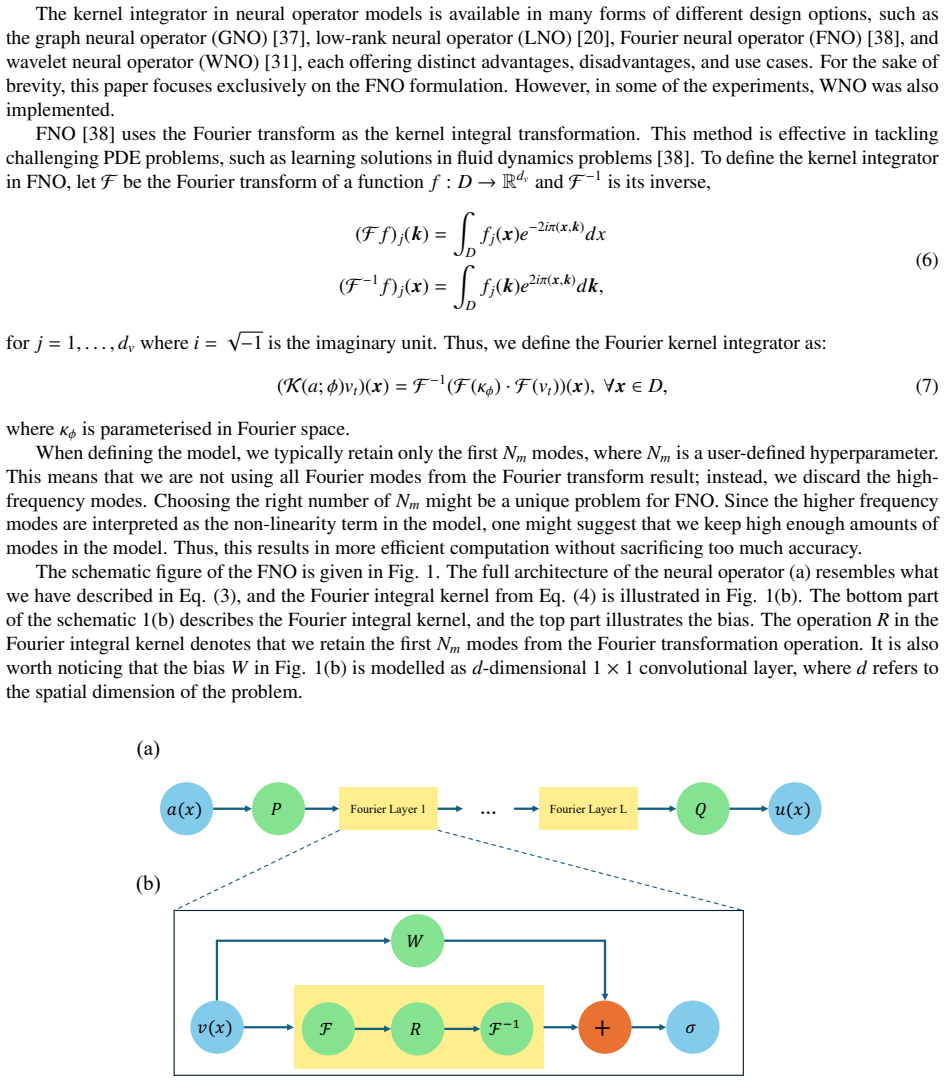
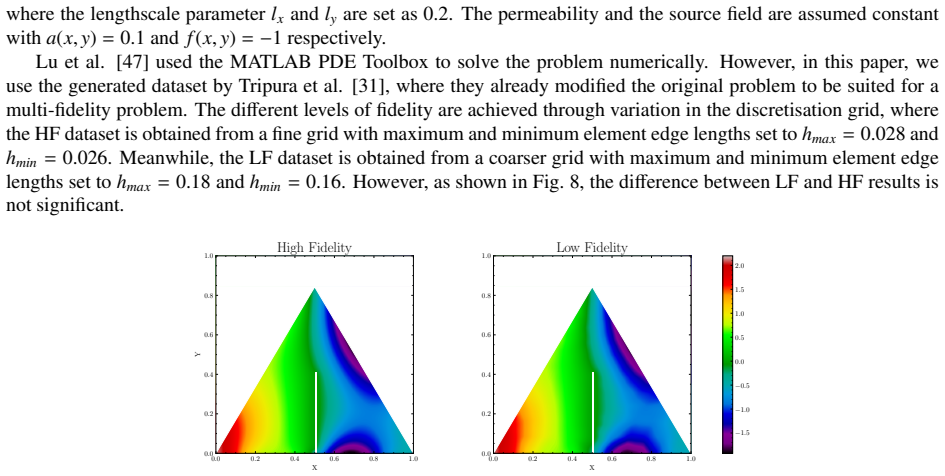
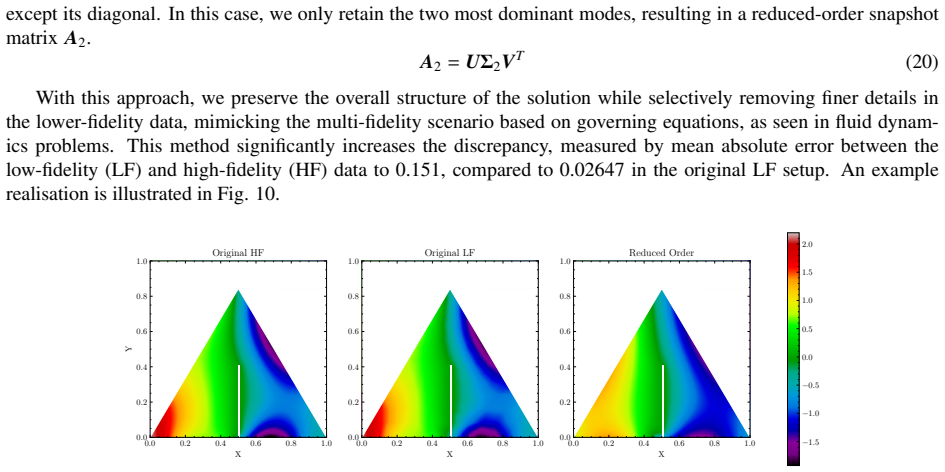
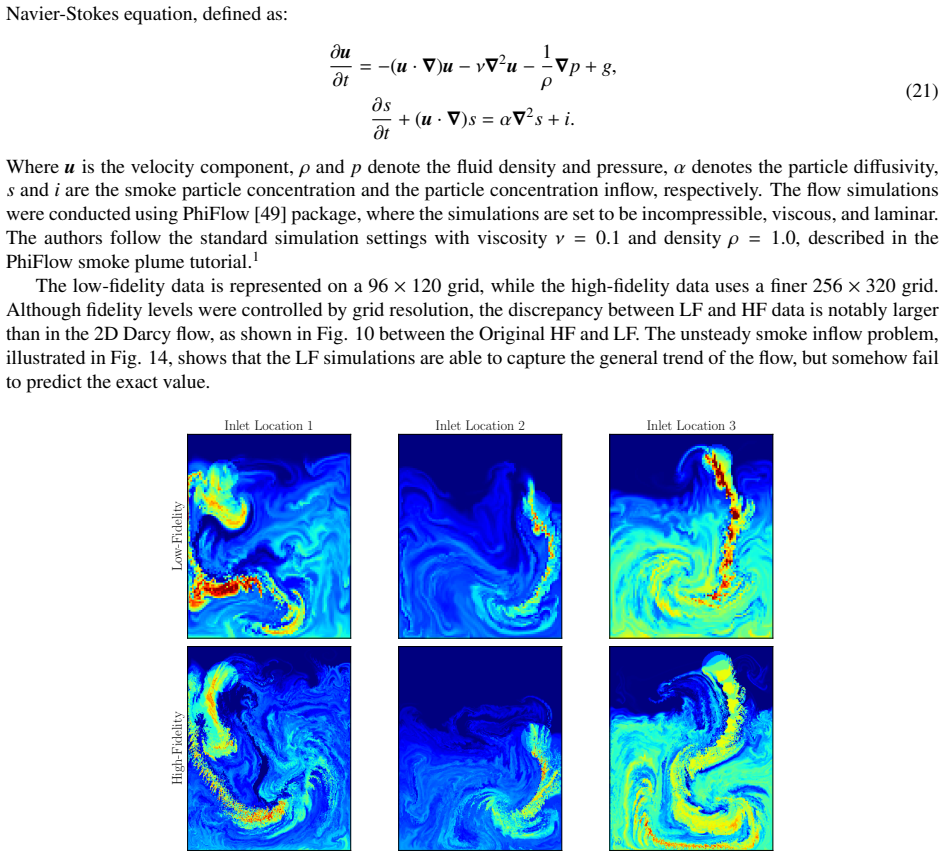
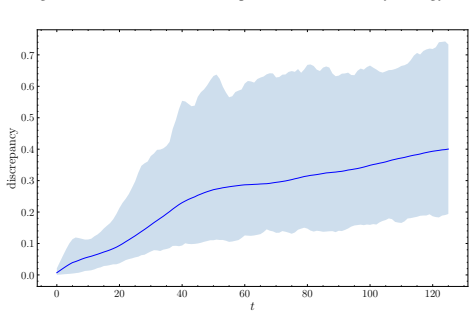
The machinery is a controlled comparison of four multi-fidelity integration schemes on one baseline architecture (Fourier neural operator, with a wavelet operator in the Darcy cases), plus two purpose-built benchmarks that separate fidelity-gap size from grid effects. The modified Darcy case creates its low-fidelity data by rank-2 proper orthogonal decomposition, $A_2=U\Sigma_2 V^T$ (Eqs. 19–20), raising the mean absolute LF-HF discrepancy from 0.02647 to 0.151; the smoke-inflow case pairs a 96×120 low-fidelity grid with a 256×320 high-fidelity grid in a time-dependent smoke-advection problem, where discrepancy grows with time and single-step rollout during training is followed by autoregressive evaluation. These benchmarks are what let the paper attribute performance differences to the LF-HF mismatch mechanism rather than to trivial resolution similarity.
What would settle it
Build a version of the Darcy or smoke-inflow benchmark where the low-fidelity data comes from a solver with a genuinely different governing equation or closure (for example, an actual turbulence model rather than a finer or coarser grid), rerun all four strategies, and check whether transfer learning still wins; if two-step or residual matches it there, the central claim is limited to the paper's projection-style fidelity gap.
Extended reading notes
Core claim
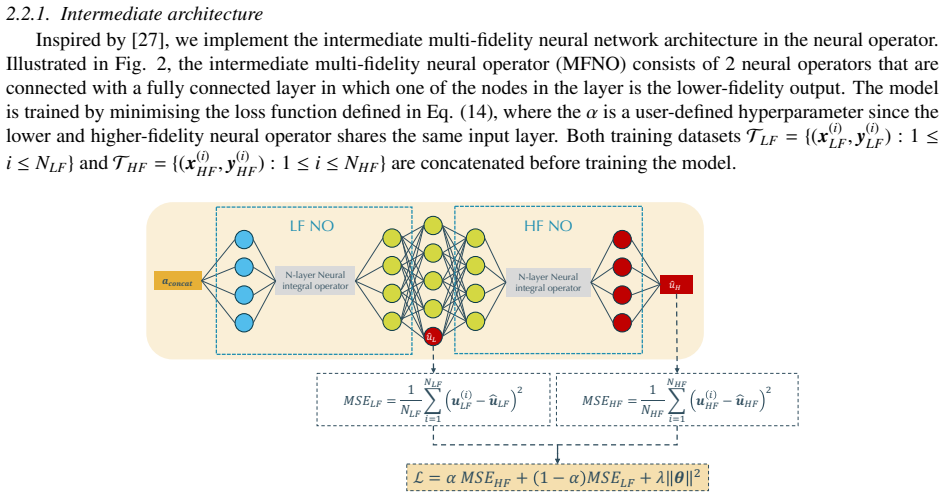
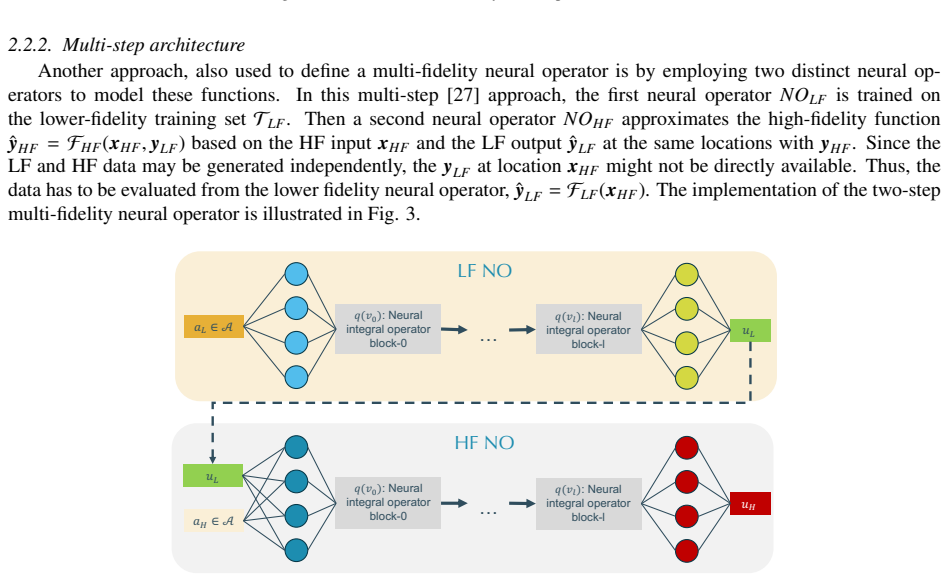
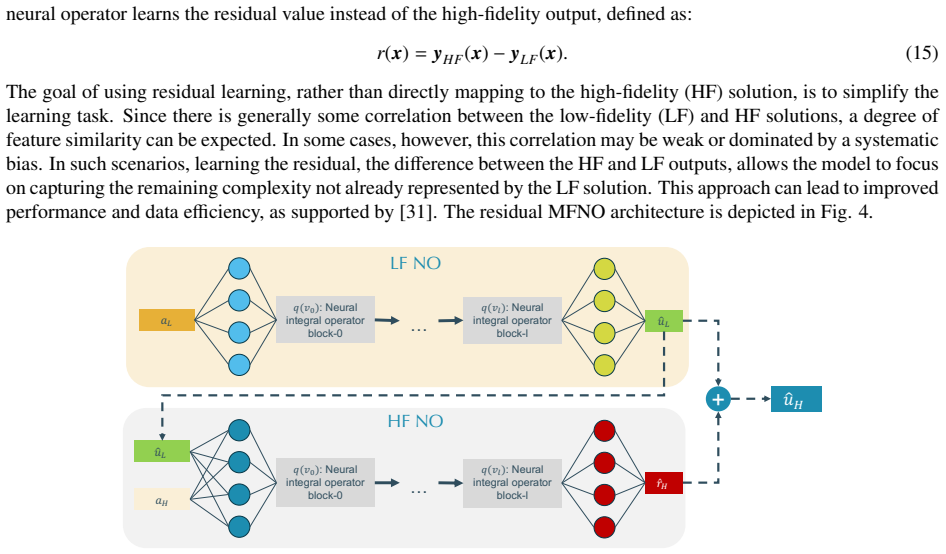
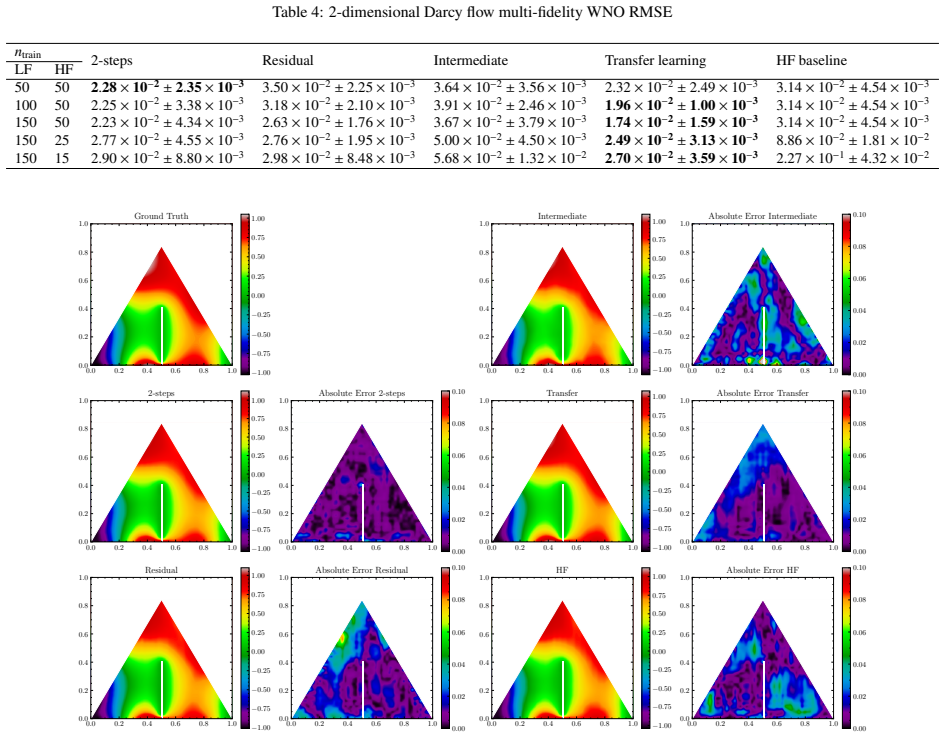
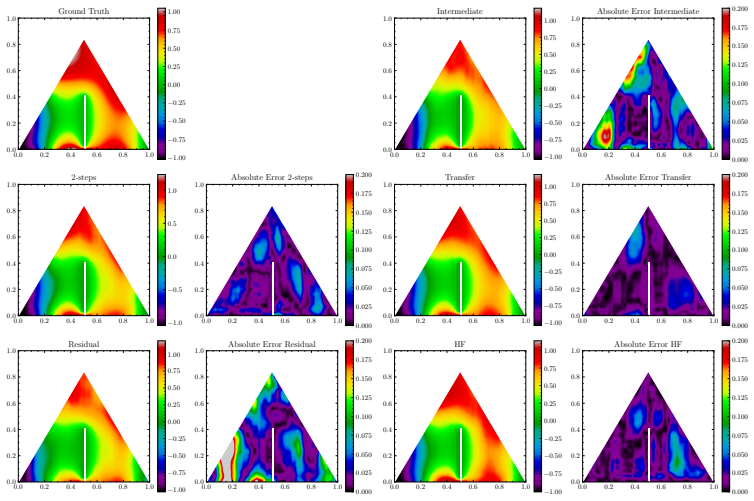
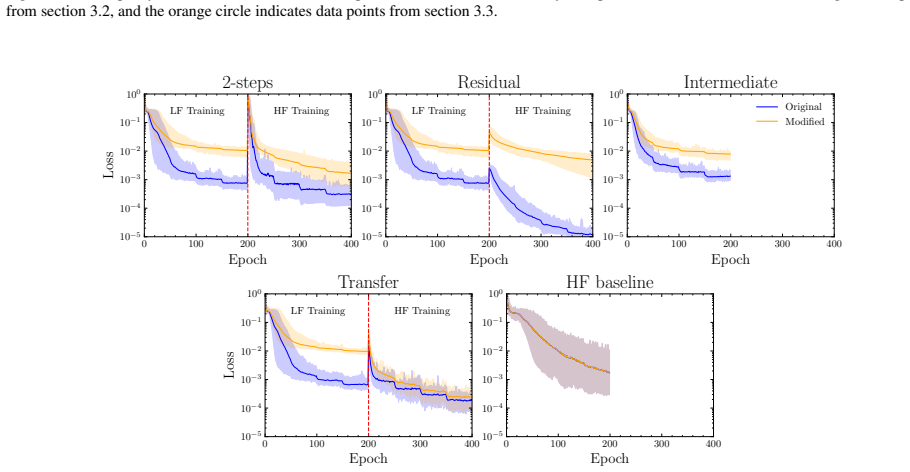
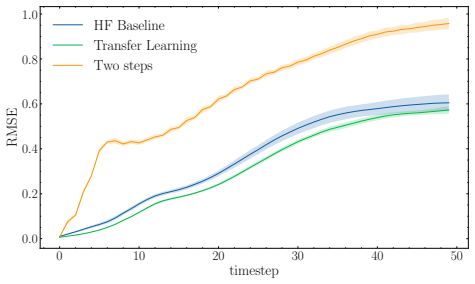
The paper's central claim is that the way low-fidelity information enters a neural operator determines whether multi-fidelity training helps or hurts. On all four test cases — 1D stochastic Poisson, 2D Darcy flow, a modified Darcy flow with a large fidelity gap, and unsteady smoke inflow — the transfer-learning strategy is the only one that consistently beats the HF-only baseline. The two-step and residual strategies, which form $\hat{y}_{HF}=F(x,\hat{y}_{LF})$ or learn the residual $r=y_{HF}-y_{LF}$, and the intermediate architecture, which shares a trunk and emits LF from a hidden layer, all lose accuracy when the LF-HF discrepancy is large; in the unsteady case the gap widens over time and autoregressive rollout compounds the error. The paper interprets this as evidence that injecting LF outputs as input features confuses the HF network, whereas LF-pretrained weights supply a structural prior that HF fine-tuning can refine.
Load-bearing premise
The paper's third test case assumes that filtering the high-fidelity solutions down to their two dominant patterns mimics the gap between two genuinely different physics models, even though the low-fidelity data is derived from the very high-fidelity solutions it is compared against, so the transfer-learning conclusion may not hold for true model-form discrepancies.
Editorial extensions
If this is right
- With scarce high-fidelity data, initialising the HF neural operator with low-fidelity-pretrained weights is the reliable way to exploit LF data; it improves accuracy over HF-only training on all tested problems.
- Two-step, residual, and intermediate architectures that inject LF predictions into the HF input should be avoided when the LF-HF gap is large, since they can underperform the HF baseline.
- In time-dependent problems, direct LF injection is especially risky: the fidelity gap widens with time and autoregressive rollout turns small errors into large ones.
- The benefit of LF data shrinks as HF data becomes plentiful, and non-transfer strategies can slightly degrade performance once 50 HF samples are available.
- Benchmark design matters: close-to-HF low-fidelity data (grid-only differences) can mask differences between multi-fidelity strategies that appear only at larger fidelity gaps.
Reading between the lines
- Editorial inference: the POD-truncated Darcy 'model-form' gap is not a true governing-equation difference — the LF data is a rank-2 projection of the HF snapshots, so it shares the HF mode structure and can only remove detail; the transfer-learning conclusion is therefore not established for genuinely different physics until a test with LF from a different solver is run.
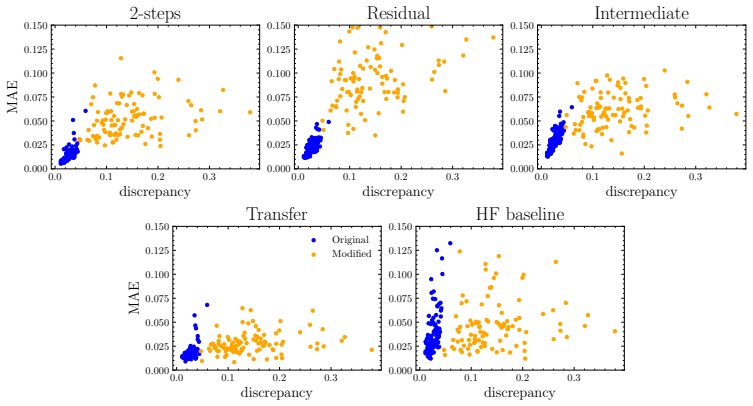
- Editorial inference: the discrepancy-error analysis suggests a practical diagnostic — measure the LF-HF gap before choosing a strategy, using transfer learning when the gap is large and any of the direct-injection methods when it is small.
- Editorial inference: the mechanism at work, that weight-space transfer tolerates strong fidelity mismatch while input-space injection does not, is not specific to neural operators and could be tested in simpler multi-fidelity regression settings where the same failure mode should appear.
Editorial analysis
A structured set of objections, weighed in public.
Referee Report
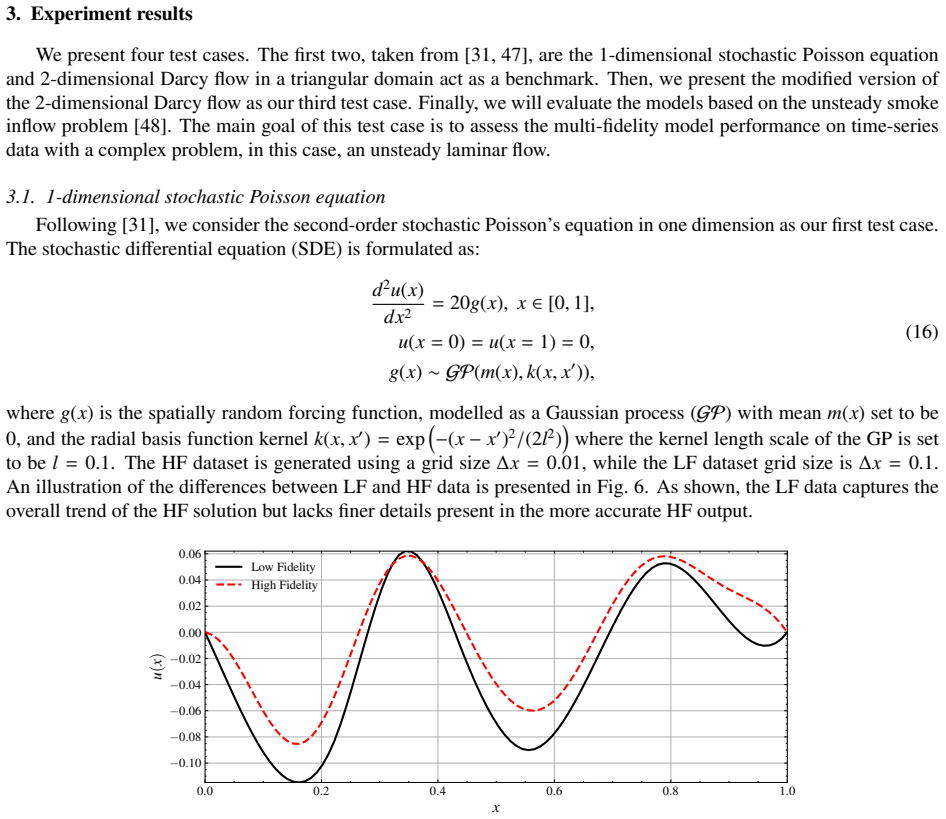
Summary. The paper evaluates four multi-fidelity neural operator strategies—intermediate, two-step, residual, and transfer learning—against a high-fidelity-only baseline across four PDE test cases: a one-dimensional stochastic Poisson equation, a two-dimensional Darcy flow, a modified Darcy flow intended to emulate governing-equation discrepancies, and an unsteady smoke inflow problem. The main empirical claim is that only transfer learning consistently outperforms the high-fidelity baseline across all scenarios, while methods that feed low-fidelity predictions into the high-fidelity model are prone to error amplification under large LF-HF discrepancy, especially in autoregressive time-stepping. The paper also introduces two new test cases: a POD-truncated Darcy flow and a time-dependent smoke inflow benchmark.
Significance. If the central empirical claims hold, the paper is a useful systematic comparison for the multi-fidelity neural operator community. Its strengths include a consistent evaluation protocol with repeated random train/test splits, a clear comparison against a high-fidelity-only baseline, and a new unsteady smoke inflow dataset that addresses an underrepresented temporal setting. The observation that transfer learning is more robust than direct LF-input injection under large discrepancies is practically relevant and falsifiable. However, the modified Darcy test case, which is the key large-discrepancy case supporting the transfer-learning conclusion, rests on a construction that is not a faithful emulation of model-form discrepancies, and the text does not rule out test information leakage through the SVD. These issues are load-bearing for the paper's main claim and require careful resolution.
major comments (3)
- [Section 3.3, Eqs. (19)-(20)] The paper does not state whether the SVD in Eq. (19) is computed on the full snapshot matrix A, including the test split, or only on training snapshots. If the full matrix is used, the low-fidelity representation of each test input is constructed from the dominant modes of the high-fidelity test solutions themselves, which leaks information from the test set into the inputs. This would invalidate the third test case as a ranking experiment. The manuscript must specify the split used and, if the SVD included test data, rerun the experiment with a training-only SVD.
- [Section 3.3, Eqs. (19)-(20) and Fig. 10] Even with a correct train/test split, a rank-2 POD projection of the HF solution does not emulate a governing-equation discrepancy such as RANS versus LES. The LF and HF fields share the same POD basis by construction, so the LF field is a projection of the HF field that only removes spatial detail. This is an information-loss gap, not a model-form gap, and it cannot produce the physically different solutions that a genuinely different model would yield. Consequently, the conclusion that transfer learning is robust under 'substantial model discrepancies' is not established for true model-form mismatches; it is established only for projection-type discrepancies. The authors should either construct the LF data from an independent solver or model, or substantially weaken the claim that this test case resembles governing-equation differences.
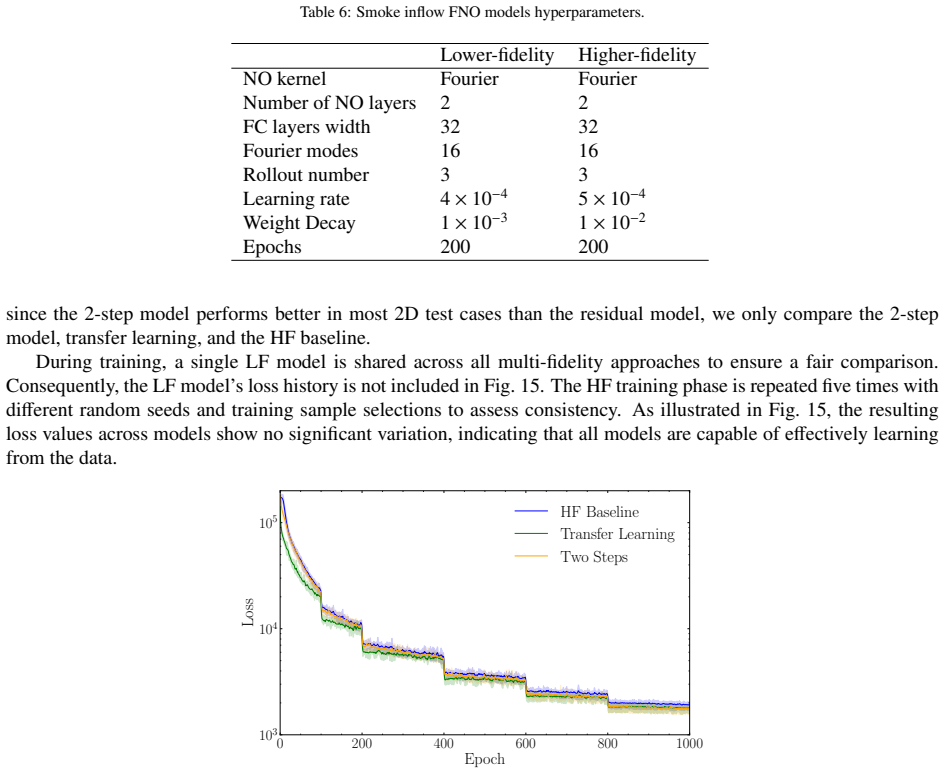
- [Section 3.4 and Table 6] The text states that the training rollout is restricted to a single step ('we restrict the rollout to a single step', and 'the HF model is trained with a rollout number of one'), but Table 6 lists Rollout number 3 for both LF and HF models. This contradiction matters because the paper attributes the two-step model's failure to error accumulation in an autoregressive setting. If the HF model was actually trained with rollout 3, the stated training protocol is wrong; if it was trained with rollout 1, the table is wrong and the claims about autoregressive error accumulation should be reconsidered or clarified.
minor comments (4)
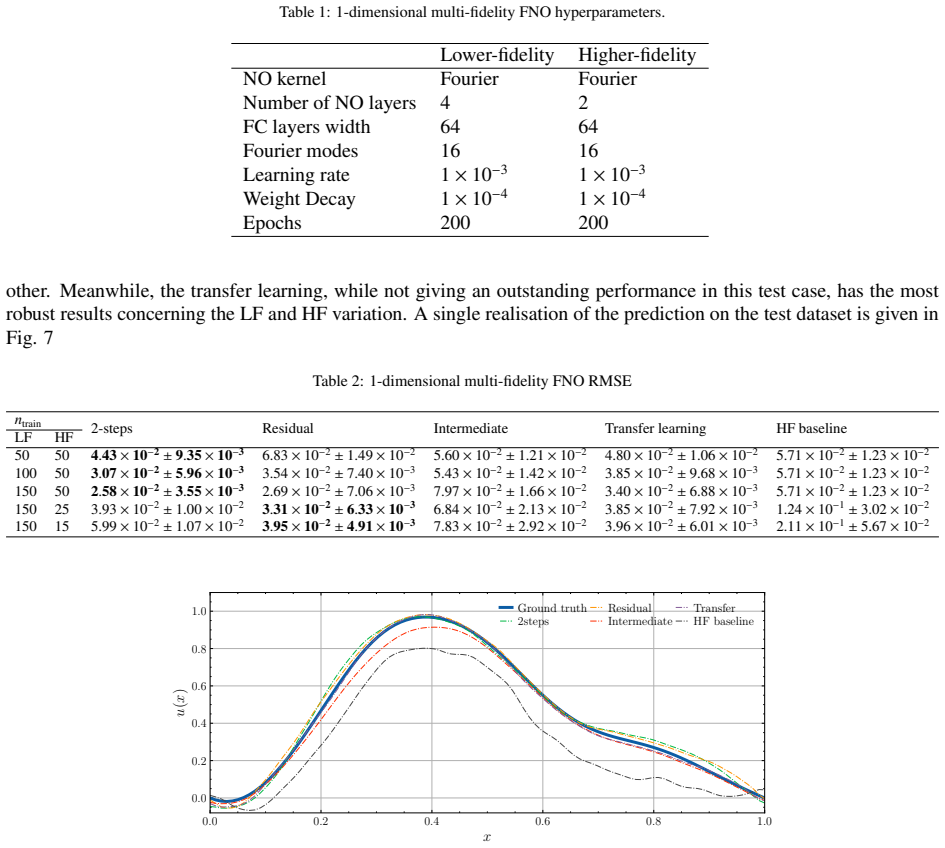
- [Table 2] The first numeric cell in the table reads '504.43×10⁻²', which appears to be a typographical error; the intended value is likely '4.43×10⁻²'. The row labels for the first two columns are also difficult to parse.
- [Section 3.1] The text says 'the FNO yields a better performance compared to other kernels, such as the Wavelet neural operator (WNO), in this test case' but the comparison is not shown. This claim should either be supported with a displayed result or removed.
- [Section 3.2 and Abstract] Section 3.2 states that both transfer learning and the two-step architecture are the only approaches that consistently surpass the HF baseline across all training sample configurations in that test case, while the abstract and conclusion state that only transfer learning consistently outperforms the baseline across all scenarios. The scope of the 'only transfer learning' claim should be clarified, since two-step also achieves this in the 2D Darcy case.
- [Fig. 12] The claim that transfer learning is 'the least sensitive' to increasing discrepancy is based on only two discrepancy levels per model. The figure shows two points per model, so the slope comparison is not statistically supported; this should be acknowledged or supplemented with more discrepancy levels.
Circularity Check
No significant circularity in the empirical comparison; the only constructional self-referentiality is in the modified-Darcy fidelity gap, which limits external validity without forcing the transfer-learning ranking.
-
self definitional
[Section 3.3, Eqs. (19)-(20)]
"we decompose the solution using a proper orthogonal decomposition (POD) method. The snapshot matrix A of the solution is decomposed through a lower rank approximation ... In this case, we only retain the two most dominant modes, resulting in a reduced-order snapshot matrix A2. A2 = UΣ2VT ... With this approach, we preserve the overall structure of the solution while selectively removing finer details in the lower-fidelity data, mimicking the multi-fidelity scenario based on governing equations, as seen in fluid dynamics problems."
By Eq. (20), the low-fidelity snapshot matrix A2 is defined as the high-fidelity snapshot matrix A truncated to its two dominant POD modes, so the LF and HF fields share the same POD basis by construction. The paper uses this construction to claim it 'mimics' RANS-vs-LES-type governing-equation discrepancies, but such discrepancies are model-form differences that can change the solution structure, whereas POD truncation can only remove detail from the very HF solution used as ground truth. Any conclusion that transfer learning is robust to 'substantial model discrepancies' drawn from this test case is therefore a statement about robustness to self-generated projection error rather than to independent model-form mismatch.
full rationale
The central claim is an empirical benchmark result: Tables 2, 4, 5 and Fig. 16 compare RMSE and MAE of transfer learning, two-step, residual, and intermediate architectures against an HF-only baseline. The transfer-learning ranking is not derived from an equation in which low-fidelity data is a fitted input; it is measured, and the paper even reports cases where multi-fidelity does not help and where residual regression degrades sharply (Table 5). There is no fitted parameter renamed as a prediction and no uniqueness theorem imported from the same authors. The only constructional circularity is in the modified Darcy test case (Eq. 20): LF data is a rank-2 POD projection of the HF snapshots, so the 'governing-equation-like' discrepancy is not an independent model-form gap. The text does not state whether the POD is computed on training snapshots only; if the test split is included, the LF test inputs would inherit HF test modes, which would bias the comparison. That is a genuine methodological caveat but not a demonstrated reduction of the concluding ranking. The smoke-inflow data is self-cited via [48], whose authors overlap with this paper, but it is a released Zenodo dataset with fixed simulation outputs, so the self-citation is not load-bearing in a way that makes the results circular. The paper itself flags a related limitation: 'the current smoke inflow test case does not reflect fidelity differences arising from variations in governing equations.' Overall, the main ranking has independent empirical content and should be judged a low-circularity benchmark; the modified-Darcy projection is a constructional weakness that caps the external-validity claim, not a derivation that forces the conclusion.
Assumptions & free parameters
free parameters (3)
- alpha (intermediate loss weight) =
not reported
- rollout number (smoke inflow) =
3 per Table 6, 1 per Section 3.4
- POD truncation rank k =
2
assumptions (4)
- domain assumption Fourier and wavelet neural operators can approximate the PDE solution operators for the four test problems within the stated data budgets.
- domain assumption LF-HF pairs in the test suite are representative of real multi-fidelity CFD scenarios, with grid coarsening and POD truncation standing in for RANS-versus-LES-type model discrepancies.
- domain assumption The datasets from Tripura et al. [31] and Zakaria et al. [48] are used as-is and match the descriptions in those references.
- ad hoc to paper Rank-2 POD truncation of the HF snapshot matrix yields a valid low-fidelity solution whose fidelity gap is comparable to a change of governing equation.
Cite this review
Pith. "Pith review of Benchmarking Multi-fidelity Neural Operators on Complex PDE Problems with Non-trivial Fidelity Differences." pith.science (2026). https://pith.science/paper/4S4TVOWC
@misc{pith2026260804708,
  author       = {Pith},
  title        = {Pith review of: Benchmarking Multi-fidelity Neural Operators on Complex PDE Problems with Non-trivial Fidelity Differences},
  year         = {2026},
  howpublished = {\url{https://pith.science/paper/4S4TVOWC}},
  note         = {Machine review of arXiv:2608.04708}
}
read the original abstract
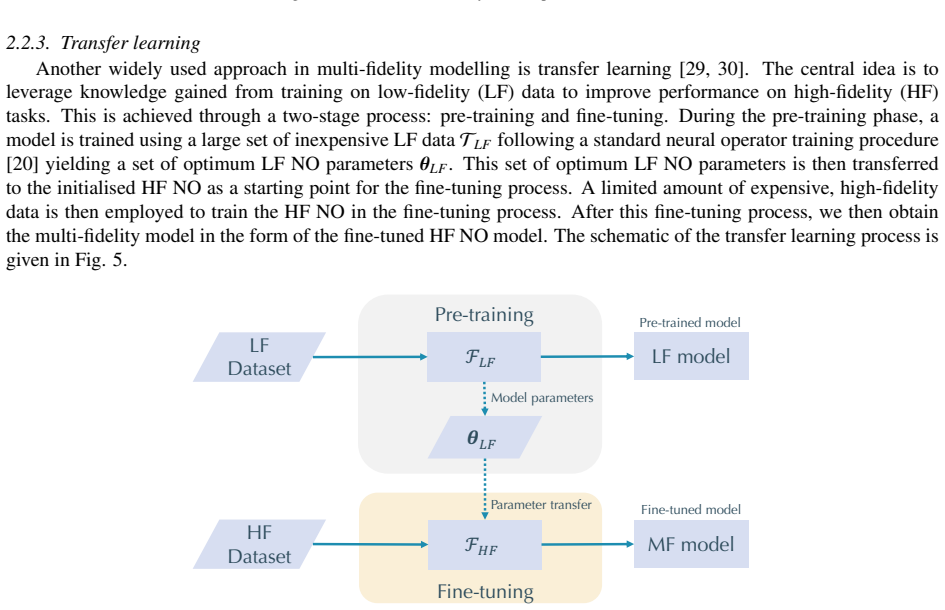
Solving PDE-governed physical problems is computationally expensive, limiting the availability of high-fidelity (HF) data for training neural operators, which typically require large datasets. Multi-fidelity learning addresses this by combining abundant low-fidelity (LF) data with limited HF samples. To evaluate several multi-fidelity neural operator strategies, including two-step, residual, intermediate, and transfer learning, we conduct a systematic assessment across four PDE test cases: two standard grid-based problems, a modified Darcy flow with LF-HF governing equation discrepancies, and an unsteady smoke inflow with temporal dynamics. Most prior studies focus on grid-based LF-HF differences, but real-world discrepancies, such as those between RANS and LES models in CFD, can be more complex. To capture these more challenging scenarios, we introduce two new test cases specifically designed to emulate nontrivial LF-HF mismatch beyond simple grid-resolution differences, enabling a more realistic assessment of multi-fidelity strategies under substantial model discrepancies. We find that methods directly feeding LF predictions into HF models are prone to error amplification under large LF-HF discrepancies, particularly in autoregressive settings. In contrast, transfer learning, which uses LF-trained weights to initialise the HF model, consistently improves accuracy by providing a robust prior refined with HF data. These results highlight the importance of establishing transfer learning as a reliable approach for efficient multi-fidelity PDE surrogate modelling.
Figures
Figures from the paper (14 more)
Reference graph
Works this paper leans on
-
[1]
P. Huthwaite, Accelerated finite element elastodynamic simulations using the gpu, Journal of Computational Physics 257 (2014) 687–707. doi:10.1016/j.jcp.2013.10.017. URLhttp://dx.doi.org/10.1016/j.jcp.2013.10.017
-
[2]
M. Bernardini, D. Modesti, F. Salvadore, S. Pirozzoli, Streams: A high-fidelity accelerated solver for direct numerical simulation of com- pressible turbulent flows, Computer Physics Communications 263 (2021) 107906. doi:10.1016/j.cpc.2021.107906. URLhttp://dx.doi.org/10.1016/j.cpc.2021.107906
arXiv 2021
-
[3]
H. Drucker, C. J. C. Burges, L. Kaufman, A. Smola, V . Vapnik, Support vector regression machines, in: M. Mozer, M. Jordan, T. Petsche (Eds.), Advances in Neural Information Processing Systems, V ol. 9, MIT Press, 1996, p. 1
work page 1996
-
[4]
C. E. Rasmussen, C. K. I. Williams, Gaussian processes for machine learning, Adaptive Computation and Machine Learning series, MIT Press, London, England, 2005
work page 2005
-
[5]
R. K. Tripathy, I. Bilionis, Deep uq: Learning deep neural network surrogate models for high dimensional uncertainty quantification, Journal of computational physics 375 (2018) 565–588
work page 2018
-
[6]
G. Sun, S. Wang, A review of the artificial neural network surrogate modeling in aerodynamic design, Proceedings of the Institution of Mechanical Engineers, Part G: Journal of Aerospace Engineering 233 (16) (2019) 5863–5872
work page 2019
-
[7]
A. Chatterjee, An introduction to the proper orthogonal decomposition, Current Science 78 (7) (2000) 808–817. URLhttp://www.jstor.org/stable/24103957
-
[8]
S. Pakravan, P. A. Mistani, M. A. Aragon-Calvo, F. Gibou, Solving inverse-pde problems with physics-aware neural networks, Journal of Computational Physics 440 (2021) 110414. doi:10.1016/j.jcp.2021.110414. URLhttp://dx.doi.org/10.1016/j.jcp.2021.110414
Show all 51 references
-
[9]
Molinaro, Y
R. Molinaro, Y . Yang, B. Engquist, S. Mishra, Neural inverse operators for solving pde inverse problems (2023). arXiv:2301.11167. URLhttps://arxiv.org/abs/2301.11167
2023 arXiv
-
[10]
J. Berg, K. Nystr ¨om, Neural networks as smooth priors for inverse problems for pdes, Journal of Computational Mathematics and Data Science 1 (2021) 100008. doi:10.1016/j.jcmds.2021.100008. URLhttp://dx.doi.org/10.1016/j.jcmds.2021.100008
2021
-
[11]
Raissi, P
M. Raissi, P. Perdikaris, G. E. Karniadakis, Multistep neural networks for data-driven discovery of nonlinear dynamical systems (2018). arXiv:1801.01236. URLhttps://arxiv.org/abs/1801.01236
2018 arXiv
-
[12]
S. Pan, K. Duraisamy, Data-driven discovery of closure models, SIAM Journal on Applied Dynamical Systems 17 (4) (2018) 2381–2413. doi:10.1137/18m1177263. URLhttp://dx.doi.org/10.1137/18M1177263
2018 doi
-
[13]
M. M. Rai, N. K. Madavan, Aerodynamic design using neural networks, AIAA Journal 38 (1) (2000) 173–182. doi:10.2514/2.938. URLhttp://dx.doi.org/10.2514/2.938
2000 doi
-
[14]
X. Du, P. He, J. R. Martins, Rapid airfoil design optimization via neural networks-based parameterization and surrogate modeling, Aerospace Science and Technology 113 (2021) 106701. doi:10.1016/j.ast.2021.106701. URLhttp://dx.doi.org/10.1016/j.ast.2021.106701
2021
-
[15]
Murtagh, Multilayer perceptrons for classification and regression, Neurocomputing 2 (5–6) (1991) 183–197
F. Murtagh, Multilayer perceptrons for classification and regression, Neurocomputing 2 (5–6) (1991) 183–197. doi:10.1016/0925- 2312(91)90023-5. URLhttp://dx.doi.org/10.1016/0925-2312(91)90023-5 18
1991 doi
-
[16]
Popescu, V
M.-C. Popescu, V . E. Balas, L. Perescu-Popescu, N. Mastorakis, Multilayer perceptron and neural networks, WSEAS Trans. Cir. and Sys. 8 (7) (2009) 579–588
2009
-
[17]
Lecun, L
Y . Lecun, L. Bottou, Y . Bengio, P. Haffner, Gradient-based learning applied to document recognition, Proceedings of the IEEE 86 (11) (1998) 2278–2324. doi:10.1109/5.726791. URLhttp://dx.doi.org/10.1109/5.726791
1998 doi
-
[18]
Raissi, P
M. Raissi, P. Perdikaris, G. Karniadakis, Physics-informed neural networks: A deep learning framework for solving forward and inverse prob- lems involving nonlinear partial differential equations, Journal of Computational Physics 378 (2019) 686–707. doi:10.1016/j.jcp.2018.10.0...
2019 doi
-
[19]
L. Lu, P. Jin, G. Pang, Z. Zhang, G. E. Karniadakis, Learning nonlinear operators via deeponet based on the universal approximation theorem of operators, Nature Machine Intelligence 3 (3) (2021) 218–229. doi:10.1038/s42256-021-00302-5. URLhttp://dx.doi.org/10.1038/s42256-021-00302-5
2021 doi
- [20]
-
[21]
D. E. Myers, Matrix formulation of co-kriging, Journal of the International Association for Mathematical Geology 14 (3) (1982) 249–257. doi:10.1007/bf01032887. URLhttp://dx.doi.org/10.1007/BF01032887
1982 doi
-
[22]
A. I. Forrester, A. S ´obester, A. J. Keane, Multi-fidelity optimization via surrogate modelling, Proceedings of the Royal Society A: Mathemat- ical, Physical and Engineering Sciences 463 (2088) (2007) 3251–3269. doi:10.1098/rspa.2007.1900. URLhttp://dx.doi.org/10.1098/rspa.2007.1900
2007
-
[23]
P. S. Palar, T. Tsuchiya, G. T. Parks, Multi-fidelity non-intrusive polynomial chaos based on regression, Computer Methods in Applied Mechanics and Engineering 305 (2016) 579–606. doi:10.1016/j.cma.2016.03.022. URLhttp://dx.doi.org/10.1016/j.cma.2016.03.022
2016 doi
-
[24]
Koziel, A
S. Koziel, A. Bekasiewicz, I. Couckuyt, T. Dhaene, Efficient multi-objective simulation-driven antenna design using co-kriging, IEEE Trans- actions on Antennas and Propagation 62 (11) (2014) 5900–5905. doi:10.1109/tap.2014.2354673. URLhttp://dx.doi.org/10.1109/TAP.2014.2354673
2014
-
[25]
X. Liu, W. Zhao, D. Wan, Multi-fidelity co-kriging surrogate model for ship hull form optimization, Ocean Engineering 243 (2022) 110239. doi:10.1016/j.oceaneng.2021.110239. URLhttp://dx.doi.org/10.1016/j.oceaneng.2021.110239
2022
-
[26]
X. Meng, G. E. Karniadakis, A composite neural network that learns from multi-fidelity data: Application to function approximation and inverse pde problems, Journal of Computational Physics 401 (2020) 109020. doi:10.1016/j.jcp.2019.109020. URLhttp://dx.doi.org/10.1016/j.jcp.20...
2020
-
[27]
M. Guo, A. Manzoni, M. Amendt, P. Conti, J. S. Hesthaven, Multi-fidelity regression using artificial neural networks: Efficient ap- proximation of parameter-dependent output quantities, Computer Methods in Applied Mechanics and Engineering 389 (2022) 114378. doi:10.1016/j.cma....
2022
-
[28]
Chakraborty, Transfer learning based multi-fidelity physics informed deep neural network, Journal of Computational Physics 426 (2021) 109942
S. Chakraborty, Transfer learning based multi-fidelity physics informed deep neural network, Journal of Computational Physics 426 (2021) 109942. doi:10.1016/j.jcp.2020.109942. URLhttp://dx.doi.org/10.1016/j.jcp.2020.109942
2021
-
[29]
Y . Lyu, X. Zhao, Z. Gong, X. Kang, W. Yao, Multi-fidelity prediction of fluid flow based on transfer learning using fourier neural operator, Physics of Fluids 35 (7) (jul 2023). doi:10.1063/5.0155555. URLhttp://dx.doi.org/10.1063/5.0155555
2023 doi
-
[30]
H. Tang, Q. Kong, J. P. Morris, Multi-fidelity fourier neural operator for fast modeling of large-scale geological carbon storage (2024). arXiv:2308.09113. URLhttps://arxiv.org/abs/2308.09113
2024 arXiv
-
[31]
Tripura, A
T. Tripura, A. Thakur, S. Chakraborty, Multi-fidelity wavelet neural operator surrogate model for time-independent and time-dependent reliability analysis, Probabilistic Engineering Mechanics 77 (2024) 103672. doi:10.1016/j.probengmech.2024.103672. URLhttp://dx.doi.org/10.1016...
2024
-
[32]
A. A. Howard, M. Perego, G. E. Karniadakis, P. Stinis, Multifidelity deep operator networks for data-driven and physics-informed problems, Journal of Computational Physics 493 (2023) 112462. doi:10.1016/j.jcp.2023.112462. URLhttp://dx.doi.org/10.1016/j.jcp.2023.112462
2023
-
[33]
Renard, S
N. Renard, S. Deck, ZONAL DETACHED EDDY SIMULATION OF UNSTEADY AIRFOIL AERODYNAMICS, in: AERO 2020+1 - 55th 3AF International Conference on Applied Conference, Poitiers (virtuel), France, 2021, p. 1. URLhttps://hal.science/hal-03206330
2020
-
[34]
Hendrycks, K
D. Hendrycks, K. Gimpel, Gaussian error linear units (gelus) (2023). arXiv:1606.08415. URLhttps://arxiv.org/abs/1606.08415
2023 arXiv
-
[35]
Elfwing, E
S. Elfwing, E. Uchibe, K. Doya, Sigmoid-weighted linear units for neural network function approximation in reinforcement learning (2017). arXiv:1702.03118. URLhttps://arxiv.org/abs/1702.03118
2017 arXiv
-
[36]
A. F. Agarap, Deep learning using rectified linear units (relu) (2019). arXiv:1803.08375. URLhttps://arxiv.org/abs/1803.08375
2019 arXiv
-
[37]
Z. Li, N. Kovachki, K. Azizzadenesheli, B. Liu, K. Bhattacharya, A. Stuart, A. Anandkumar, Neural operator: Graph kernel network for partial differential equations (2020). arXiv:2003.03485. URLhttps://arxiv.org/abs/2003.03485
2020 arXiv
-
[38]
Z. Li, N. Kovachki, K. Azizzadenesheli, B. Liu, K. Bhattacharya, A. Stuart, A. Anandkumar, Fourier neural operator for parametric partial 19 differential equations (2021). arXiv:2010.08895. URLhttps://arxiv.org/abs/2010.08895
2021 arXiv
-
[39]
Eldred, A
M. Eldred, A. Giunta, S. Collis, Second-Order Corrections for Surrogate-Based Optimization with Model Hierarchies, American Institute of Aeronautics and Astronautics, 2004, Ch. 1, p. 1. arXiv:https://arc.aiaa.org/doi/pdf/10.2514/6.2004-4457, doi:10.2514/6.2004-4457. URLhttps:/...
2004 doi
-
[40]
T. D. Robinson, M. S. Eldred, K. E. Willcox, R. Haimes, Surrogate-based optimization using multifidelity models with variable parameteri- zation and corrected space mapping, AIAA Journal 46 (11) (2008) 2814–2822. doi:10.2514/1.36043. URLhttp://dx.doi.org/10.2514/1.36043
2008 doi
-
[41]
Leifsson, S
L. Leifsson, S. Koziel, Multi-fidelity design optimization of transonic airfoils using physics-based surrogate modeling and shape-preserving response prediction, Journal of Computational Science 1 (2) (2010) 98–106. doi:10.1016/j.jocs.2010.03.007. URLhttp://dx.doi.org/10.1016/...
2010 doi
-
[42]
Zhang, N
Y . Zhang, N. H. Kim, C. Park, R. T. Haftka, Multifidelity surrogate based on single linear regression, AIAA Journal 56 (12) (2018) 4944–4952. doi:10.2514/1.j057299. URLhttp://dx.doi.org/10.2514/1.J057299
2018 doi
-
[43]
M. G. Fern ´andez-Godino, S. Dubreuil, N. Bartoli, C. Gogu, S. Balachandar, R. T. Haftka, Linear regression-based multifidelity sur- rogate for disturbance amplification in multiphase explosion, Structural and Multidisciplinary Optimization 60 (6) (2019) 2205–2220. doi:10.1007...
2019 doi
-
[44]
Giselle Fern ´andez-Godino, Review of multi-fidelity models, Advances in Computational Science and Engineering 1 (4) (2023) 351–400
M. Giselle Fern ´andez-Godino, Review of multi-fidelity models, Advances in Computational Science and Engineering 1 (4) (2023) 351–400. doi:10.3934/acse.2023015. URLhttp://dx.doi.org/10.3934/acse.2023015
2023 doi
-
[45]
Babaee, P
H. Babaee, P. Perdikaris, C. Chryssostomidis, G. E. Karniadakis, Multi-fidelity modelling of mixed convection based on experimental corre- lations and numerical simulations, Journal of Fluid Mechanics 809 (2016) 895–917. doi:10.1017/jfm.2016.718. URLhttp://dx.doi.org/10.1017/j...
2016 doi
-
[46]
Perdikaris, M
P. Perdikaris, M. Raissi, A. Damianou, N. D. Lawrence, G. E. Karniadakis, Nonlinear information fusion algorithms for data-efficient multi- fidelity modelling, Proceedings of the Royal Society A: Mathematical, Physical and Engineering Sciences 473 (2198) (2017) 20160751. doi:1...
2017
-
[47]
L. Lu, X. Meng, S. Cai, Z. Mao, S. Goswami, Z. Zhang, G. E. Karniadakis, A comprehensive and fair comparison of two neural op- erators (with practical extensions) based on fair data, Computer Methods in Applied Mechanics and Engineering 393 (2022) 114778. doi:10.1016/j.cma.202...
2022
-
[48]
Zakaria, A
K. Zakaria, A. N. Sinisuka, P. Palar, L. Zuhal, Prediction of smoke-inflow using recursive fourier neural operator dataset (2025). doi:10.5281/ZENODO.15629890. URLhttps://zenodo.org/doi/10.5281/zenodo.15629890
2025 doi
-
[49]
P. Holl, N. Thuerey,Φ flow (PhiFlow): Differentiable simulations for pytorch, tensorflow and jax, in: International Conference on Machine Learning, PMLR, 2024
2024
-
[50]
Lippe, B
P. Lippe, B. S. Veeling, P. Perdikaris, R. E. Turner, J. Brandstetter, PDE-Refiner: Achieving Accurate Long Rollouts with Temporal Neural PDE Solvers, in: Thirty-seventh Conference on Neural Information Processing Systems, 2023, p. 1. URLhttps://openreview.net/forum?id=Qv6468llWS
2023
-
[51]
Kohl, L.-W
G. Kohl, L.-W. Chen, N. Thuerey, Benchmarking autoregressive conditional diffusion models for turbulent flow simulation (2024). arXiv:2309.01745. URLhttps://arxiv.org/abs/2309.01745 20
2024 arXiv
Reviewed August 6, 2026 · model on record in the stance chip above.
Discussion (0). Sign in to comment.