QuadVerse: An Integrated Framework Aligning Visual-Physical Reality for Quadruped Simulation
Pith reviewed 2026-06-27 21:53 UTC · model grok-4.3
The pith
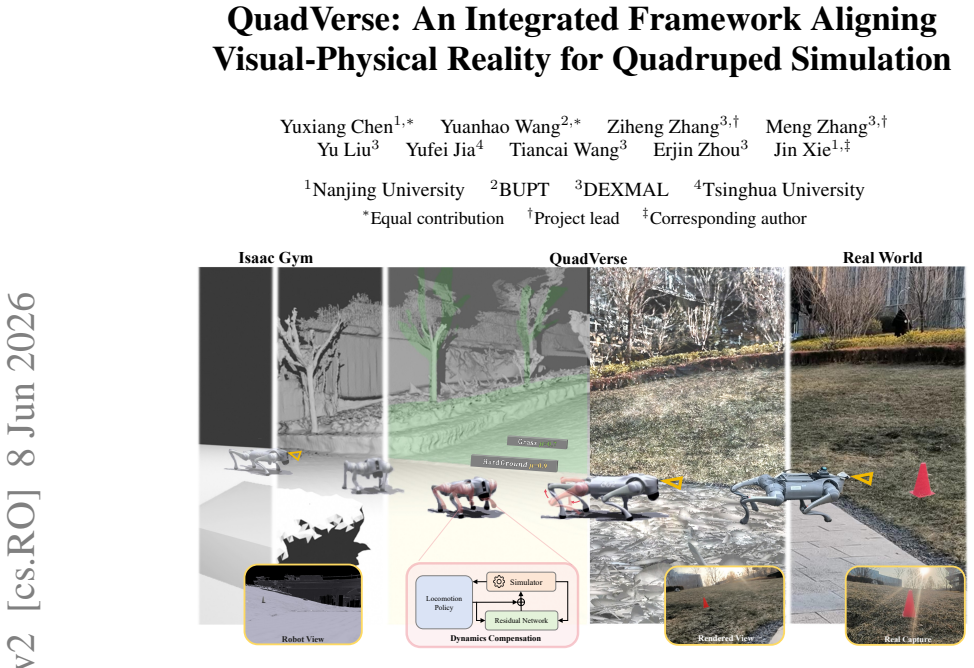
QuadVerse reconstructs 3D scenes from RGB video to align visual rendering, contact physics, and actuator dynamics in one quadruped simulation pipeline.
A machine-rendered reading of the paper's core claim, the machinery that carries it, and where it could break.
Core claim
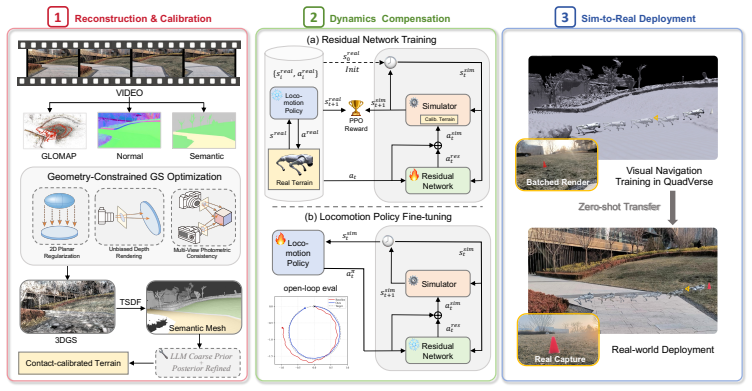
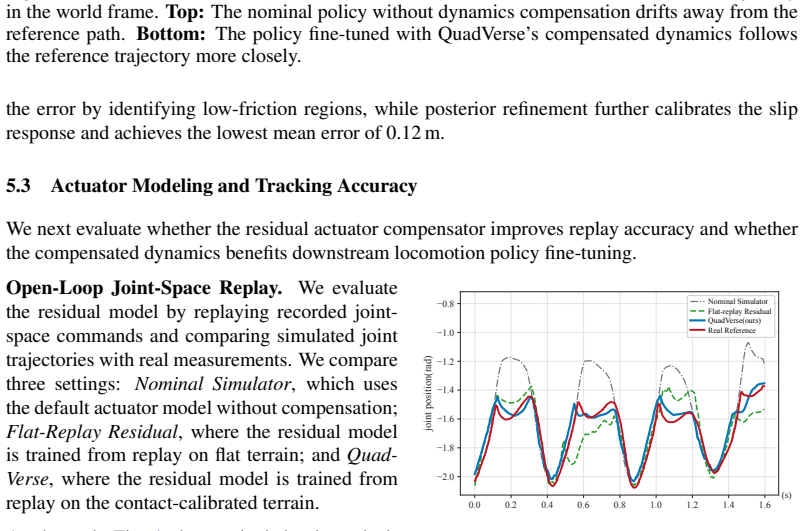
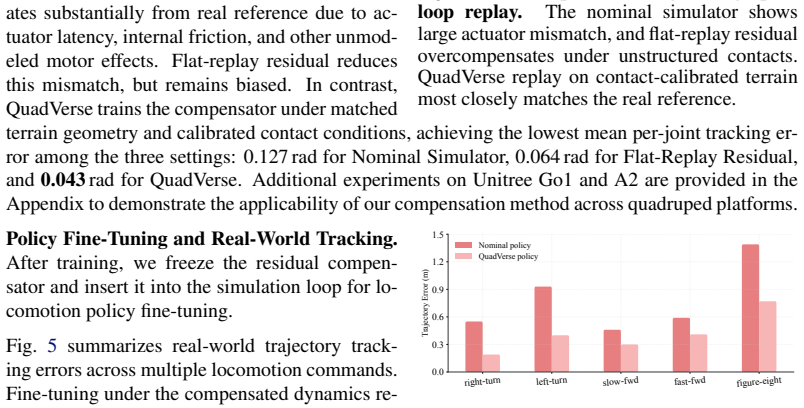
QuadVerse reconstructs geometry-constrained 3D Gaussian Splatting scenes from captured RGB videos. The scenes supply batched photorealistic rendering for visual perception and extract collision-ready semantic meshes. Contact calibration initializes spatially varying friction priors on the meshes and refines them through trajectory-based posterior search. A residual dynamics compensator trained by replaying real trajectories on the calibrated terrain then reduces entanglement between terrain-induced contact errors and actuator non-idealities. Experiments show gains in reconstruction quality and locomotion tracking, and the calibrated simulator supports robust zero-shot visual-navigation polic
What carries the argument
The QuadVerse pipeline: 3D Gaussian Splatting scene reconstruction that yields both renderable views and contact meshes, followed by posterior-search contact calibration and a replay-trained residual dynamics compensator.
If this is right
- Reconstruction quality and locomotion tracking both exceed relevant baselines.
- Visual-navigation policies transfer zero-shot without task-specific real-world rollouts.
- Batched photorealistic rendering and collision detection become available from the same reconstructed scene.
- Terrain-induced and actuator-induced errors are partially separated so each can be addressed more independently.
Where Pith is reading between the lines
- The same reconstruction-plus-calibration sequence could be applied to other robot morphologies once mesh extraction and trajectory replay are adapted.
- If the residual compensator generalizes, simulation fidelity could improve incrementally by updating only the compensator when new hardware data arrives.
- The approach suggests that error accumulation in long-horizon robot behavior can be reduced by aligning multiple mismatch sources inside one geometric substrate rather than patching them separately.
Load-bearing premise
The calibration steps on replayed trajectories are assumed to disentangle terrain contact errors from actuator discrepancies across all future environments and tasks.
What would settle it
A controlled test in which a policy trained entirely inside QuadVerse is deployed on real hardware in previously unseen terrain and its success rate is compared against the simulation-predicted success rate.
Figures


read the original abstract
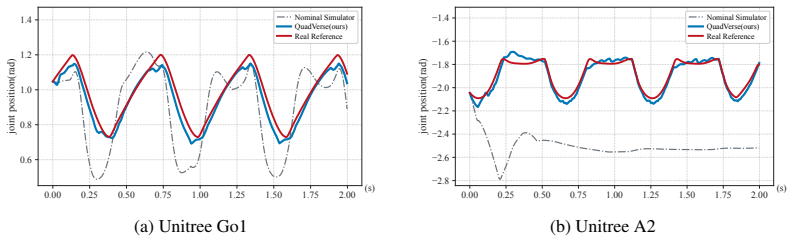
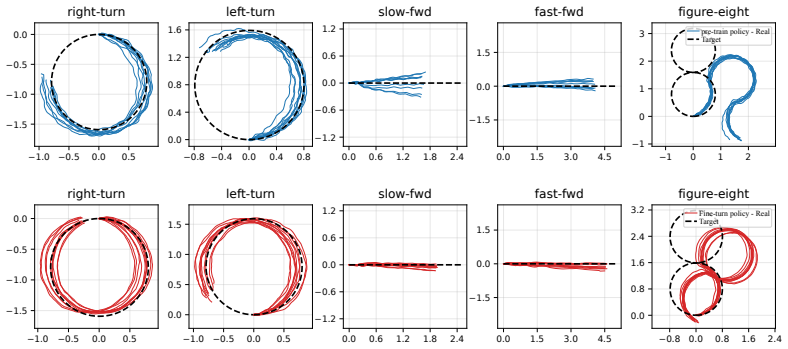
Simulation is central to robot learning, yet the sim-to-real gap remains a major bottleneck. Existing approaches often tackle visual or dynamic gaps separately, overlooking how these individual mismatches accumulate and propagate throughout the robot's state evolution. In this paper, we introduce QuadVerse, an integrated framework that uses reconstructed scenes as a calibration substrate for aligning visual perception, physical interaction, and actuator dynamics. From captured RGB videos, we reconstruct geometry-constrained 3D Gaussian Splatting (3DGS) scenes that support batched photorealistic ego-view rendering and collision-ready semantic mesh extraction. The meshes further enable contact calibration by initializing spatially varying friction priors and refining them through trajectory-based posterior search. To address remaining actuator discrepancies, QuadVerse trains a residual dynamics compensator by replaying real-world trajectories on the contact-calibrated terrain, reducing the entanglement between terrain-induced contact errors and actuator non-idealities. Experiments show that QuadVerse improves reconstruction quality and locomotion tracking over relevant baselines. Leveraging this foundation, we demonstrate robust zero-shot visual-navigation policy deployment without task-specific real-world rollouts.
Editorial analysis
A structured set of objections, weighed in public.
Referee Report
Summary. The paper introduces QuadVerse, an integrated framework for quadruped robot simulation that aligns visual perception, physical interaction, and actuator dynamics. From RGB videos it reconstructs geometry-constrained 3D Gaussian Splatting scenes supporting photorealistic ego-view rendering and collision-ready semantic mesh extraction; these meshes enable contact calibration via spatially varying friction priors refined by trajectory-based posterior search. A residual dynamics compensator is then trained by replaying real-world trajectories on the calibrated terrain to reduce entanglement between terrain-induced contact errors and actuator non-idealities. The work claims improved reconstruction quality and locomotion tracking over baselines together with robust zero-shot visual-navigation policy deployment without task-specific real-world rollouts.
Significance. If the disentanglement performed by the residual compensator generalizes and the zero-shot transfer holds, the integrated calibration pipeline could meaningfully advance sim-to-real transfer for legged robots by addressing cumulative mismatches rather than treating visual and dynamic gaps in isolation. The use of reconstructed scenes as a shared calibration substrate is a coherent design choice.
major comments (2)
- [Residual dynamics compensator (method)] Method section on residual dynamics compensator: training proceeds by replaying the same real trajectories used for posterior friction search on the contact-calibrated meshes. No description is given of held-out trajectories, cross-validation, or independent metrics that would confirm the compensator isolates actuator non-idealities rather than absorbing terrain-specific residuals. This directly affects the validity of the zero-shot navigation claim.
- [Experiments] Experiments: the abstract asserts improvements in reconstruction quality and locomotion tracking over baselines, yet the manuscript provides neither quantitative metrics, error bars, baseline implementations, nor ablation results that would allow assessment of effect size or component contributions.
minor comments (1)
- [Contact calibration] Notation for the friction prior and posterior search could be made more explicit (e.g., explicit functional form of the likelihood used in the trajectory-based search).
Simulated Author's Rebuttal
We thank the referee for the constructive feedback. We address each major comment below and will revise the manuscript to incorporate the suggested improvements.
read point-by-point responses
-
Referee: [Residual dynamics compensator (method)] Method section on residual dynamics compensator: training proceeds by replaying the same real trajectories used for posterior friction search on the contact-calibrated meshes. No description is given of held-out trajectories, cross-validation, or independent metrics that would confirm the compensator isolates actuator non-idealities rather than absorbing terrain-specific residuals. This directly affects the validity of the zero-shot navigation claim.
Authors: We agree that the method section lacks explicit details on held-out trajectories, cross-validation, or independent metrics for the residual dynamics compensator. This is a valid point that could affect interpretation of the zero-shot claims. In the revised manuscript, we will add a description of the data partitioning procedure (including held-out trajectories), cross-validation approach, and independent metrics such as residual prediction error on unseen data to demonstrate isolation of actuator non-idealities from terrain effects. revision: yes
-
Referee: [Experiments] Experiments: the abstract asserts improvements in reconstruction quality and locomotion tracking over baselines, yet the manuscript provides neither quantitative metrics, error bars, baseline implementations, nor ablation results that would allow assessment of effect size or component contributions.
Authors: We agree with the observation that the experiments section does not currently provide quantitative metrics with error bars, detailed baseline implementations, or ablation results. We will revise the experiments section to include these elements, reporting specific metrics with error bars, clarifying baseline setups, and adding ablations to quantify the contribution of each component. revision: yes
Circularity Check
No significant circularity detected
full rationale
The abstract and provided text describe a sequential pipeline: 3DGS reconstruction from RGB, mesh extraction, friction calibration via trajectory-based posterior search, followed by training a residual compensator on replays of those trajectories. No equations, self-citations, or derivations are quoted that reduce any claimed result (e.g., disentanglement or zero-shot performance) to its inputs by construction. The central claims rest on external experimental benchmarks for reconstruction quality and locomotion tracking, which are independent of the method steps. No self-definitional, fitted-input-renamed-as-prediction, or load-bearing self-citation patterns appear. This is a standard multi-stage engineering framework evaluated empirically.
Axiom & Free-Parameter Ledger
free parameters (2)
- spatially varying friction priors
- residual dynamics compensator parameters
axioms (1)
- domain assumption Reconstructed 3DGS scenes provide collision-ready semantic meshes that accurately represent real geometry for contact simulation.
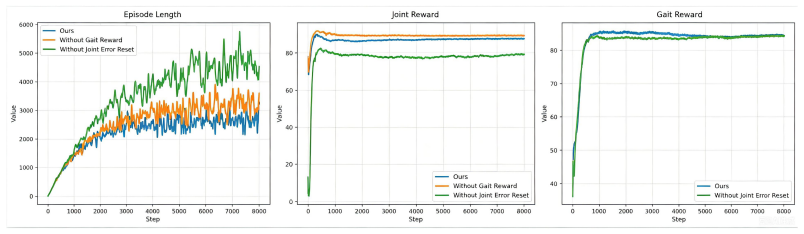
Reference graph
Works this paper leans on
-
[1]
Bledt, M
G. Bledt, M. J. Powell, B. Katz, J. Di Carlo, P. M. Wensing, and S. Kim. Mit cheetah 3: Design and control of a robust, dynamic quadruped robot. In2018 IEEE/RSJ International Conference on Intelligent Robots and Systems (IROS), pages 2245–2252. IEEE, 2018
2018
-
[2]
B. Katz, J. Di Carlo, and S. Kim. Mini cheetah: A platform for pushing the limits of dynamic quadruped control. In2019 international conference on robotics and automation (ICRA), pages 6295–6301. IEEE, 2019
2019
-
[3]
J. Lee, J. Hwangbo, L. Wellhausen, V . Koltun, and M. Hutter. Learning quadrupedal locomo- tion over challenging terrain.Science robotics, 5(47):eabc5986, 2020
2020
-
[4]
Hwangbo, J
J. Hwangbo, J. Lee, A. Dosovitskiy, D. Bellicoso, V . Tsounis, V . Koltun, and M. Hutter. Learn- ing agile and dynamic motor skills for legged robots.Science Robotics, 4(26):eaau5872, 2019
2019
-
[5]
T. Miki, J. Lee, J. Hwangbo, L. Wellhausen, V . Koltun, and M. Hutter. Learning robust percep- tive locomotion for quadrupedal robots in the wild.Science robotics, 7(62):eabk2822, 2022
2022
-
[6]
V . Makoviychuk, L. Wawrzyniak, Y . Guo, M. Lu, K. Storey, M. Macklin, D. Hoeller, N. Rudin, A. Allshire, A. Handa, et al. Isaac gym: High performance gpu-based physics simulation for robot learning.arXiv preprint arXiv:2108.10470, 2021
Pith/arXiv arXiv 2021
-
[7]
M. Mittal, P. Roth, J. Tigue, A. Richard, O. Zhang, P. Du, A. Serrano-Mu ˜noz, X. Yao, R. Zurbr ¨ugg, N. Rudin, et al. Isaac lab: A gpu-accelerated simulation framework for multi- modal robot learning.arXiv preprint arXiv:2511.04831, 2025
Pith/arXiv arXiv 2025
-
[8]
Todorov, T
E. Todorov, T. Erez, and Y . Tassa. Mujoco: A physics engine for model-based control. In2012 IEEE/RSJ international conference on intelligent robots and systems, pages 5026–5033. IEEE, 2012
2012
- [9]
-
[10]
W. Zhao, J. P. Queralta, and T. Westerlund. Sim-to-real transfer in deep reinforcement learning for robotics: a survey. In2020 IEEE symposium series on computational intelligence (SSCI), pages 737–744. IEEE, 2020
2020
-
[11]
Z. Xie, Z. Liu, Z. Peng, W. Wu, and B. Zhou. Vid2sim: Realistic and interactive simulation from video for urban navigation. InProceedings of the IEEE/CVF Conference on Computer Vision and Pattern Recognition, 2024
2024
-
[12]
S. Zhu, L. Mou, D. Li, B. Ye, R. Huang, and H. Zhao. Vr-robo: A real-to-sim-to-real frame- work for visual robot navigation and locomotion.IEEE Robotics and Automation Letters, 2025
2025
-
[13]
Chhablani, X
G. Chhablani, X. Ye, M. Z. Irshad, and Z. Kira. Embodiedsplat: Personalized real-to-sim-to- real navigation with gaussian splats from a mobile device. InProceedings of the IEEE/CVF International Conference on Computer Vision, pages 25431–25441, 2025
2025
-
[14]
A. Escontrela, J. Kerr, A. Allshire, J. Frey, R. Duan, C. Sferrazza, and P. Abbeel. Gaussgym: An open-source real-to-sim framework for learning locomotion from pixels.arXiv preprint arXiv:2510.15352, 2025
arXiv 2025
-
[15]
Tobin, R
J. Tobin, R. Fong, A. Ray, J. Schneider, W. Zaremba, and P. Abbeel. Domain randomization for transferring deep neural networks from simulation to the real world. In2017 IEEE/RSJ international conference on intelligent robots and systems (IROS), pages 23–30. IEEE, 2017
2017
-
[16]
X. B. Peng, M. Andrychowicz, W. Zaremba, and P. Abbeel. Sim-to-real transfer of robotic control with dynamics randomization. In2018 IEEE international conference on robotics and automation (ICRA), pages 3803–3810. IEEE, 2018. 9
2018
-
[17]
Siekmann, Y
J. Siekmann, Y . Godse, A. Fern, and J. Hurst. Sim-to-real learning of all common bipedal gaits via periodic reward composition. In2021 IEEE International Conference on Robotics and Automation (ICRA), pages 7309–7315. IEEE, 2021
2021
-
[18]
Masuda and K
S. Masuda and K. Takahashi. Sim-to-real transfer of compliant bipedal locomotion on torque sensor-less gear-driven humanoid. In2023 IEEE-RAS 22nd International Conference on Hu- manoid Robots (Humanoids), pages 1–8. IEEE, 2023
2023
-
[19]
O’Connell, G
M. O’Connell, G. Shi, X. Shi, K. Azizzadenesheli, A. Anandkumar, Y . Yue, and S.-J. Chung. Neural-fly enables rapid learning for agile flight in strong winds.Science Robotics, 7(66): eabm6597, 2022
2022
-
[20]
Sobanbabu, G
N. Sobanbabu, G. He, T. He, Y . Yang, and G. Shi. Sampling-based system identification with active exploration for legged sim2real learning. In9th Annual Conference on Robot Learning, 2025
2025
-
[21]
Kerbl, G
B. Kerbl, G. Kopanas, T. Leimk ¨uhler, and G. Drettakis. 3d gaussian splatting for real-time radiance field rendering.ACM Transactions on Graphics, 42(4), 2023
2023
-
[22]
H. Lou, Y . Liu, Y . Pan, Y . Geng, J. Chen, W. Ma, C. Li, L. Wang, H. Feng, L. Shi, et al. Robo- gs: A physics consistent spatial-temporal model for robotic arm with hybrid representation. In2025 IEEE International Conference on Robotics and Automation (ICRA), pages 15379– 15386. IEEE, 2025
2025
-
[23]
X. Li, J. Li, Z. Zhang, R. Zhang, F. Jia, T. Wang, H. Fan, K.-K. Tseng, and R. Wang. Robogsim: A real2sim2real robotic gaussian splatting simulator.arXiv preprint arXiv:2411.11839, 2024
arXiv 2024
-
[24]
Y . Jia, G. Wang, Y . Dong, J. Wu, Y . Zeng, H. Lin, Z. Wang, H. Ge, W. Gu, K. Ding, et al. Discoverse: Efficient robot simulation in complex high-fidelity environments.arXiv preprint arXiv:2507.21981, 2025
arXiv 2025
-
[25]
P. Ewen, G. Gunjal, H. Chen, A. Li, Y . Chen, and R. Vasudevan. Multi-modal semantic percep- tion using bayesian inference. InIEEE IROS Workshop on Integrated Perception, Planning, and Control for Physically and Contextually-Aware Robot Autonomy, 2023
2023
-
[26]
J. Chen, J. Frey, R. Zhou, T. Miki, G. Martius, and M. Hutter. Identifying terrain physical parameters from vision-towards physical-parameter-aware locomotion and navigation.IEEE Robotics and Automation Letters, 2024
2024
-
[27]
B. Peng, D. Baek, Q. Wang, and J. Ramos. Friction-aware safety locomotion for wheeled- legged robots using vision language models and reinforcement learning.arXiv preprint arXiv:2409.09845, 2024
arXiv 2024
-
[28]
X. Xu, W. Ge, D. Qiu, Z. Chen, D. Yan, Z. Liu, H. Zhao, H. Zhao, S. Zhang, J. Liang, et al. Gaussianproperty: Integrating physical properties to 3d gaussians with lmms. InProceedings of the IEEE/CVF International Conference on Computer Vision, pages 7231–7240, 2025
2025
-
[29]
G. B. Margolis, X. Fu, Y . Ji, and P. Agrawal. Learning to see physical properties with active sensing motor policies.arXiv preprint arXiv:2311.01405, 2023
arXiv 2023
-
[30]
W. Yu, J. Tan, C. K. Liu, and G. Turk. Preparing for the unknown: Learning a universal policy with online system identification.arXiv preprint arXiv:1702.02453, 2017
Pith/arXiv arXiv 2017
-
[31]
H. Kim, D. Kang, M.-G. Kim, G. Kim, and H.-W. Park. Online friction coefficient identifi- cation for legged robots on slippery terrain using smoothed contact gradients.IEEE Robotics and Automation Letters, 2025
2025
-
[32]
J. Tan, T. Zhang, E. Coumans, A. Iscen, Y . Bai, D. Hafner, S. Bohez, and V . Vanhoucke. Sim- to-real: Learning agile locomotion for quadruped robots.arXiv preprint arXiv:1804.10332, 2018. 10
Pith/arXiv arXiv 2018
-
[33]
N. Fey, G. B. Margolis, M. Peticco, and P. Agrawal. Bridging the sim-to-real gap for athletic loco-manipulation.arXiv preprint arXiv:2502.10894, 2025
arXiv 2025
-
[34]
X. Liu, H. Wang, and L. Yi. Dexndm: Closing the reality gap for dexterous in-hand rotation via joint-wise neural dynamics model.arXiv preprint arXiv:2510.08556, 2025
arXiv 2025
-
[35]
T. He, J. Gao, W. Xiao, Y . Zhang, Z. Wang, J. Wang, Z. Luo, G. He, N. Sobanbab, C. Pan, et al. Asap: Aligning simulation and real-world physics for learning agile humanoid whole- body skills.arXiv preprint arXiv:2502.01143, 2025
arXiv 2025
-
[36]
L. Pan, D. Bar ´ath, M. Pollefeys, and J. L. Sch¨onberger. Global structure-from-motion revisited. InEuropean Conference on Computer Vision, pages 58–77. Springer, 2024
2024
- [37]
-
[38]
D. Chen, H. Li, W. Ye, Y . Wang, W. Xie, S. Zhai, N. Wang, H. Liu, H. Bao, and G. Zhang. Pgsr: Planar-based gaussian splatting for efficient and high-fidelity surface reconstruction.IEEE Transactions on Visualization and Computer Graphics, 2024
2024
-
[39]
N. D. Campbell, G. V ogiatzis, C. Hern ´andez, and R. Cipolla. Using multiple hypotheses to improve depth-maps for multi-view stereo. InEuropean conference on computer vision, pages 766–779. Springer, 2008
2008
-
[40]
Q. Fu, Q. Xu, Y . S. Ong, and W. Tao. Geo-neus: Geometry-consistent neural implicit surfaces learning for multi-view reconstruction.Advances in Neural Information Processing Systems, 35:3403–3416, 2022
2022
-
[41]
C. Ye, L. Qiu, X. Gu, Q. Zuo, Y . Wu, Z. Dong, L. Bo, Y . Xiu, and X. Han. Stablenormal: Reducing diffusion variance for stable and sharp normal.ACM Transactions on Graphics (TOG), 43(6):1–18, 2024
2024
-
[42]
V . Ye, R. Li, J. Kerr, M. Turkulainen, B. Yi, Z. Pan, O. Seiskari, J. Ye, J. Hu, M. Tancik, et al. gsplat: An open-source library for gaussian splatting.Journal of Machine Learning Research, 26(34):1–17, 2025
2025
-
[43]
Y . Jia, H. Zhang, Z. Zhang, J. Wu, M. Yu, Z. Wang, D. Jiang, Z. Li, C. Cao, Z. Yu, et al. Gs- playground: A high-throughput photorealistic simulator for vision-informed robot learning. arXiv preprint arXiv:2604.25459, 2026
Pith/arXiv arXiv 2026
-
[44]
R. A. Newcombe, S. Izadi, O. Hilliges, D. Molyneaux, D. Kim, A. J. Davison, P. Kohi, J. Shot- ton, S. Hodges, and A. Fitzgibbon. Kinectfusion: Real-time dense surface mapping and track- ing. In2011 10th IEEE international symposium on mixed and augmented reality, pages 127–136. Ieee, 2011
2011
-
[45]
W. E. Lorensen and H. E. Cline. Marching cubes: A high resolution 3d surface construction algorithm. InSeminal graphics: pioneering efforts that shaped the field, pages 347–353. 1998
1998
-
[46]
Z. Chen, Y . Duan, W. Wang, J. He, T. Lu, J. Dai, and Y . Qiao. Vision transformer adapter for dense prediction. InInternational Conference on Learning Representations, 2023
2023
-
[47]
Cover and P
T. Cover and P. Hart. Nearest neighbor pattern classification.IEEE transactions on information theory, 13(1):21–27, 1967
1967
-
[48]
J. Achiam, S. Adler, S. Agarwal, L. Ahmad, I. Akkaya, F. L. Aleman, D. Almeida, J. Altenschmidt, S. Altman, S. Anadkat, et al. Gpt-4 technical report.arXiv preprint arXiv:2303.08774, 2023
Pith/arXiv arXiv 2023
-
[49]
J. Schulman, F. Wolski, P. Dhariwal, A. Radford, and O. Klimov. Proximal policy optimization algorithms.arXiv preprint arXiv:1707.06347, 2017. 11
Pith/arXiv arXiv 2017
-
[50]
Xu and F
W. Xu and F. Zhang. Fast-lio: A fast, robust lidar-inertial odometry package by tightly-coupled iterated kalman filter.IEEE Robotics and Automation Letters, 6(2):3317–3324, 2021
2021
-
[51]
M ¨uller, A
T. M ¨uller, A. Evans, C. Schied, and A. Keller. Instant neural graphics primitives with a mul- tiresolution hash encoding.ACM Transactions on Graphics (ToG), 41(4):1–15, 2022
2022
-
[52]
Y . Liu, C. Luo, Z. Tang, J. Peng, and Z. Zhang. Vggt-x: When vggt meets dense novel view synthesis.arXiv preprint arXiv:2509.25191, 2025
arXiv 2025
-
[53]
Gu ´edon, D
A. Gu ´edon, D. Gomez, N. Maruani, B. Gong, G. Drettakis, and M. Ovsjanikov. Milo: Mesh-in- the-loop gaussian splatting for detailed and efficient surface reconstruction.ACM Transactions on Graphics (TOG), 44(6):1–15, 2025. 12 Appendix Table of Contents A Details of Geometry-Anchored Reconstruction 13 A.1 Geometry-Constrained Gaussian Optimization . . . ....
2025
-
[54]
(Moderate)exp(−20∥q real −q sim∥2
100.0 Joint Pos. (Moderate)exp(−20∥q real −q sim∥2
-
[55]
(Strict)exp(−100∥q real −q sim∥2
100.0 Joint Pos. (Strict)exp(−100∥q real −q sim∥2
-
[56]
100.0 Gait and Contact Imitation Foot ContactI(F sim >10∧F real >20) 100.0 Foot Slip Penaltyexp(−10∥v sim f oot,xy∥2
-
[57]
(Z)exp(−10∥v sim z ∥2
100.0 Base Linear Vel. (Z)exp(−10∥v sim z ∥2
-
[58]
50.0 Ang. Vel. (Yaw)exp(−4∥ω real yaw −ω sim yaw∥2
-
[59]
100.0 Regularization Action Rateexp(−∥a t −a t−1∥2
-
[60]
5.0 Action Normexp(−0.01∥a t∥2
-
[61]
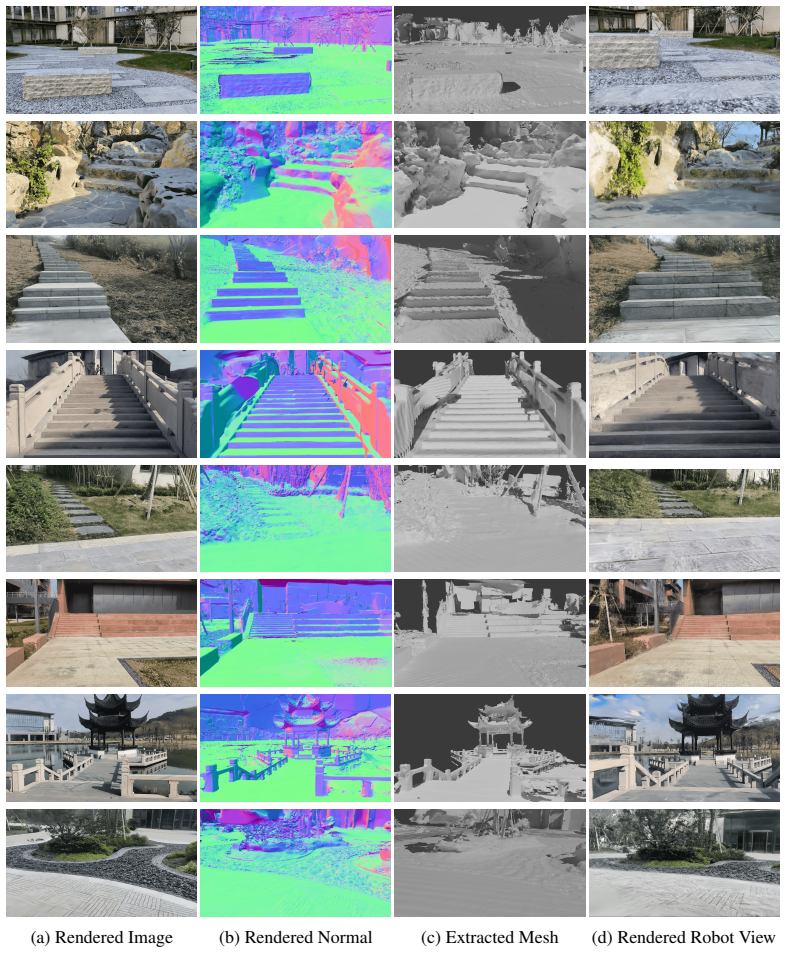
100.0 D Additional Qualitative Results of Scene Reconstruction Figure 7 shows additional qualitative reconstruction results across multiple outdoor scenarios. From left to right, the four key components are as follows: (a) the rendered RGB image, (b) the ren- dered normal map, (c) the extracted mesh, and (d) the simulated robot perspective, with the camer...
discussion (0)
Sign in with ORCID, Apple, or X to comment. Anyone can read and Pith papers without signing in.