REVIEW 3 major objections 5 minor 55 references
Headache to Overstock? Promoting Long-tail Items through Debiased Product Bundling
T0 review · 3 major / 5 minor · reviewed 2026-08-12 · deepseek-v4-flash
Pith's one-line read A distillation framework that treats bundle co-membership as a popularity-free teacher signal lifts Recall@20 for long-tail completions by up to 15.43% on Spotify and 9.34% on POG while preserving overall bundling performance.
desk verdict Useful new problem and a neat KD setup, but the debiasing claim rests on an unproven assumption about the bundle-item view. read the letter →
The pith
A machine-rendered reading of the paper's core claim, the machinery that carries it, and where it could break.
The reading
What carries the argument
The machinery is a teacher-student distillation pair. The teacher, PCD (Popularity-free Collaborative Distribution Modeling), encodes the partial bundle with only freely-learned item-ID embeddings and self-attention over the bundle-item view, producing logits for how likely each item is to complete the bundle; this view is claimed to be popularity-free. The student, UBT (Unbiased Bundle-aware Knowledge Transferring), is the actual bundling model: it fuses textual and media features (the content path) with the potentially biased user-feedback features, and is trained with the original construction loss plus a KL-divergence distillation loss (with temperature $T$) that pulls the student's logits toward the teacher's soft distribution. Using the content-only bundle representation for the student's score computation prevents the student from simply memorizing the teacher's answers.
What would settle it
Construct or find a dataset in which bundle co-membership is popularity-correlated by design—for example, bundles assembled only from popular items when popular items are in the query, so that long-tail items never co-occur with popular ones in the training bundles. Under DieT, the PCD teacher would then have no signal for the Pop-to-LT direction, and the recalls should drop back to the student-alone level; if DieT still shows a large gain, the claim that bundle-item affiliation is popularity-free would need to be revised.
Extended reading notes
Core claim
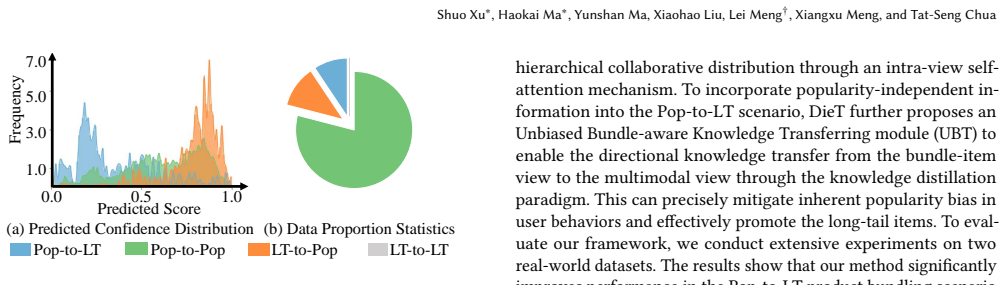
The central claim is that the popularity bias that hurts long-tail recommendations in product bundling has a specific source and a specific cure. The source is the pre-extracted user-item feedback features: they encode interaction counts, so they inflate the scores of already-popular items. The cure is to mine the bundle-item affiliation view, which the paper argues is popularity-free, and to inject its knowledge into the item-content path of a multimodal student model via distillation with soft targets. The paper demonstrates that the direction of transfer matters: transferring from bundle-item view to content view works, and the design deliberately keeps the student's bundle representation modality-specific so the student learns content-based reasoning rather than copying the teacher. Results on Spotify and POG show gains concentrated exactly in the Pop-to-LT scenario, with the largest relative improvements under the strictest popularity splits.
Load-bearing premise
The whole debiasing chain rests on the bundle-item affiliation view being free of popularity bias: if bundle membership itself is popularity-driven, the teacher that DieT distills from would teach the student the very bias it is meant to remove.
Editorial extensions
If this is right
- Surgical analysis shows that dropping user-feedback features from CLHE does not hurt and can help Pop-to-LT, while dropping bundle-item affiliation or multimodal features hurts substantially; the model design follows directly from that finding.
- On Spotify, DieT raises Recall@20 in the Pop-to-LT scenario from 0.0741 (CLHE) to 0.0860, a 15.43% relative gain, and on POG from 0.0661 to 0.0773, a 9.34% gain.
- Gains are larger at k=20 than at k=40, so the method sharpens the top of the ranked list, which is where shoppers and playlist makers actually look.
- The framework is model-agnostic: adding DieT's two modules to Transformer and Hypergraph backbones also improves their Pop-to-LT behavior, so the debiasing idea transfers beyond the original backbone.
Reading between the lines
- A further implication the paper does not pursue: the one-way transfer from bundle-item view to content view assumes the pre-trained content embeddings carry no popularity skew of their own; a stricter test would whiten or debias the content features before distillation, or run distillation in the reverse direction.
- Because gains concentrate at k=20 over k=40, an unmeasured consequence is that DieT should be even stronger at high-precision cutoffs like k=5 or k=10; a product-facing variant could re-rank existing bundle suggestions with the teacher's soft distribution at little extra cost.
- The paper defines popularity strictly as interaction count; in real catalogs, recency, price, and brand recognition also shape exposure, so the popularity-free claim is domain-dependent and would need re-verification before deploying DieT on, say, electronics or grocery bundles.
Signed reviews
Editorial analysis
A structured set of objections, weighed in public.
Referee Report
Summary. The paper addresses the task of long-tail product bundling (Pop-to-LT), where a partial bundle of popular items must be completed with long-tail items. The authors argue that item-level user feedback features introduce popularity bias, while bundle-item affiliation and multimodal content features are popularity-free. They propose DieT, a knowledge-distillation framework with two modules: PCD, which captures bundle-item collaborative distributions from the bundle-item view using only item embeddings, and UBT, which distills that knowledge into the content-feature branch of a student model while retaining the original user-feedback features for overall performance. Experiments on POG and Spotify compare DieT against several baselines, reporting gains in the Pop-to-LT scenario and comparable overall performance. The paper also includes robustness analyses over popularity ratios, distillation variants, and alternative backbones.
Significance. If the central assumption is sound, this is a useful contribution: it identifies a practically relevant scenario, proposes a model-agnostic debiasing mechanism, and shows consistent improvement over strong baselines on two real-world datasets. The generalization experiments to Transformer and Hypergraph backbones are a particular strength, as is the careful surgical analysis that motivates removing or down-weighting user-feedback features. However, the paper's core claim that the bundle-item view is “popularity-free” is asserted rather than demonstrated. Since the whole debiasing mechanism rests on this premise, the paper's main result is conditional on evidence that the teacher signal itself is not popularity-biased. The lack of error bars and significance tests also leaves the magnitude of the reported gains uncertain, especially where improvements are small.
major comments (3)
- [Section 4.2 and Eq. (4), (8)] The claim that the PCD teacher is popularity-free is load-bearing but unsupported. The text asserts that items “exhibit diverse popularity distribution in the user-item view (infrequent) and the bundle-item view (frequent)”, but no quantitative evidence is provided that bundle-item co-occurrence frequency is uncorrelated with user-item popularity. If popular items are also more likely to appear in bundles (a plausible Matthew effect in the bundle-view), the logits in Eq. (4) are popularity-biased, and the KL distillation in Eq. (8) transfers that bias into the content features rather than removing it. The authors should report the correlation (e.g., Spearman) between item popularity rank and bundle-item frequency, and ideally show the joint distribution; if such a correlation is present, they should explain why the distillation still removes bias or modify the method.
- [Section 5.2, Tables 2 and 3] No error bars, confidence intervals, or significance tests are reported for any of the main results. The improvements over the best baseline are sometimes small (e.g., POG N@20 +2.62%, N@40 +1.91% in Table 2; POG R@20 +0.11% in Table 3), and without variance information it is impossible to tell whether these gains are reproducible. The authors should run each method multiple times with different seeds and report mean and standard deviation, and ideally perform a paired significance test (e.g., Wilcoxon) for the Pop-to-LT results.
- [Section 3.3 and Section 5.1.1] The surgical analysis that motivates the design is performed on the same datasets and evaluation protocol that are later used for reporting the main results. This creates a risk of overfitting the method to dataset-specific quirks. The authors should clarify whether the observations in Section 3.3 were made on a held-out validation set, and if not, caution that the design decisions are not independent of the test set.
minor comments (5)
- [Figure 4 caption] The caption refers to “the overall structure of Diet”; this should read “DieT”.
- [Eq. (1) and notation] The notation \(\hat{\boldsymbol{H}}\) and \(\tilde{\boldsymbol{H}}\) is introduced without explicitly defining the tilde/hat distinction; please clarify the notation for the intermediate representations in the self-attention layers.
- [Eq. (9)] The summation expression \(\frac{1}{|N|}\sum_{i=0}^{N-1}\) is malformed and should be written as \(\frac{1}{N}\sum_{i=0}^{N-1}\) or similar; also ensure the symbol \(|N|\) is defined consistently with \(N\).
- [Section 5.1.1] The construction of the Pop-to-LT test set is described only briefly: “while keeping the items within the bundle unchanged, we only modify whether they act as inputs or targets in the test set.” Please specify how the 30% threshold for popular and long-tail items is applied, and how partial bundles of varying sizes are handled.
- [Section 5.4] In the generalization analysis, the phrase “these two models with three types of features as UBK’s backbone” uses “UBK” instead of “UBT”; please correct.
Circularity Check
No significant circularity: the reported gains are empirical and not forced by construction.
full rationale
The paper's derivation chain is not circular. The claimed contribution is a knowledge-distillation framework (PCD teacher over the bundle-item view, UBT student over content features, KL distillation in Eq. 8) evaluated on held-out test splits against external baselines on two real-world datasets. No fitted parameter is renamed as a prediction: hyperparameters are selected by grid search, and the reported Pop-to-LT and full-scenario metrics are measured, not entailed by the architecture. The self-cited CLHE backbone is used both as a baseline and as one possible backbone, but the authors also apply DieT to Transformer and HyperGraph backbones (Figure 6), so the central claim does not reduce to the correctness of CLHE. The 'popularity-free' characterization of bundle-item affiliation and multimodal content is an empirical assumption about correlation, not a definitional identity: the paper defines popularity solely via user-item interaction counts, and a feature's not using those counts does not by construction guarantee it is uncorrelated with popularity. That is a potential correctness weakness, but it is not a circular step, because the experimental improvements do not follow from the naming or from the loss equations alone. No uniqueness theorem, ansatz, or known result is smuggled in via self-citation, and no equation is identical to another by construction.
Assumptions & free parameters
free parameters (5)
- temperature T =
2
- distillation weight lambda =
1.0
- regularization beta =
1e-5
- learning rate =
1e-3 (POG), 1e-4 (Spotify)
- popularity ratio thresholds =
top 30% / bottom 30%
assumptions (4)
- domain assumption Popularity is defined by user-item interaction count
- domain assumption Bundle-item affiliation features are popularity-free
- domain assumption Content features (text/media) are popularity-free
- ad hoc to paper Knowledge distillation can transfer popularity-free knowledge from teacher to student
Cite this review
Pith. "Pith review of Headache to Overstock? Promoting Long-tail Items through Debiased Product Bundling." pith.science (2026). https://pith.science/paper/4SY3O6GV
@misc{pith2026241119107,
  author       = {Pith},
  title        = {Pith review of: Headache to Overstock? Promoting Long-tail Items through Debiased Product Bundling},
  year         = {2026},
  howpublished = {\url{https://pith.science/paper/4SY3O6GV}},
  note         = {Machine review of arXiv:2411.19107}
}
read the original abstract
Product bundling aims to organize a set of thematically related items into a combined bundle for shipment facilitation and item promotion. To increase the exposure of fresh or overstocked products, sellers typically bundle these items with popular products for inventory clearance. This specific task can be formulated as a long-tail product bundling scenario, which leverages the user-item interactions to define the popularity of each item. The inherent popularity bias in the pre-extracted user feedback features and the insufficient utilization of other popularity-independent knowledge may force the conventional bundling methods to find more popular items, thereby struggling with this long-tail bundling scenario. Through intuitive and empirical analysis, we navigate the core solution for this challenge, which is maximally mining the popularity-free features and effectively incorporating them into the bundling process. To achieve this, we propose a Distilled Modality-Oriented Knowledge Transfer framework (DieT) to effectively counter the popularity bias misintroduced by the user feedback features and adhere to the original intent behind the real-world bundling behaviors. Specifically, DieT first proposes the Popularity-free Collaborative Distribution Modeling module (PCD) to capture the popularity-independent information from the bundle-item view, which is proven most effective in the long-tail bundling scenario to enable the directional information transfer. With the tailored Unbiased Bundle-aware Knowledge Transferring module (UBT), DieT can highlight the significance of popularity-free features while mitigating the negative effects of user feedback features in the long-tail scenario via the knowledge distillation paradigm. Extensive experiments on two real-world datasets demonstrate the superiority of DieT over a list of SOTA methods in the long-tail bundling scenario.
Figures


Figures from the paper (3 more)


Reference graph
Works this paper leans on
-
[1]
Jinze Bai, Chang Zhou, Junshuai Song, Xiaoru Qu, Weiting An, Zhao Li, and Jun Gao. 2019. Personalized bundle list recommendation. In The World Wide Web Conference. 60–71
2019
-
[2]
Jianxin Chang, Chen Gao, Xiangnan He, Depeng Jin, and Yong Li. 2020. Bundle recommendation with graph convolutional networks. In Proceedings of the 43rd international ACM SIGIR conference on Research and development in Information Retrieval. 1673–1676
2020
-
[3]
Ching-Wei Chen, Paul Lamere, Markus Schedl, and Hamed Zamani. 2018. Recsys challenge 2018: Automatic music playlist continuation. In Proceedings of the 12th ACM Conference on Recommender Systems . 527–528
work page 2018
-
[4]
Jiawei Chen, Hande Dong, Xiang Wang, Fuli Feng, Meng Wang, and Xiangnan He. 2023. Bias and debias in recommender system: A survey and future directions. ACM Transactions on Information Systems 41, 3 (2023), 1–39
2023
-
[5]
Wen Chen, Pipei Huang, Jiaming Xu, Xin Guo, Cheng Guo, Fei Sun, Chao Li, Andreas Pfadler, Huan Zhao, and Binqiang Zhao. 2019. POG: personalized outfit generation for fashion recommendation at Alibaba iFashion. In Proceedings of the 25th ACM SIGKDD international conference on knowledge discovery & data mining. 2662–2670
2019
-
[6]
Xavier Glorot and Yoshua Bengio. 2010. Understanding the difficulty of training deep feedforward neural networks. In Proceedings of the thirteenth international conference on artificial intelligence and statistics. JMLR Workshop and Conference Proceedings, 249–256
work page 2010
-
[7]
Priyanka Gupta, Ankit Sharma, Pankaj Malhotra, Lovekesh Vig, and Gautam Shroff. 2021. Causer: Causal session-based recommendations for handling popu- larity bias. In Proceedings of the 30th ACM international conference on information & knowledge management. 3048–3052
work page 2021
-
[8]
Xintong Han, Zuxuan Wu, Yu-Gang Jiang, and Larry S Davis. 2017. Learning fashion compatibility with bidirectional lstms. In Proceedings of the 25th ACM international conference on Multimedia . 1078–1086
2017
Show all 55 references
-
[9]
Xiangnan He, Kuan Deng, Xiang Wang, Yan Li, Yongdong Zhang, and Meng Wang. 2020. Lightgcn: Simplifying and powering graph convolution network for recommendation. In Proceedings of the 43rd International ACM SIGIR conference on research and development in Information Retrieval ...
2020
-
[10]
Zhankui He, Handong Zhao, Tong Yu, Sungchul Kim, Fan Du, and Julian McAuley
-
[11]
John R Hershey and Peder A Olsen. 2007. Approximating the Kullback Leibler divergence between Gaussian mixture models. In 2007 IEEE International Confer- ence on Acoustics, Speech and Signal Processing-ICASSP’07 , Vol. 4. IEEE, IV–317
2007
-
[12]
Geoffrey Hinton, Oriol Vinyals, and Jeff Dean. 2015. Distilling the knowledge in a neural network. arXiv preprint arXiv:1503.02531 (2015)
2015 arXiv
-
[13]
Feiran Huang, Zefan Wang, Xiao Huang, Yufeng Qian, Zhetao Li, and Hao Chen
-
[14]
Hyunsik Jeon, Jongjin Kim, Jaeri Lee, Jong-eun Lee, and U Kang. 2023. Ag- gregately diversified bundle recommendation via popularity debiasing and configuration-aware reranking. In Pacific-Asia Conference on Knowledge Dis- covery and Data Mining . Springer, 348–360
2023
-
[15]
Hyunsik Jeon, Jong-eun Lee, Jeongin Yun, and U Kang. 2024. Cold-start Bundle Recommendation via Popularity-based Coalescence and Curriculum Heating. (2024)
2024
-
[16]
SeongKu Kang, Junyoung Hwang, Wonbin Kweon, and Hwanjo Yu. 2020. DE- RRD: A knowledge distillation framework for recommender system. In Pro- ceedings of the 29th ACM International Conference on Information & Knowledge Management. 605–614
2020
-
[17]
Diederik P Kingma and Jimmy Ba. 2014. Adam: A method for stochastic opti- mization. arXiv preprint arXiv:1412.6980 (2014)
2014 arXiv
-
[18]
Jae-woong Lee, Minjin Choi, Jongwuk Lee, and Hyunjung Shim. 2019. Collabora- tive distillation for top-N recommendation. In 2019 IEEE International Conference on Data Mining (ICDM) . IEEE, 369–378
2019
-
[19]
Junnan Li, Dongxu Li, Caiming Xiong, and Steven Hoi. 2022. Blip: Bootstrapping language-image pre-training for unified vision-language understanding and generation. In International conference on machine learning. PMLR, 12888–12900
2022
-
[20]
Ming Li, Lin Li, Qing Xie, Jingling Yuan, and Xiaohui Tao. 2022. MealRec: a meal recommendation dataset. arXiv preprint arXiv:2205.12133 (2022)
2022 arXiv
-
[21]
Quanquan Li, Shengying Jin, and Junjie Yan. 2017. Mimicking very efficient network for object detection. In Proceedings of the ieee conference on computer vision and pattern recognition . 6356–6364
2017
-
[22]
Dawen Liang, Rahul G Krishnan, Matthew D Hoffman, and Tony Jebara. 2018. Variational autoencoders for collaborative filtering. In Proceedings of the 2018 world wide web conference . 689–698
2018
-
[23]
Zhenghao Lin, Yeyun Gong, Xiao Liu, Hang Zhang, Chen Lin, Anlei Dong, Jian Jiao, Jingwen Lu, Daxin Jiang, Rangan Majumder, et al. 2023. Prod: Progressive distillation for dense retrieval. In Proceedings of the ACM Web Conference 2023 . 3299–3308
2023
-
[24]
Fan Liu, Huilin Chen, Zhiyong Cheng, Liqiang Nie, and Mohan Kankanhalli
-
[25]
Jian Liu, Yubo Chen, and Kang Liu. 2019. Exploiting the ground-truth: An adversarial imitation based knowledge distillation approach for event detection. In Proceedings of the AAAI Conference on Artificial Intelligence, Vol. 33. 6754–6761
2019
-
[26]
Xiaohao Liu, Jie Wu, Zhulin Tao, Yunshan Ma, Yinwei Wei, and Tat-seng Chua
-
[27]
In Proceedings of the 31st ACM International Conference on Multimedia
Semantic-Guided Feature Distillation for Multimodal Recommendation. In Proceedings of the 31st ACM International Conference on Multimedia . 6567–6575
-
[28]
Zhenghao Liu, Sen Mei, Chenyan Xiong, Xiaohua Li, Shi Yu, Zhiyuan Liu, Yu Gu, and Ge Yu. 2023. Text Matching Improves Sequential Recommendation by Reducing Popularity Biases. In Proceedings of the 32nd ACM International Conference on Information and Knowledge Management . 1534–1544
2023
-
[29]
Yunshan Ma, Yingzhi He, Xiang Wang, Yinwei Wei, Xiaoyu Du, Yuyangzi Fu, and Tat-Seng Chua. 2024. MultiCBR: Multi-view Contrastive Learning for Bundle Recommendation. ACM Transactions on Information Systems 42, 4 (2024), 1–23
2024
-
[30]
Yunshan Ma, Yingzhi He, An Zhang, Xiang Wang, and Tat-Seng Chua. 2022. Crosscbr: Cross-view contrastive learning for bundle recommendation. In Pro- ceedings of the 28th ACM SIGKDD Conference on Knowledge Discovery and Data Mining. 1233–1241
2022
-
[31]
Yuanhao Liu, Qi Cao, Huawei Shen, Yunfan Wu, Shuchang Tao, and Xueqi Cheng
-
[32]
In Proceedings of the 46th International ACM SIGIR Conference on Research and Development in Information Retrieval
Popularity Debiasing from Exposure to Interaction in Collaborative Filter- ing. In Proceedings of the 46th International ACM SIGIR Conference on Research and Development in Information Retrieval . 1801–1805
-
[33]
Yuyang Ren, Zhang Haonan, Luoyi Fu, Xinbing Wang, and Chenghu Zhou. 2023. Distillation-Enhanced Graph Masked Autoencoders for Bundle Recommendation. In Proceedings of the 46th International ACM SIGIR Conference on Research and Development in Information Retrieval . 1660–1669
2023
-
[34]
Rebecca Salganik, Xiaohao Liu, Yunshan Ma, Jian Kang, and Tat-Seng Chua
-
[35]
Meng Sun, Lin Li, Ming Li, Xiaohui Tao, Dong Zhang, Peipei Wang, and Jimmy Xi- angji Huang. 2024. A Survey on Bundle Recommendation: Methods, Applications, and Challenges. arXiv preprint arXiv:2411.00341 (2024)
2024
-
[36]
Yunshan Ma, Yingzhi He, Wenjun Zhong, Xiang Wang, Roger Zimmermann, and Tat-Seng Chua. 2024. CIRP: Cross-Item Relational Pre-training for Multimodal Product Bundling. In Proceedings of the 32nd ACM International Conference on Multimedia. 9641–9649
2024
-
[37]
Yunshan Ma, Xiaohao Liu, Yinwei Wei, Zhulin Tao, Xiang Wang, and Tat-Seng Chua. 2024. Leveraging multimodal features and item-level user feedback for bundle construction. In Proceedings of the 17th ACM International Conference on Web Search and Data Mining. 510–519
2024
-
[38]
Jiaxi Tang and Ke Wang. 2018. Ranking distillation: Learning compact ranking models with high performance for recommender system. In Proceedings of the 24th ACM SIGKDD international conference on knowledge discovery & data mining. 2289–2298
2018
-
[39]
Hao Wang. 2021. Zipf Matrix Factorization: Matrix Factorization with Matthew Effect Reduction. In 2021 4th International Conference on Artificial Intelligence and Big Data (ICAIBD) . IEEE, 217–220
2021
-
[40]
In Proceedings of the 30th ACM SIGKDD Conference on Knowledge Discovery and Data Mining
LARP: Language Audio Relational Pre-training for Cold-Start Playlist Continuation. In Proceedings of the 30th ACM SIGKDD Conference on Knowledge Discovery and Data Mining . 2524–2535
-
[41]
Yusong Wu, Ke Chen, Tianyu Zhang, Yuchen Hui, Taylor Berg-Kirkpatrick, and Shlomo Dubnov. 2023. Large-scale contrastive language-audio pretraining with feature fusion and keyword-to-caption augmentation. In ICASSP 2023-2023 IEEE International Conference on Acoustics, Speech an...
2023
-
[42]
Zhu Sun, Kaidong Feng, Jie Yang, Xinghua Qu, Hui Fang, Yew-Soon Ong, and Wenyuan Liu. 2024. Adaptive In-Context Learning with Large Language Mod- els for Bundle Generation. In Proceedings of the 47th International ACM SIGIR Conference on Research and Development in Information...
2024
-
[43]
Zhu Sun, Jie Yang, Kaidong Feng, Hui Fang, Xinghua Qu, and Yew Soon Ong. 2022. Revisiting bundle recommendation: Datasets, tasks, challenges and opportunities for intent-aware product bundling. In Proceedings of the 45th International ACM SIGIR Conference on Research and Devel...
2022
-
[44]
Zhouxin Yu, Jintang Li, Liang Chen, and Zibin Zheng. 2022. Unifying multi- associations through hypergraph for bundle recommendation. Knowledge-Based Systems 255 (2022), 109755
2022
-
[45]
Yang Zhang, Fuli Feng, Xiangnan He, Tianxin Wei, Chonggang Song, Guohui Ling, and Yongdong Zhang. 2021. Causal intervention for leveraging popularity bias in recommendation. In Proceedings of the 44th International ACM SIGIR Conference on Research and Development in Informatio...
2021
-
[46]
Yinwei Wei, Xiaohao Liu, Yunshan Ma, Xiang Wang, Liqiang Nie, and Tat-Seng Chua. 2023. Strategy-aware bundle recommender system. In Proceedings of the 46th International ACM SIGIR Conference on Research and Development in Information Retrieval. 1198–1207
2023
-
[47]
Tao Zhu, Patrick Harrington, Junjun Li, and Lei Tang. 2014. Bundle recommenda- tion in ecommerce. In Proceedings of the 37th international ACM SIGIR conference on Research & development in information retrieval . 657–666
2014
-
[48]
Yao Wu, Christopher DuBois, Alice X Zheng, and Martin Ester. 2016. Collabora- tive denoising auto-encoders for top-n recommender systems. In Proceedings of the ninth ACM international conference on web search and data mining . 153–162
2016
-
[49]
Guipeng Xv, Chen Lin, Hui Li, Jinsong Su, Weiyao Ye, and Yewang Chen. 2022. Neutralizing popularity bias in recommendation models. InProceedings of the 45th international ACM SIGIR conference on research and development in information retrieval. 2623–2628
2022
-
[52]
Yu Zheng, Chen Gao, Xiang Li, Xiangnan He, Yong Li, and Depeng Jin. 2021. Disentangling user interest and conformity for recommendation with causal embedding. In Proceedings of the Web Conference 2021 . 2980–2991
2021
-
[54]
Ziwei Zhu, Yun He, Xing Zhao, Yin Zhang, Jianling Wang, and James Caverlee
-
[2021]
In Proceedings of the 14th ACM International Conference on Web Search and Data Mining
Popularity-opportunity bias in collaborative filtering. In Proceedings of the 14th ACM International Conference on Web Search and Data Mining . 85–93
-
[2022]
In Proceed- ings of the 16th ACM Conference on Recommender Systems
Bundle MCR: Towards conversational bundle recommendation. In Proceed- ings of the 16th ACM Conference on Recommender Systems . 288–298
-
[2023]
In Proceedings of the 46th International ACM SIGIR Conference on Research and Development in Information Retrieval
Aligning distillation for cold-start item recommendation. In Proceedings of the 46th International ACM SIGIR Conference on Research and Development in Information Retrieval. 1147–1157
-
[2024]
arXiv preprint arXiv:2407.11712 (2024)
Harnessing Large Language Models for Multimodal Product Bundling. arXiv preprint arXiv:2407.11712 (2024)
2024 arXiv
Reviewed August 12, 2026 · model on record in the stance chip above.
Discussion (0). Continue with ORCID to comment.