Vortex gust interactions with a freely-flying rigid airfoil
Pith reviewed 2026-06-27 23:12 UTC · model grok-4.3
The pith
A model using lift from a stationary airfoil plus induced angle of attack and added-mass terms predicts the heave trajectory of a freely-flying airfoil hit by a vortex gust.
A machine-rendered reading of the paper's core claim, the machinery that carries it, and where it could break.
Core claim
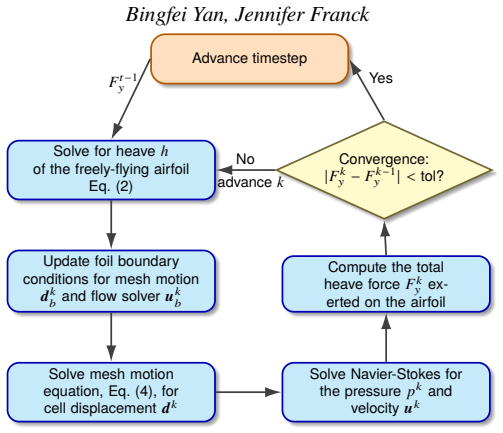
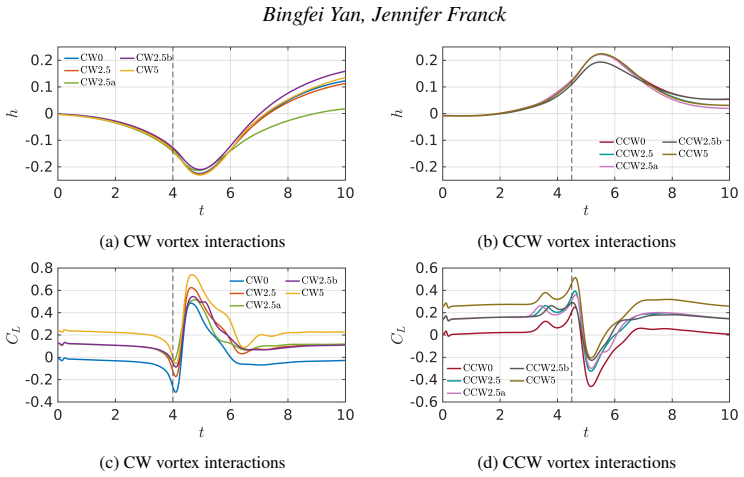
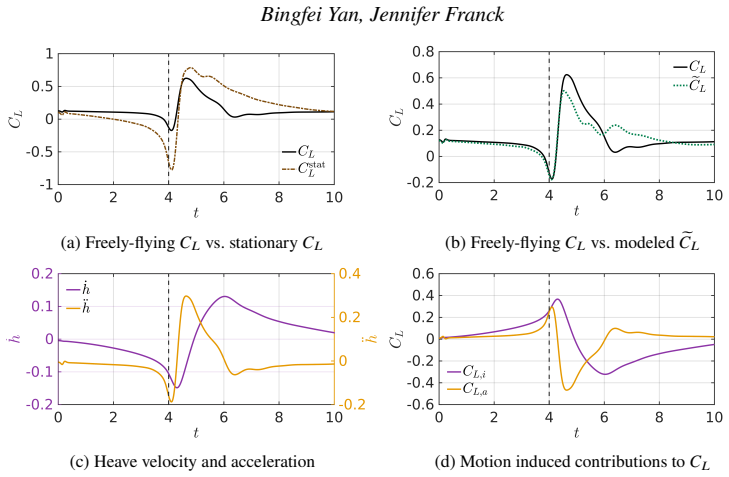
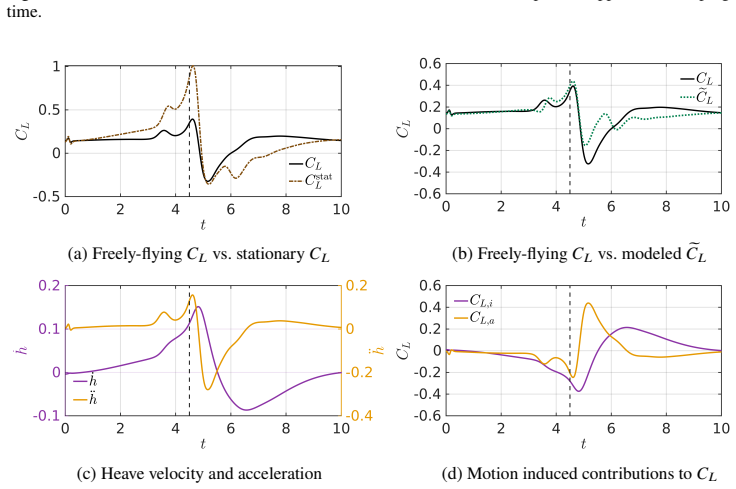
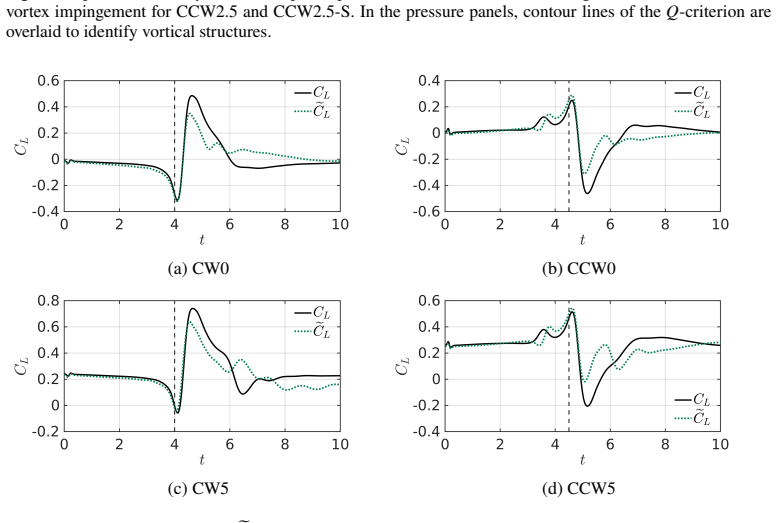
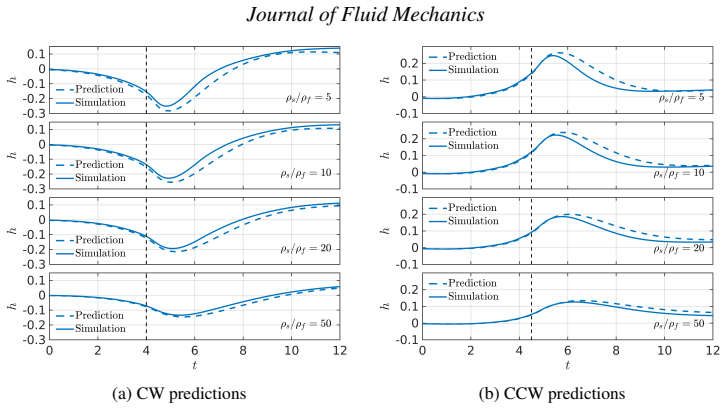
The lift coefficient on the freely-flying airfoil is obtained by augmenting the lift from the corresponding stationary-airfoil interaction with contributions from the induced angle of attack and from added mass. Direct comparison with the numerical simulations shows that these two contributions dominate the pre-impingement dynamics, whereas the post-impingement rebound is only partially recovered because gust-induced vortex shedding also acts. When the stationary-airfoil lift coefficient is supplied as input, the model reproduces the observed heave trajectory.
What carries the argument
Augmented lift model that adds induced-angle-of-attack and added-mass contributions to the stationary-airfoil lift coefficient, then integrates to obtain heave displacement.
If this is right
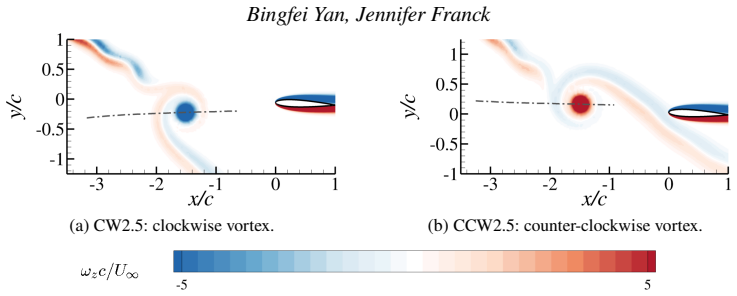
- Pre-impingement heave depends mainly on the sense of vortex rotation.
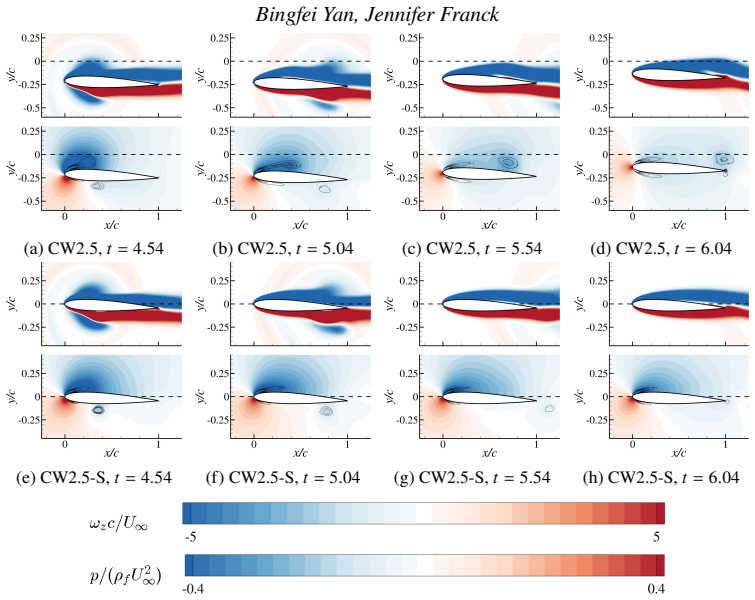
- Post-impingement rebound and the pattern of induced shedding change with angle of attack and with the vortex's transverse location.
- The same stationary-airfoil lift data can be reused to forecast heave for a range of angles of attack and vortex positions.
Where Pith is reading between the lines
- Wind-tunnel measurements on fixed airfoils could be post-processed to estimate free-flight gust responses without repeating the full dynamic simulation.
- The decomposition may apply to problems with additional degrees of freedom such as pitch or to sequences of multiple gusts.
- Similar splitting of lift into quasi-steady and motion-induced parts could be tested on flexible or cambered sections.
Load-bearing premise
Pre-impingement motion is governed only by induced angle of attack and added mass while post-impingement rebound is shaped by additional vortex shedding that the model does not fully include.
What would settle it
A numerical or experimental run in which the heave time history computed from the stationary lift input plus the two motion terms deviates measurably from the actual free-airfoil trajectory.
Figures
read the original abstract
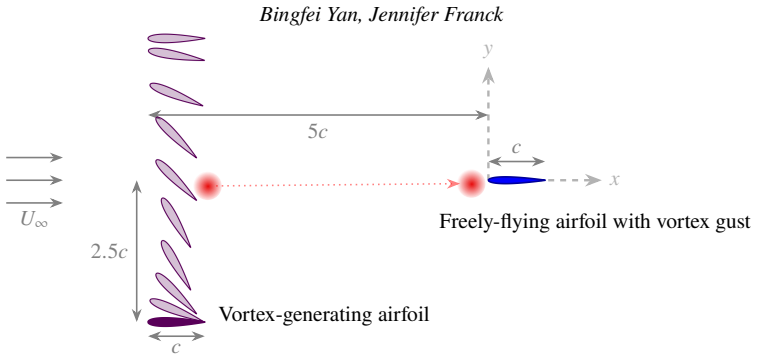
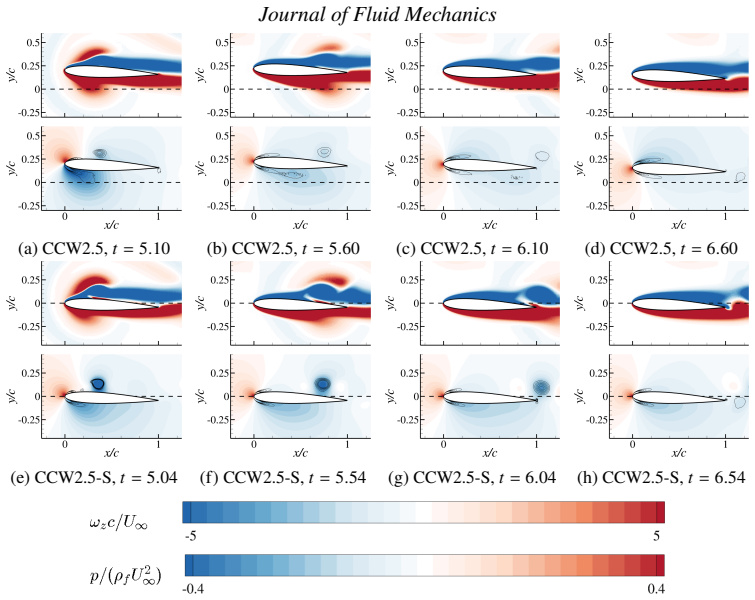
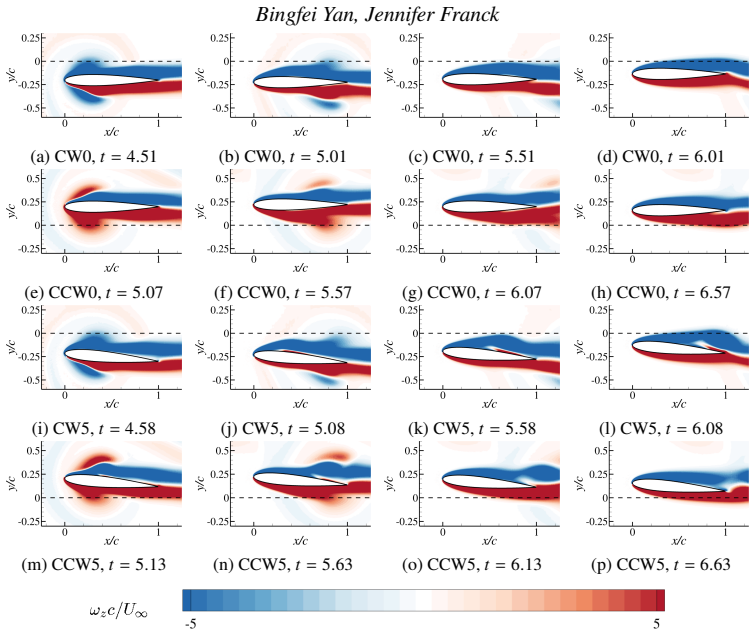
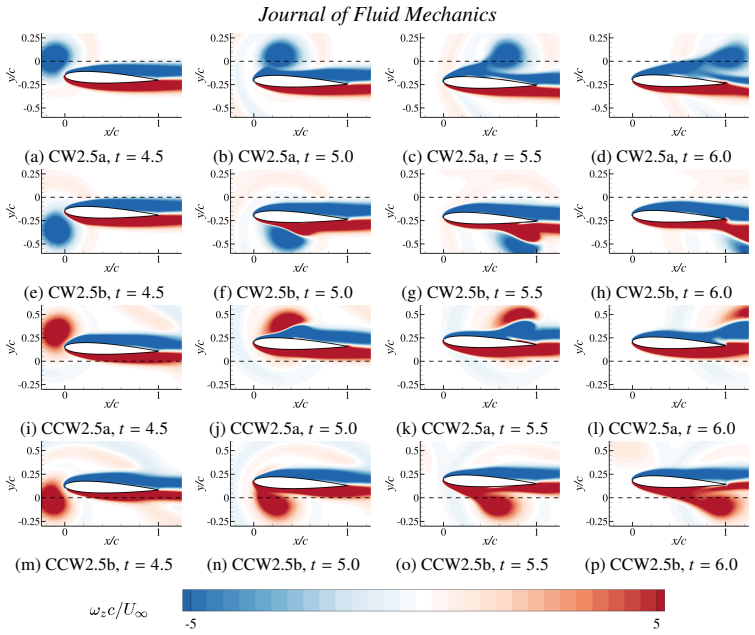
This study numerically investigates the interaction between an isolated vortex gust and a freely-flying airfoil, introducing a theoretical framework for interpreting the coupled lift and heave response. This complex and coupled dynamics is important for modern light-weight aircraft where gusts may easily perturb the wing, generating transient changes in trajectory and attitude. Here, the freely-flying airfoil is modeled with a single degree-of-freedom in heave, and is impacted by an isolated vortex gust generated upstream. Computational results demonstrate that the freely-flying airfoil reaches a maximum heave displacement after vortex impingement and subsequently rebounds with a comparable magnitude. The lift coefficient is then modeled by augmenting the lift from a corresponding stationary airfoil interaction with motion induced contributions associated with the induced angle of attack and added-mass. A comparison of the modeled lift with the simulation data confirms that the dynamics of the airfoil before impingement is dominated by these two terms, however the rebound after impingement is only partially explained by the model since it is also influenced by the gust-induced vortex shedding. Comparisons across various parameters show that the pre-impingement motion depends primarily on vortex rotation direction, whereas the post-impingement and induced shedding patterns vary with respect to angle of attack and vortex transverse position. With the lift coefficient of the corresponding stationary airfoil interaction as an input, the model can successfully predict the heave trajectory, thus providing a mechanism to assess the dynamic motion of an airfoil from experimental/computational data of gusts interacting with fixed airfoils.
Editorial analysis
A structured set of objections, weighed in public.
Referee Report
Summary. The paper numerically studies the interaction of an isolated vortex gust with a rigid airfoil free to heave (single DOF), and proposes a reduced-order model for the lift coefficient obtained by augmenting the lift history measured on the corresponding stationary airfoil with standard induced-angle-of-attack and added-mass contributions. The model is integrated to recover the heave trajectory; the abstract states that pre-impingement dynamics are captured by these two terms while the post-impingement rebound is only partially recovered because of additional gust-induced vortex shedding.
Significance. If the quantitative accuracy of the heave prediction were demonstrated, the framework would supply a practical route to infer dynamic gust response from stationary-airfoil data, which is relevant for lightweight aircraft gust-load analysis.
major comments (2)
- [Abstract] Abstract: the central claim that the model 'can successfully predict the heave trajectory' rests on qualitative visual comparisons; no L2 error norms, peak-displacement errors, or time-integrated residuals between the integrated model heave and the simulated trajectory are reported, nor is any mesh-convergence or validation study against independent test cases provided.
- [Abstract] Abstract and §4 (model description): the post-impingement rebound is explicitly stated to be 'only partially explained' by the induced-AoA + added-mass augmentation because of unmodeled gust-induced vortex shedding; without a quantitative decomposition of the residual lift force attributable to shedding versus the two motion terms, it is impossible to determine whether the heave prediction remains within acceptable engineering tolerance after impingement.
Simulated Author's Rebuttal
We thank the referee for the constructive and detailed report. The comments highlight opportunities to strengthen the quantitative support for the model's claims, which we will address in revision. We respond to each major comment below.
read point-by-point responses
-
Referee: [Abstract] Abstract: the central claim that the model 'can successfully predict the heave trajectory' rests on qualitative visual comparisons; no L2 error norms, peak-displacement errors, or time-integrated residuals between the integrated model heave and the simulated trajectory are reported, nor is any mesh-convergence or validation study against independent test cases provided.
Authors: We agree that quantitative error metrics would provide a more rigorous basis for the claim of successful prediction. In the revised manuscript we will add L2 norms, peak-displacement errors, and time-integrated residuals for the heave trajectories in all presented cases. The computational mesh follows the validated resolution used in our earlier stationary-airfoil studies; we will include a brief mesh-convergence check (lift and heave sensitivity) in an appendix. The stationary-airfoil data serve as the primary validation baseline for the augmentation terms; we will clarify this linkage in the text. revision: yes
-
Referee: [Abstract] Abstract and §4 (model description): the post-impingement rebound is explicitly stated to be 'only partially explained' by the induced-AoA + added-mass augmentation because of unmodeled gust-induced vortex shedding; without a quantitative decomposition of the residual lift force attributable to shedding versus the two motion terms, it is impossible to determine whether the heave prediction remains within acceptable engineering tolerance after impingement.
Authors: We accept that a quantitative decomposition of the residual lift would allow a clearer assessment of engineering tolerance. The present work demonstrates partial recovery via direct overlay of modeled and simulated lift histories, showing systematic deviation only after impingement. Performing a full decomposition requires additional flow-field post-processing to isolate shedding-induced forces, which exceeds the scope of the current reduced-order modeling focus. In revision we will report the magnitude of the post-impingement residual lift relative to the motion terms, quantify the resulting heave error, and discuss its implications for tolerance; a supplementary figure illustrating the residual will be added if space permits. revision: partial
Circularity Check
No significant circularity; stationary lift coefficient is external input, augmented by standard terms
full rationale
The paper obtains the stationary-airfoil lift coefficient from separate simulations of fixed airfoils interacting with the gust and uses it as an independent external input. This is then augmented only with standard induced-angle-of-attack and added-mass contributions (standard in unsteady aerodynamics) to integrate the heave equation of motion. The resulting trajectory prediction does not reduce by the paper's own equations to any quantity fitted from the dynamic free-flight data itself. The abstract explicitly acknowledges that post-impingement rebound is only partially captured due to unmodeled gust-induced vortex shedding, confirming the model is not claimed to be complete by construction. No self-citation chain or self-definitional step is load-bearing.
Axiom & Free-Parameter Ledger
axioms (1)
- domain assumption Lift on a moving airfoil can be decomposed into the lift from the corresponding stationary interaction plus contributions from induced angle of attack and added-mass effects.
Reference graph
Works this paper leans on
-
[1]
Physical Review Fluids , volume=
Gust encounters of rigid wings: Taming the parameter space , author=. Physical Review Fluids , volume=. 2020 , publisher=
2020
-
[2]
AIAA Journal , volume=
Counterclockwise vortical-gust/airfoil interactions at a transitional Reynolds number , author=. AIAA Journal , volume=. 2018 , publisher=
2018
-
[3]
AIAA Journal , volume=
Clockwise vortical-gust/airfoil interactions at a transitional Reynolds number , author=. AIAA Journal , volume=. 2018 , publisher=
2018
-
[4]
Journal of Fluids and Structures , volume=
Analysis of vortical gust impact on airfoils at low Reynolds number , author=. Journal of Fluids and Structures , volume=. 2020 , publisher=
2020
-
[5]
Physics of Fluids , volume=
Vortex dynamics during blade-vortex interactions , author=. Physics of Fluids , volume=. 2015 , publisher=
2015
-
[6]
AIAA Journal , volume=
Vortical gusts: experimental generation and interaction with wing , author=. AIAA Journal , volume=. 2019 , publisher=
2019
-
[7]
Journal of Fluids and Structures , volume=
Aeroelastic interactions and trajectory selection of vortex gusts impinging upon Joukowski airfoils , author=. Journal of Fluids and Structures , volume=. 2020 , publisher=
2020
-
[8]
Aerospace Science and Technology , volume=
Gust response of rigid and elastically mounted airfoils at a transitional Reynolds number , author=. Aerospace Science and Technology , volume=. 2018 , publisher=
2018
-
[9]
Journal of Fluids and Structures , volume=
Flow-induced vibration of a circular cylinder at limiting structural parameters , author=. Journal of Fluids and Structures , volume=. 2001 , publisher=
2001
-
[10]
Measurement Science and technology , volume=
Combining PIV, POD and vortex identification algorithms for the study of unsteady turbulent swirling flows , author=. Measurement Science and technology , volume=. 2001 , publisher=
2001
-
[11]
General theory of aerodynamic instability and the mechanism of flutter , author=
-
[12]
arXiv preprint arXiv:2603.21336 , year=
Generation of an isolated vortex gust through a heaving and pitching foil , author=. arXiv preprint arXiv:2603.21336 , year=
-
[13]
AIAA Journal , volume=
Angle of attack and core size effects on transitional vortical-gust--airfoil interactions , author=. AIAA Journal , volume=. 2020 , publisher=
2020
-
[14]
Physical Review Fluids , volume=
Extreme vortex-gust airfoil interactions at Reynolds number 5000 , author=. Physical Review Fluids , volume=. 2025 , publisher=
2025
-
[15]
Journal of Fluid Mechanics , volume=
Data-driven transient lift attenuation for extreme vortex gust--airfoil interactions , author=. Journal of Fluid Mechanics , volume=. 2024 , publisher=
2024
-
[16]
Journal of Fluids and Structures , volume=
Asymmetric distributions in pressure/load fluctuation levels during blade-vortex interactions , author=. Journal of Fluids and Structures , volume=. 2017 , publisher=
2017
-
[17]
Experiments in Fluids , doi=
Interaction of quasi-two-dimensional vortical gusts with airfoils, unswept and swept wings , author=. Experiments in Fluids , doi=. 2022 , publisher=
2022
-
[18]
The Aeronautical Journal , doi=
Lift alleviation in travelling vortical gusts , author=. The Aeronautical Journal , doi=. 2023 , publisher=
2023
-
[19]
AIAA Journal , doi=
Experimental investigation of transverse and vortex gust encounters at low Reynolds numbers , author=. AIAA Journal , doi=. 2021 , publisher=
2021
-
[20]
Journal of Fluid Mechanics , volume=
Airfoil response to periodic vertical and longitudinal gusts , author=. Journal of Fluid Mechanics , volume=. 2024 , publisher=
2024
-
[21]
Journal of Fluid Mechanics , volume=
The unsteady lift of an oscillating airfoil encountering a sinusoidal streamwise gust , author=. Journal of Fluid Mechanics , volume=. 2021 , publisher=
2021
-
[22]
Journal of Fluid Mechanics , volume=
A complete second-order theory for the unsteady flow about an airfoil due to a periodic gust , author=. Journal of Fluid Mechanics , volume=. 1976 , publisher=
1976
-
[23]
Experiments in Fluids , volume=
Controlling upwards and downwards gust loads on aerofoils by pitching , author=. Experiments in Fluids , volume=. 2023 , publisher=
2023
-
[24]
Airfoil in sinusoidal motion in a pulsating stream , author=
-
[25]
Physical Review Fluids , doi=
Wake-foil interactions and energy harvesting efficiency in tandem oscillating foils , author=. Physical Review Fluids , doi=. 2021 , publisher=
2021
discussion (0)
Sign in with ORCID, Apple, or X to comment. Anyone can read and Pith papers without signing in.