REVIEW 2 major objections 1 cited by
Degrees of Freedom and Beamforming for Large Intelligent Surfaces
T0 review · 2 major / 0 minor · reviewed 2026-06-26 · grok-4.3
Pith's one-line read The number of independent beams a large intelligent surface can form is given by its spatial degrees of freedom, calculated from the mutual shadow area.
desk verdict This paper gives closed-form DoF estimates for LIS beamforming from mutual shadow area that line up with singular-value knees and limit the number of clean beams in the simulations. read the letter →
The pith
A machine-rendered reading of the paper's core claim, the machinery that carries it, and where it could break.
The reading
What carries the argument
Mutual shadow area between source and observation regions, supplying a closed-form count of effective spatial DoF whose singular-value knee predicts the number of independent beams supportable by MRT or ZF.
What would settle it
A simulation in which MRT or ZF produces more independent beams than the mutual-shadow-area prediction while keeping interference low would falsify the central claim.
Extended reading notes
Core claim
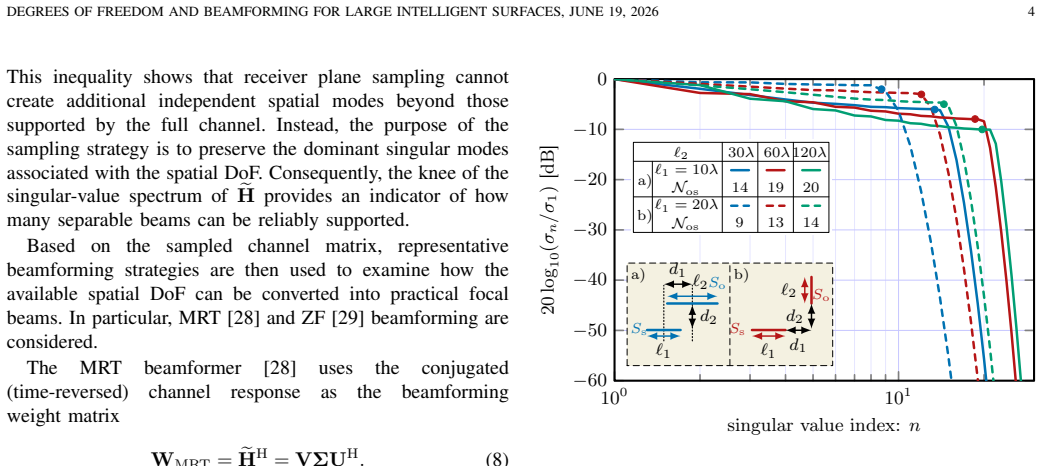
Spatial degrees of freedom are estimated using closed-form expressions from the mutual shadow area for representative LIS configurations; the predictions are validated by singular-value spectra whose knee points closely match the estimates, and beamforming results confirm that approximately the number of DoF independent beams can be formed with MRT or ZF while exceeding this limit increases interference and degrades performance.
Load-bearing premise
The mutual shadow area supplies a closed-form count of effective spatial DoF whose knee in the singular-value spectrum accurately predicts the number of independent beams supportable by MRT or ZF.
Editorial analysis
A structured set of objections, weighed in public.
Referee Report
Summary. The paper derives closed-form expressions for the spatial degrees of freedom (DoF) of large intelligent surfaces (LIS) from the mutual shadow area between source and observation regions. These predictions are compared to the knee locations in the singular-value spectra of the propagation operator for line-source and surface configurations. Analytic and numerical sampling schemes are introduced, and MRT/ZF beamforming simulations are used to show that the number of independent beams supportable without rapid interference growth is approximately equal to the predicted DoF. A polarization decomposition further shows that the total-field DoF is twice that of a single polarization component and that the electric-field components contribute unequally.
Significance. If the shadow-area DoF count is confirmed to predict beamforming capacity, the work supplies a practical closed-form tool for determining the effective spatial multiplexing limit in near-field LIS systems. The numerical agreement between the geometric DoF and the singular-value knees, together with the direct MRT/ZF trials, supplies independent support for the central claim. The polarization analysis adds a useful decomposition of field contributions. These elements could inform efficient multi-user beamforming design in future LIS deployments.
major comments (2)
- [Singular-value spectra validation] The validation sections report that singular-value spectral knee points closely match the theoretical DoF estimates, yet no quantitative fit metrics, percentage errors, or statistical measures of agreement are provided; visual inspection alone leaves the strength of the claimed match difficult to assess.
- [Beamforming results] The beamforming results state that exceeding the DoF limit produces increased interference and degraded performance, but no explicit quantitative thresholds, exclusion rules, or performance-degradation metrics (e.g., SINR drop rates) are supplied to define the onset of rapid interference growth.
Simulated Author's Rebuttal
We thank the referee for the constructive comments and positive overall assessment. We address each major comment below and will incorporate revisions to strengthen the quantitative aspects of the validation.
read point-by-point responses
-
Referee: [Singular-value spectra validation] The validation sections report that singular-value spectral knee points closely match the theoretical DoF estimates, yet no quantitative fit metrics, percentage errors, or statistical measures of agreement are provided; visual inspection alone leaves the strength of the claimed match difficult to assess.
Authors: We agree that quantitative metrics would provide a more rigorous assessment of the agreement. In the revised manuscript we will add explicit percentage errors between the closed-form DoF predictions and the observed knee locations for both line and surface configurations, together with a simple statistical measure such as the coefficient of determination computed on the singular-value spectra up to the knee. These additions will complement the existing visual comparisons without altering the underlying analysis. revision: yes
-
Referee: [Beamforming results] The beamforming results state that exceeding the DoF limit produces increased interference and degraded performance, but no explicit quantitative thresholds, exclusion rules, or performance-degradation metrics (e.g., SINR drop rates) are supplied to define the onset of rapid interference growth.
Authors: We acknowledge that the manuscript would benefit from clearer quantitative criteria. We will revise the beamforming sections to define explicit thresholds, for example the number of beams at which the average SINR falls by more than 3 dB relative to the DoF-limited case or where the interference-to-signal ratio exceeds 0.2, and report these values for the MRT and ZF simulations. This will make the transition to rapid interference growth more precise while preserving the existing numerical results. revision: yes
Circularity Check
No significant circularity; derivation is self-contained
full rationale
The paper derives a closed-form DoF count directly from the geometric mutual shadow area between source and observation regions. This quantity is then compared to the knee of the singular-value spectrum of the propagation operator (an independent numerical check) and tested via MRT/ZF beamforming simulations that measure interference growth when exceeding the count. No equation reduces the reported DoF or beamforming limit to a fitted parameter or self-citation chain; the shadow-area formula is not obtained by inverting the SVD or beamforming results. Polarization decomposition is likewise a direct extension of the same geometric count. The central claim therefore rests on external geometric and spectral evidence rather than self-definition or renaming.
Assumptions & free parameters
assumptions (1)
- standard math Singular-value decomposition of the channel matrix reveals the effective spatial degrees of freedom via its spectral knee.
Cite this review
Pith. "Pith review of Degrees of Freedom and Beamforming for Large Intelligent Surfaces." pith.science (2026). https://pith.science/paper/4THB5URD
@misc{pith2026260619666,
  author       = {Pith},
  title        = {Pith review of: Degrees of Freedom and Beamforming for Large Intelligent Surfaces},
  year         = {2026},
  howpublished = {\url{https://pith.science/paper/4THB5URD}},
  note         = {Machine review of arXiv:2606.19666}
}
read the original abstract
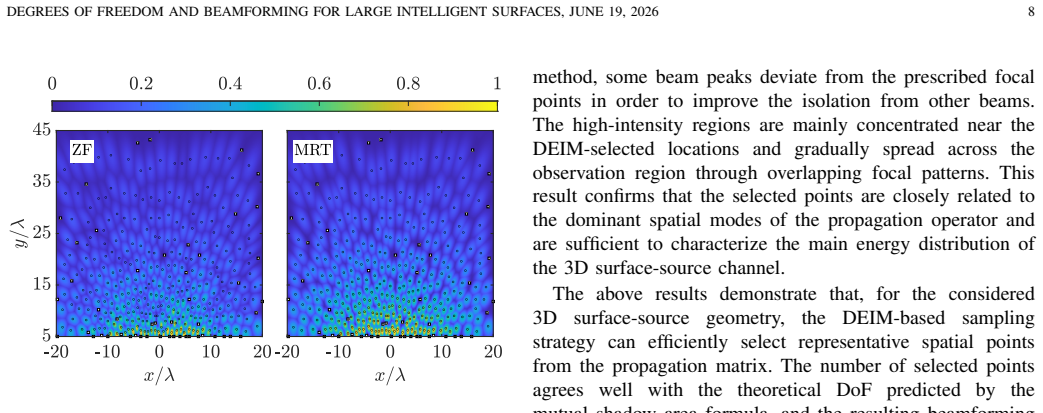
Spatial degrees of freedom (DoF), sampling, and beamforming are fundamental to multi-user large intelligent surfaces (LISs), where electromagnetic fields must be shaped, resolved, and focused at multiple near-field locations. This work estimates the number of DoF using closed-form expressions derived from the mutual shadow area for representative LIS configurations. The resulting DoF predictions are validated through numerical singular-value spectra, whose spectral knee points closely match the theoretical estimates. For line-source configurations, an analytic sampling scheme is developed by partitioning the source or observation line into unit-DoF intervals, enabling the selection of spatial samples. Beamforming results using maximum-ratio transmission and zero-forcing demonstrate that approximately the number of DoF independent beams can be formed. Attempting to exceed this limit results in increased interference and degraded performance. For surface-based LIS configurations, sampling points are instead determined numerically using the discrete empirical interpolation method. The corresponding beamforming results further confirm that the target region can support approximately as many independent beams as predicted by the DoF analysis. Finally, a polarization-aware study reveals that the electric-field components contribute unequally to the DoF and that the total-field DoF is twice that of a single polarization component.
Figures


Figures from the paper (8 more)




Forward citations
Cited by 1 Pith paper
-
Near-Field Sampling for Line Sources
Sensor positions on a receiving line are set by equal steps of a view-length-based degrees-of-freedom density, plus a tuned edge-enhancing correction, approaching the SVD-optimal sampling error.
Reference graph
Works this paper leans on
-
[1]
Beyond massive MIMO: The potential of data transmission with large intelligent surfaces,
S. Hu, F. Rusek, and O. Edfors, “Beyond massive MIMO: The potential of data transmission with large intelligent surfaces,”IEEE Trans. Signal Process., vol. 66, no. 10, pp. 2746–2758, May 2018
2018
-
[2]
Design of near-field beamforming for large intelligent surfaces,
S. Hu, H. Wang, and M. C. Ilter, “Design of near-field beamforming for large intelligent surfaces,”IEEE Trans. Wireless Commun., vol. 23, no. 1, pp. 762–774, Jan. 2023
2023
-
[3]
Fraunhofer and Fresnel distances: Unified derivation for aperture antennas,
K. T. Selvan and R. Janaswamy, “Fraunhofer and Fresnel distances: Unified derivation for aperture antennas,”IEEE Antennas Propag. Mag., vol. 59, no. 4, pp. 12–15, Aug. 2017
2017
-
[4]
E. Bj ¨ornson et al., “Towards 6G MIMO: Massive spatial multiplexing, dense arrays, and interplay between electromagnetics and processing,” arXiv preprint arXiv:2401.02844, 2024
-
[5]
Wireless power transfer with distributed antennas: System design, prototype, and experiments,
S. Shen, J. Kim, C. Song, and B. Clerckx, “Wireless power transfer with distributed antennas: System design, prototype, and experiments,”IEEE Trans. Ind. Electron., vol. 68, no. 11, pp. 10 868–10 878, Nov.2020
2020
-
[6]
Franceschetti,Wave Theory of Information
M. Franceschetti,Wave Theory of Information. Cambridge, U.K.: Cambridge Univ. Press, 2017
2017
-
[7]
Degrees of freedom and sampling representation of electromagnetic fields: Concepts and applications
O. M. Bucci and M. D. Migliore, “Degrees of freedom and sampling representation of electromagnetic fields: Concepts and applications.” IEEE Antennas Propag. Mag., vol. 67, no. 3, pp. 10–22, Jun. 2025
2025
-
[8]
Waves, modes, communications, and optics: a tutorial,
D. A. Miller, “Waves, modes, communications, and optics: a tutorial,” Advances in Optics and Photonics, vol. 11, no. 3, pp. 679–825, 2019
2019
Show all 35 references
-
[9]
Degrees of freedom in multiple-antenna channels: A signal space approach,
A. S. Poon, R. W. Brodersen, and D. N. Tse, “Degrees of freedom in multiple-antenna channels: A signal space approach,”IEEE Trans. Inf. Theory, vol. 51, no. 2, pp. 523–536, Feb. 2005
2005
-
[10]
Communication modes with large intelligent surfaces in the near field,
N. Decarli and D. Dardari, “Communication modes with large intelligent surfaces in the near field,”IEEE Access, vol. 9, pp. 165 648–165 666, Dec. 2021
2021
-
[11]
Communicating with large intelligent surfaces: Fundamental limits and models,
D. Dardari, “Communicating with large intelligent surfaces: Fundamental limits and models,”IEEE J. Sel. Areas Commun., vol. 38, no. 11, pp. 2526–2537, Nov. 2020
2020
-
[12]
On the role of the number of degrees of freedom of the field in MIMO channels,
M. D. Migliore, “On the role of the number of degrees of freedom of the field in MIMO channels,”IEEE Trans. Antennas Propag., vol. 54, no. 2, pp. 620–628, Feb. 2006
2006
-
[13]
Capacity of the continuous-space electromagnetic channel,
M. A. Jensen and J. W. Wallace, “Capacity of the continuous-space electromagnetic channel,”IEEE Trans. Antennas Propag., vol. 56, no. 2, pp. 524–531, Feb. 2008
2008
-
[14]
Maximizing independent channels and efficiency in BTS array antennas via EM degrees of freedom,
F. Puggelli, B. Biscontini, E. Martini, and S. Maci, “Maximizing independent channels and efficiency in BTS array antennas via EM degrees of freedom,”IEEE Trans. Antennas Propag., vol. 73, no. 6, pp. 3444–3458, Jun. 2025
2025
-
[15]
Breaking the degrees-of-freedom limit of holographic MIMO communications: A 3-D antenna array topology,
S. S. A. Yuan et al., “Breaking the degrees-of-freedom limit of holographic MIMO communications: A 3-D antenna array topology,” IEEE Trans. V eh. Technol., vol. 73, no. 8, pp. 11 276–11 288, Aug. 2024
2024
-
[16]
Bounds on the coupling strengths of communication channels and their information capacities,
Z. Kuang, D. A. Miller, and O. D. Miller, “Bounds on the coupling strengths of communication channels and their information capacities,” IEEE Trans. Antennas Propag., vol. 73, no. 6, pp. 3959–3974, Jan. 2025
2025
-
[17]
Beam focusing for near-field multiuser MIMO communications,
H. Zhang, N. Shlezinger, F. Guidi, D. Dardari, M. F. Imani, and Y . C. Eldar, “Beam focusing for near-field multiuser MIMO communications,” IEEE Trans. Wireless Commun., vol. 21, no. 9, pp. 7476–7490, Sep. 2022
2022
-
[18]
Multi-user modular XL-MIMO communications: Near-field beam focusing pattern and user grouping,
X. Li, Z. Dong, Y . Zeng, S. Jin, and R. Zhang, “Multi-user modular XL-MIMO communications: Near-field beam focusing pattern and user grouping,”IEEE Trans. Wireless Commun., vol. 23, no. 10, pp. 13 766–13 781, Oct. 2024
2024
-
[19]
Near-field rainbow: Wideband beam training for XL-MIMO,
M. Cui, L. Dai, and R. Zhang, “Near-field rainbow: Wideband beam training for XL-MIMO,”IEEE Trans. Wireless Commun., vol. 22, no. 6, pp. 3899–3912, Jun. 2023
2023
-
[20]
Near-field communications for extremely large-scale MIMO: A beamspace perspective,
K. Chen, C. Qi, J. Huang, O. A. Dobre, and G. Y . Li, “Near-field communications for extremely large-scale MIMO: A beamspace perspective,”IEEE Commun. Mag., vol. 63, no. 5, pp. 166–172, May 2025
2025
-
[21]
Arendt, R
W. Arendt, R. Nittka, W. Peter, and F. Steiner,Weyl’s Law: Spectral Properties of the Laplacian in Mathematics and Physics. John Wiley & Sons, Ltd, 2009
2009
-
[22]
On the degrees of freedom of scattered fields,
O. M. Bucci and G. Franceschetti, “On the degrees of freedom of scattered fields,”IEEE Trans. Antennas Propag., vol. 37, no. 7, pp. 918–926, Jul. 1989
1989
-
[23]
Representation of electromagnetic fields over arbitrary surfaces by a finite and nonredundant number of samples,
O. M. Bucci, C. Gennarelli, and C. Savarese, “Representation of electromagnetic fields over arbitrary surfaces by a finite and nonredundant number of samples,”IEEE Trans. Antennas Propag., vol. 46, no. 3, pp. 351–359, Mar. 1998
1998
-
[24]
Efficient planar near-field measurements for radiation pattern evaluation by a warping strategy,
M. A. Maisto, G. Leone, A. Brancaccio, and R. Solimene, “Efficient planar near-field measurements for radiation pattern evaluation by a warping strategy,”IEEE Access, vol. 9, pp. 62 255–62 265, Apr. 2021
2021
-
[25]
Near-field transverse resolution in planar source reconstructions,
M. A. Maisto, R. Pierri, and R. Solimene, “Near-field transverse resolution in planar source reconstructions,”IEEE Trans. Antennas Propag., vol. 69, no. 8, pp. 4836–4845, Aug. 2021
2021
-
[26]
Shadow area and degrees of freedom for free-space communication,
M. Gustafsson, “Shadow area and degrees of freedom for free-space communication,”IEEE J. Sel. Areas Inf. Theory, vol. 6, pp. 325–337, 2025
2025
-
[27]
Degrees of freedom for radiating systems,
——, “Degrees of freedom for radiating systems,”IEEE Trans. Antennas Propag., vol. 73, no. 2, pp. 1028–1038, Feb. 2025
2025
-
[28]
Performance of maximal ratio transmission with two receive antennas,
B. D. Rao and M. Yan, “Performance of maximal ratio transmission with two receive antennas,”IEEE Trans. Commun., vol. 51, no. 6, pp. 894–895, Jun. 2003
2003
-
[29]
Zero-forcing methods for downlink spatial multiplexing in multiuser MIMO channels,
Q. H. Spencer, A. L. Swindlehurst, and M. Haardt, “Zero-forcing methods for downlink spatial multiplexing in multiuser MIMO channels,”IEEE Trans. Signal Process., vol. 52, no. 2, pp. 461–471, Feb. 2004
2004
-
[30]
Reduced-order models for electromagnetic scattering problems,
A. Hochman, J. F. Villena, A. G. Polimeridis, L. M. Silveira, J. K. White, and L. Daniel, “Reduced-order models for electromagnetic scattering problems,”IEEE Trans. Antennas Propag., vol. 62, no. 6, pp. 3150–3162, Jun. 2014
2014
-
[31]
The capacity of wireless networks: Information-theoretic and physical limits,
M. Franceschetti, M. D. Migliore, and P. Minero, “The capacity of wireless networks: Information-theoretic and physical limits,”IEEE Trans. Inf. Theory, vol. 55, no. 8, pp. 3413–3424, Aug. 2009
2009
-
[32]
Interpreting moment matrix blocks spectra using mutual shadow area,
Y . Brick, F. P. Andriulli, and M. Gustafsson, “Interpreting moment matrix blocks spectra using mutual shadow area,”IEEE Trans. Antennas Propag. (in press), arXiv:2601.17965, 2026
2026
-
[33]
Radiative transfer configuration factor catalog: A listing of relations for common geometries,
J. R. Howell and M. P. Meng ¨uc ¸, “Radiative transfer configuration factor catalog: A listing of relations for common geometries,”J. Quant. Spectrosc. Radiat. Transf., vol. 112, no. 5, pp. 910–912, 2011
2011
-
[34]
R. A. Horn and C. R. Johnson,Matrix analysis. Cambridge Univ. Press, 2012
2012
-
[35]
Weighted sum-rate maximization using weighted MMSE for MIMO-BC beamforming design,
S. S. Christensen, R. Agarwal, E. De Carvalho, and J. M. Cioffi, “Weighted sum-rate maximization using weighted MMSE for MIMO-BC beamforming design,”IEEE Trans. Wireless Commun., vol. 7, no. 12, pp. 4792–4799, Dec. 2008
2008
Reviewed June 26, 2026 · model on record in the stance chip above.
Discussion (0). Continue with ORCID to comment.