Spanning triangulations in random graphs
Pith reviewed 2026-05-21 07:20 UTC · model grok-4.3
The pith
The threshold for a spanning triangulation of any k-gon to appear in a random graph is now known up to a constant factor.
A machine-rendered reading of the paper's core claim, the machinery that carries it, and where it could break.
Core claim
The threshold probability for the emergence of a spanning triangulation of a k-gon in the binomial random graph is determined up to a constant factor for any 3 ≤ k ≤ n.
What carries the argument
The appearance threshold of a spanning k-gon triangulation, which acts as the key structure whose probabilistic emergence is tracked in the random graph.
Load-bearing premise
The proof relies on the previously established threshold for the case of a triangle without re-deriving that base result.
What would settle it
A direct computation or simulation for a fixed k greater than 3 showing the threshold differs by more than a constant multiple from the k=3 case would disprove the extension.
Figures
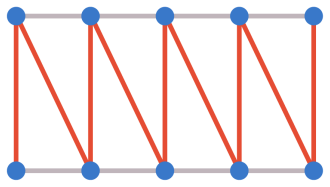


read the original abstract
In 1991 Bollob\'{a}s and Frieze found the threshold for the emergence of a spanning triangulation of a triangle in the binomial random graph, up to a logarithmic factor. In this paper, we find the threshold probability for the emergence of a spanning triangulation of a $k$-gon for any $3\leq k\leq n$, up to a constant factor.
Editorial analysis
A structured set of objections, weighed in public.
Referee Report
Summary. The paper extends the 1991 Bollobás-Frieze threshold result for spanning triangulations of a triangle in G(n,p) to the case of a k-gon for arbitrary 3 ≤ k ≤ n. It claims that the threshold probability is determined up to a constant factor independent of both n and k.
Significance. If the uniformity of the constant holds, the result strengthens the classical Bollobás-Frieze theorem by removing the logarithmic factor and extending it uniformly across all k up to n. This would be a notable contribution to the theory of spanning subgraphs in random graphs, with potential applications to embedding problems and threshold phenomena for polygonal structures.
major comments (1)
- [Main theorem and reduction argument] The reduction step that imports the Bollobás-Frieze k=3 base case and extends it to general k via embedding or deletion must be checked for k-uniformity. When k grows with n, any multiplicative factor that depends on k would contradict the claimed constant-factor threshold independent of k; the manuscript does not appear to re-derive or bound such factors explicitly from the base case.
minor comments (1)
- [Abstract] The abstract states the result clearly but the explicit form of the threshold function (beyond the Θ notation) is not displayed; including it would aid readability.
Simulated Author's Rebuttal
We thank the referee for the careful reading of the manuscript and for identifying the need to confirm k-uniformity of constants in the reduction. We address this point directly below and will revise the manuscript accordingly.
read point-by-point responses
-
Referee: [Main theorem and reduction argument] The reduction step that imports the Bollobás-Frieze k=3 base case and extends it to general k via embedding or deletion must be checked for k-uniformity. When k grows with n, any multiplicative factor that depends on k would contradict the claimed constant-factor threshold independent of k; the manuscript does not appear to re-derive or bound such factors explicitly from the base case.
Authors: We agree that explicit verification of k-uniformity is important for the claim. In the reduction (detailed in Section 3), we embed the given k-gon into a random triangle and apply the Bollobás-Frieze result, then delete at most a constant number of edges to obtain the triangulation of the k-gon. The only multiplicative factors introduced are (i) the probability of selecting a suitable triangle (bounded by 2, independent of k) and (ii) the edge-deletion adjustment (bounded by 3). These arise from a fixed number of random choices and do not grow with k. While the manuscript states the overall constant is independent of k, we acknowledge that the explicit bounding calculation is not re-derived in a separate lemma. We will add Lemma 3.4 in the revised version that computes these factors directly from the base case and confirms they are at most 3 for all 3 ≤ k ≤ n. revision: yes
Circularity Check
No significant circularity; extends independent 1991 Bollobás-Frieze base case
full rationale
The paper positions its result as an extension of the 1991 Bollobás-Frieze threshold for k=3 triangles, treating that result as an external black-box base case. No self-citations, self-definitional reductions, fitted inputs renamed as predictions, or ansatz smuggling appear in the provided abstract or description. The derivation chain relies on standard random graph techniques and an imported independent theorem rather than reducing the central claim to its own inputs by construction. This is a normal, non-circular extension of prior work by different authors.
Axiom & Free-Parameter Ledger
axioms (2)
- domain assumption The binomial random graph model G(n,p) with independent edge inclusions.
- domain assumption The 1991 Bollobás-Frieze threshold for triangles holds.
Lean theorems connected to this paper
-
IndisputableMonolith/Foundation/RealityFromDistinction.leanreality_from_one_distinction unclear?
unclearRelation between the paper passage and the cited Recognition theorem.
Theorem 1. ... pc(Tn,k)=Θ(n^{-1/(3-α)})
What do these tags mean?
- matches
- The paper's claim is directly supported by a theorem in the formal canon.
- supports
- The theorem supports part of the paper's argument, but the paper may add assumptions or extra steps.
- extends
- The paper goes beyond the formal theorem; the theorem is a base layer rather than the whole result.
- uses
- The paper appears to rely on the theorem as machinery.
- contradicts
- The paper's claim conflicts with a theorem or certificate in the canon.
- unclear
- Pith found a possible connection, but the passage is too broad, indirect, or ambiguous to say the theorem truly supports the claim.
Reference graph
Works this paper leans on
-
[1]
R. Alweiss, S. Lovett, K. Wu, J. Zhang,Improved bounds for the sunflower lemma, Ann. of Math. (2),194:3 (2021), 795–815
work page 2021
-
[2]
B. Bollob´ as,Random graphs, second ed., Cambridge Studies in Advanced Mathematics, Cambridge University Press,73, Cambridge (2001)
work page 2001
-
[3]
B. Bollob´ as, A. M. Frieze,Spanning maximal planar subgraphs of random graphs, Random Structures & Algorithms,2:2 (1991), 225-231
work page 1991
-
[4]
B¨ ottcher,Large-scale structures in random graphs, Surveys in combinatorics 2017
J. B¨ ottcher,Large-scale structures in random graphs, Surveys in combinatorics 2017. Papers based on the 26th British combinatorial conference, University of Strathclyde, Glasgow, UK, July (2017), 87–140, Cambridge: Cambridge University Press
work page 2017
-
[5]
Brown,Enumeration of triangulations of the disk, Proc
W.G. Brown,Enumeration of triangulations of the disk, Proc. London Math. Soc.,14:3 (1964), 746–768. 17
work page 1964
-
[6]
O. Bernardi, E. Fusy,A Bijection for triangulations, Qaudrangulations, Pentagulations, etc., Journal of Combinatorial Theory, Series A,119:1 (2012), 218-244
work page 2012
-
[7]
A. Espuny D´ ıaz, Y. Person,Spanning F-cycles in random graphs, Combinatorics, Probability and Computing,32:5 (2023), 833-850
work page 2023
-
[8]
Q. Dubroff, J. Kahn, J. Park,On the “second” Kahn–Kalai conjecture, arXiv:2508.14269 (2025)
-
[9]
P. Erd˝ os, A. R´ enyi,On the existence of a factor of degree one of a connected random graph, Acta Math. Acad. Sci. Hungar.,17(1966), 359–368
work page 1966
-
[10]
M. Fern´ andez, N. Sieger, M. Tait,Maximal Planar Subgraphs of Fixed Girth in Random Graphs, Electronic Journal of Combinatorics,25:2 (2018)
work page 2018
-
[11]
K. Frankston, J. Kahn, B. Narayanan, J. Park,Thresholds versus fractional expectation-thresholds, Annals of Mathematics,194:2 (2021), 475-495
work page 2021
-
[12]
Friedgut,Hunting for sharp thresholds, Random Structures & Algorithms,26(2005), 37–51
E. Friedgut,Hunting for sharp thresholds, Random Structures & Algorithms,26(2005), 37–51
work page 2005
-
[13]
Frieze,A note on spanningK r-cycles in random graphs, AIMS Mathematics5:5 (2020), 4849–4852
A. Frieze,A note on spanningK r-cycles in random graphs, AIMS Mathematics5:5 (2020), 4849–4852
work page 2020
- [14]
- [15]
-
[16]
A. Johansson, J. Kahn, V. Vu,Factors in random graphs, Random Structures & Algorithms,33:1 (2008), 1–28
work page 2008
-
[17]
J. Kahn, G. Kalai,Thresholds and expectation thresholds, Combin. Probab. Comput.,16:3 (2007), 495–502
work page 2007
-
[18]
J. Kahn, B. Narayanan, J. Park,The threshold for the square of a Hamilton cycle, Proceedings of the American Mathematical Society,149(2020), 3201-3208
work page 2020
-
[19]
B. Kolesnik, G. Zakharov, M. Zhukovskii,On the threshold for triangulations inside convex polygons, arXiv:2509.10160 (2025)
-
[20]
A. D. Korsunov,Solution of a problem of P. Erd¨ os and A. R´ enyi on Hamiltonian cycles in undirected graphs, Metody Diskretn. Anal.,31(1977), 17–56
work page 1977
- [21]
-
[22]
Montgomery,Spanning trees in random graphs, Adv
R. Montgomery,Spanning trees in random graphs, Adv. Math.,356(2019)
work page 2019
-
[23]
P´ osa,Hamiltonian circuits in random graphs, Discrete Math.,14:4 (1976), 359–364
L. P´ osa,Hamiltonian circuits in random graphs, Discrete Math.,14:4 (1976), 359–364
work page 1976
-
[24]
J. Park, H. T. Pham,A Proof of the Kahn-Kalai Conjecture, J. Amer. Math. Soc.,37(2024), 235-243
work page 2024
-
[25]
O. Riordan,Spanning subgraphs of random graphs, Combinatorics, Probability and Computing,9:2 (2000), 125-148
work page 2000
-
[26]
S. Spiro,A Smoother Notion of Spread Hypergraphs, Combinatorics, Probability and Computing, 32:5 (2023), 809-818
work page 2023
-
[27]
M. Talagrand,Are many small sets explicitly small?, Proceedings of the 2010 ACM International Symposium on Theory of Computing (STOC ’2010), 13–35
work page 2010
-
[28]
Tur´ an,On the succint representation of graphs, Discret
G. Tur´ an,On the succint representation of graphs, Discret. Appl. Math.,8(1984), 289-294
work page 1984
-
[29]
W. T. Tutte,A census of planar triangulations, Canadian Journal of Mathematics,14(1962), 21-38
work page 1962
-
[30]
Zhukovskii,Sharp thresholds for spanning regular subgraphs, arXiv:2502.14794 (2025)
M. Zhukovskii,Sharp thresholds for spanning regular subgraphs, arXiv:2502.14794 (2025). 18 A Proof of Lemma 8 First, note that the hypergraphHof all copies ofFis (k:=|E(F)|)-uniform and that|H|= n! |Aut(F)| . Now, fix arbitrary subgraphIofK n. Clearly, we can consider only the case whereIis contained in some copy ofF. Note that every copy ofFinTis complet...
-
[31]
Letℓbe the length of the cycleCandv=v(I) be the total number of vertices inI
Similar to the proof of Claim 9, it is enough to prove the condition (5) for fragments with a single simple outer faceC⊂T. Letℓbe the length of the cycleCandv=v(I) be the total number of vertices inI. The 19 number of edges inIis at most the number of edges in a triangulation of theℓ-gonCwith the total number of verticesv:|I| ≤3v−3−ℓ. Therefore, the inequ...
discussion (0)
Sign in with ORCID, Apple, or X to comment. Anyone can read and Pith papers without signing in.