REVIEW 3 major objections 5 minor 97 references
The GHOSDT Simulations (Galaxy Hydrodynamical Simulations with Supernova-Driven Turbulence) -- I. Magnetic Support in Gas Rich Disks
T0 review · 3 major / 5 minor · reviewed 2026-08-12 · deepseek-v4-flash
Pith's one-line read In gas-rich disks, supernova-driven turbulence, not initial conditions, sets the magnetic field of dense star-forming gas to 10-40 microgauss, following roughly B proportional to the square root of gas surface density.
desk verdict Strong simulation paper with a likely-robust B-Sigma slope and a normalization that is not yet converged; worth refereeing seriously, but the dynamo saturation tests need to be addressed before the 10-40 microgauss claim is quoted. read the letter →
The pith
A machine-rendered reading of the paper's core claim, the machinery that carries it, and where it could break.
The reading
What carries the argument
The mechanism that carries the argument is the supernova-driven small-scale turbulent dynamo embedded in a self-regulated feedback cycle: supernovae inject kinetic energy, turbulence stretches and amplifies a weak seed field, and magnetic energy saturates at a level set by the rate of turbulent injection, which is in turn set by the gas surface density through the star formation rate. The numerical machinery is the GHOSDT suite itself, built on the Gizmo meshless finite-mass method with ideal MHD and Powell plus Dedner divergence cleaning, time-dependent hydrogen chemistry, a Jeans-based stochastic star formation recipe over a Kroupa IMF, and star-by-star supernova and photoionization feedback. The load-bearing test inside the machinery is dynamo convergence: the saturated dense-gas field must be independent of the value and geometry of the initial field, and the paper argues it is, to within a factor of about two across four orders of magnitude in seed strength.
What would settle it
Rerun a fixed-surface-density case such as M40 or M60 with progressively more accurate magnetic-field treatment: the constrained-gradient divergence cleaning already tested in Appendix C, higher resolution, and possibly non-ideal resistivity, then check whether the saturated dense-gas field stays near 10--40 microgauss; the paper already reports that divergence cleaning alone lowers $B_{100}$ by a factor of about two, so a continued decline would refute convergence. Observationally, Zeeman or dust-polarization measurements of molecular clouds across galaxies spanning a decade in gas surface density would test the predicted $B \propto \Sigma_{\rm gas}^{0.5}$ trend directly.
Extended reading notes
Core claim
On the paper's own terms, the central discovery is that a magnetized, self-regulated interstellar medium settles into a quasi-steady state in which the magnetic field of dense star-forming gas is set by the gas surface density. Varying the initial field strength by up to four orders of magnitude, and replacing the uniform seed field with a randomized one, changes the saturated field in gas denser than $100\;\mathrm{cm}^{-3}$ by less than a factor of about two. The saturated field follows approximately $B \propto \Sigma_{\rm gas}^{0.5}$, rising from roughly $7\;\mu$G at $\Sigma_{\rm gas}\approx 4\;M_\odot\,\mathrm{pc}^{-2}$ to roughly $30\;\mu$G at $\Sigma_{\rm gas}\approx 60\;M_\odot\,\mathrm{pc}^{-2}$, with 10--40 microgauss across the suite, comparable to fields measured in Galactic molecular clouds. The authors interpret this as the signature of a supernova-driven small-scale dynamo, in which turbulence stretches and amplifies a weak seed field. The amplified field feeds back on the gas: relative to pure-hydrodynamical runs at the same column density, it raises the cold gas fraction by up to 40 percent, halves the disk scale height, smooths the burstiness of star formation, and lets a quasi-steady disk form where hydrodynamics alone blows most of the gas out of the box.
Load-bearing premise
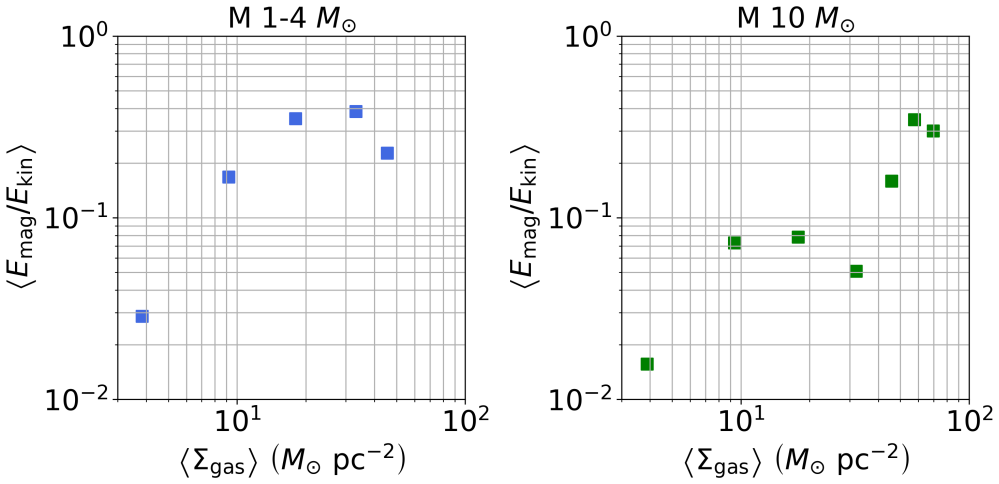
The central claim depends on the saturation level of the simulated small-scale dynamo being physical and numerically converged; the authors themselves flag that magnetic energy reaches up to 40 percent of kinetic energy, well above the few percent seen in comparable dynamo simulations, and call for a dedicated follow-up study.
Editorial extensions
If this is right
- At surface densities above roughly $40\;M_\odot\,\mathrm{pc}^{-2}$, magnetic fields are required for a quasi-steady star-forming disk to exist; pure-hydrodynamical runs blow out most of their gas unless the initial conditions are deliberately made turbulent.
- The dense-gas magnetic field becomes a predicted function of local gas surface density, roughly $B \propto \Sigma_{\rm gas}^{0.5}$, directly comparable to field measurements in molecular clouds across galaxies.
- Because magnetic support raises the cold gas fraction by up to 40 percent and halves the disk scale height, interpreting cold-gas tracers such as CO, [C I], and [C II] in gas-rich galaxies requires MHD modeling rather than hydrodynamics alone.
- Time-averaged star formation stays on the observed Kennicutt--Schmidt relation, and the disks sit in vertical pressure equilibrium consistent with the pressure-regulated, feedback-modulated theory of star formation.
- Star formation becomes less bursty when magnetic fields are present, so the observed burstiness of gas-rich galaxies carries information about the magnetization of their interstellar medium.
Reading between the lines
- Editorial extension: if the dense-gas field is set locally by surface density within a few hundred megayears, galaxy-scale and cosmological simulations could adopt a local magnetic-field closure rather than evolving a global seed field, since initial memory is erased on that timescale.
- Editorial extension: the paper's Appendix C reports that a more accurate divergence-cleaning scheme lowers the saturated dense-gas field by a factor of about two, so the quoted 10--40 microgauss values are best read as an upper envelope until convergence of the $\nabla\cdot B$ treatment is demonstrated.
- Editorial extension: if the dynamo interpretation survives, magnetic-field observations of molecular clouds become an indirect measure of turbulent energy injection, effectively a probe of the local supernova rate in galaxies that are too distant to resolve into individual supernovae.
Editorial analysis
A structured set of objections, weighed in public.
Referee Report
Summary. This paper introduces GHOSDT, a suite of galactic-patch magnetohydrodynamical simulations with star-by-star SN feedback, spanning initial gas surface densities of 4-100 M_sun pc^-2. The authors report that magnetic fields stabilize high-column-density disks against strong initial collapse, increase cold gas fractions by up to 40%, reduce disk scale height and star-formation burstiness, and produce a steady-state magnetic field in dense gas (n > 100 cm^-3) of 10-40 microG that is insensitive to the initial field strength and roughly follows B proportional to Sigma_gas^0.5. They also compare their Sigma_SFR versus P_DE relation with the PRFM framework of Ostriker and Kim (2022) and find consistency within about 30% for the equilibrium runs.
Significance. If the dynamo saturation is physical, the paper provides a plausible local, turbulence-based origin for magnetic fields in dense gas of high-redshift disk galaxies, with concrete predictions (10-40 microG, B-Sigma_gas dependence) that can be tested against Zeeman and dust-polarization observations. Strengths include the wide range of gas surface densities, simulation times of 0.5-1 Gyr, explicit variation of the initial magnetic field B0 over up to four orders of magnitude, and the external PRFM benchmark against observations and TIGRESS-NCR. The main weakness is that the saturated field strength is not yet shown to be numerically converged: the constrained-gradient test in Appendix C changes B100 by a factor of about two at fixed resolution, and the magnetic-to-kinetic energy ratio reaches 40%, in tension with other SN-driven dynamo simulations as the authors acknowledge. The significance of the central claims is therefore conditional on establishing numerical convergence of the dynamo saturation.
major comments (3)
- [Appendix C, Fig. 15] The central claim that B100 is a physical quasi-steady state set by SN-driven small-scale dynamo is not yet established, because the saturated value is scheme-dependent: replacing the default Powell/Dedner cleaning with the constrained-gradient reconstruction reduces B100 by a factor of approximately two at identical resolution in the M10 test (Fig. 15, right column). Since magnetic pressure enters as B^2, this factor-of-two change alters beta_th,100 by roughly a factor of four and directly affects the magnetic-support statements in Sections 3.3.2 and 3.3.3, as well as the normalization of the B100-Sigma_gas relation in Fig. 10. The insensitivity to B0 shown in Section 4.1 is necessary but not sufficient; the authors should demonstrate that the saturation is converged with respect to resolution and divergence-control method, for example by running CG variants for several Sigma_gas,0 values and by a resolution study of B100 and of the magnetic-to-kinetic energy ratio in Fig. 13.
- [Sec. 4.2, Fig. 10] The abstract and Section 5 claim an approximately B proportional to Sigma_gas^0.5 relation, but no quantitative fit is reported: the power-law index, normalization, and scatter are not given, and Fig. 10 shows only a visual guide. Given the factor-of-about-two scatter in B100 visible in Table 2 and Fig. 9, the authors should provide a fitted slope with uncertainty, separate fits for the 1-4 M_sun and 10 M_sun resolution samples, and a comparison with observational B-Sigma_gas constraints. Without this, the scaling claim is not testable and its uncertainty cannot be assessed.
- [Sec. 3.3.2, Fig. 5] The resolution trend in beta_th,100 and beta_turb is in the direction of increasing magnetic importance at higher resolution, which means the conclusion that magnetic pressure is dynamically important in dense gas is not yet converged. The paper notes the trend but does not quantify it or demonstrate that it saturates; a convergence study, or at least an explicit statement of the systematic uncertainty on beta_th,100 arising from resolution, is needed before the magnetic-support claim can be considered robust.
minor comments (5)
- [Sec. 3.1, Fig. 3] The text says that for the 2D histogram the runs with Sigma_gas,0 >= 40 M_sun pc^-2 are substituted with group HV runs, but the caption of Fig. 3 states that groups H and M are used; please clarify which runs are actually plotted.
- [Appendix A, Fig. 13] The caption reads 'the ratio median ratio between the total magnetic and kinetic energy'; the duplicated word should be corrected.
- [Sec. 2.4] The phrase 'we supplement the simulations in Table 1 with an additional set of simulations' is redundant and could be shortened.
- [Table 1] The M60 model is run with m_g = 4 M_sun and is grouped with the 1 M_sun models in the analysis; please state explicitly how this affects the resolution comparisons, since Fig. 10 and Fig. 5 plot the 1-4 M_sun and 10 M_sun samples separately.
- [Sec. 2.3] The convergence criterion for a quasi-steady magnetic field is described as a visual check with a 200 Myr moving average; it would be more reproducible to specify a quantitative threshold, for example on the time derivative of the moving average relative to its mean.
Circularity Check
No significant circularity: B100–Sigma is a measured emergent relation, B0 is varied by orders of magnitude, and the PRFM comparison is an external benchmark.
full rationale
The derivation chain is self-contained. The central result—a quasi-steady dense-gas magnetic field B100 that tracks gas surface density roughly as B ∝ Sigma^0.5—is measured from the simulations, not imposed by the input constants. The initial field B0 is varied by up to four orders of magnitude at fixed gas surface density (Section 4.1, Fig. 9, Table 2), and B100 converges to within a factor of about 2, so the B–Sigma relation is not a re-expression of the chosen B0 values. The densest-gas magnetic field and the plasma-beta diagnostics are outputs of the MHD calculation, not fitted targets. The PRFM comparison (Figs. 4 and 12) is benchmarked against the external Ostriker & Kim (2022) and Kim et al. (2024) formalism, not fitted to it. The only load-bearing inherited framework is the HSvD21 (Hu et al. 2021) ISM, chemistry, and feedback module, which is prior published methodology and does not already contain the magnetic-support conclusion. The paper's own caveats—resolution dependence of beta_th,100 (Fig. 5), a factor-of-two lower B100 with constrained-gradient cleaning (Fig. 15), and magnetic-to-kinetic ratios up to 40% (Fig. 13)—are numerical-convergence and physical-saturation risks, but they do not make any claimed result equivalent to its input by construction. No circular step can be exhibited from the text or equations.
Assumptions & free parameters
free parameters (4)
- Initial magnetic field strength B0 =
0.05-40 microG depending on Sigma_gas,0 (Table 1)
- Star formation efficiency epsilon_sf =
0.5
- Instantaneous star formation density threshold n_isf =
1e5 cm^-3
- Fixed stellar disk surface density Sigma_* =
40 Msun pc^-2
assumptions (4)
- domain assumption Ideal MHD approximation with flux freezing holds throughout the simulated ISM.
- domain assumption The small-scale dynamo is captured adequately at the numerical resolution used.
- domain assumption The fixed external stellar and dark matter potential is representative for all gas surface densities.
- domain assumption Star-by-star SN feedback with thermal injection is sufficient to capture the momentum feedback of clustered SNe.
Cite this review
Pith. "Pith review of The GHOSDT Simulations (Galaxy Hydrodynamical Simulations with Supernova-Driven Turbulence) -- I. Magnetic Support in Gas Rich Disks." pith.science (2026). https://pith.science/paper/4ULIHUZW
@misc{pith2026241110514,
  author       = {Pith},
  title        = {Pith review of: The GHOSDT Simulations (Galaxy Hydrodynamical Simulations with Supernova-Driven Turbulence) -- I. Magnetic Support in Gas Rich Disks},
  year         = {2026},
  howpublished = {\url{https://pith.science/paper/4ULIHUZW}},
  note         = {Machine review of arXiv:2411.10514}
}
abstract
Galaxies at redshift $z\sim 1-2$ display high star formation rates (SFRs) with elevated cold gas fractions and column densities. Simulating a self-regulated ISM in a hydrodynamical, self-consistent context, has proven challenging due to strong outflows triggered by supernova (SN) feedback. At sufficiently high gas column densities, if magnetic fields or other mitigating measures are not implemented, these outflows can prevent a quasi-steady disk from forming for several 100 Myr. To this end, we present GHOSDT, a suite of magneto-hydrodynamical simulations that implement ISM physics at high resolution. We demonstrate that magnetic pressure is important in the dense ISM of gas-rich star-forming disks. We show that a relation between the magnetic field and gas surface density emerges naturally from our simulations. We argue that the magnetic field in the dense, star-forming gas, may be set by the SN-driven turbulent gas motions. When compared to pure hydrodynamical runs, we find that the inclusion of magnetic fields increases the cold gas fraction by up to 40\%, reduces the disc scale height by up to a factor of $\sim 2$, and reduces the star formation burstiness. In dense ($n>100\;\rm{cm}^{-3}$) gas, we find steady-state magnetic field strengths of 10--40 $\mu$G, comparable to those observed in Galactic molecular clouds. Finally, we demonstrate that our simulation framework is consistent with the Ostriker et al. (2022) Pressure Regulated Feedback Modulated Theory of star formation and stellar feedback.
Figures


Figures from the paper (10 more)




Reference graph
Works this paper leans on
-
[1]
, " * write output.state after.block = add.period write newline
ENTRY address archivePrefix author booktitle chapter doi edition editor eprint howpublished institution journal key month number organization pages publisher school series title misctitle type volume year version url label extra.label sort.label short.list INTEGERS output.state before.all mid.sentence after.sentence after.block FUNCTION init.state.consts ...
-
[2]
write newline
" write newline "" before.all 'output.state := FUNCTION format.url url empty "" new.block "" url * "" * if FUNCTION format.eprint eprint empty "" archivePrefix empty "" archivePrefix "arXiv" = new.block " " eprint * " " * new.block " " eprint * " " * if if if FUNCTION format.doi doi empty "" " " doi * " " * if FUNCTION format.pid doi empty eprint empty ur...
-
[3]
- [1] #1 = = ^ ^ ^ .\!\!^ d .\!\!^ h .\!\!^ m .\!\!^ s .\!\!^ @mss
thebibliography [1] 20pt to REFERENCES 6pt =0pt 10pt plus 3pt =0pt =0pt =1pt plus 1pt =0pt =0pt -12pt =13pt plus 1pt =20pt =13pt plus 1pt \@M =10000 =-1.0em =0pt =0pt 0pt =0pt =1.0em @enumiv\@empty 10000 10000 `\.\@m \@noitemerr \@latex@warning Empty `thebibliography' environment \@ifnextchar \@reference \@latexerr Missing key on reference command Each re...
2019
-
[4]
, " * write output.state after.block = add.period write newline
ENTRY address author booktitle chapter edition editor howpublished institution journal key month note number organization pages publisher school series title type volume year label extra.label sort.label short.list INTEGERS output.state before.all mid.sentence after.sentence after.block FUNCTION init.state.consts #0 'before.all := #1 'mid.sentence := #2 '...
-
[5]
write newline
" write newline "" before.all 'output.state := FUNCTION n.dashify 't := "" t empty not t #1 #1 substring "-" = t #1 #2 substring "--" = not "--" * t #2 global.max substring 't := t #1 #1 substring "-" = "-" * t #2 global.max substring 't := while if t #1 #1 substring * t #2 global.max substring 't := if while FUNCTION word.in bbl.in " " * FUNCTION format....
-
[6]
Andersson, E. P., Agertz, O., & Renaud, F. 2020, Monthly Notices of the Royal Astronomical Society, 494, 3328, 10.1093/mnras/staa889
-
[7]
1986, , 324, 446, 10.1038/324446a0
Barnes , J., & Hut , P. 1986, , 324, 446, 10.1038/324446a0
doi:10.1038/324446a0 1986
-
[8]
Barrera-Ballesteros , J. K., S \'a nchez , S. F., Heckman , T., et al. 2021, , 503, 3643, 10.1093/mnras/stab755
Show all 97 references
-
[9]
2019, ApJ, 881, 160, 10.3847/1538-4357/ab2fd1
Bialy, S., & Sternberg, A. 2019, ApJ, 881, 160, 10.3847/1538-4357/ab2fd1
2019 doi
-
[10]
2008, AJ, 136, 2846, 10.1088/0004-6256/136/6/2846
Bigiel, F., Leroy, A., Walter, F., et al. 2008, AJ, 136, 2846, 10.1088/0004-6256/136/6/2846
2008 doi
-
[12]
2023 b , , 675, A144, 10.1051/0004-6361/202244915
---. 2023 b , , 675, A144, 10.1051/0004-6361/202244915
2023 doi
-
[13]
A., Meyer, D
Cardelli, J. A., Meyer, D. M., Jura, M., & Savage, B. D. 1996, ApJ, 467, 334, 10.1086/177608
1996 doi
- [14]
-
[15]
V., Smith , J
Croxall , K. V., Smith , J. D., Pellegrini , E., et al. 2017, , 845, 96, 10.3847/1538-4357/aa8035
2017 doi
-
[16]
M., Wandelt , B., Heiles , C., Falgarone , E., & Troland , T
Crutcher , R. M., Wandelt , B., Heiles , C., Falgarone , E., & Troland , T. H. 2010, , 725, 466, 10.1088/0004-637X/725/1/466
2010 doi
-
[17]
2004, , 289, 479, 10.1023/B:ASTR.0000014981.50094.8f
de Avillez , M., & Breitschwerdt , D. 2004, , 289, 479, 10.1023/B:ASTR.0000014981.50094.8f
2004
-
[18]
2002, Journal of Computational Physics, 175, 645, 10.1006/jcph.2001.6961
Dedner , A., Kemm , F., Kr \"o ner , D., et al. 2002, Journal of Computational Physics, 175, 645, 10.1006/jcph.2001.6961
2002
-
[19]
L., & Mac Low , M.-M
Emerick , A., Bryan , G. L., & Mac Low , M.-M. 2019, , 482, 1304, 10.1093/mnras/sty2689
2019 doi
-
[20]
M., & Wuyts , S
F \"o rster Schreiber , N. M., & Wuyts , S. 2020, , 58, 661, 10.1146/annurev-astro-032620-021910
2020 doi
-
[21]
2009, , 137, 266, 10.1088/0004-6256/137/1/266
Fuchs , B., Jahrei , H., & Flynn , C. 2009, , 137, 266, 10.1088/0004-6256/137/1/266
2009 doi
-
[23]
A., Mac Low , M.-M., K \"a pyl \"a , M
Gent , F. A., Mac Low , M.-M., K \"a pyl \"a , M. J., & Singh , N. K. 2021, , 910, L15, 10.3847/2041-8213/abed59
2021 doi
-
[24]
A., Mac Low , M.-M., Korpi-Lagg , M
Gent , F. A., Mac Low , M.-M., Korpi-Lagg , M. J., & Singh , N. K. 2023, , 943, 176, 10.3847/1538-4357/acac20
2023 doi
-
[25]
2018, , 480, 3511, 10.1093/mnras/sty2016
Girichidis , P., Seifried , D., Naab , T., et al. 2018, , 480, 3511, 10.1093/mnras/sty2016
2018 doi
-
[26]
2015, eprint arXiv:1508.06646
Girichidis, P., Walch, S., Naab, T., et al. 2015, eprint arXiv:1508.06646. http://adsabs.harvard.edu/abs/2015arXiv150806646G
2015 arXiv
-
[27]
Glover , S. C. O., & Clark , P. C. 2012, , 421, 116, 10.1111/j.1365-2966.2011.20260.x
2012
-
[28]
Glover, S. C. O., & Mac Low , M. 2007, ApJS, 169, 239, 10.1086/512238
2007 doi
-
[29]
M., & Hivon , E
G \'o rski , K. M., & Hivon , E. 2011, HEALPix: Hierarchical Equal Area isoLatitude Pixelization of a sphere , Astrophysics Source Code Library. 1107.018
2011
-
[30]
2008, , 486, L35, 10.1051/0004-6361:200810195
Gressel , O., Elstner , D., Ziegler , U., & R \"u diger , G. 2008, , 486, L35, 10.1051/0004-6361:200810195
2008 doi
-
[31]
Y., Guszejnov , D., Hopkins , P
Grudi \'c , M. Y., Guszejnov , D., Hopkins , P. F., Offner , S. S. R., & Faucher-Gigu \`e re , C.-A. 2021, , 506, 2199, 10.1093/mnras/stab1347
2021 doi
-
[32]
Y., Guszejnov , D., Offner , S
Grudi \'c , M. Y., Guszejnov , D., Offner , S. S. R., et al. 2022, , 512, 216, 10.1093/mnras/stac526
2022 doi
-
[33]
Gurman , A., Hu , C.-Y., Sternberg , A., & van Dishoeck , E. F. 2024, , 965, 179, 10.3847/1538-4357/ad2eac
2024 doi
-
[34]
2018, , 478, 4799, 10.1093/mnras/sty1315
Haid , S., Walch , S., Seifried , D., et al. 2018, , 478, 4799, 10.1093/mnras/sty1315
2018 doi
-
[35]
2014, , 570, A81, 10.1051/0004-6361/201423392
Hennebelle , P., & Iffrig , O. 2014, , 570, A81, 10.1051/0004-6361/201423392
2014 doi
-
[36]
S., Joung , M
Hill , A. S., Joung , M. R., Mac Low , M.-M., et al. 2012, , 750, 104, 10.1088/0004-637X/750/2/104
2012 doi
-
[37]
S., & Saitoh , T
Hirai , Y., Fujii , M. S., & Saitoh , T. R. 2021, , 73, 1036, 10.1093/pasj/psab038
2021 doi
-
[38]
Hopkins , P. F. 2015, , 450, 53, 10.1093/mnras/stv195
2015 doi
- [39]
- [40]
-
[41]
2019, , 483, 3363, 10.1093/mnras/sty3252
Hu , C.-Y. 2019, , 483, 3363, 10.1093/mnras/sty3252
2019 doi
-
[42]
2021, huchiayu/AstroChemistry.jl:, v0.2.2, Zenodo, 10.5281/zenodo.4775808
Hu, C.-Y. 2021, huchiayu/AstroChemistry.jl:, v0.2.2, Zenodo, 10.5281/zenodo.4775808
2021 doi
-
[43]
Hu , C.-Y., Naab , T., Glover , S. C. O., Walch , S., & Clark , P. C. 2017, , 471, 2151, 10.1093/mnras/stx1773
2017 doi
-
[44]
Hu , C.-Y., Naab , T., Walch , S., Glover , S. C. O., & Clark , P. C. 2016, , 458, 3528, 10.1093/mnras/stw544
2016 doi
-
[45]
Hu , C.-Y., Schruba , A., Sternberg , A., & van Dishoeck , E. F. 2022, , 931, 28, 10.3847/1538-4357/ac65fd
2022 doi
-
[46]
Hu , C.-Y., Sternberg , A., & van Dishoeck , E. F. 2021, , 920, 44, 10.3847/1538-4357/ac0dbd
2021 doi
-
[47]
C., Teyssier , R., et al
Hu , C.-Y., Smith , M. C., Teyssier , R., et al. 2023, , 950, 132, 10.3847/1538-4357/accf9e
2023 doi
-
[48]
2017, , 604, A70, 10.1051/0004-6361/201630290
Iffrig , O., & Hennebelle , P. 2017, , 604, A70, 10.1051/0004-6361/201630290
2017 doi
-
[49]
Joung , M. K. R., & Mac Low , M.-M. 2006, , 653, 1266, 10.1086/508795
2006 doi
-
[50]
M., Glover , S
Kannan , R., Marinacci , F., Simpson , C. M., Glover , S. C. O., & Hernquist , L. 2020, , 491, 2088, 10.1093/mnras/stz3078
2020 doi
-
[51]
1998, , 498, 541, 10.1086/305588
Kennicutt , Robert C., J. 1998, , 498, 541, 10.1086/305588
1998 doi
-
[52]
G., & Ostriker, E
Kim, C. G., & Ostriker, E. C. 2015, ApJ, 802, 99, 10.1088/0004-637X/802/2/99
2015 doi
-
[53]
Kim, C.-G., & Ostriker, E. C. 2017, ApJ, 846, 133, 10.3847/1538-4357/aa8599
2017 doi
-
[54]
Kim , C.-G., & Ostriker , E. C. 2018, , 853, 173, 10.3847/1538-4357/aaa5ff
2018 doi
-
[55]
C., Fielding , D
Kim , C.-G., Ostriker , E. C., Fielding , D. B., et al. 2020 a , , 903, L34, 10.3847/2041-8213/abc252
2020 doi
-
[56]
C., Somerville , R
Kim , C.-G., Ostriker , E. C., Somerville , R. S., et al. 2020 b , , 900, 61, 10.3847/1538-4357/aba962
2020 doi
-
[57]
C., Kim , J.-G., et al
Kim , C.-G., Ostriker , E. C., Kim , J.-G., et al. 2024, , 972, 67, 10.3847/1538-4357/ad59ab
2024 doi
-
[58]
S., & Glover , S
Klessen , R. S., & Glover , S. C. O. 2016, Saas-Fee Advanced Course, 43, 85, 10.1007/978-3-662-47890-5_2
2016 doi
- [59]
-
[60]
H., et al
Lah \'e n , N., Naab , T., Johansson , P. H., et al. 2020, , 891, 2, 10.3847/1538-4357/ab7190
2020 doi
-
[61]
C., Kim , J.-G., & Kim , C.-G
Lancaster , L., Ostriker , E. C., Kim , J.-G., & Kim , C.-G. 2021 a , , 914, 89, 10.3847/1538-4357/abf8ab
2021 doi
-
[62]
2021 b , , 914, 90, 10.3847/1538-4357/abf8ac
---. 2021 b , , 914, 90, 10.3847/1538-4357/abf8ac
2021 doi
-
[63]
K., Walter, F., Brinks, E., et al
Leroy, A. K., Walter, F., Brinks, E., et al. 2008, AJ, 136, 2782, 10.1088/0004-6256/136/6/2782
2008 doi
-
[64]
K., Schinnerer , E., Hughes , A., et al
Leroy , A. K., Schinnerer , E., Hughes , A., et al. 2021, , 257, 43, 10.3847/1538-4365/ac17f3
2021 doi
-
[65]
2022, , 925, 30, 10.3847/1538-4357/ac3911
Liu , J., Qiu , K., & Zhang , Q. 2022, , 925, 30, 10.3847/1538-4357/ac3911
2022 doi
-
[66]
2014, ARA & A, 52, 415, 10.1146/annurev-astro-081811-125615
Madau, P., & Dickinson, M. 2014, ARA & A, 52, 415, 10.1146/annurev-astro-081811-125615
2014 doi
-
[67]
F., & Ostriker, E
McKee, C. F., & Ostriker, E. C. 2007, ARA & A, 45, 565, 10.1146/annurev.astro.45.051806.110602
2007 arXiv
-
[68]
P., Naab , T., & White , S
Moster , B. P., Naab , T., & White , S. D. M. 2018, , 477, 1822, 10.1093/mnras/sty655
2018 doi
-
[69]
Naab, T., & Ostriker, J. P. 2017, ARA & A, 55, 59, 10.1146/annurev-astro-081913-040019
2017 doi
-
[70]
F., Frenk , C
Navarro , J. F., Frenk , C. S., & White , S. D. M. 1997, , 490, 493, 10.1086/304888
1997 doi
-
[71]
G., Weiner , B
Noeske , K. G., Weiner , B. J., Faber , S. M., et al. 2007, , 660, L43, 10.1086/517926
2007 doi
-
[72]
C., & Kim , C.-G
Ostriker , E. C., & Kim , C.-G. 2022, , 936, 137, 10.3847/1538-4357/ac7de2
2022 doi
-
[73]
C., McKee, C
Ostriker, E. C., McKee, C. F., & Leroy, A. K. 2010, ApJ, 721, 975, 10.1088/0004-637X/721/2/975
2010 doi
-
[74]
C., & Shetty, R
Ostriker, E. C., & Shetty, R. 2011, ApJ, 731, 41, 10.1088/0004-637X/731/1/41
2011 doi
-
[75]
1999, , 526, 279, 10.1086/307956
Padoan , P., & Nordlund , A . 1999, , 526, 279, 10.1086/307956
1999 doi
-
[76]
A., Grand , R
Pakmor , R., G \'o mez , F. A., Grand , R. J. J., et al. 2017, , 469, 3185, 10.1093/mnras/stx1074
2017 doi
- [77]
-
[78]
2023, in Astronomical Society of the Pacific Conference Series, Vol
Pattle , K., Fissel , L., Tahani , M., Liu , T., & Ntormousi , E. 2023, in Astronomical Society of the Pacific Conference Series, Vol. 534, Protostars and Planets VII, ed. S. Inutsuka , Y. Aikawa , T. Muto , K. Tomida , & M. Tamura , 193, 10.48550/arXiv.2203.11179
-
[79]
L., Langer , W
Pineda , J. L., Langer , W. D., & Goldsmith , P. F. 2014, , 570, A121, 10.1051/0004-6361/201424054
2014 doi
-
[80]
G., Roe , P
Powell , K. G., Roe , P. L., Linde , T. J., Gombosi , T. I., & De Zeeuw , D. L. 1999, Journal of Computational Physics, 154, 284, 10.1006/jcph.1999.6299
1999
-
[81]
2023, , 522, 1843, 10.1093/mnras/stad1104
Rathjen , T.-E., Naab , T., Walch , S., et al. 2023, , 522, 1843, 10.1093/mnras/stad1104
2023 doi
- [82]
-
[83]
2017, , 471, 2674, 10.1093/mnras/stx1670
Rieder , M., & Teyssier , R. 2017, , 471, 2674, 10.1093/mnras/stx1670
2017 doi
-
[84]
R., Howk , J
Sembach , K. R., Howk , J. C., Ryans , R. S. I., & Keenan , F. P. 2000, , 528, 310, 10.1086/308173
2000 doi
-
[85]
M., Pakmor , R., Marinacci , F., et al
Simpson , C. M., Pakmor , R., Marinacci , F., et al. 2016, , 827, L29, 10.3847/2041-8205/827/2/L29
2016 doi
-
[86]
Smith , M. C. 2021, , 502, 5417, 10.1093/mnras/stab291
2021 doi
- [87]
-
[88]
2005, , 364, 1105, 10.1111/j.1365-2966.2005.09655.x
Springel , V. 2005, , 364, 1105, 10.1111/j.1365-2966.2005.09655.x
2005
-
[89]
P., Moster , B
Steinwandel , U. P., Moster , B. P., Naab , T., Hu , C.-Y., & Walch , S. 2020, , 495, 1035, 10.1093/mnras/staa821
2020 doi
-
[90]
K., Ostriker , E
Sun , J., Leroy , A. K., Ostriker , E. C., et al. 2023, , 945, L19, 10.3847/2041-8213/acbd9c
2023 doi
-
[91]
J., Genzel, R., & Sternberg, A
Tacconi, L. J., Genzel, R., & Sternberg, A. 2020, arXiv:2003.06245, 10.1146/annurev-astro-082812-141034
2020 arXiv
-
[92]
S., & Price , D
Tricco , T. S., & Price , D. J. 2012, Journal of Computational Physics, 231, 7214, 10.1016/j.jcp.2012.06.039
2012 doi
-
[93]
2015, , 454, 238, 10.1093/mnras/stv1975
Walch , S., Girichidis , P., Naab , T., et al. 2015, , 454, 238, 10.1093/mnras/stv1975
2015 doi
-
[94]
E., Franx , M., Leja , J., et al
Whitaker , K. E., Franx , M., Leja , J., et al. 2014, , 795, 104, 10.1088/0004-637X/795/2/104
2014 doi
-
[95]
2024, , 271, 35, 10.3847/1538-4365/ad20c9
Wong , T., Cao , Y., Luo , Y., et al. 2024, , 271, 35, 10.3847/1538-4365/ad20c9
2024 doi
- [96]
-
[97]
C., Jr., Vishniac, E., & Sneden, C.\ 2006, , 652, 847
Kennicutt, R. C., Jr., Vishniac, E., & Sneden, C.\ 2006, , 652, 847
2006
-
[98]
J., Eichhorn, G., Accomazzi, A., et al.\ 2000, , 143, 41
Kurtz, M. J., Eichhorn, G., Accomazzi, A., et al.\ 2000, , 143, 41
2000
-
[99]
T.\ 2012, American Astronomical Society Meeting Abstracts \#219, 219, 204.04
Vishniac, E. T.\ 2012, American Astronomical Society Meeting Abstracts \#219, 219, 204.04
2012
Reviewed August 12, 2026 · model on record in the stance chip above.
Discussion (0). Continue with ORCID to comment.