Diffuse Interface Energies with Microscopic Heterogeneities II: Rare Events
Pith reviewed 2026-06-26 23:54 UTC · model grok-4.3
The pith
If the ratio of heterogeneity scale to interface width vanishes too slowly, the limiting energy of Allen-Cahn functionals falls below the homogenized value.
A machine-rendered reading of the paper's core claim, the machinery that carries it, and where it could break.
Core claim
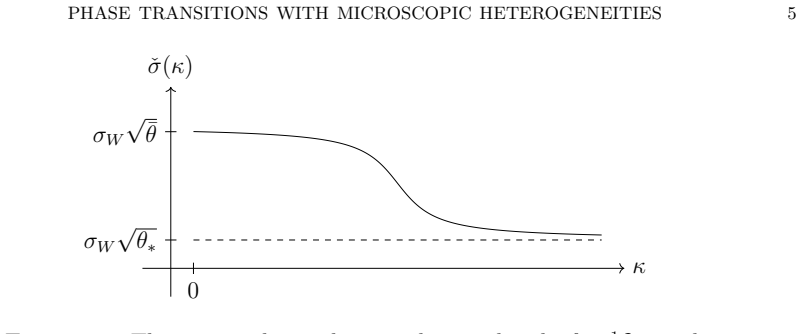
When the ratio ε^{-1} δ vanishes too slowly, the limit of the functional may actually be smaller than the homogenized energy. In the case of the random checkerboard in dimension one, the limiting energy depends in a nontrivial way on the limit of ε^{-1} δ |log ε|. Rare events become relevant at algebraic scales δ ≈ ε^{1+α} for arbitrary α > 0, and atypical configurations play the same role in almost periodic examples.
What carries the argument
Large deviations principle for stationary ergodic random fields, which quantifies the cost of atypical configurations that lower the energy when the scale ratio vanishes slowly.
If this is right
- The limiting energy for the one-dimensional checkerboard is modified by a nontrivial dependence on lim ε^{-1} δ |log ε|.
- Rare events dominate the limit at polynomial scale separations δ ≈ ε^{1+α} for any α > 0.
- Almost periodic media exhibit energy reduction equivalent to that from random rare events.
- The homogenized energy from the companion paper is not the correct Gamma-limit when the ratio vanishes slowly.
Where Pith is reading between the lines
- Physical models of interfaces in heterogeneous media may require sampling rare configurations to obtain correct energy scaling at intermediate scale ratios.
- The dependence on the scale ratio limit could take different forms in dimensions greater than one or in other phase-field models.
- Numerical approximation schemes for such energies would need to incorporate large-deviation sampling to avoid underestimating the reduction.
Load-bearing premise
The coefficients are stationary ergodic random fields for which a large deviation principle holds with a good rate function allowing atypical configurations to be quantified.
What would settle it
Numerical computation of the minimal energy for the one-dimensional random checkerboard Allen-Cahn functional across sequences where ε^{-1} δ |log ε| approaches different finite limits, checking whether the value matches the predicted modified energy rather than the homogenized one.
Figures
read the original abstract
We analyze Allen-Cahn functionals with stationary ergodic coefficients in the regime where the length scale $\delta$ of the heterogeneities is much smaller (microscopic) than the interface width $\epsilon$ (mesoscopic). In a companion paper, we show that if the ratio $\epsilon^{-1} \delta$ vanishes fast enough as $\epsilon \to 0$, then the functionals converge to an effective surface energy where the energy density is determined by homogenization effects originating at microscopic scales. Here we prove that if the ratio $\epsilon^{-1} \delta $ vanishes too slowly, the limit of the functional may actually be smaller than this homogenized energy. We refer to this as the rare events regime. In the case of the random checkerboard in dimension one, we use large deviations techniques to give a complete description of the rare events regime, showing that the limiting energy depends in a nontrivial way on the limit of $\epsilon^{-1} \delta | \log \epsilon |$. We further construct, in any dimension, examples of random media in which rare events become relevant at algebraic scales $\delta \approx \epsilon^{1 + \alpha}$ for an arbitrary $\alpha > 0$, as well as almost periodic examples in which atypical configurations play the same role as rare events.
Editorial analysis
A structured set of objections, weighed in public.
Referee Report
Summary. The manuscript analyzes Allen-Cahn functionals with stationary ergodic coefficients in the regime δ ≪ ε. The companion paper establishes Γ-convergence to a homogenized surface energy when ε^{-1}δ vanishes sufficiently fast. This paper shows that when the ratio vanishes too slowly the Γ-limit is strictly smaller (rare-events regime). For the 1D random checkerboard, large-deviation techniques yield a complete description in which the limiting energy depends nontrivially on lim ε^{-1}δ |log ε|. Explicit constructions are given in any dimension for random media where rare events dominate at algebraic scales δ ≈ ε^{1+α} (α>0 arbitrary) and for almost-periodic media in which atypical configurations play an analogous role.
Significance. If the results hold, the work completes the asymptotic picture for diffuse-interface energies with microscopic heterogeneities by identifying and characterizing the rare-events regime that can lower the effective energy below the homogenized value. The explicit 1D large-deviation analysis and the general constructions at algebraic scales constitute concrete, falsifiable contributions that build directly on established ergodic theory and large-deviation principles.
minor comments (2)
- The abstract refers to 'the companion paper' without a citation; adding the arXiv number or title in the introduction would improve readability.
- Notation for the scaling ratio ε^{-1}δ and the logarithmic correction is introduced clearly in the abstract; ensure the same symbols are used consistently in all statements of the main theorems.
Simulated Author's Rebuttal
We thank the referee for the positive and constructive report, which accurately summarizes the scope of both papers in the series. The recommendation of minor revision is noted; we will incorporate any editorial or typographical suggestions in the revised manuscript.
Circularity Check
No significant circularity; derivation applies external LDP and ergodicity independently
full rationale
The paper establishes the rare-events regime by applying standard large-deviation principles for stationary ergodic random fields (from prior probability theory) to the Allen-Cahn functional when ε^{-1}δ vanishes slowly. The companion paper supplies only the baseline homogenized energy for the fast-vanishing case; the slower-vanishing claim, the explicit 1D checkerboard description via lim ε^{-1}δ|log ε|, and the algebraic-scale constructions in any dimension are derived directly from LDP rate functions and recovery-sequence arguments without reducing to fitted parameters, self-definitional loops, or load-bearing self-citations. The argument remains self-contained against external mathematical benchmarks.
Axiom & Free-Parameter Ledger
axioms (2)
- domain assumption The random coefficients are stationary and ergodic.
- domain assumption A large deviation principle holds for the probability measures on the random media with a good rate function.
Reference graph
Works this paper leans on
-
[1]
Variational models for phase transitions, an approach via Γ-convergence
Giovanni Alberti. Variational models for phase transitions, an approach via Γ-convergence. In Calculus of variations and partial differential equations (Pisa, 1996), pages 95–114. Springer, Berlin, 2000
1996
-
[2]
Gradient theory of phase transitions in composite media.Proc
Nadia Ansini, Andrea Braides, and Valeria Chiad` o Piat. Gradient theory of phase transitions in composite media.Proc. Roy. Soc. Edinburgh Sect. A, 133(2):265–296, 2003
2003
-
[3]
Oxford University Press, Oxford, 2013
St´ ephane Boucheron, G´ abor Lugosi, and Pascal Massart.Concentration inequalities. Oxford University Press, Oxford, 2013. A nonasymptotic theory of independence, With a foreword by Michel Ledoux
2013
-
[4]
The homogenization of surfaces and boundaries.Bull
Luis Caffarelli. The homogenization of surfaces and boundaries.Bull. Braz. Math. Soc. (N.S.), 44(4):755–775, 2013
2013
-
[5]
Homogenization and phase separation with fixed wells—the supercritical case.SIAM J
Riccardo Cristoferi, Irene Fonseca, and Likhit Ganedi. Homogenization and phase separation with fixed wells—the supercritical case.SIAM J. Math. Anal., 57(2):2138–2173, 2025
2025
-
[6]
Springer-Verlag, New York, second edition, 1998
Amir Dembo and Ofer Zeitouni.Large deviations techniques and applications, volume 38 of Applications of Mathematics (New York). Springer-Verlag, New York, second edition, 1998
1998
-
[7]
Springer Science & Business Media, 2010
Martin Eden Glicksman.Principles of solidification: an introduction to modern casting and crystal growth concepts. Springer Science & Business Media, 2010
2010
-
[8]
Grimmett and David R
Geoffrey R. Grimmett and David R. Stirzaker.Probability and random processes. Oxford Uni- versity Press, New York, third edition, 2001
2001
-
[9]
PhD thesis, Carnegie Mellon University, 2019
Adrian Hagerty.Variational Methods for Second Order Structured Deformations and Multiscale Problems. PhD thesis, Carnegie Mellon University, 2019. PHASE TRANSITIONS WITH MICROSCOPIC HETEROGENEITIES 43
2019
-
[10]
The gradient theory of phase transitions and the minimal interface criterion
Luciano Modica. The gradient theory of phase transitions and the minimal interface criterion. Arch. Rational Mech. Anal., 98(2):123–142, 1987
1987
-
[11]
Un esempio di Γ −-convergenza.Boll
Luciano Modica and Stefano Mortola. Un esempio di Γ −-convergenza.Boll. Un. Mat. Ital. B (5), 14(1):285–299, 1977
1977
-
[12]
Peter S. Morfe. Surface tension and Γ-convergence of Van der Waals–Cahn-Hilliard phase tran- sitions in stationary ergodic media.J. Stat. Phys., 181(6):2225–2256, 2020
2020
-
[13]
Morfe.Homogenization of Interface Motions in the Parabolic Scaling
Peter S. Morfe.Homogenization of Interface Motions in the Parabolic Scaling. PhD thesis, The University of Chicago, 2022
2022
-
[14]
Peter S. Morfe. A variational principle for pulsating standing waves and an Einstein relation in the sharp interface limit.Arch. Ration. Mech. Anal., 244(3):919–1018, 2022
2022
-
[15]
Peter S. Morfe and Christian Wagner. Diffuse interface energies with microscopic heterogeneities I: Homogenization.arXiv preprint arXiv:2408.14914v2, 2024
Pith/arXiv arXiv 2024
-
[16]
Oxtoby.Measure and category, volume 2 ofGraduate Texts in Mathematics
John C. Oxtoby.Measure and category, volume 2 ofGraduate Texts in Mathematics. Springer- Verlag, New York-Berlin, second edition, 1980. A survey of the analogies between topological and measure spaces
1980
-
[17]
American Mathematical Society, Providence, RI, 2015
Firas Rassoul-Agha and Timo Sepp¨ al¨ ainen.A course on large deviations with an introduction to Gibbs measures, volume 162 ofGraduate Studies in Mathematics. American Mathematical Society, Providence, RI, 2015
2015
-
[18]
The thermodynamic theory of cap- illarity under the hypothesis of a continuous variation of density
J. S. Rowlinson. Translation of Johannes D. van der Waals’ “The thermodynamic theory of cap- illarity under the hypothesis of a continuous variation of density”.J. Statist. Phys., 20(2):197– 244, 1979
1979
-
[19]
van der Waals
Johannes D. van der Waals. The thermodynamic theory of capillarity under the hypothesis of a continuous variation of density.Verhandel. Konink. Akad. Weten. Amsterdam, 1(8), 1892
-
[20]
Westdickenberg
Eric Vanden-Eijnden and Maria G. Westdickenberg. Rare events in stochastic partial differential equations on large spatial domains.J. Stat. Phys., 131(6):1023–1038, 2008
2008
-
[21]
S. R. Srinivasa Varadhan.Large deviations, volume 27 ofCourant Lecture Notes in Mathemat- ics. Courant Institute of Mathematical Sciences, New York; American Mathematical Society, Providence, RI, 2016
2016
-
[22]
A note on spatially inhomogeneous cahn-hilliard energies.arXiv preprint arXiv:2408.02154, 2024
Stephan Wojtowytsch. A note on spatially inhomogeneous cahn-hilliard energies.arXiv preprint arXiv:2408.02154, 2024. Pennsylvania State University, 219B McAllister Building, University Park, State College, PA 16802 Email address:pmorfe@psu.edu Institute for Science and Technology Austria (ISTA), Am Campus 1, 3400 Kloster- neuburg, Austria Email address:ch...
arXiv 2024
discussion (0)
Sign in with ORCID, Apple, or X to comment. Anyone can read and Pith papers without signing in.