REVIEW 3 major objections 6 minor 19 references
Exploring trends in audio mixes and masters: Insights from a dataset analysis
T0 review · 3 major / 6 minor · reviewed 2026-08-11 · deepseek-v4-flash
Pith's one-line read Analysis of 218,109 audio mixes and masters reveals that loudness and dynamics issues are the most common audio problems, with mastered audio often too loud and clipped while mixes are frequently undercompressed.
desk verdict A genuinely useful public dataset of 218k amateur mixes and masters, but the headline issue rankings rest on unvalidated detector thresholds and a genre-relative compression reference; treat as a descriptive resource, not ground truth. read the letter →
The pith
A machine-rendered reading of the paper's core claim, the machinery that carries it, and where it could break.
The reading
What carries the argument
The analysis is carried by the MixCheck Studio platform's automated audio analysis pipeline, which converts each uploaded track into a fixed set of categorical and numeric descriptors: integrated loudness and true peak from the ITU BS.1770 standard, clipping from counts of samples exceeding 0 dBFS, mono compatibility from mid/side correlation, phase issues from mean absolute phase difference compared to a heuristic 1.7-radian threshold, compression from dynamic-range ratios compared to 'empirical average genre-specific levels', stereo width from inter-channel level differences, and tonal profile from band energy comparisons to perceptual weightings. The paper then applies frequency distributions, cross-tabulations, Cramér's V tests for association between stereo field and phase or mono issues, and chi-square tests linking compression to tonal energy in bass and high frequencies. The genre-specific empirical references and the 1.7-radian phase threshold are the load-bearing definitions that turn raw audio measurements into 'issues'.
What would settle it
Take a random sample of 1,000 tracks from the same dataset and have several professional audio engineers independently label compression issues, clipping, and phase problems by listening, then compare their labels to MixCheck's categories; if the engineers' prevalence rankings diverge from Table 2, the paper's rankings are artifacts of the platform's detectors rather than properties of amateur audio production. Alternatively, recompute the phase-issue and compression categories with varied thresholds and genre references to see if the rank order of issues changes.
Extended reading notes
Core claim
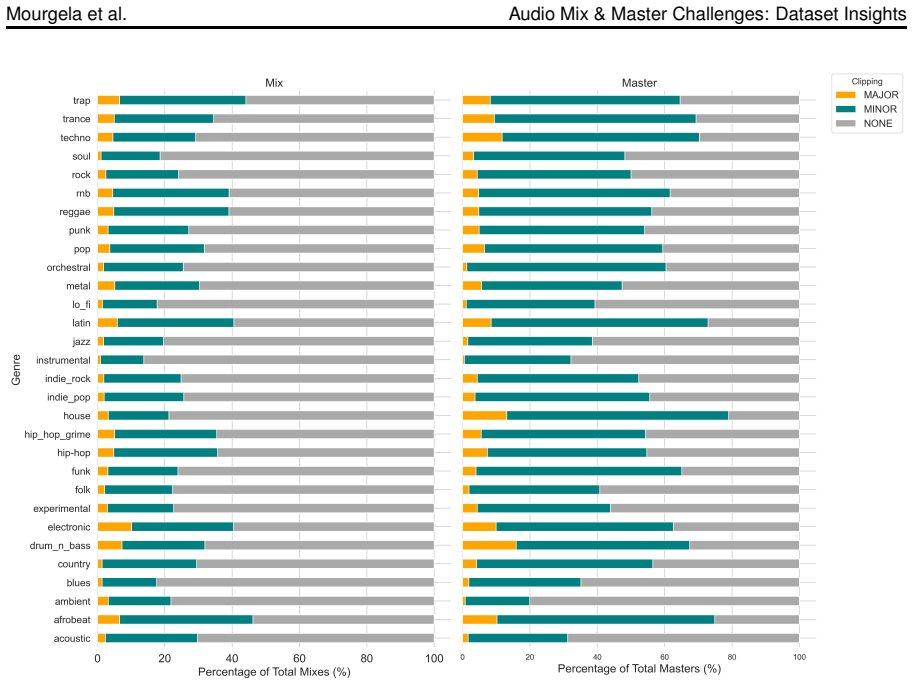
The paper's central claim is a ranked prevalence of audio issues in mixes versus masters. For mixes, the most common issue is undercompression (46.43% of mixes need more compression), followed by stereo field issues and excessive loudness; for masters, the top issues are being too loud, clipping, and overcompression. Approximately 79% of mastered tracks exceed Spotify's -14 LUFS recommendation and 91.55% exceed Apple Music's -16 LUFS, and only 42.53% of masters are free of clipping compared to 68.58% of mixes. Masters are nevertheless better compressed overall, with 51.63% hitting the 'optimal' genre-based compression range versus 46.43% of mixes that are undercompressed, and they show fewer stereo field (16.45% narrow vs 39.04% for mixes) and mono compatibility issues (12.0% vs 16.9%). These results are framed as evidence that the mastering stage fixes many mix problems, especially dynamics and spatial coherence, but introduces or amplifies loudness and clipping problems.
Load-bearing premise
The results assume that MixCheck's built-in issue detectors, with their heuristic phase threshold, genre-based compression references, and clipping conventions, correctly identify what counts as an audio problem in the first place.
Editorial extensions
If this is right
- Educational feedback for amateur producers should prioritize loudness management, clipping prevention, and compression balance, since these dominate the issue rankings.
- The mastering stage is a common source of clipping and excessive loudness for amateurs, even as it resolves undercompression and stereo problems, so mastering guidance should focus on gain staging and loudness targets.
- Automatic mixing and mastering systems can encode knowledge-engineering rules derived from these ranked issues, such as capping integrated loudness, testing mono compatibility, and checking true peak headroom.
- The large share of tracks exceeding streaming loudness targets (79% of masters above -14 LUFS) implies that most amateur masters are being attenuated by streaming normalization, which should be a standard warning to users.
- Genre-specific differences in tonal profile and clipping (e.g., electronic, drum'n'bass, techno emphasize bass; orchestral and metal show high-frequency peaks) suggest that feedback tools should adapt to genre norms.
Reading between the lines
- Because the dataset comes from a single platform whose feedback is visible to users during production, the prevalence rankings may partially reflect a feedback loop: producers fix issues the tool flags, so the remaining distribution shows what the tool either does not flag or cannot easily fix. This is an inference from the study design, not a claim the paper makes.
- The phase-issue threshold (mean absolute phase difference above 1.7 radians) is stated to be heuristic; re-running the analysis with a different threshold would test how stable the ranking of phase issues is, a sensitivity analysis the paper does not report.
- The genre-based compression references are treated as industry consensus, but genres evolve; the 46.43% undercompression figure for mixes might reflect a stylistic preference for wide dynamics in amateur productions rather than a defect, so the 'optimal' label is a normative judgment.
- A natural testable extension would be to compare the platform's issue labels against blind expert listening on a random subset of the same tracks, which would check whether the ranked issues match human perception.
Signed reviews
Editorial analysis
A structured set of objections, weighed in public.
Referee Report
Summary. The paper analyzes 218,109 entries from the MixCheck Studio web platform (67,838 user-labeled mixes and 150,217 masters) and reports descriptive statistics on integrated loudness, true peak, clipping, mono compatibility, phase issues, stereo width, dynamic-range compression categories, and tonal profile across 30 user-specified genres. The central result, summarized in the abstract and Table 2, is a ranked prevalence of audio issues: undercompression, stereo field issues, and excessive loudness are the most common mix issues, while masters most often suffer from being too loud, clipping, and overcompression; the authors also report that masters show better compression and fewer stereo field and phase issues. The dataset is made publicly available on Zenodo.
Significance. If the result holds, the paper provides a large-scale, real-world descriptive resource on common issues in amateur mixes and masters, with openly available data and straightforward descriptive methods that are easy to reproduce. The main value is the scale (218k entries) and the explicit focus on issue prevalence rather than isolated acoustic metrics. However, the central issue labels are produced by MixCheck's proprietary or heuristic detectors, and the paper does not validate those detectors or show that the headline ranking is robust to their thresholds. The significance is therefore conditional: the paper is a credible descriptive report of what MixCheck flags, but its generalization to 'trends in audio mixes and masters' requires either validation of the detectors or a careful rescoping of the claims.
major comments (3)
- [Table 1 / Section 3.5] The compression classification is load-bearing for the abstract's claim that 'mastered audio presents better results in compression' and for Table 2, where undercompression is the top mix issue and overcompression is the third master issue. Table 1 says dynamic ranges are compared to 'empirical average genre-specific levels found in the industry,' but the paper gives no reference corpus, no threshold values, and no validation. Please specify what the reference corpus is (in particular, whether it consists of mastered audio, which would make the optimal-compression result partly circular), state the actual genre-specific ranges used, and report a sensitivity analysis showing whether the Table 2 ordering changes under plausible shifts of those ranges.
- [Table 1 / Sections 3.4 and 3.8] The ranked issue list in Table 2 mixes categories whose detection thresholds are heuristic or undisclosed: phase issues use a threshold of 1.7 radians 'set heuristically,' major clipping uses a 10,000-sample cutoff, and stereo field issues are based on inter-channel level difference with no threshold given. Since Table 2 is the central result, these thresholds should not be treated as ground truth. Please report the underlying prevalence proportions with bootstrap confidence intervals and repeat the ranking with alternative thresholds (e.g., phase 1.5/1.9 rad, clipping 5k/20k samples) to demonstrate that the ordering in Table 2 is stable, or explicitly rescope the conclusions to 'issues as defined by MixCheck's current heuristics.'
- [Section 2.1 / Discussion] The platform is described as providing 'actionable feedback' to users, which creates a feedback loop: users may upload revised tracks that already conform to MixCheck's recommendations. This could explain, for example, why masters cluster around -14 LUFS and why 51.63% of masters fall into the 'optimal' compression category. The Discussion acknowledges user-reported genre and mix/master labels as limitations, but it does not acknowledge this dependency on the platform's own guidance. Please add a limitation stating that the dataset reflects tracks uploaded to MixCheck under its feedback regime, and temper the generalization from 'issues in audio production' to 'issues in MixCheck-analyzed amateur production.'
minor comments (6)
- [Section 3.1] The statement that masters cluster around -14 LUFS 'aligns with the target loudness levels required by most streaming platforms' overstates the situation: streaming services normalize loudness rather than requiring a specific integrated loudness, and Apple's target is -16 LUFS, so 'recommended' would be more accurate than 'required.'
- [Section 3.8] The paper reports Cramér's V values and chi-square statistics without confidence intervals or effect-size interpretation. Given the very large sample size, even trivially small associations will be statistically significant; please include confidence intervals or interpret the magnitudes (e.g., Cramér's V of 0.059 is very weak) in the text.
- [Section 3.6] The text states that a small percentage of mono mixes and masters were excluded from the stereo field analysis, but it does not report the excluded counts; please give these numbers and clarify whether the exclusion affects the denominators used in Table 2.
- [Section 2.2] Cramér's V is an effect-size measure, not a significance test; the phrasing 'Cramér's V tests' is misleading. Please rephrase to something like 'we computed Cramér's V to measure the strength of association.'
- [Discussion] The Discussion states that 'excessive loudness and clipping' are correlated, but no correlation coefficient or contingency table is reported in the Results; please either report the actual association or rephrase as an observed co-occurrence.
- [References] Reference [15] cites a MeterPlugs blog post for Apple's loudness target; a primary source from Apple or an official developer document would be more appropriate if available.
Circularity Check
No significant circularity; the dataset analysis is self-contained and transparent about its detector definitions.
full rationale
The paper is a descriptive analysis of a dataset from MixCheck Studio, not a derivation of predictions from first principles. The central claims—ranked issue prevalence, masters being more compressed, and masters having fewer stereo/phase issues—are direct statistical summaries of platform-generated labels. The compression classifier compares dynamic range to 'empirical average genre-specific levels found in the industry' (Table 1), and the phase detector uses a 'predefined threshold of 1.7 radians, set heuristically' (Table 1). These are external reference inputs, not parameters fitted to the same dataset, so the resulting prevalence rankings are not circularly forced; they are conditional on stated definitions. The paper explicitly acknowledges that these metrics 'should be regarded as informed estimates that encapsulate prevailing stylistic and aesthetic preferences rather than exact quantifications' (Discussion). The self-citations [17-19] appear only in a forward-looking discussion about potential QA rules for automatic mixing and are not load-bearing for the empirical findings. The concern that MixCheck's feedback may influence user behavior is a data-generation and external-validity issue, not an internal circular derivation. No equation, fitted parameter, or load-bearing self-citation reduces a claimed result to its inputs.
Assumptions & free parameters
free parameters (6)
- Phase issue threshold =
1.7 radians
- Major clipping threshold =
10,000 clipped samples
- Genre-specific optimal compression ranges =
Not disclosed (empirical industry averages)
- Tonal profile perceptual thresholds =
Not disclosed
- Stereo width category thresholds =
Not disclosed
- Mono compatibility correlation threshold =
Not disclosed
assumptions (4)
- domain assumption Each uploaded track is an independent observation and no track appears multiple times.
- domain assumption User-selected genre and mix/master labels are accurate.
- domain assumption The platform's audio feature extraction accurately measures the stated properties.
- ad hoc to paper The platform's educational feedback does not materially shape the uploaded audio.
Cite this review
Pith. "Pith review of Exploring trends in audio mixes and masters: Insights from a dataset analysis." pith.science (2026). https://pith.science/paper/4V2D7QCV
@misc{pith2026241203373,
  author       = {Pith},
  title        = {Pith review of: Exploring trends in audio mixes and masters: Insights from a dataset analysis},
  year         = {2026},
  howpublished = {\url{https://pith.science/paper/4V2D7QCV}},
  note         = {Machine review of arXiv:2412.03373}
}
read the original abstract
We present an analysis of a dataset of audio metrics and aesthetic considerations about mixes and masters provided by the web platform MixCheck studio. The platform is designed for educational purposes, primarily targeting amateur music producers, and aimed at analysing their recordings prior to them being released. The analysis focuses on the following data points: integrated loudness, mono compatibility, presence of clipping and phase issues, compression and tonal profile across 30 user-specified genres. Both mixed (mixes) and mastered audio (masters) are included in the analysis, where mixes refer to the initial combination and balance of individual tracks, and masters refer to the final refined version optimized for distribution. Results show that loudness-related issues along with dynamics issues are the most prevalent, particularly in mastered audio. However mastered audio presents better results in compression than just mixed audio. Additionally, results show that mastered audio has a lower percentage of stereo field and phase issues.
Figures


Figures from the paper (3 more)


Reference graph
Works this paper leans on
-
[1]
Audio Signal Visu- alisation and Measurement,
Gareus, R. and Goddard, C., “Audio Signal Visu- alisation and Measurement,” in ICMC, 2014
work page 2014
-
[2]
Brixen, E., Audio metering: measurements, stan- dards and practice, Focal Press, 2020
work page 2020
-
[3]
Izhaki, R., Mixing audio: concepts, practices, and tools, Routledge, 2017
work page 2017
-
[4]
Loudness normal- isation and permitted maximum level of audio signals,
EBU-Recommendation, R., “Loudness normal- isation and permitted maximum level of audio signals,” European Broadcasting Union, 2011
work page 2011
-
[5]
Detection of clipped fragments in speech signals,
Aleinik, S. and Matveev, Y ., “Detection of clipped fragments in speech signals,” Int. J. Electr . Com- put. Energ. Electron. Commun. Eng, 8(2), pp. 286– 292, 2014
work page 2014
-
[6]
Problems of Mono/Stereo Compat- ibility in Broadcasting,
Small, E., “Problems of Mono/Stereo Compat- ibility in Broadcasting,” IEEE Transactions on Broadcasting, (2), pp. 56–60, 1971
work page 1971
-
[7]
Duggal, S., “Phase,” inRecord, Mix and Master: A Beginner’s Guide to Audio Production, pp. 99– 103, Springer, 2024
work page 2024
-
[8]
Owsinski, B., The mixing engineer’s handbook, Course Technology, Cengage Learning, 2014
work page 2014
Show all 19 references
-
[9]
Digital dynamic range compressor design—A tutorial and analysis,
Giannoulis, D., Massberg, M., and Reiss, J. D., “Digital dynamic range compressor design—A tutorial and analysis,” Journal of the Audio Engi- neering Society, 60(6), pp. 399–408, 2012
2012
-
[10]
About dynamic pro- cessing in mainstream music,
Deruty, E. and Tardieu, D., “About dynamic pro- cessing in mainstream music,” Journal of the Audio Engineering Society , 62(1/2), pp. 42–55, 2014
2014
-
[11]
A New Set of Directional Weights for ITU-R BS. 1770 Loudness Measurement of Multichannel Audio,
Pires, L., Vieira, M., Yehia, H., Brookes, T., and Mason, R., “A New Set of Directional Weights for ITU-R BS. 1770 Loudness Measurement of Multichannel Audio,” ICT Discoveries, 2020
2020
-
[12]
J., Handbook of parametric and non- parametric statistical procedures, Chapman and hall/CRC, 2003
Sheskin, D. J., Handbook of parametric and non- parametric statistical procedures, Chapman and hall/CRC, 2003. AES 157th Convention, New Y ork, NY , USA 2024 October 8–10 Page 10 of 11 Mourgela et al. Audio Mix & Master Challenges: Dataset Insights
2003
-
[13]
Chi-square test and its application in hypothesis testing,
Rana, R. and Singhal, R., “Chi-square test and its application in hypothesis testing,”Journal of Primary Care Specialties, 1(1), pp. 69–71, 2015
2015
-
[14]
Loudness Normalization,
Spotify, “Loudness Normalization,”https:// support.spotify.com/us/artists/ article/loudness-normalization/, 2023, accessed: 15/07/2024
2023
-
[15]
Apple Switch to LUFS,
MeterPlugs, “Apple Switch to LUFS,” https: //www.meterplugs.com/blog/2022/ 03/23/apple-switch-to-lufs.html , 2022, accessed: 15/07/2024
2022
-
[16]
The loudness war: Background, speculation, and recommendations,
Vickers, E., “The loudness war: Background, speculation, and recommendations,” in Audio En- gineering Society Convention 129 , Audio Engi- neering Society, 2010
2010
-
[17]
A knowledge- engineered autonomous mixing system,
De Man, B. and Reiss, J. D., “A knowledge- engineered autonomous mixing system,” inAudio Engineering Society Convention 135, Audio En- gineering Society, 2013
2013
-
[18]
The impact of subgrouping practices on the perception of multitrack music mixes,
Ronan, D., De Man, B., Gunes, H., and Reiss, J. D., “The impact of subgrouping practices on the perception of multitrack music mixes,” in Au- dio Engineering Society Convention 139 , Audio Engineering Society, 2015
2015
-
[19]
Analysis of the subgrouping practices of profes- sional mix engineers,
Ronan, D. M., Gunes, H., and Reiss, J. D., “Analysis of the subgrouping practices of profes- sional mix engineers,” inAudio Engineering Soci- ety Convention 142, Audio Engineering Society, 2017. AES 157th Convention, New Y ork, NY , USA 2024 October 8–10 Page 11 of 11
2017
Reviewed August 11, 2026 · model on record in the stance chip above.
Discussion (0). Continue with ORCID to comment.