REVIEW 4 major objections 6 minor 1 cited by
Probing the detectability of electromagnetic signatures from Galactic isolated black holes
T0 review · 4 major / 6 minor · reviewed 2026-08-06 · deepseek-v4-flash
Pith's one-line read Isolated black holes, normally quiet, should become detectable multiwavelength emitters when they cross dense molecular cloud cores.
desk verdict A careful, honest modeling paper with concrete multiwavelength predictions for isolated black holes, but the radio/mm/gamma detectability claims rest entirely on an assumed persistent outflow that is plausible, not yet verified. read the letter →
The pith
A machine-rendered reading of the paper's core claim, the machinery that carries it, and where it could break.
The reading
What carries the argument
The central object is a semi-analytical three-zone radiation model: an advection-dominated accretion flow (ADAF), a shocked outflow–medium interaction tube, and particles diffusing through a molecular cloud. The ADAF is fed by Bondi–Hoyle accretion and radiates through synchrotron, bremsstrahlung, and Compton upscattering. The outflow is treated as a collimated, moderately relativistic flow that is deflected by ambient ram pressure; a multi-zone tube then follows the shocked gas through successive cells, computing pressure, density, velocity, and magnetic field, and from them the thermal free–free, synchrotron, and hadronic emission. The power that drives the whole emission budget is tied to accretion through the scaling $L_{\rm out}=c_{\rm eff}\,\dot{M}_{\rm IBH}c^{2}$, with $c_{\rm eff}<1$, which is what connects the detectability predictions to the assumed accretion rate.
What would settle it
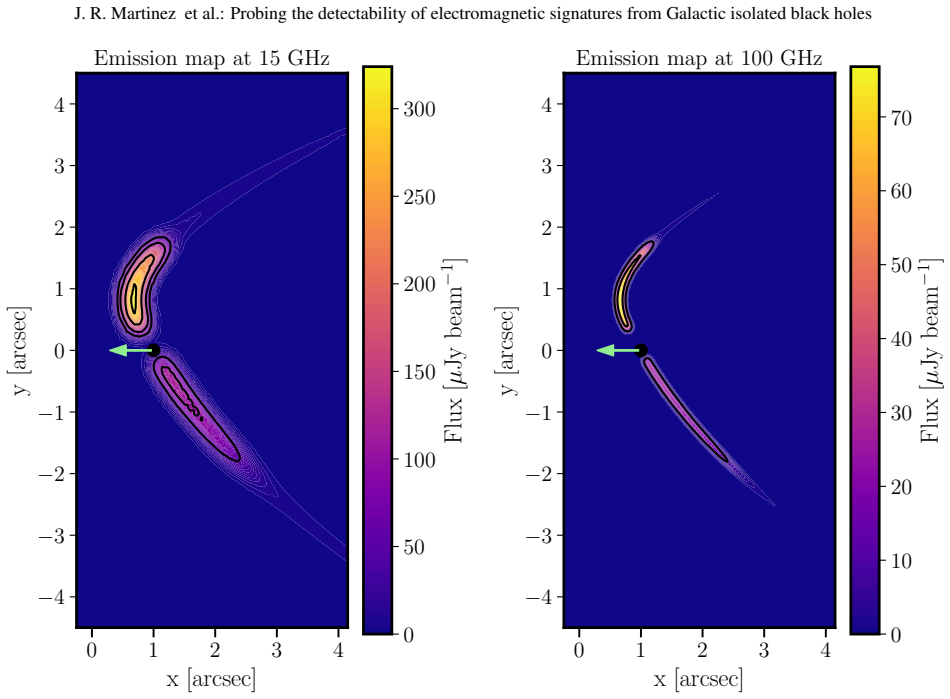
A decisive test is a targeted radio and millimetre search at the position of a microlensing-selected isolated black hole candidate that is inferred to lie inside a dense molecular cloud core. For the paper's reference parameters, the model predicts a compact, resolved structure with peak surface brightness of roughly 300 microjansky per beam at 15 GHz and 85 microjansky per beam at 100 GHz; a non-detection at several times those levels, once the dense core is confirmed independently, would rule out the outflow–medium emission component. Similarly, the predicted mid-infrared and hard X-ray accretion component could be tested by stacking observations of a sample of such candidates.
Extended reading notes
Core claim
The paper claims that an isolated stellar-mass black hole moving supersonically through a dense molecular cloud core becomes a multiwavelength source: accretion onto the hole forms an advection-dominated flow whose thermal synchrotron and Comptonised emission is visible in the mid-infrared and hard X-rays; a relativistic outflow colliding with the ambient gas produces a shocked interaction structure emitting thermal free-free and non-thermal synchrotron radiation in radio and millimetre bands; and protons and electrons that escape into the cloud and diffuse through it produce gamma rays via proton-proton collisions and bremsstrahlung. Applying the model to the microlensing object MOA-2011-BLG-191/OGLE-2011-BLG-0462, the paper infers that radio and infrared detection is plausible if that object sits in a dense medium. It further derives that Galactic IBHs could supply about 0.1% of cosmic rays above 50 GeV and about 1% above 1 PeV, and that primordial black holes with efficient electron acceleration in outflow shocks would be ruled out as a major dark matter component.
Load-bearing premise
The load-bearing premise is that an isolated black hole accreting at about one thousandth of the Eddington rate launches persistent, moderately relativistic outflows with total power near $10^{36}$ erg s$^{-1}$ and speed near $0.5c$, a behaviour borrowed from X-ray binaries; if isolated black holes launch much weaker outflows or none, the predicted radio, millimetre, and gamma-ray emission largely disappears, leaving only the accretion component.
Editorial extensions
If this is right
- An isolated black hole crossing a molecular cloud core becomes a multiwavelength source, with the accretion flow bright enough for current mid-infrared and hard X-ray instruments out to several kiloparsecs.
- The outflow–medium interaction structure is resolved and detectable with radio interferometers and ALMA at distances up to a few kiloparsecs, and fainter analogues become reachable with next-generation radio facilities.
- Relativistic protons escaping into the cloud produce gamma rays through proton–proton collisions; a detection near 2 kpc would imply the local isolated black hole density is at the higher end of current estimates.
- Galactic isolated black holes could contribute roughly 0.1% of cosmic rays above 50 GeV and about 1% above 1 PeV, making them a small but relevant high-energy source population.
- For MOA-2011-BLG-191/OGLE-2011-BLG-0462, the model predicts that radio and infrared detection is plausible provided the black hole lies in a dense medium, while remaining consistent with existing X-ray and radio upper limits.
Reading between the lines
- A direct extension of the model is that blind radio and millimetre surveys of molecular cloud cores in the Galactic plane could uncover isolated black holes without relying on microlensing alerts, since the predicted surface brightness exceeds the cloud background at high angular resolution.
- If future observations systematically fail to find the predicted sources in cores within a few kiloparsecs, the most likely resolution is a lower outflow power or a lower isolated black hole number density rather than a failure of the accretion model.
- The same outflow–medium machinery, applied to black holes at high redshift, would predict that efficient electron acceleration produces ionising radiation that constrains primordial black hole dark matter; this paper's PBH argument gives a concrete quantitative route to that constraint.
- The predicted spectrum closely resembles a low-hard state microquasar but without periodic variability, offering a practical way to distinguish an isolated black hole from a binary system in follow-up observations.
Signed reviews
Editorial analysis
A structured set of objections, weighed in public.
Referee Report
Summary. The paper presents a semi-analytical model for the electromagnetic emission of an isolated stellar-mass black hole (IBH) accreting from the interstellar medium, with focus on an IBH crossing a molecular cloud core. It couples a Bondi-Hoyle accretion prescription with an assumed two-sided outflow, a multi-zone description of the shocked outflow/medium interaction tube, and one-zone models for particles diffusing into the cloud core and outer cloud. From these ingredients it computes thermal and non-thermal spectra from the ADAF, the interaction structure, and the diffuse region, and compares them with instrument sensitivities. The model is then applied to MOA-2011-BLG-191/OGLE-2011-BLG-0462, used to estimate a possible IBH contribution to Galactic cosmic rays, and extended to primordial black holes. The headline claims are that an IBH in a dense core can be detected in the mid-IR and hard X-rays from accretion, in radio and millimetre bands from the interaction structure, and possibly in gamma rays from pp interactions of diffusing protons, with borderline radio/IR detectability for the microlensing IBH.
Significance. If the assumptions hold, the paper provides a concrete, falsifiable multiwavelength search strategy for IBHs and identifies molecular cloud cores as the most promising targets. Its strengths are the transparent semi-analytical framework, a single table of parameters, explicit instrument-sensitivity comparisons, and the use of the MOA/OGLE upper limits as consistency checks rather than fits. The paper also honestly flags several phenomenological choices. The significance is necessarily conditional because the radio/mm/gamma-ray predictions are powered by an assumed persistent outflow whose existence for IBHs is not yet established; the more robust ADAF component alone would still produce the IR/X-ray detectability claim.
major comments (4)
- [§3.3.1, Table 1, Eqs. (41)–(46)] The radio, millimetre, and gamma-ray detectability claims (Sect. 4.2–4.3, Fig. 2) are powered entirely by the assumed persistent outflow with Lout ≈ 10^36 erg s^-1 and vout ≈ 0.5c. The abstract states that outflow formation is assumed, and the derivation of Lout from Eq. (4) of Heinz & Grimm (2005) is not shown. Equations (42), (45), and (46) show that Lff ∝ Lout, Lsyn ∝ Lout^1.5, and Lpp ∝ Lout, so if isolated black holes do not launch such outflows the multiwavelength claim reduces to the ADAF component. Please either provide a physical justification for applying X-ray binary jet scaling to IBHs, or explicitly re-scope the conclusions as conditional on outflow formation and propose an observational discriminant (for example, the ratio of radio/mm structure flux to ADAF flux) that would distinguish the two cases.
- [§3.3.2–3.3.4] The post-shock advection velocity v1 = 0.1c (Eqs. 9–10) and the assumed tube disruption at ~15 zout (Sect. 3.3.3) are free parameters that set the density, residence time, and non-thermal particle content of the shocked outflow. The paper states that results are not severely affected by v1 variations and compares with the non-mixing Rankine-Hugoniot case, but the quantitative fluxes in Figs. 2 and 5 still depend on these choices. A compact parameter scan (e.g., v1 = 0.03c–0.3c and disruption distances 5–30 zout) would show whether the claimed VLA/ALMA detection levels survive over the plausible range.
- [§3.3.4, §3.4, §4.3, §4.5] The hadronic gamma-ray signal and the diffuse core emission rely on a dense-wall target density n = 5×10^5 cm^-3 (Eq. 29) and on Bohm diffusion in the core, which the paper explicitly labels as upper limits or optimistic. The 'borderline detectability with CTA' statement and the ~1% cosmic-ray contribution at 1 PeV additionally assume that 10% of Lout goes into relativistic protons. Because these are upper-limit estimates, the text should state the scaling of Lpp and of the CR injection with the wall density, diffusion coefficient, and proton fraction, so the reader can judge how much the detection claim weakens under less optimistic assumptions.
- [§4.6, Fig. 6] The MOA-2011-BLG-191/OGLE-2011-BLG-0462 radio and infrared detectability prediction assumes a dense environment with n_med = 10^2 cm^-3, and the paper notes that this is uncertain (Kimura et al. 2025). Even under that assumption the predicted signals are only borderline. The abstract's statement that radio and infrared detection is 'plausible' should be softened or accompanied by a quantitative estimate of how likely a dense environment is along the line of sight.
minor comments (6)
- [§3.3.4] The target density is written as n = 5×ncore = 5×10^5 cm^3; the units should be cm^-3.
- [Fig. 2 caption] There is a typo: 'on-sourve time' should read 'on-source time'.
- [§4.5] The sentence 'The majority of these of these objects' contains a duplicated phrase, and the density unit 'cm^-2' in the same paragraph should be 'cm^-3'.
- [§1] The remark that multiple black hole systems 'may not differ too strongly' from the IBH scenario is vague; please add a reference or a one-sentence justification, or remove it.
- [§3.3.1] The parameter ε = Mdot_out/Mdot_IBH is used in Eq. (5) but defined only afterwards; define it before the equation.
- [Fig. 6] The spectrum is labeled unabsorbed, but the text discusses core absorption; a sentence indicating which predicted bands in Fig. 6 are affected by absorption would avoid confusion.
Circularity Check
No significant circularity: the claimed detectability is a conditional forward-model prediction, not a fit or a self-referential derivation.
full rationale
The paper is a forward-modeling study. Its key quantities (Bondi-Hoyle accretion rate, ADAF spectrum via Gutiérrez et al. 2021, outflow power via Heinz & Grimm 2005, injection efficiencies eta_NT and eta_B) are fixed inputs before the emission calculation; none of the claimed predictions (radio/mm from the shocked outflow, gamma rays from diffusing protons, IR/X-ray from the ADAF) is obtained by inverting or fitting the same data it purports to predict. The MOA-2011-BLG-191/OGLE-2011-BLG-0462 upper limits are used only as posterior consistency checks and are not fed back into the model. The scaling relations in Sect. 4.4 express how the output luminosities depend on the input Mdot and Lout; they are model consequences, not a reconstruction of inputs from outputs. The outflow assumption is explicitly flagged in the abstract ('assumed the formation of an outflow') and in Sect. 3.3.1, and the 1% cosmic-ray estimate is explicitly conditional on assumed efficiencies and source counts. Self-citations (Bosch-Ramon 2022 for lambda_acc; del Palacio et al. 2018 and Martinez et al. 2022 for the multi-zone technique) supply parameter values or numerical methods with external anchors; they do not smuggle the target conclusion in. The acknowledged uncertainties (Sect. 4.4: Mdot 'somewhat unconstrained'; Sect. 3.4: Bohm diffusion 'optimistic') are limitations on robustness, not circularity.
Assumptions & free parameters
free parameters (12)
- lambda_acc =
0.1
- v1 (post-shock advection velocity) =
0.1 c
- eta_B =
0.1
- eta_NT =
0.1
- v_out =
0.5 c
- theta =
60 degrees
- chi =
0.2 rad
- proton-to-electron power split =
0.9 / 0.1
- target density for pp and bremsstrahlung =
5e5 cm^-3
- tube disruption distance =
15 zout ~ 0.05 pc
- magnetic field in cloud core / outer cloud =
100 uG / 10 uG
- reference distance =
2 kpc
assumptions (11)
- standard math Bondi-Hoyle cylindrical accretion rate and accretion radius formulas (Eqs. 1-2).
- domain assumption The accretion flow develops a two-temperature ADAF with the spectrum from Gutierrez et al. (2021).
- domain assumption Low-accretion black holes launch persistent outflows with Lout ~ 1e36 erg/s and vout ~ 0.5c.
- domain assumption Mechanical feedback reduces the accretion rate by a factor lambda_acc = 0.1 (Bosch-Ramon 2022).
- domain assumption Diffusive shock acceleration injects an E^-2 power law with exponential cutoff and a 90/10 proton/electron split.
- domain assumption Particles diffuse under Bohm diffusion in the cloud core and outer cloud.
- ad hoc to paper Energy is conserved across the shock during mass loading, with velocity v1 treated as a free parameter (Eqs. 9-10).
- ad hoc to paper The outflow tube disrupts at ~15 zout (0.05 pc) and injects particles into the cloud.
- ad hoc to paper Protons and electrons interact with dense walls of density n = 5e5 cm^-3 for pp and bremsstrahlung losses.
- standard math The Saha equation describes hydrogen ionization in the shocked medium.
- domain assumption CMB constraints on PBH ionizing luminosity from Piga et al. (2022) apply to the modeled PBH emission.
Cite this review
Pith. "Pith review of Probing the detectability of electromagnetic signatures from Galactic isolated black holes." pith.science (2026). https://pith.science/paper/4V6EGGKB
@misc{pith2026250623427,
  author       = {Pith},
  title        = {Pith review of: Probing the detectability of electromagnetic signatures from Galactic isolated black holes},
  year         = {2026},
  howpublished = {\url{https://pith.science/paper/4V6EGGKB}},
  note         = {Machine review of arXiv:2506.23427}
}
read the original abstract
Context: A large number of isolated black holes (IBHs) are expected to populate the Galaxy. However, only one has been confirmed by the analysis of a microlensing event, and no confirmed emission detection from an IBH has been reported so far. Aims: We analysed the detectability of electromagnetic signatures from IBHs moving in the Galaxy. Methods: We considered accretion from the interstellar medium onto an IBH and assumed the formation of an outflow. We modelled the accretion process and the interaction of the outflow with the surrounding medium on large scales, including mechanical feedback on the accretion process. Furthermore, we also calculated the emission from three different regions: the accretion region, the radiation from the outflow medium interaction structure, and the emission of relativistic particles that diffuse in the surrounding medium. Results: Multiwavelength emission associated with Galactic IBHs can be detected in systems moving through a very dense medium. Thermal emission from accretion could be observed in the mid infrared and in hard X rays with current and forthcoming observatories. Thermal and non thermal emission from the outflow medium shock could also be detected in the radio and millimetre ranges. Moreover, detection of the emission from particles diffusing in a dense medium could be feasible in gamma rays. Applying our model to the IBH associated with the gravitational microlensing event MOA2011BLG191 OGLE2011BLG0462, we inferred that radio and infrared detection of the IBH is plausible. Also, we derived that IBHs could be modest Galactic cosmic ray contributors, potentially reaching a 1% contribution at 1 PeV. Finally, by extending our model to primordial black holes, we conclude that efficient leptonic acceleration in their outflow medium interactions would rule them out as a major dark matter component.
Figures


Figures from the paper (2 more)

Forward citations
Cited by 1 Pith paper
-
A Space Mission to Earth's Nearest Black Hole: Reality or Science Fiction?
An interstellar nanocraft mission to a nearby black hole is technologically speculative but potentially feasible within decades and could deliver precision strong-field tests of General Relativity.
Reference graph
Works this paper leans on
- [1]
- [2]
- [3]
-
[4]
Barkov, M. V . & Bosch-Ramon, V . 2022, MNRAS, 510, 3479
work page 2022
-
[5]
Barkov, M. V . & Khangulyan, D. V . 2012, MNRAS, 421, 1351
2012
-
[6]
V ., Khangulyan, D
Barkov, M. V ., Khangulyan, D. V ., & Popov, S. B. 2012, MNRAS, 427, 589
2012
-
[7]
Benaglia, P., del Palacio, S., Hales, C., & Colazo, M. E. 2021, MNRAS, 503, 2514
2021
- [8]
Show all 76 references
-
[9]
Blandford, R. D. & Begelman, M. C. 1999, MNRAS, 303, L1
1999
-
[10]
M., Wright, E
Blondin, J. M., Wright, E. B., Borkowski, K. J., & Reynolds, S. P. 1998, ApJ, 500, 342
1998
-
[11]
1952, MNRAS, 112, 195
Bondi, H. 1952, MNRAS, 112, 195
1952
-
[12]
& Hoyle, F
Bondi, H. & Hoyle, F. 1944, MNRAS, 104, 273
1944
-
[13]
2022, A&A, 660, A5
Bosch-Ramon, V . 2022, A&A, 660, A5
2022
-
[14]
& Barkov, M
Bosch-Ramon, V . & Barkov, M. V . 2016, A&A, 590, A119
2016
-
[15]
& Bellomo, N
Bosch-Ramon, V . & Bellomo, N. 2020, A&A, 638, A132
2020
-
[16]
2016, Phys
Carr, B., Kühnel, F., & Sandstad, M. 2016, Phys. Rev. D, 94, 083504
2016
-
[17]
Carr, B. J. & Hawking, S. W. 1974, MNRAS, 168, 399
1974
-
[18]
2023, ApJ, 948, 136 Cherenkov Telescope Array Consortium, Acharya, B
Chen, K., Ren, J., & Dai, Z.-G. 2023, ApJ, 948, 136 Cherenkov Telescope Array Consortium, Acharya, B. S., Agudo, I., et al. 2019, Science with the Cherenkov Telescope Array
2023
-
[19]
F., McKee, C
Cioffi, D. F., McKee, C. F., & Bertschinger, E. 1988, ApJ, 334, 252
1988
-
[20]
& García-Bellido, J
Clesse, S. & García-Bellido, J. 2017, Physics of the Dark Universe, 15, 142
2017
-
[21]
Crutcher, R. M. 1999, ApJ, 520, 706 del Palacio, S., Bosch-Ramon, V ., Müller, A. L., & Romero, G. E. 2018, A&A, 617, A13
1999
-
[22]
Drury, L. O. 1983, Reports on Progress in Physics, 46, 973
1983
-
[23]
W., Thomson, A
Duchesne, S. W., Thomson, A. J. M., Pritchard, J., et al. 2023, PASA, 40, e034
2023
-
[24]
A., Narayan, R., Cui, W., Grove, J
Esin, A. A., Narayan, R., Cui, W., Grove, J. E., & Zhang, S.-N. 1998, ApJ, 505, 854
1998
-
[25]
P., Maccarone, T
Fender, R. P., Maccarone, T. J., & Heywood, I. 2013, MNRAS, 430, 1538
2013
-
[26]
2002, in SF2A-2002: Semaine de l’Astrophysique Francaise, ed
Ferrando, P. 2002, in SF2A-2002: Semaine de l’Astrophysique Francaise, ed. F. Combes & D. Barret, 271 Ferrière, K. M. 2001, Reviews of Modern Physics, 73, 1031
2002
-
[27]
Fujita, Y ., Inoue, S., Nakamura, T., Manmoto, T., & Nakamura, K. E. 1998, ApJ, 495, L85 Gaia Collaboration, Brown, A. G. A., Vallenari, A., et al. 2021, A&A, 649, A1
1998
-
[28]
A., Black, J
Grenier, I. A., Black, J. H., & Strong, A. W. 2015, ARA&A, 53, 199 Gutiérrez, E. M., Vieyro, F. L., & Romero, G. E. 2021, A&A, 649, A87
2015
-
[29]
V ., Alexashov, D
Gvaramadze, V . V ., Alexashov, D. B., Katushkina, O. A., & Kniazev, A. Y . 2018, MNRAS, 474, 4421
2018
-
[30]
& Grimm, H
Heinz, S. & Grimm, H. J. 2005, ApJ, 633, 384 Hörandel, J. R. 2003, Astroparticle Physics, 19, 193
2005
-
[31]
Hummer, D. G. & Storey, P. J. 1987, MNRAS, 224, 801
1987
-
[32]
T., Jagannathan, P., Mooley, K
Intema, H. T., Jagannathan, P., Mooley, K. P., & Frail, D. A. 2017, A&A, 598, A78
2017
-
[33]
R., Aharonian, F
Kelner, S. R., Aharonian, F. A., & Bugayov, V . V . 2006, Phys. Rev. D, 74, 034018
2006
-
[34]
S., Kashiyama, K., & Hotokezaka, K
Kimura, S. S., Kashiyama, K., & Hotokezaka, K. 2021, ApJ, 922, L15
2021
-
[35]
S., Murchikova, L., & Sahu, K
Kimura, S. S., Murchikova, L., & Sahu, K. C. 2025, ApJ, 986, 135
2025
-
[36]
Kin, K., Kuze, R., & Kimura, S. S. 2025, ApJ, 985, 251
2025
-
[37]
E., Christensen, F
Koglin, J. E., Christensen, F. E., Craig, W. W., et al. 2005, in Society of Photo- Optical Instrumentation Engineers (SPIE) Conference Series, V ol. 5900, Op- tics for EUV , X-Ray, and Gamma-Ray Astronomy II, ed. O. Citterio & S. L. O’Dell, 266–275 Körding, E. G., Fender, R. P...
2005
-
[38]
A., Chandler, C
Lacy, M., Baum, S. A., Chandler, C. J., et al. 2020, PASP, 132, 035001
2020
-
[39]
J., Alves, J., & Lada, E
Lada, C. J., Alves, J., & Lada, E. A. 1999, in The Physics and Chemistry of the Interstellar Medium, ed. V . Ossenkopf, J. Stutzki, & G. Winnewisser, 161
1999
-
[40]
Lam, C. Y . & Lu, J. R. 2023, ApJ, 955, 116
2023
-
[41]
Y ., Lu, J
Lam, C. Y ., Lu, J. R., Udalski, A., et al. 2022, ApJ, 933, L23
2022
-
[42]
D., & Armitage, P
Li, X., Chang, P., Levin, Y ., Matzner, C. D., & Armitage, P. J. 2020, MNRAS, 494, 2327
2020
-
[43]
Mackey, J., Langer, N., & Gvaramadze, V . V . 2013, MNRAS, 436, 859
2013
-
[44]
2011, ApJ, 731, 53
Mainzer, A., Bauer, J., Grav, T., et al. 2011, ApJ, 731, 53
2011
-
[45]
R., del Palacio, S., & Bosch-Ramon, V
Martinez, J. R., del Palacio, S., & Bosch-Ramon, V . 2023, A&A, 680, A99
2023
-
[46]
R., del Palacio, S., Bosch-Ramon, V ., & Romero, G
Martinez, J. R., del Palacio, S., Bosch-Ramon, V ., & Romero, G. E. 2022, A&A, 661, A102
2022
-
[47]
2018, MNRAS, 475, 1251
Matsumoto, T., Teraki, Y ., & Ioka, K. 2018, MNRAS, 475, 1251
2018
-
[48]
2019, in Bulletin of the American Astronomical Society, V ol
McKinnon, M., Beasley, A., Murphy, E., et al. 2019, in Bulletin of the American Astronomical Society, V ol. 51, 81
2019
-
[49]
2022, ApJ, 934, 62
Mereghetti, S., Sidoli, L., Ponti, G., & Treves, A. 2022, ApJ, 934, 62
2022
-
[50]
& Bosch-Ramon, V
Molina, E. & Bosch-Ramon, V . 2018, A&A, 618, A146
2018
-
[51]
2019, A&A, 629, A129
Molina, E., del Palacio, S., & Bosch-Ramon, V . 2019, A&A, 629, A129
2019
-
[52]
& McCammon, D
Morrison, R. & McCammon, D. 1983, ApJ, 270, 119
1983
-
[53]
V ., Zhekov, S
Myasnikov, A. V ., Zhekov, S. A., & Belov, N. A. 1998, MNRAS, 298, 1021
1998
-
[54]
& Watson, A
Nagano, M. & Watson, A. A. 2000, Reviews of Modern Physics, 72, 689
2000
-
[55]
1995, Nature, 374, 623
Narayan, R., Yi, I., & Mahadevan, R. 1995, Nature, 374, 623
1995
-
[56]
V ., Galli, D., & Caselli, P
Padovani, M., Ivlev, A. V ., Galli, D., & Caselli, P. 2018, A&A, 614, A111
2018
-
[57]
& Ricotti, M
Park, K. & Ricotti, M. 2013, ApJ, 767, 163
2013
-
[58]
Piga, L., Lucca, M., Bellomo, N., et al. 2022, J. Cosmology Astropart. Phys., 2022, 016 Planck Collaboration, Ade, P. A. R., Aghanim, N., et al. 2014, A&A, 564, A45
2022
-
[59]
J., Ormes, J
Ryan, M. J., Ormes, J. F., & Balasubrahmanyan, V . K. 1972, Phys. Rev. Lett., 28, 985
1972
-
[60]
Rybicki, G. B. & Lightman, A. P. 1979, Radiative processes in astrophysics
1979
-
[61]
C., Anderson, J., Casertano, S., et al
Sahu, K. C., Anderson, J., Casertano, S., et al. 2025, ApJ, 983, 104
2025
-
[62]
C., Anderson, J., Casertano, S., et al
Sahu, K. C., Anderson, J., Casertano, S., et al. 2022, ApJ, 933, 83
2022
-
[63]
M., Bramich, D
Saikia, P., Russell, D. M., Bramich, D. M., et al. 2019, ApJ, 887, 21
2019
-
[64]
E., de Koter, A., et al
Sana, H., de Mink, S. E., de Koter, A., et al. 2012, Science, 337, 444
2012
-
[65]
2021, MNRAS, 505, 4036
Scarcella, F., Gaggero, D., Connors, R., et al. 2021, MNRAS, 505, 4036
2021
-
[66]
Shakura, N. I. & Sunyaev, R. A. 1973, A&A, 24, 337
1973
-
[67]
J., Davidson, D
Sokolowski, M., Tingay, S. J., Davidson, D. B., et al. 2022, PASA, 39, e015
2022
-
[68]
Stahler, S. W. & Palla, F. 2004, The Formation of Stars
2004
-
[69]
R., Blondin, J
Stevens, I. R., Blondin, J. M., & Pollock, A. M. T. 1992, ApJ, 386, 265
1992
-
[70]
2019, in Bulletin of the American Astronomical Society, V ol
Tomsick, J., Zoglauer, A., Sleator, C., et al. 2019, in Bulletin of the American Astronomical Society, V ol. 51, 98
2019
-
[71]
& Kawanaka, N
Tsuna, D. & Kawanaka, N. 2019, MNRAS, 488, 2099
2019
-
[72]
2018, MNRAS, 477, 791
Tsuna, D., Kawanaka, N., & Totani, T. 2018, MNRAS, 477, 791
2018
-
[73]
V ., Fedorova, A
Tutukov, A. V ., Fedorova, A. V ., & Cherepashchuk, A. M. 2011, Astronomy Reports, 55, 247 van den Heuvel, E. P. J. 1992, Endpoints of stellar evolution: the incidence of stellar mass black holes in the Galaxy., In ESA, Environment Observation and Climate Modelling Through Int...
2011
-
[74]
Whittet, D. C. B., Bode, M. F., Longmore, A. J., et al. 1988, MNRAS, 233, 321
1988
-
[75]
& Narayan, R
Yuan, F. & Narayan, R. 2014, ARA&A, 52, 529 Zel’dovich, Y . B. & Novikov, I. D. 1967, Soviet Ast., 10, 602
2014
-
[76]
& Fryer, C
Zhang, W. & Fryer, C. L. 2001, ApJ, 550, 357 Article number, page 14 of 15 J. R. Martinez et al.: Probing the detectability of electromagnetic signatures from Galactic isolated black holes 10□6 10□3 100 103 106 ϵ [eV] 1020 1025 1030 1035 1040 ϵL(ϵ) [erg s □1] Chandra JWST NEOW...
1973
Reviewed August 6, 2026 · model on record in the stance chip above.
Discussion (0). Continue with ORCID to comment.