REVIEW 3 major objections 5 minor 40 references
A Least-Privilege Memory Protection Model for Modern Hardware
T0 review · 3 major / 5 minor · reviewed 2026-08-14 · deepseek-v4-flash
Pith's one-line read The paper claims that memory management can be faithfully based on a least-privilege model of address translation as a configurable network of address spaces, and that such a model can be implemented without sacrificing performance.
desk verdict A credible systems contribution that turns decoding nets into a least-privilege memory model with a real Barrelfish implementation; the completeness claim is overbroad but the core is solid. read the letter →
The pith
A machine-rendered reading of the paper's core claim, the machinery that carries it, and where it could break.
The reading
What carries the argument
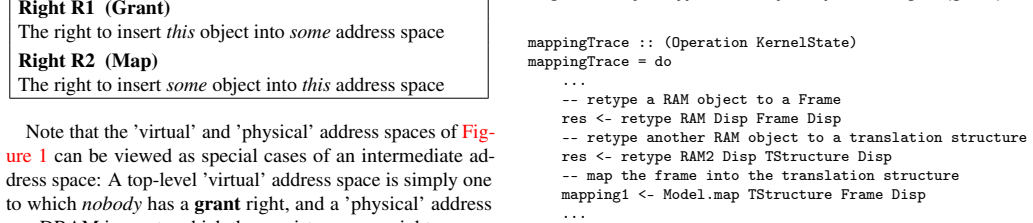
The central object is the decoding net: a directed graph in which each node is an address space or device with an accept set of local addresses and a translate function sending them to addresses in other spaces. The paper extends this with dynamic configuration spaces, so the graph is not just a static snapshot but a set of allowable programmable states, and overlays an access-control matrix over two rights—grant and map. That matrix is the abstract specification of who may touch memory and who may reprogram translation hardware. On the implementation side, a partitioned capability system uses canonical object names, a mapping database ordered by containment, and typed page-table capabilities to make the model executable while keeping translation structures unmappable and unforgeable.
What would settle it
A concrete falsifier is to take any existing or simulated translation unit whose behavior depends on the history of accesses or on context beyond the current configuration, and show that it cannot be represented as a decoding-net node with an accept set, a translate function, and a configuration space; that would refute the completeness claim on which the paper's security argument rests.
Extended reading notes
Core claim
The paper's central claim is that the semantics of real modern address-translation hardware can be captured completely by a graph of address spaces, and that an operating system can enforce least privilege on top of that graph. It identifies two distinct authorities that conventional kernels conflate: the grant right to insert a memory object into some address space, and the map right to insert some object into a particular address space. Separating these rights and recording them in an access-control matrix lets a system grant a device driver enough authority to set up a shared buffer without letting it reconfigure translations it does not own. The paper demonstrates the whole chain—abstract model, executable Haskell specification, and a C implementation in a capability-based OS—and reports that the implementation is competitive with Linux on standard memory-operation benchmarks.
Load-bearing premise
The load-bearing premise is that every real address-translation unit—including unusual or stateful ones—can be expressed as a decoding-net node that accepts a set of local addresses, translates them through a function, and has a configuration space of allowed states; if any existing hardware fails to fit this form, the model's completeness and the safety of an OS built on it collapse.
Editorial extensions
If this is right
- An OS built on the model can give device drivers precisely the authority they need—for example, mapping a buffer into an IOMMU without granting the right to reconfigure the IOMMU broadly.
- Least-privilege memory management can be decentralized: user-space drivers and co-processors can set up shared memory through capability invocation rather than through a single trusted kernel.
- Verified operating systems could substitute this richer hardware model for the simplifying single-address-space assumptions in their correctness proofs, covering systems with multiple translation units.
- The performance results suggest that fine-grained capability-based memory management does not inherently cost more than conventional virtual memory in common operations such as map, protect, and unmap.
- The implementation manages memory on simulated platforms with swapped, private, and private-plus-swapped address-space topologies, which mainstream OS designs do not currently support.
Reading between the lines
- A natural extension the paper does not build is a conformance harness that runs the C implementation against the Haskell executable specification as an oracle, checking every mapping operation against the model.
- The grant/map distinction could apply to other configuration resources beyond memory, such as virtualized network address translation or programmable device mappings; the paper does not generalize in that direction.
- The Linux sketch suggests a weaker, ACL-based variant of the model could be retrofitted to monolithic kernels, but the paper does not implement or benchmark that variant.
- Because the evaluation focuses on microbenchmarks, end-to-end application workloads might reveal different trade-offs; the paper's measured overheads are for specific operations, not full systems.
Signed reviews
Editorial analysis
A structured set of objections, weighed in public.
Referee Report
Summary. The paper argues that the traditional OS abstraction of a single, shared physical address space is inadequate for modern heterogeneous platforms, and proposes a least-privilege model of addressing based on decoding nets. It extends the decoding-net formalism with dynamic configuration and an access-control matrix distinguishing map rights (to insert objects into an address space) and grant rights (to insert an object into some address space). The model is refined into an executable Haskell specification and then implemented as Barrelfish/MAS, an extension of the Barrelfish capability system. The paper reports that Barrelfish/MAS achieves performance comparable to or better than Linux on memory-management microbenchmarks, successfully configures Xeon Phi and IOMMU address spaces, scales well in synthetic topology benchmarks, and boots on simulated ARM platforms with unusual address-space topologies. The paper frames the model as a sound basis for future formal verification, but explicitly states that no formally verified OS software is presented.
Significance. This is a substantial systems contribution with a concrete, implemented alternative to the single-address-space abstraction. The paper gives a clear mapping from access-control concepts to a capability system, demonstrates the model on real hardware including the Xeon Phi and IOMMUs, and provides detailed benchmark measurements. The open implementation and the explicit non-goals are strengths: the authors do not overclaim the existence of a formal proof, and they provide reproducible artifacts. If the completeness claim can be substantiated or suitably qualified, the model would be a useful design basis for future OS memory-management and verification work. The performance results are plausible and the comparison with Linux is carefully documented, including mitigated and unmitigated configurations.
major comments (3)
- [§3, §4.2, §5.2] The central completeness claim that the model captures 'the full semantics of real addressing hardware without simplifying assumptions' (Section 1) is not supported by the formalism as presented. In Section 3, node.translate has type address -> {name}, and in Section 4.1, configuration is defined as address space -> node. This makes translation a pure function of the local address only. Real IOMMUs and System MMUs select translation contexts based on the requester or device context (for example PCIe ATS/PRI requester IDs, SMMU stream IDs, or PASID-based translation), so the resulting global name can depend on who issues the access. Such behavior cannot be expressed without extending node.translate with a requester argument or adding explicit requester-state to nodes. This is directly relevant to the stated goal of covering secure co-processors and devices (Sections 1 and 6.4). I recommend either extending the model with requester-dependent translation or explicitly restricting the completeness claim and stating the class of hardware the model is designed to cover.
- [§3, §4.2, §5.2] The correspondence between the abstract access-control matrix, the Haskell executable specification, and the C implementation is asserted 'by inspection and careful construction' rather than demonstrated. Since the paper motivates the model as a basis for formal verification of system software, the absence of any refinement proof, or even a precise statement of the invariants relating the three levels, leaves a gap between the model and the implementation. This is acceptable for a systems paper if framed as a design artifact, but the current wording overstates the formal status of the artifact and of the 'sound foundation' claim in the conclusion.
- [§6.4] The section titled 'Correctness on simulated platforms' demonstrates only that Barrelfish/MAS boots and can allocate and manage memory on four simulator topologies; no correctness property (for example, absence of unauthorized mappings, no dangling capabilities, or translation resolving as predicted) is checked. The results support functionality and flexibility, but they do not by themselves support the correctness of the model or its safety guarantees. The title and the corresponding claim in the conclusion should be softened accordingly.
minor comments (5)
- [§5.2] The text contains several typos: 'has has support' should be 'has support', 'capablities' and 'capablity' should be 'capabilities' and 'capability', and 'cannonical' should be 'canonical'.
- [§5.2.1] In the descendant definition, 'We say a capability B is a descendant of capability A if A is smaller than A' contains a typo; the condition should presumably read 'B is smaller than A' or 'B is contained in A'.
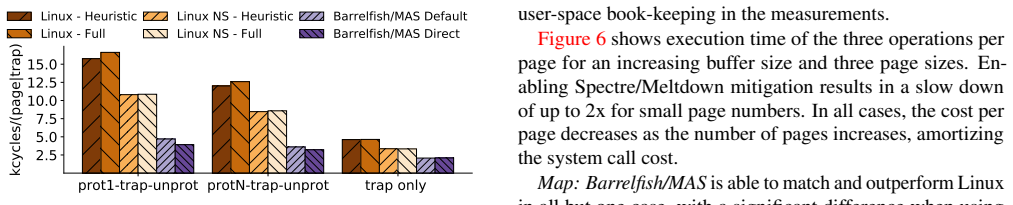
- [§6.1] The performance comparison would be clearer if the effect of the missing Spectre/Meltdown mitigations in Barrelfish/MAS were discussed beyond noting the slowdown; the NS (no-mitigation) Linux numbers help, but the headline 'up to 4x faster' is stated relative to mitigated Linux without repeating this caveat in the figure caption.
- [§3] The notation 'name = Name nodeid address' and 'node = Node accept ::{address} translate :: address->{name}' is typeset in a way that is hard to parse; explicit type signatures or a small example would improve readability.
- [§6.5] The claim 'There is typically less than one capability for each frame of memory' is confusingly phrased; presumably the authors mean that on average there is fewer than one capability per frame, which should be stated as an average ratio rather than a typical count.
Circularity Check
No significant circularity: the model builds on independently machine-checked prior work and the central claims are empirical or explicitly assumed, not derived from their own conclusions.
full rationale
The paper's derivation chain starts from the decoding-net model of Achermann et al. [1,2]. Although these are self-citations, [2] is an Isabelle/HOL formalization of physical addressing, which counts as independent machine-checked support under the review rules; the present paper does not rely on an unverified uniqueness theorem or on a fitted parameter. The refinement to dynamic configuration and to grant/map rights is presented explicitly as an access-control matrix in the sense of Lampson [24], and the static/dynamic security condition is a definition of correctness rather than a prediction derived from the model. The completeness claim in Section 1 ('capture the full semantics of real addressing hardware without simplifying assumptions') is asserted rather than proven, and the paper candidly states that the correspondence between abstract and executable models is 'by inspection and careful construction' (Section 3); these are correctness risks, not circularities. The performance and scaling results are direct measurements on Linux and Barrelfish/MAS, so no fitted input is relabeled as a prediction. I therefore find no circular step requiring remediation.
Assumptions & free parameters
assumptions (3)
- domain assumption The decoding net model of Achermann et al. (nodes accept/translate addresses) correctly and completely captures modern address translation hardware.
- domain assumption Security is equivalent to consistency of the current configuration with an access control matrix of grant and map rights.
- ad hoc to paper The Haskell executable specification corresponds to the abstract model, and the C implementation corresponds to the executable specification, by inspection and careful construction.
Cite this review
Pith. "Pith review of A Least-Privilege Memory Protection Model for Modern Hardware." pith.science (2026). https://pith.science/paper/4VV4IJ7W
@misc{pith2026190808707,
  author       = {Pith},
  title        = {Pith review of: A Least-Privilege Memory Protection Model for Modern Hardware},
  year         = {2026},
  howpublished = {\url{https://pith.science/paper/4VV4IJ7W}},
  note         = {Machine review of arXiv:1908.08707}
}
read the original abstract
We present a new least-privilege-based model of addressing on which to base memory management functionality in an OS for modern computers like phones or server-based accelerators. Existing software assumptions do not account for heterogeneous cores with different views of the address space, leading to the related problems of numerous security bugs in memory management code (for example programming IOMMUs), and an inability of mainstream OSes to securely manage the complete set of hardware resources on, say, a phone System-on-Chip. Our new work is based on a recent formal model of address translation hardware which views the machine as a configurable network of address spaces. We refine this to capture existing address translation hardware from modern SoCs and accelerators at a sufficiently fine granularity to model minimal rights both to access memory and configure translation hardware. We then build an executable specification in Haskell, which expresses the model and metadata structures in terms of partitioned capabilities. Finally, we show a fully functional implementation of the model in C created by extending the capability system of the Barrelfish research OS. Our evaluation shows that our unoptimized implementation has comparable (and in some cases) better performance than the Linux virtual memory system, despite both capturing all the functionality of modern hardware addressing and enabling least-privilege, decentralized authority to access physical memory and devices.
Figures



Figures from the paper (4 more)

Reference graph
Works this paper leans on
-
[1]
Formalizing Memory Accesses and Interrupts
Reto Achermann, Lukas Humbel, David Cock, and Timothy Roscoe. Formalizing Memory Accesses and Interrupts. In Proceedings of the 2nd Workshop on Models for Formal Analysis of Real Systems, MARS 2017, pages 66–116, 2017
work page 2017
-
[2]
Physical Addressing on Real Hardware in Isabelle/HOL
Reto Achermann, Lukas Humbel, David Cock, and Timothy Roscoe. Physical Addressing on Real Hardware in Isabelle/HOL. In Interactive Theorem Proving, ITP’18, pages 1–19, Oxford, United Kingdom, 2018. Springer International Publishing
work page 2018
-
[3]
Do- It-Yourself Virtual Memory Translation
Hanna Alam, Tianhao Zhang, Mattan Erez, and Yoav Etsion. Do- It-Yourself Virtual Memory Translation. In Proceedings of the 44th Annual International Symposium on Computer Architecture, ISCA ’17, pages 457–468, New York, NY , USA, 2017. ACM
work page 2017
-
[4]
James P. Anderson. Computer Security Technology Planning Study. Technical Report ESD-TR-73-51, V ol. I, AD-758 206, Electronic Sys- tems Division, Deputy for Command and Management Systems HQ Electronic Systems Division (AFSC), L. G. Hanscom Field, Bedford, Massachusetts 01730, USA, October 1972
work page 1972
-
[5]
Andy Whitcroft. Sparsemem Memory Model. https://lwn.net/ Articles/134804/, Aug 2019
work page 2019
-
[6]
Andrew W. Appel and Kai Li. Virtual Memory Primitives for User Programs. In Proceedings of the Fourth International Conference on Architectural Support for Programming Languages and Operating Systems, ASPLOS IV , pages 96–107, New York, NY , USA, 1991. ACM
work page 1991
-
[7]
Development Tools and Software: Fast Mod- els
ARM Ltd. Development Tools and Software: Fast Mod- els. https://www.arm.com/products/development-tools/ simulation/fast-models, August 2019. 11
work page 2019
-
[8]
Rachata Ausavarungnirun, Joshua Landgraf, Vance Miller, Saugata Ghose, Jayneel Gandhi, Christopher J. Rossbach, and Onur Mutlu. Mo- saic: A GPU Memory Manager with Application-transparent Support for Multiple Page Sizes. In Proceedings of the 50th Annual IEEE/ACM International Symposium on Microarchitecture, MICRO-50 ’17, pages 136–150, New York, NY , USA...
work page 2017
Show all 40 references
-
[9]
It’s Time to Think About an Operating System for Near Data Processing Architectures
Antonio Barbalace, Anthony Iliopoulos, Holm Rauchfuss, and Goetz Brasche. It’s Time to Think About an Operating System for Near Data Processing Architectures. In Proceedings of the 16th Workshop on Hot Topics in Operating Systems, HotOS ’17, pages 56–61, New York, NY , USA, 2017. ACM
2017
-
[10]
Popcorn: Bridging the Programmability Gap in heterogeneous-ISA Platforms
Antonio Barbalace, Marina Sadini, Saif Ansary, Christopher Jeles- nianski, Akshay Ravichandran, Cagil Kendir, Alastair Murray, and Binoy Ravindran. Popcorn: Bridging the Programmability Gap in heterogeneous-ISA Platforms. In Proceedings of the Tenth European Conference on Comp...
2015
-
[11]
The Multikernel: A New OS Architecture for Scalable Multicore Systems
Andrew Baumann, Paul Barham, Pierre-Evariste Dagand, Tim Harris, Rebecca Isaacs, Simon Peter, Timothy Roscoe, Adrian Schüpbach, and Akhilesh Singhania. The Multikernel: A New OS Architecture for Scalable Multicore Systems. In Proceedings of the ACM SIGOPS 22Nd Symposium on Ope...
2009
-
[12]
Secure Microkernels, State Monads and Scalable Refinement
David Cock, Gerwin Klein, and Thomas Sewell. Secure Microkernels, State Monads and Scalable Refinement. In Proceedings of the 21st International Conference on Theorem Proving in Higher Order Logics, TPHOLs ’08, pages 167–182, Berlin, Heidelberg, 2008. Springer- Verlag
2008
-
[13]
Philip Derrin, Kevin Elphinstone, Gerwin Klein, David Cock, and Manuel M. T. Chakravarty. Running the Manual: An Approach to High-assurance Microkernel Development. In Proceedings of the 2006 ACM SIGPLAN Workshop on Haskell, Haskell ’06, pages 60–71, New York, NY , USA, 2006. ACM
2006
-
[14]
Verified Protection Model of the seL4 Microkernel
Dhammika Elkaduwe, Gerwin Klein, and Kevin Elphinstone. Verified Protection Model of the seL4 Microkernel. In Proceedings of the 2Nd International Conference on Verified Software: Theories, Tools, Experiments, VSTTE ’08, pages 99–114, Berlin, Heidelberg, 2008. Springer-Verlag
2008
-
[15]
Authorization, Protection, and Allocation of Memory in a Large System
Simon Gerber. Authorization, Protection, and Allocation of Memory in a Large System. PhD thesis, ETH Zurich, 2018
2018
-
[16]
Not Your Parents’ Physical Address Space
Simon Gerber, Gerd Zellweger, Reto Achermann, Kornilios Kourtis, Timothy Roscoe, and Dejan Milojicic. Not Your Parents’ Physical Address Space. In Proceedings of the 15th USENIX Conference on Hot Topics in Operating Systems, HOTOS’15, pages 16–16, Berkeley, CA, USA, 2015. USEN...
2015
-
[17]
CertiKOS: An Extensible Archi- tecture for Building Certified Concurrent OS Kernels
Ronghui Gu, Zhong Shao, Hao Chen, Xiongnan Wu, Jieung Kim, Vil- helm Sjöberg, and David Costanzo. CertiKOS: An Extensible Archi- tecture for Building Certified Concurrent OS Kernels. In Proceedings of the 12th USENIX Conference on Operating Systems Design and Implementation, OS...
2016
-
[18]
Multiple Physical Mappings: Dynamic DRAM Channel Sharing and Partitioning
Marius Hillenbrand, Mathias Gottschlag, Jens Kehne, and Frank Bel- losa. Multiple Physical Mappings: Dynamic DRAM Channel Sharing and Partitioning. In Proceedings of the 8th Asia-Pacific Workshop on Systems, APSys ’17, pages 21:1–21:9, Mumbai, India, 2017
2017
-
[19]
HSA Runtime Programmer’s Reference Manual, version: 1.1.4 edition, Oct 2016
HSA Foundation. HSA Runtime Programmer’s Reference Manual, version: 1.1.4 edition, Oct 2016
2016
-
[20]
Qureshi, and Karsten Schwan
Jian Huang, Moinuddin K. Qureshi, and Karsten Schwan. An Evo- lutionary Study of Linux Memory Management for Fun and Profit. In Proceedings of the 2016 USENIX Conference on Usenix Annual Technical Conference, USENIX ATC ’16, pages 465–478, Berkeley, CA, USA, 2016. USENIX Association
2016
-
[21]
Intel Xeon Phi Coprocessor System Software Devel- opers Guide, 2014
Intel Corporation. Intel Xeon Phi Coprocessor System Software Devel- opers Guide, 2014
2014
-
[22]
The OpenCL Specification, version: 2.0, document revision: 29 edition, July 2015
Khronos OpenCL Working Group. The OpenCL Specification, version: 2.0, document revision: 29 edition, July 2015
2015
-
[23]
seL4: Formal Verification of an OS Kernel
Gerwin Klein, Kevin Elphinstone, Gernot Heiser, June Andronick, David Cock, Philip Derrin, Dhammika Elkaduwe, Kai Engelhardt, Rafal Kolanski, Michael Norrish, Thomas Sewell, Harvey Tuch, and Simon Winwood. seL4: Formal Verification of an OS Kernel. In Proceedings of the ACM SIG...
-
[24]
Protection
Butler W Lampson. Protection. ACM SIGOPS Operating Systems Review, 8(1):18–24, 1974
1974
-
[25]
V AST: The Illusion of a Large Memory Space for GPUs
Janghaeng Lee, Mehrzad Samadi, and Scott Mahlke. V AST: The Illusion of a Large Memory Space for GPUs. InProceedings of the 23rd International Conference on Parallel Architectures and Compilation, PACT ’14, pages 443–454, New York, NY , USA, 2014. ACM
2014
-
[26]
Henry M. Levy. Capability-Based Computer Systems. Butterworth- Heinemann, Newton, MA, USA, 1984
1984
-
[27]
Thunderclap: Exploring Vulnerabilities in Operating System IOMMU Protection via DMA from Untrustworthy Peripherals
A Theodore Markettos, Colin Rothwell, Brett F Gutstein, Allison Pearce, Peter G Neumann, Simon W Moore, and Robert NM Watson. Thunderclap: Exploring Vulnerabilities in Operating System IOMMU Protection via DMA from Untrustworthy Peripherals. In NDSS, 2019
2019
-
[28]
True IOMMU Pro- tection from DMA Attacks: When Copy is Faster Than Zero Copy
Alex Markuze, Adam Morrison, and Dan Tsafrir. True IOMMU Pro- tection from DMA Attacks: When Copy is Faster Than Zero Copy. In Proceedings of the Twenty-First International Conference on Archi- tectural Support for Programming Languages and Operating Systems, ASPLOS ’16, pages...
2016
-
[29]
Bypassing IOMMU Protection against I/O Attacks
Benot Morgan, Eric Alata, Vincent Nicomette, and Mohamed Kaaniche. Bypassing IOMMU Protection against I/O Attacks. In 2016 Seventh Latin-American Symposium on Dependable Computing (LADC), pages 145–150, Oct 2016
2016
-
[30]
IOMMU Protection Against I/O Attacks: A Vulnerability and a Proof of Concept
Benot Morgan, Eric Alata, Vincent Nicomette, and Mohamed Kaaniche. IOMMU Protection Against I/O Attacks: A Vulnerability and a Proof of Concept. Journal of the Brazilian Computer Society, 24(1):2, Jan 2018
2018
-
[31]
NVIDIA Parker Series SoC Technical Reference Manual, v.1.0p edition, June 2017
NVIDIA. NVIDIA Parker Series SoC Technical Reference Manual, v.1.0p edition, June 2017
2017
-
[32]
Unified Memory in CUDA 6, Nov 2013
NVIDIA Corporation . Unified Memory in CUDA 6, Nov 2013. https: //devblogs.nvidia.com/unified-memory-in-cuda-6/
2013
-
[33]
i.MX 8DualXPlus/8QuadXPlus Applications Processor Ref- erence Manual, January 2019
NXP. i.MX 8DualXPlus/8QuadXPlus Applications Processor Ref- erence Manual, January 2019. REV 1, www.nxp.com/docs/en/ user-guide/IMX8QXPMEKHUG.pdf
2019
-
[34]
A Case for Intelligent RAM
David Patterson, Thomas Anderson, Neal Cardwell, Richard Fromm, Kimberly Keeton, Christoforos Kozyrakis, Randi Thomas, and Kather- ine Yelick. A Case for Intelligent RAM. IEEE Micro, 17(2):34–44, March 1997
1997
-
[35]
CBufs: Efficient, System-wide Memory Management and Sharing
Yuxin Ren, Gabriel Parmer, Teo Georgiev, and Gedare Bloom. CBufs: Efficient, System-wide Memory Management and Sharing. In Proceed- ings of the 2016 ACM SIGPLAN International Symposium on Memory Management, ISMM 2016, pages 68–77, New York, NY , USA, 2016. ACM
2016
-
[36]
Romanescu, Alvin R
Bogdan F. Romanescu, Alvin R. Lebeck, and Daniel J. Sorin. Speci- fying and Dynamically Verifying Address Translation-aware Memory Consistency. In Proceedings of the Fifteenth Edition of ASPLOS on Architectural Support for Programming Languages and Operating Systems, ASPLOS XV...
2010
-
[37]
A Declarative Language Approach to Device Configuration
Adrian Schüpbach, Andrew Baumann, Timothy Roscoe, and Simon Peter. A Declarative Language Approach to Device Configuration. In Proceedings of the Sixteenth International Conference on Architectural Support for Programming Languages and Operating Systems, ASPLOS XVI, pages 119–1...
2011
-
[38]
seL4 Enforces Integrity
Thomas Sewell, Simon Winwood, Peter Gammie, Toby Murray, June Andronick, and Gerwin Klein. seL4 Enforces Integrity. In Markovan Eekelen, Herman Geuvers, Julien Schmaltz, and Freek Wiedijk, editors, Interactive Theorem Proving, pages 325–340, Berlin, Heidelberg, 2011. Springer ...
2011
-
[39]
OMAP44xx Multimedia Device Technical Ref- erence Manual, April 2014
Texas Instruments. OMAP44xx Multimedia Device Technical Ref- erence Manual, April 2014. Version AB, www.ti.com/lit/ug/ swpu235ab/swpu235ab.pdf
2014
-
[40]
Mind the Gap
Simon Winwood, Gerwin Klein, Thomas Sewell, June Andronick, David Cock, and Michael Norrish. Mind the Gap. In Proceedings of the 22Nd International Conference on Theorem Proving in Higher Order Logics, TPHOLs ’09, pages 500–515, Berlin, Heidelberg, 2009. Springer-Verlag. 12
2009
Reviewed August 14, 2026 · model on record in the stance chip above.
Discussion (0). Continue with ORCID to comment.