Efficiency Meets Reliability: Enhanced Generalized Interleaved Transform for Random Multiplexing
Pith reviewed 2026-06-27 08:54 UTC · model grok-4.3
The pith
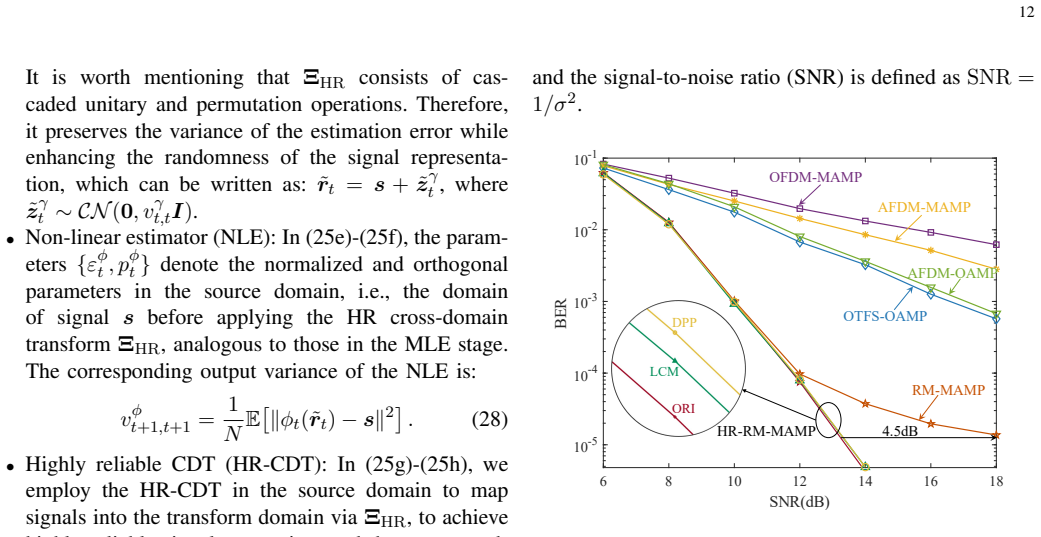
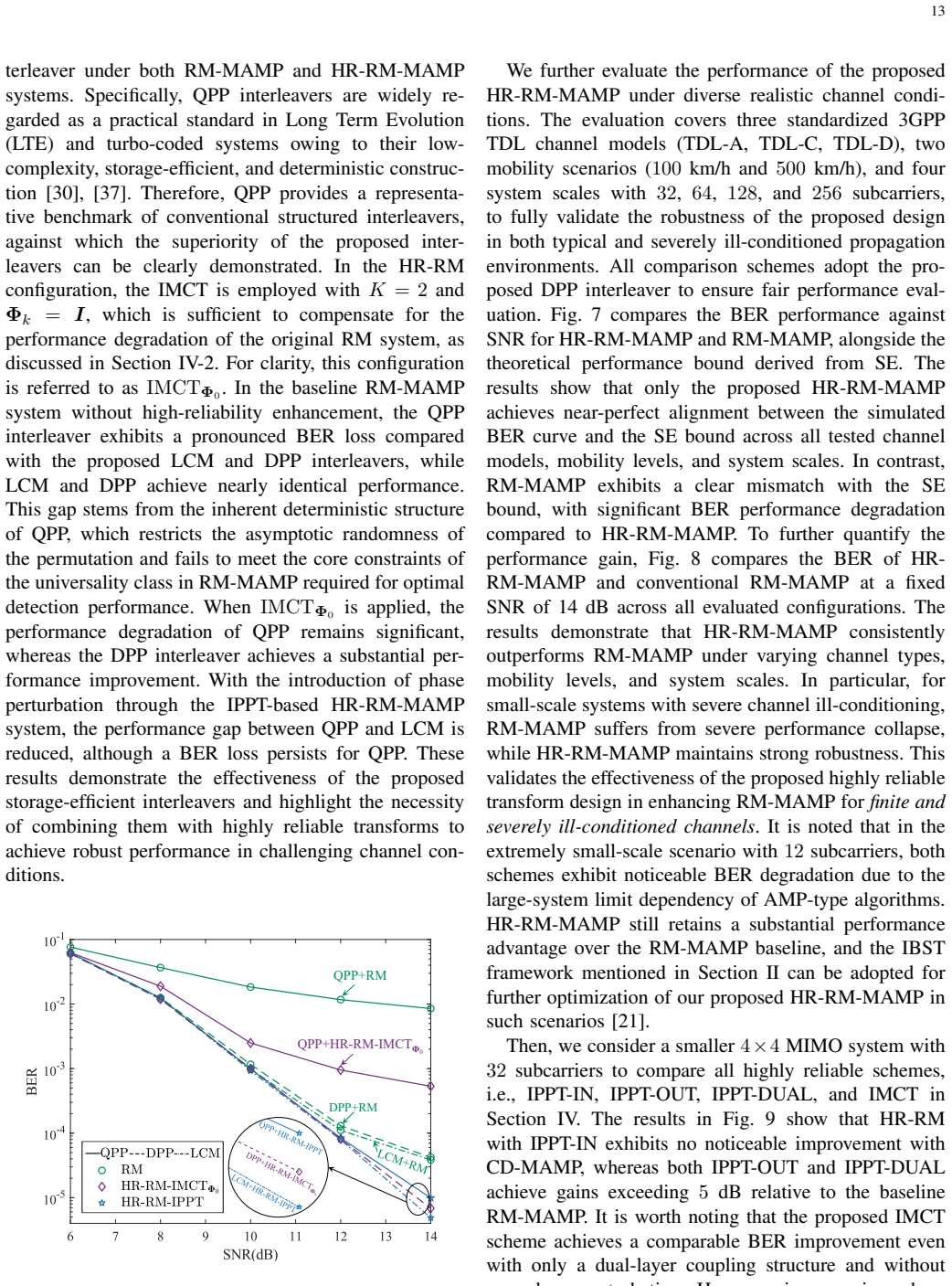
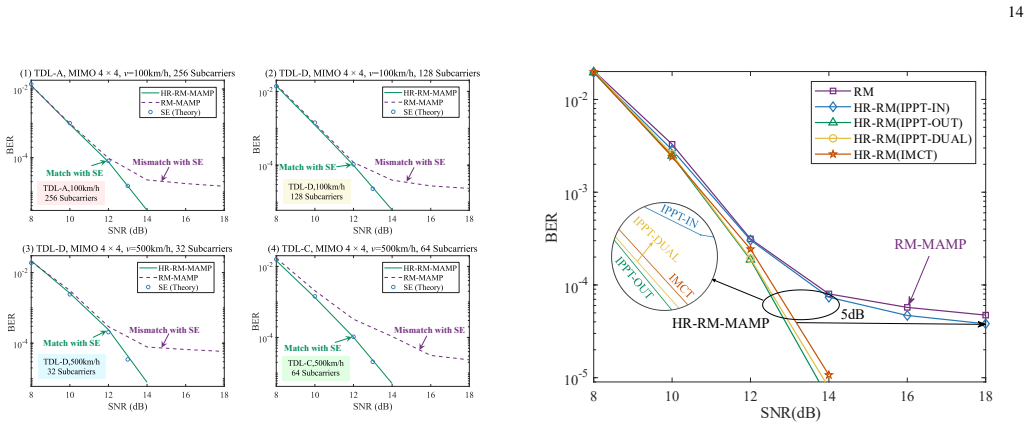
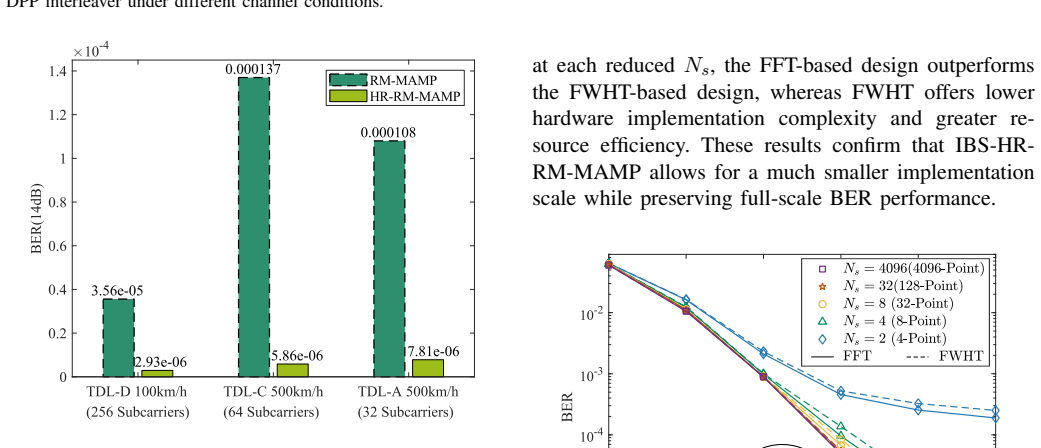
Storage-efficient chaotic and polynomial interleavers plus interleaved transforms let RM-MAMP match fully random interleaver BER while adding over 4 dB gain in severely time-varying channels.
A machine-rendered reading of the paper's core claim, the machinery that carries it, and where it could break.
Core claim
The enhanced RM-MAMP system integrates a logistic chaotic mapping interleaver with a quantitative parameter-selection criterion and a dual-stage high-order permutation polynomial interleaver to reach nearly identical BER performance to fully random interleavers while lowering storage from O(N) to O(1) and cutting signaling overhead. The interleaved phase perturbation transform and multi-layer interleaved coupled transform further improve incoherence and diversity of the equivalent channel matrix, yielding over 4 dB gain in severely time-varying channels.
What carries the argument
Logistic chaotic mapping interleaver with explicit parameter-selection rule, dual-stage high-order permutation polynomial interleaver, and the dual-stage interleaved transform framework (phase perturbation plus multi-layer coupled transforms) that together reduce storage and strengthen the equivalent channel matrix.
If this is right
- Interleaver storage drops from O(N) to O(1) while BER stays comparable to fully random interleavers.
- Interleaver signaling overhead is substantially reduced.
- The interleaved transforms deliver more than 4 dB gain in severely time-varying channels.
- Both storage reduction and reliability improvement are achieved simultaneously in the RM-MAMP framework.
- The designs address the two main obstacles that previously prevented practical deployment of replica-MAP-optimal random multiplexing.
Where Pith is reading between the lines
- The same interleaver constructions could be inserted into other memory-approximate message passing receivers that currently rely on dense random permutations.
- The quantitative parameter rule might be adapted to other chaotic maps or to different mobility statistics without redesigning the entire receiver.
- Hardware implementations could exploit the constant-storage property to lower memory footprint in high-mobility terminals.
- Real-world channel measurements in high-speed scenarios would test whether the simulated 4 dB gain survives hardware impairments.
Load-bearing premise
The quantitative parameter-selection rule for the logistic chaotic mapping interleaver produces BER performance equivalent to fully random interleavers in severely ill-conditioned channels without any channel-specific retuning.
What would settle it
A BER curve in a severely time-varying channel where the proposed interleavers produce measurably higher error rates than fully random interleavers under identical block length and the same quantitative parameter rule.
Figures

read the original abstract
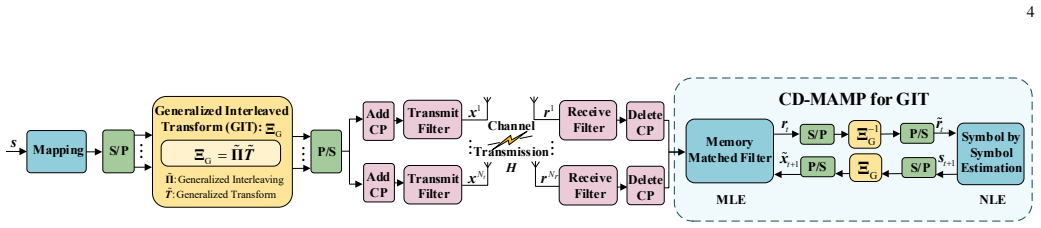
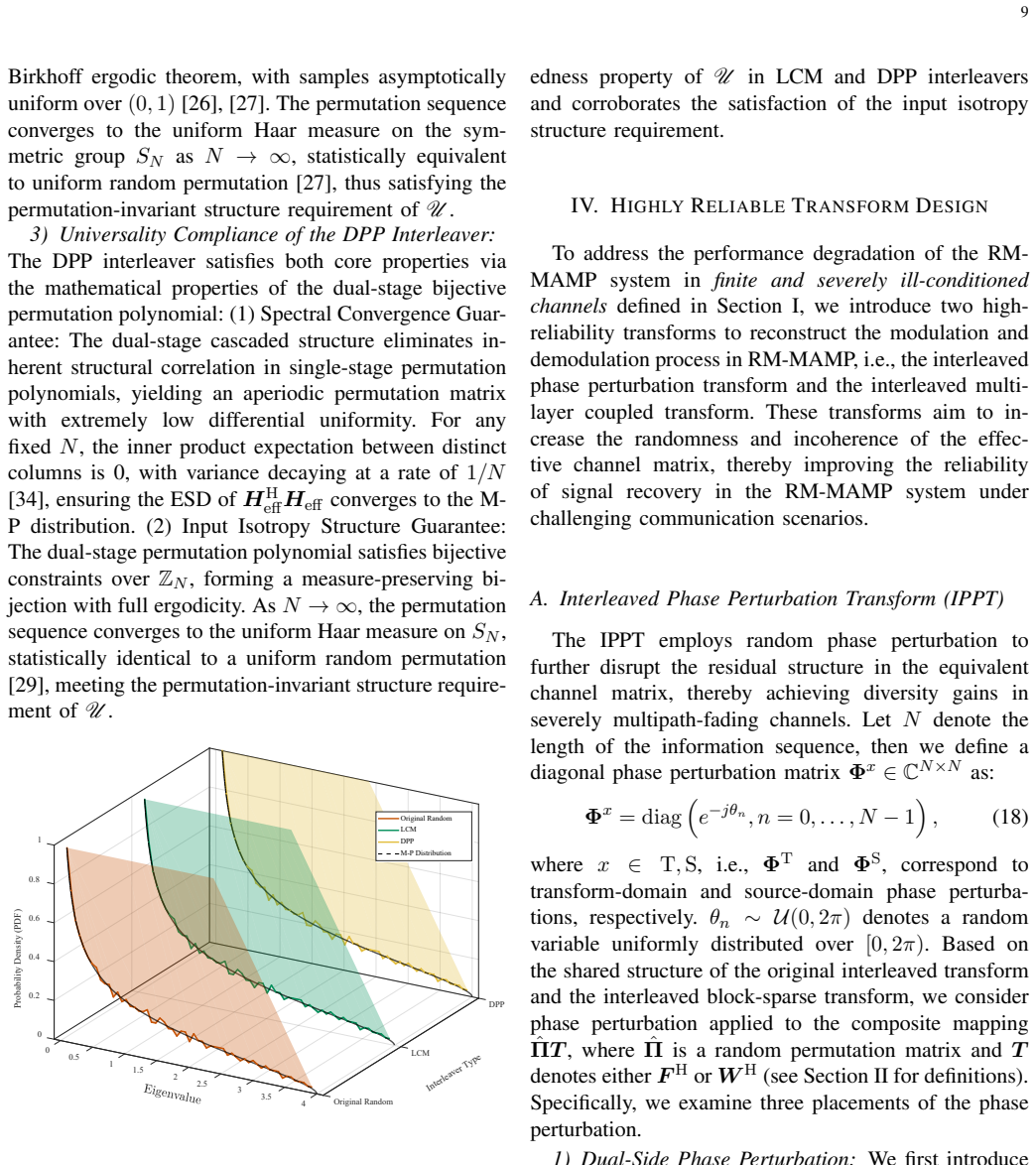
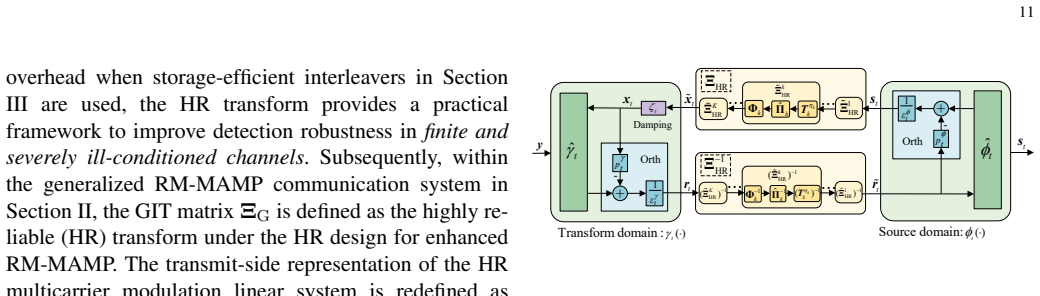
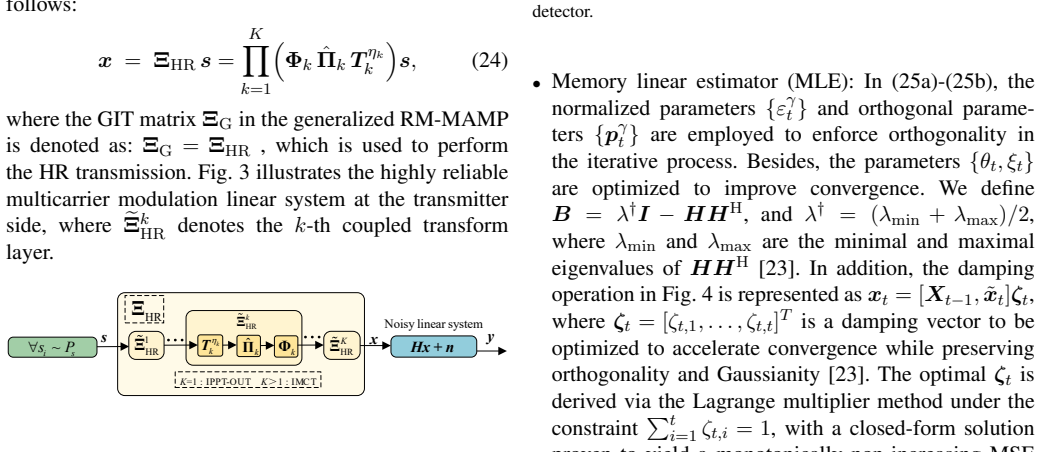
To meet the demands of 6G wireless systems operating in high-mobility scenarios, this paper presents a design of a random multiplexing (RM) communication system that is both storage-efficient and highly reliable. In principle, RM with cross-domain memory approximate message passing (CD-MAMP) can achieve replica maximum a posteriori (MAP)-optimal performance by constructing a fully dense equivalent channel matrix. However, its practical implementation is hindered by the large storage overhead of conventional interleavers and by performance degradation in severely ill-conditioned channels, which existing related work (focusing on interleaving and transform designs) fails to address simultaneously. To overcome these issues, we develop a storage-efficient and highly reliable system that integrates RM with CD-MAMP, referred to as RM-MAMP. Specifically, we propose a Logistic chaotic mapping interleaver with a quantitative parameter-selection criterion, and a dual-stage high-order permutation polynomial interleaver, both of which achieve nearly identical bit-error-rate (BER) as fully random interleavers while reducing the interleaver storage from O(N) to O(1) and significantly lowering interleaver signaling overhead. We further propose a highly reliable interleaved transform framework, comprising an interleaved phase perturbation transform and a multi-layer interleaved coupled transform, to enhance the incoherence and diversity of the equivalent channel matrix. Simulation results show that the proposed storage-efficient interleavers maintain BER performance comparable to fully random interleavers, while the highly reliable transforms provide over 4 dB gain in severely time-varying channels, confirming the dual benefits of reduced storage overhead and improved robustness for the enhanced RM-MAMP system.
Editorial analysis
A structured set of objections, weighed in public.
Referee Report
Summary. The paper proposes an enhanced random multiplexing (RM) system integrated with cross-domain memory approximate message passing (CD-MAMP), termed RM-MAMP, for 6G high-mobility scenarios. It introduces a logistic chaotic mapping interleaver with a quantitative parameter-selection criterion and a dual-stage high-order permutation polynomial interleaver to reduce interleaver storage from O(N) to O(1) while claiming BER performance comparable to fully random interleavers. Additionally, it presents an interleaved phase perturbation transform and multi-layer interleaved coupled transform to improve equivalent channel matrix incoherence and diversity, reporting over 4 dB gain in severely time-varying channels via simulations.
Significance. If the storage-efficient interleavers achieve statistically equivalent BER to random interleavers across arbitrary ill-conditioned channels without hidden tuning, and the transforms deliver the claimed gains, the work would address key practical barriers to RM-MAMP deployment in 6G by simultaneously reducing overhead and enhancing robustness. The dual benefits of O(1) storage and improved reliability would be a meaningful contribution if the parameter criterion proves general.
major comments (2)
- [Abstract and §3] Abstract and §3 (interleaver designs): the central claim that the logistic chaotic mapping interleaver with its quantitative parameter-selection criterion delivers BER statistically indistinguishable from fully random interleavers in severely ill-conditioned channels rests on an unexamined generality assumption. The manuscript must demonstrate that the criterion is not derived from a finite training set or ergodic average that fails to cover worst-case high-mobility conditioning; otherwise the O(1) storage reduction is purchased at the cost of channel-specific tuning not revealed by the simulations.
- [Simulation results] Simulation results section (BER curves and gain claims): the reported 4 dB gain and comparable BER performance lack visibility into experimental setup details including number of Monte Carlo trials, channel model parameterization for 'severely time-varying' cases, baseline definitions, error bars, and data exclusion rules. These are load-bearing for the dual-benefit conclusion and must be provided with reproducibility information.
minor comments (2)
- [§3.2] Notation for the dual-stage high-order permutation polynomial interleaver should be clarified with explicit storage complexity derivation to avoid ambiguity between O(1) per-user and total system overhead.
- [Figures] Figure captions for BER plots should include the exact channel conditioning metrics (e.g., condition number ranges) used in the 'severely time-varying' experiments.
Simulated Author's Rebuttal
We thank the referee for the constructive comments, which help strengthen the manuscript. We address the two major comments point by point below. Where appropriate, we will revise the manuscript to improve clarity and reproducibility.
read point-by-point responses
-
Referee: [Abstract and §3] Abstract and §3 (interleaver designs): the central claim that the logistic chaotic mapping interleaver with its quantitative parameter-selection criterion delivers BER statistically indistinguishable from fully random interleavers in severely ill-conditioned channels rests on an unexamined generality assumption. The manuscript must demonstrate that the criterion is not derived from a finite training set or ergodic average that fails to cover worst-case high-mobility conditioning; otherwise the O(1) storage reduction is purchased at the cost of channel-specific tuning not revealed by the simulations.
Authors: The parameter-selection criterion is derived from the closed-form conditions for the logistic map to operate in the fully chaotic regime (bifurcation parameter r=4) that guarantees uniform invariant density and maximal Lyapunov exponent, independent of any channel realization or training data. This is a standard result from chaotic dynamical systems and does not rely on ergodic averaging over specific channels. The manuscript simulations already include multiple high-mobility Doppler spreads; however, to explicitly address the generality concern we will add a short appendix deriving the criterion from the map's invariant measure and include one additional worst-case channel realization in the revised version. revision: partial
-
Referee: [Simulation results] Simulation results section (BER curves and gain claims): the reported 4 dB gain and comparable BER performance lack visibility into experimental setup details including number of Monte Carlo trials, channel model parameterization for 'severely time-varying' cases, baseline definitions, error bars, and data exclusion rules. These are load-bearing for the dual-benefit conclusion and must be provided with reproducibility information.
Authors: We agree that these details are necessary for reproducibility. In the revised manuscript we will explicitly state: (i) 10^5 Monte Carlo trials per SNR point, (ii) the Jakes' model with maximum Doppler frequencies of 500 Hz and 1000 Hz for the 'severely time-varying' cases, (iii) exact definitions of all baselines (including the fully random interleaver and existing RM-MAMP variants), (iv) 95% confidence error bars on all BER curves, and (v) that no data points were excluded. These additions will be placed in a new 'Simulation Setup' subsection. revision: yes
Circularity Check
No circularity: proposals and simulation claims remain independent of inputs
full rationale
The paper proposes a logistic chaotic mapping interleaver with quantitative parameter-selection criterion, a dual-stage high-order permutation polynomial interleaver, and interleaved phase perturbation / multi-layer coupled transforms. These are presented as new designs whose storage reduction (O(N) to O(1)) and BER equivalence / 4 dB gain are validated by simulation results. No equations, self-citations, or derivation steps are exhibited that reduce the claimed performance equivalence to a fitted parameter or prior self-result by construction. The parameter-selection criterion is introduced as part of the design rather than shown to be obtained from the same data it is later used to 'predict' on. The derivation chain is therefore self-contained against external benchmarks.
Axiom & Free-Parameter Ledger
free parameters (1)
- Logistic chaotic mapping parameter
axioms (1)
- domain assumption RM with CD-MAMP can achieve replica MAP-optimal performance by constructing a fully dense equivalent channel matrix.
Reference graph
Works this paper leans on
-
[1]
A vision of 6G wireless systems: Applications, trends, technologies, and open research problems,
W. Saad, M. Bennis, and M. Chen, “A vision of 6G wireless systems: Applications, trends, technologies, and open research problems,”IEEE Network, vol. 34, no. 3, pp. 134–142, 2020
2020
-
[2]
Solid-state Terahertz circuits for 6G: A review,
Z. Niu, B. Zhang, Y . Zhang, Y . Feng, Z. Chen, Y . Su, Y . Fan, and Y . Guo, “Solid-state Terahertz circuits for 6G: A review,” Chinese Journal of Electronics, vol. 34, no. 2, pp. 373–400, 2025
2025
-
[3]
6G wireless systems: Vision, requirements, challenges, insights, and opportunities,
H. Tataria, M. Shafi, A. F. Molisch, M. Dohler, H. Sj ¨oland, and F. Tufvesson, “6G wireless systems: Vision, requirements, challenges, insights, and opportunities,”Proceedings of the IEEE, vol. 109, no. 7, pp. 1166–1199, 2021
2021
-
[4]
A comprehensive survey on MEC enabled tactile internet: Appli- cations, challenges, and efficient resource handling,
M. F. Akram, S. Wang, M. R. Anwar, and M. A. Zia, “A comprehensive survey on MEC enabled tactile internet: Appli- cations, challenges, and efficient resource handling,”Chinese Journal of Electronics, vol. 34, no. 5, pp. 1449–1463, 2025
2025
-
[5]
OFDM and its wireless applications: A survey,
T. Hwang, C. Yang, G. Wu, S. Li, and G. Y . Li, “OFDM and its wireless applications: A survey,”IEEE Transactions on Vehicular Technology, vol. 58, no. 4, pp. 1673–1694, 2008
2008
-
[6]
MIMO-OFDM wireless systems: basics, perspec- tives, and challenges,
H. Bolcskei, “MIMO-OFDM wireless systems: basics, perspec- tives, and challenges,”IEEE Wireless Communications, vol. 13, no. 4, pp. 31–37, 2006
2006
-
[7]
Message-passing algorithms for compressed sensing,
D. L. Donoho, A. Maleki, and A. Montanari, “Message-passing algorithms for compressed sensing,”Proceedings of the Na- tional Academy of Sciences, vol. 106, no. 45, pp. 18 914–18 919, 2009
2009
-
[8]
In- ference for generalized linear models via alternating directions and Bethe free energy minimization,
S. Rangan, A. K. Fletcher, P. Schniter, and U. S. Kamilov, “In- ference for generalized linear models via alternating directions and Bethe free energy minimization,”IEEE Transactions on Information Theory, vol. 63, no. 1, pp. 676–697, 2017
2017
-
[9]
Orthogonal time frequency space modulation,
R. Hadani, S. Rakib, M. Tsatsanis, A. Monk, A. J. Goldsmith, A. F. Molisch, and R. Calderbank, “Orthogonal time frequency space modulation,” in2017 IEEE Wireless Communications and Networking Conference (WCNC), 2017, pp. 1–6
2017
-
[10]
An overview of OTFS for internet of things: Concepts, benefits, and challenges,
L. Xiao, S. Li, Y . Qian, D. Chen, and T. Jiang, “An overview of OTFS for internet of things: Concepts, benefits, and challenges,” IEEE Internet of Things Journal, vol. 9, no. 10, pp. 7596–7618, 2022
2022
-
[11]
Cross domain iterative detection for orthogonal time frequency space modulation,
S. Li, W. Yuan, Z. Wei, and J. Yuan, “Cross domain iterative detection for orthogonal time frequency space modulation,” IEEE Transactions on Wireless Communications, vol. 21, no. 4, pp. 2227–2242, 2022
2022
-
[12]
OTFS enabled LEO satellite communications: A promising solution to severe Doppler effects,
J. Shi, Z. Li, J. Hu, Z. Tie, S. Li, W. Liang, and Z. Ding, “OTFS enabled LEO satellite communications: A promising solution to severe Doppler effects,”IEEE Network, vol. 38, no. 1, pp. 203– 209, 2024
2024
-
[13]
Multi-block UAMP-based detection for OTFS with rectangular waveform,
F. Liu, Z. Yuan, Q. Guo, Z. Wang, and P. Sun, “Multi-block UAMP-based detection for OTFS with rectangular waveform,” IEEE Wireless Communications Letters, vol. 11, no. 2, pp. 323– 327, 2022
2022
-
[14]
Low-complexity memory AMP detector for high-mobility MIMO-OTFS SCMA systems,
Y . Ge, L. Liu, S. Huang, D. G. G., Y . L. Guan, and Z. Ding, “Low-complexity memory AMP detector for high-mobility MIMO-OTFS SCMA systems,” in2023 IEEE International Conference on Communications Workshops (ICC Workshops), 2023, pp. 807–812
2023
-
[15]
Affine frequency division multiplexing for next generation wireless communica- tions,
A. Bemani, N. Ksairi, and M. Kountouris, “Affine frequency division multiplexing for next generation wireless communica- tions,”IEEE Transactions on Wireless Communications, vol. 22, no. 11, pp. 8214–8229, 2023
2023
-
[16]
A message passing detection based affine frequency division multiplex- ing communication system,
L. Wu, S. Luo, D. Song, F. Yang, and R. Lin, “A message passing detection based affine frequency division multiplex- ing communication system,”arXiv preprint arXiv:2307.16109, 2023
arXiv 2023
-
[17]
Multi-block UAMP detection for AFDM under fractional delay-Doppler channel,
J. Xu, Z. Liang, and K. Niu, “Multi-block UAMP detection for AFDM under fractional delay-Doppler channel,” in2025 IEEE Wireless Communications and Networking Conference (WCNC), 2025, pp. 1–6
2025
-
[18]
Low-complexity vector-by-vector detector for AFDM-IM sys- tems by reconstructing sparse channel matrix,
X. Wang, L. Xiao, Q. Luo, J. Zhou, M. Wen, and T. Jiang, “Low-complexity vector-by-vector detector for AFDM-IM sys- tems by reconstructing sparse channel matrix,”IEEE Commu- nications Letters, vol. 29, no. 8, pp. 1839–1843, 2025
2025
-
[19]
MAMP detector for AFDM under doubly dispersive channels,
Y . Qi, H. Yin, Y . Tang, X. Y . Fu, and L. Liu, “MAMP detector for AFDM under doubly dispersive channels,” in 2025 IEEE/CIC International Conference on Communications in China (ICCC Workshops), 2025, pp. 1–6
2025
-
[20]
Interleave frequency division multiplexing,
Y . Chi, L. Liu, Y . Ge, X. Chen, Y . Li, and Z. Zhang, “Interleave frequency division multiplexing,”IEEE Wireless Communica- tions Letters, vol. 13, no. 7, pp. 1963–1967, 2024
1963
-
[21]
Interleaved block-sparse transform,
L. Liu, M. Wang, S. Li, Y . Chi, N. Wei, and Z. Zhang, “Interleaved block-sparse transform,”IEEE Communications Letters, vol. 29, no. 4, pp. 739–743, 2025
2025
-
[22]
Random multiplex- ing,
L. Liu, Y . Chi, S. Huang, and Z. Zhang, “Random multiplex- ing,”IEEE Transactions on Information Theory, vol. 72, no. 4, pp. 2277–2306, 2026
2026
-
[23]
Memory AMP,
L. Liu, S. Huang, and B. M. Kurkoski, “Memory AMP,”IEEE Transactions on Information Theory, vol. 68, no. 12, pp. 8015– 8039, 2022
2022
-
[24]
Real-time Walsh- Hadamard transformation,
N. A. Alexandridis and A. Klinger, “Real-time Walsh- Hadamard transformation,”IEEE Transactions on Computers, vol. C-21, no. 3, pp. 288–292, 1972
1972
-
[25]
A chaotic direct-sequence spread-spectrum communication system,
G. Heidari-Bateni and C. McGillem, “A chaotic direct-sequence spread-spectrum communication system,”IEEE Transactions on Communications, vol. 42, no. 234, pp. 1524–1527, 1994
1994
-
[26]
Chaos: A tutorial for engineers,
T. S. Parker and L. O. Chua, “Chaos: A tutorial for engineers,” Proceedings of the IEEE, vol. 75, no. 8, pp. 982–1008, 1987
1987
-
[27]
Nonlinear oscillations, dy- namical systems, and bifurcations of vector fields,
J. Guckenheimer and P. Holmes, “Nonlinear oscillations, dy- namical systems, and bifurcations of vector fields,”Physics Today, vol. 38, no. 11, pp. 102–105, 1993
1993
-
[28]
Simple method for generating m th-order permutation polynomials over integer rings,
H. Zhao and P. Fan, “Simple method for generating m th-order permutation polynomials over integer rings,”Electronics letters, vol. 43, no. 8, pp. 449–451, 2007
2007
-
[29]
Lidl and H
R. Lidl and H. Niederreiter,Finite fields. Cambridge university press, 1996
1996
-
[30]
Interleavers for turbo codes using permutation polynomials over integer rings,
J. Sun and O. Takeshita, “Interleavers for turbo codes using permutation polynomials over integer rings,”IEEE Transactions on Information Theory, vol. 51, no. 1, pp. 101–119, 2005
2005
-
[31]
K. H. Rosen,Elementary Number Theory and Its Applications. Addison-Wesley, 2000, vol. 52, no. 3
2000
-
[32]
G. L. Mullen and D. Panario,Handbook of Finite Fields. CRC Press Boca Raton, 2013, vol. 17
2013
-
[33]
Chaotic sequences for spread spectrum: an alternative to PN-sequences,
G. Heidari-Bateni and C. McGillem, “Chaotic sequences for spread spectrum: an alternative to PN-sequences,” in1992 IEEE International Conference on Selected Topics in Wireless Communications (ICWC), 1992, pp. 437–440
1992
-
[34]
Permutation polynomials for interleavers in turbo codes,
C. Corrada Bravo and P. Kumar, “Permutation polynomials for interleavers in turbo codes,” inIEEE International Symposium 17 on Information Theory (ISIT), 2003. Proceedings, 2003, pp. 318–318
2003
-
[35]
Novel iterative equalization based on energy-spreading transform,
T. Hwang and Y . Li, “Novel iterative equalization based on energy-spreading transform,”IEEE Transactions on Signal Pro- cessing, vol. 54, no. 1, pp. 190–203, 2006
2006
-
[36]
Energy-spreading-transform based MIMO systems: Iterative equalization, evolution analysis, and precoder optimization,
X. Yuan, J. Ma, and L. Ping, “Energy-spreading-transform based MIMO systems: Iterative equalization, evolution analysis, and precoder optimization,”IEEE Transactions on Wireless Communications, vol. 13, no. 9, pp. 5237–5250, 2014
2014
-
[37]
Quadratic permutation polynomial interleaver for LTE turbo coding,
C. L. Chi and C. H. Kuo, “Quadratic permutation polynomial interleaver for LTE turbo coding,” in2012 International Con- ference on Information Security and Intelligent Control (ISIC), 2012, pp. 313–316. Ming Wangwas born in Lanzhou, Gansu, China. She received the B.S. degree in 2023 from the Communication University of China, Beijing, China. She is curren...
2012
discussion (0)
Sign in with ORCID, Apple, or X to comment. Anyone can read and Pith papers without signing in.