REVIEW 3 major objections 5 minor 10 references
The Effects of the Galactic Magnetic Field on UHECR From Local Sources
T0 review · 3 major / 5 minor · reviewed 2026-08-14 · deepseek-v4-flash
Pith's one-line read The paper establishes that in a three-component model of the Galactic magnetic field, the x-field component causes the shadowing behind the Galactic center and the longitude shift of cosmic rays from Cen A, while the toroidal component…
desk verdict The component-attribution claim isn't supported by the figures as captioned; a worthwhile question, but the proceedings format and a text-figure mismatch keep it from being citable. read the letter →
The pith
A machine-rendered reading of the paper's core claim, the machinery that carries it, and where it could break.
The reading
What carries the argument
The engine of the analysis is the three-component regular Galactic magnetic field model: a disk field confined near the Galactic plane, a toroidal halo field wrapping around the Galaxy, and an x-field whose field lines loop out of the plane, giving it that name. The paper computes trajectories of $3.2\times10^{18}$ eV protons at fixed rigidity through these fields, in each case also removing one component at a time, and compares the resulting steady-state density maps and arrival-direction skymaps. For the tunnel-vision question, it backtracks an isotropic flux of protons from Earth through each field configuration. The isolation-by-removal procedure is what lets the paper assign each observed distortion to a single component.
What would settle it
A high-statistics map of UHECR arrival directions around $10^{18.5}$ eV from the Cen A region that shows no shadowing deficit behind the Galactic center and no longitude-dominant displacement matching the predicted x-field shift would rule out the component attribution.
Extended reading notes
Core claim
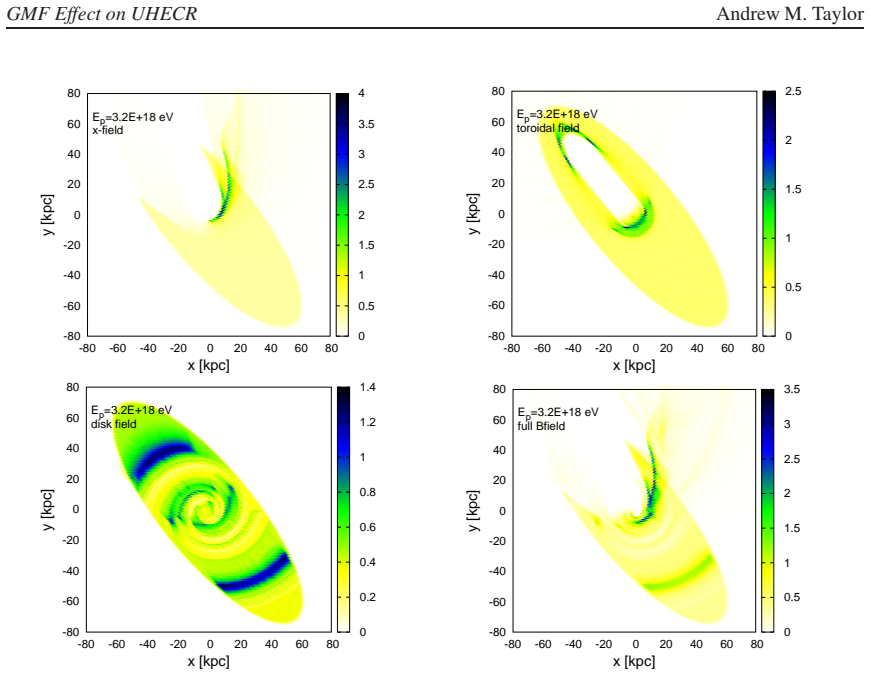
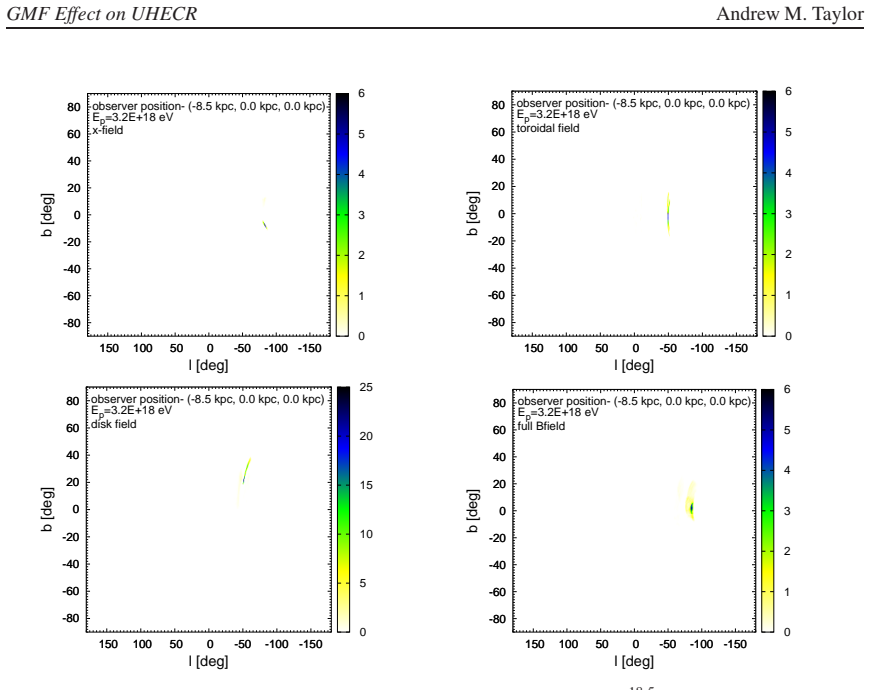
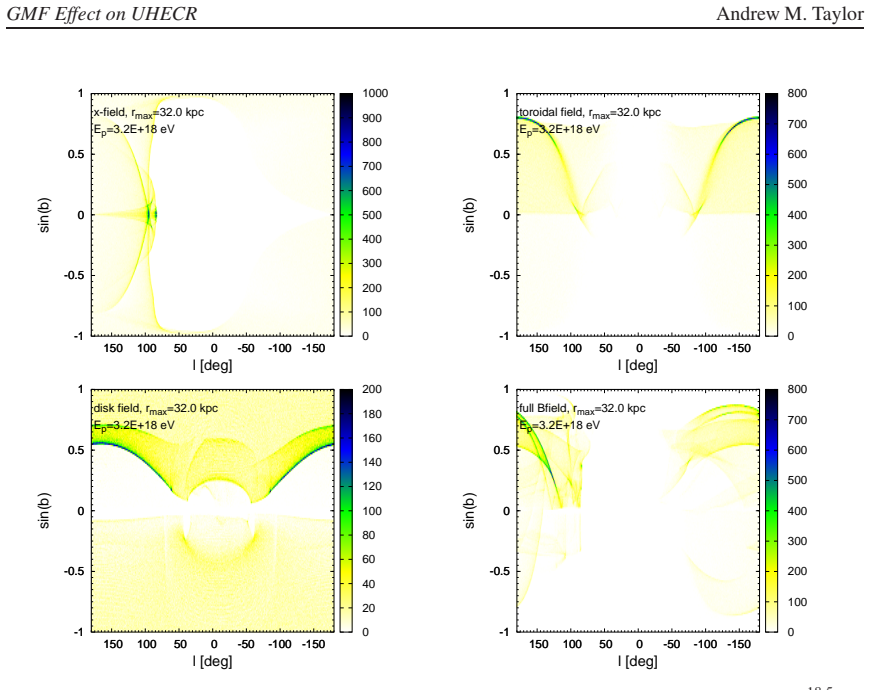
The paper's central result is a component-by-component accounting of how the regular Galactic magnetic field distorts the arrival of about $10^{18.5}$ eV protons from local sources. For Cen A, the x-field component is the primary cause of the shadow region visible in the steady-state density on the far side of the Galactic center, and it dominates the coherent displacement of the arrival-direction pattern in Galactic longitude. The toroidal halo component is the primary cause of the displacement in Galactic latitude and of the magnetic tunnel vision that prefers the northern extragalactic hemisphere. The disk field, confined near the Galactic plane, contributes little to any of these effects.
Load-bearing premise
The analysis assumes the model's regular magnetic field, particularly its out-of-plane parts, matches the real Galaxy; if that geometry is wrong, every component attribution in the paper changes.
Editorial extensions
If this is right
- At rigidity near $3\times10^{18}$ V, a UHECR telescope pointed at Cen A should not expect to see the source at its true coordinates: the x-field shifts the apparent position in longitude and the toroidal field in latitude.
- In the same model, directions behind the Galactic center are shadowed for protons from Cen A, so a deficit of UHECRs from that region can be a magnetic-lens effect rather than an absence of sources.
- The northern extragalactic hemisphere is preferentially probed from Earth, meaning even an isotropic extragalactic source distribution would look anisotropic at these energies; anisotropy analyses must subtract this tunnel-vision bias.
- The disk field is essentially irrelevant for these distortions, so improving Galactic-plane observations alone will not refine these predictions; the out-of-plane toroidal and x-field geometries must be pinned down.
Reading between the lines
- Inference (not in the paper): because deflections for protons scale roughly as $1/R$ at fixed field structure, the shadowing and shifts should shrink at $10^{19}$-$10^{20}$ eV, making the highest-energy sources point nearly back to their true directions; the paper's attributions are made at $10^{18.5}$ eV only.
- Inference (not in the paper): if the composition at this rigidity is not purely protons but includes heavier nuclei, the effective rigidity is lower and all three effects would be stronger; the paper's quantitative maps assume protons.
- Inference (not in the paper): a direct test would be to take a future high-statistics UHECR sky map and remove the modeled magnetic-lens distortion; a residual structure aligned with Cen A and the local source distribution would support the model, while an inconsistent residual would indicate that the out-of-plane field geometry needs revision.
Signed reviews
Editorial analysis
A structured set of objections, weighed in public.
Referee Report
Summary. This proceedings paper reports a simulation study of the deflection of 10^18.5 eV protons by the regular component of the Jansson-Farrar (JF12) Galactic magnetic field, applied to sources at the distance of Cen A. Using forward-propagated beams and backward-tracked isotropic particles, the authors examine three effects: shadowing behind the Galactic center, apparent shift of the source direction, and 'tunnel vision' (preferential sampling of the extragalactic sky). The central claim is that the x-field component of JF12 dominates the shadowing and the longitude shift of Cen A, while the toroidal component dominates the latitude shift and the northern-sky preference.
Significance. If the component attributions are correct, they provide a useful framework for interpreting UHECR anisotropy data and for estimating systematic offsets in arrival directions from local sources. The paper uses a standard, externally constrained model (JF12) with no free parameters, and it explicitly acknowledges the model limitations in the conclusion. The forward/backtracking consistency check is a strength. However, the evidence presented is mostly qualitative, and the methodology is described too sparsely to verify the central attribution claims.
major comments (3)
- [Section 3.2, Fig. 2] The text states that component dominance was identified by 'switching off' the disk, torus, and x-field components, but the four panels of Fig. 2 are captioned as the x-field, toroidal, disk, and total fields individually. If the panels are single-component simulations, they cannot establish dominance in the full field because deflections are nonlinear in the total magnetic field and Larmor radii are comparable to the field structure sizes; if the panels instead show the full field with one component removed, the captions are mislabeled. This load-bearing ambiguity makes the central claim about the dominant component unsupported as reported.
- [Sections 3.2, 3.3, and 4] The claims that one component 'dominates' a given effect are not quantified. No numerical values are given for the magnitude of the longitude or latitude shifts, for the shadowing factor, or for the northern/southern hemisphere asymmetry; no particle numbers, statistical uncertainties, or propagation code details are provided. The conclusions in Section 4 therefore rest on visual comparison of color maps with different scales, which is not a sufficient basis for the stated dominance hierarchy.
- [Figures 1-3] The color scales differ between panels (e.g., in Fig. 2 the disk-field panel reaches a density of 25 while the full-field panel reaches 6; in Fig. 3 the x-field and toroid panels reach hundreds while the disk panel reaches 200). Because the maps are not normalized to a common scale, apparent differences between components could be artifacts of the color stretch, further weakening the visual support for the dominance claims.
minor comments (5)
- [Abstract and Section 2] The unit is written as 'EV' instead of 'eV' in the abstract and in the phrase '10^18.5 EV'; please correct the typo.
- [Section 2] The phrase 'the: disk field, a toroidal field, and an x-field components' is grammatically awkward; consider rewriting as 'the disk field, the toroidal field, and the x-field components.'
- [Section 3.1] The description of the injection geometry should state the location of the observer and the direction of the beam relative to Cen A explicitly, so that the shadowing maps can be interpreted unambiguously.
- [Section 3.2] The sentence 'This overall shift in the source position is consistent with the finding in [10]' would benefit from a quantitative comparison with Keivani et al. (2014), including the deflection angle and direction.
- [Figure 3 caption] The caption says 'following the injection of isotropic distribution of 10^18.5 eV protons at Earth' but the text describes backtracking; please clarify the direction of integration to avoid confusion.
Circularity Check
No significant circularity: the UHECR deflection results are simulated outcomes of the externally specified JF12 field model, not re-statements of the model or fitted data.
full rationale
The paper's derivation chain is a trajectory simulation: it adopts the regular component of the JF12 Galactic magnetic field model [7] as input, injects 10^18.5 eV protons from the Cen A direction (or backtracks an isotropic flux from Earth), integrates Lorentz-force trajectories, and reports the resulting shadowing, source shifts, and sky-access maps. No parameter in the simulation is fitted to the target phenomena, and no target quantity is used to define the model components; therefore the component attributions in Sections 3.2-4 are conditional deductions from the assumed field, not tautologies. The JF12 model is externally constrained by Faraday rotation measures and synchrotron emission, and the authors themselves flag the model limitation: 'Our limited understanding of these components strongly constrains our ability to accurately describe the shadowing, source shifting, and tunnel vision effects noted in this study.' A methodological ambiguity exists—Section 3.2 says the shift analysis was done by 'switching off' components while Fig. 2's captions describe single-component runs—but this is an internal-consistency or reproducibility concern, not a circularity: even if the attribution procedure was mis-described, the reported effects are not equivalent by construction to the input field. The few self-citations ([2] for the 80 Mpc distance scale) are background context and are not load-bearing for the deflection conclusions. Hence the appropriate circularity score is 0.
Assumptions & free parameters
assumptions (4)
- domain assumption The regular component of the JF12 model accurately represents the Galactic magnetic field.
- domain assumption UHECRs at 10^18.5 eV propagate ballistically in the GMF, ignoring energy losses, diffusion, and extragalactic magnetic fields.
- domain assumption Cen A is treated as a continuous, parallel beam source illuminating half of the Galactic magnetosphere.
- domain assumption The steady-state CR density in the disk region is obtained by tracking particles until escape and assuming continuous illumination.
Cite this review
Pith. "Pith review of The Effects of the Galactic Magnetic Field on UHECR From Local Sources." pith.science (2026). https://pith.science/paper/4X7SFCXW
@misc{pith2026190802481,
  author       = {Pith},
  title        = {Pith review of: The Effects of the Galactic Magnetic Field on UHECR From Local Sources},
  year         = {2026},
  howpublished = {\url{https://pith.science/paper/4X7SFCXW}},
  note         = {Machine review of arXiv:1908.02481}
}
abstract
We summarise the results found following a study of the effects that Galactic magnetic fields can have on the propagation of cosmic rays from local extragalactic sources. This study focuses on the coherent structures in the Jansson-Farrar Galactic magnetic field model, namely the: disk field, a toroidal field, and an x-field components. The phenomena of Galactic magnetic field shadowing, source deflection, and Galactic magnetic field tunnel vision are all noted. Attention throughout this study is placed on particles with rigidity around $10^{18.5}$ EV, believed to dominate the cosmic ray spectrum above the ankle. The Galactic magnetic field component predominantly responsible for giving rise to each of these different effects was determined.
Figures
Reference graph
Works this paper leans on
-
[1]
A. M. Hillas, Ann. Rev. Astron. Astrophys. 22, 425 (1984)
work page 1984
-
[2]
A. M. Taylor, M. Ahlers and F. A. Aharonian, Phys. Rev. D 84 (2011) 105007 doi:10.1103/PhysRevD.84.105007 [arXiv:1107.2055 [astro-ph.HE]]
work page Pith review arXiv 2011
-
[3]
C. A. Norman, D. B. Melrose, A. Achterberg, Astrophysica l Journal 454 60N (1995)
work page 1995
- [4]
-
[5]
R. Alves Batista et al., Front. Astron. Space Sci. 6 (2019) 23 doi:10.3389/fspas.2019.00023 [arXiv:1903.06714 [astro-ph.HE]]
arXiv 2019
-
[6]
S. Wykes et al., Astron. Astrophys. 558 (2013) A19 doi:10.1051/0004-6361/201321622 [arXiv:1305.2761 [astro-ph.HE]]
arXiv 2013
-
[7]
R. Jansson and G. R. Farrar, Astrophys. J. 757 (2012) 14 doi:10.1088/0004-637X/757/1/14 [arXiv:1204.3662 [astro-ph.GA]]
arXiv 2012
-
[8]
L. O. Drury, Astropart. Phys. 39-40 (2012) 52 doi:10.1016/j.astropartphys.2012.02.006 [arXiv:1203.3681 [astro-ph.HE]]
work page Pith review arXiv 2012
Show all 10 references
-
[9]
Amenomori et al
M. Amenomori et al. [Tibet ASgamma Collaboration], Phys. Rev. Lett. 111 (2013) no.1, 011101 doi:10.1103/PhysRevLett.111.011101 [arXiv:1306.3009 [astro-ph.SR]]
2013 arXiv
-
[10]
Keivani, G
A. Keivani, G. R. Farrar and M. Sutherland, Astropart. P hys. 61 (2014) 47 doi:10.1016/j.astropartphys.2014.07.001 [arXiv:1406.5249 [astro-ph.HE]]. 6
2014 arXiv
Reviewed August 14, 2026 · model on record in the stance chip above.
Discussion (0). Continue with ORCID to comment.