REVIEW 3 major objections 6 minor 2 references
Advancing AI Capabilities and Evolving Labor Outcomes
T0 review · 3 major / 6 minor · reviewed 2026-08-06 · deepseek-v4-flash
Pith's one-line read This paper claims that U.S. occupations with larger increases in AI task-level exposure between late 2022 and early 2025 experienced measurable employment declines, higher unemployment, and shorter work hours.
desk verdict Dynamic AI exposure scores tied to CPS data are genuinely new, but the unvalidated LLM self-reports make the headline estimates conditional on measurement assumptions the paper acknowledges but does not resolve. read the letter →
The pith
A machine-rendered reading of the paper's core claim, the machinery that carries it, and where it could break.
The reading
What carries the argument
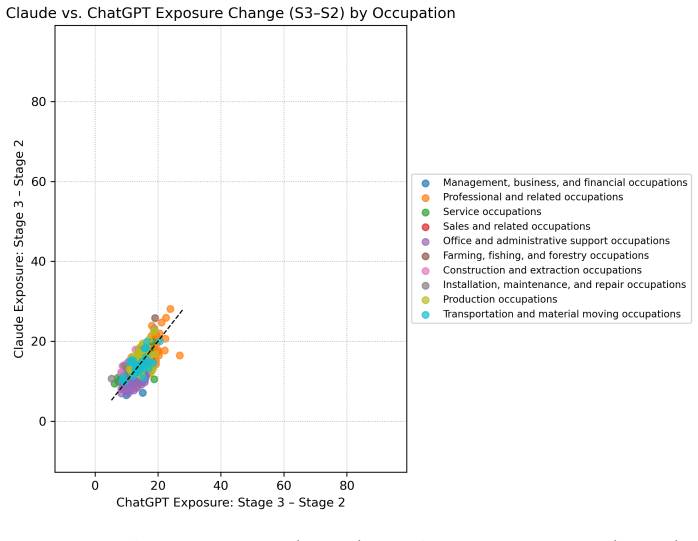
The central object is the five-stage Occupational AI Exposure Score (OAIES), a 0–100 measure of the share of an occupation's O*NET tasks that a frontier LLM reports being able to perform. Stage 1 is pre-LLM machine learning; Stage 2 early LLMs; Stage 3 multimodal models; Stage 4 reasoning models; Stage 5 agentic AI. The scoring works by prompting ChatGPT-4o and Claude 3.5 Sonnet to estimate the percentage of each task performable at each stage, weighting task estimates by O*NET relevance, and aggregating to Census-SOC occupations. The empirical engine is an occupation-level first-differenced regression of labor outcome changes (employment, unemployment rate, hours, part-time, second jobs) between Periods 2 and 4 on the exposure change from Stage 1 to Stage 3, with demographic composition and task indices as controls. The five-stage design is what makes the exposure measure dynamic rather than a static snapshot.
What would settle it
Collect ground-truth performance data: have independent human experts or standardized benchmark suites rate the same O*NET tasks at each of the five stages, then compare those ratings with the LLM self-assessments. If the two diverge systematically—for example, if models overstate their ability on tasks that require physical presence, tacit knowledge, or accountability—the exposure regressor is mismeasured and the estimated employment and unemployment associations are not trustworthy. A simpler version: rerun the analysis with exposure scores built from expert ratings instead of LLM self-assessments and check whether the signs and magnitudes survive.
Extended reading notes
Core claim
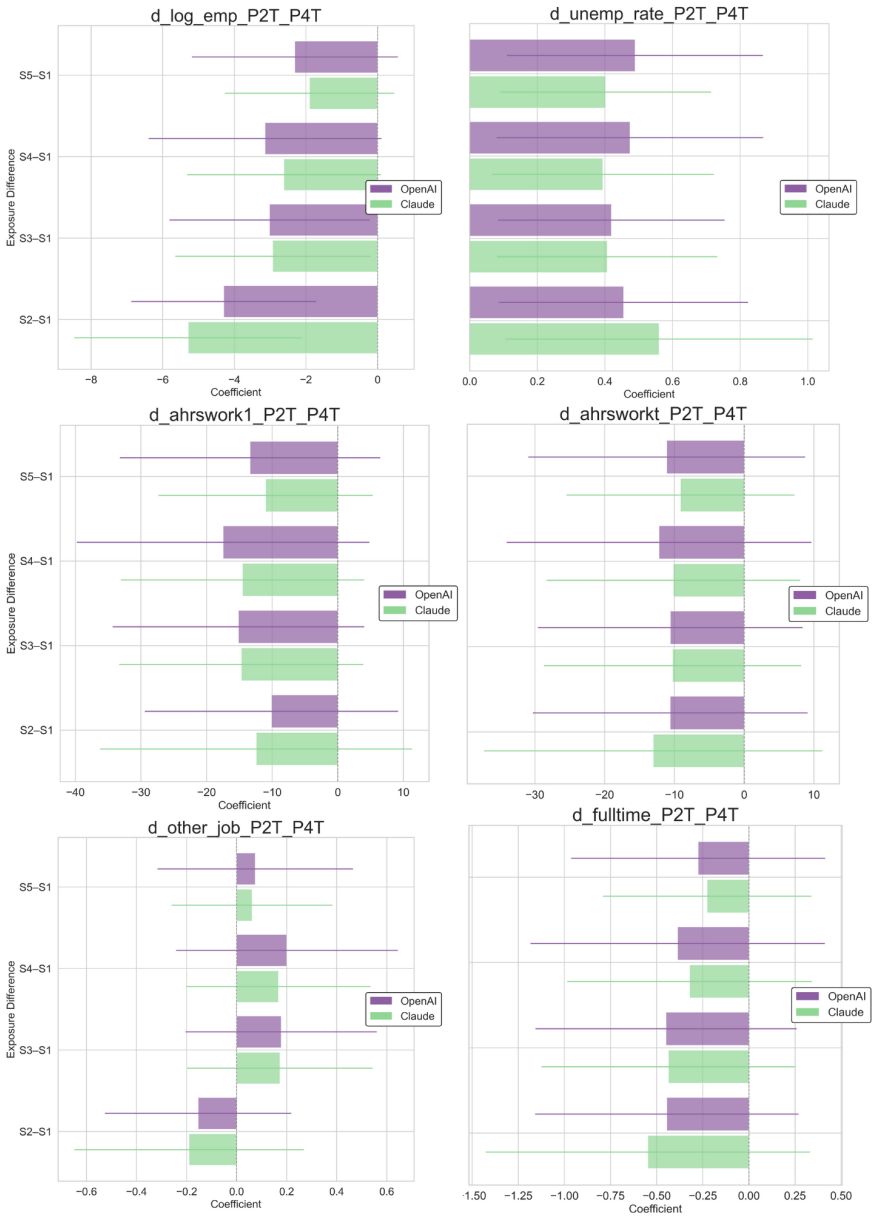
The paper's central claim is that rising occupational exposure to AI capability is associated with deterioration in labor outcomes in the United States between the late-2022 launch of ChatGPT and early 2025. In the fully controlled specification, a 10-point increase in exposure between Stage 1 (pre-LLM machine learning) and Stage 3 (multimodal LLMs) is associated with a 5.6 percentage point decline in occupational employment and a 0.64 percentage point rise in the unemployment rate using ChatGPT-generated scores, and an 8.5 percentage point employment decline and 0.68 percentage point unemployment rise using Claude-generated scores. The same exposure change is tied to shorter main-job hours and, among several subgroups, more secondary job holding and less full-time work. The authors interpret these as associations, not causal effects, and read them as evidence that AI-driven labor shifts are appearing on both the extensive margin (fewer jobs) and the intensive margin (fewer hours).
Load-bearing premise
The load-bearing premise is that an LLM's self-reported percentage of each occupation's tasks it can perform is a valid measure of real AI capability exposure; the paper itself concedes the scores do not validate their own accuracy.
Editorial extensions
If this is right
- If the central association is correct, occupations with high exposure change should continue to show employment and hours losses in later CPS releases as Stage 4 and Stage 5 capabilities diffuse.
- Policymakers monitoring unemployment by occupation can treat the exposure score as an early-warning signal of future employment decline.
- The paper's period decomposition implies the first visible sign of AI disruption should be rising unemployment and secondary-job activity, followed a year or two later by larger employment losses.
- College-educated workers' smaller employment losses but larger shifts in hours and full-time status imply workforce adjustment will show up first as job restructuring rather than layoffs in highly educated occupations.
- Manual and routine-manual occupations are predicted to be relatively insulated in the near term, with possible employment gains.
Reading between the lines
- Editorial inference: the exposure measure treats task overlap as potential substitution, but a task that AI can perform may instead be a complement that raises demand for the worker; the paper's design cannot distinguish substitution from complementarity, so the negative associations may understate or overstate true displacement.
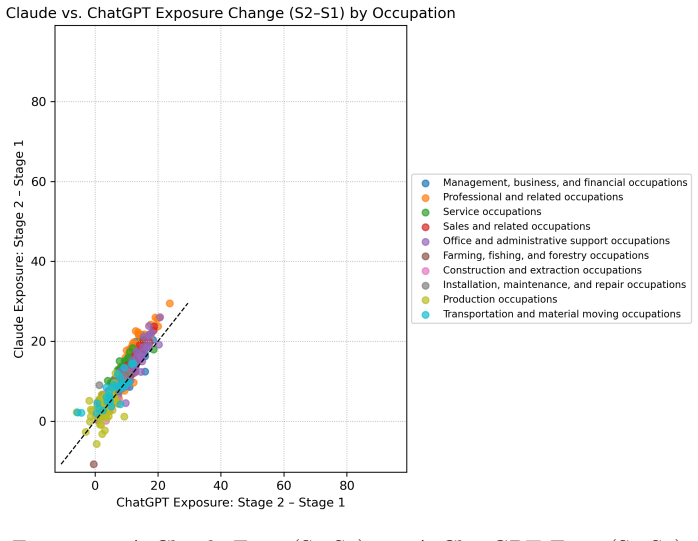
- Editorial inference: because the two LLMs produce correlated but different magnitudes (Claude's employment coefficient is about 50% larger), the quantitative size of the effect is model-dependent; a validation exercise against observed firm-level adoption or layoff announcements would identify which score is closer to reality.
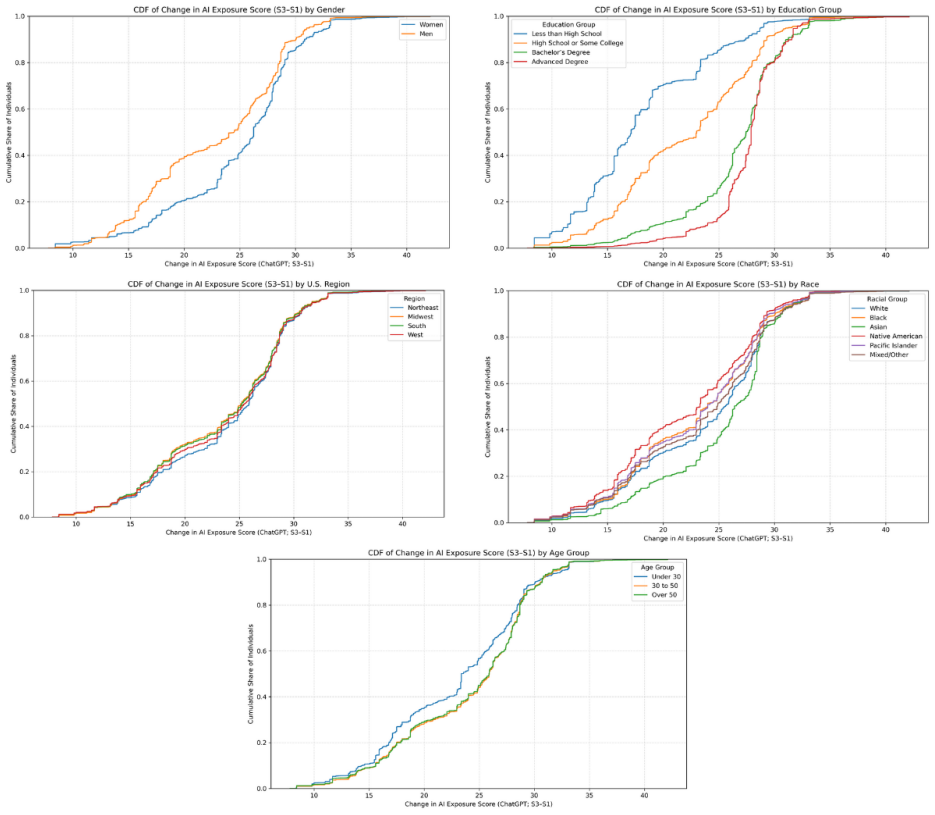
- Editorial inference: the finding that women had larger exposure increases yet men saw larger adverse outcomes suggests exposure level alone is not the driver; occupation-level task context and labor-market power likely mediate the effect, a mechanism the paper notes but does not test.
Editorial analysis
A structured set of objections, weighed in public.
Referee Report
Summary. This paper constructs a dynamic Occupational AI Exposure Score (OAIES) by asking two LLMs (ChatGPT-4o and Claude 3.5 Sonnet) to self-assess, for each O*NET task, the percentage the model could perform at each of five hypothetical AI capability stages. The scores are aggregated to 513 Census-SOC occupations and linked to occupation-level outcomes from the CPS. Using first-differenced regressions between October 2022–March 2023 and October 2024–March 2025, the paper reports that a 10-point increase in the S3–S1 exposure change is associated with a 5.6–8.5 percentage point decline in scaled log employment, a 0.64–0.68 percentage point increase in the unemployment rate, and reductions in main-job hours, with heterogeneous effects by age, gender, education, and task content. The authors explicitly interpret the results as associations, not causal effects.
Significance. If the OAIES is a valid measure of AI capability exposure, this is a valuable and timely contribution: it is among the first near-real-time occupation-level analyses of AI and labor outcomes using the CPS, and it extends the outcome set beyond employment to hours, full-time status, and secondary jobs. The empirical work is careful in several respects: the analysis uses first differences, demographic and task controls, placebo periods before ChatGPT, an alternative harmonized occupational classification (OCC2010), a work-from-home robustness check, and varying occupation sample-size thresholds. These design choices are appropriate for a descriptive association study. However, the central claim rests entirely on an unvalidated LLM self-assessment measure, and the paper's own Limitations section concedes that the scores 'do not validate the accuracy of the scores themselves.' Cross-model agreement is evidence of inter-rater reliability, not validity. The significance of the headline findings is therefore conditional on an assumption that the paper does not yet establish.
major comments (3)
- [Section 2.1, Eq. (1), Table 12] The key regressor, ΔExp(S3–S1), is constructed from LLM self-assessments of task performance with no external benchmark. The paper's own Limitations (Section 5) state that the scores 'do not validate the accuracy of the scores themselves.' The high cross-model correlations in Table 12 (Pearson 0.89–0.96 for S3–S1) establish inter-rater reliability, not validity: both models share training distributions and were given the same prompting frame. If LLM self-assessments are systematically over- or under-confident for occupations that also have differential employment trends (e.g., cognitive versus manual jobs), the coefficients in Table 5 Panel C inherit that bias. The placebo tests in Figure 8 check pre-trends in outcomes, not measurement error in the regressor. I would like to see validation against an external benchmark—for example, human expert task ratings, the Eloundou et al. (2024) task-level ratings, or Webb's (2019) patent-based exposure measure—and re-estimation of the main specification with that alternative.
- [Table 5, Panels A–C] The raw association between ΔExp(S3–S1) and changes in log employment is essentially zero in Panel A (β = -0.07, s.e. 0.13 for ChatGPT; β = -0.07, s.e. 0.14 for Claude). The headline coefficients (-0.558 and -0.846) emerge only after demographic controls and task indices are added. This makes the central result heavily dependent on the control specification. Because the controls are measured in Period 2 and may themselves be affected by early AI adoption or by occupational compositional changes correlated with exposure, the estimates could reflect selection on controls rather than a robust exposure effect. The authors should present a structured sensitivity analysis—for example, adding controls one at a time or reporting coefficient stability measures such as Oster's (2019) delta—and justify why the P2 demographic shares are appropriate controls in a first-differenced design.
- [Section 4.1–4.2, Eq. (1), Figure 9] The exposure regressor ΔExp(S3–S1) is a capability-stage contrast: Stage 3 begins in October 2023, while the outcome window is the change from Period 2 (October 2022–March 2023) to Period 4 (October 2024–March 2025), which includes Stage 4. The paper's own Figure 9 shows that the standardized coefficient varies substantially across stage differences, with the strongest associations for S2–S1 and weaker or different patterns for S4–S1. Using S3–S1 as 'the' exposure change is therefore not neutral. The authors should either align the exposure change with the outcome window (e.g., S4–S1 or a time-varying exposure measure) or provide a substantive justification for why the S3–S1 contrast is the relevant one for the P4–P2 outcome change.
minor comments (6)
- [Section 2.1] The text states that 'The full prompt text is included in the Appendix,' but the appendix as presented contains only figures and tables, not the prompt. Please include the complete prompt so that the exposure construction is reproducible.
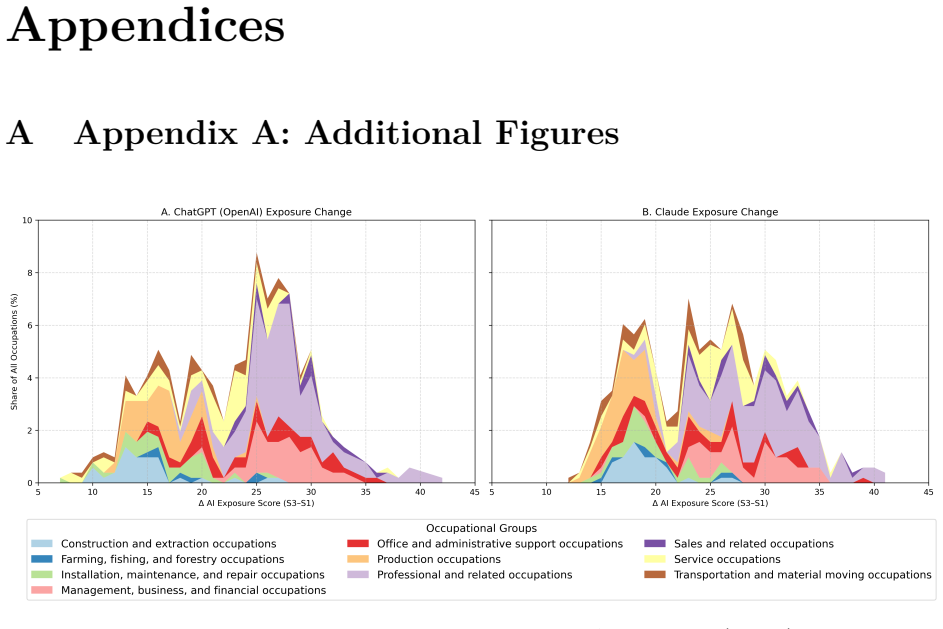
- [Section 3.1] The sentence 'These patterns align with expectations that generative AI primarily affects cognitive information-processing tasks, s to earlier technologies like robotics' contains a typo; it should read 'compared to earlier technologies like robotics.'
- [Section 4.6] The demographic heterogeneity model is introduced as 'equation (3)' but the displayed equation is labeled '(2)'; the equation numbering should be corrected.
- [Section 4.2 and References] The paper refers to 'Dingel and Nieman' in the text; the correct spelling is 'Neiman' (Dingel and Neiman, 2020).
- [Sections 2.2 and 5] Section 2.2 says the analysis uses robust standard errors that do not account for the CPS complex survey design, but Section 5's Limitations state 'we include clustered standard errors.' Please clarify which standard errors are actually reported and, if clustering is used, state the clustering unit.
- [Table 19 note] The note says Capped Earnings are 'normalized to constant 2010 dollars' but the cap of $2,884.61 appears to be a nominal cap; please clarify whether the cap is applied before or after the CPI adjustment so the wage results are interpretable.
Circularity Check
No load-bearing circularity: the exposure regressor is not constructed from labor outcomes, and no equation reduces to a fitted parameter; remaining concerns are measurement validity, not circularity.
full rationale
The derivation chain runs from O*NET task descriptions and LLM self-assessments (OAIES) to occupation-level first differences in CPS outcomes. Equation (1) regresses change in labor outcomes on change in AI exposure; nothing in Equation (1) or in the construction in Section 2.1 fits the exposure scores to employment, unemployment, or hours. The S3-S1 regressor is a function of model-generated task percentages and O*NET task-relevance weights, not of the outcome variables. The paper's self-citations (e.g., Lee et al. 2022, Chung and Lee 2023, Lee et al. 2025) appear in literature-review and policy contexts and do not carry the identification. The Section 5 limitation that the scores 'do not validate the accuracy of the scores themselves' is an honest validity caveat: cross-model correlation (Appendix Table 12) is inter-rater reliability, not ground truth, but the absence of external validation is a measurement-error concern, not circularity. The placebo tests and period decompositions reuse the same regressor, but they check pre-trends and timing patterns, not definitional equivalence. Therefore no circular step can be exhibited with a specific reduction. The score of 2 reflects the presence of minor, non-load-bearing self-citation and the self-referential nature of the exposure measure, rather than any demonstrated circular derivation.
Assumptions & free parameters
free parameters (3)
- Stage contrast S3-S1 =
Stage 3 minus Stage 1 exposure change
- Stage dates =
Nov 2022, Dec 2022, Oct 2023, Dec 2024
- Occupation sample threshold =
>=10 average monthly observations in P2
assumptions (5)
- domain assumption O*NET task descriptions and importance weights accurately represent the content of US occupations.
- ad hoc to paper LLM self-assessed task-completion percentages are a valid measure of AI capability exposure.
- ad hoc to paper The five-stage AI capability timeline corresponds to meaningful real-world capability shifts.
- domain assumption First-differenced regression with demographic and task controls removes confounding occupational trends.
- domain assumption CPS occupation-level aggregates with analytic weights approximate population labor market outcomes.
Cite this review
Pith. "Pith review of Advancing AI Capabilities and Evolving Labor Outcomes." pith.science (2026). https://pith.science/paper/4XBANYJJ
@misc{pith2026250708244,
  author       = {Pith},
  title        = {Pith review of: Advancing AI Capabilities and Evolving Labor Outcomes},
  year         = {2026},
  howpublished = {\url{https://pith.science/paper/4XBANYJJ}},
  note         = {Machine review of arXiv:2507.08244}
}
read the original abstract
This study investigates the labor market consequences of AI by analyzing near real-time changes in employment status and work hours across occupations in relation to advances in AI capabilities. We construct a dynamic Occupational AI Exposure Score based on a task-level assessment using state-of-the-art AI models, including ChatGPT 4o and Anthropic Claude 3.5 Sonnet. We introduce a five-stage framework that evaluates how AI's capability to perform tasks in occupations changes as technology advances from traditional machine learning to agentic AI. The Occupational AI Exposure Scores are then linked to the US Current Population Survey, allowing for near real-time analysis of employment, unemployment, work hours, and full-time status. We conduct a first-differenced analysis comparing the period from October 2022 to March 2023 with the period from October 2024 to March 2025. Higher exposure to AI is associated with reduced employment, higher unemployment rates, and shorter work hours. We also observe some evidence of increased secondary job holding and a decrease in full-time employment among certain demographics. These associations are more pronounced among older and younger workers, men, and college-educated individuals. College-educated workers tend to experience smaller declines in employment but are more likely to see changes in work intensity and job structure. In addition, occupations that rely heavily on complex reasoning and problem-solving tend to experience larger declines in full-time work and overall employment in association with rising AI exposure. In contrast, those involving manual physical tasks appear less affected. Overall, the results suggest that AI-driven shifts in labor are occurring along both the extensive margin (unemployment) and the intensive margin (work hours), with varying effects across occupational task content and demographics.
Figures


Figures from the paper (17 more)




Reference graph
Works this paper leans on
-
[2]
Regressions use analytic weights based on the average monthly occupation sample size in P2. Outcomes are scaled by 100. Panels vary the minimum threshold of average monthly observations per occupation in P2: Panel A (≥ 20), Panel B (≥ 50), Panel C (≥ 100), Panel D (≥ 150). 79 Table 19:Change in Weekly Earnings (P4 – P2) and Change in Exposure (S3-S1) Week...
work page 2022
-
[2025]
Amazon CEO Says AI Will Lead to Smaller Workforce,
arXiv:2503.04761. Herrera, Sebastian and Chip Cutter, “Amazon CEO Says AI Will Lead to Smaller Workforce,”The Wall Street Journal, June 2025. Herrera, Sebastian Sebastian, “Microsoft Plans to Cut Thousands More Employees,” The Wall Street Journal, June 2025. Humlum, Anders and Emilie Vestergaard, “Large Language Models, Small Labor Market Effects,” Techni...
arXiv 2011
Reviewed August 6, 2026 · model on record in the stance chip above.
Discussion (0). Sign in to comment.