REVIEW 4 major objections 6 minor 48 references
Near-Field Directional Modulation for RIS-Aided Movable Antenna MIMO Systems with Hardware Impairments
T0 review · 4 major / 6 minor · reviewed 2026-08-07 · deepseek-v4-flash
Pith's one-line read Jointly tuning movable-antenna positions, RIS phases, beamforming, and artificial noise raises the secrecy sum rate by 28 percent with 37.5 percent fewer antennas than fixed-position arrays, even with hardware impairments and imperfect…
desk verdict A genuinely new combination of near-field DM, RIS, MAs, HWIs, and imperfect CSI, but the central 28% gain claim rests on an unproven SLNR-to-SSR surrogate and an unaddressed α–wk feedback loop. read the letter →
The pith
A machine-rendered reading of the paper's core claim, the machinery that carries it, and where it could break.
The reading
What carries the argument
The load-bearing object is the leakage-theoretic SLNR surrogate of Sec. 4.2: for each user k, the objective is the ratio of the desired received power at that user to the sum of leakage power to all other users, noise terms, the hardware-impairment virtual channel, and an imperfection penalty that grows with the channel-estimation error bounds. Maximizing this ratio is a generalized Rayleigh quotient; the paper solves it by taking the leading eigenvector after a null-space projection that enforces the artificial-noise orthogonality constraints. Two supporting mechanisms carry the rest: a phase-difference variable with monotonic-gain constraints that turns the RIS phase optimization into a convex program, and a compressed-sensing group-sparsity problem that approximates the antenna-selection constraint by an ell-one norm over per-position beamforming weights, generating non-uniform position groups at far lower complexity than exhaustive search.
What would settle it
Compute the true secrecy sum rate in (20) at the beamforming and phase-shift solutions produced by the SLNR-based Algorithm 1, then at several deliberately perturbed alternatives that score lower on the surrogate; if any perturbed design achieves a higher true SSR, the claimed surrogate-to-SSR equivalence is broken. A simpler check is to re-run the simulation with alpha re-updated inside the iteration loop; if the secrecy sum rate changes by more than the simulation's tolerance, the fixed-point assumption behind the reported 28% gain is violated.
Extended reading notes
Core claim
The paper's discovery, stated on its own terms, is that the secrecy sum rate maximization for a near-field RIS-assisted MA downlink, a non-convex problem that couples beamforming vectors, RIS phases, MA positions, power allocation, and receive filters, can be decomposed and solved without exhaustive search over antenna positions. In the decomposition, the SSR objective is replaced by a signal-to-leakage-noise ratio (SLNR) built from leakage matrices, a virtual channel that absorbs the transmitter and receiver hardware impairments, and channel-estimation error bounds, turning each beamforming subproblem into a generalized Rayleigh quotient solvable by an eigenvector computation with null-space projection to keep the artificial noise out of Eve's subspace. The RIS phases are then updated through a convex phase-alignment step that guarantees Bob's received power does not decrease between iterations, and the discrete MA positions are chosen by grouping candidate positions uniformly or by a compressed-sensing group-sparsity formulation that prunes redundant locations. Simulations then show the combined design delivering the claimed 28% SSR enhancement with a 37.5% antenna reduction against FPA baselines, plus larger gains from active RIS than passive RIS and saturation behavior in antenna count, candidate positions, and transmit power.
Load-bearing premise
Everything hinges on the paper's signal-to-leakage-noise-ratio substitute in Section 4.2 rising and falling with the true secrecy sum rate; the paper asserts that equivalence but never proves it, so the claimed 28 percent gain is only as solid as that match.
Editorial extensions
If this is right
- If the central claim holds, antenna count is a tradeable resource: a base station can give up roughly three of every eight antennas and recover the lost secrecy performance by letting the remaining antennas move within a small region, cutting RF-chain and hardware cost.
- Active RIS should be preferred over passive RIS for near-field secrecy when the reflection power budget allows, since the simulations show substantially larger SSR gains, while adding RIS elements beyond a point yields diminishing returns in MA-aided systems.
- The CS-based non-uniform grouping (Algorithm 3) is the better choice when the movable region or candidate-position count is small, and it approaches the best-of-10000-random-placements benchmark as candidate positions grow.
- Secrecy performance degrades measurably with hardware impairment levels (up to 24% at mu_t = mu_r = 0.01 versus the impairment-free baseline), so improving transceiver hardware quality is a direct route to secrecy.
Reading between the lines
- The SLNR construction that absorbs HWIs and CSI error bounds into a virtual channel is portable: the same trick could convert secrecy-rate or covert-rate optimizations in other architectures (such as cell-free networks, STAR-RIS, or terahertz links) into Rayleigh-quotient problems, with the same unproven surrogate-to-SSR gap to watch.
- The alpha-w_k fixed-point loop is incomplete: alpha is computed from w_k in (80) while w_k depends on alpha through L_4,k in (49), and Algorithm 1 never re-updates alpha. A natural testable extension is to alternate an alpha-update into the iteration and check whether SSR rises; if it does, the reported 28% gain is a lower bound.
- The discrete MA-position selection is structurally a sparse-array selection problem, so the CS grouping could be sharpened by proving that the ell-one relaxation preserves the SSR ordering of position groups; absent such a proof, the grouping is a heuristic whose worst-case gap to exhaustive search is unknown.
- Because the near-field boundary shifts with the array aperture as antennas move, the channel model's Fresnel-zone assumption should be re-checked when the movable region is large; a testable extension would vary the region size and verify the NF steering vectors against a full spherical-wave model.
Editorial analysis
A structured set of objections, weighed in public.
Referee Report
Summary. This paper formulates a secrecy sum rate (SSR) maximization problem for a near-field RIS-assisted MIMO system with movable antennas, hardware impairments, imperfect CSI, discrete MA placement, and artificial noise. The authors decompose the non-convex joint problem and propose three algorithms: an iterative leakage-theory/phase-alignment method for transmit beamforming and RIS phases, a uniform-grouping discrete MA placement algorithm, and a compressed-sensing-based non-uniform grouping algorithm. Receive beamforming is derived by an MMSE criterion. Simulation results claim a 28% SSR enhancement with 37.5% fewer antennas relative to fixed-position-antenna systems. The paper is a useful extension of directional modulation to MA/RIS near-field settings, but two load-bearing issues—the asserted equivalence of the SLNR surrogate to SSR and the circular dependence on α—need to be resolved before the central quantitative claim can be accepted.
Significance. If the reported gains are reproducible, the paper would be among the first to combine near-field directional modulation, movable antennas, RIS, hardware impairments, and imperfect CSI in a single design, with low-complexity discrete MA positioning. The explicit modeling of active-RIS power constraints, the use of leakage theory for beamforming, and the two MA-grouping algorithms are concrete contributions. The paper is not parameter-fitted to a target output: the optimization is formulated with channel and impairment constraints and then evaluated by simulation. However, the significance is tempered by the lack of a proof or numerical validation that the SLNR surrogate tracks the true SSR, by an unspecified treatment of α in the main iterative loop, and by the absence of any statistical characterization of the simulation results.
major comments (4)
- [Sec. 4.2, Eqs. (44)-(53)] The paper asserts that the SLNR ratio in (44), and its later forms (49) and (53), is 'equivalent to the SSR maximization problem,' but no proof of a monotonic relationship is provided. The original SSR in (20) is a sum over users of log(1 + SINR_bob) - log(1 + SINR_eve), whereas (53) defines Rs(wk) as a single per-user Rayleigh quotient. Maximizing such a quotient is not generally equivalent to maximizing a sum of logarithms of SINR differences, especially under the HWIs and imperfect-CSI terms folded into L4,k and L5,k. Since every subsequent optimization step (P3-P6, Algorithms 1-3) is built on this surrogate, the reported 28% SSR gain may reflect the surrogate rather than the true SSR. The authors should either prove the equivalence under the stated constraints or provide a numerical comparison showing that the surrogate-optimized solution closely tracks the true SSR (20) across the simulated parameter range.
- [Sec. 4.2, Eq. (49) and Sec. 4.4, Eq. (80); Algorithm 1] The factor α enters the beamforming optimization through L4,k in (49) via the term (ε̂e P0/K + ε̂k(1−α)P0)||θ̂|| I_N, but α is not part of Algorithm 1's input list and is not updated inside the iteration; it is computed only afterward from wk using (80). This creates a circular dependency: the wk obtained from Algorithm 1 depends on an unspecified value of α, and the value of α obtained from (80) will not, in general, be consistent with the α used in that wk computation. In addition, (80) is k-dependent, while α in (1) must be a single global scalar; the manuscript does not say how the per-user expressions are reconciled. The authors must specify how α is initialized, whether it is updated jointly with wk in a fixed-point loop, and how a consistent (wk, α) pair is obtained for the reported simulations.
- [Sec. 5, Figs. 5-10] The simulation section reports no error bars, no number of channel realizations, and no description of how the random channel estimation errors in (21)-(24) are sampled for each plotted point. The headline numbers—28% SSR enhancement and 37.5% antenna reduction—are single-point comparisons extracted from these figures. Since the imperfect-CSI errors and the channel realizations are stochastic, the reader cannot assess whether the claimed gains are statistically significant or specific to one realization. The authors should specify the Monte Carlo protocol, the number of averaged realizations, and confidence intervals or at least standard-error markers for the main comparisons.
- [Sec. 4.2, Eqs. (48)-(49) and (53)] The transition from (48) to (49) multiplies the imperfect-CSI penalty by ||θ̂|| in the denominator, but the derivation of (37)-(38) already uses the inequality ||θ̂ Âe T w_k|| ≤ ε̂e ||θ̂|| ||T w_k||, and the resulting bound is then inserted as an additive term inside the Rayleigh quotient. It is not shown that this additive substitution preserves the monotonic ordering of the original SLNR or that the subsequent eigenvector solution of P5 is a valid approximation of the constrained problem with C9 and C10. A formal statement of the approximation error, or a comparison against the original constrained problem for a small instance, would be needed to justify the use of (49) and (53) as the objective in P3-P5.
minor comments (6)
- [Sec. 3.1, Eq. (5)] The variable N_z is used in the mapping (5) but is never defined; it appears to be N_v or N_h. Please define it explicitly.
- [Sec. 3.1, Eqs. (9)-(10)] The sum notation in (9) and (10) is rendered as '∑ 4 i=1' and '∑ 3 i=1', which is unclear; it should be ∑_{i=1}^{4} and ∑_{i=1}^{3}.
- [Sec. 4.3.1] The complexity expression 'approximately Nt n0^3 / (S N^3) that of the exhaustive search algorithm' is grammatically and mathematically unclear; please state whether it means 'N_t n_0^3 / (S N^3)' times the exhaustive-search complexity, and define all symbols.
- [Sec. 4.2, Eq. (55)] In the passive-RIS initial state, the bound (55) uses ||θ||^2 = M, but the preceding line writes the inequality as if ||θ||^2 appears without identifying that θ is the all-ones vector scaled by unit modulus; please clarify the initial-state assumptions.
- [Sec. 4.4, Eq. (82)] In the MMSE derivation, the expression for E_k(u_k) is written with both u_k and u_k^H dependencies, but the derivative in (85) is taken with respect to u_k^*; it would be helpful to state the Wirtinger-calculus convention used.
- [General] The text contains several spacing artifacts, such as 'T ABLE 1' and 'achieve' split across lines; a careful copyedit would improve readability.
Circularity Check
No significant circularity; the optimization pipeline is evaluated against the true SSR, and self-citations are not load-bearing. A fixed-point gap between alpha and w_k is a reproducibility concern, not a circular derivation.
full rationale
The paper's central 28% SSR claim comes from running Algorithms 1-3 and evaluating the secrecy sum rate via Eq. (20), not from substituting a fitted parameter back into the objective. The SLNR surrogates in Eqs. (44)-(54) are heuristic replacements for the true SSR, and the reported R_s values are computed with Eq. (20) inside Algorithm 1 (step 8) and Algorithms 2-3, so the headline gain is not forced by construction. The self-citations to Shu et al. (refs. [2], [4], [6], [7]) are ordinary technique citations; in particular, 'the normalization method in [6]' is used only to enforce the active-RIS power constraint C8 and is not a uniqueness theorem or an ansatz that determines the main result. One genuine consistency gap should be flagged: alpha appears inside L_{4,k} in Eq. (49), so the P5 solution for w_k depends on alpha, yet Algorithm 1 does not list alpha as an input or update it, and alpha is computed only afterwards from w_k via Eq. (80), leaving a fixed-point dependency unresolved. This is an omitted/incomplete update, i.e., a correctness and reproducibility risk, rather than a circular derivation that makes the predicted SSR equivalent to its inputs. No step was found where an output variable is definitionally identical to an input variable, and no load-bearing self-citation chain forces the conclusion.
Assumptions & free parameters
free parameters (3)
- ξ1 =
not stated
- ξ2 =
not stated
- n0 =
3 used in Fig. 10
assumptions (4)
- domain assumption Near-field spherical-wave channel model for BS-RIS, RIS-user, and BS-user links, with deterministic steering vectors based on distances and angles (eqs (25)-(29))
- domain assumption Hardware impairments are modeled as Gaussian distortion noise proportional to signal power at both transmitter and receiver (eqs (1)-(2), (7)), following [44]
- domain assumption Channel estimation errors are norm-bounded with known upper bounds εk and εe (eqs (21)-(24)), following [48]
- ad hoc to paper The SLNR ratio (44)-(49) is a valid surrogate for the secrecy sum rate under HWIs and imperfect CSI
Cite this review
Pith. "Pith review of Near-Field Directional Modulation for RIS-Aided Movable Antenna MIMO Systems with Hardware Impairments." pith.science (2026). https://pith.science/paper/4XBLVDXY
@misc{pith2026250600972,
  author       = {Pith},
  title        = {Pith review of: Near-Field Directional Modulation for RIS-Aided Movable Antenna MIMO Systems with Hardware Impairments},
  year         = {2026},
  howpublished = {\url{https://pith.science/paper/4XBLVDXY}},
  note         = {Machine review of arXiv:2506.00972}
}
read the original abstract
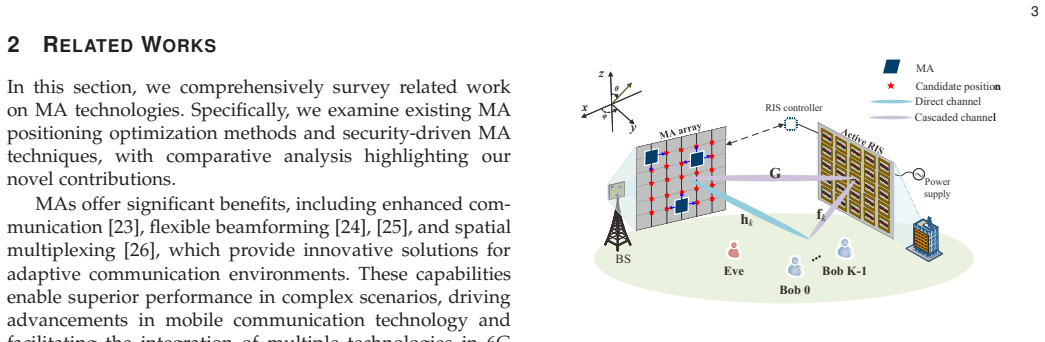
Movable antennas (MAs) are a promising technology to achieve a significant enhancement in rate for future wireless networks. The pioneering investigation on near-field directional modulation design for a reconfigurable intelligent surface (RIS)-assisted MA system is presented, with the base station equipped with a MA array. To maximize the secrecy sum rate (Max-SSR) with hardware impairments (HWIs) and imperfect channel state information (CSI), which involves a joint optimization of beamforming vectors for confidential messages and artificial noise (AN), power allocation factors, phase shift matrices, MA positions, and receive beamforming vectors. Firstly, the transmit beamforming vectors and phase shift matrices are iteratively optimized, leveraging leakage theory and phase alignment techniques. Then, two novel algorithms for discrete MA positioning are proposed, respectively, employing uniform and compressed sensing (CS)-based non-uniform grouping strategies. Subsequently, the AN is considered and designed as the additional energy required for zero-space projection, and the receive beamforming vector is derived using the minimum mean square error (MMSE) method. The proposed algorithms have low computational complexity. Simulation results demonstrate the effectiveness of the proposed algorithms. Under HWIs and imperfect CSI, the proposed algorithm can achieve a 28\% enhancement in SSR performance while reducing the number of antennas by 37.5\% compared to traditional fixed-position antenna (FPA) systems.
Figures


Figures from the paper (4 more)


Reference graph
Works this paper leans on
-
[1]
Physical la yer security for ultra-reliable and low-latency communicatio ns,
R. Chen, C. Li, S. Y an, R. Malaney , and J. Y uan, “Physical la yer security for ultra-reliable and low-latency communicatio ns,” IEEE Wireless Communications, vol. 26, no. 5, pp. 6–11, 2019
work page 2019
-
[2]
Enhanced secrecy rate maximization for directional modul ation networks via IRS,
F. Shu, Y . Teng, J. Li, M. Huang, W. Shi, J. Li, Y . Wu, and J. Wan g, “Enhanced secrecy rate maximization for directional modul ation networks via IRS,” IEEE T ransactions on Communications , vol. 69, no. 12, pp. 8388–8401, 2021
work page 2021
-
[3]
R. Lin, H. Qiu, J. Wang, Z. Zhang, L. Wu, and F. Shu, “Physica l- layer security enhancement in energy-harvesting-based co gnitive internet of things: A gan-powered deep reinforcement learn ing approach,” IEEE Internet of Things Journal , vol. 11, no. 3, pp. 4899– 4913, 2024
work page 2024
-
[4]
F. Shu, R. Dong, Y . Lin, H. He, W. Shi, Y . Y ao, L. Shi, Q. Cheng, J . Li, and J. Wang, “Beamforming and phase shift design for HR-IRS- aided directional modulation network with a malicious atta cker,” IEEE T ransactions on Wireless Communications , vol. 23, no. 8, pp. 9016–9032, 2024
work page 2024
-
[5]
Directional modulation with artificial-noise injection i nto time- modulated arrays,
R. Maneiro-Catoira, J. Br´ egains, J. A. Garc´ ıa-Naya, a nd L. Castedo, “Directional modulation with artificial-noise injection i nto time- modulated arrays,” IEEE Antennas and Wireless Propagation Letters , vol. 23, no. 8, pp. 2336–2340, 2024
work page 2024
-
[6]
Three high-rate beamforming methods for active IR S- aided wireless network,
F. Shu, J. Liu, Y . Lin, Y . Liu, Z. Chen, X. Wang, R. Dong, and J. Wang, “Three high-rate beamforming methods for active IR S- aided wireless network,” IEEE T ransactions on Vehicular T echnology, vol. 72, no. 11, pp. 15 052–15 056, 2023
work page 2023
-
[7]
F. Shu, X. Wu, J. Hu, J. Li, R. Chen, and J. Wang, “Secure and pr e- cise wireless transmission for random-subcarrier-select ion-based directional modulation transmit antenna array ,” IEEE Journal on Selected Areas in Communications , vol. 36, no. 4, pp. 890–904, 2018
work page 2018
-
[8]
Guaranteeing secrecy using artificia l noise,
S. Goel and R. Negi, “Guaranteeing secrecy using artificia l noise,” IEEE T ransactions on Wireless Communications , vol. 7, no. 6, pp. 2180–2189, 2008
work page 2008
Show all 48 references
-
[9]
Secure directional modul ation with few-bit phase shifters: Optimal and iterative-closed -form designs,
Z. Wei, C. Masouros, and F. Liu, “Secure directional modul ation with few-bit phase shifters: Optimal and iterative-closed -form designs,” IEEE T ransactions on Communications , vol. 69, no. 1, pp. 486–500, 2021. 14
2021
-
[10]
Decomposed and distribu ted directional modulation for secure wireless communication ,
B. Qiu, W. Cheng, and W. Zhang, “Decomposed and distribu ted directional modulation for secure wireless communication ,” IEEE T ransactions on Wireless Communications , vol. 23, no. 5, pp. 5219– 5231, 2024
2024
-
[11]
Coverage enhance ment in millimeter-wave cellular networks via distributed IRSs,
X. Shi, N. Deng, N. Zhao, and D. Niyato, “Coverage enhance ment in millimeter-wave cellular networks via distributed IRSs, ” IEEE T ransactions on Communications, vol. 71, no. 2, pp. 1153–1167, 2023
2023
-
[12]
A fr ame- work for energy efficiency optimization in IRS-aided hybrid m u- MIMO systems,
X. Ju, H. Liu, S. Gong, C. Xing, N. Zhao, and D. Niyato, “A fr ame- work for energy efficiency optimization in IRS-aided hybrid m u- MIMO systems,” IEEE Journal on Selected Areas in Communications , vol. 43, no. 3, pp. 883–898, 2025
2025
-
[13]
Degree-of-freedom of modulating infor- mation in the phases of reconfigurable intelligent surface,
H. V . Cheng and W. Y u, “Degree-of-freedom of modulating infor- mation in the phases of reconfigurable intelligent surface, ” IEEE T ransactions on Information Theory, vol. 70, no. 1, pp. 170–188, 2024
2024
-
[14]
Reconfigurable intelligent surfa ce-assisted multi-user secrecy transmission with low-resolution dacs ,
K. Li, H. Du, and S. Li, “Reconfigurable intelligent surfa ce-assisted multi-user secrecy transmission with low-resolution dacs ,” IEEE T ransactions on Green Communications and Networking , vol. 8, no. 3, pp. 1205–1221, 2024
2024
-
[15]
Distributed hybrid active-p assive IRS- assisted thz wireless systems: Performance analysis and op timiza- tion,
N. P . Le and M.-S. Alouini, “Distributed hybrid active-p assive IRS- assisted thz wireless systems: Performance analysis and op timiza- tion,” IEEE T ransactions on Communications, vol. 73, no. 2, pp. 1399– 1414, 2025
2025
-
[16]
Applications of absorpt ive reconfigurable intelligent surfaces in interference mitig ation and physical layer security ,
F. Wang and A. L. Swindlehurst, “Applications of absorpt ive reconfigurable intelligent surfaces in interference mitig ation and physical layer security ,” IEEE T ransactions on Wireless Communica- tions, vol. 23, no. 5, pp. 3918–3931, 2024
2024
-
[17]
AI-enabled STAR- IRS aided MISO isac secure communications,
Z. Zhu, M. Gong, G. Sun, P . Liu, and D. Mi, “AI-enabled STAR- IRS aided MISO isac secure communications,” T singhua Science and T echnology, vol. 30, no. 3, pp. 998–1011, 2025
2025
-
[18]
Mems reconfigurable vee antenna,
J.-C. Chiao, Y . Fu, I. M. Chio, M. DeLisio, and L.-Y . Lin, “Mems reconfigurable vee antenna,” in 1999 IEEE MTT-S International Microwave Symposium Digest (Cat. No.99CH36282) , vol. 4, 1999, pp. 1515–1518 vol.4
1999
-
[19]
Liquid antenna systems,
Y . Kosta and S. Kosta, “Liquid antenna systems,” in IEEE Antennas and Propagation Society Symposium, 2004. , vol. 3, 2004, pp. 2392– 2395 V ol.3
2004
-
[20]
MEMS Integrated and Micromachined Antenna Elements, Array s, and Feeding Networks, 2008, pp. 829–865
2008
-
[21]
Flui d antenna system for 6g: When bruce lee inspires wireless communications,
K.-K. Wong, K.-F. Tong, Y . Zhang, and Z. Zhongbin, “Flui d antenna system for 6g: When bruce lee inspires wireless communications,” Electronics Letters , vol. 56, pp. 1288–1290, 2020. [Online]. Available: https://digital-library .theiet.org/doi/abs/10. 1049/el.2020.2788
2020
-
[22]
Modeling and performance an aly- sis for movable antenna enabled wireless communications,
L. Zhu, W. Ma, and R. Zhang, “Modeling and performance an aly- sis for movable antenna enabled wireless communications,” IEEE T ransactions on Wireless Communications , vol. 23, no. 6, pp. 6234– 6250, 2024
2024
-
[23]
Movable-antenna en - hanced multiuser communication via antenna position optim iza- tion,
L. Zhu, W. Ma, B. Ning, and R. Zhang, “Movable-antenna en - hanced multiuser communication via antenna position optim iza- tion,” IEEE T ransactions on Wireless Communications , vol. 23, no. 7, pp. 7214–7229, 2024
2024
-
[24]
Flexible p re- coding for multi-user movable antenna communications,
S. Y ang, W. Lyu, B. Ning, Z. Zhang, and C. Y uen, “Flexible p re- coding for multi-user movable antenna communications,” IEEE Wireless Communications Letters, vol. 13, no. 5, pp. 1404–1408, 2024
2024
-
[25]
Movable-antenna array enha nced beamforming: Achieving full array gain with null steering,
L. Zhu, W. Ma, and R. Zhang, “Movable-antenna array enha nced beamforming: Achieving full array gain with null steering, ” IEEE Communications Letters, vol. 27, no. 12, pp. 3340–3344, 2023
2023
-
[26]
Star- IRS aided communication system with movable antennas exploiti ng statistical csi,
Y . Sun, H. Xu, B. Ning, L. Zhu, C. Ouyang, and H. Y ang, “Star- IRS aided communication system with movable antennas exploiti ng statistical csi,” IEEE Communications Letters , vol. 29, no. 4, pp. 824– 828, 2025
2025
-
[27]
Secure MIMO communication relying on movable antennas,
J. Tang, C. Pan, Y . Zhang, H. Ren, and K. Wang, “Secure MIMO communication relying on movable antennas,” IEEE T ransactions on Communications, vol. 73, no. 4, pp. 2159–2175, 2025
2025
-
[28]
Secure wireles s communication via movable-antenna array ,
G. Hu, Q. Wu, K. Xu, J. Si, and N. Al-Dhahir, “Secure wireles s communication via movable-antenna array ,” IEEE Signal Process- ing Letters, vol. 31, pp. 516–520, 2024
2024
-
[29]
Movable antenna-aided se cure full- duplex multi-user communications,
J. Ding, Z. Zhou, and B. Jiao, “Movable antenna-aided se cure full- duplex multi-user communications,” IEEE T ransactions on Wireless Communications, vol. 24, no. 3, pp. 2389–2403, 2025
2025
-
[30]
Movable-antenna enabled covert communication,
P . Liu, J. Si, Z. Cheng, Z. Li, and H. Hu, “Movable-antenna enabled covert communication,” IEEE Wireless Communications Letters, vol. 14, no. 2, pp. 280–284, 2025
2025
-
[31]
Sum rate maximization for movable antenna enhanced multiuser covert communications,
H. Mao, X. Pi, L. Zhu, Z. Xiao, X.-G. Xia, and R. Zhang, “Sum rate maximization for movable antenna enhanced multiuser covert communications,” IEEE Wireless Communications Letters , vol. 14, no. 3, pp. 611–615, 2025
2025
-
[32]
Movable antennas-assisted secure transmission without e aves- droppers’ instantaneous csi,
G. Hu, Q. Wu, D. Xu, K. Xu, J. Si, Y . Cai, and N. Al-Dhahir, “Movable antennas-assisted secure transmission without e aves- droppers’ instantaneous csi,” IEEE T ransactions on Mobile Comput- ing, vol. 23, no. 12, pp. 14 263–14 279, 2024
2024
-
[33]
Two-timescale design for movable antenna array-enabled multiuser uplink communications,
G. Hu, Q. Wu, G. Li, D. Xu, K. Xu, J. Si, Y . Cai, and N. Al- Dhahir, “Two-timescale design for movable antenna array-enabled multiuser uplink communications,” IEEE T ransactions on Vehicular T echnology, vol. 74, no. 3, pp. 5152–5157, 2025
2025
-
[34]
Sum- rate enhancement for IRS-assisted movable antenna systems: Joint transmit beamforming, reflecting design, and antenna posit ion- ing,
B. Zhang, K. Xu, X. Xia, G. Hu, C. Wei, C. Li, and K. Cheng, “ Sum- rate enhancement for IRS-assisted movable antenna systems: Joint transmit beamforming, reflecting design, and antenna posit ion- ing,” IEEE T ransactions on Vehicular T echnology, vol. 74, no. 3, pp. 4376–4392, 2025
2025
-
[35]
Movable-antenna-assisted covert communications with re config- urable intelligent surfaces,
W. Xie, Z. Li, C. Y u, H. Xu, J. Wang, W. Wu, X. Li, and L. Y ang , “Movable-antenna-assisted covert communications with re config- urable intelligent surfaces,” IEEE Internet of Things Journal , vol. 12, no. 9, pp. 12 369–12 382, 2025
2025
-
[36]
Deep learning enabled multicast beamform ing with movable antenna array ,
J.-M. Kang, “Deep learning enabled multicast beamform ing with movable antenna array ,” IEEE Wireless Communications Letters , vol. 13, no. 7, pp. 1848–1852, 2024
2024
-
[37]
6d movable antenna based on user distribution: Modeling and optimization,
X. Shao, Q. Jiang, and R. Zhang, “6d movable antenna based on user distribution: Modeling and optimization,” IEEE T ransactions on Wireless Communications , vol. 24, no. 1, pp. 355–370, 2025
2025
-
[38]
6d movable ant enna enhanced wireless network via discrete position and rotati on optimization,
X. Shao, R. Zhang, Q. Jiang, and R. Schober, “6d movable ant enna enhanced wireless network via discrete position and rotati on optimization,” IEEE Journal on Selected Areas in Communications , vol. 43, no. 3, pp. 674–687, 2025
2025
-
[39]
Mo v- able antenna-enhanced multiuser communication: Jointly o ptimal discrete antenna positioning and beamforming,
Y . Wu, D. Xu, D. W. K. Ng, W. Gerstacker, and R. Schober, “Mo v- able antenna-enhanced multiuser communication: Jointly o ptimal discrete antenna positioning and beamforming,” in GLOBECOM 2023 - 2023 IEEE Global Communications Conference , 2023, pp. 7508– 7513
2023
-
[40]
Movable-a ntenna position optimization: A graph-based approach,
W. Mei, X. Wei, B. Ning, Z. Chen, and R. Zhang, “Movable-a ntenna position optimization: A graph-based approach,” IEEE Wireless Communications Letters, vol. 13, no. 7, pp. 1853–1857, 2024
2024
-
[41]
Near-field source localization and beamforming in the spherical secto r har- monics domain,
S. K. Y adav , S. R. M. Prasanna, and N. V . George, “Near-field source localization and beamforming in the spherical secto r har- monics domain,” IEEE Journal of Selected T opics in Signal Processing, vol. 18, no. 4, pp. 546–560, 2024
2024
-
[42]
Near-fiel d multiuser communications aided by movable antennas,
J. Ding, L. Zhu, Z. Zhou, B. Jiao, and R. Zhang, “Near-fiel d multiuser communications aided by movable antennas,” IEEE Wireless Communications Letters , vol. 14, no. 1, pp. 138–142, 2025
2025
-
[43]
Movable antenna ena bled near-field communications: Channel modeling and performan ce optimization,
L. Zhu, W. Ma, Z. Xiao, and R. Zhang, “Movable antenna ena bled near-field communications: Channel modeling and performan ce optimization,” IEEE T ransactions on Communications, pp. 1–1, 2025
2025
-
[44]
Secure communication in active IRS-assisted miso systems with hard ware impairments,
X. Bai, A. Y u, F. Fang, X. Wang, Y . Y ang, and Y . Li, “Secure communication in active IRS-assisted miso systems with hard ware impairments,” IEEE Wireless Communications Letters, vol. 13, no. 12, pp. 3528–3532, 2024
2024
-
[45]
Robust transmission design for IRS-assisted multi-cluster wireless powered communicatio ns with hardware impairments,
L. Zhai, Y . Zou, and J. Zhu, “Robust transmission design for IRS-assisted multi-cluster wireless powered communicatio ns with hardware impairments,” IEEE T ransactions on Communications , vol. 72, no. 5, pp. 3035–3050, 2024
2024
-
[46]
Per - formance analysis and optimization for distributed IRS-ass isted mmwave massive MIMO with multi-antenna users and hardware impairments,
Z. Wang, Y . Zhang, H. Zhou, J. Li, D. Wang, and X. Y ou, “Per - formance analysis and optimization for distributed IRS-ass isted mmwave massive MIMO with multi-antenna users and hardware impairments,” IEEE T ransactions on Communications, vol. 72, no. 8, pp. 4661–4676, 2024
2024
-
[47]
Multi-beam design for near - field extremely large-scale IRS-aided wireless communicati ons,
D. Shen, L. Dai, X. Su, and S. Suo, “Multi-beam design for near - field extremely large-scale IRS-aided wireless communicati ons,” IEEE T ransactions on Green Communications and Networking , vol. 7, no. 3, pp. 1542–1553, 2023
2023
-
[48]
Robus t beamforming design for IRS-aided cell-free systems with csi un- certainties and capacity-limited backhaul,
J. Y ao, J. Xu, W. Xu, D. W. K. Ng, C. Y uen, and X. Y ou, “Robus t beamforming design for IRS-aided cell-free systems with csi un- certainties and capacity-limited backhaul,” IEEE T ransactions on Communications, vol. 71, no. 8, pp. 4636–4649, 2023
2023
Reviewed August 7, 2026 · model on record in the stance chip above.
Discussion (0). Sign in to comment.