Multi-Kernel TOF-PET Image Reconstruction Using ADMM
Pith reviewed 2026-06-29 00:05 UTC · model grok-4.3
The pith
TOF-decomp ADMM splits fast- and slow-CTR log-likelihood terms under a constraint to balance their contributions in multi-kernel TOF-PET reconstruction.
A machine-rendered reading of the paper's core claim, the machinery that carries it, and where it could break.
Core claim
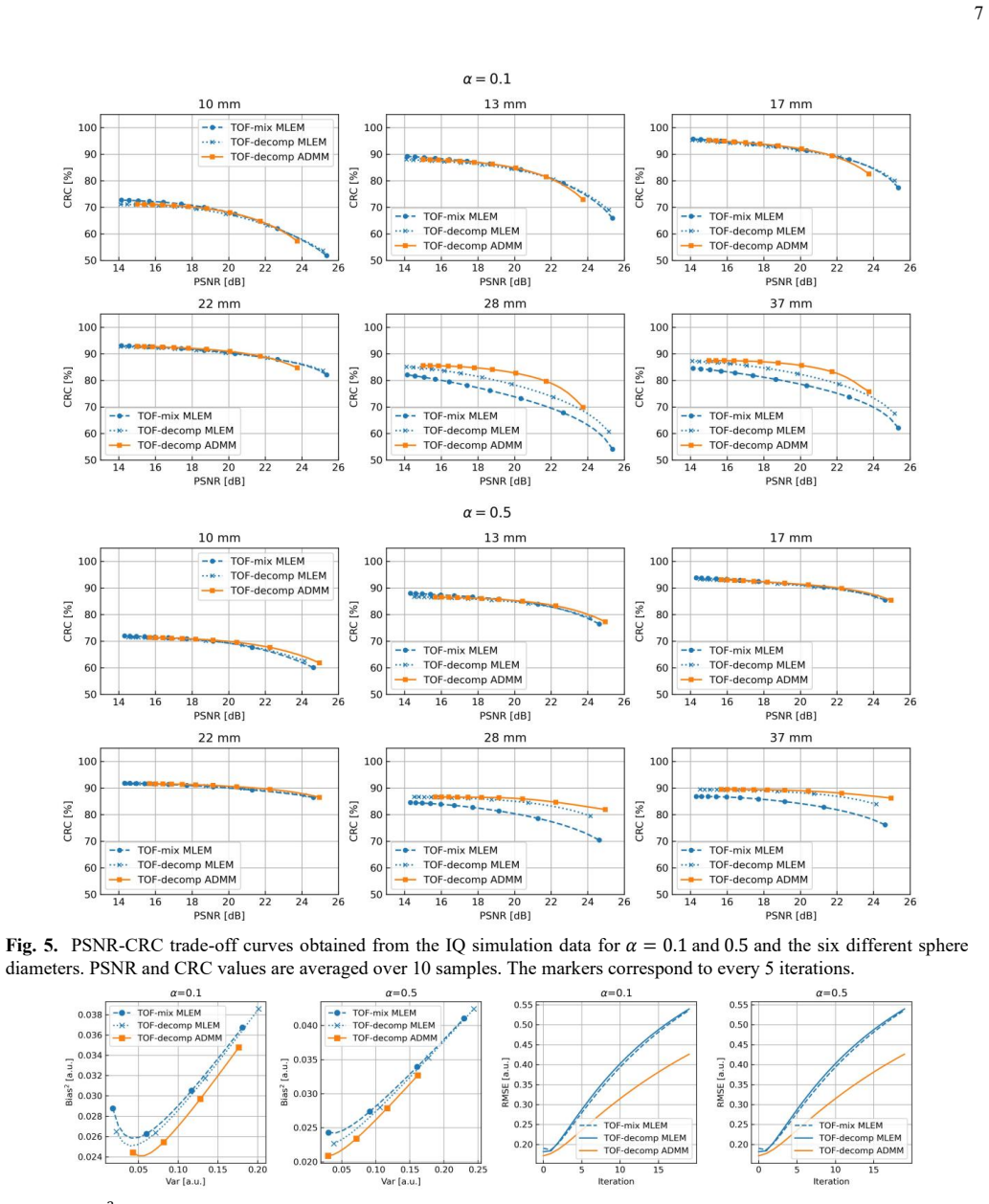
The TOF-decomp ADMM explicitly balances the contributions of fast- and slow-CTR components by splitting their log-likelihood terms and optimizing them separately under a constraint. This strategy addresses the convergence imbalance inherent to multi-kernel TOF-PET and enables early stopping at iterations that yield improved contrast-noise trade-offs compared with conventional methods, as shown in brain and image quality phantom simulations that demonstrate more stabilized convergence.
What carries the argument
TOF-decomp ADMM, which splits the fast- and slow-CTR log-likelihood terms and optimizes them separately under a constraint to balance their contributions.
If this is right
- Improved contrast-noise characteristics result from more stabilized convergence.
- Early stopping becomes viable at iterations that already deliver better trade-offs than full runs of conventional methods.
- The approach supplies a framework for using timing information from detectors that mix Cherenkov and scintillation photons.
- The imbalance between fast and slow components is removed by separate optimization under the linking constraint.
Where Pith is reading between the lines
- The same splitting idea could be tested on data sets containing three or more distinct CTR kernels to check whether the balancing effect scales.
- If accurate kernel labels are available from hardware, the method may shorten total reconstruction time in settings where full convergence is computationally expensive.
- Phantom results suggest the technique could be applied to other iterative PET algorithms that suffer from heterogeneous timing statistics.
Load-bearing premise
The method requires that each detected event is correctly labeled with its timing kernel.
What would settle it
A head-to-head run on the same phantom data where standard ADMM and TOF-decomp ADMM are stopped at the same early iteration number and the contrast-noise curve of the proposed method is compared directly to the conventional curve.
Figures
read the original abstract
Time-of-flight positron emission tomography (TOF-PET) detectors exhibiting multiple coincidence time resolution (CTR) components, such as those induced by the mixing of Cherenkov and scintillation photons, have attracted increasing attention. However, to fully exploit the latent potential of multi-kernel TOF-PET, new iterative image reconstruction methods are required. In this study, assuming that the events are labeled with the appropriate kernels, we propose an alternating direction method of multipliers (ADMM) for multi-kernel TOF-PET reconstruction, termed TOF-decomp ADMM. As the convergence speed of the TOF-PET log-likelihood depends on the CTR, the proposed method splits the fast- and slow-CTR log-likelihood terms and optimizes them separately under a constraint. This strategy explicitly balances the contributions of fast- and slow-CTR components and enables early stopping at iterations that yield improved contrast-noise trade-offs compared with conventional methods. We validated the proposed method using brain and image quality phantom simulations, demonstrating improved contrast-noise characteristics from a more stabilized convergence. By addressing the convergence imbalance inherent to multi-kernel TOF-PET, this work establishes a framework for exploiting the timing information available in emerging detector technologies.
Editorial analysis
A structured set of objections, weighed in public.
Referee Report
Summary. The manuscript proposes TOF-decomp ADMM, an alternating direction method of multipliers algorithm for multi-kernel TOF-PET reconstruction. Assuming per-event labels assigning each coincidence to either a fast or slow CTR kernel are available, the method decomposes the log-likelihood into separate fast- and slow-CTR terms that are optimized independently under an explicit consistency constraint. This decomposition is claimed to balance the differing convergence rates induced by the two CTR components, permitting early stopping at iterations that improve the contrast-noise trade-off relative to standard methods. Validation consists of brain and image-quality phantom simulations that reportedly demonstrate more stable convergence and better contrast-noise characteristics.
Significance. If the kernel-labeling step can be performed reliably on measured data, the approach would provide a practical way to exploit detectors that mix Cherenkov and scintillation timing information. The simulation evidence of stabilized convergence supplies an initial indication that the split formulation can mitigate the convergence imbalance inherent to multi-kernel data; however, the absence of quantitative metrics and real-data experiments limits the immediate clinical or technical impact.
major comments (2)
- [Abstract] Abstract: The central claim that the split enables 'early stopping at iterations that yield improved contrast-noise trade-offs' rests entirely on the assumption that 'events are labeled with the appropriate kernels.' The manuscript supplies neither an algorithm for obtaining these labels from real detector signals nor any sensitivity analysis showing how label errors degrade the balancing property. Because the simulations use oracle labels, the reported stabilization is not shown to survive the labeling step that would be required in practice.
- [Abstract / Results] Validation description (Abstract and Results): The abstract asserts 'improved contrast-noise characteristics from a more stabilized convergence' yet reports no numerical values (contrast-recovery coefficients, standard deviation of background, iteration numbers at stopping, or statistical comparisons against conventional ADMM). Without these quantities or error analysis, the magnitude and reproducibility of the claimed benefit cannot be assessed.
minor comments (1)
- [Methods] The manuscript should clarify whether the constraint in the ADMM formulation is enforced exactly or approximately and how the penalty parameter is chosen.
Simulated Author's Rebuttal
We thank the referee for the detailed review and constructive comments. Our responses to the major comments are provided below. The work is presented under the explicit assumption of available event labels, as stated throughout the manuscript, and focuses on the reconstruction algorithm rather than the upstream labeling process.
read point-by-point responses
-
Referee: [Abstract] Abstract: The central claim that the split enables 'early stopping at iterations that yield improved contrast-noise trade-offs' rests entirely on the assumption that 'events are labeled with the appropriate kernels.' The manuscript supplies neither an algorithm for obtaining these labels from real detector signals nor any sensitivity analysis showing how label errors degrade the balancing property. Because the simulations use oracle labels, the reported stabilization is not shown to survive the labeling step that would be required in practice.
Authors: The manuscript explicitly frames the TOF-decomp ADMM under the assumption that per-event kernel labels are available, as stated in the abstract and methods. The contribution is the constrained decomposition that balances convergence rates of the fast- and slow-CTR terms once labels are given. We do not provide or claim a labeling algorithm, which would be a separate signal-processing task. The oracle-label simulations demonstrate the potential benefit of the split formulation; we agree that label-error sensitivity is an important practical consideration and will expand the discussion section to address this limitation and outline possible labeling strategies based on timing-signal features. revision: partial
-
Referee: [Abstract / Results] Validation description (Abstract and Results): The abstract asserts 'improved contrast-noise characteristics from a more stabilized convergence' yet reports no numerical values (contrast-recovery coefficients, standard deviation of background, iteration numbers at stopping, or statistical comparisons against conventional ADMM). Without these quantities or error analysis, the magnitude and reproducibility of the claimed benefit cannot be assessed.
Authors: We acknowledge that the current validation relies primarily on visual inspection of convergence behavior and image quality in the presented figures. To improve quantitative assessment, the revised manuscript will include tables reporting contrast-recovery coefficients, background standard deviations, and the specific iteration numbers selected for early stopping, together with direct numerical comparisons against conventional ADMM on the same simulated datasets. revision: yes
- Development and validation of a reliable per-event kernel labeling algorithm from measured detector signals
- Experimental validation using real (non-simulated) measured TOF-PET data
Circularity Check
No significant circularity; method is an algorithmic split under stated assumption
full rationale
The derivation consists of proposing an ADMM splitting of fast- and slow-CTR log-likelihood terms under an explicit external assumption that events are pre-labeled with kernels. This assumption is stated upfront and the validation uses oracle labels in simulation; the contrast-noise improvement is shown empirically rather than obtained by fitting parameters to the target metric or by reducing to a self-citation chain. No equation or claim reduces to its own inputs by construction, and the paper does not invoke uniqueness theorems or ansatzes from prior self-work as load-bearing justification.
Axiom & Free-Parameter Ledger
Reference graph
Works this paper leans on
-
[1]
Pushing Cherenkov PET with BGO via coincidence time resolution classification and correction ,
N. Kratochwil, et al ., “Pushing Cherenkov PET with BGO via coincidence time resolution classification and correction ,” Phys. Med. Biol., vol. 65, no. 11, pp. 115004, 2020
2020
-
[2]
BGO as a hybrid scintillator/Cherenkov radiator for cost-effective time-of-flight PET,
S. E. Brunner and D. R. Schaart, “BGO as a hybrid scintillator/Cherenkov radiator for cost-effective time-of-flight PET,” Phys. Med. Biol., vol. 62, no. 11, pp. 4421–4439, 2017
2017
-
[3]
Ultrafast timing enables reconstruction -free positron emission imaging,
S II Kwon, et al., “Ultrafast timing enables reconstruction -free positron emission imaging,” Nat. Photonics, vol. 15, pp. 914–918, 2021
2021
-
[4]
R. Ota, et al., “Scintillator-integrated microchannel plate photomultiplier tubes for ultrafast timing over keV –GeV energy scales ,” arXiv:2510.03488, 2025. [Online]. Available: https://arxiv.org/abs/2510.03488
-
[5]
Towards a metamaterial approach for fast timing in PET: experimental proof-of-concept,
R. M. Turtos, et al., “Towards a metamaterial approach for fast timing in PET: experimental proof-of-concept,” Phys. Med. Biol, vol. 64, no. 18, pp. 185018, 2019
2019
-
[6]
Advances in heterostructured scintillators: toward a new generation of detectors for TOF-PET,
F. Pagano, et al., “Advances in heterostructured scintillators: toward a new generation of detectors for TOF-PET,” Phys. Med. Biol., vol. 67, no. 13, pp. 135010, 2022
2022
-
[7]
Toward a second generation of metascintillators using the Purcell effect,
A. Shultzman, et al., “Toward a second generation of metascintillators using the Purcell effect,” IEEE Trans. Radiat. Plasma. Med. Sci ., vo. 9, no. 2, pp. 141–147, 2025
2025
-
[8]
Timing estimation and limits in TOF -PET detectors producing prompt photons,
F. Loignon-Houle, et al ., “Timing estimation and limits in TOF -PET detectors producing prompt photons,” IEEE Trans. Radiat. Plasma Med. Sci., vol. 7, no. 7, pp. 692–703, 2023
2023
-
[9]
Analytic timing calculations and timing limits with prompt photons, high-aspect-ratio crystals, and complex TOF-kernels in TOF-PET,
N. Kratochwil, et al., “Analytic timing calculations and timing limits with prompt photons, high-aspect-ratio crystals, and complex TOF-kernels in TOF-PET,” IEEE Trans. Radiat. Plasma Med. Sci., Early Access, 2026
2026
-
[10]
The SNR of positron emission data with Gaussian and non-Gaussian time-of-flight kernels, with application to prompt photon coincidence,
J. Nuyts, et al., “The SNR of positron emission data with Gaussian and non-Gaussian time-of-flight kernels, with application to prompt photon coincidence,” IEEE Trans. Med. Imaging, vol. 42, no. 5, pp. 1254–1264, 2023
2023
-
[11]
TOF-PET image reconstruction with multiple timing kernels applied on Cherenkov radiation in BGO ,
N. Efthimiou, et al ., “TOF-PET image reconstruction with multiple timing kernels applied on Cherenkov radiation in BGO ,” IEEE Trans. Radiat. Plasma Med. Sci., vol. 5, no. 5, pp. 703–711, 2021
2021
-
[12]
Benefit of time -of-flight in PET: experimental and clinical results,
J. S. Karp, et al ., “Benefit of time -of-flight in PET: experimental and clinical results,” J. Nucl. Med., vol. 49, no. 3, pp. 462–470, 2008
2008
-
[13]
Image-reconstruction and noise evaluation in photon time-of-flight assisted positron emission tomography,
T. Tomitani, et al., “Image-reconstruction and noise evaluation in photon time-of-flight assisted positron emission tomography,” IEEE Trans. Nucl. Sci., vol. 28, no. 6, pp. 4581–4589, 1981
1981
-
[14]
Time of flight in perspective: Instrumental and computational aspects of time resolution in positron emission tomography,
D. R. Schaart, et al ., “Time of flight in perspective: Instrumental and computational aspects of time resolution in positron emission tomography,” IEEE Trans. Radiat. Plasma Med. Sci. , vol. 5, no. 5, pp. 598–618, 2021
2021
-
[15]
Maximum likelihood reconstruction for emission tomography
L. A. Shepp and Y. Vardi, “Maximum likelihood reconstruction for emission tomography.” IEEE Trans. Med. Imaging, vol. 1, no. 2, pp. 113– 122, 1982
1982
-
[16]
Noise properties of the EM algorithm: II. Monte Carlo simulations,
D. W. Wilson, B. M. Tsui, and H. H. Barrett, “Noise properties of the EM algorithm: II. Monte Carlo simulations,” Phys. Med. Biol., vol. 39, no. 5, pp. 847–871, 1994
1994
-
[17]
Distributed optimization and statistical learning via the alternating direction method of multipliers,
S. Boyd, et al., “Distributed optimization and statistical learning via the alternating direction method of multipliers,” Found. Trends Mach. Learn., vol. 3., no. 1, pp. 1–122, 2011
2011
-
[18]
Motion compensation in histogram -mode and list-mode EM reconstructions: beyond the event-driven approach,
A. Rahmim, et al ., “Motion compensation in histogram -mode and list-mode EM reconstructions: beyond the event-driven approach,” IEEE Trans. Nucl. Sci., vol. 51, no. 5, pp. 2588–2596, 2004
2004
-
[19]
Calculation of the sensitivity image in list-mode reconstruction for PET,
J. Qi, “Calculation of the sensitivity image in list-mode reconstruction for PET,” IEEE Trans. Nucl. Sci., vol. 53, no. 5, pp. 2746–2751, 2006
2006
-
[20]
Lange, D
K. Lange, D. R. Hunter, and I. Yang, “Optimization transfer using surrogate objective functions,“ J. Comput. Graph. Stat., vol. 9, no. 1, pp. 1–20, 2000
2000
-
[21]
Penalized likelihood PET image reconstruction using patch-based edge-preserving regularization,
G. Wang and J. Qi, “Penalized likelihood PET image reconstruction using patch-based edge-preserving regularization,” IEEE Trans. Med. Imaging, vol. 31, no. 12, pp. 2194–2204, 2012
2012
-
[22]
Performance evaluation of dedicated brain PET scanner with motion correction system,
Y. Onishi, et al., “Performance evaluation of dedicated brain PET scanner with motion correction system, ” Ann. Nucl. Med ., vol. 36, no. 8, pp. 746-755, 2022
2022
-
[23]
Design and construction of a realistic digital brain phantom,
D. L. Collins, et al., “Design and construction of a realistic digital brain phantom,” IEEE Trans Med. Imaging, vol. 17, no. 3, pp. 463–468, 1998
1998
-
[24]
PET performance measurements using the NEMA NU 2 –2001 standard,
M. E. Daube-Witherspoon, et al., “PET performance measurements using the NEMA NU 2 –2001 standard,” J. Nucl. Med ., vol. 43, no. 10, pp. 1398–1409, 2002
2001
-
[25]
One -pass list -mode EM algorithm for high-resolution 3-D PET image reconstruction into large arrays,
A. J. Reader , et al. , “One -pass list -mode EM algorithm for high-resolution 3-D PET image reconstruction into large arrays,” IEEE Trans. Nucl. Sci., vol. 49, no. 3, pp. 693–699, 2002
2002
-
[26]
List-mode PET image reconstruction using deep image prior,
K. Ote, et al., “List-mode PET image reconstruction using deep image prior,” IEEE Trans. Med. Imaging, vol. 42, no. 3, pp. 1822–1834, 2023
2023
-
[27]
PARALLELPROJ—an open -source framework for fast calculation of projections in tomography,
G. Schramm and K. Thielemans, “PARALLELPROJ—an open -source framework for fast calculation of projections in tomography,” Front. Nucl. Med., vol. 3, pp. 1324562, 2023
2023
-
[28]
Advantages of improved time resolution for TOF -PET at very low statistics,
V. Westerwoudt, M. Conti, and L. Eriksson, “Advantages of improved time resolution for TOF -PET at very low statistics, ” IEEE Trans. Nucl. Sci., vol. 61, no. 1, pp. 126–133, 2014
2014
-
[29]
Impacts of improved TOF timing resolutions on cold contrast of PET images,
H. Sato, et al ., “Impacts of improved TOF timing resolutions on cold contrast of PET images,” J. Nucl. Med., vol. 62 (Suppl 1), pp. 3037, 2021
2021
-
[30]
Ote , et al., “List-mode PET image reconstruction using Dykstra-like splitting,“ IEEE Trans
K. Ote , et al., “List-mode PET image reconstruction using Dykstra-like splitting,“ IEEE Trans. Radiat. Plasma Med. Sci., vol. 9, no. 1, pp. 29–39, 2025
2025
-
[31]
The Dykstra algorithm with Bregman projections,
Y. Censor and S. Reich, “The Dykstra algorithm with Bregman projections,” Appl. Anal., vol. 2, no. 3, pp. 407–420, 1998
1998
-
[32]
Fast and memory-efficient reconstruction of sparse Poisson data in listmode with non -smooth priors with application to time -of-flight PET,
G. Schramm and M Holler, “Fast and memory-efficient reconstruction of sparse Poisson data in listmode with non -smooth priors with application to time -of-flight PET,” Phys. Med. Biol ., vol. 67, no. 15, pp. 155020, 2022
2022
-
[33]
Emphasizing Cherenkov photons from Bismuth Germanate by single photon response deconvolution,
R. Ota and K. Ote, “Emphasizing Cherenkov photons from Bismuth Germanate by single photon response deconvolution,” IEEE Trans. Radiat. Plasma. Med. Sci., vol. 8, no. 6, pp. 595–606, 2024
2024
-
[34]
Single photon response deconvolution for boosting an understanding of BGO emission,
Y. Onishi, K. Ote, F. Hashimoto, and R. Ota, “Single photon response deconvolution for boosting an understanding of BGO emission, ” 2024 IEEE Nucl. Sci. Symp. Cong. Rec. Tampa, FL, USA, 2024
2024
-
[35]
F. Loignon-Houle, et al ., “Improving timing resolution of BGO for TOF-PET: a comparative analysis with and without deep learning ,” EJNMMI Phys ., vol. 12, no. 2, pp. 1 –15, 2025. https://doi.org/10.1186/s40658-024-00711-6
-
[36]
Event classification in heterostructured scintillators with limited readout information using neural networks,
C. Lowis, et al., “Event classification in heterostructured scintillators with limited readout information using neural networks,” IEEE Trans. Radiat. Plasma. Med. Sci., vol. 9, no. 6, pp. 756–761, 2025
2025
-
[37]
Deep learning -based PET image denoising and reconstruction: a review,
F. Hashimoto, et al ., “Deep learning -based PET image denoising and reconstruction: a review, ” Radiol. Phys. Technol ., vol. 17, pp. 24–46,
-
[38]
https://doi.org/10.1007/s12194-024-00780-3 1 SUPPLEMENTARY MATERIALS Fig. S1 RMSE curves as a function of the number of updates, obtained from brain simulation data for the four different fractions of events with fast CTR. Fig. S2 PSNR-TR curves of 𝒙, 𝒛, and (𝒙 + 𝒛) 2⁄ in TOF-decomp ADMM, obtained from the brain simulation data at 𝛼 = 0.1
discussion (0)
Sign in with ORCID, Apple, or X to comment. Anyone can read and Pith papers without signing in.