Effects of Rotation on the Gravitational Tug-Boat Mechanism for Neutron-Star Kicks and Implications for Spin-Kick Alignment
Pith reviewed 2026-06-26 23:57 UTC · model grok-4.3
The pith
Rotation of expanding ejecta sets the spin-kick angle in the tug-boat mechanism by the product of expansion-time-to-rotation-period ratio and asymmetry orientation relative to the spin axis.
A machine-rendered reading of the paper's core claim, the machinery that carries it, and where it could break.
Core claim
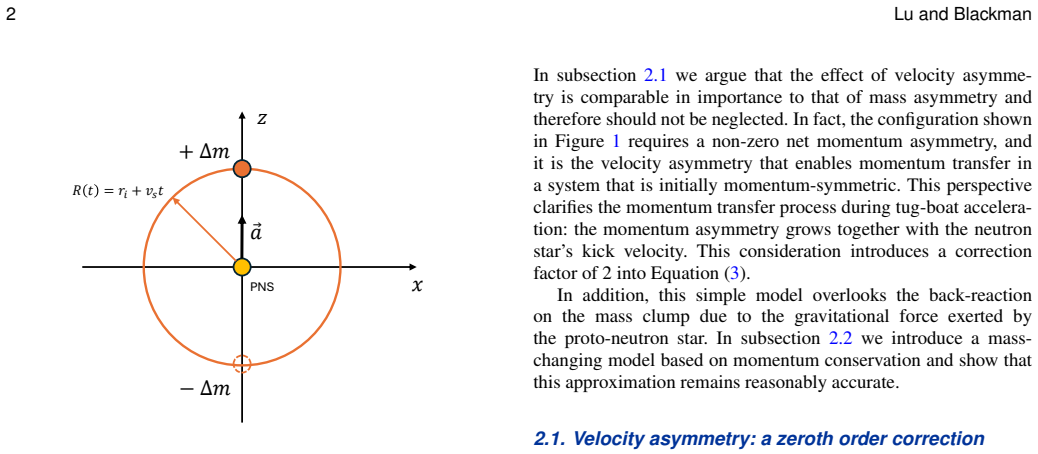
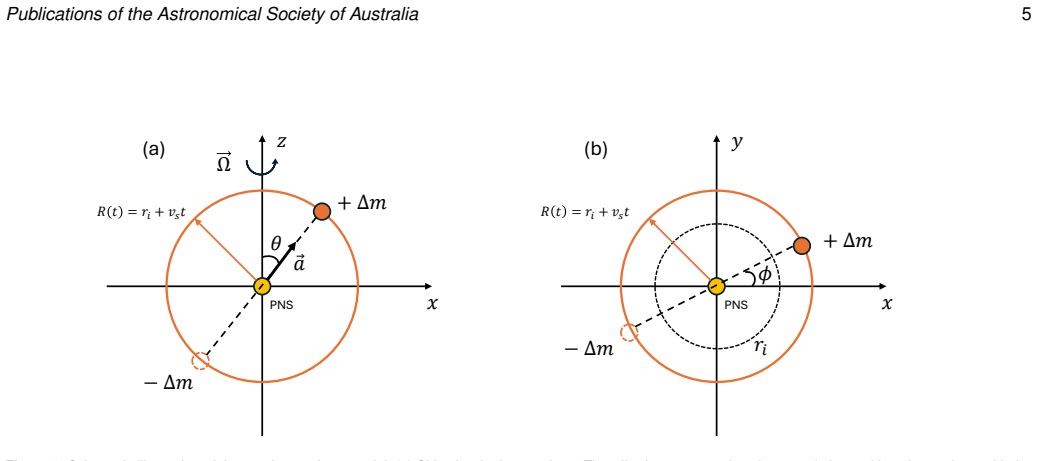
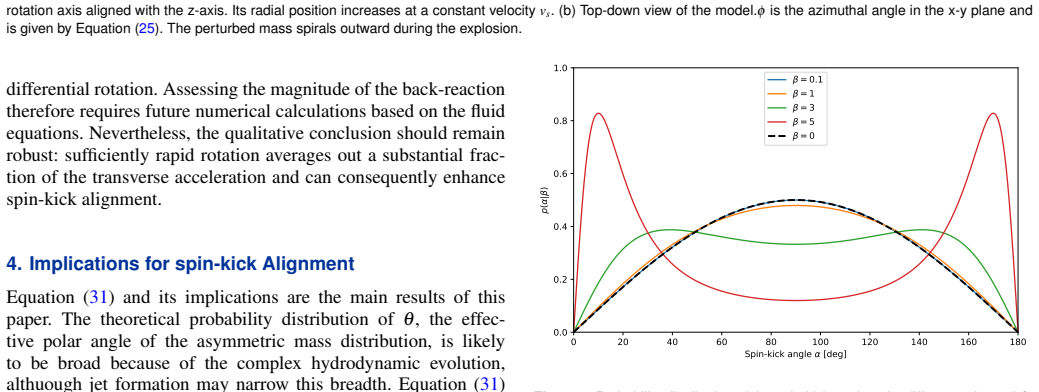
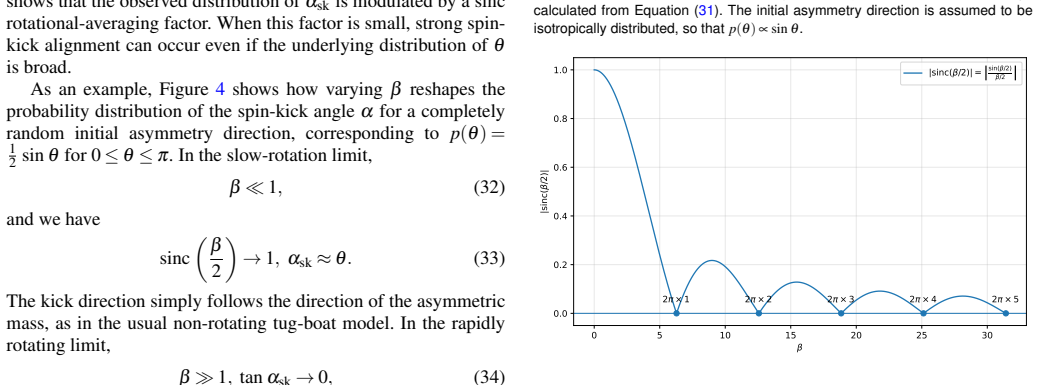
We show that the spin-kick angle is determined by the product of two factors, one that depends on the ratio of shock expansion time to the rotation period and the other which depends on the orientation of the asymmetric mass distribution with respect to the spin-axis. For fast enough rotation, the first factor amounts to axially averaging out non-axisymmetry thereby suppressing the perpendicular tug and leaving only a spin-aligned force. However, the rotation speed required for this effect would be unrealistically large unless magnetic fields could transport angular momentum from the core to the outflow efficiently. Otherwise, spin-kick alignment for the tug-boat mechanism would be more like
What carries the argument
The product of the shock-expansion-time-to-rotation-period ratio and the asymmetry-orientation factor relative to the spin axis, which together determine the spin-kick angle.
If this is right
- Fast rotation suppresses the perpendicular component of the kick through axial averaging of the asymmetry.
- Magnetic angular-momentum transport from core to outflow is required for the averaging mechanism to operate at realistic rotation rates.
- Alignment can instead arise when the mass-flux asymmetry is itself preferentially aligned with the spin axis.
- The model connects progenitor rotation rate and asymmetry orientation to the statistical distribution of observed spin-kick angles.
Where Pith is reading between the lines
- Common spin-kick alignments could constrain the efficiency of magnetic angular-momentum transport during the supernova.
- If alignments persist at slow rotation rates, the mechanism generating the initial mass asymmetry must itself favor the spin axis.
- Full hydrodynamic simulations that include rotation can test whether the minimal model's predictions survive additional physics.
- The same two-factor structure may apply to other asymmetric explosion channels that impart kicks.
Load-bearing premise
The derivation assumes a minimalist extension of the tug-boat model that adds only initial rotation and a possible magnetic angular-momentum transport channel while neglecting hydrodynamical back-reaction, neutrino transport, and further instabilities.
What would settle it
A clear observation of strong spin-kick misalignment in a system with independently measured fast core rotation and no evidence for efficient magnetic transport would falsify the averaging pathway as the primary source of alignment.
Figures
read the original abstract
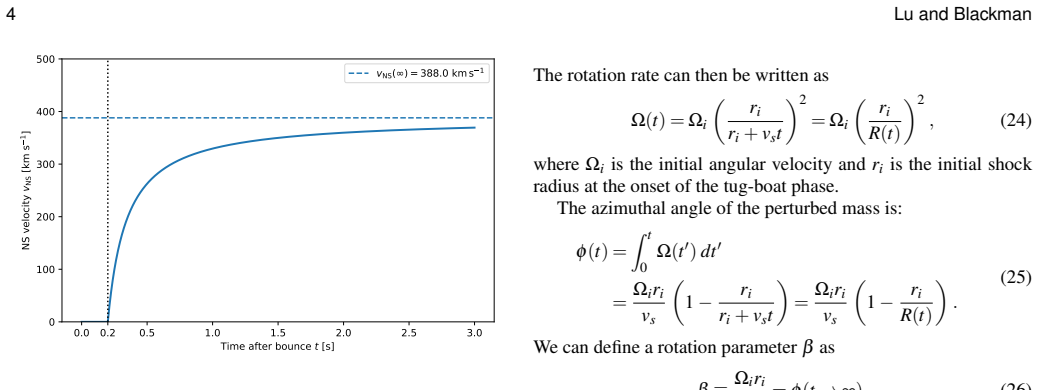
Neutron stars are often born with large recoil velocities, or natal kicks, whose physical origin remains an open question in core-collapse supernova theory. One possible mechanism is the gravitational tug-boat effect, in which anisotropic ejecta gravitationally accelerate the proto-neutron star over a timescale of seconds after shock revival. Observations suggest that the spin-kick angle distribution is not isotropic but skewed toward spin-kick alignment. Previous derivations of the tug-boat mechanism do not include the effect of initial stellar rotation. Here we derive a minimalist extension to assess how rotation of the expanding asymmetric mass distribution influences the spin-kick alignment. We show that the spin-kick angle is determined by the product of two factors, one that depends on the ratio of shock expansion time to the rotation period and the other which depends on the orientation of the asymmetric mass distribution with respect to the spin-axis. For fast enough rotation, the first factor amounts to axially averaging out non-axisymmetry thereby suppressing the perpendicular tug and leaving only a spin-aligned force. However, the rotation speed required for this effect would be unrealistically large unless magnetic fields could transport angular momentum from the core to the outflow efficiently. Otherwise, spin-kick alignment for the tug-boat mechanism would be more likely achieved via the second factor, namely for systems in which the mass flux asymmetry is itself preferentially spin-aligned.
Editorial analysis
A structured set of objections, weighed in public.
Referee Report
Summary. The manuscript derives an analytic factorization for the spin-kick angle in an extended gravitational tug-boat model that includes initial stellar rotation. The angle is expressed as the product of (i) a factor depending on the ratio of shock-expansion time to rotation period, which axially averages non-axisymmetric ejecta for sufficiently rapid rotation and thereby suppresses the perpendicular kick component, and (ii) a geometric factor set by the orientation of the asymmetric mass distribution relative to the spin axis. The authors conclude that realistic alignment would require either unrealistically high core rotation rates or efficient magnetic angular-momentum transport, or else a preferentially spin-aligned mass-flux asymmetry; the model is explicitly minimalist and neglects hydrodynamical back-reaction and non-axisymmetric instabilities.
Significance. If the derivation is correct, the result supplies a transparent, parameter-free analytic limit that isolates how rotation modulates the tug-boat kick and spin-kick alignment. The explicit statement of the minimalist assumptions and the unrealistic rotation speeds required without magnetic transport constitute a clear strength, providing a useful benchmark against which more complete simulations can be compared.
minor comments (2)
- [Abstract / §3] The abstract states that the first factor 'amounts to axially averaging out non-axisymmetry' for fast rotation; an explicit equation or short derivation of this averaging in the main text would make the factorization immediately verifiable.
- [Discussion] The manuscript flags that the required rotation speeds are 'unrealistically large' without magnetic transport; a brief numerical estimate of the critical period (in ms) relative to typical core-collapse timescales would strengthen the claim.
Simulated Author's Rebuttal
We thank the referee for the supportive summary, recognition of the analytic result as a useful benchmark, and recommendation of minor revision. No specific major comments were provided in the report.
Circularity Check
No significant circularity; derivation is self-contained
full rationale
The paper presents an analytical derivation extending the tug-boat model to include rotation, showing the spin-kick angle factors as the product of a shock-expansion-to-rotation-period ratio term and an orientation term. No equations, steps, or claims reduce by construction to fitted parameters, self-definitions, or load-bearing self-citations. The result follows from the stated minimalist assumptions without renaming known results or smuggling ansatzes. This is the normal case of a self-contained first-principles extension.
Axiom & Free-Parameter Ledger
axioms (2)
- domain assumption The gravitational tug-boat mechanism operates over a timescale of seconds after shock revival
- domain assumption Observations indicate that the spin-kick angle distribution is skewed toward alignment
Reference graph
Works this paper leans on
-
[1]
doi: 10.1093/mnras/stz990. H. Andresen, R. Glas, and H.-Th Janka. Gravitational-wave signals from 3D supernova simulations with different neutrino-transport methods.MNRAS, 503(3):3552–3567, May
-
[2]
doi: 10.1093/mnras/stab675. Z. Arzoumanian, D. F. Chernoff, and J. M. Cordes. The Velocity Distribution of Isolated Radio Pulsars.ApJ, 568(1):289–301, March
-
[3]
doi: 10.1017/pasa.2025.10069. John M. Blondin and Samantha Shaw. Linear Growth of Spiral SASI Modes in Core-Collapse Supernovae.ApJ, 656(1):366–371, February
-
[4]
doi: 10.1086/510614. John M. Blondin, Anthony Mezzacappa, and Christine DeMarino. Stability of Standing Accretion Shocks, with an Eye toward Core-Collapse Supernovae. ApJ, 584(2):971–980, February
-
[5]
doi: 10.1086/345812. G. Hobbs, D. R. Lorimer, A. G. Lyne, and M. Kramer. A statistical study of 233 pulsar proper motions.MNRAS, 360(3):974–992, July
-
[6]
doi: 10.1111/j.1365-2966.2005.09087.x. H.-T. Janka and E. Mueller. Neutron star recoils from anisotropic supernovae. A&A, 290:496–502, October
-
[7]
doi: 10.1111/j.1365-2966. 2005.09669.x. R´emi Kazeroni, J ´erˆome Guilet, and Thierry Foglizzo. Are pulsars spun up or down by SASI spiral modes?MNRAS, 471(1):914–925, October
-
[8]
doi: 10.1093/mnras/stx1566. Ilya A. Kondratyev, Sergey G. Moiseenko, and Gennady S. Bisnovatyi-Kogan. Magnetorotational neutron star kicks.Phys. Rev. D, 110:083025, Oct
-
[9]
URL https://link.aps.org/doi/10.1103/ PhysRevD.110.083025
doi: 10.1103/PhysRevD.110.083025. URL https://link.aps.org/doi/10.1103/ PhysRevD.110.083025. Dong Lai and Yong-Zhong Qian. Neutrino Transport in Strongly Magnetized Proto-Neutron Stars and the Origin of Pulsar Kicks: The Effect of Asymmetric Magnetic Field Topology.ApJ, 505(2):844–853, October
-
[10]
doi: 10.1086/306203. C.-Y . Ng and Roger W. Romani. Birth Kick Distributions and the Spin-Kick Correlation of Young Pulsars.ApJ, 660(2):1357–1374, May
-
[11]
doi: 10.1086/513597. J. Nordhaus, T. D. Brandt, A. Burrows, and A. Almgren. The hydrodynamic origin of neutron star kicks.MNRAS, 423(2):1805–1812, June
-
[12]
doi: 10.1111/j.1365-2966.2012.21002.x. A. Noutsos, M. Kramer, P. Carr, and S. Johnston. Pulsar spin-velocity align- ment: further results and discussion.MNRAS, 423(3):2736–2752, July
-
[13]
doi: 10.1111/j.1365-2966.2012.20768.x
doi: 10.1111/j.1365-2966.2012.21083.x. Jade Powell, Bernhard M ¨uller, David R. Aguilera-Dena, and Norbert Langer. Three dimensional magnetorotational core-collapse supernova explosions of a 39 solar mass progenitor star.MNRAS, 522(4):6070–6086, July
-
[14]
doi: 10.1093/mnras/stad1292. L. Scheck, K. Kifonidis, H.-Th. Janka, and E. M¨uller. Multidimensional super- nova simulations with approximative neutrino transport. I. Neutron star kicks and the anisotropy of neutrino-driven explosions in two spatial dimen- sions.A&A, 457(3):963–986, October
-
[15]
Swapnil Shankar, Philipp M ¨osta, Roland Haas, and Erik Schnetter
doi: 10.1051/0004-6361: 20064855. Swapnil Shankar, Philipp M ¨osta, Roland Haas, and Erik Schnetter. 3d full- gr simulations of magnetorotational core-collapse supernovae on gpus: a systematic study of rotation rates and magnetic fields.Monthly Notices of the Royal Astronomical Society, 548(2):stag646, 05
-
[16]
ISSN 0035-8711. doi: 10.1093/mnras/stag646. URL https://doi.org/10.1093/mnras/stag646. H. Spruit and E. S. Phinney. Birth kicks as the origin of pulsar rotation.Nature, 393(6681):139–141, May
-
[17]
doi: 10.1038/30168. A. Wongwathanarat, H.-Th. Janka, and E. M¨uller. Three-dimensional neutrino- driven supernovae: Neutron star kicks, spins, and asymmetric ejection of nucleosynthesis products.A&A, 552:A126, April
discussion (0)
Sign in with ORCID, Apple, or X to comment. Anyone can read and Pith papers without signing in.