Optical spectroscopy of Bose-Einstein condensates at finite temperature
Pith reviewed 2026-06-25 21:57 UTC · model grok-4.3
The pith
Spectroscopy of ultracold rubidium gases separates thermal atoms from the condensate and detects small thermal fractions with higher sensitivity than time-of-flight imaging.
A machine-rendered reading of the paper's core claim, the machinery that carries it, and where it could break.
Core claim
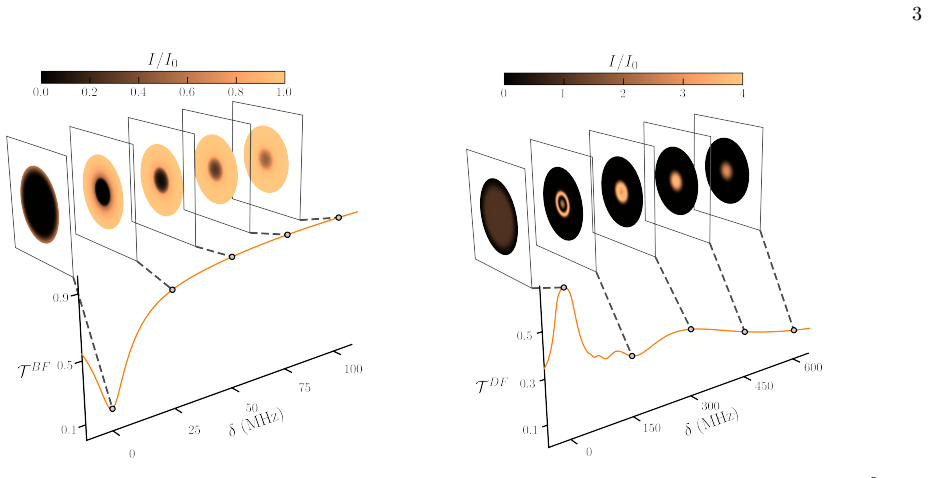
Distinct spectral features arise from the thermal and condensed components of ultracold 87Rb gases. A model for light propagation through an inhomogeneous cloud converts the observed spectra into extracted values of temperature and atom number. These extracted parameters match those obtained by time-of-flight absorption imaging but exhibit enhanced sensitivity to small thermal fractions in nearly pure condensates. Dark-field spectroscopy outperforms bright-field spectroscopy for the same clouds.
What carries the argument
The model for light propagation through an inhomogeneous atomic cloud that interprets the observed spectra to extract temperature and atom number.
If this is right
- Temperature and atom number become measurable in situ without releasing the cloud from the trap.
- Small thermal fractions become detectable in condensates that are otherwise nearly pure.
- Dark-field detection gives superior signal quality compared with bright-field detection in optically dense samples.
- Previously unseen spectral structure appears in the frequency response of dense ultracold gases.
Where Pith is reading between the lines
- The method may allow repeated, low-disturbance checks on the same condensate during experiments.
- It could be adapted to monitor condensate growth or decay in real time inside the trap.
- Similar spectral separation might appear in other bosonic or fermionic gases when probed at comparable optical densities.
Load-bearing premise
The light propagation model correctly converts the measured spectra into accurate values for temperature and atom number.
What would settle it
A set of clouds measured by both spectroscopy and time-of-flight imaging where the temperatures or atom numbers extracted from the spectra deviate systematically from the imaging results.
Figures
read the original abstract
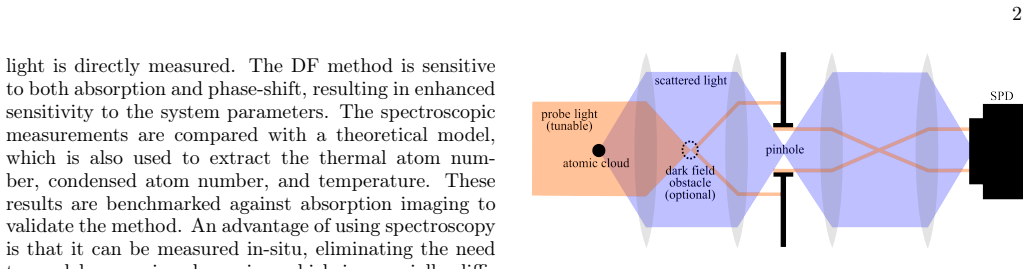
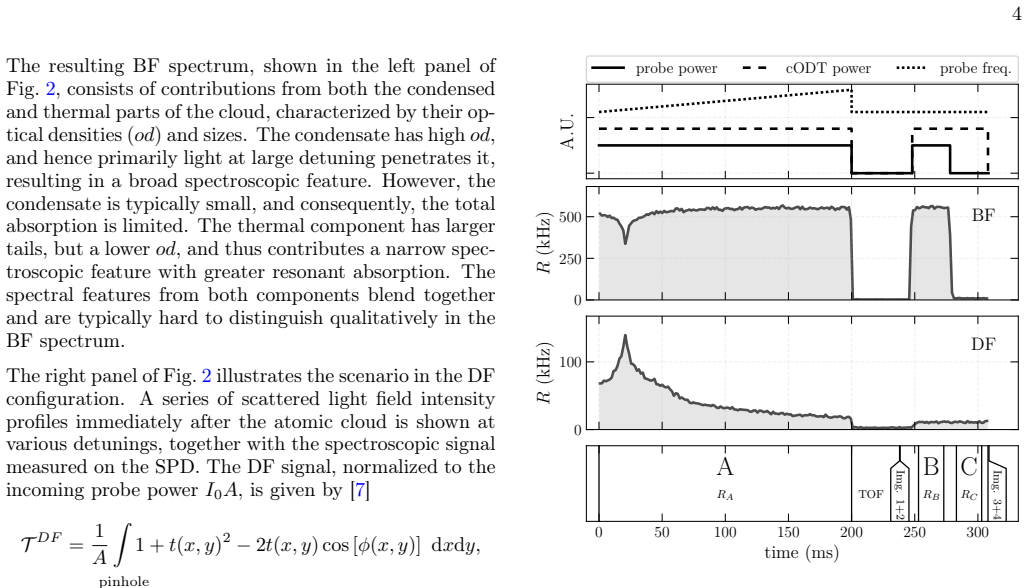
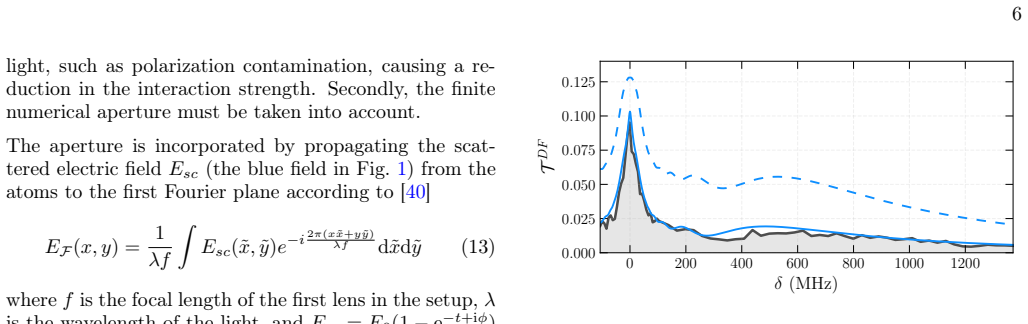
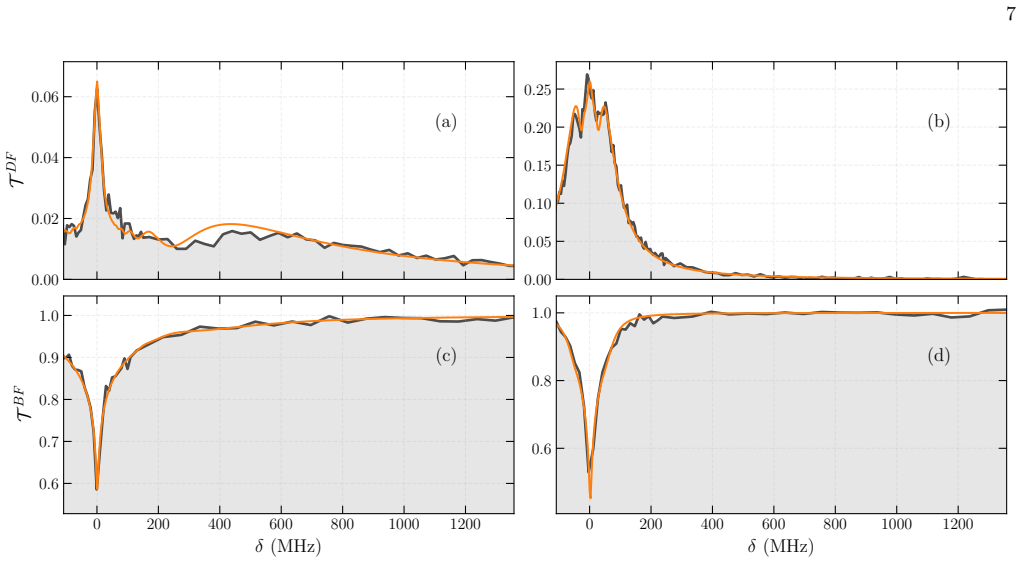
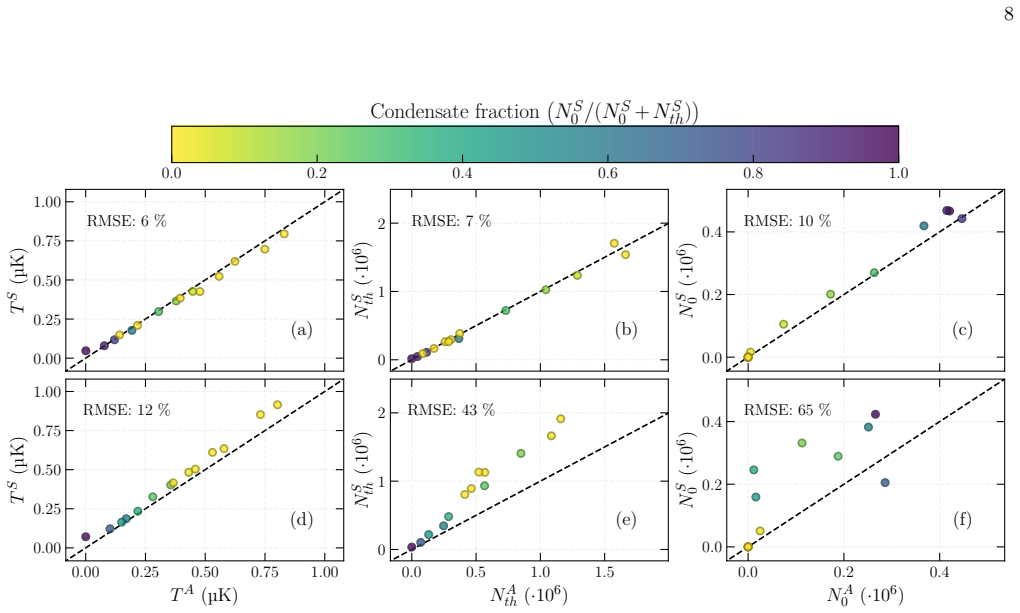
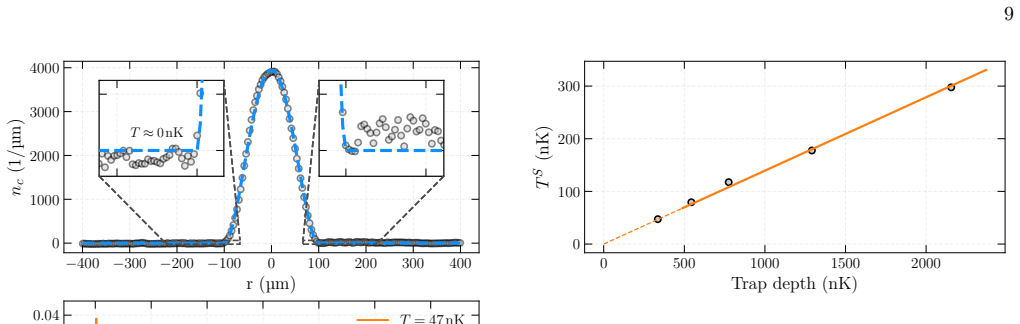
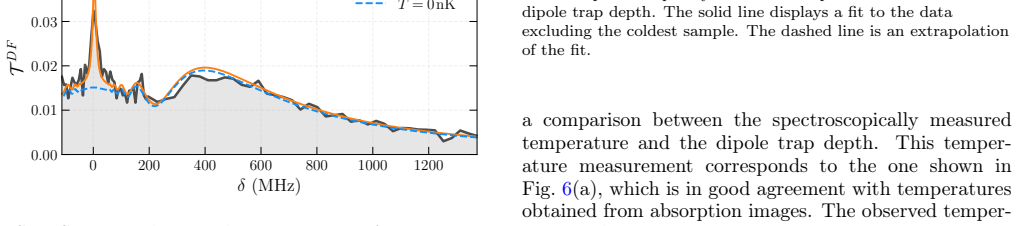
We report on optical spectroscopic measurements of ultracold and partially condensed 87Rb gases, which show distinct spectral features due to the thermal and the Bose condensed components in the frequency domain. These features are detected in-situ by using a dark-field configuration with single-photon sensitivity and a frequency-agile laser system. To interpret the observed spectra, we develop a model for light propagation through an inhomogeneous atomic cloud. This model enables the extraction of temperature and atom number, which we benchmark against conventional time-of-flight absorption imaging. The spectroscopically obtained cloud parameters show enhanced sensitivity to small thermal fractions in nearly pure condensates. We further compare the spectroscopy in dark-field and bright-field configurations, demonstrating the superior performance of the former. Our results reveal previously unexplored spectral structure in optically dense ultracold gases and establish spectroscopy as a tool for characterizing ultracold systems at very low temperatures.
Editorial analysis
A structured set of objections, weighed in public.
Referee Report
Summary. The manuscript reports optical spectroscopic measurements of partially condensed 87Rb gases in a dark-field single-photon-sensitive configuration, identifying distinct frequency-domain spectral features from thermal and Bose-condensed components. A model for light propagation through an inhomogeneous atomic cloud is developed to extract temperature and atom number; these parameters are benchmarked against conventional time-of-flight absorption imaging. The work claims enhanced sensitivity of the spectroscopic method to small thermal fractions in nearly pure condensates and demonstrates superior performance of dark-field over bright-field configurations.
Significance. If the benchmarking holds, the result establishes in-situ optical spectroscopy as a viable high-sensitivity tool for characterizing ultracold gases at very low temperatures where thermal fractions are small, complementing time-of-flight methods and revealing previously unexplored spectral structure in optically dense samples.
minor comments (2)
- [Abstract] Abstract: the statement that spectroscopically obtained parameters 'show enhanced sensitivity' is not accompanied by any quantitative metric (e.g., a factor by which thermal-fraction uncertainty is reduced); adding a specific comparison would make the central claim immediately verifiable from the summary.
- The model for light propagation is described only at a high level in the abstract; the manuscript should explicitly state the key approximations (e.g., treatment of inhomogeneous density, Doppler broadening, or optical depth) and any free parameters in a dedicated methods or theory section so that the extraction procedure can be reproduced.
Simulated Author's Rebuttal
We thank the referee for the positive assessment of our manuscript, the accurate summary of our results, and the recommendation for minor revision. The report correctly identifies the key contributions regarding dark-field spectroscopy for distinguishing thermal and condensed fractions in situ.
Circularity Check
No significant circularity; model validated externally
full rationale
The paper develops a light-propagation model to interpret spectra and extract T and N, then directly benchmarks those extracted values against independent time-of-flight absorption imaging. No derivation step reduces by construction to a fitted input, self-citation, or renamed ansatz; the claimed sensitivity advantage is presented as an empirical outcome of that comparison. The approach is self-contained against external benchmarks.
Axiom & Free-Parameter Ledger
Reference graph
Works this paper leans on
-
[1]
C. J. Pethick and H. Smith,Bose-Einstein condensation in dilute gases, 2nd ed. (Cambridge, 2008)
2008
-
[2]
L. P. Pitaevskii and S. Stringari,Bose-Einstein Conden- sation, International Series of Monographs on Physics (Oxford, New York, 2003)
2003
-
[3]
Bloch, J
I. Bloch, J. Dalibard, and W. Zwerger, Many-body physics with ultracold gases, Rev. Mod. Phys.80, 885 (2008)
2008
-
[4]
Pitaevskii and S
L. Pitaevskii and S. Stringari,Bose-Einstein Condensa- tion and Superfluidity(Oxford University Press, 2016)
2016
-
[5]
L. Wolswijk, L. Cavicchioli, G. Vinelli, M. Chiarotti, L. Donati, M. F. Fernandez, D. H. Rajkov, C. Mancini, P. Vezio, T. Zhou, G. D. Pace, C. Mazzinghi, N. Antolini, L. Salvi, and V. Gavryusev, Trapping, manipulating and probingultracoldatoms: aquantumtechnologiestutorial (2025), arXiv:2510.20790 [cond-mat.quant-gas]
arXiv 2025
-
[6]
Vibel, M
T. Vibel, M. B. Christensen, M. A. Kristensen, J. J. Thuesen, L. N. Stokholm, C. A. Weidner, and J. J. Arlt, Spatial calibration of high-density absorption imaging, J. Phys. B57, 145301 (2024)
2024
-
[7]
Ketterle, D
W. Ketterle, D. S. Durfee, and D. M. Stamper-Kurn, Making, probing and understanding Bose-Einstein con- densates (1999)
1999
-
[8]
Reinaudi, T
G. Reinaudi, T. Lahaye, Z. Wang, and D. Guéry-Odelin, Strong saturation absorption imaging of dense clouds of ultracold atoms, Opt. Lett.32, 3143 (2007)
2007
-
[9]
Pappa, P
M. Pappa, P. C. Condylis, G. O. Konstantinidis, V. Bol- pasi, A. Lazoudis, O. Morizot, D. Sahagun, M. Baker, and W. von Klitzing, Ultra-sensitive atom imaging for matter-wave optics, New J. Phys.13, 115012 (2011)
2011
-
[10]
Reinhard, J.-F
A. Reinhard, J.-F. Riou, L. A. Zundel, and D. S. Weiss, Dark-ground imaging of high optical thickness atom clouds, Opt. Commun.324, 30 (2014)
2014
-
[11]
M. R. Andrews, M.-O. Mewes, N. J. van Druten, D. S. Durfee, D. M. Kurn, and W. Ketterle, Direct, nonde- structive observation of a Bose condensate, Science273, 84 (1996)
1996
-
[12]
C. C. Bradley, C. A. Sackett, and R. G. Hulet, Bose- Einstein condensation of lithium: Observation of limited condensate number, Phys. Rev. Lett.78, 985 (1997)
1997
-
[13]
Gajdacz, P
M. Gajdacz, P. L. Pedersen, T. Mørch, A. J. Hilliard, J.Arlt,andJ.F.Sherson,Non-destructiveFaradayimag- ing of dynamically controlled ultracold atoms, Rev. of Scient. Inst.84, 083105 (2013)
2013
-
[14]
A. E. Leanhardt, T. A. Pasquini, M. Saba, A. Schirotzek, Y. Shin, D. Kielpinski, D. E. Pritchard, and W. Ketterle, Cooling Bose-Einstein Condensates below 500 picokelvin, Science301, 1513 (2003)
2003
-
[15]
N.Gaaloul, M.Meister, R.Corgier, A.Pichery, P.Boegel, W. Herr, H. Ahlers, E. Charron, J. R. Williams, R. J. Thompson, W. P. Schleich, E. M. Rasel, and N. P. Bigelow, A space-based quantum gas laboratory at pi- cokelvin energy scales, Nature Communications13, 7889 (2022)
2022
-
[16]
Hohmann, F
M. Hohmann, F. Kindermann, T. Lausch, D. Mayer, F. Schmidt, and A. Widera, Single-atom thermometer for ultracold gases, Phys. Rev. A93, 043607 (2016). 11
2016
-
[17]
R. Olf, F. Fang, G. E. Marti, A. MacRae, and D. M. Stamper-Kurn, Thermometry and cooling of a Bose gas to 0.02 times the condensation temperature, Nature Physics11, 720 (2015)
2015
-
[18]
Gerbier, J
F. Gerbier, J. H. Thywissen, S. Richard, M. Hugbart, P. Bouyer, and A. Aspect, Experimental study of the thermodynamics of an interacting trapped Bose-Einstein condensed gas, Phys. Rev. A70, 013607 (2004)
2004
-
[19]
D. G. Fried, T. C. Killian, L. Willmann, D. Landhuis, S. C. Moss, D. Kleppner, and T. J. Greytak, Bose- Einstein condensation of atomic hydrogen, Phys. Rev. Lett.81, 3811 (1998)
1998
-
[20]
T. Ido, T. H. Loftus, M. M. Boyd, A. D. Ludlow, K. W. Holman, and J. Ye, Precision spectroscopy and density- dependent frequency shifts in ultracold Sr, Phys. Rev. Lett.94, 153001 (2005)
2005
-
[21]
Jennewein, M
S. Jennewein, M. Besbes, N. J. Schilder, S. D. Jenkins, C. Sauvan, J. Ruostekoski, J.-J. Greffet, Y. R. P. Sortais, and A. Browaeys, Coherent scattering of near-resonant light by a dense microscopic cold atomic cloud, Phys. Rev. Lett.116, 233601 (2016)
2016
-
[22]
Pellegrino, R
J. Pellegrino, R. Bourgain, S. Jennewein, Y. R. P. Sor- tais, A. Browaeys, S. D. Jenkins, and J. Ruostekoski, Observation of suppression of light scattering induced by dipole-dipole interactions in a cold-atom ensemble, Phys. Rev. Lett.113, 133602 (2014)
2014
-
[23]
L. V. Hau, S. E. Harris, Z. Dutton, and C. H. Behroozi, Light speed reduction to 17 metres per second in an ul- tracold atomic gas, Nature397, 594 (1999)
1999
-
[24]
Rastogi, E
A. Rastogi, E. Saglamyurek, T. Hrushevskyi, S. Hubele, and L. J. LeBlanc, Discerning quantum memories based onelectromagnetically-induced-transparencyandAutler- Townes-splitting protocols, Phys. Rev. A100, 012314 (2019)
2019
-
[25]
Peters, B
T. Peters, B. Wittrock, F. Blatt, T. Halfmann, and L. P. Yatsenko, Thermometry of ultracold atoms by electro- magnetically induced transparency, Phys. Rev. A85, 063416 (2012)
2012
-
[26]
R. M. F. Andersen, S. Frederiksen, L. Stokholm, I. Ze- bergs, M. Kristensen, C. A. Weidner, and J. J. Arlt, Cloud parameter estimation for interacting BEC after time-of-flight, J. Phys. B59, 095502 (2026)
2026
-
[27]
Andersen,Spectrally Probing Ultra-Cold Bosonic Clouds, Ph.D
M. Andersen,Spectrally Probing Ultra-Cold Bosonic Clouds, Ph.D. thesis, Aarhus University (2025)
2025
-
[28]
Stokholm,Real-Time Quantum Sensing in Rubidium: Few-Photon Probing of Ultracold Gases and Rydberg Mi- crowave Polarimetry, Ph.D
L. Stokholm,Real-Time Quantum Sensing in Rubidium: Few-Photon Probing of Ultracold Gases and Rydberg Mi- crowave Polarimetry, Ph.D. thesis, Aarhus University (2026)
2026
-
[29]
Appel, A
J. Appel, A. MacRae, and A. I. Lvovsky, A versatile digi- tal GHz phase lock for external cavity diode lasers, Meas. Scien. and Tech.20, 055302 (2009)
2009
-
[30]
J. D. Jackson,Classical Electrodynamics, 3rd ed. (John Wiley & Sons, New York, 1999)
1999
-
[31]
Meppelink, R
R. Meppelink, R. A. Rozendaal, S. B. Koller, J. M. Vo- gels, and P. van der Straten, Thermodynamics of Bose- Einstein-condensed clouds using phase-contrast imaging, Phys. Rev. A81, 053632 (2010)
2010
-
[32]
R. W. Boyd, Chapter 6 - nonlinear optics in the two-level approximation, inNonlinear Optics(Academic Press, Burlington, 2008) 3rd ed., pp. 277–328
2008
-
[33]
Konstantinou, Y
K. Konstantinou, Y. Zhang, P. H. C. Wong, F. Wang, Y.-K. Lu, N. Dogra, C. Eigen, T. Satoor, W. Ket- terle, and Z. Hadzibabic, Suppression and enhancement of bosonic stimulation by atomic interactions, Nat. Phys. 22, 362–366 (2026)
2026
-
[34]
Morice, Y
O. Morice, Y. Castin, and J. Dalibard, Refractive index of a dilute Bose gas, Phys. Rev. A51, 3896 (1995)
1995
-
[35]
P. C. Bons, R. de Haas, D. de Jong, A. Groot, and P. van der Straten, Quantum enhancement of the index of refraction in a Bose-Einstein condensate, Phys. Rev. Lett.116, 173602 (2016)
2016
-
[36]
Y.-K. Lu, Y. Margalit, and W. Ketterle, Bosonic stimula- tion of atom–light scattering in an ultracold gas, Nature Physics19, 210 (2023)
2023
-
[37]
Maiwöger, M
M. Maiwöger, M. Sonnleitner, T. Zhang, I. Mazets, M.Mallweger, D.Rätzel, F.Borselli, S.Erne, J.Schmied- mayer, and P. Haslinger, Observation of light-induced dipole-dipole forces in ultracold atomic gases, Phys. Rev. X12, 031018 (2022)
2022
-
[38]
Naraschewski and D
M. Naraschewski and D. M. Stamper-Kurn, Analytical description of a trapped semi-ideal Bose gas at finite tem- perature, Phys. Rev. A58, 2423 (1998)
1998
-
[39]
A. B. Deb, J. Chung, and N. Kjærgaard, Dispersive de- tectionofatomicensemblesinthepresenceofstronglens- ing, New J. Phys.22, 073017 (2020)
2020
-
[40]
J. W. Goodman,Introduction to Fourier Optics, 2nd ed. (McGraw-Hill, 1998)
1998
discussion (0)
Sign in with ORCID, Apple, or X to comment. Anyone can read and Pith papers without signing in.