AegisTS: A Hierarchical Agent System with Reinforcement Learning for Multivariate Time Series Data Cleaning
Pith reviewed 2026-05-08 16:21 UTC · model grok-4.3
The pith
A hierarchical reinforcement learning agent system can jointly optimize the processing order and method selection to clean multiple quality issues in multivariate time series data without needing ground truth.
A machine-rendered reading of the paper's core claim, the machinery that carries it, and where it could break.
Core claim
The paper establishes that framing multivariate time series cleaning as a joint optimization of issue order and cleaning model selection, solved through a hierarchical agent architecture with a dual-stage reward that couples cleaning quality and downstream performance, enables effective navigation of the cleaning pipeline space and superior results compared to existing limited-scope methods.
What carries the argument
The hierarchical agent architecture, consisting of a high-level agent that determines the order for processing data quality issues and a low-level agent that selects appropriate cleaning methods for each, directed by a dual-stage reward mechanism linking upstream cleaning to downstream analytics performance.
If this is right
- The system can manage co-occurring issues such as missing values, outliers, and constraint violations in a single pipeline.
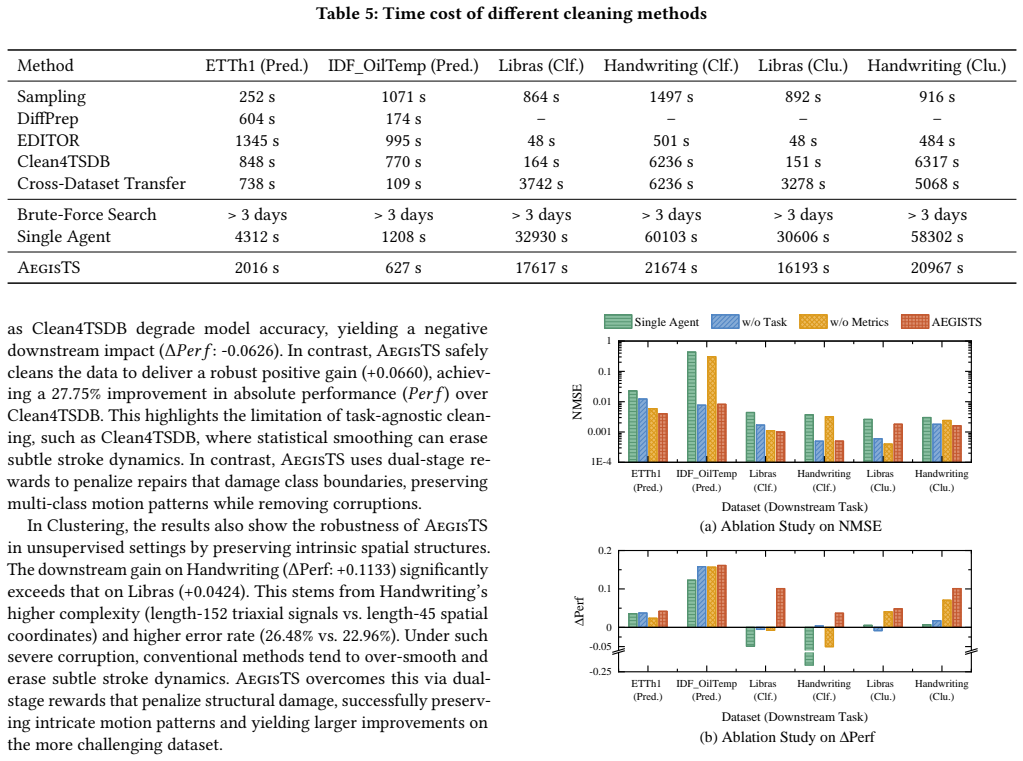
- Cleaning quality improves by up to 96% and downstream task performance by up to 27% over prior methods.
- Optimization proceeds without ground truth data or domain-specific rules, making it suitable for practical applications.
- Joint decision-making on order and methods allows efficient exploration of many possible cleaning sequences.
Where Pith is reading between the lines
- Similar hierarchical decision structures might apply to cleaning other data formats like images or text.
- Emphasizing end-task performance in rewards could become standard for designing unsupervised data improvement systems.
- Future work could test the approach on streaming time series where issues arise dynamically.
Load-bearing premise
The dual-stage reward mechanism can reliably guide the hierarchical agents toward optimal cleaning pipelines even when no ground truth data is available.
What would settle it
Running the system on a benchmark dataset with available ground truth and observing that its cleaning quality or downstream improvements do not exceed those of methods that use the ground truth for supervision.
Figures




read the original abstract
Multivariate time series (MTS) are frequently affected by co-occurring quality issues, such as missing values, outliers, and constraint violations, which significantly undermine downstream analytics. Existing cleaning approaches fix only a limited set of such issues, making them ill-suited for scenarios where multiple quality problems arise simultaneously. Furthermore, these methods commonly depend on the availability of ground truth data or domain-specific rules, both of which are rarely accessible in real-world applications. In this paper, we introduce AegisTS, an agent system with reinforcement learning designed to clean multiple data quality issues in MTS. We cast the cleaning process as a joint optimization problem that simultaneously handles quality issue order and cleaning model selection, allowing efficient navigation of the large space of possible cleaning pipelines. Our framework relies on a hierarchical agent architecture, where a high-level agent determines the order in which data quality issues should be processed, while a low-level agent identifies the most suitable cleaning method for each issue. To guide the agent toward an optimal cleaning pipeline, we propose a dual-stage reward mechanism that couples upstream (cleaning) and downstream performance, enabling effective optimization without relying on ground truth. Our experimental results show that AegisTS consistently outperforms existing methods, achieving up to 96% improvement in data cleaning quality and 27% improvement in downstream performance.
Editorial analysis
A structured set of objections, weighed in public.
Referee Report
Summary. The paper proposes AegisTS, a hierarchical reinforcement learning agent system for cleaning multivariate time series data affected by co-occurring issues such as missing values, outliers, and constraint violations. It models the problem as joint optimization over issue processing order (high-level agent) and method selection (low-level agent), guided by a dual-stage reward that combines upstream cleaning signals with downstream task performance to enable optimization without ground truth. Experiments are reported to show consistent outperformance, with up to 96% gains in cleaning quality and 27% in downstream performance.
Significance. If the dual-stage reward reliably proxies true cleaning quality and the reported gains prove robust across datasets and baselines, the work could advance automated, ground-truth-free cleaning pipelines for complex MTS, with applications in sensor networks, finance, and IoT where multiple quality issues co-occur and manual rules are unavailable. The hierarchical RL framing provides a principled way to search large pipeline spaces.
major comments (2)
- [Abstract and §4 (Experiments)] Abstract and experimental evaluation: the central claim of up to 96% cleaning-quality and 27% downstream improvement rests on the dual-stage reward guiding agents to superior pipelines, yet no information is supplied on the datasets used, the baselines compared, the statistical significance tests performed, or the precise formulation and weighting of the upstream proxy component of the reward. This prevents evaluation of whether the upstream signal actually correlates with true quality metrics on data with injected errors.
- [Methodology (dual-stage reward)] The dual-stage reward mechanism (described in the abstract and methodology): the upstream component is asserted to serve as a reliable proxy for cleaning quality (missing values, outliers, constraints) without ground truth, but the manuscript provides no controlled validation—e.g., on synthetic MTS with known injected errors—showing that proxy scores correlate with actual post-cleaning quality or downstream gains. If this correlation is weak, the joint optimization over order and method selection will optimize for the proxy rather than real quality, undermining the reported improvements.
minor comments (1)
- [Abstract] The abstract claims 'consistent outperformance' but does not name the specific existing methods used as baselines; adding this list would improve clarity.
Simulated Author's Rebuttal
We thank the referee for the constructive and detailed feedback. We address each major comment below and commit to revisions that will improve clarity and provide the requested validation.
read point-by-point responses
-
Referee: [Abstract and §4 (Experiments)] Abstract and experimental evaluation: the central claim of up to 96% cleaning-quality and 27% downstream improvement rests on the dual-stage reward guiding agents to superior pipelines, yet no information is supplied on the datasets used, the baselines compared, the statistical significance tests performed, or the precise formulation and weighting of the upstream proxy component of the reward. This prevents evaluation of whether the upstream signal actually correlates with true quality metrics on data with injected errors.
Authors: We agree that greater transparency is needed for independent evaluation. In the revised manuscript we will expand the abstract to summarize the datasets (both real-world sensor and financial MTS as well as synthetic series with controlled co-occurring errors), list the full set of baselines, and report statistical significance (paired t-tests with p-values). We will also move the exact mathematical definition of the upstream proxy—including its component scores for missing-value imputation, outlier detection, and constraint satisfaction together with the weighting coefficients—into the main methodology section and add a short correlation analysis between proxy values and ground-truth quality metrics on held-out data. revision: yes
-
Referee: [Methodology (dual-stage reward)] The dual-stage reward mechanism (described in the abstract and methodology): the upstream component is asserted to serve as a reliable proxy for cleaning quality (missing values, outliers, constraints) without ground truth, but the manuscript provides no controlled validation—e.g., on synthetic MTS with known injected errors—showing that proxy scores correlate with actual post-cleaning quality or downstream gains. If this correlation is weak, the joint optimization over order and method selection will optimize for the proxy rather than real quality, undermining the reported improvements.
Authors: We acknowledge that an explicit controlled validation of the upstream proxy would strengthen the central claim. Although the current experiments already compare the dual-stage reward against single-stage variants and show consistent gains in both cleaning metrics and downstream performance, we did not include a dedicated synthetic-data study. We will add such experiments in the revision: synthetic MTS will be generated with known injected missing values, outliers, and constraint violations; the upstream proxy will be computed without access to ground truth; and we will report Pearson/Spearman correlations between proxy scores and both true post-cleaning quality and downstream task improvement. These results will be presented in a new subsection of the experimental evaluation. revision: yes
Circularity Check
No circularity: hierarchical RL design and dual-stage reward are independent proposals validated by external experiments
full rationale
The paper presents AegisTS as a proposed hierarchical agent architecture with a dual-stage reward that explicitly incorporates downstream task performance as an external optimization signal, without ground truth. No equations, self-definitions, or fitted parameters are shown reducing the claimed cleaning quality or downstream gains to the inputs by construction. The reported improvements (up to 96% and 27%) are framed as empirical comparisons against existing methods rather than derived predictions. The framework relies on standard RL components and external benchmarks, making the central claims self-contained against falsifiable experiments rather than tautological.
Axiom & Free-Parameter Ledger
axioms (1)
- domain assumption A dual-stage reward that combines cleaning quality and downstream task performance can guide agents to optimal pipelines without ground truth data.
discussion (0)
Sign in with ORCID, Apple, or X to comment. Anyone can read and Pith papers without signing in.