REVIEW 2 major objections 5 minor 57 references
Diagnosing the AGN population origin of TeV neutrinos with their spatial correlation
T0 review · 2 major / 5 minor · reviewed 2026-08-03 · deepseek-v4-flash
Pith's one-line read The paper forecasts that a 30 km³ underwater neutrino telescope with ~0.04° angular resolution can confirm or refute an AGN origin of diffuse TeV neutrinos at 8.7σ within one year.
desk verdict A useful, internally consistent forecast of when future neutrino telescopes can test the AGN-origin hypothesis, but the headline significance rests on a linear neutrino-X-ray scaling that the data don't yet justify. read the letter →
The pith
A machine-rendered reading of the paper's core claim, the machinery that carries it, and where it could break.
The reading
What carries the argument
The central machinery is an unbinned maximum-likelihood stacking analysis: each neutrino event is assigned a signal probability that is a sum of Gaussians centred on catalogued AGNs, weighted by the AGN's X-ray flux, and the significance is the likelihood ratio against an isotropic background. The method's reliability hinges on a source-confusion criterion derived from simulations: the mean angular separation of the selected AGN subset must be at least three times the detector's point-spread function (d̄ ≥ 3σ_psf). This criterion sets the X-ray flux threshold, which in turn controls how much of the AGN population must be accounted for by an X-ray luminosity function extrapolation.
What would settle it
Compare the likelihood-ratio test statistic from the first year of HUNT data above 300 TeV (in the 142 deg² eFEDS field or a wider X-ray survey) with the predicted ~8.7σ. If the observed TS corresponds to less than ~3σ, then either AGNs contribute <17% of the astrophysical neutrino flux or the linear X-ray-flux weighting is wrong. A more direct test: measure the flux-weighting index s by fitting the signal PDF with free s; s consistent with 0 would falsify the linear-correlation assumption.
Extended reading notes
Core claim
The paper's central claim is that the AGN origin of the diffuse astrophysical neutrino flux is diagnosable by spatial correlation, and that the diagnostic power is set by the detector's point-spread function rather than by its size alone. Using a flux-weighted unbinned likelihood analysis applied to the eFEDS AGN catalog, the authors simulate the expected test statistic under the hypothesis that all astrophysical neutrinos above a few hundred TeV come from AGNs with neutrino luminosity ∝ X-ray flux. They find that a 30 km³ underwater telescope achieving ~0.04° resolution above 300 TeV would yield ~8.7σ significance in one year (rising to ~19σ in five years), whereas IceCube-Gen2 with ~0.2° r
Load-bearing premise
The forecast assumes that an AGN's neutrino luminosity scales linearly with its X-ray flux (Nν ∝ F_X); if the true correlation is weaker or absent, the 8.7σ and 3.1σ significances collapse toward ~2σ.
Editorial extensions
If this is right
- With one year of HUNT-like exposure above 300 TeV, the AGN-origin hypothesis can be confirmed or excluded at ~8.7σ, given α=1 and linear X-ray flux scaling.
- IceCube-Gen2's five-year reach (~3.1σ) is insufficient for a decisive test, so angular resolution is the primary design driver for next-generation observatories.
- If AGNs contribute less than ~17% of the astrophysical neutrino flux, three years of HUNT data cannot distinguish them from an isotropic background at 3σ; the threshold drops to ~9% with ten years.
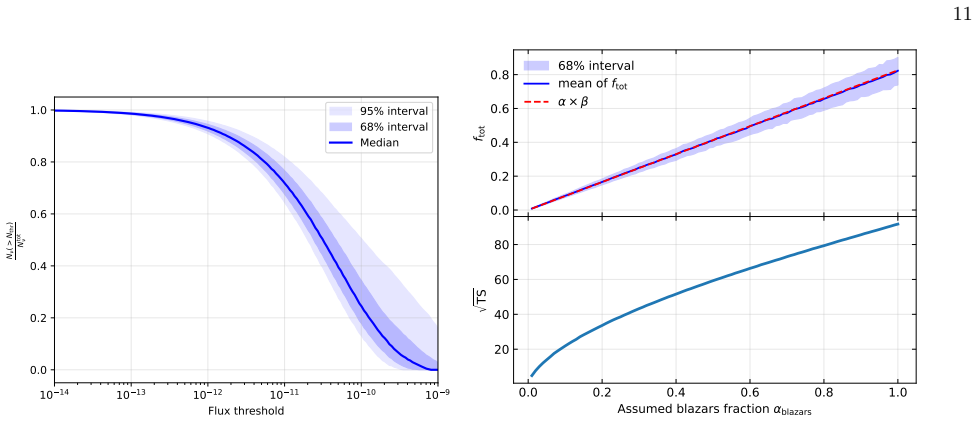
- The same method, applied to blazars, could detect a ~5% blazar contribution above 300 TeV at >9σ with three years of HUNT exposure, indicating the method generalizes to other source classes.
- Future wide-area X-ray surveys (e.g., all-sky eROSITA catalogs) would reduce the XLF extrapolation uncertainty and improve the achievable significance.
Reading between the lines
- If the linear Nν ∝ F_X scaling is replaced by a weaker correlation (s < 0.5), the predicted significance for HUNT drops to ~2σ; a measurement of s from early HUNT data would therefore determine whether the 8.7σ forecast is realistic, independent of the AGN fraction.
- The source-confusion criterion d̄ ≥ 3σ_psf implicitly assumes the X-ray AGN positions are exact and that the neutrino direction error is Gaussian; with real data, catalog incompleteness and non-Gaussian tails in the PSF could degrade the significance more than the quoted systematics.
- The same likelihood framework could be applied to gamma-ray AGNs or star-forming galaxies, with the X-ray flux replaced by other tracers, to test which source population dominates the neutrino background.
Editorial analysis
A structured set of objections, weighed in public.
Referee Report
Summary. This paper presents Monte Carlo forecasts for detecting a spatial correlation between X-ray-selected AGNs (from the eFEDS catalog) and TeV muon neutrinos with future neutrino telescopes. The analysis uses an unbinned likelihood ratio, a source-confusion criterion (mean AGN separation must exceed 3 times the PSF), and an XLF-based extrapolation from the flux-limited AGN subset to the full population, with uncertainties from the XLF and from event-by-event PSF variation included. Under the fiducial model with alpha=1 (all astrophysical neutrinos from AGNs) and N_nu proportional to F_X, the paper quotes 3.1 sigma for IceCube-Gen2 after 5 years and 8.7 sigma for a 30 km^3 HUNT-class detector after 1 year. It also explores partial AGN contributions and a power-law weighting index s.
Significance. If the fiducial linear scaling holds, the paper makes a concrete and useful planning statement: angular resolution, not just exposure, is the decisive factor, and a 30 km^3 telescope could establish or rule out an AGN origin within about one year. The Monte Carlo framework is carefully built, with a 5x10^6 background-only TS calibration (Appendix A) and a transparent treatment of XLF and PSF systematics. A notable strength is that the authors explicitly explore the dependence on the flux-weighting index s; however, that same exploration shows how sensitive the headline significance is to an assumption they themselves label as unwarranted.
major comments (2)
- [Section 5.2, Eq. (5), Fig. 8] The headline numbers (8.7 sigma for HUNT after one year, 3.1 sigma for IceCube-Gen2 after five years) assume s=1, i.e., N_nu proportional to F_X. The paper states that "the linear relationship is unwarranted yet," and Fig. 8 shows that for a 30 km^3 detector with three years of exposure the significance drops to about 2 sigma at s=0. Because the signal weights w_j in Eq. (5) and the XLF extrapolation in Eq. (3) both depend on this scaling, the advertised significances are conditional on an unvalidated physical assumption. The abstract and conclusions should present the s=1 values as a fiducial model, explicitly state the dependence, and preferably quote a conservative s<1 scenario.
- [Section 2.3, Fig. 2] The source-confusion criterion d_bar >= 3 sigma_psf is calibrated from simulations with a true f_tot = 0.5 only. The text claims this trend is valid for a wide range of f_tot, but no supporting result is shown. The HUNT one-year forecast uses f_tot = alpha*beta = 0.8 at E_nu > 300 TeV, and the likelihood bias from confusion can depend on the signal fraction. Please add validation runs at the f_tot values actually used in the forecasts, or state the range of f_tot over which the criterion has been verified.
minor comments (5)
- [Abstract vs. Section 4] The abstract says "about 8 sigma" with one year of HUNT, while Section 4 quotes 8.7 sigma. Earlier abstract variants also mention 3 sigma with ten years and 6 sigma with one year. Please harmonize the quoted numbers across the manuscript.
- [Eq. (4)-(5) and Section 2.1] The symbol f is used both for the fitted signal fraction in the flux-limited sample and for the extrapolated total f_tot. This overloaded notation is confusing; define the two quantities explicitly at first use.
- [Figure 6] The bottom panel y-axis is labeled "TS" and the caption says the plotted quantity is sqrt(TS), but the quoted values (3.1, 8.7, etc.) are sqrt(TS). Relabel the axis or clarify to avoid ambiguity.
- [Figure 2] The color-bar annotation "frecover 0.5" is unclear. State explicitly that the plotted quantity is f_tot - 0.5 or the recovered fraction offset from the true value.
- [Section 4] There is a typo: "after one years of exposure" should be "after one year of exposure."
Circularity Check
No significant circularity: the significance forecasts are forward Monte Carlo sensitivity calculations under explicit external inputs, not derivations from the hypothesis being tested.
full rationale
The paper does not fit any parameter to the quantity it claims to predict. The astrophysical-neutrino fraction β is taken from IceCube 9.5-year data; the AGN X-ray luminosity function and its 1σ uncertainties are taken from Ueda et al. (2014); detector angular resolutions and effective areas are taken from the IceCube-Gen2 design study and HUNT detector simulations. The only tuned quantity, F_min, is set by the independent source-confusion criterion d̄ ≥ 3σ_psf and is explicitly varied (Figures 2 and 5); it is not adjusted to maximize significance. The headline 8.7σ is a conditional sensitivity: the simulation injects an AGN-origin signal with α=1 and s=1 and then reconstructs it with the same likelihood, which is the standard way to forecast detection significance. The assumption N_ν ∝ F_X is openly labeled 'unwarranted yet' (§5.2), and the paper itself shows the significance falls to ~2σ at s=0 (Figure 8), so the result is transparently model-dependent rather than circular. No load-bearing self-citation or imported uniqueness theorem is used; the HUNT performance reference is to the detector collaboration, not to an unverified claim by the same authors. Appendix A calibrates the TS distribution against 5×10^6 background-only Monte Carlo realizations and Wilks' theorem; this validates, not pre-determines, the quoted significance. No step in the derivation chain reduces by construction to its own inputs.
Assumptions & free parameters
free parameters (3)
- alpha (AGN fraction of astrophysical neutrinos) =
1 (baseline; varied in Fig. 7)
- s (flux-weighting index, Nν ∝ F_X^s) =
1 (baseline; varied in Fig. 8)
- F_min (AGN X-ray flux threshold) =
2.4e-13 erg s^-1 cm^-2 (IceCube-Gen2, E>100 TeV); 4e-14 erg s^-1 cm^-2 (HUNT, E>300 TeV)
assumptions (6)
- domain assumption eFEDS 142 deg^2 AGN catalog is representative of the all-sky AGN population after XLF extrapolation
- domain assumption Ueda et al. (2014) XLF with 1σ uncertainties adequately describes the X-ray AGN population
- domain assumption Detector performance projections (PSF, effective area) accurately represent future telescopes
- ad hoc to paper The d>3σpsf source-confusion criterion is valid for all adopted F_min
- domain assumption The atmospheric neutrino background is isotropic and uniform across the field (B_i = 1/Ω)
- standard math Wilks theorem applies to the TS distribution
Cite this review
Pith. "Pith review of Diagnosing the AGN population origin of TeV neutrinos with their spatial correlation." pith.science (2026). https://pith.science/paper/526CH5VZ
@misc{pith2026251219403,
  author       = {Pith},
  title        = {Pith review of: Diagnosing the AGN population origin of TeV neutrinos with their spatial correlation},
  year         = {2026},
  howpublished = {\url{https://pith.science/paper/526CH5VZ}},
  note         = {Machine review of arXiv:2512.19403}
}
abstract
The recent detection of TeV neutrinos from nearby Seyfert galaxies (e.g., NGC 1068) by IceCube suggests that active galactic nuclei (AGNs) could make a significant contribution to diffuse astrophysical neutrinos. The absence of TeV gamma-rays from NGC 1068 indicates neutrino production in a compact opaque region of gamma-rays. The vicinity of the supermassive black hole, such as the disk-corona, is an ideal region, where the high radiation density leads to efficient neutrino production and gamma-ray attenuation. Disk-corona models predict that the neutrino emission from AGNs correlates with X-ray emission, which traces the coronal activity. In this paper, we assess whether diffuse TeV neutrinos can originate from X-ray-emitting AGNs with Monte Carlo simulations, considering the predicted performance of future neutrino telescopes. We test this hypothesis by searching for spatial correlations between the X-ray AGN population and high-energy neutrinos, assuming that the neutrino flux scales with the AGN X-ray flux. After accounting for the fraction of the AGN X-ray flux resolved by eFEDS and the remaining unresolved AGN component, we find that an AGN origin of diffuse neutrinos can be tested at a significance of about $3\sigma$ with ten years of IceCube-Gen2 observations. With improved angular resolution and sensitivity, a 30\,km$^{3}$-scale underwater neutrino telescope such as HUNT is expected to reach a significance of about $6\sigma$ with one year of exposure. The detection significance decreases if AGNs contribute partially to the total astrophysical neutrino flux. Our results highlight the critical role of angular resolution in diagnosing the AGN origin of diffuse TeV neutrinos.
Figures


Figures from the paper (6 more)



Reference graph
Works this paper leans on
-
[1]
G., Abraham, K., Ackermann, M., et al
Aartsen, M. G., Abraham, K., Ackermann, M., et al. 2017, The Contribution of Fermi-2LAC Blazars to Diffuse TeV-PeV Neutrino Flux, ApJ, 835, 45, doi: 10.3847/1538-4357/835/1/45
-
[2]
G., Ackermann, M., Adams, J., et al
Aartsen, M. G., Ackermann, M., Adams, J., et al. 2020a, Time-Integrated Neutrino Source Searches with 10 Years of IceCube Data, PhRvL, 124, 051103, doi: 10.1103/PhysRevLett.124.051103 13 0 5 10 15 20 TS 10 6 10 5 10 4 10 3 10 2 10 1 100 Probability density Background MC 2 1 (Wilks) 3 5 Figure 10.Test statistic (TS) distribution obtained from 5×10 6 backgr...
-
[3]
G., Ackermann, M., Adams, J., et al
Aartsen, M. G., Ackermann, M., Adams, J., et al. 2020b, Characteristics of the Diffuse Astrophysical Electron and Tau Neutrino Flux with Six Years of IceCube High Energy Cascade Data, PhRvL, 125, 121104, doi: 10.1103/PhysRevLett.125.121104
-
[4]
G., Abbasi, R., Ackermann, M., et al
Aartsen, M. G., Abbasi, R., Ackermann, M., et al. 2021, IceCube-Gen2: the window to the extreme Universe, Journal of Physics G Nuclear Physics, 48, 060501, doi: 10.1088/1361-6471/abbd48
-
[5]
Abbasi, R., Ackermann, M., Adams, J., et al. 2022, Improved Characterization of the Astrophysical Muon-Neutrino Flux with 9.5 Years of IceCube Data, The Astrophysical Journal, 928, 50, doi: 10.3847/1538-4357/ac4d29
-
[6]
Abbasi, R., Ackermann, M., Adams, J., et al. 2022, Search for neutrino emission from cores of active galactic nuclei, PhRvD, 106, 022005, doi: 10.1103/PhysRevD.106.022005
-
[7]
Abbasi, R., Ackermann, M., Adams, J., et al. 2023, Search for Correlations of High-energy Neutrinos Detected in IceCube with Radio-bright AGN and Gamma-Ray Emission from Blazars, ApJ, 954, 75, doi: 10.3847/1538-4357/acdfcb
-
[8]
Abbasi, R., Ackermann, M., Adams, J., et al. 2024, Probing the Connection between IceCube Neutrinos and MOJA VE AGN, ApJ, 973, 97, doi: 10.3847/1538-4357/ad643d
Show all 57 references
-
[9]
2025a, Evidence for Neutrino Emission from X-ray Bright Active Galactic Nuclei with IceCube, arXiv e-prints, arXiv:2510.13403, doi: 10.48550/arXiv.2510.13403
Abbasi, R., Ackermann, M., Adams, J., et al. 2025a, Evidence for Neutrino Emission from X-ray Bright Active Galactic Nuclei with IceCube, arXiv e-prints, arXiv:2510.13403, doi: 10.48550/arXiv.2510.13403
-
[10]
IceCube, ApJ, 981, 131, doi: 10.3847/1538-4357/ada94b
-
[11]
A., Ansoldi, S., Antonelli, L
Acciari, V. A., Ansoldi, S., Antonelli, L. A., et al. 2019, Constraints on Gamma-Ray and Neutrino Emission from NGC 1068 with the MAGIC Telescopes, ApJ, 883, 135, doi: 10.3847/1538-4357/ab3a51
2019 doi
-
[12]
2015, The Spectrum of Isotropic Diffuse Gamma-Ray Emission between 100 MeV and 820 GeV, ApJ, 799, 86, doi: 10.1088/0004-637X/799/1/86
Ackermann, M., Ajello, M., Albert, A., et al. 2015, The Spectrum of Isotropic Diffuse Gamma-Ray Emission between 100 MeV and 820 GeV, ApJ, 799, 86, doi: 10.1088/0004-637X/799/1/86
2015 doi
-
[13]
Ackermann, M., Ajello, M., Albert, A., et al. 2016, Resolving the Extragalacticγ-Ray Background above 50 GeV with the Fermi Large Area Telescope, PhRvL, 116, 151105, doi: 10.1103/PhysRevLett.116.151105 Adri´ an-Mart ´ ınez, S., Ageron, M., Aharonian, F., et al. 2016, Letter of...
2016 doi
-
[14]
2022, The Fourth Catalog of Active Galactic Nuclei Detected by the Fermi Large Area Telescope: Data Release 3, ApJS, 263, 24, doi: 10.3847/1538-4365/ac9523
Ajello, M., Baldini, L., Ballet, J., et al. 2022, The Fourth Catalog of Active Galactic Nuclei Detected by the Fermi Large Area Telescope: Data Release 3, ApJS, 263, 24, doi: 10.3847/1538-4365/ac9523
2022 doi
- [15]
- [16]
-
[17]
1992, Confusion Noise and Source Clustering, ApJ, 396, 460, doi: 10.1086/171733
Barcons, X. 1992, Confusion Noise and Source Clustering, ApJ, 396, 460, doi: 10.1086/171733
1992 doi
-
[18]
2017, Evidence against Star-forming Galaxies as the Dominant Source of Icecube Neutrinos, ApJ, 836, 47, doi: 10.3847/1538-4357/836/1/47
Vandenbroucke, J. 2017, Evidence against Star-forming Galaxies as the Dominant Source of Icecube Neutrinos, ApJ, 836, 47, doi: 10.3847/1538-4357/836/1/47
2017 doi
-
[19]
Belolaptikov, I., Dzhilkibaev, Z. A. M., Allakhverdyan, V. A., et al. 2022, in 37th International Cosmic Ray Conference, 2, doi: 10.22323/1.395.002
2022 doi
-
[20]
2019, in European Physical Journal Web of Conferences, Vol
Bradascio, F., & Gl¨ usenkamp, T. 2019, in European Physical Journal Web of Conferences, Vol. 207, European Physical Journal Web of Conferences (EDP), 05002, doi: 10.1051/epjconf/201920705002
2019
-
[21]
2008, Methods for Point Source Analysis in High Energy Neutrino
Braun, J., Dumm, J., De Palma, F., et al. 2008, Methods for Point Source Analysis in High Energy Neutrino
2008
-
[22]
Telescopes, Astroparticle Physics, 29, 299, doi: 10.1016/j.astropartphys.2008.02.007
2008 doi
-
[23]
2022, The eROSITA Final Equatorial Depth Survey (eFEDS)
Brunner, H., Liu, T., Lamer, G., et al. 2022, The eROSITA Final Equatorial Depth Survey (eFEDS). X-ray catalogue, A&A, 661, A1, doi: 10.1051/0004-6361/202141266
2022 doi
-
[24]
2022, Beginning a Journey Across the Universe: The Discovery of Extragalactic Neutrino Factories, ApJL, 933, L43, doi: 10.3847/2041-8213/ac7d5b
Buson, S., Tramacere, A., Pfeiffer, L., et al. 2022, Beginning a Journey Across the Universe: The Discovery of Extragalactic Neutrino Factories, ApJL, 933, L43, doi: 10.3847/2041-8213/ac7d5b
2022 doi
-
[25]
2020, New constraints on the origin of medium-energy neutrinos observed by IceCube, PhRvD, 101, 103012, doi: 10.1103/PhysRevD.101.103012
Capanema, A., Esmaili, A., & Murase, K. 2020, New constraints on the origin of medium-energy neutrinos observed by IceCube, PhRvD, 101, 103012, doi: 10.1103/PhysRevD.101.103012
2020 doi
-
[26]
2011, Asymptotic formulae for likelihood-based tests of new physics, European Physical Journal C, 71, 1554, doi: 10.1140/epjc/s10052-011-1554-0
Cowan, G., Cranmer, K., Gross, E., & Vitells, O. 2011, Asymptotic formulae for likelihood-based tests of new physics, European Physical Journal C, 71, 1554, doi: 10.1140/epjc/s10052-011-1554-0
2011 doi
-
[27]
2022, Seeking Neutrino Emission from AGN through Temporal and Spatial Cross-Correlation, Physical Review D, 105, 123035, doi: 10.1103/PhysRevD.105.123035
Creque-Sarbinowski, C., Kamionkowski, M., & Zhou, B. 2022, Seeking Neutrino Emission from AGN through Temporal and Spatial Cross-Correlation, Physical Review D, 105, 123035, doi: 10.1103/PhysRevD.105.123035
2022 doi
-
[28]
2022, Cosmogenic gamma-ray and neutrino fluxes from blazars associated with IceCube events, A&A, 658, L6, doi: 10.1051/0004-6361/202142123
Das, S., Razzaque, S., & Gupta, N. 2022, Cosmogenic gamma-ray and neutrino fluxes from blazars associated with IceCube events, A&A, 658, L6, doi: 10.1051/0004-6361/202142123
2022 doi
-
[29]
Eichmann, B., Oikonomou, F., Salvatore, S., Dettmar, R.-J., & Tjus, J. B. 2022, Solving the Multimessenger Puzzle of the AGN-starburst Composite Galaxy NGC 1068, ApJ, 939, 43, doi: 10.3847/1538-4357/ac9588
2022 doi
-
[30]
S., & Halzen, F
Fang, K., Gallagher, J. S., & Halzen, F. 2022, The TeV Diffuse Cosmic Neutrino Spectrum and the Nature of Astrophysical Neutrino Sources, ApJ, 933, 190, doi: 10.3847/1538-4357/ac7649
2022 doi
-
[31]
Fiorillo, D. F. G., Comisso, L., Peretti, E., Petropoulou, M., & Sironi, L. 2025, The contribution of turbulent AGN coronae to the diffuse neutrino flux, arXiv e-prints, arXiv:2504.06336, doi: 10.48550/arXiv.2504.06336
2025 doi
-
[32]
Q., Cao, Z., Chen, M., et al
Huang, T. Q., Cao, Z., Chen, M., et al. 2024, in 38th International Cosmic Ray Conference, 1080
2024
-
[33]
Q., & HUNT Collaboration
Huang, T. Q., & HUNT Collaboration. 2025, in 39th International Cosmic Ray Conference, 1061 IceCube Collaboration, Aartsen, M. G., Ackermann, M., et al. 2018, Neutrino emission from the direction of the blazar TXS 0506+056 prior to the IceCube-170922A alert, Science, 361, 147,...
2025 doi
-
[34]
2020, On the Origin of High-energy Neutrinos from NGC 1068: The Role of Nonthermal Coronal Activity, ApJL, 891, L33, doi: 10.3847/2041-8213/ab7661
Inoue, Y., Khangulyan, D., & Doi, A. 2020, On the Origin of High-energy Neutrinos from NGC 1068: The Role of Nonthermal Coronal Activity, ApJL, 891, L33, doi: 10.3847/2041-8213/ab7661
2020 doi
-
[35]
G., Haynes, M
Jones, M. G., Haynes, M. P., Giovanelli, R., & Papastergis, E. 2016, When is stacking confusing? The impact of confusion on stacking in deep H I galaxy surveys, MNRAS, 455, 1574, doi: 10.1093/mnras/stv2394
2016 doi
-
[36]
Kheirandish, A., Murase, K., & Kimura, S. S. 2021, High-energy Neutrinos from Magnetized Coronae of Active Galactic Nuclei and Prospects for Identification of Seyfert Galaxies and Quasars in Neutrino Telescopes, ApJ, 922, 45, doi: 10.3847/1538-4357/ac1c77
2021 doi
-
[37]
2025, The promise of deep-stacking for neutrino astronomy, arXiv e-prints, arXiv:2501.10213, doi: 10.48550/arXiv.2501.10213
Kowalski, M., Ackermann, M., & Bartos, I. 2025, The promise of deep-stacking for neutrino astronomy, arXiv e-prints, arXiv:2501.10213, doi: 10.48550/arXiv.2501.10213
-
[38]
B., et al
Kun, E., Bartos, I., Tjus, J. B., et al. 2024, Possible correlation between unabsorbed hard x rays and neutrinos in radio-loud and radio-quiet active galactic nuclei, PhRvD, 110, 123014, doi: 10.1103/PhysRevD.110.123014 15
2024 doi
-
[39]
2010, A Simultaneous Stacking and Deblending Algorithm for Astronomical
Kurczynski, P., & Gawiser, E. 2010, A Simultaneous Stacking and Deblending Algorithm for Astronomical
2010
-
[40]
Images, AJ, 139, 1592, doi: 10.1088/0004-6256/139/4/1592
-
[41]
2022, The eROSITA Final Equatorial-Depth Survey (eFEDS): The AGN Catalog and Its X-ray Spectral Properties, Astronomy & Astrophysics, 661, A5, doi: 10.1051/0004-6361/202141643
Liu, T., Buchner, J., Nandra, K., et al. 2022, The eROSITA Final Equatorial-Depth Survey (eFEDS): The AGN Catalog and Its X-ray Spectral Properties, Astronomy & Astrophysics, 661, A5, doi: 10.1051/0004-6361/202141643
2022 doi
-
[42]
2020, Testing gamma-ray models of blazars in the extragalactic sky, PhRvD, 101, 103026, doi: 10.1103/PhysRevD.101.103026
Manconi, S., Korsmeier, M., Donato, F., et al. 2020, Testing gamma-ray models of blazars in the extragalactic sky, PhRvD, 101, 103026, doi: 10.1103/PhysRevD.101.103026
2020 doi
-
[43]
A., & Stone, J
Miller, K. A., & Stone, J. M. 2000, The Formation and Structure of a Strongly Magnetized Corona above a Weakly Magnetized Accretion Disk, ApJ, 534, 398, doi: 10.1086/308736
2000 doi
-
[44]
2016, Hidden Cosmic-Ray Accelerators as an Origin of TeV-PeV Cosmic Neutrinos, PhRvL, 116, 071101, doi: 10.1103/PhysRevLett.116.071101
Murase, K., Guetta, D., & Ahlers, M. 2016, Hidden Cosmic-Ray Accelerators as an Origin of TeV-PeV Cosmic Neutrinos, PhRvL, 116, 071101, doi: 10.1103/PhysRevLett.116.071101
2016 doi
-
[45]
Murase, K., Inoue, Y., & Dermer, C. D. 2014, Diffuse neutrino intensity from the inner jets of active galactic nuclei: Impacts of external photon fields and the blazar sequence, PhRvD, 90, 023007, doi: 10.1103/PhysRevD.90.023007
2014 doi
-
[46]
S., & M´ esz´ aros, P
Murase, K., Kimura, S. S., & M´ esz´ aros, P. 2020, Hidden Cores of Active Galactic Nuclei as the Origin of Medium-Energy Neutrinos: Critical Tests with the MeV Gamma-Ray Connection, PhRvL, 125, 011101, doi: 10.1103/PhysRevLett.125.011101
2020 doi
-
[47]
S., Dom ´ ınguez, A., Ajello, M., Franckowiak, A., & Hartmann, D
Paliya, V. S., Dom ´ ınguez, A., Ajello, M., Franckowiak, A., & Hartmann, D. 2019, Fermi-LAT Stacking Analysis Technique: An Application to Extreme Blazars and Prospects for their CTA Detection, ApJL, 882, L3, doi: 10.3847/2041-8213/ab398a
2019 doi
-
[48]
2025, Counterpart identification and classification for eRASS1 and characterisation of the active galactic nuclei content, A&A, 704, A344, doi: 10.1051/0004-6361/202556142
Salvato, M., Wolf, J., Dwelly, T., et al. 2025, Counterpart identification and classification for eRASS1 and characterisation of the active galactic nuclei content, A&A, 704, A344, doi: 10.1051/0004-6361/202556142
2025 doi
-
[49]
Saurenhaus, L., Capel, F., Oikonomou, F., & Buchner, J. 2025, Constraining the contribution of Seyfert galaxies to the diffuse neutrino flux in light of point source observations, arXiv e-prints, arXiv:2507.06110, doi: 10.48550/arXiv.2507.06110
2025 doi
-
[50]
Senno, N., M´ esz´ aros, P., Murase, K., Baerwald, P., & Rees, M. J. 2015, Extragalactic Star-forming Galaxies with Hypernovae and Supernovae as High-energy Neutrino and Gamma-ray Sources: the case of the 10 TeV Neutrino data, ApJ, 806, 24, doi: 10.1088/0004-637X/806/1/24
2015 doi
-
[51]
Watson, M. G. 2014, TOW ARD THE STANDARD POPULATION SYNTHESIS MODEL OF THE X-RAY BACKGROUND: EVOLUTION OF X-RAY LUMINOSITY AND ABSORPTION FUNCTIONS OF ACTIVE GALACTIC NUCLEI INCLUDING COMPTON-THICK POPULATIONS, The Astrophysical Journal, 786, 104, doi: 10.1088/0004-637X/786/2/104
2014 doi
-
[52]
Wilks, S. S. 1938, The large-sample distribution of the likelihood ratio for testing composite hypotheses, Annals of Mathematical Statistics, 9, 60, doi: 10.1214/aoms/1177732360
1938
-
[53]
2022, HA WC Follow-up on IceCube evidence from NGC 1068, The Astronomer’s Telegram, 15765, 1
Willox, E., & HA WC Collaboration. 2022, HA WC Follow-up on IceCube evidence from NGC 1068, The Astronomer’s Telegram, 15765, 1
2022
-
[54]
P., Hu, F., Tian, W., et al
Ye, Z. P., Hu, F., Tian, W., et al. 2023, A multi-cubic-kilometre neutrino telescope in the western Pacific Ocean, Nature Astronomy, 7, 1497, doi: 10.1038/s41550-023-02087-6
2023 doi
-
[55]
2025, IceCat-2: Updated IceCube Event Catalog of Alert Tracks, arXiv e-prints, arXiv:2507.06176, doi: 10.48550/arXiv.2507.06176
Valtonen-Mattila, N., & Yuan, T. 2025, IceCat-2: Updated IceCube Event Catalog of Alert Tracks, arXiv e-prints, arXiv:2507.06176, doi: 10.48550/arXiv.2507.06176
-
[56]
2025, A Proposed Deep Sea Neutrino Observatory in the Nanhai, Astroparticle Physics, 171, 103123, doi: 10.1016/j.astropartphys.2025.103123
Zhang, H., Cui, Y., Huang, Y., et al. 2025, A Proposed Deep Sea Neutrino Observatory in the Nanhai, Astroparticle Physics, 171, 103123, doi: 10.1016/j.astropartphys.2025.103123
2025
-
[57]
2021, Search for high-energy neutrino emission from radio-bright AGN, PhRvD, 103, 123018, doi: 10.1103/PhysRevD.103.123018
Zhou, B., Kamionkowski, M., & Liang, Y.-f. 2021, Search for high-energy neutrino emission from radio-bright AGN, PhRvD, 103, 123018, doi: 10.1103/PhysRevD.103.123018
2021 doi
Reviewed August 3, 2026 · model on record in the stance chip above.
Discussion (0). Continue with ORCID to comment.