REVIEW 2 major objections 2 minor 2 references
Homological Nielsen realization for the manifolds $\#_n \mathbb{CP}^2$
T0 review · 2 major / 2 minor · reviewed 2026-06-29 · grok-4.3
Pith's one-line read Finite isometry groups of the intersection form on sums of many CP2s almost never lift to finite diffeomorphism groups.
desk verdict The paper shows asymptotic sparsity of Nielsen-realizable subgroups for large #_n CP^2 via analytic combinatorics on O(H2), but the random model is the key unverified step. read the letter →
The pith
A machine-rendered reading of the paper's core claim, the machinery that carries it, and where it could break.
The reading
What carries the argument
Asymptotic density of non-realizable subgroups inside O(H2(Mn;Z)) under a natural probabilistic model on the orthogonal group of the standard positive-definite form, combined with equivariant connected-sum constructions and fixed-point obstructions.
What would settle it
An explicit construction, for arbitrarily large n, of a positive-density family of finite subgroups of O(H2(Mn;Z)) that each lift to a finite subgroup of Diff+(Mn).
Extended reading notes
Core claim
Even though every isometry of H2(Mn;Z) is induced by some orientation-preserving diffeomorphism of Mn, Nielsen realization is sparse: as n o∞, a random subgroup of O(H2(Mn;Z)) is asymptotically almost never realizable in Diff+(Mn); the same is true for random odd order elements of O(H2(Mn;Z)). Positive realization results hold in certain cases while obstructions from fixed-point theory and finite group actions on surfaces apply in others.
Load-bearing premise
The probabilistic model that defines a random subgroup of O(H2(Mn;Z)) and the analytic combinatorics that compute its density of non-realizable groups accurately capture the geometric question of which groups admit diffeomorphism realizations.
Editorial extensions
If this is right
- Certain finite subgroups of O(H2(Mn;Z)) are still realizable by diffeomorphisms for every n.
- Obstructions coming from fixed-point theory and actions on surfaces rule out realization for many groups when n is large.
- The same sparsity conclusion applies separately to random odd-order elements.
- The full isometry group O(H2(Mn;Z)) is realized by (possibly infinite-order) diffeomorphisms for every n.
Reading between the lines
- The finite part of the diffeomorphism group of Mn becomes negligible compared with the algebraic isometry group as n increases.
- Similar density arguments may apply to other families of 4-manifolds whose intersection forms admit large orthogonal groups.
- The result highlights a gap between homological actions that exist algebraically and those that can be realized geometrically by finite-order maps.
Signed reviews
Editorial analysis
A structured set of objections, weighed in public.
Referee Report
Summary. The manuscript studies the homological Nielsen realization problem for the 4-manifolds M_n = #_n CP^2. It claims that every isometry of the intersection form is realized by some (not necessarily finite-order) diffeomorphism, yet finite subgroups of O(H_2(M_n;Z)) ≅ ℤ_2 ≀ S_n and random odd-order elements are asymptotically almost never realizable by orientation-preserving diffeomorphisms as n → ∞. Positive realization results are given in special cases, while obstructions arise from equivariant connected sums, fixed-point theory, and Hambleton–Tanase conditions; the sparsity statements rely on a probabilistic model on the orthogonal group together with analytic combinatorics.
Significance. If the central sparsity claim holds under a geometrically meaningful probability measure, the result quantifies how exceptional finite diffeomorphism actions are among homological isometries for these simply-connected positive-definite 4-manifolds. The explicit combination of equivariant geometric constructions with analytic combinatorics to obtain asymptotic densities is a methodological strength, as are the positive realization theorems that delineate the boundary between realizable and non-realizable cases.
major comments (2)
- [abstract and the section introducing the probabilistic model] The definition of the probability measure on subgroups (or on odd-order elements) of O(H_2(M_n;Z)) is load-bearing for the asymptotic claim in the abstract. The manuscript must specify this measure (uniform over subgroups of bounded order, via random generators, or generating-function enumeration) and verify that the analytic combinatorics correctly extract the density of subgroups violating the fixed-point or equivariant connected-sum obstructions; without an explicit statement of the measure and independence hypotheses used in the counting, it is unclear whether the model aligns with subgroups that could arise from actual Diff^+(M_n) actions.
- [analytic combinatorics section] The passage from the combinatorial density of non-realizable groups to the geometric statement requires that the chosen obstructions (Hambleton–Tanase conditions, fixed-point constraints) are sufficiently independent under the random model. If the paper’s analytic combinatorics section assumes independence that fails for the wreath-product structure of O(H_2(M_n;Z)), the limit probability may not tend to 1.
minor comments (2)
- [introduction] Notation for the wreath product ℤ_2 ≀ S_n and for the random model should be introduced with a short self-contained paragraph before the main theorems.
- [positive results section] The positive realization results would benefit from an explicit table or list of the finite groups for which realization is proved, cross-referenced to the obstruction criteria.
Simulated Author's Rebuttal
We thank the referee for the careful reading and for identifying points that require greater explicitness. We address each major comment below and will revise the manuscript accordingly to clarify the probabilistic model and the handling of dependencies in the wreath product.
read point-by-point responses
-
Referee: [abstract and the section introducing the probabilistic model] The definition of the probability measure on subgroups (or on odd-order elements) of O(H_2(M_n;Z)) is load-bearing for the asymptotic claim in the abstract. The manuscript must specify this measure (uniform over subgroups of bounded order, via random generators, or generating-function enumeration) and verify that the analytic combinatorics correctly extract the density of subgroups violating the fixed-point or equivariant connected-sum obstructions; without an explicit statement of the measure and independence hypotheses used in the counting, it is unclear whether the model aligns with subgroups that could arise from actual Diff^+(M_n) actions.
Authors: The model is the asymptotic density (as n→∞) of subgroups or odd-order elements in the wreath product ℤ_2 ≀ S_n that violate at least one obstruction, obtained via generating-function enumeration of the group elements and their cycle structures. We agree that the current text does not state this with sufficient precision in the abstract and introductory section. We will add an explicit definition of the measure (uniform over elements of bounded odd order, or over subgroups via their generators counted by the cycle index of the wreath product) together with a short verification that the obstructions are counted correctly under this enumeration. This revision will also note that the model is chosen precisely because it is the natural one compatible with the group structure of O(H_2(M_n;ℤ)). revision: yes
-
Referee: [analytic combinatorics section] The passage from the combinatorial density of non-realizable groups to the geometric statement requires that the chosen obstructions (Hambleton–Tanase conditions, fixed-point constraints) are sufficiently independent under the random model. If the paper’s analytic combinatorics section assumes independence that fails for the wreath-product structure of O(H_2(M_n;Z)), the limit probability may not tend to 1.
Authors: The analytic combinatorics section employs the cycle-index generating functions of the full wreath product rather than assuming statistical independence of the ℤ_2 and S_n factors. The fixed-point and Hambleton–Tanase obstructions factor according to the sign vector and the permutation cycle type; the exponential generating functions already incorporate the dependencies that arise from the semidirect product. Consequently the probability that a random element (or subgroup) simultaneously satisfies all realizability conditions tends to zero. We will insert a short remark in the analytic combinatorics section spelling out this wreath-product enumeration and confirming that the limit remains 1. Should the referee see a concrete dependence that our generating functions overlook, we would be grateful for the clarification. revision: yes
Circularity Check
No circularity: sparsity result derived from explicit probabilistic model and external obstructions
full rationale
The central claim establishes asymptotic non-realizability of random subgroups and odd-order elements in O(H2(Mn;Z)) via analytic combinatorics applied to an explicitly defined probability measure on subgroups of ℤ2 ≀ Sn, combined with fixed-point and equivariant obstructions drawn from the external reference Hambleton–Tanase. No step equates a derived quantity to a fitted input by construction, renames a known result, or loads the argument on a self-citation whose content is unverified; the derivation chain remains independent of the target sparsity statement.
Assumptions & free parameters
Cite this review
Pith. "Pith review of Homological Nielsen realization for the manifolds $\#_n \mathbb{CP}^2$." pith.science (2026). https://pith.science/paper/52HPBGDY
@misc{pith2026260527537,
  author       = {Pith},
  title        = {Pith review of: Homological Nielsen realization for the manifolds $\#_n \mathbbCP^2$},
  year         = {2026},
  howpublished = {\url{https://pith.science/paper/52HPBGDY}},
  note         = {Machine review of arXiv:2605.27537}
}
abstract
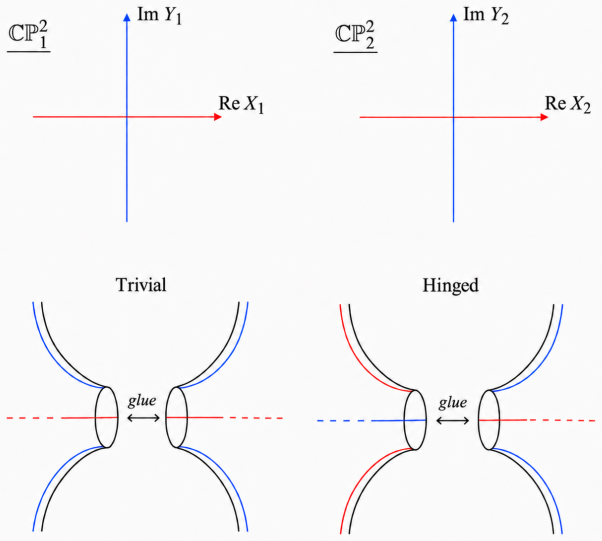
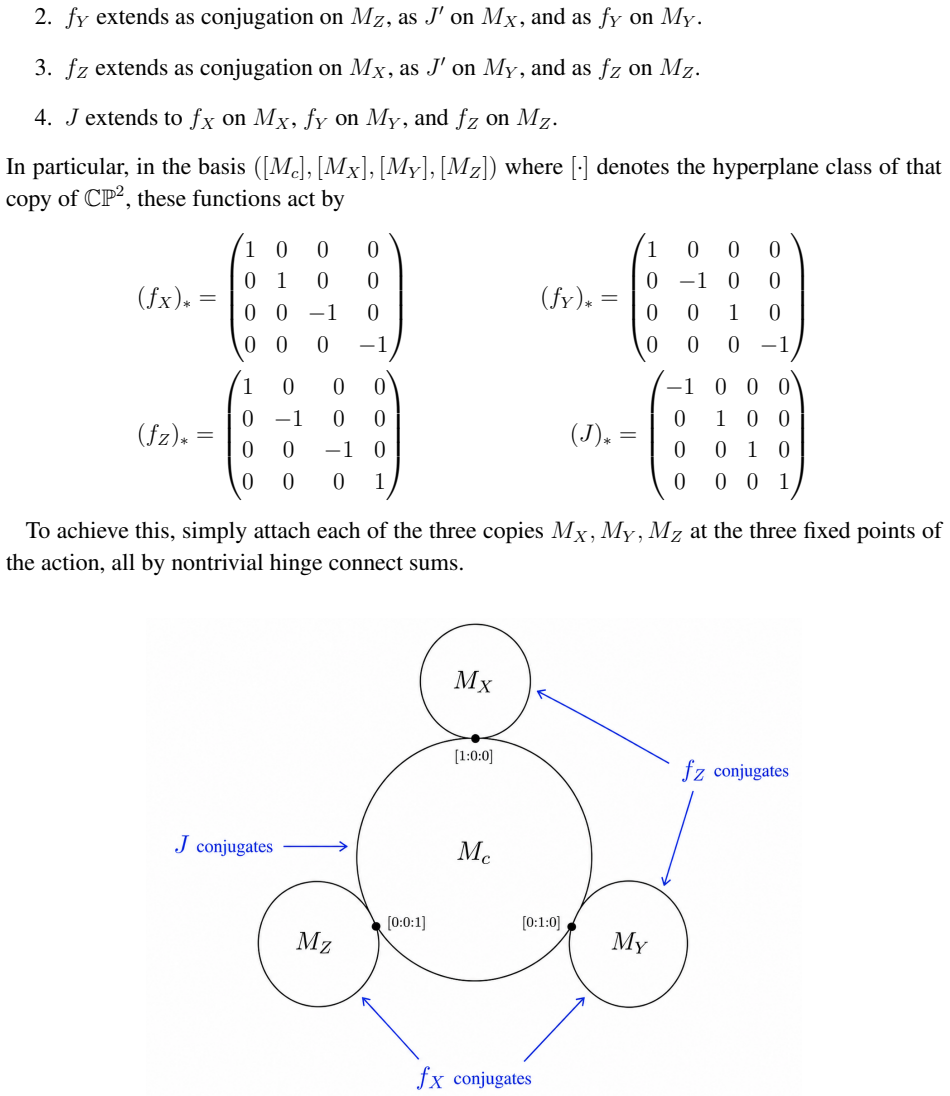
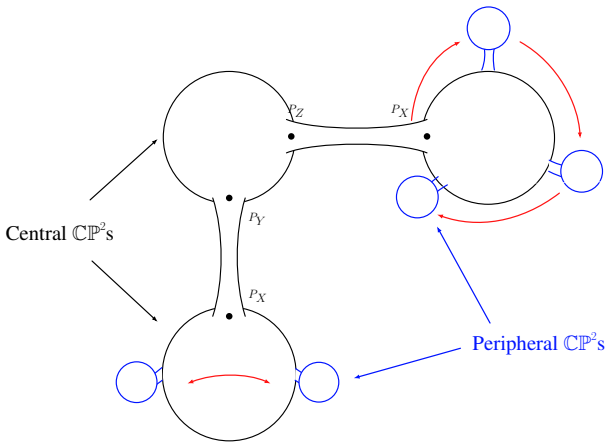
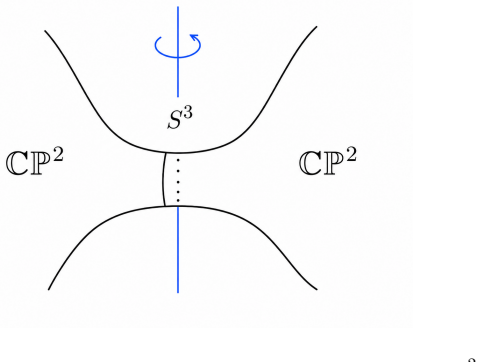
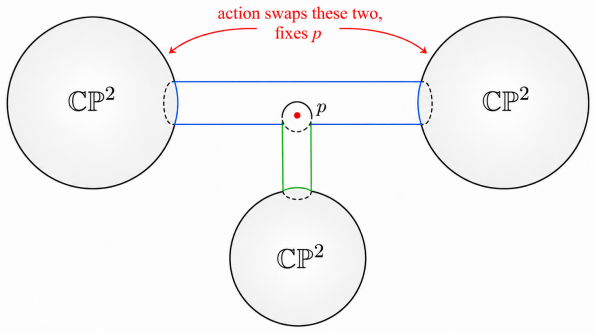
Given a smooth, oriented, simply-connected $4$-manifold $M$, the homological Nielsen realization problem asks: when does a finite group of isometries $G\leq O(H_2(M;\mathbb{Z}))$ preserving the intersection form lift isomorphically to a finite group of orientation-preserving diffeomorphisms? We study this question for the smooth, positive-definite 4-manifolds $M_n:=\#_n\mathbb{CP}^2$. Even though every isometry of $H_2(M_n;\mathbb{Z})$ is induced by some orientation-preserving diffeomorphism, not necessarily of finite order, we show that Nielsen realization is sparse: as $n\to\infty$, a random subgroup of $O(H_2(M_n;\mathbb{Z}))$ is asymptotically almost never realizable in $\mathrm{Diff}^+(M_n)$; the same is true for random odd order elements of $O(H_2(M_n;\mathbb{Z}))$. We present both positive realization results in certain cases and a range of obstructions to realization in other cases. The proofs combine equivariant connected-sum constructions, fixed-point theory for group actions on 4-manifolds, finite group actions on surfaces, analytic combinatorics, and previous work of Hambleton--Tanase.
Figures

Figures from the paper (4 more)

Reference graph
Works this paper leans on
-
[1]
On the mapping class groups of simply-connected smooth 4-manifolds
[BA25] R. ˙Inanc Baykur and Mihail Arabadji. “Nielsen realization in dimension four and pro- jective twists”. In:Adv. Math.463.110112 (2025). [Bar] David Baraglia. “On the Mapping Class Groups of Simply-Connected Smooth 4- Manifolds”. To appear in Algebraic Topology and Geometry, arXiv:2310.18819. [BK23] David Baraglia and Hokuto Konno. “A note on the Nie...
work page Pith review arXiv 2025
-
[2]
[Fre82] Michael H. Freedman. “The topology of 4-manifolds”. In:J. Diff. Geom.17.3 (1982), pp. 357–453. [Gab+] David Gabai et al. “Pseudo-isotopies of simply connected 4-manifolds”. arXiv:2311.11196. [HL95] Ian Hambleton and Ronnie Lee. “Smooth group actions on definite 4-manifolds and moduli spaces”. In:Duke Math. J.78 (1995), pp. 715–732. [HT04] Ian Hamb...
Reviewed June 29, 2026 · model on record in the stance chip above.
Discussion (0). Continue with ORCID to comment.