REVIEW 3 major objections 4 minor 7 references
Refractometry of birefringent materials at Brewster angle
T0 review · 3 major / 4 minor · reviewed 2026-08-14 · deepseek-v4-flash
Pith's one-line read With the optic axis in the test plane, two Brewster minima in one p-polarized reflection scan give both the ordinary and extraordinary refractive indices of a uniaxial material through the tangent relation.
desk verdict A Brewster-refractometry extension with a plausible ordinary-ray recipe but an unsupported extraordinary-ray formula and a quartz check that doesn't check. read the letter →
The pith
A machine-rendered reading of the paper's core claim, the machinery that carries it, and where it could break.
The reading
What carries the argument
The load-bearing identity is the Brewster relation $\tan\varphi_{\mathrm{Brw}} = n$, applied separately to the ordinary and extraordinary rays after the optic axis is placed in the test plane and alternately aligned so that the testing light is ordinary or extraordinary. The experimental mechanism is an angular scan of the reflected power of p-polarized light, with the Brewster angle read from the zero of the derivative of reflected power with respect to the scan angle, which removes the constant residual-power floor that displaces the apparent minimum. The combination of the tangent identity and the derivative-zero reading is what converts two measured angular minima into $n_o$ and $n_e$.
What would settle it
Take a well-characterized uniaxial crystal, for example quartz or calcite, with the optic axis in the plane of incidence, measure the p-polarized reflectance minimum as a function of incidence angle, and compare the angle with $\arctan(n_e)$ from independent minimum-deviation or prism measurements. If the observed minimum is shifted by more than the claimed sub-minute accuracy, or if the zero of the exact uniaxial Fresnel reflection coefficient lies elsewhere, the central claim fails.
Extended reading notes
Core claim
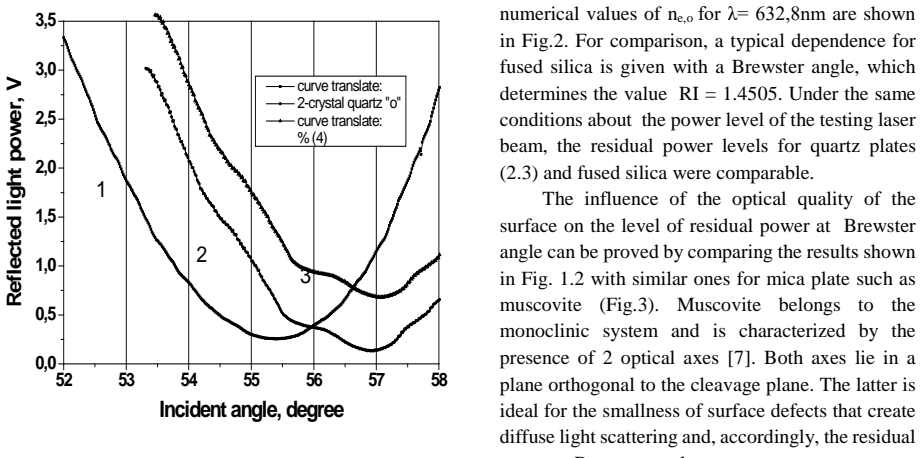
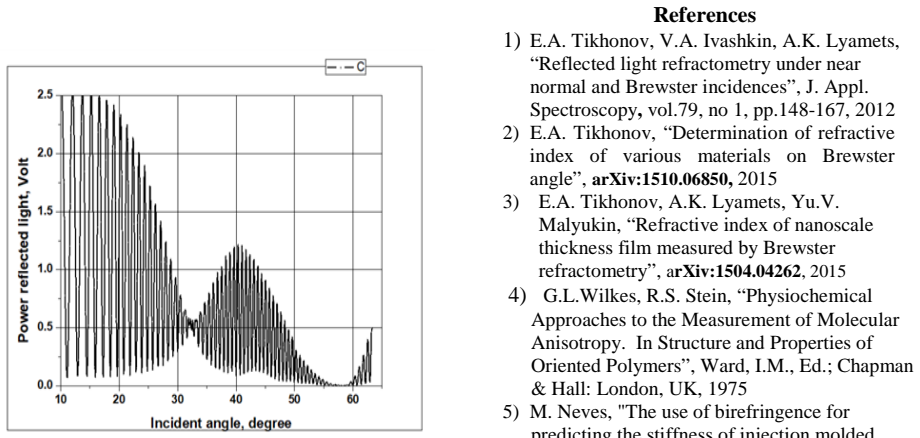
The paper claims that a uniaxial birefringent material whose optic axis lies in the test plane produces two distinct Brewster minima in a single angular scan of p-polarized reflected light, one for the ordinary ray and one for the extraordinary ray, and that these minima obey $\tan\varphi_{\mathrm{Brw}} = n_o$ and $\tan\varphi_{\mathrm{Brw}} = n_e$. This is put forward as a new method for determining the refractive indices of birefringent materials by Brewster refractometry, requiring only one optically polished surface. The paper also explains that the residual power at the Brewster minimum is not zero in practice—surface roughness, incomplete polarization, misalignment, and back-surface reflections contribute—and that the true angle should be located from the zero of the derivative of reflected power with respect to angle. Tests on an oriented polymer film, a $\lambda/4$ quartz plate, and muscovite mica give birefringence values comparable to known data, with the quartz result differing from sodium-line values only in the third decimal place due to dispersion.
Load-bearing premise
The load-bearing premise is that the isotropic Brewster relation $\tan\varphi_{\mathrm{Brw}} = n$ remains exactly valid for the extraordinary ray when the optic axis lies in the test plane and the electric field is parallel to it, so that the two measured minima can be converted directly into $n_o$ and $n_e$ without correcting for the angle between the wave normal and the optic axis.
Editorial extensions
If this is right
- With a single polished surface, both principal refractive indices ($n_o$ and $n_e$) of a uniaxial material can be extracted from one angular scan, since each Brewster minimum maps directly to an index through $\tan\varphi_{\mathrm{Brw}} = n_{o,e}$.
- Reading the Brewster angle from the zero of the derivative of reflected power rather than from the residual minimum removes constant background offsets, making the angle determination robust to diffuse scattering and constant noise power.
- The birefringence $\Delta n = n_e - n_o$ follows directly from the difference of the two tangent values, so the method gives an anisotropy measurement without needing thickness or two-surface data.
- The residual power at the Brewster minimum becomes a surface-quality indicator; the mica measurement shows it can be three orders of magnitude below the off-Brewster reflected power on a clean cleavage plane.
- For oriented polymer films with production-induced anisotropy, the method turns a standard reflected-intensity scan into a quantitative measure of the ordinary and extraordinary indices, comparable to what crossed-polarizer inspection only indicates qualitatively.
Reading between the lines
- A natural extension not developed in the paper is to map $n_o$ and $n_e$ spatially by translating the beam across a film and repeating the derivative-zero analysis; because the method needs only one surface, it could produce two-dimensional index maps of stretched polymers.
- The same derivative-zero data-reduction could be adopted in other reflectance-based refractometry and ellipsometry settings whenever an angle-independent background contaminates the minimum, since the zero of $dR/d\varphi$ is invariant to constant offsets.
- The paper's own caveat about biaxial mica suggests the method may generalize to two-axis crystals when the optic plane is handled carefully, but the required beam classification for two-axis crystals remains open and would need independent verification.
- A direct theoretical check of the assumption would be to solve the exact reflection problem for a uniaxial half-space with the optic axis in the plane of incidence; if the zero-reflection angle is not $\arctan(n_e)$ but a function of the angle between the wave normal and the axis, then the extraordinary index obtained by the simple tangent formula carries a systematic bias.
Signed reviews
Editorial analysis
A structured set of objections, weighed in public.
Referee Report
Summary. The paper proposes a Brewster-angle refractometry method for uniaxial birefringent materials. The authors claim that by orienting the optical axis in the plane of incidence and aligning it alternately parallel and perpendicular to the incident p-polarized electric field, two angular minima are observed; each minimum is converted to a refractive index through the isotropic relation tan(φ_Brw) = n_{e,o}. Measurements are reported for Scotch tape, a crystalline quartz λ/4 plate, and muscovite mica, and the nonzero residual reflected power at the Brewster angle is discussed. The paper concludes that it 'presents a new method for determining refractive indices for uniaxial birefringent materials using Brewster refractometry method.'
Significance. If the method were valid, it would offer a simple single-surface technique for measuring both the ordinary and extraordinary refractive indices of uniaxial materials, which would be practically useful. The paper also draws attention to the practical problem of residual reflected power at the Brewster angle and proposes a derivative-based method for locating the minimum that can mitigate angle-dependent noise. However, the central claim is not established: the extraordinary-ray conversion is asserted without a derivation, and the quartz benchmark is quantitatively inconsistent with accepted refractive-index data. The method's factual basis is therefore currently unsupported, and the significance of the contribution as presented is limited.
major comments (3)
- [Section 2 (Core of Brewster refractometry) and Section 2 (Determination IR at birefringence)] The conversion tan(φ_Brw) = n_e for the extraordinary ray is invoked without derivation for the stated geometry. When the optic axis lies in the plane of incidence and the wave normal inside the crystal makes an angle with the optic axis, the extraordinary wave has an effective refractive index that depends on that angle, and the zero-reflection condition must be obtained from the anisotropic Fresnel boundary-value problem rather than by inserting n_e into the isotropic formula. The projection argument presented in the text (that the cos(x) component of the electric field parallel to the optic axis excites the extraordinary wave while the sin(x) component is inert) does not lead to the Brewster condition, and the manuscript itself defers the matter by stating that the 'correct determination of Brewster angle will be checked out experimentally.' Because the claimed two-index method in Section 4 rests entirely on tan(φ_Brw) = n_{e,o}, this missing derivation is load-bearing.
- [Section 2 (Determination IR at birefringence), Fig. 2] The quartz validation is quantitatively inconsistent with accepted values. The paper reports n_{e,o} = 1.544 and 1.536 for crystalline quartz at 632.8 nm, whereas accepted values are n_o ≈ 1.542 and n_e ≈ 1.551 (quartz is positive uniaxial). The reported extraordinary index is about 0.015 lower than the accepted value and is lower than the reported ordinary index, which contradicts the known sign of quartz birefringence. The text attributes the deviation to dispersion from the sodium D line, but dispersion between 589.3 nm and 632.8 nm is only about 0.002–0.003, not 0.015. Thus the validation does not independently confirm the extraordinary-ray formula and instead suggests that the extraordinary-ray measurement is systematically in error.
- [Section 2 (Determination IR at birefringence)] No uncertainty analysis or error bars are reported for the refractive indices. The authors mention a 1 arcmin scanning step and claim sub-minute determination of the Brewster angle, but they do not propagate this angular uncertainty into n, and the paper's own discussion of residual power and possible angular shifts of the minimum (due to angle-dependent noise) makes such an error estimate essential. For a metrology-oriented paper, the absence of any error estimate leaves the claimed accuracy unsupported.
minor comments (4)
- [Throughout] The manuscript contains numerous typographical and grammatical errors, including duplicated section numbering (both sections are numbered 2), 'IR' instead of 'RI' in the section title 'DETERMINATION IR AT BIREFRINGENCE,' and nonstandard phrasing such as 'the testing light does not experience the birefringent in the material.'
- [Section 2 (Core of Brewster refractometry)] The term 'TH-wave' is used without definition; presumably it means a transverse-magnetic (p-polarized) wave. Please define it at first use.
- [Fig. 1 and Fig. 2 captions] The figure captions are incomplete and some sentences are cut off (e.g., 'at an(j) indication of correct determination of the Brewster angle' and 'of the residual noise disappears'). These need to be rewritten so that each caption is self-contained.
- [Section 2 (Determination IR at birefringence)] The phrase 'differ in the 3rd sign from the values on the yellow sodium line' is unclear; presumably 'in the third decimal place' is meant. Please rewrite.
Circularity Check
No circularity: measured Brewster angles are converted by the independent Fresnel law tan(phi)=n, and quartz/mica data serve as external benchmarks.
full rationale
The paper's derivation chain is linear: angular positions of reflected-power minima are measured directly; the refractive indices are then inferred through the standard Fresnel Brewster relation tan(phi_Brw)=n_e,o. The angle is an independent observable, and n is not a fitted parameter renamed as a prediction. The validation against crystalline quartz and muscovite mica constitutes an external benchmark, not an input to the measurement. The references to the authors' earlier work [1,2,3] concern the isotropic Brewster refractometry procedure, noise treatment, and residual-power corrections; the central Fresnel formula is textbook physics and does not depend on those papers for its content. The paper's treatment of the extraordinary ray is physically underived, since the zero-reflection condition for a uniaxial crystal is not generally tan(phi)=n_e, but that is a correctness or rigor issue, not circularity: the paper does not define the extraordinary index as the tangent of the measured angle by construction, and it explicitly states that the correct determination is to be checked experimentally. No step in the argument reduces to its own input, so no circularity is exhibited.
Assumptions & free parameters
assumptions (3)
- domain assumption Isotropic Fresnel Brewster relation tan(φ_Brw)=n applies to both ordinary and extraordinary rays in the birefringent geometry.
- ad hoc to paper Only the component of the incident electric field parallel to the optical axis excites the extraordinary polarization wave; the sin(x) component is inert.
- domain assumption The optical axis of the sample can be aligned parallel to the turning axis (ordinary case) or parallel to the electric field (extraordinary case) with negligible error.
Cite this review
Pith. "Pith review of Refractometry of birefringent materials at Brewster angle." pith.science (2026). https://pith.science/paper/52J3EF5E
@misc{pith2026190809620,
  author       = {Pith},
  title        = {Pith review of: Refractometry of birefringent materials at Brewster angle},
  year         = {2026},
  howpublished = {\url{https://pith.science/paper/52J3EF5E}},
  note         = {Machine review of arXiv:1908.09620}
}
read the original abstract
A refractometry taking measuring of Brewster angles for birefringent materials is proposed. The technique is based on the angular scanning of the reflected power of p-polarized light and the determination of the two specific minimums at the Brewster angles for the two orthogonal orientations of the optical axis of the material. In these configurations, the testing light does not experience the birefringent in the material, assuming the state of ordinary or extraordinary rays alternately to orientation of the optical axis. The origin and influence on the measurement of the nonzero residual power at Brewster angle are accentuated.
Figures
Reference graph
Works this paper leans on
-
[1]
Reflected light refractometry under near normal and Brewster incidences
E.A. Tikhonov, V.A. Ivashkin, A.K. Lyamets, “Reflected light refractometry under near normal and Brewster incidences”, J. Appl. Spectroscopy, vol.79, no 1, pp.148-167, 2012
work page 2012
-
[2]
Determination of refractive index of various materials on Brewster angle
E.A. Tikhonov, “Determination of refractive index of various materials on Brewster angle”, arXiv:1510.06850, 2015
work page Pith review arXiv 2015
-
[3]
Refractive index of nanoscale thickness films measured by Brewster refractometry
E.A. Tikhonov, A.K. Lyamets, Yu.V. Malyukin, “Refractive index of nanoscale thickness film measured by Brewster refractometry”, arXiv:1504.04262, 2015
work page Pith review arXiv 2015
-
[4]
G.L.Wilkes, R.S. Stein, “Physiochemical Approaches to the Measurement of Molecular Anisotropy. In Structure and Properties of Oriented Polymers”, Ward, I.M., Ed.; Chapman & Hall: London, UK, 1975
work page 1975
-
[5]
The use of birefringence for predicting the stiffness of injection molded polycarbonate discs
M. Neves, "The use of birefringence for predicting the stiffness of injection molded polycarbonate discs", Polymer Engineering & Science, vol. 38, no 10, pp.1770-1778, , doi:10.1002/pen.10347, 1998
-
[6]
Effect of Moisture on the Orientation, Birefringence of Cellulose Esters
M.Edeerozey, AbdManaf, M.Tsuji, Sh. Nobukawa, M. Yamaguchi, “Effect of Moisture on the Orientation, Birefringence of Cellulose Esters”, Polymers, vol.3 pp.955-966, doi:10.3390/polymer30209552011, 2011,
-
[7]
Mica, Types and main parameters, Russia State Standards (ГОСТ) 1069, 8-80, 1988
work page 1988
Reviewed August 14, 2026 · model on record in the stance chip above.
Discussion (0). Continue with ORCID to comment.