REVIEW 4 major objections 4 minor 1 cited by
Evaluation of nearby young moving groups based on unsupervised machine learning
T0 review · 4 major / 4 minor · reviewed 2026-08-14 · deepseek-v4-flash
Pith's one-line read Unsupervised clustering of young stars recovers six known moving groups and merges three others into two, so standard group boundaries should be revised.
desk verdict An honest re-clustering of known moving-group members that recovers six groups but overreaches when it defines THC by post-hoc union of clusters the two algorithms keep separate. read the letter →
The pith
A machine-rendered reading of the paper's core claim, the machinery that carries it, and where it could break.
The reading
What carries the argument
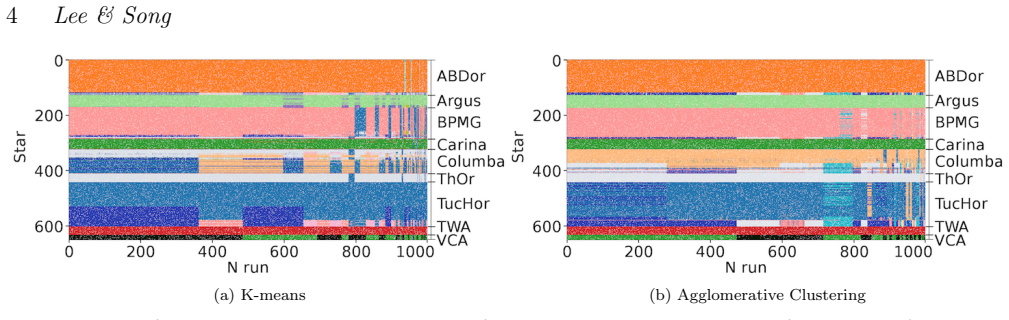
The load-bearing mechanism is a repeated-clustering stability test. K-means (which minimises within-cluster squared distances) and agglomerative clustering with Ward linkage are each run 1,000 times for every choice of cluster number from 3 to 10, with each run using a random 95 per cent subsample of the 652 input stars after the positions, velocities, and age classes have been rescaled to comparable ranges. A star is counted as a bona fide member of a newly recognised group only if it falls in the same cluster in more than 70 per cent of the runs of both algorithms. The conclusions are built from the recurrent grouping pattern across the 16,000 runs rather than from any single clustering.
What would settle it
Run the same two clustering algorithms on a sample of young nearby stars selected without prior membership labels—for example, all stars within 100 pc with high-precision astrometry, radial velocities, and lithium-based ages—without fixing the cluster number to the old nine-group count, and ask whether the six recovered groups persist while ThOr-Col and THC reappear as their own clusters. If the two hybrid groups dissolve into the field or recombine differently, the proposed redrawing of ThOr, Columba, and TucHor is not robust.
Extended reading notes
Core claim
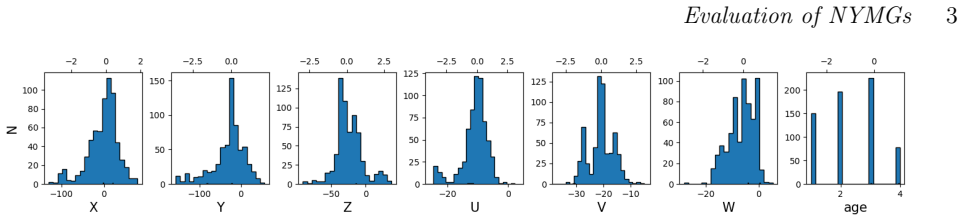
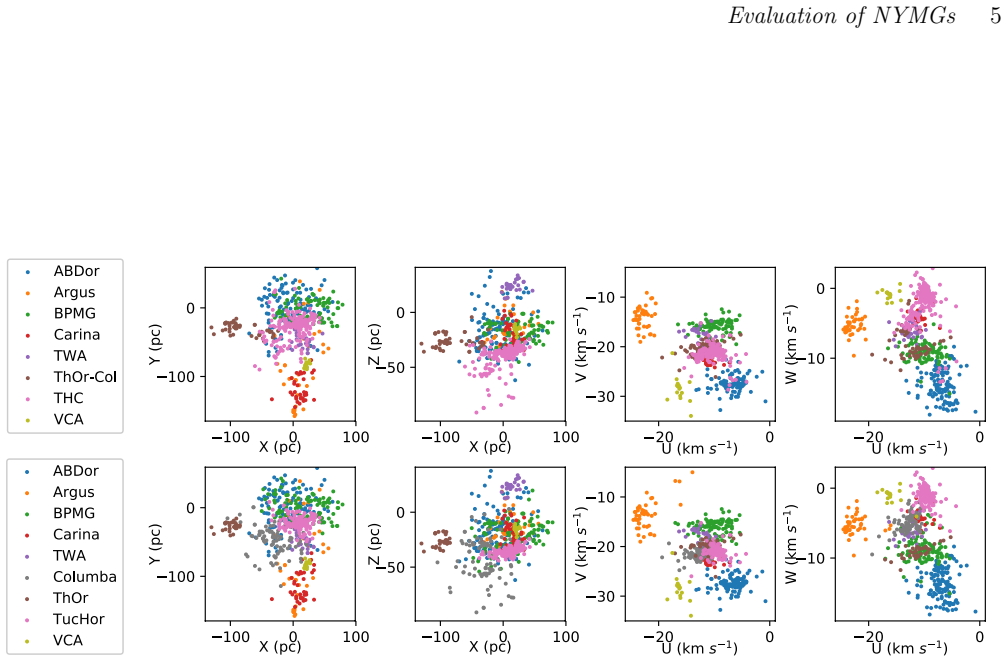
The central claim is that unsupervised clustering in the seven-dimensional space of Galactic position ($X,Y,Z$), space velocity ($U,V,W$), and categorical age recovers six previously defined moving groups as robust entities but does not recover ThOr, Columba, and TucHor as separate clusters. With the cluster number set to nine, both K-means and agglomerative clustering place essentially all of ThOr together with a large subset of Columba in a group the authors name ThOr-Col, and place TucHor with most of the remaining Columba members in a group named THC. The authors conclude that those three groups cannot be cleanly separated with the available age-spatio-kinematic information, so their traditional division should be revised; they note this agrees with an earlier proposal to merge TucHor and Columba. They also report that 11 of 18 known planet-host stars remain bona fide members of the newly defined groups, while 7 are no longer consistently retained.
Load-bearing premise
The test depends on the authors' earlier membership catalog being an unbiased and complete picture of the true moving groups; the machine can only regroup the 652 stars that someone already accepted as members, so any group missing from that input or any selection bias in it would be inherited by the clusters.
Editorial extensions
If this is right
- Six of the traditional nine groupings—AB Doradus, Argus, $\beta$ Pic, TWA, Carina, and Volans-Carina—are stable clusters in the repeated trials, so those moving-group labels appear to correspond to real spatio-kinematic structures.
- The ThOr-Col and THC groupings imply that ThOr, Columba, and TucHor should not be treated as three independent associations in studies of young stars.
- The THC result supports the earlier suggestion that TucHor and Columba members should be combined because they cannot be reliably separated.
- The new bona fide member lists keep 11 of 18 planet-host stars and drop 7, so the redefined groups change which stars are used as young-planet host samples.
- Adopting the new eight-group configuration provides a consistently defined input set for future, fully unbiased searches of nearby young stars.
Reading between the lines
- Because the input stars were preselected as known members, the recovery of six groups does not by itself prove those groups are real; the genuinely new information is the recombination of ThOr, Columba, and TucHor.
- Using continuous ages with measured uncertainties instead of five broad age classes could split the ThOr-Col hybrid into finer populations, a testable extension of this scheme.
- Applying the same bootstrap-clustering protocol to an all-sky sample that includes field stars would test whether the eight proposed groups persist without any prior membership labels.
- Requiring agreement among more than two algorithms, or a higher consensus threshold, would likely shrink the new member lists, so the group sizes should be read as sensitive to the chosen stability criterion.
Signed reviews
Editorial analysis
A structured set of objections, weighed in public.
Referee Report
Summary. The paper applies two unsupervised clustering algorithms (K-means and Agglomerative Clustering) to 652 previously identified bona fide members of nine nearby young moving groups from the authors' prior catalog (Lee & Song 2019), using XYZ, UVW, and an age-class variable. For each algorithm and for nclusters values from 3 to 10, the authors run 1000 trials with 95% random sampling. At nclusters=9, they report recovering six of the nine input groups (AB Doradus, Argus, beta Pic, Carina, TWA, Volans-Carina) and propose two new merged groups: ThOr-Col (ThOr plus part of Columba) and THC (TucHor plus part of Columba). The paper concludes that some traditionally defined moving group boundaries are not supported by the spatio-kinematic-age data.
Significance. If the central claim is validated, the finding that ThOr, Columba, and TucHor do not emerge as distinct clusters would be of real interest to the nearby-young-moving-group community and would lend support to earlier suggestions of mergers (e.g., Zuckerman et al. 2011). The paper is commendable for making its clustering exercise transparent via repeated bootstrap runs and for presenting detailed visualizations of run-to-run variability. However, the validity of the two new merged groups, and of the recovery claim for six groups, is weakened by internal inconsistencies with the paper's own recognition criteria, as detailed below.
major comments (4)
- [Section 3.2, Table 1] The paper's own reliability criterion is not met for Carina and VCA. In Table 1, Carina is recognized in 70% of K-means runs but only 35% of Agglomerative Clustering runs, and VCA likewise in 70% and 35% of runs, respectively. According to the criterion stated in Section 2.3.2 that members are recognized as bona fide only when consistently assessed in more than 70% of trial runs between the two algorithms, Carina and VCA would not be reliably recognized by the Agglomerative algorithm. The paper nevertheless lists them among the six recovered groups, which overstates the support for the recovery claim.
- [Section 3.2, Table 1] The definition of THC violates the paper's own group-recognition standard. The text states that in the remaining TucHor/Columba members, the two groups found by K-means and Agglomerative Clustering 'do not match well,' and that a single group is then defined enclosing these two group members. THC is therefore a residual set, not a cluster produced by either algorithm, and it cannot satisfy the >70% consistency criterion across algorithms. The claim that TucHor and Columba form a new combined group is unsupported by the clustering output. Appendix A reinforces this by showing that at nclusters=8 Agglomerative Clustering keeps Columba and TucHor separate, and at nclusters=10 TucHor is split into two groups; THC appears to be an artifact of the chosen nclusters=9 and the post-hoc merging of disagreeing clusters.
- [Section 2.1 and Section 1] The evaluation is not independent of the input labels. The clustering input is the authors' own Lee & Song (2019) bona fide member catalog, and the 'recovery' of six groups is measured against those same labels. Consequently, the recovery of six groups is partly a restatement of the input selection and cannot by itself validate the reality of those groups. The language in the abstract and Section 1 about evaluating NYMGs 'without relying on any previous knowledge' is misleading because, while the algorithms themselves are unsupervised, the data selection and the decision to use nclusters=9 (Section 3.2) reintroduce prior knowledge. The paper should explicitly limit the strength of the recovery claims.
- [Section 3.2, Appendix A] The choice of nclusters=9 is not robustly justified. The four-group test with nclusters=4 recovering the four input groups is suggestive but does not establish that nclusters=9 is the correct number of groups for the full dataset. Appendix A shows that results are qualitatively sensitive to nclusters: Carina and VCA are merged at nclusters=8 and separated only at nclusters=9-10, and TucHor/Columba separations change with nclusters. A quantitative cluster-validity index (e.g., silhouette width) or a formal stability analysis across nclusters should be provided before drawing strong conclusions about the number and composition of distinct moving groups.
minor comments (4)
- [Abstract] The sentence 'Three the other known groups are recognised as well; however, they are combined into two new separate groups' is grammatically awkward; it should be rephrased, for instance as 'The remaining three known groups are not recovered in their original form; instead, they are combined into two new groups.'
- [Appendix A] The table header 'Tabel A1' contains a typo and should read 'Table A1'.
- [Section 2.3.1] The transformation constants for the age class (subtract 3.125, multiply by 1.25) are stated without explanation; providing the rationale for these particular values would aid reproducibility.
- [Section 3.2, Table 1] The notation using primes (′, ″) to indicate partial membership is not defined in the table itself; it should be defined in the caption or in the text immediately preceding the table.
Circularity Check
The claimed THC group is a post-hoc union of leftover input members, not a cluster; the six recovered groups and ThOr-Col are genuine unsupervised outputs, so the circularity is partial.
-
renaming known result
[Section 3.2, definition of THC immediately after Table 1]
"While each K-means and Agglomerative Clustering algorithm recognises two groups in the remaining members, the two groups from these algorithms do not match well (i.e., the specific content of two groups from both algorithms are different). Therefore, we define a single group enclosing these two group members. This group is called THC (TucHor-Col)."
At nclusters=9, the two algorithms never agree on a TucHor+Columba cluster: Table 1 shows K-means producing Columba'+TucHor' (60%) and Columba'+TucHor'' (60%), while Agglomerative Clustering produces Columba' (80%) and TucHor' (50%). THC is therefore defined post hoc as the union of the leftover members of two input groups, and the abstract's statement that these three known groups 'are combined into two new separate groups (ThOr+Columba and TucHor+Columba)' is true by definition for THC, not by the clustering output. The paper's own >70% consistent-assignment criterion for bona fide groups is not met by THC.
full rationale
The core clustering procedure is not circular: the two unsupervised algorithms never see the input group labels, so the recovery of ABDor, Argus, BPMG, TWA, Carina, and VCA is a genuine consistency check, and ThOr-Col is also an emergent cluster rather than a relabeling of the input. The use of the authors' own Paper I membership catalog as input is a real selection-bias limitation, and the paper explicitly concedes that a fully unbiased test would need to include field stars and unknowns; but that is a limitation of experimental design, not a derivation that reduces to its own input. The one circular step is the THC group: it is not a cluster produced by either algorithm at nclusters=9 but a group defined by the authors around the disagreeing residual members of the input TucHor and Columba groups. Since the novel claim that TucHor and Columba merge into a new group rests on this definition, that component of the paper's central result is circular by construction, while the remaining claims retain independent content.
Assumptions & free parameters
free parameters (3)
- nclusters =
9 for the main result, range 3 to 10 tested
- Resilience threshold =
70 percent of runs across both algorithms
- Age class transformation constants =
scale by 1.25 and shift by 3.125
assumptions (3)
- domain assumption The bona fide membership lists of Lee and Song (2019) are a sufficiently unbiased and complete representation of the true nearby young moving groups.
- domain assumption The 7D spatio-kinematic plus age-class space is sufficient to characterize moving group membership.
- domain assumption The two clustering algorithms and their underlying distance geometry are appropriate for identifying stellar moving groups.
invented entities (2)
-
ThOr-Col group
-
THC group
Cite this review
Pith. "Pith review of Evaluation of nearby young moving groups based on unsupervised machine learning." pith.science (2026). https://pith.science/paper/52RY5EFV
@misc{pith2026190805922,
  author       = {Pith},
  title        = {Pith review of: Evaluation of nearby young moving groups based on unsupervised machine learning},
  year         = {2026},
  howpublished = {\url{https://pith.science/paper/52RY5EFV}},
  note         = {Machine review of arXiv:1908.05922}
}
abstract
Nearby young stellar moving groups have been identified by many research groups with different methods and criteria giving rise to cautions on the reality of some groups. We aim to utilise moving groups in an unbiased way to create a list of unambiguously recognisable moving groups and their members. For the analysis, two unsupervised machine learning algorithms (K-means and Agglomerative Clustering) are applied to previously known bona fide members of nine moving groups from our previous study. As a result of this study, we recovered six previously known groups (AB Doradus, Argus, $\beta$-Pic, Carina, TWA, and Volans-Carina). Three the other known groups are recognised as well; however, they are combined into two new separate groups (ThOr+Columba and TucHor+Columba).
Figures
Forward citations
Cited by 1 Pith paper
-
Peering through the disc of HD 98800 BaBb. Precise timing predictions for the HD 98800 AaAb occultation
New RVs and multi-wavelength astrometry tighten the HD 98800 outer orbit by ~2×, yielding 5–15-day 1σ windows for the 2025–2031 disc occultation of AaAb.
Reference graph
Works this paper leans on
-
[1]
Elliott P., Bayo A., Melo C. H. F., Torres C. A. O., Sterzik M., Quast G. R., Montes D., Brahm R., 2014, , 590, 13
work page 2014
-
[2]
Faherty J., Bochanski J., Gagn\' e J., Nelson O., Coker K., Smithka I., Desir D., Vasquez C., 2018, , 863, 91
work page 2018
-
[3]
Gagn\' e J., Lafreni\` e re D., Doyon R., Malo L., Artigau \' E ., 2014, , 783, 121
work page 2014
- [4]
-
[5]
H., Zuckerman B., Weintraub D.A., Forveille T., 1997, Science, 277, 67
Kastner J. H., Zuckerman B., Weintraub D.A., Forveille T., 1997, Science, 277, 67
work page 1997
-
[6]
Lee J., Song I., 2019, , 486, 3434
work page 2019
-
[7]
Liu M., 2015, Proceedings IAU Symposium, 314, 2015
work page 2015
- [8]
Show all 24 references
-
[9]
Malo L., Doyon R., Lafreni\` e re D., Artigau, \' E , Gagn\' e J., Baron, F., Riedel A., 2013, , 762, 88
2013
-
[10]
E., 2007, in B.G
Mamajek E. E., 2007, in B.G. Elmegreen, J. Palous, eds, Proc. IAU Symp. 237, Triggered Star Formation in a Turbulent ISM. Cambridge Univ. Press, p. 442
2007
-
[11]
et al., 2011, J
Pedregosa F. et al., 2011, J. Mach. Learn. Res., 12, 2825
2011
-
[12]
Riedel et al., 2017, , 153, 95
2017
-
[13]
Rodriguez et al., 2011, , 727, 62
2011
-
[14]
2010, , 48, 581
Soderblom D. 2010, , 48, 581
2010
-
[15]
Torres C. A. O., da Silva L., Quast G. R., de la Reza R., Jilinski E., 2000, , 120, 1410
2000
-
[16]
Torres C. A. O., Quast G. R., de La Reza R., da Silva L., Melo C. H. F., 2003, ASPC, 287, 439
2003
-
[17]
R., Melo C
Torres C.A.O., Quast G. R., Melo C. H. F., Sterzik M., 2008, in Handbook of Star Forming Regions, Volume II: The Southern Sky, ed. B. Reipurth (ASP Monograph Publ., Vol. 5; San Francisco, CA: ASP), 757
2008
-
[18]
Viana Almeida P., Santos N.C., Melo C., Ammler-von Eiff M., Torres C.A.O., Quast G.R., Gameiro J.F., Sterzik M., 2009, , 501, 965
2009
-
[19]
A., 2000, , 535, 959
Zuckerman B, Webb R. A., 2000, , 535, 959
2000
-
[20]
S., Webb R
Zuckerman B, Song I., Bessell M. S., Webb R. A., 2001, , 562, 87
2001
-
[21]
Zuckerman B., 2001, ASP conference, 244, 122
2001
-
[22]
Zuckerman B, Song I., 2004, , 42, 685
2004
-
[23]
S., 2011, , 732, 61
Zuckerman B., Rhee J., Song I., Bessell M. S., 2011, , 732, 61
2011
-
[24]
Zuckerman B., 2019, , 870, 27
2019
Reviewed August 14, 2026 · model on record in the stance chip above.
Discussion (0). Continue with ORCID to comment.