REVIEW 5 major objections 5 minor 141 references
Testing the AGN unified model with simulated emission lines from the circumgalactic medium (CGM)
T0 review · 5 major / 5 minor · reviewed 2026-08-06 · deepseek-v4-flash
Pith's one-line read Simulated CGM nebulae around obscured and unobscured AGN at z=2–3 differ in symmetry, surface brightness slope, and Lyα line width, but only joint stacking along radio jets can test the unified model.
desk verdict First useful simulations of type-II AGN nebulae and a promising radio-jet stacking test, but the ≥75-source requirement rests on a pseudo-replicated bootstrap and needs reframing. read the letter →
The pith
A machine-rendered reading of the paper's core claim, the machinery that carries it, and where it could break.
The reading
What carries the argument
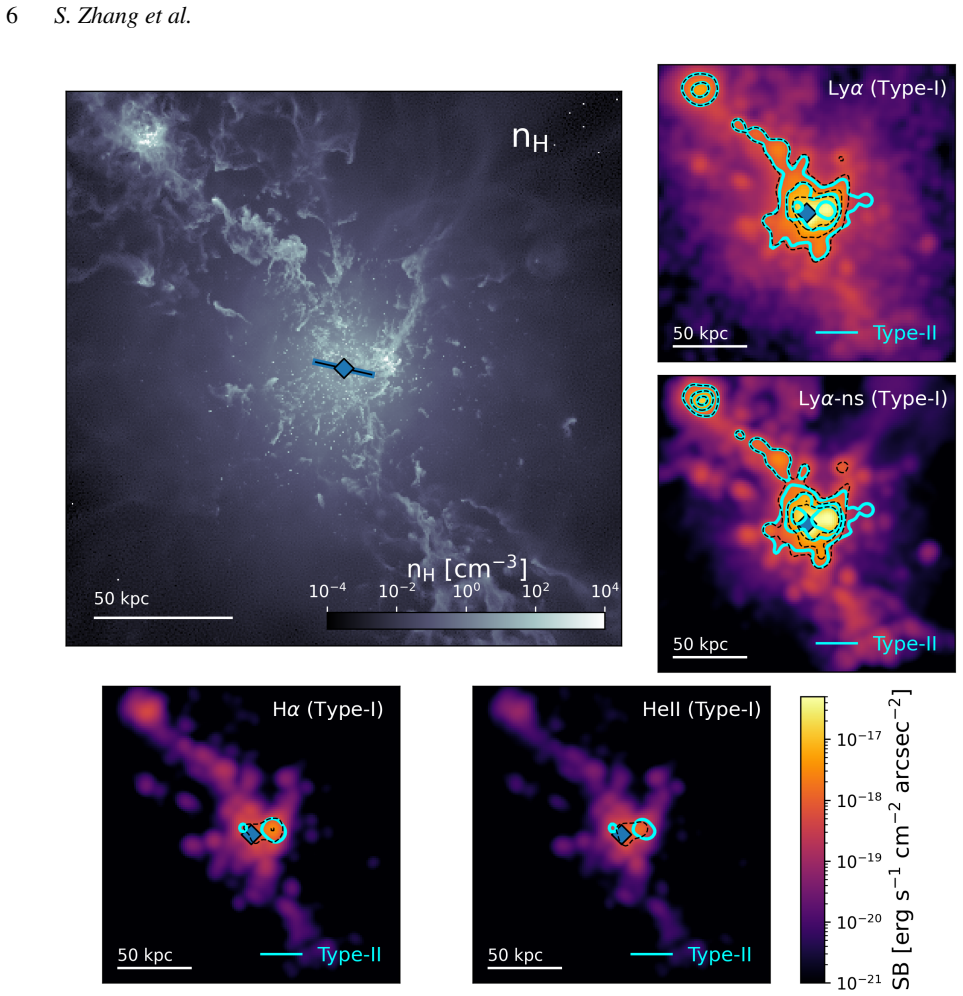
The central object is the ionization cone carved by the AGN's dusty torus: sightlines inside the cone (type-I) project the cone as a circle, while sightlines outside (type-II) project it as an hourglass-like shape. This projection difference drives the predicted asymmetries (quantified by the flux-weighted αw axis-ratio parameter), the flatter surface brightness profiles (quantified by the scale length r_h), and the outer line-width offsets. The stacking test relies on the assumption that radio jets are coaxial with the torus, so aligning nebulae along the jet direction exposes the cone's elongation.
What would settle it
Conduct the jet-aligned stacking of ≥75 type-II Lyα nebulae at z=2–3 with a surface brightness limit near $10^{-18}$ erg $s^{-1}$ $cm^{-2}$ $arcsec^{-2}$; if the stacked type-II nebulae show no elongation along the jet axis relative to type-I stacks, the claim that the ionization cone imprints on CGM nebulae would be falsified.
Extended reading notes
Core claim
Under the AGN unified model, the paper claims that type-II (obscured) CGM nebulae exhibit less symmetric morphologies, flatter surface brightness profiles, and larger Lyα emission line widths at R≥10 kpc than type-I (unobscured) nebulae, while luminosity, area, and HeII/Lyα are statistically indistinguishable. Because the projection of the ionization cone cannot be known a priori in observations, nebula observations alone cannot test the unified model. However, stacking at least 75 type-II Lyα nebulae aligned along their radio jets can reveal the ionization cone at 95% confidence with current instruments.
Load-bearing premise
The simulation assumes type-I and type-II AGN have identical intrinsic luminosity and SED, differing only by the observer's viewing angle through the dusty torus; if real obscured AGN are intrinsically fainter or have different SEDs, the predicted differences may not transfer to observations.
Editorial extensions
If this is right
- Type-II nebulae should be systematically less symmetric than type-I nebulae when AGN luminosity and torus opening angle are matched.
- Type-II nebulae should show flatter surface brightness profiles (larger scale length) and larger Lyα line widths at R≥10 kpc, although the ~20 km s−1 width offset may be near current instrument limits.
- Nebula properties correlate with AGN intrinsic luminosity and torus half-opening angle, so they can constrain the AGN engine but cannot test the unified model by themselves.
- Stacking ≥75 type-II Lyα nebulae aligned along their radio jets should reveal the ionization cone at ≥95% confidence with present-day instruments.
Reading between the lines
- If the unified model holds, the predicted HeII/Lyα equality between types implies that line-ratio selection alone cannot classify obscured versus unobscured nebulae, so future surveys should prioritize morphological and kinematic diagnostics.
- A natural extension is to apply the same jet-aligned stacking to already abundant type-I Lyα nebulae; residual elongation there would signal jet-enhancement of Lyα rather than the cone, contaminating the test.
- The ≥75-source requirement implies that current samples of type-II nebulae (only a few cases) are far too small, so a dedicated narrowband or IFU survey of obscured AGN at z=2–3 is a concrete next step.
- Because the simulations omit AGN feedback, the predicted differences may be amplified or damped in real systems; including quasar-mode feedback would boost the anisotropy, making the cone easier to detect.
Editorial analysis
A structured set of objections, weighed in public.
Referee Report
Summary. This paper uses ten FIRE zoom-in halos at z=2-3 and post-processes them with CLOUDY and the Lyα Monte Carlo code RASCAS to generate mock Lyα, Hα, and HeII nebulae around type-I (unobscured) and type-II (obscured) AGN. The AGN radiation is anisotropic, with torus half-opening angle Δ ∈ [50°,70°] and observer viewing angle defining AGN type (Sec. 2.2). The central results are: the two nebula types have statistically indistinguishable luminosity, area, and HeII/Lyα within the virial radius; type-II nebulae are less symmetric, have flatter SB profiles, and have larger Lyα line widths at R≥10 kpc; nebulae properties correlate with Δ and L_AGN in a complicated way; and stacking ≥75 type-II Lyα nebulae aligned on radio jets could reveal the ionization cone at 95% confidence with current instruments (Secs. 3, 4). The paper concludes that nebula observations alone cannot test the unified model because the cone geometry is unknown a priori.
Significance. If the predictions are robust, this is the first systematic simulation of type-II CGM nebulae and gives a concrete, falsifiable observing strategy for the ionization cone at z=2-3. Strengths include the use of a realistic multiphase CGM from FIRE, the explicit treatment of photoionization with CLOUDY and resonant scattering with RASCAS, and the favorable comparison with observed type-I Lyα luminosity-area, symmetry, and SB profiles. The paper also carefully flags several model limitations in the text (Sec. 3.5, Sec. 4.3, Appendix B). However, the headline sample-size estimate rests on pseudo-replication of only 10 halos, and the transfer of the predictions to observed type-II AGN assumes identical intrinsic luminosity between the two populations. These issues must be addressed before the quantitative claims can be adopted.
major comments (5)
- [Sec. 4.2, Fig. 14, Sec. A4] The bootstrap behind the '≥75 type-II Lyα nebulae' estimate draws with replacement from 90 type-II (and 90 type-I) mock images, but these images are not 90 independent CGM realizations: they are 10 halos × 3 random cone orientations × 3 torus half-opening angles (Sec. A4), with the same gas density fields reused across orientation and Δ. The resampled distribution therefore mixes within-halo and between-halo variance, and the resulting 95% confidence sample size does not directly estimate the halo-to-halo variance a real survey would have. If between-halo scatter dominates, the required N is larger than 75; if within-halo scatter dominates, it is smaller. Please replace the naive bootstrap with a cluster/block bootstrap that resamples halos (or otherwise reports the uncertainty in N_required), and re-derive the headline number.
- [Sec. 4.1, Table 3, Fig. 13] The claim that nebulae observations can constrain the AGN engine is supported mainly by the correlation analysis in Sec. 4.1. These correlations are computed for a single halo (A1 at z=3.0) with repeated random cone orientations and varied Δ or MBH. The Spearman p-values in Table 3 treat those repeated realizations as independent, but they share the same gas density field; the effective independent sample size is much smaller than the number of mock images. The p-values and correlation coefficients should be recomputed (or clearly labeled) with halo as the unit of independence, or the section should be presented as an illustrative single-halo study rather than a general constraint.
- [Sec. 2.2, Sec. 3.2, Sec. 3.3] The type-I/type-II mock images are generated by construction: the observer is placed inside the ionization cone for type-I and outside for type-II (Sec. 2.2, Fig. 2). The reported differences in asymmetry (Sec. 3.2) and surface-brightness slope (Sec. 3.3) therefore follow largely from the assumed projection geometry of the unified model. This makes the results a self-consistent prediction of the model, not an independent test of it. To justify the 'testing the unified model' framing, the paper should either confront the predictions with the existing type-II nebulae in detail (e.g., den Brok et al. 2020; Zhang et al. 2023a,c) or demonstrate that an alternative model (e.g., intrinsically different SEDs or feedback) would not reproduce the same observables.
- [Sec. 3.5, Sec. A1.1] The predictions assume that unobscured and obscured AGN share the same intrinsic luminosity and SED, differing only by the viewing angle through the dusty torus (Eq. A1; Sec. A1.1; also explicitly stated in Sec. 3.5). If the real type-II population at z=2-3 is intrinsically fainter or has a different SED, the predicted non-differences in luminosity, area, and HeII/Lyα, and the sample-size requirement in Sec. 4.2, will not transfer directly to observations. The authors flag this limitation, but it is load-bearing; please add a sensitivity test that varies the relative intrinsic luminosity and/or SED of the two populations, or soften the abstract and conclusions accordingly.
- [Sec. A2, Eq. A2, Appendix B] The photoionization grid uses Φ(H) computed from Eq. A2 under the assumption that the CGM is fully ionized. Appendix B shows that this is inaccurate outside the ionization cone (f_ion,esc drops to ~0.5 by 20 kpc), but it only estimates the effect on Lyα emissivity, not on the HeII/Lyα ratio or the line-width profiles. The Sec. 3.5 claim that type-I and type-II nebulae have consistent HeII/Lyα in 10-100 kpc could be sensitive to this approximation. Please quantify the effect of the optically-thin assumption on the HeII/Lyα prediction (or explicitly state that this prediction is provisional).
minor comments (5)
- [Sec. 3.2] The sentence 'αw,I≈0.71 and αw,I≈0.55' should refer to αw,II for the second value.
- [Fig. 7 caption] The caption 'the SB profiles of the type-I nebulae are flatter than those of the type-I nebulae' should read 'type-II nebulae are flatter than type-I nebulae'.
- [Table 3] The last row entries '0.78 ≥ 99' and '0.84 ≥ 99' are missing a slash and should be formatted like the other p-values (e.g., '0.78 / ≥ 99').
- [Throughout] 'Welsch t-test' should be 'Welch's t-test'.
- [Data Availability] Consider depositing the CLOUDY emissivity tables and the RASCAS configuration files in a public repository rather than 'available upon request', which would strengthen reproducibility.
Circularity Check
No circularity: the paper is a forward-modeling study whose geometric input (torus viewing angle) is explicitly acknowledged, and its quantitative claims rest on radiative-transfer post-processing and external comparisons rather than fitted outputs.
full rationale
This paper is a forward-modeling experiment, not a derivation of the unified model from nebular observations. Type-I and type-II nebulae are generated by placing the observer inside or outside a pre-assumed ionization cone (Sec. 2.2, A4), and the resulting morphological asymmetries and flatter surface-brightness profiles are openly attributed to that projection geometry (Secs. 3.1, 3.2, 3.3.1). Because the model is the input and the nebular properties are the computed output, reporting these differences as model predictions is not circular: the differences are not used to infer the very assumptions that produced them, and the paper explicitly concludes that nebular observations alone cannot test the unified model without independent knowledge of the cone orientation. The nontrivial quantitative claims—statistically indistinguishable luminosity, area, and HeII/Lyα, the ~20 km/s line-width offset, and the ≥75-source stacking requirement—emerge from CLOUDY and RASCAS post-processing of multi-phase FIRE halos with no parameter fitted to those predicted quantities, and are checked against external observational benchmarks (luminosity-area relation, observed type-I SB profiles and α_w, HeII/Lyα). The self-citations to Obreja et al. (2024) are supporting rather than load-bearing, as the paper's own χ² comparisons independently favor Δ=60°. The Sec. 3.5 caveat that observed type-I and type-II AGN may not share identical intrinsic luminosity is a transfer limitation, not a circular step, and the bootstrap pseudo-replication in Sec. 4.2 (90 images from 10 halos) is a statistical-validity concern outside the circularity definition adopted here.
Assumptions & free parameters
free parameters (5)
- Torus half-opening angle Δ =
50-70 degrees in main runs; 10-80 degrees in Sec. 4.1.1; Δ=60 degrees favored by comparison with observed SB profiles
- Viewing angle θ (observer inclination) =
0-360 degrees in steps of 10, then random in/out of cone
- Eddington ratio λ =
0.1
- AGN intrinsic luminosity L_AGN =
2.3-15.2 × 10^45 erg/s from MBH values in Table A1
- Surface brightness threshold σ_SB =
3.0×10^-19 for morphology, 3.5×10^-18 for luminosity-area, varied 10^-21 to 10^-17 in Fig. 14
assumptions (6)
- domain assumption AGN unified model geometry: an optically thick dusty torus with N_H ≥ 10^22 cm^-2 obscures the BLR along equatorial sightlines, and the ionization cone is coaxial with the torus axis
- domain assumption CGM gas from FIRE zoom-in simulations without AGN feedback is a valid template for z=2-3 massive halos
- domain assumption Both AGN types share the same intrinsic luminosity and SED, with only the viewing angle differing
- domain assumption SMBH masses are inferred from stellar masses using the MBH-M* relation at z~2 rather than from the simulated MBH
- domain assumption Radio jets are coaxial with the torus axis
- ad hoc to paper The CGM is treated as fully ionized when computing the incident ionizing flux Φ(H) in Eq. A2
Cite this review
Pith. "Pith review of Testing the AGN unified model with simulated emission lines from the circumgalactic medium (CGM)." pith.science (2026). https://pith.science/paper/53K6P5MY
@misc{pith2026250719585,
  author       = {Pith},
  title        = {Pith review of: Testing the AGN unified model with simulated emission lines from the circumgalactic medium (CGM)},
  year         = {2026},
  howpublished = {\url{https://pith.science/paper/53K6P5MY}},
  note         = {Machine review of arXiv:2507.19585}
}
abstract
The CGM around unobscured AGN has received much attention in recent years. Comparatively, nebulae associated with obscured AGN are less studied. Here, we simulate the Ly$\alpha$, H$\alpha$, and HeII nebulae around the two types of AGN at $z=2-3$ with ten massive systems from the FIRE simulations based on the unified model to show their differences and to test if they can be used to constrain the AGN model. We post-process the data with the CLOUDY and the Ly$\alpha$ radiative transfer code, RASCAS. Overall, we find that the Ly$\alpha$ nebulae around the unobscured AGN (type-I nebulae) and obscured AGN (type-II nebulae) do not exhibit significant differences in the luminosity, area, and HeII/Ly$\alpha$ when the simulated cutout is set to the halo virial radius. Whereas, the type-II nebulae exhibit less symmetric morphologies, flatter surface brightness profiles, and larger emission line widths (at $R\geq 10$ kpc) than those of the type-I nebulae. These nebulae properties exhibit complicated correlations with the AGN, indicating that nebulae observations can be applied to constrain the AGN engine. However, independent observations on nebulae in the mentioned emissions are insufficient to test the unified model as a priori in observations is not possible to know the direction and opening angle of the ionization cone. We prompt that the joint observations of Ly$\alpha$ nebulae and radio jets can help to reveal the ionization cone to probe the unified model. Our calculations suggest that this method requires $\geq 75$ type-II Ly$\alpha$ nebulae with current instruments to reach a confidence level of $\geq 95\%$.
Figures


Figures from the paper (10 more)


Reference graph
Works this paper leans on
-
[1]
write newline
" write newline "" before.all 'output.state := FUNCTION fin.entry write newline FUNCTION new.block output.state before.all = 'skip after.block 'output.state := if FUNCTION new.sentence output.state after.block = 'skip output.state before.all = 'skip after.sentence 'output.state := if if FUNCTION not #0 #1 if FUNCTION and 'skip pop #0 if FUNCTION or pop #1...
-
[2]
Aird J., Coil A. L., 2021, @doi [ ] 10.1093/mnras/stab312 , https://ui.adsabs.harvard.edu/abs/2021MNRAS.502.5962A 502, 5962
-
[3]
Alexander D. M., Hickox R. C., 2012, @doi [ ] 10.1016/j.newar.2011.11.003 , https://ui.adsabs.harvard.edu/abs/2012NewAR..56...93A 56, 93
-
[4]
Alexandroff R., et al., 2013, @doi [ ] 10.1093/mnras/stt1500 , https://ui.adsabs.harvard.edu/abs/2013MNRAS.435.3306A 435, 3306
-
[5]
Angl \'e s-Alc \'a zar D., Faucher-Gigu \`e re C.-A., Kere s D., Hopkins P. F., Quataert E., Murray N., 2017, @doi [ ] 10.1093/mnras/stx1517 , https://ui.adsabs.harvard.edu/abs/2017MNRAS.470.4698A 470, 4698
-
[6]
Antonucci R., 1993, @doi [ ] 10.1146/annurev.aa.31.090193.002353 , https://ui.adsabs.harvard.edu/abs/1993ARA&A..31..473A 31, 473
arXiv 1993
-
[7]
Arrigoni Battaia F., Hennawi J. F., Cantalupo S., Prochaska J. X., 2016, @doi [ ] 10.3847/0004-637X/829/1/3 , https://ui.adsabs.harvard.edu/abs/2016ApJ...829....3A 829, 3
-
[8]
Arrigoni Battaia F., Prochaska J. X., Hennawi J. F., Obreja A., Buck T., Cantalupo S., Dutton A. A., Macci \`o A. V., 2018, @doi [ ] 10.1093/mnras/stx2465 , https://ui.adsabs.harvard.edu/abs/2018MNRAS.473.3907A 473, 3907
Show all 141 references
-
[9]
F., Prochaska J
Arrigoni Battaia F., Hennawi J. F., Prochaska J. X., O \ n orbe J., Farina E. P., Cantalupo S., Lusso E., 2019, @doi [ ] 10.1093/mnras/sty2827 , https://ui.adsabs.harvard.edu/abs/2019MNRAS.482.3162A 482, 3162
2019 doi
-
[10]
P., Cai Z., 2023, @doi [ ] 10.3847/2041-8213/ace42b , https://ui.adsabs.harvard.edu/abs/2023ApJ...952L..24A 952, L24
Arrigoni Battaia F., Obreja A., Costa T., Farina E. P., Cai Z., 2023, @doi [ ] 10.3847/2041-8213/ace42b , https://ui.adsabs.harvard.edu/abs/2023ApJ...952L..24A 952, L24
2023 doi
-
[11]
S., Ramsay S
Bacon R., et al., 2010, in McLean I. S., Ramsay S. K., Takami H., eds, Society of Photo-Optical Instrumentation Engineers (SPIE) Conference Series Vol. 7735, Ground-based and Airborne Instrumentation for Astronomy III. p. 773508 ( @eprint arXiv 2211.16795 ), @doi 10.1117/12.856027
2010 arXiv
-
[12]
Baes M., Verstappen J., De Looze I., Fritz J., Saftly W., Vidal P \'e rez E., Stalevski M., Valcke S., 2011, @doi [ ] 10.1088/0067-0049/196/2/22 , https://ui.adsabs.harvard.edu/abs/2011ApJS..196...22B 196, 22
2011 doi
-
[13]
K., Salas H., 2019, @doi [ ] 10.1051/0004-6361/201834156 , https://ui.adsabs.harvard.edu/abs/2019A&A...622A.103B 622, A103
Boquien M., Burgarella D., Roehlly Y., Buat V., Ciesla L., Corre D., Inoue A. K., Salas H., 2019, @doi [ ] 10.1051/0004-6361/201834156 , https://ui.adsabs.harvard.edu/abs/2019A&A...622A.103B 622, A103
2019 doi
-
[14]
Borisova E., et al., 2016, @doi [ ] 10.3847/0004-637X/831/1/39 , https://ui.adsabs.harvard.edu/abs/2016ApJ...831...39B 831, 39
2016 doi
-
[15]
Buchner J., et al., 2015, @doi [ ] 10.1088/0004-637X/802/2/89 , https://ui.adsabs.harvard.edu/abs/2015ApJ...802...89B 802, 89
2015 doi
-
[16]
Byrohl C., et al., 2021, @doi [ ] 10.1093/mnras/stab1958 , https://ui.adsabs.harvard.edu/abs/2021MNRAS.506.5129B 506, 5129
2021 doi
-
[17]
Cai Z., et al., 2017, @doi [ ] 10.3847/1538-4357/aa5d14 , https://ui.adsabs.harvard.edu/abs/2017ApJ...837...71C 837, 71
2017 doi
-
[18]
Cai Z., et al., 2019, @doi [ ] 10.3847/1538-4365/ab4796 , https://ui.adsabs.harvard.edu/abs/2019ApJS..245...23C 245, 23
2019 doi
-
[19]
C., Kinney A
Calzetti D., Armus L., Bohlin R. C., Kinney A. L., Koornneef J., Storchi-Bergmann T., 2000, @doi [ ] 10.1086/308692 , https://ui.adsabs.harvard.edu/abs/2000ApJ...533..682C 533, 682
2000 doi
-
[20]
Camps P., Baes M., 2015, @doi [Astronomy and Computing] 10.1016/j.ascom.2014.10.004 , https://ui.adsabs.harvard.edu/abs/2015A&C.....9...20C 9, 20
2015 doi
-
[21]
X., Hennawi J
Cantalupo S., Arrigoni-Battaia F., Prochaska J. X., Hennawi J. F., Madau P., 2014, @doi [ ] 10.1038/nature12898 , https://ui.adsabs.harvard.edu/abs/2014Natur.506...63C 506, 63
2014 doi
-
[22]
Cantalupo S., et al., 2019, @doi [ ] 10.1093/mnras/sty3481 , https://ui.adsabs.harvard.edu/abs/2019MNRAS.483.5188C 483, 5188
2019 doi
-
[23]
L., Perley R
Carilli C. L., Perley R. A., Dhawan V., Perley D. A., 2019, @doi [ ] 10.3847/2041-8213/ab1019 , https://ui.adsabs.harvard.edu/abs/2019ApJ...874L..32C 874, L32
2019 doi
-
[24]
Chen Y., et al., 2021, @doi [ ] 10.1093/mnras/stab2383 , https://ui.adsabs.harvard.edu/abs/2021MNRAS.508...19C 508, 19
2021 doi
-
[25]
F., 2006, @doi [ ] 10.1051/0004-6361:20065318 , https://ui.adsabs.harvard.edu/abs/2006A&A...459..717C 459, 717
Christensen L., Jahnke K., Wisotzki L., S \'a nchez S. F., 2006, @doi [ ] 10.1051/0004-6361:20065318 , https://ui.adsabs.harvard.edu/abs/2006A&A...459..717C 459, 717
2006 doi
-
[26]
Ciesla L., et al., 2015, @doi [ ] 10.1051/0004-6361/201425252 , https://ui.adsabs.harvard.edu/abs/2015A&A...576A..10C 576, A10
2015 doi
-
[27]
Claeyssens A., et al., 2022, @doi [ ] 10.1051/0004-6361/202142320 , https://ui.adsabs.harvard.edu/abs/2022A&A...666A..78C 666, A78
2022 doi
-
[28]
P., Keating L
Costa T., Arrigoni Battaia F., Farina E. P., Keating L. C., Rosdahl J., Kimm T., 2022, @doi [ ] 10.1093/mnras/stac2432 , https://ui.adsabs.harvard.edu/abs/2022MNRAS.517.1767C 517, 1767
2022 doi
-
[29]
Cui W., et al., 2022, @doi [ ] 10.1093/mnras/stac1402 , https://ui.adsabs.harvard.edu/abs/2022MNRAS.514..977C 514, 977
2022 doi
-
[30]
Daddi E., et al., 2022, @doi [ ] 10.3847/2041-8213/ac531f , https://ui.adsabs.harvard.edu/abs/2022ApJ...926L..21D 926, L21
2022 doi
-
[31]
A., Helou G., Magdis G
Dale D. A., Helou G., Magdis G. E., Armus L., D \' az-Santos T., Shi Y., 2014, @doi [ ] 10.1088/0004-637X/784/1/83 , https://ui.adsabs.harvard.edu/abs/2014ApJ...784...83D 784, 83
2014 doi
-
[32]
Dicken D., et al., 2024, @doi [ ] 10.1051/0004-6361/202449451 , https://ui.adsabs.harvard.edu/abs/2024A&A...689A...5D 689, A5
2024 doi
-
[33]
B., Farina E
Drake A. B., Farina E. P., Neeleman M., Walter F., Venemans B., Banados E., Mazzucchelli C., Decarli R., 2019, @doi [ ] 10.3847/1538-4357/ab2984 , https://ui.adsabs.harvard.edu/abs/2019ApJ...881..131D 881, 131
2019 doi
-
[34]
Drouart G., et al., 2012, @doi [ ] 10.1051/0004-6361/201220059 , https://ui.adsabs.harvard.edu/abs/2012A&A...548A..45D 548, A45
2012 doi
-
[35]
P., et al., 2019, @doi [ ] 10.3847/1538-4357/ab5847 , https://ui.adsabs.harvard.edu/abs/2019ApJ...887..196F 887, 196
Farina E. P., et al., 2019, @doi [ ] 10.3847/1538-4357/ab5847 , https://ui.adsabs.harvard.edu/abs/2019ApJ...887..196F 887, 196
2019 doi
-
[36]
P., 2023, @doi [ ] 10.1146/annurev-astro-052920-125203 , https://ui.adsabs.harvard.edu/abs/2023ARA&A..61..131F 61, 131
Faucher-Gigu \`e re C.-A., Oh S. P., 2023, @doi [ ] 10.1146/annurev-astro-052920-125203 , https://ui.adsabs.harvard.edu/abs/2023ARA&A..61..131F 61, 131
2023 doi
-
[37]
Faucher-Gigu \`e re C.-A., Lidz A., Zaldarriaga M., Hernquist L., 2009, @doi [ ] 10.1088/0004-637X/703/2/1416 , https://ui.adsabs.harvard.edu/abs/2009ApJ...703.1416F 703, 1416
2009 doi
-
[38]
A., et al., 2023, @doi [ ] 10.1093/mnras/stad2603 , https://ui.adsabs.harvard.edu/abs/2023MNRAS.525.5575F 525, 5575
Fawcett V. A., et al., 2023, @doi [ ] 10.1093/mnras/stad2603 , https://ui.adsabs.harvard.edu/abs/2023MNRAS.525.5575F 525, 5575
2023 doi
-
[39]
F., Quataert E., Faucher-Gigu \`e re C.-A., Kere s D., 2016, @doi [ ] 10.1093/mnrasl/slw014 , https://ui.adsabs.harvard.edu/abs/2016MNRAS.458L..14F 458, L14
Feldmann R., Hopkins P. F., Quataert E., Faucher-Gigu \`e re C.-A., Kere s D., 2016, @doi [ ] 10.1093/mnrasl/slw014 , https://ui.adsabs.harvard.edu/abs/2016MNRAS.458L..14F 458, L14
2016 doi
-
[40]
F., Faucher-Gigu \`e re C.-A., Kere s D., 2017, @doi [ ] 10.1093/mnras/stx1120 , https://ui.adsabs.harvard.edu/abs/2017MNRAS.470.1050F 470, 1050
Feldmann R., Quataert E., Hopkins P. F., Faucher-Gigu \`e re C.-A., Kere s D., 2017, @doi [ ] 10.1093/mnras/stx1120 , https://ui.adsabs.harvard.edu/abs/2017MNRAS.470.1050F 470, 1050
2017 doi
-
[41]
Feltre A., Hatziminaoglou E., Fritz J., Franceschini A., 2012, @doi [ ] 10.1111/j.1365-2966.2012.21695.x , https://ui.adsabs.harvard.edu/abs/2012MNRAS.426..120F 426, 120
2012
- [42]
-
[43]
Fossati M., et al., 2021, @doi [ ] 10.1093/mnras/stab660 , https://ui.adsabs.harvard.edu/abs/2021MNRAS.503.3044F 503, 3044
2021 doi
-
[44]
Fritz J., Franceschini A., Hatziminaoglou E., 2006, @doi [ ] 10.1111/j.1365-2966.2006.09866.x , https://ui.adsabs.harvard.edu/abs/2006MNRAS.366..767F 366, 767
2006
- [45]
-
[46]
E., Peacock J
Geach J. E., Peacock J. A., Myers A. D., Hickox R. C., Burchard M. C., Jones M. L., 2019, @doi [ ] 10.3847/1538-4357/ab0894 , https://ui.adsabs.harvard.edu/abs/2019ApJ...874...85G 874, 85
2019 doi
-
[47]
W., Hamann F., Perrotta S., Rupke D
Gillette J., Lau M. W., Hamann F., Perrotta S., Rupke D. S. N., Wylezalek D., Zakamska N. L., Vayner A., 2023, @doi [ ] 10.1093/mnras/stad2923 , https://ui.adsabs.harvard.edu/abs/2023MNRAS.526.2578G 526, 2578
2023 doi
-
[48]
Girdhar A., et al., 2022, @doi [ ] 10.1093/mnras/stac073 , https://ui.adsabs.harvard.edu/abs/2022MNRAS.512.1608G 512, 1608
2022 doi
-
[49]
Girdhar A., et al., 2024, @doi [ ] 10.1093/mnras/stad3453 , https://ui.adsabs.harvard.edu/abs/2024MNRAS.527.9322G 527, 9322
2024 doi
-
[50]
Y., Kravtsov A
Gnedin N. Y., Kravtsov A. V., Chen H.-W., 2008, @doi [ ] 10.1086/524007 , https://ui.adsabs.harvard.edu/abs/2008ApJ...672..765G 672, 765
2008 doi
-
[51]
Gonz \'a lez Lobos V., et al., 2023, @doi [ ] 10.1051/0004-6361/202346879 , https://ui.adsabs.harvard.edu/abs/2023A&A...679A..41G 679, A41
2023 doi
-
[52]
L., De Zotti G., Silva L., Bressan A., Danese L., 2004, @doi [ ] 10.1086/379875 , https://ui.adsabs.harvard.edu/abs/2004ApJ...600..580G 600, 580
Granato G. L., De Zotti G., Silva L., Bressan A., Danese L., 2004, @doi [ ] 10.1086/379875 , https://ui.adsabs.harvard.edu/abs/2004ApJ...600..580G 600, 580
2004 doi
-
[53]
E., et al., 2024, @doi [ ] 10.3847/1538-4357/ad1e5f , https://ui.adsabs.harvard.edu/abs/2024ApJ...964...39G 964, 39
Greene J. E., et al., 2024, @doi [ ] 10.3847/1538-4357/ad1e5f , https://ui.adsabs.harvard.edu/abs/2024ApJ...964...39G 964, 39
2024 doi
-
[54]
Guo Y., et al., 2020, @doi [ ] 10.3847/1538-4357/ab9b7f , https://ui.adsabs.harvard.edu/abs/2020ApJ...898...26G 898, 26
2020 doi
-
[55]
J., Croston J
Hardcastle M. J., Croston J. H., 2020, @doi [ ] 10.1016/j.newar.2020.101539 , https://ui.adsabs.harvard.edu/abs/2020NewAR..8801539H 88, 101539
2020
-
[56]
Harikane Y., et al., 2023, @doi [ ] 10.3847/1538-4357/ad029e , https://ui.adsabs.harvard.edu/abs/2023ApJ...959...39H 959, 39
2023 doi
-
[57]
Hasinger G., 2008, @doi [ ] 10.1051/0004-6361:200809839 , https://ui.adsabs.harvard.edu/abs/2008A&A...490..905H 490, 905
2008 doi
-
[58]
M., Lehnert M
Heckman T. M., Lehnert M. D., van Breugel W., Miley G. K., 1991, @doi [ ] 10.1086/169794 , https://ui.adsabs.harvard.edu/abs/1991ApJ...370...78H 370, 78
1991 doi
-
[59]
F., Prochaska J
Hennawi J. F., Prochaska J. X., 2013, @doi [ ] 10.1088/0004-637X/766/1/58 , https://ui.adsabs.harvard.edu/abs/2013ApJ...766...58H 766, 58
2013 doi
-
[60]
F., et al., 2006, @doi [ ] 10.1086/507069 , https://ui.adsabs.harvard.edu/abs/2006ApJ...651...61H 651, 61
Hennawi J. F., et al., 2006, @doi [ ] 10.1086/507069 , https://ui.adsabs.harvard.edu/abs/2006ApJ...651...61H 651, 61
2006 doi
-
[61]
F., Prochaska J
Hennawi J. F., Prochaska J. X., Cantalupo S., Arrigoni-Battaia F., 2015, @doi [Science] 10.1126/science.aaa5397 , https://ui.adsabs.harvard.edu/abs/2015Sci...348..779H 348, 779
2015 doi
- [62]
-
[63]
F., Hernquist L., Cox T
Hopkins P. F., Hernquist L., Cox T. J., Kere s D., 2008, @doi [ ] 10.1086/524362 , https://ui.adsabs.harvard.edu/abs/2008ApJS..175..356H 175, 356
2008 doi
-
[65]
F., Kere s D., O \ n orbe J., Faucher-Gigu \`e re C.-A., Quataert E., Murray N., Bullock J
Hopkins P. F., Kere s D., O \ n orbe J., Faucher-Gigu \`e re C.-A., Quataert E., Murray N., Bullock J. S., 2014, @doi [ ] 10.1093/mnras/stu1738 , https://ui.adsabs.harvard.edu/abs/2014MNRAS.445..581H 445, 581
2014 doi
-
[66]
F., Torrey P., Faucher-Gigu \`e re C.-A., Quataert E., Murray N., 2016, @doi [ ] 10.1093/mnras/stw289 , https://ui.adsabs.harvard.edu/abs/2016MNRAS.458..816H 458, 816
Hopkins P. F., Torrey P., Faucher-Gigu \`e re C.-A., Quataert E., Murray N., 2016, @doi [ ] 10.1093/mnras/stw289 , https://ui.adsabs.harvard.edu/abs/2016MNRAS.458..816H 458, 816
2016 doi
-
[67]
D., Chen H.-W., Mulchaey J
Johnson S. D., Chen H.-W., Mulchaey J. S., 2015, @doi [ ] 10.1093/mnras/stv1481 , https://ui.adsabs.harvard.edu/abs/2015MNRAS.452.2553J 452, 2553
2015 doi
-
[68]
H., Hernquist L., 1996, @doi [ ] 10.1086/192305 , https://ui.adsabs.harvard.edu/abs/1996ApJS..105...19K 105, 19
Katz N., Weinberg D. H., Hernquist L., 1996, @doi [ ] 10.1086/192305 , https://ui.adsabs.harvard.edu/abs/1996ApJS..105...19K 105, 19
1996 doi
-
[69]
Khaire V., Srianand R., 2019, @doi [ ] 10.1093/mnras/stz174 , https://ui.adsabs.harvard.edu/abs/2019MNRAS.484.4174K 484, 4174
2019 doi
- [70]
-
[71]
Kokorev V., et al., 2024, @doi [ ] 10.3847/1538-4357/ad4265 , https://ui.adsabs.harvard.edu/abs/2024ApJ...968...38K 968, 38
2024 doi
-
[72]
W., Hamann F., Gillette J., Perrotta S., Rupke D
Lau M. W., Hamann F., Gillette J., Perrotta S., Rupke D. S. N., Wylezalek D., Zakamska N. L., 2022, @doi [ ] 10.1093/mnras/stac1823 , https://ui.adsabs.harvard.edu/abs/2022MNRAS.515.1624L 515, 1624
2022 doi
-
[73]
C., 2009, @doi [ ] 10.1088/0004-637X/704/2/1640 , https://ui.adsabs.harvard.edu/abs/2009ApJ...704.1640L 704, 1640
Laursen P., Sommer-Larsen J., Andersen A. C., 2009, @doi [ ] 10.1088/0004-637X/704/2/1640 , https://ui.adsabs.harvard.edu/abs/2009ApJ...704.1640L 704, 1640
2009 doi
-
[74]
R., Steidel C
Law D. R., Steidel C. C., Chen Y., Strom A. L., Rudie G. C., Trainor R. F., 2018, @doi [ ] 10.3847/1538-4357/aae156 , https://ui.adsabs.harvard.edu/abs/2018ApJ...866..119L 866, 119
2018 doi
-
[75]
Leitherer C., et al., 1999, @doi [ ] 10.1086/313233 , https://ui.adsabs.harvard.edu/abs/1999ApJS..123....3L 123, 3
1999 doi
-
[76]
H., Calzetti D., Heckman T
Leitherer C., Li I. H., Calzetti D., Heckman T. M., 2002, @doi [ ] 10.1086/342486 , https://ui.adsabs.harvard.edu/abs/2002ApJS..140..303L 140, 303
2002 doi
- [77]
-
[78]
Liu W., et al., 2024, @doi [ ] 10.3847/1538-4357/ad2b63 , https://ui.adsabs.harvard.edu/abs/2024ApJ...965..152L 965, 152
2024 doi
-
[79]
X., Hennawi J
Lusso E., Fumagalli M., Rafelski M., Neeleman M., Prochaska J. X., Hennawi J. F., O'Meara J. M., Theuns T., 2018, @doi [ ] 10.3847/1538-4357/aac514 , https://ui.adsabs.harvard.edu/abs/2018ApJ...860...41L 860, 41
2018 doi
-
[80]
Mackenzie R., et al., 2021, @doi [ ] 10.1093/mnras/staa3277 , https://ui.adsabs.harvard.edu/abs/2021MNRAS.502..494M 502, 494
2021 doi
- [81]
-
[82]
A., et al., 2019, @doi [ ] 10.3847/1538-4357/ab2881 , https://ui.adsabs.harvard.edu/abs/2019ApJ...880...47M 880, 47
Marino R. A., et al., 2019, @doi [ ] 10.3847/1538-4357/ab2881 , https://ui.adsabs.harvard.edu/abs/2019ApJ...880...47M 880, 47
2019 doi
-
[83]
Marques-Chaves R., et al., 2019, @doi [ ] 10.1051/0004-6361/201936013 , https://ui.adsabs.harvard.edu/abs/2019A&A...629A..23M 629, A23
2019 doi
-
[84]
A., Schaller M., Bower R., Theuns T., 2017, @doi [ ] 10.1093/mnras/stw2884 , https://ui.adsabs.harvard.edu/abs/2017MNRAS.465.2381M 465, 2381
Matthee J., Schaye J., Crain R. A., Schaller M., Bower R., Theuns T., 2017, @doi [ ] 10.1093/mnras/stw2884 , https://ui.adsabs.harvard.edu/abs/2017MNRAS.465.2381M 465, 2381
2017 doi
-
[85]
Matthee J., et al., 2023, @doi [ ] 10.3847/1538-4357/ad2345 , https://ui.adsabs.harvard.edu/abs/2024ApJ...963..129M 963, 129
2023 doi
-
[86]
A., Walter F., Di Mascia F., Decarli R., Neeleman M., Venemans B., 2025, @doi [arXiv e-prints] 10.48550/arXiv.2502.14539 , https://ui.adsabs.harvard.edu/abs/2025arXiv250214539M p
Meyer R. A., Walter F., Di Mascia F., Decarli R., Neeleman M., Venemans B., 2025, @doi [arXiv e-prints] 10.48550/arXiv.2502.14539 , https://ui.adsabs.harvard.edu/abs/2025arXiv250214539M p. arXiv:2502.14539
-
[87]
Michel-Dansac L., Blaizot J., Garel T., Verhamme A., Kimm T., Trebitsch M., 2020, @doi [ ] 10.1051/0004-6361/201834961 , https://ui.adsabs.harvard.edu/abs/2020A&A...635A.154M 635, A154
2020 doi
-
[88]
Mignoli M., et al., 2019, @doi [ ] 10.1051/0004-6361/201935062 , https://ui.adsabs.harvard.edu/abs/2019A&A...626A...9M 626, A9
2019 doi
-
[89]
C., Shahinyan K., Sugarman H
Moran E. C., Shahinyan K., Sugarman H. R., V \'e lez D. O., Eracleous M., 2014, @doi [ ] 10.1088/0004-6256/148/6/136 , https://ui.adsabs.harvard.edu/abs/2014AJ....148..136M 148, 136
2014 doi
-
[90]
Morrissey P., et al., 2018, @doi [ ] 10.3847/1538-4357/aad597 , https://ui.adsabs.harvard.edu/abs/2018ApJ...864...93M 864, 93
2018 doi
-
[91]
P., Naab T., White S
Moster B. P., Naab T., White S. D. M., 2018, @doi [ ] 10.1093/mnras/sty655 , https://ui.adsabs.harvard.edu/abs/2018MNRAS.477.1822M 477, 1822
2018 doi
-
[92]
R., Alexander D
Mullaney J. R., Alexander D. M., Fine S., Goulding A. D., Harrison C. M., Hickox R. C., 2013, @doi [ ] 10.1093/mnras/stt751 , https://ui.adsabs.harvard.edu/abs/2013MNRAS.433..622M 433, 622
2013 doi
-
[93]
Nelson D., et al., 2019, @doi [ ] 10.1093/mnras/stz2306 , https://ui.adsabs.harvard.edu/abs/2019MNRAS.490.3234N 490, 3234
2019 doi
-
[94]
Nesvadba N. P. H., Lehnert M. D., Eisenhauer F., Gilbert A., Tecza M., Abuter R., 2006, @doi [ ] 10.1086/507266 , https://ui.adsabs.harvard.edu/abs/2006ApJ...650..693N 650, 693
2006 doi
-
[95]
Nesvadba N. P. H., Lehnert M. D., De Breuck C., Gilbert A. M., van Breugel W., 2008, @doi [ ] 10.1051/0004-6361:200810346 , https://ui.adsabs.harvard.edu/abs/2008A&A...491..407N 491, 407
2008 doi
-
[96]
Netzer H., 2015, @doi [ ] 10.1146/annurev-astro-082214-122302 , https://ui.adsabs.harvard.edu/abs/2015ARA&A..53..365N 53, 365
2015 doi
-
[97]
B., Martin C., Matuszewski M., Hoadley K., Hamden E., Neill J
O'Sullivan D. B., Martin C., Matuszewski M., Hoadley K., Hamden E., Neill J. D., Lin Z., Parihar P., 2020, @doi [ ] 10.3847/1538-4357/ab838c , https://ui.adsabs.harvard.edu/abs/2020ApJ...894....3O 894, 3
2020 doi
-
[98]
V., Buck T., 2024, @doi [ ] 10.1093/mnras/stad3410 , https://ui.adsabs.harvard.edu/abs/2024MNRAS.527.8078O 527, 8078
Obreja A., Arrigoni Battaia F., Macci \`o A. V., Buck T., 2024, @doi [ ] 10.1093/mnras/stad3410 , https://ui.adsabs.harvard.edu/abs/2024MNRAS.527.8078O 527, 8078
2024 doi
-
[99]
E., Ferland G
Osterbrock D. E., Ferland G. J., 2006, Astrophysics of gaseous nebulae and active galactic nuclei
2006
-
[100]
Padovani P., et al., 2017, @doi [ ] 10.1007/s00159-017-0102-9 , https://ui.adsabs.harvard.edu/abs/2017A&ARv..25....2P 25, 2
2017 doi
-
[101]
Planck Collaboration et al., 2014, @doi [ ] 10.1051/0004-6361/201321591 , https://ui.adsabs.harvard.edu/abs/2014A&A...571A..16P 571, A16
2014 doi
-
[102]
Ploeckinger S., Schaye J., 2020, @doi [ ] 10.1093/mnras/staa2172 , https://ui.adsabs.harvard.edu/abs/2020MNRAS.497.4857P 497, 4857
2020 doi
-
[103]
X., et al., 2013, @doi [ ] 10.1088/0004-637X/776/2/136 , https://ui.adsabs.harvard.edu/abs/2013ApJ...776..136P 776, 136
Prochaska J. X., et al., 2013, @doi [ ] 10.1088/0004-637X/776/2/136 , https://ui.adsabs.harvard.edu/abs/2013ApJ...776..136P 776, 136
2013 doi
-
[104]
X., Lau M
Prochaska J. X., Lau M. W., Hennawi J. F., 2014, @doi [ ] 10.1088/0004-637X/796/2/140 , https://ui.adsabs.harvard.edu/abs/2014ApJ...796..140P 796, 140
2014 doi
-
[105]
H., Rai c evi \'c M., Schaye J., 2013, @doi [ ] 10.1093/mnras/stt066 , https://ui.adsabs.harvard.edu/abs/2013MNRAS.430.2427R 430, 2427
Rahmati A., Pawlik A. H., Rai c evi \'c M., Schaye J., 2013, @doi [ ] 10.1093/mnras/stt066 , https://ui.adsabs.harvard.edu/abs/2013MNRAS.430.2427R 430, 2427
2013 doi
-
[106]
E., Greene J
Reines A. E., Greene J. E., Geha M., 2013, @doi [ ] 10.1088/0004-637X/775/2/116 , https://ui.adsabs.harvard.edu/abs/2013ApJ...775..116R 775, 116
2013 doi
-
[107]
F., Quataert E., 2012, @doi [ ] 10.1088/0004-637X/759/1/36 , https://ui.adsabs.harvard.edu/abs/2012ApJ...759...36R 759, 36
Roth N., Kasen D., Hopkins P. F., Quataert E., 2012, @doi [ ] 10.1088/0004-637X/759/1/36 , https://ui.adsabs.harvard.edu/abs/2012ApJ...759...36R 759, 36
2012 doi
-
[108]
C., Steidel C
Rudie G. C., Steidel C. C., Pettini M., Trainor R. F., Strom A. L., Hummels C. B., Reddy N. A., Shapley A. E., 2019, @doi [ ] 10.3847/1538-4357/ab4255 , https://ui.adsabs.harvard.edu/abs/2019ApJ...885...61R 885, 61
2019 doi
-
[109]
B., Lightman A
Rybicki G. B., Lightman A. P., 1986, Radiative Processes in Astrophysics
1986
-
[110]
B., Soifer B
Sanders D. B., Soifer B. T., Elias J. H., Madore B. F., Matthews K., Neugebauer G., Scoville N. Z., 1988, @doi [ ] 10.1086/165983 , https://ui.adsabs.harvard.edu/abs/1988ApJ...325...74S 325, 74
1988 doi
-
[111]
N., Prescott M
Sanderson K. N., Prescott M. K. M., Christensen L., Fynbo J., M ller P., 2021, @doi [ ] 10.3847/1538-4357/ac3077 , https://ui.adsabs.harvard.edu/abs/2021ApJ...923..252S 923, 252
2021 doi
-
[112]
Schaye J., 2001, @doi [ ] 10.1086/322421 , https://ui.adsabs.harvard.edu/abs/2001ApJ...559..507S 559, 507
2001 doi
-
[113]
Shen Y., et al., 2011, @doi [ ] 10.1088/0067-0049/194/2/45 , https://ui.adsabs.harvard.edu/abs/2011ApJS..194...45S 194, 45
2011 doi
-
[114]
Shuntov M., et al., 2022, @doi [ ] 10.1051/0004-6361/202243136 , https://ui.adsabs.harvard.edu/abs/2022A&A...664A..61S 664, A61
2022 doi
-
[115]
Singha M., et al., 2023, @doi [ ] 10.3847/1538-4357/ad004d , https://ui.adsabs.harvard.edu/abs/2023ApJ...959..107S 959, 107
2023 doi
-
[116]
Springel V., 2005, @doi [ ] 10.1111/j.1365-2966.2005.09655.x , https://ui.adsabs.harvard.edu/abs/2005MNRAS.364.1105S 364, 1105
2005
-
[117]
C ., 2012, @doi [ ] 10.1111/j.1365-2966.2011.19775.x , https://ui.adsabs.harvard.edu/abs/2012MNRAS.420.2756S 420, 2756
Stalevski M., Fritz J., Baes M., Nakos T., Popovi \'c L. C ., 2012, @doi [ ] 10.1111/j.1365-2966.2011.19775.x , https://ui.adsabs.harvard.edu/abs/2012MNRAS.420.2756S 420, 2756
2012
-
[118]
Stalevski M., Ricci C., Ueda Y., Lira P., Fritz J., Baes M., 2016, @doi [ ] 10.1093/mnras/stw444 , https://ui.adsabs.harvard.edu/abs/2016MNRAS.458.2288S 458, 2288
2016 doi
-
[119]
Stoughton C., et al., 2002, @doi [ ] 10.1086/324741 , https://ui.adsabs.harvard.edu/abs/2002AJ....123..485S 123, 485
2002 doi
-
[120]
D., Schramm M., 2015, @doi [ ] 10.1088/0004-637X/815/2/129 , https://ui.adsabs.harvard.edu/abs/2015ApJ...815..129S 815, 129
Suh H., Hasinger G., Steinhardt C., Silverman J. D., Schramm M., 2015, @doi [ ] 10.1088/0004-637X/815/2/129 , https://ui.adsabs.harvard.edu/abs/2015ApJ...815..129S 815, 129
2015 doi
-
[121]
A., et al., 2020, @doi [ ] 10.1093/mnras/staa374 , https://ui.adsabs.harvard.edu/abs/2020MNRAS.493.1888T 493, 1888
Terrazas B. A., et al., 2020, @doi [ ] 10.1093/mnras/staa374 , https://ui.adsabs.harvard.edu/abs/2020MNRAS.493.1888T 493, 1888
2020 doi
-
[122]
Tristram K. R. W., Burtscher L., Jaffe W., Meisenheimer K., H \"o nig S. F., Kishimoto M., Schartmann M., Weigelt G., 2014, @doi [ ] 10.1051/0004-6361/201322698 , https://ui.adsabs.harvard.edu/abs/2014A&A...563A..82T 563, A82
2014 doi
-
[123]
Truong N., Pillepich A., Nelson D., Werner N., Hernquist L., 2021, @doi [ ] 10.1093/mnras/stab2638 , https://ui.adsabs.harvard.edu/abs/2021MNRAS.508.1563T 508, 1563
2021 doi
-
[124]
S., Werk J
Tumlinson J., Peeples M. S., Werk J. K., 2017, @doi [ ] 10.1146/annurev-astro-091916-055240 , https://ui.adsabs.harvard.edu/abs/2017ARA&A..55..389T 55, 389
2017 doi
-
[125]
J., Smith B
Turk M. J., Smith B. D., Oishi J. S., Skory S., Skillman S. W., Abel T., Norman M. L., 2011, @doi [ ] 10.1088/0067-0049/192/1/9 , https://ui.adsabs.harvard.edu/abs/2011ApJS..192....9T 192, 9
2011 doi
-
[126]
M., Padovani P., 1995, @doi [ ] 10.1086/133630 , https://ui.adsabs.harvard.edu/abs/1995PASP..107..803U 107, 803
Urry C. M., Padovani P., 1995, @doi [ ] 10.1086/133630 , https://ui.adsabs.harvard.edu/abs/1995PASP..107..803U 107, 803
1995 doi
-
[127]
Venturi G., et al., 2021, @doi [ ] 10.1051/0004-6361/202039869 , https://ui.adsabs.harvard.edu/abs/2021A&A...648A..17V 648, A17
2021 doi
-
[128]
Vernet J., Fosbury R. A. E., Villar-Mart \' n M., Cohen M. H., Cimatti A., di Serego Alighieri S., Goodrich R. W., 2001, @doi [ ] 10.1051/0004-6361:20000076 , https://ui.adsabs.harvard.edu/abs/2001A&A...366....7V 366, 7
2001 doi
-
[129]
Vietri G., et al., 2020, @doi [ ] 10.1051/0004-6361/202039136 , https://ui.adsabs.harvard.edu/abs/2020A&A...644A.175V 644, A175
2020 doi
-
[130]
Vijarnwannaluk B., et al., 2022, @doi [ ] 10.3847/1538-4357/ac9c07 , https://ui.adsabs.harvard.edu/abs/2022ApJ...941...97V 941, 97
2022 doi
-
[131]
Wang W., et al., 2023, @doi [ ] 10.1051/0004-6361/202346415 , https://ui.adsabs.harvard.edu/abs/2023A&A...680A..70W 680, A70
2023 doi
-
[132]
Wang W., et al., 2024, @doi [ ] 10.1051/0004-6361/202348531 , https://ui.adsabs.harvard.edu/abs/2024A&A...683A.169W 683, A169
2024 doi
- [133]
-
[134]
Weidinger M., M ller P., Fynbo J. P. U., 2004, @doi [ ] 10.1038/nature02793 , https://ui.adsabs.harvard.edu/abs/2004Natur.430..999W 430, 999
2004 doi
-
[135]
Weidinger M., M ller P., Fynbo J. P. U., Thomsen B., 2005, @doi [ ] 10.1051/0004-6361:20042304 , https://ui.adsabs.harvard.edu/abs/2005A&A...436..825W 436, 825
2005 doi
-
[136]
Wiersma R. P. C., Schaye J., Smith B. D., 2009, @doi [ ] 10.1111/j.1365-2966.2008.14191.x , https://ui.adsabs.harvard.edu/abs/2009MNRAS.393...99W 393, 99
2009
-
[137]
Yang G., et al., 2020, @doi [ ] 10.1093/mnras/stz3001 , https://ui.adsabs.harvard.edu/abs/2020MNRAS.491..740Y 491, 740
2020 doi
-
[138]
A., Sorini D., 2024, @doi [ ] 10.1093/mnras/stad3223 , https://ui.adsabs.harvard.edu/abs/2024MNRAS.527.1612Y 527, 1612
Yang T., Dav \'e R., Cui W., Cai Y.-C., Peacock J. A., Sorini D., 2024, @doi [ ] 10.1093/mnras/stad3223 , https://ui.adsabs.harvard.edu/abs/2024MNRAS.527.1612Y 527, 1612
2024 doi
-
[139]
Zhang S., et al., 2023a, @doi [Science] 10.1126/science.abj9192 , https://ui.adsabs.harvard.edu/abs/2023Sci...380..494Z 380, 494
-
[140]
Zhang Y., et al., 2023b, @doi [ ] 10.3847/1538-4357/acc2c2 , https://ui.adsabs.harvard.edu/abs/2023ApJ...948..103Z 948, 103
-
[141]
Zhang S., et al., 2023c, @doi [ ] 10.3847/1538-4357/acd760 , https://ui.adsabs.harvard.edu/abs/2023ApJ...952..124Z 952, 124
-
[142]
S., et al., 2020, @doi [ ] 10.1093/mnras/staa1269 , https://ui.adsabs.harvard.edu/abs/2020MNRAS.495.1874D 495, 1874
den Brok J. S., et al., 2020, @doi [ ] 10.1093/mnras/staa1269 , https://ui.adsabs.harvard.edu/abs/2020MNRAS.495.1874D 495, 1874
2020 doi
Reviewed August 6, 2026 · model on record in the stance chip above.
Discussion (0). Sign in to comment.