Illuminating English Letters Using a Flying Light Speck
Pith reviewed 2026-06-26 09:23 UTC · model grok-4.3
The pith
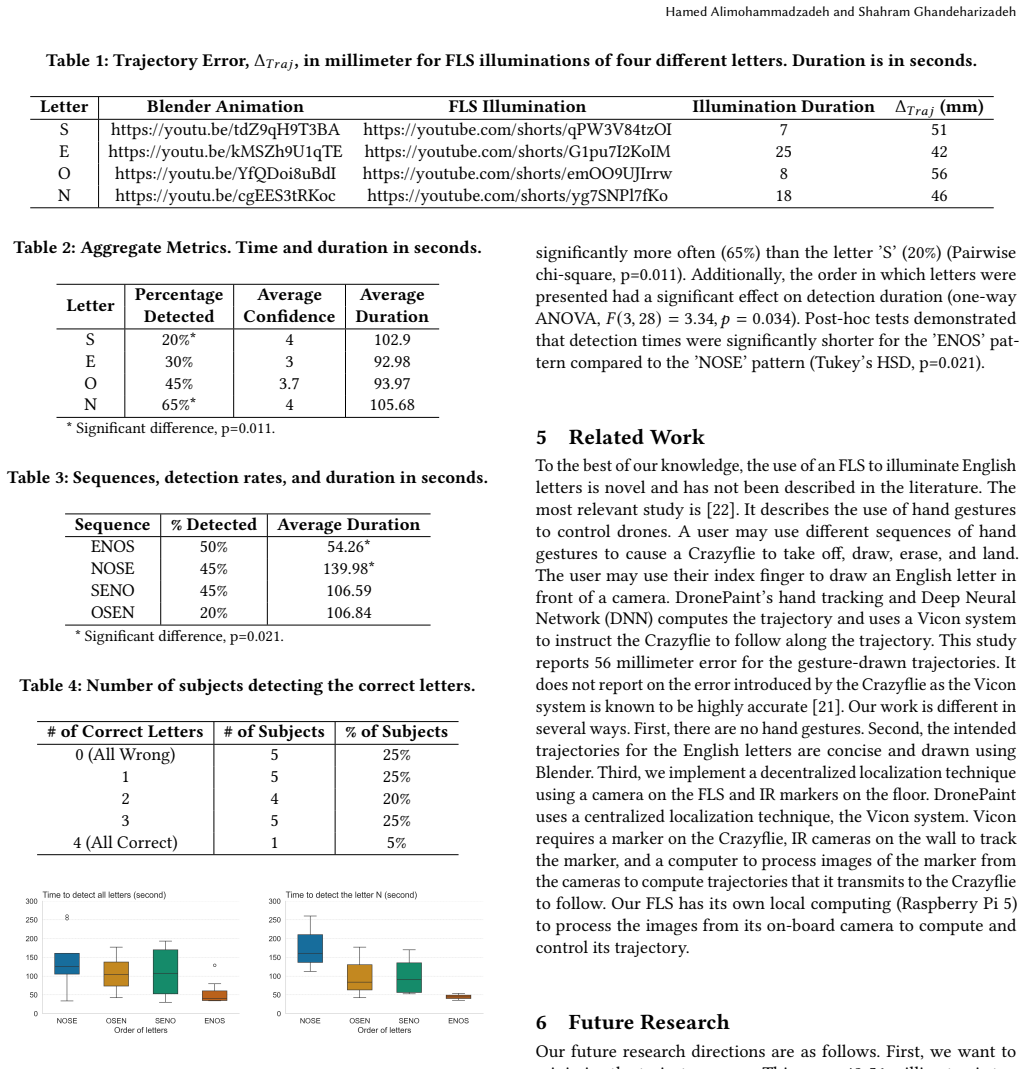
A Flying Light Speck illuminates English letters by following trajectories with its onboard camera, producing 42 to 56 millimeter error.
A machine-rendered reading of the paper's core claim, the machinery that carries it, and where it could break.
Core claim
The Flying Light Speck illuminates English letters by localizing itself via its onboard camera and following a trajectory. Results from the implementation show a 42 to 56 millimeter error that impacts letter detection. The human subject study reveals that the order of illuminating letters has a significant effect on how long it takes subjects to detect them.
What carries the argument
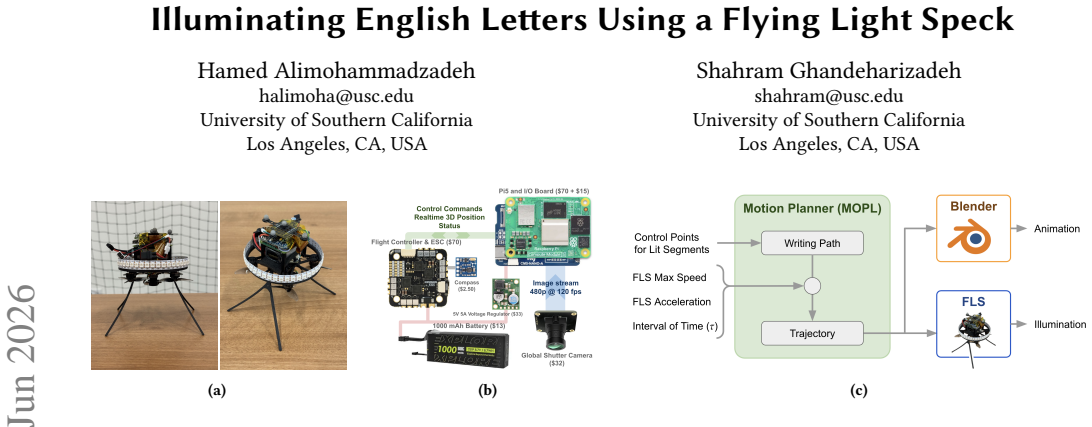
Flying Light Speck (FLS) that uses onboard camera and computing for localization and trajectory following to illuminate letters.
If this is right
- The 42 to 56 millimeter error directly impacts subjects' ability to detect the illuminated letters.
- The order in which letters are illuminated to subjects significantly affects detection duration.
- The system combines quantitative error measurement with qualitative assessment from human participants.
- Design and implementation of the FLS enables autonomous illumination of letter shapes.
Where Pith is reading between the lines
- The presentation order effect suggests that human perception of these illuminations involves sequential learning or expectation.
- Similar trajectory-following approaches could be tested for illuminating numbers or other symbols.
- Lowering the illumination error might increase the reliability of letter detection in future iterations.
Load-bearing premise
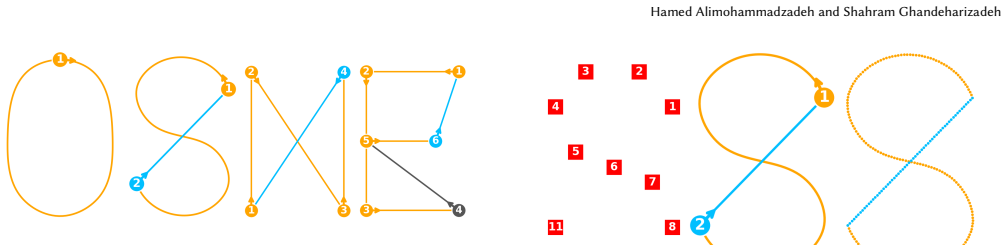
The FLS can use its onboard camera and computing to localize and follow the trajectory sufficiently well to illuminate recognizable English letters.
What would settle it
A measurement showing illumination paths that deviate more than 56 millimeters from intended letter shapes, or a human study where detection duration does not depend on presentation order.
Figures
read the original abstract
This paper presents the design and implementation of a Flying Light Speck (FLS) to illuminate English letters. The FLS uses its onboard camera and computing to localize and follow a trajectory to illuminate a letter. We evaluate the illuminations quantitatively and qualitatively. The latter is based on an IRB approved human subject study with 20 participants. The obtained results show a 42 to 56 millimeter error that impacts the detection of letters. A key finding is that the order in which the illumination of letters is presented to subjects has a significant effect on detection duration.
Editorial analysis
A structured set of objections, weighed in public.
Referee Report
Summary. The manuscript presents the design and implementation of a Flying Light Speck (FLS) to illuminate English letters. The FLS uses its onboard camera and computing to localize and follow a trajectory to illuminate a letter. Quantitative evaluation reports a 42 to 56 millimeter error that impacts letter detection, while qualitative evaluation via an IRB-approved human subject study with 20 participants finds that the order of illumination presentation has a significant effect on detection duration.
Significance. If the results hold, the work demonstrates a practical hardware system for dynamic illumination in graphics applications, combining onboard localization with both error metrics and human-subject findings on presentation order. The reported order effect is a potentially useful insight for system design. However, the absence of methodological details limits assessment of reproducibility and validity.
major comments (1)
- [Abstract] Abstract: The abstract states specific quantitative results (42-56 mm error) and human study outcomes (order effect on detection duration) but provides no details on experimental setup, measurement procedures, ground truth for error, statistical analysis for the order effect, participant information, or data. This is load-bearing for the central claims, as the reader's soundness assessment notes that abstract-only access prevents verification of whether measurements support the claims.
Simulated Author's Rebuttal
We thank the referee for their review and recommendation. We address the major comment below and will revise the manuscript accordingly to strengthen the abstract.
read point-by-point responses
-
Referee: [Abstract] Abstract: The abstract states specific quantitative results (42-56 mm error) and human study outcomes (order effect on detection duration) but provides no details on experimental setup, measurement procedures, ground truth for error, statistical analysis for the order effect, participant information, or data. This is load-bearing for the central claims, as the reader's soundness assessment notes that abstract-only access prevents verification of whether measurements support the claims.
Authors: We agree that the abstract, while concise, would benefit from additional methodological details to better support the central claims for readers accessing only the abstract. The full manuscript details the experimental setup (onboard camera-based localization and trajectory following), error measurement procedures (against ground-truth trajectories), participant information (20 subjects, IRB-approved), and statistical analysis (significant order effect on detection duration). To address this concern directly, we will revise the abstract to include key elements such as the participant count, IRB approval, and reference to the statistical significance of the order effect. This change will be incorporated in the revised manuscript. revision: yes
Circularity Check
No significant circularity
full rationale
The paper describes the design and implementation of a Flying Light Speck (FLS) system for illuminating English letters, followed by quantitative error measurements (42-56 mm) and a human-subject study on detection duration and order effects. No mathematical derivations, equations, fitted parameters presented as predictions, or load-bearing self-citations are present in the abstract or described content. All central claims are direct experimental outcomes rather than reductions to inputs by construction, making the work self-contained against external benchmarks with no circular steps.
Axiom & Free-Parameter Ledger
Reference graph
Works this paper leans on
-
[1]
Hamed Alimohammadzadeh, Rohit Bernard, Yang Chen, Trung Phan, Prashant Singh, Shuqin Zhu, Heather Culbertson, and Shahram Ghandeharizadeh. 2023. Dronevision: An Experimental 3D Testbed for Flying Light Specks. InThe First International Conference on Holodecks(Los Angeles, California)(Holodecks ’23). Mitra LLC, Los Angeles, CA, USA, 1–9. https://doi.org/10...
-
[2]
Hamed Alimohammadzadeh, Heather Culbertson, and Shahram Ghande- harizadeh. 2024. An Evaluation of Decentralized Group Formation Tech- niques for Flying Light Specks. InProceedings of the 5th ACM International Conference on Multimedia in Asia(Tainan, Taiwan)(MMAsia ’23). Association for Computing Machinery, New York, NY, USA, Article 84, 7 pages. https: //...
-
[3]
Hamed Alimohammadzadeh and Shahram Ghandeharizadeh. 2023. SwarMer: A Decentralized Localization Framework for Flying Light Specks. InThe First International Conference on Holodecks(Los Angeles, California)(Holodecks ’23). Mitra LLC, Los Angeles, CA, USA, 10–22. https://doi.org/10.61981/ZFSH2302
-
[4]
Hamed Alimohammadzadeh and Shahram Ghandeharizadeh. 2024. Swarical: An Integrated Hierarchical Approach to Localizing Flying Light Specks. InProceed- ings of the 32nd ACM International Conference on Multimedia(Melbourne VIC, Australia)(MM ’24). Association for Computing Machinery, New York, NY, USA, 6153–6161. https://doi.org/10.1145/3664647.3681080
-
[5]
Hamed Alimohammadzadeh and Shahram Ghandeharizadeh. 2024. Swazure: Swarm Measurement of Pose for Flying Light Specks. InThe Second International Conference on Holodecks(Los Angeles, California)(Holodecks ’24). Mitra LLC, Los Angeles, CA, USA, 17–25. https://doi.org/10.61981/ZFSH2403
-
[6]
Hamed Alimohammadzadeh, Shahram Ghandeharizadeh, Federico Cunico, and Joshua Springer. 2025. Reproducibility Companion Paper: Swarical: An Integrated Hierarchical Approach to Localizing Flying Light Specks. InProceedings of the 33rd ACM International Conference on Multimedia(Dublin, Ireland)(MM ’25). Association for Computing Machinery, New York, NY, USA,...
-
[7]
Hamed Alimohammadzadeh, Daryon Mehraban, and Shahram Ghandeharizadeh
-
[8]
InACM Multimedia Systems(Vancouver, Canada)(MMSys ’23)
Modeling Illumination Data with Flying Light Specks. InACM Multimedia Systems(Vancouver, Canada)(MMSys ’23). Association for Computing Machinery, New York, NY, USA, 363–368. https://doi.org/10.1145/3587819.3592544
-
[9]
Hamed Alimohammadzadeh, Shuqin Zhu, Jiadong Bai, and Shahram Ghan- deharizadeh. 2024. Reliability Groups with Standby Flying Light Specks. In Proceedings of the 15th ACM Multimedia Systems Conference(Bari, Italy)(MM- Sys ’24). Association for Computing Machinery, New York, NY, USA, 1–11. https://doi.org/10.1145/3625468.3647606
-
[10]
Hamed Alimohammadzadeh, Shuqin Zhu, and Shahram Ghandeharizadeh. 2025. Techniques to Conceal Dark Standby Flying Light Specks.ACM Trans. Multimedia Comput. Commun. Appl.(April 2025). https://doi.org/10.1145/3724399 Just Accepted
-
[11]
G. Bradski. 2000. The OpenCV Library.Dr. Dobb’s Journal of Software Tools (2000)
2000
-
[12]
Yang Chen, Hamed Alimohammadzadeh, Heather Culbertson, and Shahram Ghandeharizadeh. 2023. Towards a Stable 3D Physical Human-Drone Inter- action. InThe First International Conference on Holodecks(Los Angeles, Cal- ifornia)(Holodecks ’23). Mitra LLC, Los Angeles, CA, USA, 34–37. https: //doi.org/10.61981/ZFSH2308
-
[13]
Yang Chen, Hamed Alimohammadzadeh, Shahram Ghandeharizadeh, and Heather Culbertson. 2023. Towards Enabling Complex Touch-based Human- Drone Interaction.. InIROS Workshop on Human Multi-Robot Interaction(Detroit, USA)
2023
-
[14]
Yang Chen, Hamed Alimohammadzadeh, Shahram Ghandeharizadeh, and Heather Culbertson. 2024. Force-Feedback Through Touch-based Interactions With A Nanocopter. In2024 IEEE Haptics Symposium (HAPTICS). 271–277. https://doi.org/10.1109/HAPTICS59260.2024.10520851
-
[15]
Ronald A. Fisher. 1935.The Design of Experiments. Oliver and Boyd, Edinburgh. A foundational text in experimental design; discusses Latin squares extensively
1935
-
[16]
Shahram Ghandeharizadeh. 2021. Holodeck: Immersive 3D Displays Using Swarms of Flying Light Specks. InACM Multimedia Asia(Gold Coast, Australia). ACM Press, New York, NY, 1–7. https://doi.org/10.1145/3469877.3493698
-
[17]
Shahram Ghandeharizadeh. 2022. Display of 3D Illuminations using Flying Light Specks. InACM Multimedia. ACM Press, New York, NY, 2996–3005. https: //doi.org/10.1145/3503161.3548250
-
[18]
Shahram Ghandeharizadeh. 2025. Flying Light Specks: Dronevision, Holodecks and Spatial Computing. InProceedings of the 3rd International Workshop on Multimedia Content Generation and Evaluation: New Methods and Practice (McGE ’25)(Dublin, Ireland)(McGE ’25). Association for Computing Machinery, New York, NY, USA, 2 pages. https://doi.org/10.1145/3746278.3759395
-
[19]
Tong Ke and Stergios I. Roumeliotis. 2017. An Efficient Algebraic Solution to the Perspective-Three-Point Problem. In2017 IEEE Conference on Computer Vision and Pattern Recognition (CVPR). 4618–4626. https://doi.org/10.1109/CVPR.2017.491
-
[20]
Eric Marchand, Hideaki Uchiyama, and Fabien Spindler. 2016. Pose Estimation for Augmented Reality: A Hands-On Survey.IEEE Transactions on Visualization and Computer Graphics22, 12 (2016), 2633–2651. https://doi.org/10.1109/TVCG. 2015.2513408
-
[21]
Trung Phan, Hamed Alimohammadzadeh, Heather Culbertson, and Shahram Ghandeharizadeh. 2023. An Evaluation of Three Distance Measurement Tech- nologies for Flying Light Specks*. In2023 International Conference on Intelligent Metaverse Technologies & Applications (iMETA). 1–8. https://doi.org/10.1109/ iMETA59369.2023.10294597
arXiv 2023
-
[22]
James Preiss, Wolfgang Honig, Gaurav Sukhatme, and Nora Ayanian. 2017. Crazyswarm: A Large Nano-Quadcopter Swarm. InIEEE International Conference on Robotics and Automation (ICRA). IEEE, 3299–3304. https://doi.org/10.1109/ ICRA.2017.7989376
arXiv 2017
-
[23]
Valerii Serpiva, Ekaterina Karmanova, Aleksey Fedoseev, Stepan Perminov, and Dzmitry Tsetserukou. 2021. DronePaint: Swarm Light Painting with DNN-based Gesture Recognition. InACM SIGGRAPH 2021 Emerging Technologies(Virtual Event, USA)(SIGGRAPH ’21). Association for Computing Machinery, New York, NY, USA, Article 6, 4 pages. https://doi.org/10.1145/3450550.3465349
-
[24]
Tingyu Wang, Yujiao Shi, Fabian Deuser, Shaofei Huang, Guosheng Hu, Si Liu, Zhedong Zheng, and Roger Zimmermann. 2025. The 3rd Workshop on UAVs in Multimedia: Capturing the World from a New Perspective. InProceedings of the 33rd ACM International Conference on Multimedia Workshop
2025
-
[25]
Nima Yazdani, Hamed Alimohammadzadeh, and Shahram Ghandeharizadeh
-
[26]
InThe First International Conference on Holodecks(Los Angeles, California)(Holodecks ’23)
A Conceptual Model of Intelligent Multimedia Data Rendered using Flying Light Specks. InThe First International Conference on Holodecks(Los Angeles, California)(Holodecks ’23). Mitra LLC, Los Angeles, CA, USA, 38–44. https://doi.org/10.61981/ZFSH2309
-
[27]
Nima Yazdani and Shahram Ghandeharizadeh. 2025. Integration of 3D FLS Displays with 3D Authoring Tools. InProceedings of the Third ACM International Workshop on Interactive Extended Reality(Dublin, Ireland)(IXR ’25). ACM Press, New York, NY, 8 pages. https://doi.org/10.1145/3746269.3760418
-
[28]
Shuqin Zhu and Shahram Ghandeharizadeh. 2023. Flight Patterns for Swarms of Drones. InThe First International Conference on Holodecks(Los Angeles, California)(Holodecks ’23). Mitra LLC, Los Angeles, CA, USA, 29–33. https: //doi.org/10.61981/ZFSH2303
-
[29]
Shuqin Zhu and Shahram Ghandeharizadeh. 2024. Circular Flight Patterns for Dronevision. InThe Second International Conference on Holodecks(Los Angeles, California)(Holodecks ’24). Mitra LLC, Los Angeles, CA, USA, 1–11. https: //doi.org/10.61981/ZFSH2404
discussion (0)
Sign in with ORCID, Apple, or X to comment. Anyone can read and Pith papers without signing in.