REVIEW 3 major objections 4 minor 48 references
Joint Waveform and Receiver Design for Co-Channel Hybrid Active-Passive Sensing with Timing Uncertainty
T0 review · 3 major / 4 minor · reviewed 2026-08-14 · deepseek-v4-flash
Pith's one-line read This paper claims that a co-channel hybrid active-passive radar, with jointly designed radar waveform and receive filters, achieves substantially higher output SINR and better detection than either active-only or passive-only radar, while…
desk verdict Solid within-subfield contribution: new robust joint waveform/filter designs for co-channel hybrid active-passive radar under timing uncertainty, with a real but fixable gap around fractional timing shifts. read the letter →
The pith
A machine-rendered reading of the paper's core claim, the machinery that carries it, and where it could break.
The reading
What carries the argument
The load-bearing construction is the discrete-time model of the illuminator-of-opportunity signal as a known pulse-shaping matrix $H$ multiplying unknown uncorrelated symbols $\mathbf{b}$, followed by an integer sample-shift matrix $J_k$: $\mathbf{s}_c = J_k H \mathbf{b}$. The shift index $k$ carries all location- and synchronization-induced timing uncertainty, and the output SINR for each $k$ splits into an active-branch and a passive-branch generalized Rayleigh quotient. On top of this model, the solution machinery alternates among the two receive filters and the radar waveform, using semidefinite relaxation with randomization, a fractional-programming iteration for worst-case ratio problems, a quadratic-transform iteration for sums of ratios, and sequential convex programming with a first-order approximation for the waveform update; when $K=0$ both design criteria reduce to a common problem whose receive-filter updates are closed-form.
What would settle it
Measure the output SINR and detection probability of the $K=3$ designs when the true relative delay is half a sample, or any non-integer shift. A substantial drop below the designed worst-case SINR, or a larger miss-probability loss than seen for integer shifts, would show the integer-shift model is the limiting assumption. A separate test with correlated IO symbols, i.e. $\mathbf{R}_b \neq \mathbf{I}$, would show how sensitive the design is to the uncorrelated-symbol assumption.
Extended reading notes
Core claim
The central claim is that a co-channel hybrid active-passive radar can treat the communication signal as a second useful illumination rather than only as interference, provided the radar waveform and receive filters are optimized jointly. The paper models the communication waveform as a known pulse shape multiplied by unknown, uncorrelated symbols, with the timing mismatch represented as an integer sample shift $k$. It derives the output SINR as a sum of an active-path and a passive-path SINR, then formulates the design as either maximizing the worst-case SINR over $k$ in a bounded interval or maximizing a weighted sum of SINR values over that interval, subject to a transmit power constraint. Because the resulting problems are nonconvex, the paper proposes alternating optimization using semidefinite relaxation with randomization, fractional programming for worst-case ratios, a quadratic-transform method for sums of ratios, and sequential convex programming for the waveform update. Numerical results show the hybrid designs outperform active-only and passive-only systems, with the max-min design giving a uniform SINR floor across the assumed uncertainty interval and the weighted-sum design losing little at the nominal delay.
Load-bearing premise
The design assumes the timing mismatch is an integer number of sampling intervals and that the IO pulse shape and modulation are known while the data symbols are uncorrelated; if the actual delay is fractional or the communication signal's statistics differ, the shift-matrix model and the optimized designs are no longer matched to the received signal.
Editorial extensions
If this is right
- A hybrid radar can trade active transmit power against illuminator-of-opportunity strength while holding target SINR fixed, so co-channel operation offers an energy-efficiency lever.
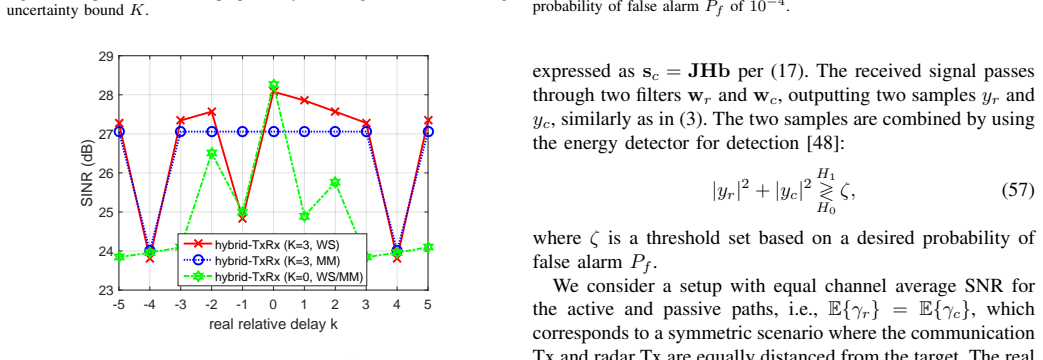
- A max-min design guarantees an SINR floor across the entire assumed delay uncertainty interval, whereas a design that ignores timing uncertainty loses SINR when the real delay is nonzero.
- The weighted-sum design with a nonzero uncertainty bound loses little at the nominal delay, so robustness can be obtained without sacrificing the ideal no-uncertainty performance.
- Jointly optimizing the radar waveform and receive filters outperforms optimizing only the receive filters with a fixed radar waveform in the simulated scenarios.
- Detection simulations show the hybrid scheme has a steeper miss-probability slope than active-only or passive-only sensing, indicating a spatial diversity gain from using both illumination paths.
Reading between the lines
- The integer-shift timing model could be extended to fractional delays by replacing $J_k$ with a fractional-delay filter; the same alternating optimization framework would likely carry over, but the paper does not test this.
- The weighted-sum criterion's weights could encode a prior distribution over delay, turning the design into expected-SINR maximization; the paper only simulates uniform weights.
- The diversity-order gain visible in the detection curves suggests an analytic diversity analysis of hybrid active-passive detection is a natural follow-up not pursued here.
- Because the paper assumes radar-to-communication interference is negligible under directive transmission, the design is tailored to that spectrum-sharing regime; relaxing this assumption would couple the radar waveform design to communication-receiver constraints.
Signed reviews
Editorial analysis
A structured set of objections, weighed in public.
Referee Report
Summary. The paper considers a co-channel hybrid active-passive radar in which a monostatic active radar and a non-cooperative illuminator of opportunity (IO) operate in the same frequency band. The received signal contains target echoes from both the active and passive paths, and the radar jointly designs its transmit waveform and two receive filters to maximize the output SINR, assuming the IO modulation format and pulse shape are known but the data symbols are not. Timing uncertainty is modeled as an integer sample shift k in a shift matrix Jk (Eqs. (19)-(21)), and two design criteria are proposed: a max-min (MM) design that maximizes the worst-case SINR over k in {-K,...,K}, and a weighted-sum (WS) design that maximizes a weighted average of the SINR over this set. Both problems are nonconvex and are solved by alternating sequential convex programming (SCP) and semidefinite relaxation (SDR) with randomization, with a simplified closed-form receiver update for the K=0 case. Numerical simulations show convergence of the algorithms, SINR improvements over active-only and passive-only baselines, robustness of the MM and WS designs over integer delays, and better detection probability for the hybrid designs.
Significance. If the results hold, the paper makes a useful contribution to co-channel hybrid radar design by explicitly accounting for timing uncertainty between the active and passive illuminators. The signal model is clearly formulated, the optimization framework is technically sound as a heuristic, and the simulation study is reasonably extensive, including convergence checks, SINR contours, timing-robustness plots, and detection probability. Strengths include the explicit derivation of the SINR expressions, the algorithmic detail, and the falsifiable numerical predictions. The main limitation is that the robustness claims are established only for integer sample shifts, which narrows the scope of the headline result. The lack of convergence guarantees for the alternating SCP/SDR procedure is a secondary gap that should be acknowledged.
major comments (3)
- [Section III-B, Eqs. (19)-(21); Fig. 7] The timing uncertainty model is restricted to integer sample shifts. For a fractional delay (k+δ)Ts with δ in (0,1), the sampled IO signal is not JkHb, because the pulse-shaping matrix H in Eq. (14) would need to be rebuilt with samples g(pTs - iTc - δTs), making H itself delay-dependent. Consequently, the MM design's claimed 'uniform output SINR over the timing uncertainty interval' and the WS design's reported robustness are statements about the discrete set {-K,...,K} only. Fig. 7 also evaluates the designs only at integer k. The paper should either clearly scope all robustness claims to integer sample shifts (and qualify the abstract and introduction accordingly), or extend the signal model to continuous delays and re-evaluate the worst-case performance over the continuous uncertainty interval.
- [Section III-C, after Eq. (22)] The statement 'Without loss of generality, we assume Rb = I' is only valid when the communication symbols are uncorrelated and have equal power, i.e., Rb = σ²I, because a scalar factor can be absorbed into γc. For correlated symbols or non-uniform symbol powers, the interference covariance is not a scaled identity, and the subsequent MM/WS designs do not address the resulting covariance structure. Please replace the WLOG claim with an explicit assumption of uncorrelated equal-power symbols, or justify the reduction for arbitrary Rb.
- [Section IV, Algorithms 2 and 3] The alternating SCP/SDR procedure is heuristic: no convergence guarantee is provided for the outer loop or the SCP inner loop, and the randomization step produces approximate rank-one solutions. The stopping criterion is based on observed SINR improvement, and Fig. 5 demonstrates empirical convergence for one configuration. This is acceptable as a numerical method, but the paper should state clearly that only local/empirical convergence is claimed, and ideally provide a short discussion of conditions under which the SCP updates are guaranteed to improve the objective (e.g., monotonicity properties of the inner problems). Without this, the reported SINR values should be interpreted as achievable by the specific algorithm, not as globally optimal SINR values.
minor comments (4)
- [Eq. (34)] In the last term of Eq. (34), the expectation should read E{ξ^H (γc Jk H H^H Jk^H + I) ξ}, with a conjugate transpose on the first ξ; the current expression omits the Hermitian transpose and is dimensionally inconsistent.
- [Fig. 7] The x-axis label 'real relative delay k' suggests a continuous quantity, but only integer sample shifts are evaluated. Please state in the caption that k is an integer sample index, or plot markers at the evaluated integer points.
- [Algorithm 1] A brief explanatory sentence after Step 2 of Algorithm 1 would help: the update of λ uses the ratio f_k/g_k with f_k including the κ_k term, so that κ_k is not double-counted in the subsequent convex problem (30).
- [Section II, Remark 1] The single-pulse assumption and the neglect of Doppler are stated, but the detection results in Section V-C are also for a single pulse; a sentence connecting the single-pulse SINR design to the energy-detector detection simulation would improve clarity.
Circularity Check
No significant circularity; the optimized SINR is reported against external baselines and out-of-set delays.
full rationale
The derivation chain is self-contained. The SINR expression in Eq. (22) is derived from the signal model in Eq. (1), the linear-modulation representation in Eqs. (10)-(14), and the integer timing-shift model in Eqs. (19)-(21). The MM and WS optimization problems in Eqs. (23) and (24) directly maximize this SINR, and reporting that SINR as the performance metric is not circular because the comparisons are against active-only and passive-only baselines that do not use the jointly optimized waveform and receive filters. The robustness test in Fig. 7 also evaluates designs at delays outside the design set (e.g., k = -5, -4, 4, 5 when the design used K = 3), providing external support. The self-citations present, such as [7] and [11], supply background and motivation for hybrid active-passive radar and are not load-bearing for the central derivation. No fitted parameter is relabeled as a prediction, and no uniqueness theorem is imported from the authors' prior work. The integer-only timing-shift model is a modeling limitation relevant to correctness, not a circularity. Therefore no circular step is established.
Assumptions & free parameters
free parameters (4)
- Design channel SNRs γr and γc =
25 dB in detection simulation
- Weights u_k of weighted-sum criterion =
u_k = 1 for all k
- Timing uncertainty bound K =
K = 3 in most timing-uncertainty simulations, K = 4 in detection
- Number of randomization trials Q =
Q = 200 in simulations
assumptions (5)
- domain assumption The communication signal is generated by linear digital modulation with a known pulse shape g(t) (Eq. 10).
- domain assumption The communication symbols are uncorrelated with Rb = I (Section III-C).
- domain assumption Timing uncertainty is an integer multiple of the sampling interval Ts (Eq. 19).
- domain assumption The interference from the radar to the communication receiver is negligible due to directive transmission (Remark 3).
- domain assumption The target is modeled with a single-pulse scenario with no Doppler shift (Remark 1).
Cite this review
Pith. "Pith review of Joint Waveform and Receiver Design for Co-Channel Hybrid Active-Passive Sensing with Timing Uncertainty." pith.science (2026). https://pith.science/paper/544UIHQX
@misc{pith2026190811016,
  author       = {Pith},
  title        = {Pith review of: Joint Waveform and Receiver Design for Co-Channel Hybrid Active-Passive Sensing with Timing Uncertainty},
  year         = {2026},
  howpublished = {\url{https://pith.science/paper/544UIHQX}},
  note         = {Machine review of arXiv:1908.11016}
}
read the original abstract
We consider a hybrid active-passive radar system that employs a wireless source as a passive illuminator of opportunity (IO) and a co-channel active radar transmitter operating in the same frequency band to seek spectral efficiency. The hybrid system can take advantage of the strengths of passive radar (e.g., energy efficiency, bi-/multi-static configuration, and spatial diversity) as well as those of active radar (dedicated transmitter, flexible transmit beam steering, waveform optimized for sensing, etc.). To mitigate the mutual interference and location-induced timing uncertainty between the radar and communication signals, we propose two designs for the joint optimization of the radar waveform and receive filters. The first is a max-min (MM) criterion that optimizes a worst-case performance metric over a timing uncertainty interval, and the other a weighted-sum (WS) criterion that forms a weighted sum of the performance metric at each delay within the delay uncertainty interval. Both design criteria result in nonconvex constrained optimization problems that are solved by sequential convex programming methods. When timing uncertainty vanishes, the two designs become identical and admit a simpler solution. Numerical results are presented to demonstrate the performance of the proposed hybrid schemes in comparison with conventional active-only and passive-only radar systems.
Figures



Figures from the paper (2 more)

Reference graph
Works this paper leans on
-
[1]
Passive coherent location radar systems. part 1: performance prediction,
H. D. Griffiths and C. J. Baker, “Passive coherent location radar systems. part 1: performance prediction,” IEE Proceedings - Radar, Sonar and Navigation, vol. 152, no. 3, pp. 153–159, June 2005
work page 2005
-
[2]
DVB-T passive radar signal processing,
J. E. Palmer, H. A. Harms, S. J. Searle, and L. Davis, “DVB-T passive radar signal processing,” IEEE Transactions on Signal Processing , vol. 61, no. 8, pp. 2116–2126, April 2013
work page 2013
-
[3]
Ambigu- ity function analysis for UMTS-based passive multistatic radar,
S. Gogineni, M. Rangaswamy, B. D. Rigling, and A. Nehorai, “Ambigu- ity function analysis for UMTS-based passive multistatic radar,” IEEE Transactions on Signal Processing, vol. 62, no. 11, pp. 2945–2957, June 2014
work page 2014
-
[4]
T. Shan, S. Liu, Y . D. Zhang, M. G. Amin, R. Tao, and Y . Feng, “Effi- cient architecture and hardware implementation of coherent integration processor for digital video broadcast-based passive bistatic radar,” IET Radar, Sonar Navigation, vol. 10, no. 1, pp. 97–106, 2016
work page 2016
-
[5]
Detection in passive MIMO radar networks,
D. E. Hack, L. K. Patton, B. Himed, and M. A. Saville, “Detection in passive MIMO radar networks,” IEEE Transactions on Signal Process- ing, vol. 62, no. 11, pp. 2999–3012, June 2014
work page 2014
-
[6]
Joint delay and Doppler estimation for passive sensing with direct-path interference,
X. Zhang, H. Li, J. Liu, and B. Himed, “Joint delay and Doppler estimation for passive sensing with direct-path interference,” IEEE Transactions on Signal Processing , vol. 64, no. 3, pp. 630–640, Feb 2016
work page 2016
-
[7]
Signal parameter estimation for passive bistatic radar with waveform correlation exploitation,
F. Wang, H. Li, X. Zhang, and B. Himed, “Signal parameter estimation for passive bistatic radar with waveform correlation exploitation,” IEEE Transactions on Aerospace and Electronic Systems , vol. 54, no. 3, pp. 1135–1150, June 2018
work page 2018
-
[8]
Improved detection performance for passive radars exploiting known communication signal form,
A. K. Karthik and R. S. Blum, “Improved detection performance for passive radars exploiting known communication signal form,” IEEE Signal Processing Letters , vol. 25, no. 11, pp. 1625–1629, Nov 2018
work page 2018
Show all 48 references
-
[9]
Limited-complexity receiver design for passive/active MIMO radar detection,
Y . Li, Q. He, and R. S. Blum, “Limited-complexity receiver design for passive/active MIMO radar detection,” IEEE Transactions on Signal Processing, vol. 67, no. 12, pp. 3258–3271, June 2019
2019
-
[10]
On the impact of unknown signals on delay, Doppler, amplitude, and phase parameter estimation,
Y . Chen and R. S. Blum, “On the impact of unknown signals on delay, Doppler, amplitude, and phase parameter estimation,” IEEE Transactions on Signal Processing , vol. 67, no. 2, pp. 431–443, Jan 2019
2019
-
[11]
Joint transmit and receive beamforming for hybrid activepassive radar,
Y . Gao, H. Li, and B. Himed, “Joint transmit and receive beamforming for hybrid activepassive radar,” IEEE Signal Processing Letters, vol. 24, no. 6, pp. 779–783, June 2017
2017
-
[12]
Optimum co-design for spectrum sharing between matrix completion based MIMO radars and a MIMO communication system,
B. Li, A. P. Petropulu, and W. Trappe, “Optimum co-design for spectrum sharing between matrix completion based MIMO radars and a MIMO communication system,” IEEE Transactions on Signal Processing , vol. 64, no. 17, pp. 4562–4575, Sep. 2016
2016
-
[13]
Joint design of overlaid communication systems and pulsed radars,
L. Zheng, M. Lops, X. Wang, and E. Grossi, “Joint design of overlaid communication systems and pulsed radars,” IEEE Transactions on Signal Processing, vol. 66, no. 1, pp. 139–154, Jan 2018
2018
-
[14]
Power allocation and co-design of multicarrier communication and radar systems for spectral coexistence,
F. Wang, H. Li, and M. A. Govoni, “Power allocation and co-design of multicarrier communication and radar systems for spectral coexistence,” IEEE Transactions on Signal Processing, vol. 67, no. 14, pp. 3818–3831, July 2019
2019
-
[15]
Radar and communi- cation coexistence: An overview: A review of recent methods,
L. Zheng, M. Lops, Y . C. Eldar, and X. Wang, “Radar and communi- cation coexistence: An overview: A review of recent methods,” IEEE Signal Processing Magazine , vol. 36, no. 5, pp. 85–99, Sep. 2019
2019
-
[16]
Toward millimeter-wave joint radar communications: A signal processing perspective,
K. V . Mishra, M. R. Bhavani Shankar, V . Koivunen, B. Ottersten, and S. A. V orobyov, “Toward millimeter-wave joint radar communications: A signal processing perspective,” IEEE Signal Processing Magazine , vol. 36, no. 5, pp. 100–114, Sep. 2019
2019
-
[17]
Opportunistic radar waveform design in joint radar and cellular communication systems,
M. Bica, K. Huang, U. Mitra, and V . Koivunen, “Opportunistic radar waveform design in joint radar and cellular communication systems,” in 2015 IEEE Global Communications Conference (GLOBECOM) , Dec 2015, pp. 1–7
2015
-
[18]
Delay estimation method for coexisting radar and wireless communication systems,
M. Bica and V . Koivunen, “Delay estimation method for coexisting radar and wireless communication systems,” in 2017 IEEE Radar Conference (RadarConf), May 2017, pp. 1557–1561
2017
-
[19]
Performance gains from cooperative MIMO radar and MIMO communication systems,
Q. He, Z. Wang, J. Hu, and R. S. Blum, “Performance gains from cooperative MIMO radar and MIMO communication systems,” IEEE Signal Processing Letters , vol. 26, no. 1, pp. 194–198, Jan 2019
2019
-
[20]
Design of phase codes for radar performance optimization with a similarity constraint,
A. De Maio, S. De Nicola, Y . Huang, Z. Luo, and S. Zhang, “Design of phase codes for radar performance optimization with a similarity constraint,” IEEE Transactions on Signal Processing , vol. 57, no. 2, pp. 610–621, Feb 2009
2009
-
[21]
Design of optimized radar codes with a peak to average power ratio constraint,
A. De Maio, Y . Huang, M. Piezzo, S. Zhang, and A. Farina, “Design of optimized radar codes with a peak to average power ratio constraint,” IEEE Transactions on Signal Processing, vol. 59, no. 6, pp. 2683–2697, June 2011
2011
-
[22]
Quadratic optimization with similarity constraint for unimodular sequence synthesis,
G. Cui, X. Yu, G. Foglia, Y . Huang, and J. Li, “Quadratic optimization with similarity constraint for unimodular sequence synthesis,” IEEE Transactions on Signal Processing, vol. 65, no. 18, pp. 4756–4769, Sep. 2017
2017
-
[23]
Constrained waveform design for colocated MIMO radar with uncertain steering matrices,
X. Yu, G. Cui, L. Kong, J. Li, and G. Gui, “Constrained waveform design for colocated MIMO radar with uncertain steering matrices,” IEEE Transactions on Aerospace and Electronic Systems, vol. 55, no. 1, pp. 356–370, Feb 2019
2019
-
[24]
Knowledge-aided (potentially cognitive) transmit signal and receive filter design in signal- dependent clutter,
A. Aubry, A. De Maio, A. Farina, and M. Wicks, “Knowledge-aided (potentially cognitive) transmit signal and receive filter design in signal- dependent clutter,” IEEE Transactions on Aerospace and Electronic Systems, vol. 49, no. 1, pp. 93–117, Jan 2013
2013
-
[25]
A Doppler robust design of transmit sequence and receive filter in the presence of signal-dependent interference,
M. M. Naghsh, M. Soltanalian, P. Stoica, M. Modarres-Hashemi, A. De Maio, and A. Aubry, “A Doppler robust design of transmit sequence and receive filter in the presence of signal-dependent interference,” IEEE Transactions on Signal Processing , vol. 62, no. 4, pp. 772–785, Feb 2014
2014
-
[26]
Optimizing radar waveform and Doppler filter bank via generalized fractional programming,
A. Aubry, A. De Maio, and M. M. Naghsh, “Optimizing radar waveform and Doppler filter bank via generalized fractional programming,” IEEE Journal of Selected Topics in Signal Processing, vol. 9, no. 8, pp. 1387– 1399, Dec 2015
2015
-
[27]
Intrapulse radar-embedded communications via multiobjective optimization,
D. Ciuonzo, A. De Maio, G. Foglia, and M. Piezzo, “Intrapulse radar-embedded communications via multiobjective optimization,” IEEE Transactions on Aerospace and Electronic Systems , vol. 51, no. 4, pp. 2960–2974, Oct 2015
2015
-
[28]
Robust waveform and filter bank design of polarimetric radar,
X. Cheng, A. Aubry, D. Ciuonzo, A. De Maio, and X. Wang, “Robust waveform and filter bank design of polarimetric radar,” IEEE Transac- tions on Aerospace and Electronic Systems , vol. 53, no. 1, pp. 370–384, Feb 2017
2017
-
[29]
Maximin joint optimization of transmitting code and receiving filter in radar and communications,
L. Zhao and D. P. Palomar, “Maximin joint optimization of transmitting code and receiving filter in radar and communications,” IEEE Transac- tions on Signal Processing , vol. 65, no. 4, pp. 850–863, Feb 2017
2017
-
[30]
Space-time transmit code and receive filter design for colocated MIMO radar,
G. Cui, X. Yu, V . Carotenuto, and L. Kong, “Space-time transmit code and receive filter design for colocated MIMO radar,” IEEE Transactions on Signal Processing , vol. 65, no. 5, pp. 1116–1129, March 2017
2017
-
[31]
Robust transmitter-receiver design in the presence of signal-dependent clutter,
G. Cui, Y . Fu, X. Yu, and J. Li, “Robust transmitter-receiver design in the presence of signal-dependent clutter,” IEEE Transactions on Aerospace and Electronic Systems , vol. 54, no. 4, pp. 1871–1882, Aug 2018
2018
-
[32]
Cognitive radar: a way of the future,
S. Haykin, “Cognitive radar: a way of the future,” IEEE Signal Process- ing Magazine, vol. 23, no. 1, pp. 30–40, Jan 2006
2006
-
[33]
Fully adaptive radar for target tracking part I: Single target tracking,
K. L. Bell, C. J. Baker, G. E. Smith, J. T. Johnson, and M. Rangaswamy, “Fully adaptive radar for target tracking part I: Single target tracking,” in 2014 IEEE Radar Conference , May 2014, pp. 0303–0308
2014
-
[34]
Fully adaptive radar for target tracking part II: Target detection and track initiation,
——, “Fully adaptive radar for target tracking part II: Target detection and track initiation,” in 2014 IEEE Radar Conference , May 2014, pp. 0309–0314. 12
2014
-
[35]
Spectrum sharing between communications and ATC radar systems,
H. Wang, J. T. Johnson, and C. J. Baker, “Spectrum sharing between communications and ATC radar systems,” IET Radar, Sonar Navigation, vol. 11, no. 6, pp. 994–1001, 2017
2017
-
[36]
An as- sessment of the near-term viability of accommodating wireless broad- band systems in the 1675–1710 MHz, 1755–1780 MHz, 3500–3650 MHz, and 4200–4220 MHz, 4380–4400 MHz bands,
National Telecommunications and Information Administration, “An as- sessment of the near-term viability of accommodating wireless broad- band systems in the 1675–1710 MHz, 1755–1780 MHz, 3500–3650 MHz, and 4200–4220 MHz, 4380–4400 MHz bands,” https://www.ntia. doc.gov/files/nti...
-
[37]
Analysis and resolution of RF interference to radars operating in the band 2700–2900 MHz from broadband communication transmitters,
F. H. Sanders, R. L. Sole, J. E. Carroll, G. S. Secrest, and T. L. Allmon, “Analysis and resolution of RF interference to radars operating in the band 2700–2900 MHz from broadband communication transmitters,” US Department of Commerce, National Telecommunications and Informa- ...
2012
-
[38]
Proakis and M
J. Proakis and M. Salehi, Digital Communications. McGraw-Hill, 2008
2008
-
[39]
Prediction of radar range,
L. Blake, “Prediction of radar range,” in Radar Handbook, M. Skolnik, Ed. McGraw-Hill, 1990
1990
-
[40]
Semidefinite relaxation of quadratic optimization problems,
Z. Luo, W. Ma, A. M. So, Y . Ye, and S. Zhang, “Semidefinite relaxation of quadratic optimization problems,” IEEE Signal Processing Magazine, vol. 27, no. 3, pp. 20–34, May 2010
2010
-
[41]
On nonlinear fractional programming,
W. Dinkelbach, “On nonlinear fractional programming,” Management Science, vol. 13, no. 7, pp. 492–498, 1967
1967
-
[42]
CVX: Matlab software for disciplined convex programming, version 2.1,
M. Grant and S. Boyd, “CVX: Matlab software for disciplined convex programming, version 2.1,” http://cvxr.com/cvx, Mar. 2014
2014
-
[43]
Boyd and L
S. Boyd and L. Vandenberghe, Convex Optimization . Cambridge University Press, 2004
2004
-
[44]
Local convergence of sequential convex programming for nonconvex optimization,
Q. T. Dinh and M. Diehl, “Local convergence of sequential convex programming for nonconvex optimization,” in Recent Advances in Optimization and its Applications in Engineering . Springer Berlin Heidelberg, 2010, pp. 93–102
2010
-
[45]
The matrix cookbook,
K. B. Petersen and M. S. Pedersen, “The matrix cookbook,” Nov 2012
2012
-
[46]
Cognitive design of the receive filter and transmitted phase code in reverberating environment,
A. Aubry, A. De Maio, M. Piezzo, A. Farina, and M. Wicks, “Cognitive design of the receive filter and transmitted phase code in reverberating environment,” IET Radar, Sonar Navigation, vol. 6, no. 9, pp. 822–833, December 2012
2012
-
[47]
Fractional programming for communication systems part I: Power control and beamforming,
K. Shen and W. Yu, “Fractional programming for communication systems part I: Power control and beamforming,” IEEE Transactions on Signal Processing , vol. 66, no. 10, pp. 2616–2630, May 2018
2018
-
[48]
MIMO radar with widely separated antennas,
A. M. Haimovich, R. S. Blum, and L. J. Cimini, “MIMO radar with widely separated antennas,” IEEE Signal Processing Magazine , vol. 25, no. 1, pp. 116–129, 2008
2008
Reviewed August 14, 2026 · model on record in the stance chip above.
Discussion (0). Continue with ORCID to comment.