REVIEW 4 major objections 6 minor 58 references
Collective Excitation of Quantum Droplet with Different Ranges of the Interaction of P\"oschl-Teller Potential
T0 review · 4 major / 6 minor · reviewed 2026-08-15 · deepseek-v4-flash
Pith's one-line read A two-species quantum droplet with a tunable Pöschl-Teller interaction develops a finite excitation gap at zero momentum and a sharp roton minimum when the interaction is long-ranged, and both features grow with the interaction's range…
desk verdict The zero-momentum gap is likely an artifact of incomplete linearization; the paper's headline claim is not credible, though the roton trend may survive a corrected derivation. read the letter →
The pith
A machine-rendered reading of the paper's core claim, the machinery that carries it, and where it could break.
The reading
What carries the argument
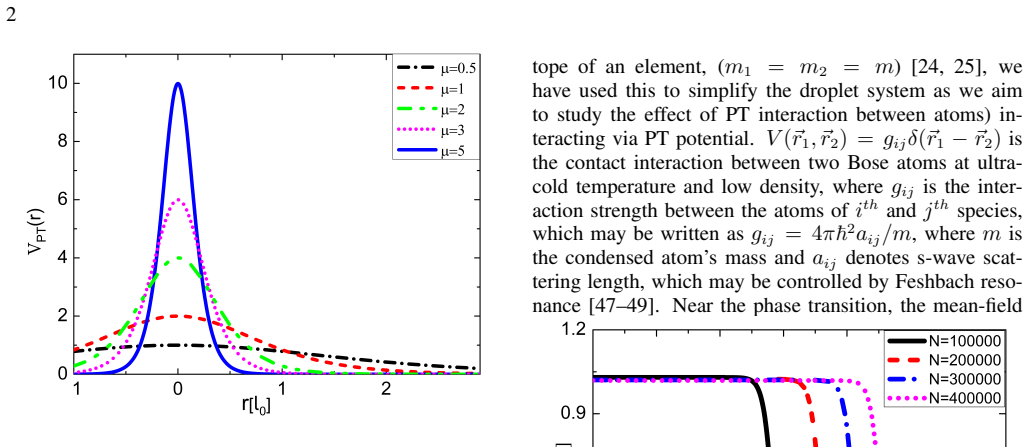
The load-bearing object is the Pöschl-Teller pair potential $V_{\mathrm{PT}}(r)=U\,2\mu/\cosh^2(\mu r)$, in which $\mu$ controls the inverse width (so the range is $1/\mu$) and $U$ controls the strength. Its continuous deformation from a delta-like contact interaction to a long-range potential lets a single model interpolate between regimes. In the excitation calculation, the potential enters through its Fourier transform $\tilde{V}_{\mathrm{PT}}(k)$ in the density-dependent matrix element $C=\tilde{V}_{\mathrm{PT}}(k)\rho$; because this term is momentum dependent, it reshapes the spectrum, producing the roton minimum and, at $k=0$, the finite gap. The ground state is obtained from the Gross-Pitaevskii equation with the Lee-Huang-Yang correction using imaginary-time propagation, and the uniform density justifies the plane-wave Bogoliubov ansatz.
What would settle it
One decisive check is to compute the excitation spectrum for the same $\mu$ and $U$ at several particle numbers with fixed density: if the zero-momentum gap shrinks toward zero or the roton minimum flattens as $N$ grows, the claimed long-range gap is a finite-size artifact. An experimental version would measure the Bragg-scattering spectrum of a two-species droplet with a tunable long-range interaction; the prediction would fail if low-momentum excitations remain gapless whenever the PT interaction is present.
Extended reading notes
Core claim
The paper's central claim is that when atoms in a two-species quantum droplet interact through a repulsive Pöschl-Teller potential of long range (small $\mu$), the Bogoliubov excitation spectrum is not the usual phononic one: it has a finite gap at zero momentum, no phonon branch, and a sharp roton minimum at finite momentum. As the potential is made more short-ranged (larger $\mu$), the roton weakens and moves to higher momentum and eventually disappears, while a phonon mode reappears. Increasing the interaction strength $U$ makes the roton sharper, shifts it to higher momentum, and widens the zero-momentum gap. The same calculations show that the ground-state density of the droplet decreases with $U$ and saturates as $\mu$ becomes large, consistent with the PT potential becoming delta-function-like. The paper presents this as a distinctive feature of the Pöschl-Teller interaction, different from dipolar and Coulomb long-range interactions.
Load-bearing premise
The main load-bearing premise is that the droplet is effectively infinite and uniform, so the plane-wave Bogoliubov calculation from a homogeneous density captures the true bulk excitation spectrum and surface effects are negligible.
Editorial extensions
If this is right
- For long-range PT interactions ($\mu$ small), the droplet's low-momentum spectrum is gapped rather than phononic; if confirmed, Bragg spectroscopy should show a threshold at zero momentum instead of a linear sound mode.
- Tuning $\mu$ from small to large moves the spectrum from gapped-roton to phonon-dominated, so a single potential parameter controls the superfluid response of the droplet.
- Increasing $U$ lowers the droplet density, sharpens the roton, moves it to higher momentum, and increases the zero-momentum gap.
- Because the PT potential has no singularity, it offers a cleaner theoretical model for long-range interaction effects than dipolar or Coulomb potentials, where infrared behavior complicates the analysis.
Reading between the lines
- A natural next test is to measure the dynamic structure factor of a two-species condensate dressed with a soft-core potential that approximates the PT shape; a finite gap at zero momentum would appear as an energy threshold and the roton as a finite-momentum peak.
- If the zero-momentum gap survives the thermodynamic limit, it would be a rare case of a gapped excitation in a self-bound superfluid, which would require reconciling the droplet's broken gauge symmetry with the usual expectation of a gapless Goldstone mode.
- The finite-$N$ droplet used in the numerics ($N=10^5$) could in principle introduce surface effects; repeating the calculation at several $N$ values and checking convergence of the gap and roton depth would separate the bulk prediction from a finite-size artifact.
Signed reviews
Editorial analysis
A structured set of objections, weighed in public.
Referee Report
Summary. The manuscript studies a two-species quantum droplet described by a Gross-Pitaevskii (GP) equation that includes contact interactions, a Lee-Huang-Yang (LHY) beyond-mean-field term, and a Pöschl-Teller (PT) interaction whose range and strength can be tuned. The authors first solve the GP equation numerically with an imaginary-time split-step Crank-Nicolson method to obtain ground-state density profiles for various PT parameters, and then compute collective-excitation spectra using Bogoliubov theory in a uniform-density approximation. The central claimed findings are that long-range PT interactions produce a sharp roton minimum, suppress the phonon mode, and generate a zero-momentum gap that increases with the range and strength of the PT interaction.
Significance. The numerical work is transparent and reproducible in principle: the spectra are direct outputs of a LAPACK diagonalization rather than fits to target spectra, and the density calculations use a standard method. If the central claims were correct, the paper would demonstrate a qualitatively new excitation spectrum for quantum droplets with finite-range interactions, which would be of genuine interest to the ultracold-atom community. However, the zero-momentum gap assertion is not supported by the theory as presented: the Bogoliubov matrix in Eq. (7) omits the off-diagonal density-fluctuation terms that arise from linearizing the PT Hartree term, and for a smooth, integrable potential with finite VPT(0) the standard Bogoliubov result is gapless. Thus the paper's main physical conclusion is currently not established.
major comments (4)
- [Collective excitation, Eq. (7)] Equation (7) is not the Bogoliubov linearization of Eq. (2). Linearizing the PT Hartree term, Φψ_i with Φ=∫dr′ V_PT(r−r′)ρ(r′), around a uniform condensate yields two contributions: a diagonal term V_PT(0)ρ δψ_i that is absorbed into the chemical potential, and a density-fluctuation term V_PT(k)φ_i δρ_k that couples the U and V amplitudes of both species. The matrix in Eq. (7), however, contains only the diagonal shift C=V_PT(k)ρ on H1, H2, −H1, −H2 and omits the off-diagonal couplings. If μ_s includes the k=0 Hartree shift, the C term cancels at k=0 and the matrix cannot produce the U-dependent gap; if μ_s excludes it, the condensate is not stationary and the gap is an artifact of an inconsistent chemical potential. In either reading, the central claim of a zero-momentum gap induced by the long-range PT interaction is not supported by the equations presented.
- [Conclusion and standard Bogoliubov theory] The reported gap also contradicts a standard theorem of Bogoliubov theory: for an integrable, finite-range potential with finite V_PT(0), the excitation spectrum is gapless, ω(k→0) ~ c k, and a k=0 gap requires a singular Fourier transform such as the Coulomb 1/k² divergence. The paper itself states in the Conclusion that "there is no singularity in the PT potential," which is in direct tension with the reported gap. This tension is not resolved in the manuscript and reinforces that the gap is an artifact of the incomplete linearization in Eq. (7).
- [Collective excitation, chemical potential] The manuscript never specifies the values of μ_s and the uniform density n used to construct the matrix (7), nor does it verify that they satisfy the stationary GP equation (2) and the Hugenholtz-Pines condition. Figures 5 and 6 are the central results, but without this self-consistency check the diagonalization may be performed at a non-equilibrium density, which can introduce a spurious gap. The authors should state the chemical potential used and demonstrate that it equals the derivative of the GP energy functional at the chosen density.
- [Model and calculation, thermodynamic limit] The plane-wave Bogoliubov description assumes an infinite uniform system, but the calculation is applied to a self-bound droplet with N=100000. The claim that surface effects scale as N^{-1/2} is not justified for a three-dimensional droplet, where the surface-to-volume ratio scales as N^{-1/3}; the density profiles in Figs. 2-4 show a visible surface region. The authors should provide a convergence check with N or an estimate of the surface-layer fraction and show that the roton minimum and the purported gap are insensitive to finite-size effects.
minor comments (6)
- [Fig. 1 caption] The caption reads "in units ofl0" and should read "in units of l0"; it should also explain why the potential is plotted for negative r although the separation r is positive.
- [References] References [39] and [55] are duplicates (both A. Boudjemaa, Phys. Lett. A 465, 128712 (2023)); reference [34] is cited in support of the gap but appears to concern single-particle excitation shifts and does not establish a gapped Bogoliubov spectrum.
- [Results, Fourier transform] The Fourier transform V_PT(k) is never shown. Since the entire gap and roton discussion depends on the shape of V_PT(k), the authors should provide its analytic expression or a plot.
- [Conclusion vs. Fig. 5] The Conclusion states that "the phonon mode stiffens [40] with a stronger and longer range of interactions," whereas Fig. 5 shows that for long-range interactions (small μ) the phonon mode is missing and only appears at μ=50. This internal inconsistency should be resolved.
- [Eq. (1)] Equation (1) is written with "U X_{i<j}" without defining the pair sum; it should define the indices, the domain of r, and the dimensions of U.
- [Eq. (7), derivation] The matrix elements in Eq. (7) are not derived in the text; a derivation or a clear reference for the linearization of all terms in Eq. (2), including the PT term, is needed.
Circularity Check
No significant circularity: the excitation spectra are outputs of a Bogoliubov diagonalization, not re-statements of fitted inputs or self-cited results.
full rationale
The paper computes ground-state densities from the GP equation (2) by imaginary-time Crank-Nicolson and then diagonalizes the 4x4 Bogoliubov matrix (7) to obtain collective-excitation spectra. The gap and roton energies are outputs of that diagonalization; no excitation frequency is used as input and no parameter is fitted to the reported spectra. The chosen parameters g12=4, gii=1, gLHY=5/2 are selected, following Petrov's uniform-droplet model, to produce a uniform ground-state density; that choice does not encode the target zero-momentum gap or roton minimum. The only self-citation is [54], used together with [55] for the standard plane-wave Bogoliubov fluctuation ansatz in Eq. (6); that is a textbook form and is not load-bearing for the central claim. Any concern that the PT Hartree term is linearized incompletely in Eq. (7) (for example, that off-diagonal V_PT(k) density-fluctuation couplings are omitted) is a physics-correctness or consistency issue, not a circularity of the derivation chain. The claimed predictions are therefore not equivalent by construction to the inputs, and the paper is self-contained in the sense relevant to circularity.
Assumptions & free parameters
free parameters (4)
- U (Pöschl-Teller strength) =
varied; U=50 in Fig. 5, U=0,10,20,30,40,50 in Fig. 6
- µ (Pöschl-Teller range parameter) =
varied (e.g., µ=1, 2, 3, 5, 10, 50)
- g12, gii, gLHY =
g12=4, gii=1, gLHY=5/2
- Uniform density and chemical potential used in the Bogoliubov matrix =
not reported
assumptions (5)
- domain assumption Two-species quantum droplets are described by the extended Gross-Pitaevskii equation with the LHY quantum-fluctuation term.
- domain assumption The droplet is uniform in the thermodynamic limit and surface effects are negligible for N=100000.
- domain assumption The Pöschl-Teller potential is a valid two-body interaction for Bose atoms and its Fourier transform exists.
- standard math The Bogoliubov-de Gennes matrix (Eq. 7) is derived correctly from the GP equation.
- domain assumption A positive (repulsive) long-range interaction can produce a roton minimum and a k=0 gap.
Cite this review
Pith. "Pith review of Collective Excitation of Quantum Droplet with Different Ranges of the Interaction of P\"oschl-Teller Potential." pith.science (2026). https://pith.science/paper/54RM4HJS
@misc{pith2026250509447,
  author       = {Pith},
  title        = {Pith review of: Collective Excitation of Quantum Droplet with Different Ranges of the Interaction of P\"oschl-Teller Potential},
  year         = {2026},
  howpublished = {\url{https://pith.science/paper/54RM4HJS}},
  note         = {Machine review of arXiv:2505.09447}
}
read the original abstract
In this article, we studied quantum droplet with the P\"oschl-Teller (PT) interaction potential between the Bose atoms. The Gross-Pitaevskii (GP) equation governs the system. The range and strength of the PT interaction can be adjusted. First, we studied the quantum droplet's density variation for various PT interaction parameters by the imaginary-time split-step Crank-Nicolson (CN) method. We then used the Bogoliubov theory to examine the collective excitation spectra. We observed that sharp roton forms and phonon modes are missing during long-range interactions. There is a gap at the zero momentum zone due to the long-range PT interaction, which increases with the range and strength of the interaction.
Figures


Figures from the paper (3 more)


Reference graph
Works this paper leans on
-
[1]
A. Einstein, Sitzungsber. Kgl. Preuss. Akad. Wiss, 261 (1924); S. N. Bose, Z. Phys. 26, 178 (1924)
work page 1924
-
[2]
A. Khan, A. Debnath, Frontiers in Physics 10, 887338 (2022)
work page 2022
-
[3]
D. S. Petrov, Phys. Rev. Lett. 115, 155302 (2015)
2015
-
[4]
C. R. Cabrera, L. Tanzi, J. Sanz, B. Naylor, P. Thomas, P. Cheiney, L. Tarruell, Science359, 301 (2018)
2018
- [5]
-
[6]
L .D. Carr, D. DeMille, R.V . Krems, J. Ye, New. J.Phys11, 055049 (2009)
work page 2009
- [7]
-
[8]
P. Cheiney, C. R. Cabrera, J. Sanz, B. Naylor, L. Tanzi, L. Tarruell, Phys. Rev. Lett.120, 135301 (2018)
work page 2018
Show all 58 references
-
[9]
Kadau, M
Observation of dipolar droplets in 2016: H. Kadau, M. Schmitt, M. Wenzel, C. Wink, T. Maier, I. F. Barbut, T. Pfau, Nat. Phys. 530, 194 (2016); I. F. Barbut, H. Kadau, M. Schmitt, M. Wenzel, T. Pfau, Phys. Rev. Lett. 116, 215301 (2016); I. F. Barbut, M. Schmitt, M. Wenzel, H. ...
2016
-
[10]
Aikawa et al., Phys
K. Aikawa et al., Phys. Rev. Lett. 108, 210401 (2012)
2012
-
[11]
P. B. Blakie, Photonics 10(4), 393 (2023)
2023
-
[12]
Lahaye et al., Rep
T. Lahaye et al., Rep. Prog. Phys. 72, 126401 (2009)
2009
-
[13]
Baillie, P
Au-Chen Lee, D. Baillie, P. B. Blakie, Phys. Rev. Research 3, 013283 (2021)
2021
-
[14]
A. R. P. Lima, A. Pelster, Phys. Rev. A 84, 041604(R) (2011)
2011
-
[15]
T. D. Lee, C. N. Yang, Phys. Rev. 105, 1119 (1957); T. D. Lee, Kerson Huang, C. N. Yang, Phys. Rev. 106, 1135 (1957)
1957
-
[16]
A. R. P. Lima, A. Pelster, Phys. Rev. A 86, 063609 (2012)
2012
-
[17]
Semeghini, G
G. Semeghini, G. Ferioli, L. Masi, C. Mazzinghi, L. Wol- swijk, F. Minardi, M. Modugno, G. Modugno, M. Inguscio, M. Fattori, Phys. Rev. Lett. 120, 235301 (2018)
2018
-
[18]
S. K. Adhikari, Phys. Rev. A 95, 023606 (2017)
2017
-
[19]
Bottcher, J
F. Bottcher, J. N. Schmidt, J. Hertkorn, K. S. H. Ng, S. D. Graham, M. Guo, T. Langen, T. Pfau, Rep. Prog. Phys. 84 012403 (2021)
2021
-
[20]
Parisi, G
L. Parisi, G. E. Astrakharchik, S. Giorgini, Phys. Rev. Lett. 122, 105302 (2019)
2019
-
[21]
Modugno, M
G. Modugno, M. Modugno, F. Riboli, G. Roati, M. Ingus- cio, Phys. Rev. Lett. 89, 190404 (2002)
2002
-
[22]
Thalhammer, G
G. Thalhammer, G. Barontini, L. De Sarlo, J. Catani, F. Mi- nardi, M. Inguscio, Phys. Rev. Lett. 100, 210402 (2008)
2008
-
[23]
Burchianti, C
A. Burchianti, C. D. Errico, M. Prevedelli, F. Ancilotto, M. Modugno, L. Salasnich, F. Minardi, C. Fort, Condens. Mat- ter 5, 21 (2020)
2020
-
[24]
Stenger, S
J. Stenger, S. Inouye, D. M. Stamper-Kurn, H. J. Miesner, A. P. Chikkatur, W. Ketterle, Nat. Phys.396, 345 (1998); M. S. Chang, C. D. Hamley, M. D. Barrett, J. A. Sauer, K. M. Fortier, W. Zhang, L. You, M. S. Chapman, Phys. Rev. Lett. 92, 140403 (2004)
1998
-
[25]
S. B. Papp, J. M. Pino, C. E. Wieman, Phys. Rev. Lett. 101, 040402 (2008)
2008
-
[26]
L.D. Carr, D. DeMille, R.V . Krems,J. Ye, New. J. Phys 11, 055049 (2009)
2009
-
[27]
M. A. Baranov, Physics Reports 464, 71 (2008)
2008
-
[28]
Z.-H. Luo, W. Pang, B. Liu, Y .-Y . Li, B. A. Malomed, Fron- tiers of Physics 16, 32201 (2021)
2021
-
[29]
Boëttcher, J.-N
F. Boëttcher, J.-N. Schmidt, J. Hertkorn, K. Ng, Graham, M. Guo, T. Langen, T. Pfau, Reports on Progress in Physics 84, 012403 (2021)
2021
-
[30]
M. Guo, T. Pfau, Frontiers of Physics 16, 32202 (2021)
2021
-
[31]
H. Lieb, J. P. Solovej, Commun. Math. Phys. 217, 127 (2001)
2001
-
[32]
Tamaddonpur, H
M. Tamaddonpur, H. Yavari, Z. Saeidi, Low Temp. Phys. 45, 1187 (2019)
2019
-
[33]
Darsheshdar, H
E. Darsheshdar, H. Yavari, S. M. Moniri, Eur. Phys. J. Plus 131, 178 (2016)
2016
-
[34]
Davoudi, M
B. Davoudi, M. P. Tosi, Phys. Rev. B72, 134520 (2005)
2005
-
[35]
D. Das, S. Sahu, D. Majumder, Physica B: Condensed Mat- ter 550, 96 (2018)
2018
-
[36]
A. J. Morris, P. L. Rios, R. J. Needs, Phys. Rev. A 81, 033619 (2010)
2010
-
[37]
L. C. Pereira , V . A. d. Nascimento, Materials 13(10), 2236 (2020)
2020
-
[38]
Debnath, A
A. Debnath, A. Khan, Eur. Phys. J. D 74, 184 (2020)
2020
-
[40]
H. Lyu, Y . Zhang, T. Busch, Phys. Rev. A 106, 013302 (2022)
2022
-
[41]
Landau, J
L. Landau, J. Phys. USSR 5, 71 (1941)
1941
-
[42]
Landau, J
L. Landau, J. Phys. USSR 11, 91 (1947)
1947
-
[43]
Allum, P
D. Allum, P. Mcclintock, A. Phillips, R. Bowley, Philos. Trans. R. Soc. London, Ser. A 284, 179 (1977)
1977
-
[44]
C. A. M. Castelijns, K. F. Coates, A. M. Guénault, S. G. Mussett, G. R. Pickett, Phys. Rev. Lett. 56, 69 (1986)
1986
-
[45]
S.-C. Ji, L. Zhang, X.-T. Xu, Z. Wu, Y . Deng, S. Chen, J.-W. Pan, Phys. Rev. Lett. 114, 105301 (2015)
2015
-
[46]
M. A. Khamehchi, Y . Zhang, C. Hamner, T. Busch, P. En- gels, Phys. Rev. A 90, 063624 (2014)
2014
-
[47]
Li, Y .-D
W.-X. Li, Y .-D. Chen, Y .-T. Sun, S. Tung, Paul S. Julienne, Phys. Rev. A 106, 023317 (2022)
2022
-
[48]
C. Chin, R. Grimm, P. Julienne, E. Tiesinga, Rev. Mod. Phys. 82, 1225 (2010)
2010
-
[49]
Barbe, A
V . Barbe, A. Ciamei, B. Pasquiou, L. Reichsollner, F. Schreck, P. S. Zuchowski, L.M. Hutson, Nature Physics 14, 881 (2018)
2018
-
[50]
Y . V . Kartashov, B. A. Malomed, L. Tarruell, L. Torner, Phys. Rev. A 98, 013612 (2018)
2018
-
[51]
R. K. Kumar, L. E. Young-S., D. Vudragovi ´c, A. Balaž, P. Muruganandam, S.K. Adhikari, Comput. Phys. Commun. 195, 117 (2015)
2015
-
[52]
Muruganandam, S
P. Muruganandam, S. K. Adhikari, Comput. Phys. Com- mun. 180, 1888 (2009)
2009
-
[53]
H. Hu, X. J. Liu, Phys. Rev. A 102, 053303 (2020)
2020
-
[54]
Banerjee, D
A. Banerjee, D. Majumder, J. Low Temp. Phys. 215, 64 7 (2024)
2024
-
[55]
Boudjemaa, Phys
A. Boudjemaa, Phys. Lett. A 465, 128712 (2023)
2023
-
[56]
Gautam, A
S. Gautam, A. K. Adhikari, J. Phys. B 52, 055302 (2019); Annals of Phys. 409, 167917 (2019)
2019
-
[57]
Matrix diagonalization subroutine is available here (Linear Algebra PACKage) https://www.netlib.org/
-
[58]
Edmonds, T
M. Edmonds, T. Bland, N. Parker, J. Phys. Commun. 4, 125008 (2020)
2020
-
[59]
S. M. Moniri, H. Yavari, E. Darsheshdar, Annals of Phys. 438, 168788 (2022)
2022
Reviewed August 15, 2026 · model on record in the stance chip above.
Discussion (0). Continue with ORCID to comment.