A spherical harmonic pseudo-spectral approach to mean curvature flow of surfaces with spherical topology
Pith reviewed 2026-06-26 13:32 UTC · model grok-4.3
The pith
A spherical harmonic pseudo-spectral method proves exponential convergence of the position error for mean curvature flow of spherical surfaces when the initial parametrization is analytic.
A machine-rendered reading of the paper's core claim, the machinery that carries it, and where it could break.
Core claim
The central claim is that the spherical harmonic pseudo-spectral discretization of Dziuk's weak formulation for mean curvature flow yields exponential convergence of the position error to the exact solution, provided the initial global parametrization over the unit sphere is analytic, after explicitly incorporating quadrature errors on the evolving numerical surface.
What carries the argument
Spherical harmonic pseudo-spectral discretization of the continuous weak formulation with explicit accounting for quadrature errors on the autonomously evolving surface.
If this is right
- The discretization supplies a high-order scheme for long-time simulation of mean curvature flow on surfaces of spherical topology.
- Exponential decay of the position error implies that the numerical surface stays arbitrarily close to the true flow for large times.
- The quadrature-aware analysis extends without change to other geometric evolution equations that admit a global spherical parametrization.
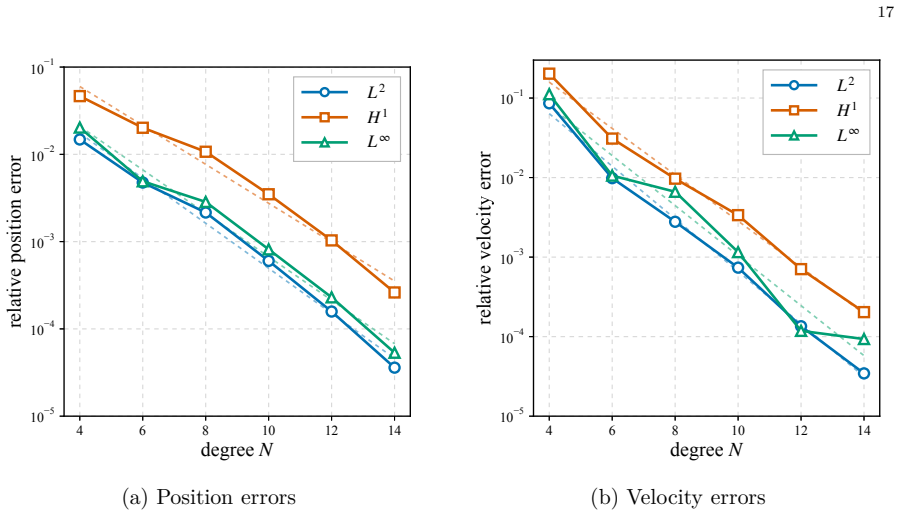
- Numerical tests in the paper reproduce the predicted exponential rate for analytic initial data.
Where Pith is reading between the lines
- The analyticity hypothesis could be weakened in practice to C^infty smoothness while still observing rapid convergence in floating-point arithmetic.
- The same global parametrization and error treatment could be applied to related flows such as surface diffusion or Willmore flow.
- Avoiding local charts removes the need for frequent remeshing that appears in many other surface-evolution codes.
Load-bearing premise
The initial global parametrization over the unit sphere must be analytic in order for the error analysis to produce an exponential bound after quadrature corrections are included.
What would settle it
A computation that starts from a smooth but non-analytic initial parametrization and exhibits only algebraic decay of the position error rather than exponential decay would falsify the claimed convergence rate.
Figures
read the original abstract
We propose and analyze a spherical harmonic pseudo-spectral method for the mean curvature flow of closed surfaces with spherical topology. The evolving surface is represented by a global parametrization over the unit sphere, and the continuous weak formulation underlying Dziuk's method [G. Dziuk, Numer. Math., 1991] is discretized in a finite-dimensional space of spherical harmonics. By explicitly taking into account quadrature errors on the autonomously evolving numerical surface, we prove exponential convergence of the position error under the assumption that the initial global parametrization is analytic. The convergence analysis developed herein is general and could apply to other moving-domain and geometric evolution problems. Numerical experiments confirm the theoretical result.
Editorial analysis
A structured set of objections, weighed in public.
Referee Report
Summary. The paper proposes a spherical harmonic pseudo-spectral discretization of Dziuk's weak formulation for mean curvature flow of closed surfaces with spherical topology. The evolving surface is represented via a global parametrization over the unit sphere; the method accounts explicitly for quadrature errors on the autonomously evolving numerical surface and proves exponential convergence of the position error assuming the initial parametrization is analytic. The analysis is presented as generalizable to other moving-domain problems, and numerical experiments are included to confirm the theoretical rates.
Significance. If the convergence analysis holds, the work supplies a rigorous high-order method achieving exponential accuracy for geometric evolution equations while handling quadrature on a moving surface. The claimed generality of the error analysis could extend to other surface PDEs or moving-domain problems, which would be a useful contribution to the numerical analysis of geometric flows.
minor comments (3)
- [Abstract] The abstract states that the convergence analysis 'could apply to other moving-domain and geometric evolution problems,' but the manuscript does not indicate which specific steps rely on the spherical-harmonic basis versus the weak-form structure; a short remark clarifying the scope of generality would help readers assess transferability.
- [Theorem 4.1 (or equivalent)] In the statement of the main theorem, the precise norm in which the position error converges exponentially should be stated explicitly (e.g., H^1 or L^2 on the surface) rather than left as 'position error.'
- [Section 5] Figure captions for the numerical experiments should include the specific spherical-harmonic degree N and time-step size used, so that the observed rates can be directly compared with the theorem hypotheses.
Simulated Author's Rebuttal
We thank the referee for their careful reading, positive summary of the contribution, and recommendation of minor revision. No specific major comments were provided in the report.
Circularity Check
No significant circularity; derivation self-contained
full rationale
The paper discretizes the external weak formulation of Dziuk (1991) in a spherical-harmonics space and derives an exponential error bound after explicitly incorporating quadrature errors on the evolving surface; the analyticity assumption on the initial parametrization is an external hypothesis used to close the estimate, not a quantity fitted or defined from the result itself. No self-citations, fitted-input predictions, or ansatz smuggling appear in the described chain, so the central convergence claim does not reduce to its own inputs by construction.
Axiom & Free-Parameter Ledger
axioms (1)
- domain assumption The initial global parametrization is analytic.
Reference graph
Works this paper leans on
-
[1]
K. E. Atkinson and W. Han. Spherical Harmonics and Approximations on the Unit Sphere: An Introduction, volume 2044. Springer Science & Business Media, 2012
2044
-
[2]
G. Bai, H. Garcke, and S. Veerapeneni. Convergence analy sis for the Barrett–Garcke–Nürnberg method of transport type. Numer. Math. , 158:361–410, 2026
2026
-
[3]
Bai and B
G. Bai and B. Li. Erratum: Convergence of Dziuk’s semidis crete finite element method for mean curvature flow of closed surfaces with high-order finite elements. SIAM J. Numer. Anal. , 61(3):1609–1612, 2023
2023
-
[4]
Bai and B
G. Bai and B. Li. A new approach to the analysis of parametr ic finite element approximations to mean curvature flow. Found. Comput. Math. , 24(5):1673–1737, 2024
2024
-
[5]
Bai and B
G. Bai and B. Li. Convergence of a stabilized parametric fi nite element method of the Barrett–Garcke– Nürnberg type for curve shortening flow. Math. Comp. , 94(355):2151–2220, 2025
2025
-
[6]
Bai and S
G. Bai and S. Veerapaneni. A structure-preserving fast s pectral method for locally inextensible vesicles with tangential smoothing. To be submitted, 2026
2026
-
[7]
Bänsch, P
E. Bänsch, P. Morin, and R. H. Nochetto. Surface diffusion of graphs: variational formulation, error analysis, and simulation. SIAM J. Numer. Anal. , 42(2):773–799, 2004
2004
-
[8]
Barrett, H
J. Barrett, H. Garcke, and R. Nürnberg. Parametric finite element approximations of curvature driven interface evolutions. In Handb. Numer. Anal. , volume 21, pages 275–423. Elsevier, 2020
2020
-
[9]
J. W. Barrett, H. Garcke, and R. Nürnberg. A parametric fin ite element method for fourth order geometric evolution equations. J. Comput. Phys. , 222:441–467, 2007
2007
-
[10]
J. W. Barrett, H. Garcke, and R. Nürnberg. On the paramet ric finite element approximation of evolving hypersurfaces in R3. J. Comput. Phys. , 227:4281–4307, 2008
2008
-
[11]
Canuto, M
C. Canuto, M. Y. Hussaini, A. Quarteroni, and T. A. Zang. Spectral Methods in Fluid Dynamics . Springer Berlin Heidelberg, 1988
1988
-
[12]
Chen and L
B.-L. Chen and L. Yin. Uniqueness and pseudolocality th eorems of the mean curvature flow. Comm. Anal. Geom., 15:435–490, 2007
2007
-
[13]
F. Dai, H. Feng, and S. Tikhonov. Reverse Hölder inequal ity for spherical harmonics. Proc. Amer. Math. Soc., 144(3):1041–1051, 2016
2016
-
[14]
F. Dai, D. Gorbachev, and S. Tikhonov. Nikolskii consta nts for polynomials on the unit sphere. J. Anal. Math., 140(1):161–185, 2020
2020
-
[15]
Dai and Y
F. Dai and Y. Xu. Approximation Theory and Harmonic Analysis on Spheres and B alls. Springer, 2013
2013
-
[16]
Deckelnick and G
K. Deckelnick and G. Dziuk. Convergence of a finite eleme nt method for non-parametric mean curvature flow. Numer. Math. , 72(2):197–222, 1995. 18
1995
-
[17]
Deckelnick and G
K. Deckelnick and G. Dziuk. Error estimates for a semi-i mplicit fully discrete finite element scheme for the mean curvature flow of graphs. Interfaces Free Bound., 2(4):341–359, 2000
2000
-
[18]
Deckelnick and G
K. Deckelnick and G. Dziuk. Error analysis of a finite ele ment method for the Willmore flow of graphs. Interfaces Free Bound., 8:21–46, 2006
2006
-
[19]
Deckelnick, G
K. Deckelnick, G. Dziuk, and C. M. Elliott. Computation of geometric partial differential equations and mean curvature flow. Acta Numer. , 14:139–232, 2005
2005
-
[20]
D. M. DeTurck. Deforming metrics in the direction of the ir Ricci tensors. J. Differential Geom. , 18(1):157– 162, 1983
1983
-
[21]
Dziuk and C
G. Dziuk and C. M. Elliott. Finite element methods for su rface PDEs. Acta Numer. , 22:289–396, 2013
2013
-
[22]
K. Ecker. A local monotonicity formula for mean curvatu re flow. Ann. of Math. , 154(2):503–525, 2001
2001
-
[23]
K. Ecker. Regularity Theory for Mean Curvature Flow . Springer, 2012
2012
-
[24]
Ecker and G
K. Ecker and G. Huisken. Mean curvature evolution of ent ire graphs. Ann. of Math. , 130(3):453–471, 1989
1989
-
[25]
Ecker and G
K. Ecker and G. Huisken. Interior estimates for hypersu rfaces moving by mean curvature. Invent. Math. , 105(1):547–569, 1991
1991
-
[26]
C. M. Elliott and H. Fritz. On approximations of the curv e shortening flow and of the mean curvature flow based on the DeTurck trick. IMA J. Numer. Anal. , 37(2):543–603, 2017
2017
-
[27]
Firouznia, S
M. Firouznia, S. H. Bryngelson, and D. Saintillan. A spe ctral boundary integral method for simulating electrohydrodynamic flows in viscous drops. J. Comput. Phys. , 489:112248, 2023
2023
-
[28]
H. Fritz. Finite Elemente Approximation der Ricci-Krümmung und Simu lation des Ricci-DeTurck-Flusses . PhD thesis, Albert-Ludwigs-Universität Freiburg, 2013
2013
-
[29]
Ganesh, Q
M. Ganesh, Q. T. Le Gia, and I. H. Sloan. A pseudospectral quadrature method for Navier–Stokes equations on rotating spheres. Math. Comp. , 80(275):1397–1430, 2011
2011
-
[30]
I. G. Graham and I. H. Sloan. Fully discrete spectral bou ndary integral methods for Helmholtz problems on smooth closed surfaces in R3. Numer. Math. , 92(2):289–323, 2002
2002
-
[31]
G. Huisken. Flow by mean curvature of convex surfaces in to spheres. J. Differential Geom. , 20(1):237–266, 1984
1984
-
[32]
G. Huisken. Asymptotic behavior for singularities of t he mean curvature flow. J. Differential Geom. , 31(1):285–299, 1990
1990
-
[33]
Kovács, B
B. Kovács, B. Li, and C. Lubich. A convergent evolving fin ite element algorithm for mean curvature flow of closed surfaces. Numer. Math. , 143:797–853, 2019
2019
-
[34]
Kovács, B
B. Kovács, B. Li, and C. Lubich. A convergent evolving fin ite element algorithm for Willmore flow of closed surfaces. Numer. Math. , 149:595–643, 2021
2021
-
[35]
S. G. Krantz and H. R. Parks. A Primer of Real Analytic Functions . Springer Science & Business Media, 2002
2002
-
[36]
Lakkis and R
O. Lakkis and R. H. Nochetto. A posteriori error analysi s for the mean curvature flow of graphs. SIAM J. Numer. Anal. , 42(5):1875–1898, 2005
2005
-
[37]
Q. T. Le Gia and H. N. Mhaskar. Polynomial operators and l ocal approximation of solutions of pseudo- differential equations on the sphere. Numer. Math. , 103(2):299–322, 2006
2006
-
[38]
B. Li. Convergence of Dziuk’s semidiscrete finite eleme nt method for mean curvature flow of closed surfaces with high-order finite elements. SIAM J. Numer. Anal. , 59:1592–1617, 2021
2021
-
[39]
Mantegazza
C. Mantegazza. Lecture Notes on Mean Curvature Flow . Applied Mathematical Sciences. Springer Basel AG, 2012
2012
-
[40]
M. J. Mohlenkamp. A fast transform for spherical harmon ics. J. Fourier Anal. Appl. , 5(2):159–184, 1999
1999
-
[41]
S. Roman. Advanced Linear Algebra. Springer, 2005
2005
-
[42]
R. T. Seeley. Eigenfunction expansions of analytic fun ctions. Proc. Amer. Math. Soc. , 21(3):734–738, 1969
1969
-
[43]
J. Shen, T. Tang, and L.-L. Wang. Spectral Methods: Algorithms, Analysis and Applications , volume 41. Springer Science & Business Media, 2011
2011
-
[44]
I. H. Sloan. Polynomial interpolation and hyperinterp olation over general regions. J. Approx. Theory , 83(2):238–254, 1995
1995
-
[45]
I. H. Sloan and R. S. Womersley. Constructive polynomia l approximation on the sphere. J. Approx. Theory , 103(1):91–118, 2000
2000
-
[46]
Sorgentone and A.-K
C. Sorgentone and A.-K. Tornberg. A highly accurate bou ndary integral equation method for surfactant- laden drops in 3D. J. Comput. Phys. , 360:167–191, 2018
2018
-
[47]
L. N. Trefethen. Spectral Methods in MATLAB . SIAM, 2000
2000
-
[48]
S. K. Veerapaneni, D. Gueyffier, G. Biros, and D. Zorin. A n umerical method for simulating the dynamics of 3D axisymmetric vesicles suspended in viscous flows. J. Comput. Phys. , 228(19):7233–7249, 2009
2009
-
[49]
S. K. Veerapaneni, D. Gueyffier, D. Zorin, and G. Biros. A b oundary integral method for simulating the dynamics of inextensible vesicles suspended in a viscous flu id in 2D. J. Comput. Phys. , 228(7):2334–2353, 2009
2009
-
[50]
S. K. Veerapaneni, A. Rahimian, G. Biros, and D. Zorin. A fast algorithm for simulating vesicle flows in three dimensions. J. Comput. Phys. , 230(14):5610–5634, 2011
2011
-
[51]
B. White. A local regularity theorem for mean curvature flow. Ann. of Math. , 161(3):1487–1519, 2005. 19
2005
-
[52]
Y. Xu. Best polynomial approximation on the unit sphere and the unit ball. In Approximation Theory XIV: San Antonio 2013 , pages 357–375. Springer, 2014
2013
-
[53]
Zavodnik and M
J. Zavodnik and M. Brojan. Spherical harmonics-based p seudo-spectral method for quantitative analysis of symmetry breaking in wrinkling of shells with soft cores. Comput. Methods Appl. Mech. Eng. , 433:117529, 2025
2025
discussion (0)
Sign in with ORCID, Apple, or X to comment. Anyone can read and Pith papers without signing in.