REVIEW 3 major objections 5 minor 22 references
Open Traffic Models -- A framework for hybrid simulation of transportation networks
T0 review · 3 major / 5 minor · reviewed 2026-08-14 · deepseek-v4-flash
Pith's one-line read A model-agnostic boundary protocol can couple micro, meso, and macro traffic simulations while preserving vehicle counts across links.
desk verdict A genuinely useful, honestly scoped framework paper whose headline claim about second-order macroscopic models outruns what is implemented and tested. read the letter →
The pith
A machine-rendered reading of the paper's core claim, the machinery that carries it, and where it could break.
The reading
What carries the argument
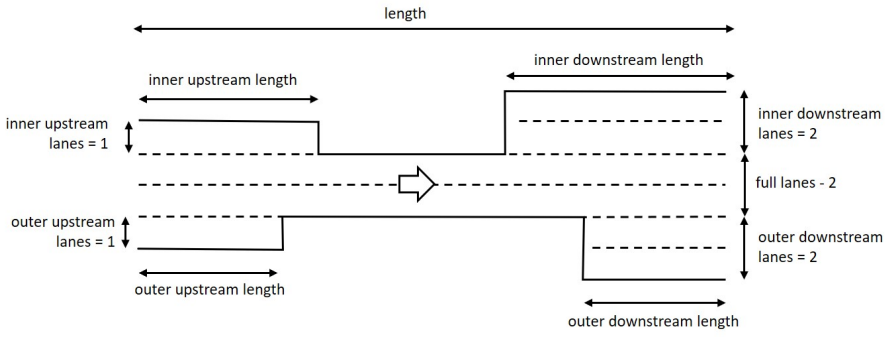
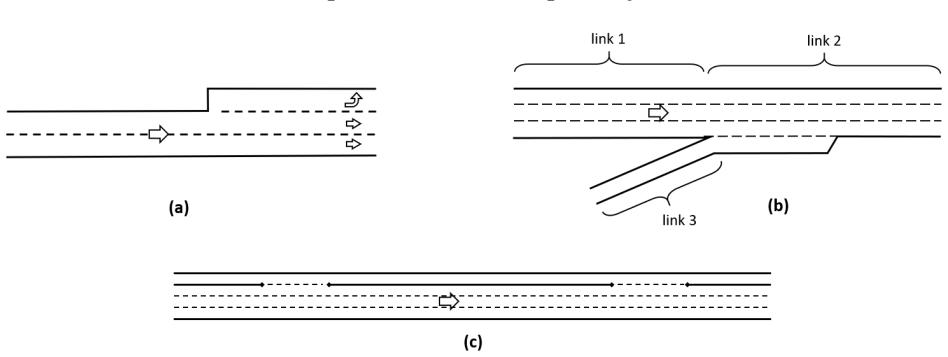
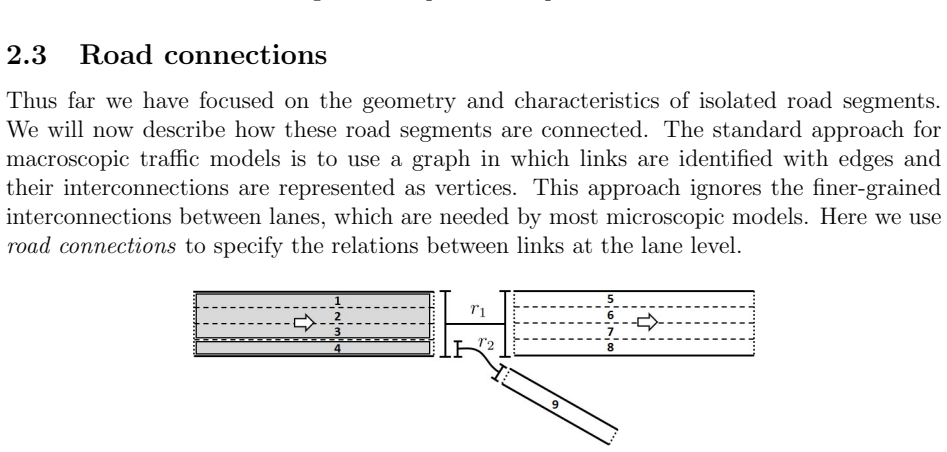
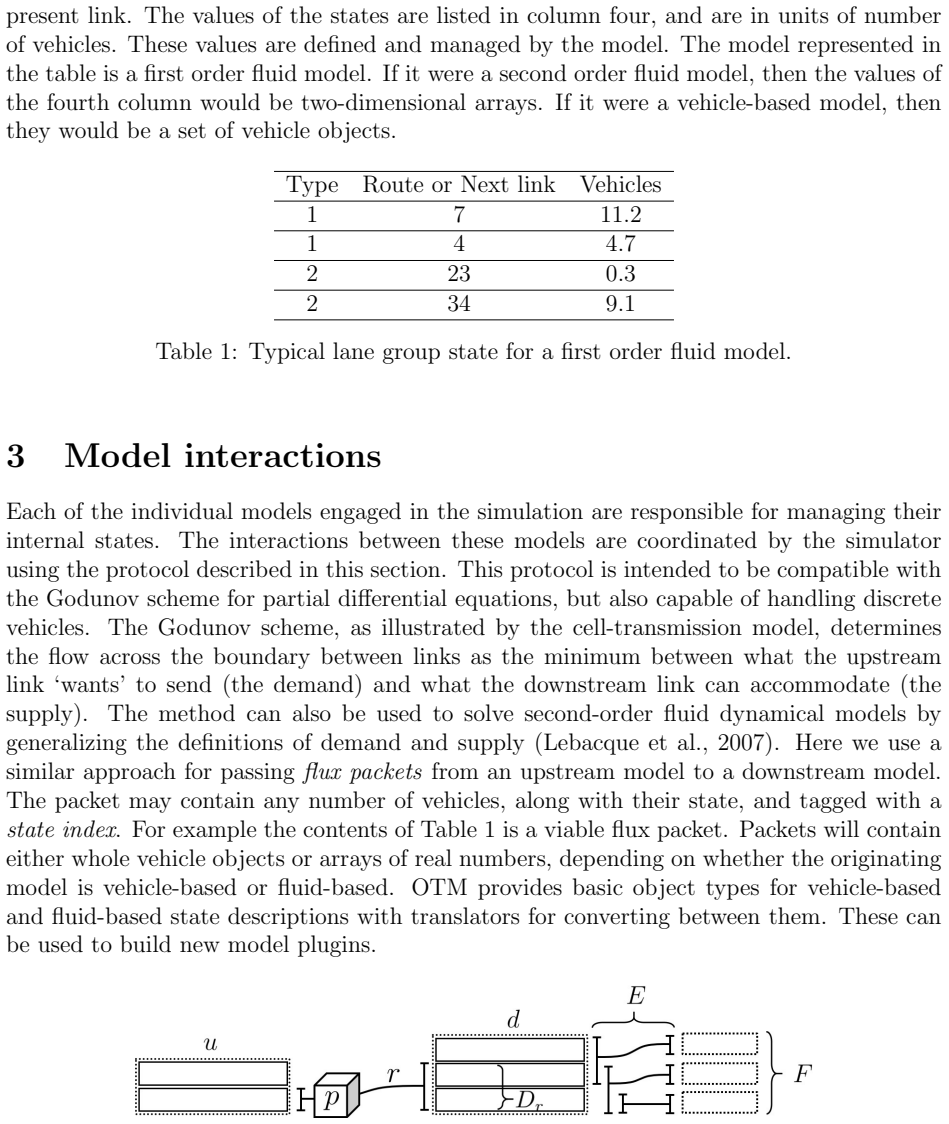
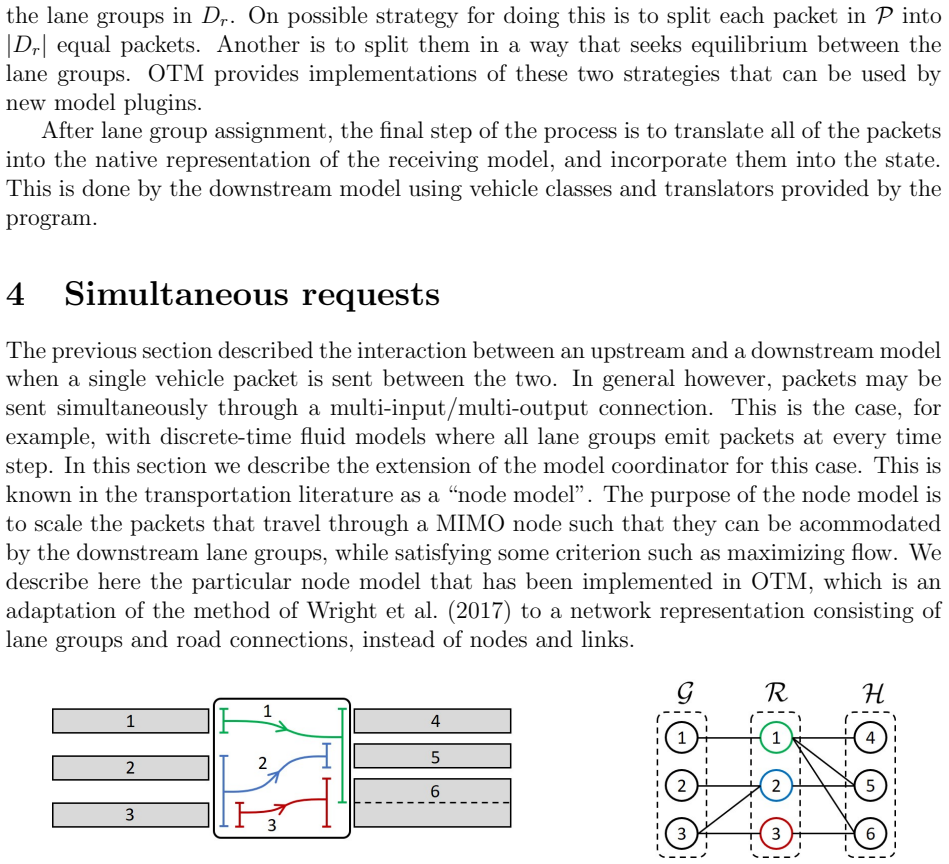
The load-bearing mechanism is the packet-scaling boundary protocol built on the model interface. A flux packet $p$ is a vector of vehicle counts per "state index" (vehicle type plus route or next link); before delivery, the downstream model reports $|p|$ and $\bar{p}$, and the packet is scaled by $\alpha = \min(1, \bar{p}/|p|)$. The node model extends the single-boundary rule to simultaneous multi-input/multi-output junctions by iteratively reducing upstream demands until downstream supplies are respected, following a demand-apportionment scheme. Lane groups and road connections supply the shared geometry: a lane group is a set of speed-synchronized lanes with a common set of exiting connections, so one instance of longitudinal dynamics — a lane, a FIFO queue, or a fluid cell — represents it in any model class. The scaling rule is what converts a fluid-compatible Godunov flux into a form that discrete vehicle or queue models can accept without a transition zone.
What would settle it
Build a plugin whose downstream get_max_packet_size is not homogeneous in packet composition — for example, a second-order model whose accepted space depends on which vehicle type arrives first — and send a mixed-type packet near capacity across the boundary. If the uniformly scaled packet is rejected, or if the total vehicle count before and after the boundary differs, the assumption behind Eq. (3) is false for that model class.
Extended reading notes
Core claim
The paper's central claim is that the transition zone used by earlier hybrid traffic simulators is unnecessary. Instead, each model exposes a small interface — packet size, maximum acceptable packet size, packet reception, and distance-to-last-vehicle queries — and the simulator mediates every boundary by computing a uniform scaling factor $\alpha = \min(1, \bar{p}/|p|)$ for a packet $p$. Multiplying all state entries in the packet by $\alpha$, the paper argues, makes the packet fit in the downstream link whenever the downstream model is a first-order fluid model or belongs to the generic second-order (GSOM) class, and for vehicle-based models the same factor is applied per state index with whole-vehicle rounding. A multi-input/multi-output node model, iterated until no upstream lane group can advance, handles simultaneous packets at junctions. The paper concludes that this protocol, together with a lane-group/road-connection network representation, covers microscopic, mesoscopic, and macroscopic models and conserves both the number of vehicles and the distinguishing characteristics assigned to each vehicle type.
Load-bearing premise
The load-bearing premise is Eq. (3): scaling every vehicle count in a packet uniformly by $\alpha = \min(1, \bar{p}/|p|)$ always yields a packet that fits in the downstream link; if some model pair's downstream supply does not scale that way, the boundary could create or destroy vehicle space.
Editorial extensions
If this is right
- A network can be partitioned arbitrarily into subregions, each running a different model class, and congestion waves cross the boundaries without a hand-crafted transition zone.
- Vehicle conservation and vehicle-type identity are preserved across the boundary, so multi-class flows such as cars versus trucks or HOV versus general traffic survive model changes.
- The same sensors and actuators work regardless of which model manages a link, so control strategies such as ramp metering or signal timing can be developed once and tested against macro, meso, or micro models.
- Because interactions are mediated by a protocol rather than by direct model-to-model code, the architecture is suited to distributed-memory execution, which the paper identifies as a planned extension.
- Models can be added, combined, and distributed as plugins that implement the interface, allowing third parties to integrate new models alongside the three canonical ones.
Reading between the lines
- Editorial inference: The uniform-scaling rule suggests a testable criterion for model compatibility: any downstream supply function that is homogeneous in packet composition should couple cleanly through Eq. (3), while multi-class or state-dependent supply functions that violate homogeneity would need a composition-dependent node model of the kind the paper cites as future work.
- Editorial inference: Because the paper reports different congestion wave speeds and queueing densities on the two sides of the boundary, the boundary itself can act as a filter that modifies shock behavior; an interesting extension would be to quantify how much numerical smearing or state distortion the scaling rule introduces at the interface.
- Editorial inference: The lane-group abstraction could support adaptive model selection, where a link whose lanes are nearly synchronized runs as a fluid lane group and switches to microscopic resolution when speed variance rises, using the same protocol as the seam.
Signed reviews
Editorial analysis
A structured set of objections, weighed in public.
Referee Report
Summary. The paper proposes Open Traffic Models (OTM), a framework for hybrid traffic simulation in which different links of a network may be managed by different traffic models (microscopic, mesoscopic, or macroscopic). The key mechanism is a model interface: upstream models emit vehicle packets, downstream models report available space through get_packet_size and get_max_packet_size, and a scaling factor alpha is computed to make packets fit; a node model handles simultaneous multi-input/multi-output requests. The paper describes a lane-group network representation, three example models (Newell car-following, two-queue, and CTM), a sensor/actuator control interface, and qualitative demonstrations on a linear network with pairs of model types. The central claim is that the coupling protocol generalizes the Godunov scheme and covers first- and second-order macroscopic models (the GSOM class), with an open-source implementation available on GitHub.
Significance. If the generality claimed in Sections 1 and 3 were fully realized, the framework would be a valuable open-source testbed for hybrid traffic simulation. The lane-group abstraction is a sensible bridge between lane-based microscopic and aggregate macroscopic representations, and the packet-interface design with model-agnostic sensors and actuators is clean and extensible. The paper is also commendably honest about the implementation scope in Sections 4 and 7. However, the experiments are qualitative demonstrations only, and the GSOM/second-order support is asserted rather than implemented or tested. The significance therefore rests mainly on the architecture and the promise of extensibility rather than on demonstrated correctness for the full claimed model class.
major comments (3)
- [Section 3, Eq. (3)] The uniform scaling assumption, that multiplying a packet by alpha = min(1, pbar/|p|) yields a packet that fits downstream while preserving all other states, is stated as true for first-order fluid models and the GSOM class, but no proof, counterexample analysis, or precise reference to a derivation is given. This property is load-bearing because it is the mechanism by which the protocol enforces the conservation requirement of Section 2. The acknowledged composition dependence of pbar for GSOM is also not analyzed; a scaling that is uniform over state indices is not obviously valid when the available space depends on the packet's composition. Please provide a derivation or a precise citation establishing the property for the GSOM class, or explicitly restrict the claim of generality.
- [Section 4] The implemented node model is 'confine[d] to the simpler case, where the total supply in downstream lane groups are independent of the composition of the packets being sent,' which the paper notes covers first-order fluid models and most vehicle-based models; the composition-dependent case needed for the GSOM class is deferred to future work. This directly limits the central claim in Section 1 that the methodology captures macroscopic models of first and second order. The Section 7 experiments, as the authors state, do not exercise the node model, lane changing, vehicle types, or controllers. The claims in Sections 1 and 3 should be scaled back to match the implemented and tested scope, or the missing composition-dependent case should be implemented and exercised.
- [Section 4, Eq. (20)] Equation (20) is presented without derivation, and its behavior at blocked connectors is undefined as written: Section 4 states that gamma_r = 1 for a blocked road connection (all downstream lane groups blocked), which makes (1 - gamma_h)/(1 - gamma_r) equal to 0/0 whenever h is blocked. Since the node model's correctness depends on this update, either derive Eq. (20) from the Wright et al. (2017) scheme, state the limiting convention for blocked connectors, or show that the blocked case never reaches this formula in a well-defined way.
minor comments (5)
- [Section 7] The text says 'Figures 13, 14, and 15 show other combinations of the three model types' immediately after presenting Figure 13; this should be 'Figures 14 and 15' or the figures should be renumbered consistently.
- [Throughout] There are numerous typographical errors, including 'macropscopic', 'coninuum', 'receiveing', 'acommodated', 'limitted', 'downtream', and 'the the densities'; these should be corrected in a revision.
- [Section 2.3] The notation for overlapping upstream lanes (lup_r intersection lup_r' nonempty) is broken in the typeset text and should be formatted properly.
- [Section 5.1, Eq. (26)] The get_distance_to_last_vehicle method returns a distance, but the text does not explain how this distance is converted into the headway h_i(t) used in Eq. (22) for the first vehicle in a lane group; a sentence clarifying this relation would aid reproducibility.
- [Section 3] The description of scaling vehicle-based packets, where 'each state index is scaled separately by the largest amount that preserves whole vehicles while not exceeding the value of alpha', is underspecified for mixed vehicle-based packets; an explicit algorithm or example would improve reproducibility.
Circularity Check
No significant circularity: the coupling protocol and tests are self-contained demonstrations; the GSOM scope limitation is a caveat, not a circular reduction.
full rationale
The paper's central contribution is a model-agnostic coupling protocol based on the Godunov demand/supply concept. Eq. (3) defines the scaling alpha = min(1, pbar/|p|) as an interface assumption, not as a fitted quantity: OTM does not tune any parameter to the experimental outcomes, and the Section 7 experiments are explicitly qualitative demonstrations of congestion propagation between model pairs, not predictions derived from fitted inputs. The node model in Section 4 is presented as an adaptation of Wright et al. (2017), which is peer-reviewed prior work co-authored by the present author; that citation supplies independent support for the MIMO algorithm, which is moreover written out explicitly in Eqs. (5)-(21). No uniqueness theorem is imported from the authors' prior work to force the choice, and no known empirical pattern is renamed as a new result. The paper does honestly state a limitation: 'We confine the description to the simpler case, where the total supply in downstream lane groups are independent of the composition of the packets being sent to those lanes groups. This case covers first-order fluid models and most vehicle-based models. This more general case has been developed by Wright and Horowitz (2017) for graph representations, and will be developed for OTM in a future publication.' This is a scope caveat about the GSOM/composition-dependent case, not a circular step: the paper does not claim to derive the general GSOM support from the same GSOM assumption, and the central protocol does not reduce by construction to its own outputs. Accordingly, no circular step meets the required evidentiary standard.
Assumptions & free parameters
free parameters (1)
- xi (lane-change supply apportionment factor in CTM)
assumptions (5)
- domain assumption Scaling a packet by alpha=min(1, available_space/packet_size) produces a packet that fits in the downstream link, uniformly over state indices.
- domain assumption Each lane group behaves as FIFO for purposes of blocking, so a single vehicle blocked on one exiting road connection blocks the whole lane group.
- domain assumption Total supply of each downstream lane group is independent of the composition of incoming packets.
- domain assumption All vehicles select their next link upon entering a link, before traveling through it.
- domain assumption The road connections leaving a single lane group all lead to different links.
Cite this review
Pith. "Pith review of Open Traffic Models -- A framework for hybrid simulation of transportation networks." pith.science (2026). https://pith.science/paper/55UL63GO
@misc{pith2026190804009,
  author       = {Pith},
  title        = {Pith review of: Open Traffic Models -- A framework for hybrid simulation of transportation networks},
  year         = {2026},
  howpublished = {\url{https://pith.science/paper/55UL63GO}},
  note         = {Machine review of arXiv:1908.04009}
}
read the original abstract
This paper introduces a new approach to hybrid traffic modeling, along with its implementation in software. The software allows modelers to assign traffic models to individual links in a network. Each model implements a series of methods, refered to as the modeling interface. These methods are used by the program to exchange information between adjacent models. Traffic controllers are implemented in a similar manner. The paper outlines the important components of the method: the network description, the description of demands, and the modeling and control interfaces. We include tests demonstrating the propagation of congestion between pairs of macroscpoic, mesoscopic, and microscopic models. Open Traffic Models is an open source implementation of these concepts, and is available at https://github.com/ggomes/otm-sim.
Figures

Figures from the paper (12 more)




Reference graph
Works this paper leans on
-
[1]
Aimsun. https://www.aimsun.com/, 2019. [Online; accessed January 2019]
work page 2019
-
[2]
E. Bourrel and J.B. Lesort. Mixing micro and macro representations of traffic flow: A hybrid model based on the LWR theory. In 82th Annual Meeting of the Transportation Research Board, 2003
work page 2003
-
[3]
W. Burghout, H. Koutsopoulos, and I. Andréasson. Hybrid mesoscopic–microscopic traffic simulation. Transportation Research Record: Journal of the Transportation Research Board, 1934: 0 218–225, 2005
work page 1934
-
[4]
R. Chandler, R. Herman, and E. Montroll. Traffic dynamics: Studies in car following . Operations Research , 6, 1958
work page 1958
-
[5]
C. Daganzo. The cell transmission model a dynamic representation of highway traffic consistent with the hydrodynamic theory. Transportation Research Part B, 28B 0 (4): 0 269--287, 1994
work page 1994
-
[6]
B. Greenshields. A study of highway capacity. Proceedings Highway Research Record, 14, 1935
work page 1935
-
[7]
CORSIM User's Guide, CORSIM Reference Manual, Version 6.0, May 2005
Systems Division ITT Industries, Inc. CORSIM User's Guide, CORSIM Reference Manual, Version 6.0, May 2005. Prepared for Federal Highway Administration under contract number: DTFH61-01-C-00005
work page 2005
-
[8]
P. Kor c ek, L. Sekanina, and O. Fu c ik. Cellular automata based traffic simulation accelerated on GPU . page 395–402, 2011
work page 2011
Show all 22 references
-
[9]
Krajzewicz, M
D. Krajzewicz, M. Bonert, and P. Wagner. The open source traffic simulation package SUMO . In RoboCup 2006, 2006
2006
-
[10]
Laval and C
J. Laval and C. Daganzo. Lane-changing in traffic streams. Transportation Research Part B, 40: 0 251–264, 2006
2006
-
[11]
Mammar, and H
J.P Lebacque, S. Mammar, and H. Haj-Salem. Generic second order traffic flow modelling. 17th International Symposium on Transportation and Traffic Theory, 2007
2007
-
[12]
Leclercq
L. Leclercq. Hybrid approaches to the solutions of the Lighthill–Whitham–Richards model. Transportation Research Part B, 41: 0 701–709, 2007
2007
-
[13]
Lieberman
E. Lieberman. Brief history of traffic simulation. Traffic and Transportation Simulation - Looking Back and Looking Ahead: Celebrating 50 Years of Traffic Flow Theory, a Workshop, pages 17--29, 2004
2004
-
[14]
Lighthill and G.B
M.J. Lighthill and G.B. Whitham. On kinematic waves II . A theory of traffic on long crowded roads. Proceedings of the Royal Society A, 229: 0 317–345, 1955
1955
-
[15]
Nagel and M
K. Nagel and M. Schreckenberg. A cellular automaton model for freeway traffic. Journal de Physique I, 2 0 (12): 0 2221--2229, 1992
1992
-
[16]
G. Newell. A simplified car-following theory: A lower order model. Transportation Research Part B , 36: 0 195--205, 2002
2002
-
[17]
Richards
P. Richards. Shock waves on the highway. Operations Research, 4: 0 42--51, 1956
1956
-
[18]
van Wageningen-Kessels, H
F. van Wageningen-Kessels, H. van Lint, K. Vuik, and S. Hoogendoorn. Genealogy of traffic flow models. EURO Journal on Transportation and Logistics, 4 0 (4): 0 445--473, 2015
2015
-
[19]
P. Varaiya. Max pressure control of a network of signalized intersections. Transportation Research Part C , 36: 0 177--195, 2013
2013
-
[20]
Wright, G
M. Wright, G. Gomes, R. Horowitz, and A. Kurzhanskiy. On node models for high-dimensional road networks. Transportation Research Part B: Methodological, 105: 0 212--234, 2017
2017
-
[21]
Wright and R
M.A. Wright and R. Horowitz. Generic second-order macroscopic traffic node model for general multi-input multi-output road junctions via a dynamic system approach. arXiv:1707.09346 [cs, math], July 2017. URL http://arxiv.org/abs/1707.09346
2017 arXiv
-
[22]
Zhou and J
X. Zhou and J. Taylor. DTALite: A queue-based mesoscopic traffic simulator for fast model evaluation and calibration . Cogent Engineering , 1 0 (1), 2014
2014
Reviewed August 14, 2026 · model on record in the stance chip above.
Discussion (0). Continue with ORCID to comment.