REVIEW 4 minor 66 references
How do Conservative Backbone Curves Perturb into Forced Responses? A Melnikov Function Analysis
T0 review · 0 major / 4 minor · reviewed 2026-08-14 · deepseek-v4-flash
Pith's one-line read The paper reduces the survival of conservative periodic orbits under small damping and forcing to the zeros of a single Melnikov-type integral, and uses those zeros to predict resonance maxima and isola births.
desk verdict Solid, honest generalization of Melnikov's idea to multi-DOF conservative orbit families, with real numerical verification and clearly scoped limits; worth refereeing seriously. read the letter →
The pith
A machine-rendered reading of the paper's core claim, the machinery that carries it, and where it could break.
The reading
What carries the argument
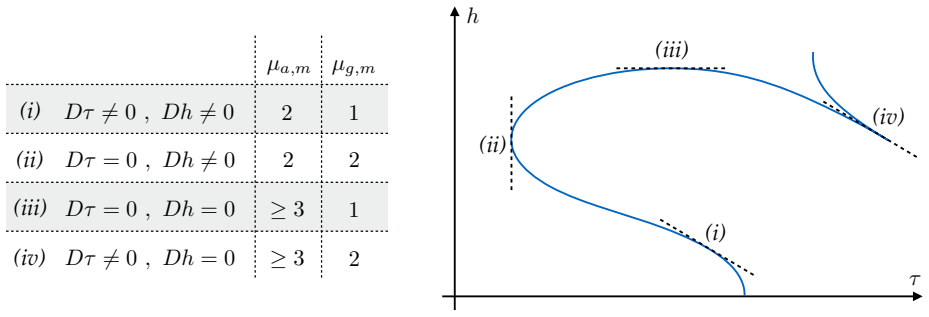
The central object is the subharmonic Melnikov function $M_{m:l}(s)$ of Eq. (9), an integral of the perturbation against the energy gradient along the unperturbed orbit. It is the leading-order term of the one-cycle energy balance; its zeros are exactly the phase shifts $s$ at which the perturbation does zero net work. Because it is scalar, the implicit function theorem reduces an $(n+1)$-dimensional persistence problem to checking whether $M_{m:l}$ crosses zero transversally. The second necessary ingredient is the $m$-normal periodic orbit, a nondegeneracy condition (geometric multiplicity of the $+1$ Floquet multiplier at most two, with a tangency condition in the multiplicity-two case) that guarantees the conservative orbit belongs to a smooth one-parameter family; this replaces the integrability assumptions of classical Melnikov theory.
What would settle it
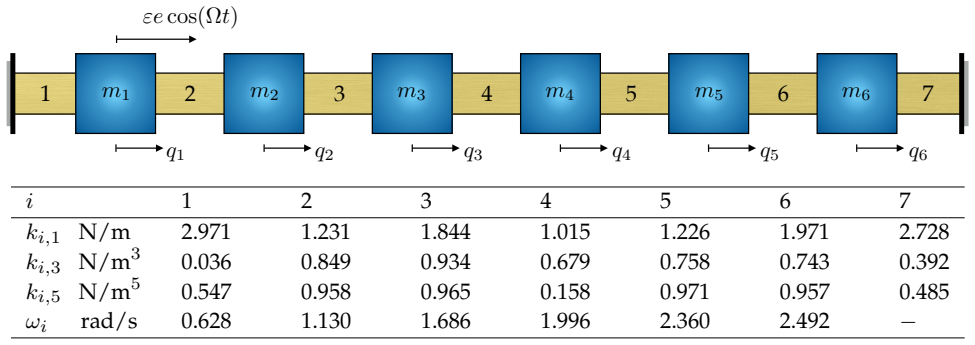
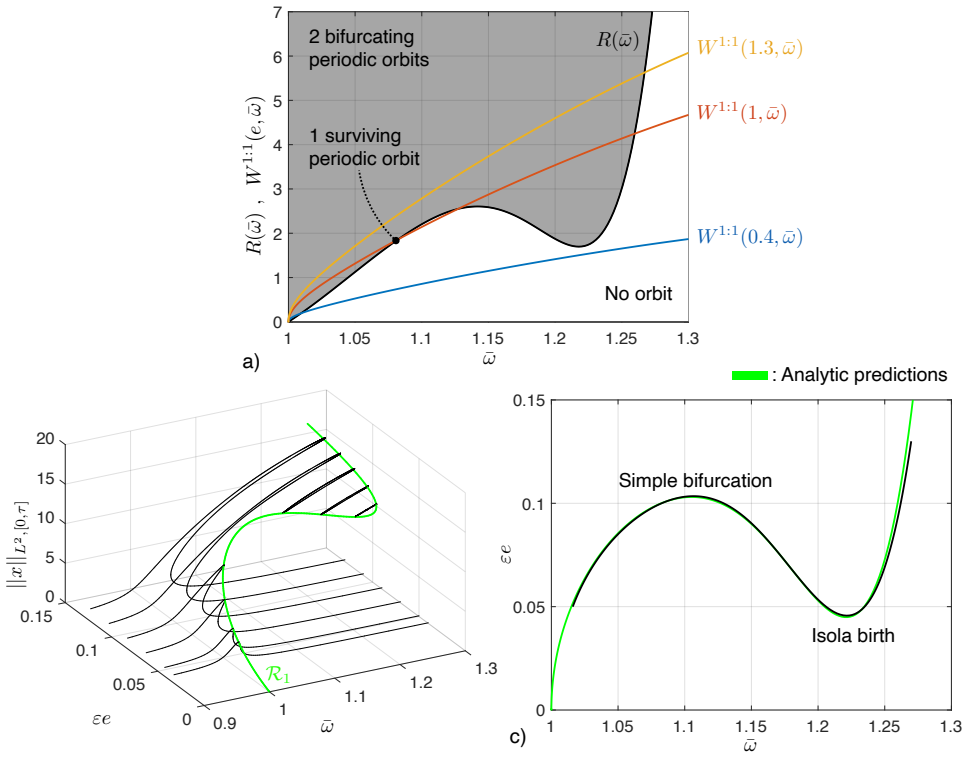
Return to the six-mass example with $\alpha=0.2481$, $\beta=-1.085$, $\gamma=0.8314$, $\varepsilon=0.1$, and use the first-mode conservative family. The paper predicts an isola birth near $e\approx 0.4$ and a reconnection to the main branch near $e\approx 1$, both $O(\varepsilon)$-close to the ridge $e=\Gamma_1(\bar\omega)$. Continuing forced periodic orbits directly and tracking saddle-node curves: if the isola does not appear, or appears at amplitudes outside the predicted interval, or if any forced branch bifurcates continuously from a conservative orbit for which $W_{1:1}<R$, the criterion is contradicted.
Extended reading notes
Core claim
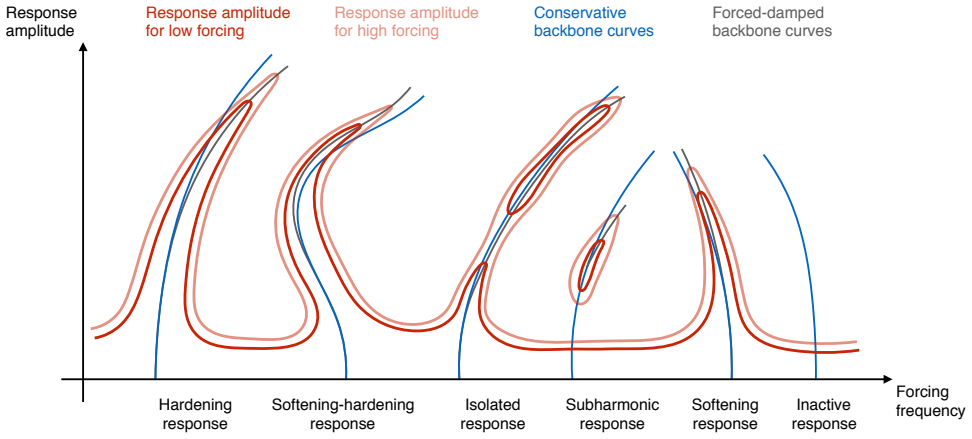
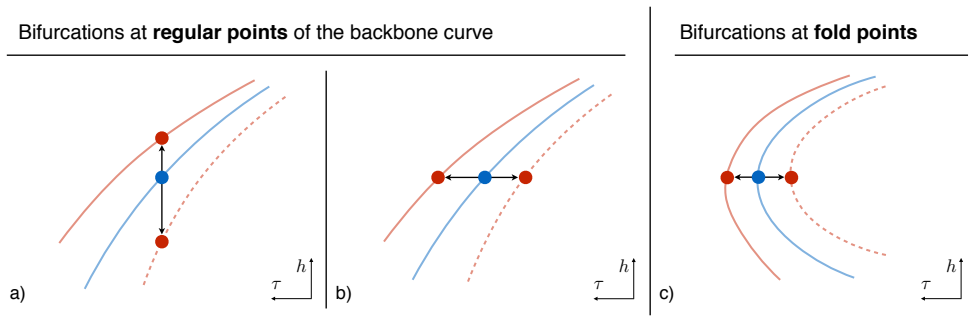
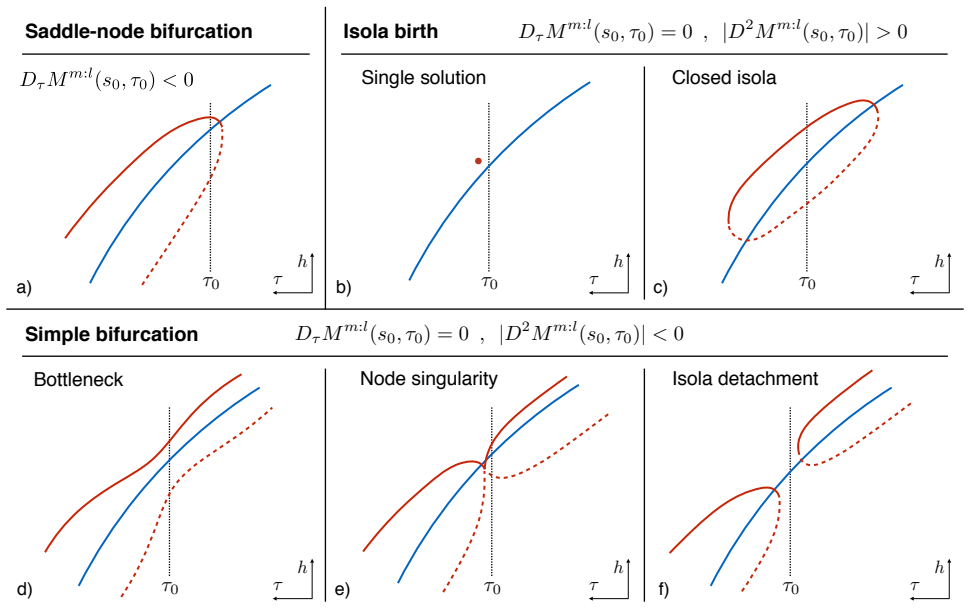
The central claim is that the fate of a one-parameter family of conservative periodic orbits under small damping and periodic forcing is governed by the zeros of the scalar Melnikov function $$M_{m:l}(s)=\$int_0^{{m\tau}}$\langle \nabla H(x_0(t+s;p)), g(x_0(t+s;p),t;\tau m/l,0)\rangle\,dt.$$ Theorem 3.1 asserts that if $M_{m:l}$ has a simple zero at $s_0$, the $m$-normal orbit $Z$ continues smoothly, with initial condition and period $O(\varepsilon)$-close to $Z$ and $m\tau$; if $M_{m:l}$ is bounded away from zero, there is no such smooth continuation. Theorem 3.2 classifies quadratic zeros as saddle-node bifurcations, isola births, or simple bifurcations. Under monoharmonic forcing and arbitrary dissipation, the function factors as $M_{1:l}=W_{1:l}(e)\cos(l\omega s-\alpha_{l,e})-R$, and Proposition 4.2 shows that the ridge $e=\Gamma_l(\lambda)=R(\lambda)/A_{l,e}(\lambda)$ is an $O(\varepsilon)$-close locus of maximal or minimal forced responses when $\Gamma_l$ has nonzero slope, and of isola births or simple bifurcations where the slope vanishes. The paper argues this justifies the energy principle and a generalized phase-lag quadrature criterion, and demonstrates the predictions on a six-degree-of-freedom chain.
Load-bearing premise
The claim presupposes that the forced-damped response is an $O(\varepsilon)$ smooth continuation of a nondegenerate ($m$-normal) conservative periodic orbit, so near branch points where normality fails, or for perturbations that are not small, the Melnikov criterion does not apply.
Editorial extensions
If this is right
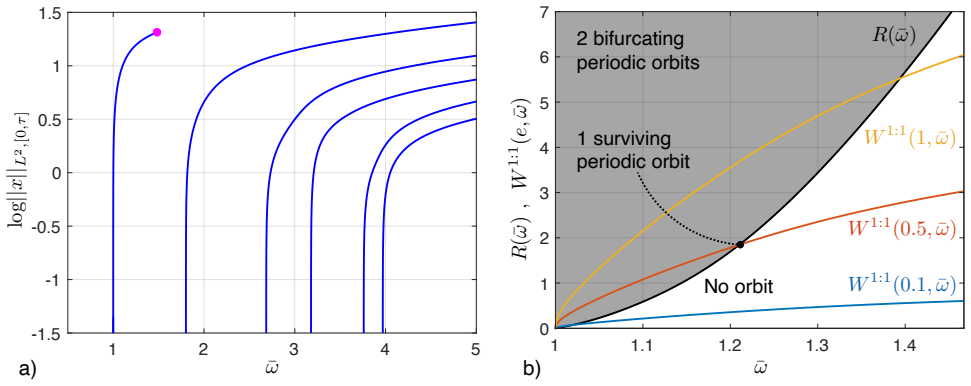
- For monoharmonic forcing, each conservative orbit produces two forced responses exactly when the forcing's work exceeds the damping's resistance, one response at equality, and none below; this gives a closed-form amplitude threshold.
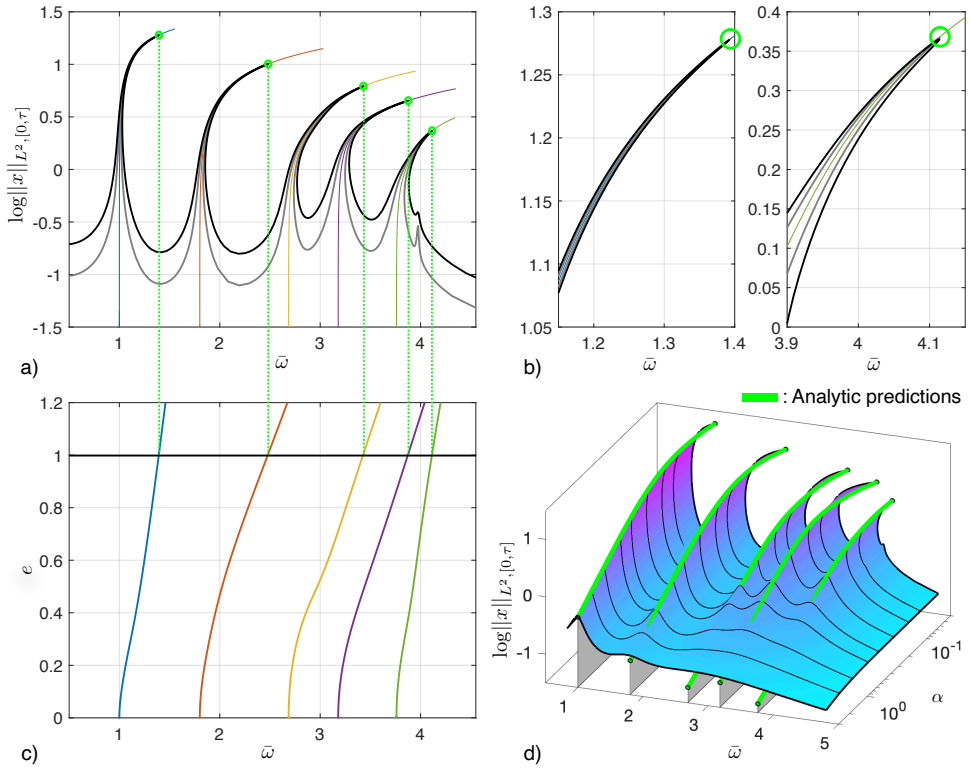
- Ridges computed from the conservative limit alone locate the peaks of frequency-response diagrams to within $O(\varepsilon)$, so numerical continuation of the forced-damped system is not needed to find them.
- Quadratic zeros of the Melnikov function are analytic early-warning signatures of isolas, which are otherwise hard to find by continuation.
- The phase-lag quadrature criterion is valid for asynchronous, multi-harmonic periodic motions with arbitrary smooth damping, provided the phase lag is measured in co-location with the forcing.
- For the monoharmonic forcing class considered, the criterion automatically rules out superharmonic and ultrasubharmonic resonances, while subharmonic resonances are captured through the $1:l$ case.
Reading between the lines
- Extension: because the ridge uses only conservative-limit data, the same computation could screen many candidate modes and damping laws for isola-prone zones before any forced-damped continuation is run.
- Extension: a natural next step would be to derive a generalized ridge for multi-harmonic forcing, where each harmonic should contribute its own phase and amplitude term; the paper only treats monoharmonic forcing.
- Extension: near the branch point where the first mode stops being $1$-normal, the Melnikov criterion is silent, so a higher-dimensional bifurcation function would be needed to cover that amplitude regime; this is a concrete boundary of the present result.
Signed reviews
Editorial analysis
A structured set of objections, weighed in public.
Referee Report
Summary. This paper develops a Melnikov-type criterion for the persistence and bifurcation of periodic orbits of a conservative mechanical system under small damping and time-periodic forcing. The main mathematical result (Theorem 3.1) reduces the persistence problem for an m-normal periodic orbit to the zeros of a scalar Melnikov function M_{m:l}(s); a simple zero guarantees two O(ε)-close smooth continuations, while a quadratic zero leads to saddle-node, isola birth, or simple bifurcation phenomena (Theorem 3.2). For monoharmonic forcing with arbitrary dissipation, the authors compute M explicitly and derive ridge curves Γ_l(λ) that locate maximal response and isola births from the conservative backbone curve alone, as well as a generalized phase-lag quadrature criterion. The theoretical predictions are validated on a six-degree-of-freedom chain with linear and nonlinear damping, including the birth and merging of an isola. The central limitation, explicitly stated in Remark A.1, is that Theorem 3.1 addresses smooth persistence only; periodic orbits that are O(ε)-close but not smoothly connected to the conservative orbit are outside the scope.
Significance. The results are significant for nonlinear structural dynamics and for perturbation theory. They extend subharmonic Melnikov theory beyond planar/integrable systems, exploiting one-parameter families of periodic orbits instead of integrability. They also provide rigorous justification for energy balance and force-appropriation methods under broader conditions than before. The predictions are falsifiable: ridge curves and bifurcation thresholds are computed from the unperturbed conservative limit, with no parameters fitted to forced-response data. The numerical example supports the claimed accuracy even at ε=0.1. The main caveat—smooth persistence only—is a genuine but clearly scoped boundary of the method.
minor comments (4)
- [§4.2 (Proposition 4.2, Eq. (25))] The statement that DΓ_l>0 yields a 'maximal response' is derived from the existence of two orbits for λ<λ0 and none for λ>λ0; it would be clearer to state explicitly that this is a fold with respect to λ and to point out that in the examples λ plays the role of the frequency ω, which is what makes the ridge coincide with the peaks in Figure 7(a).
- [§5.2] The values α=0.2481, β=-1.085, γ=0.8314 are selected to break the monotonic trend of the resistance; it might be worth stressing that this choice does not introduce any fitted parameter in the ridge prediction, since Γ_1(λ) is computed solely from the conservative limit.
- [§3.1 (Theorem 3.1, Remark A.1)] The paper explicitly limits the result to smooth persistence; I suggest cross-referencing Remark A.1 in the main-text discussion around Fig. 1 so that readers do not infer that all O(ε)-close forced responses are captured.
- [§5 (Eq. (34) and Figure 6)] The duplicated paragraph and several typographical errors (e.g., 'detachement' in the Figure 4 caption, and the stray 'some' in the draft text) should be corrected in a final version.
Circularity Check
No circularity: the Melnikov predictions are computed solely from the conservative limit and validated against independent forced-response continuation.
full rationale
The paper's central derivation chain is self-contained and non-circular. The persistence problem is reduced, via Lyapunov-Schmidt / implicit-function arguments (Theorem A.2), to a scalar Melnikov function whose leading-order term is computed along the unperturbed conservative periodic orbit only: M_{m:l}(s) = ∫<DH, g> dt. For monoharmonic forcing this becomes M_{1:l}(s,e,λ) = A_{l,e}(λ)(e cos(lωs−α) − Γ_l(λ)), where Γ_l = R/A_{l,e} is built from the resistance R and Fourier coefficients of the conservative orbit. The ridge locus e = Γ_l(λ) is therefore an output of conservative-limit data, not a fit to forced-response measurements. The forced-response folds and isola births are then obtained by applying Theorem 3.2 to this derived Melnikov function, so the 'prediction' is a mathematical consequence rather than a restatement of the numerical result. The numerical continuation at ε = 0.05 and 0.1 is an independent check, and the nonlinear-damping coefficients in Section 5.2 were chosen to create a nonmonotone resistance, not to match the predicted ridge. The paper itself flags the one genuine scoping limitation in Remark A.1: Theorem 3.1 guarantees smooth persistence only, and orbits that are O(ε)-close but not smoothly connected lie outside the criterion. That is an acknowledged boundary of validity, not a circular step. Self-citations to prior Haller-group work appear as contextual background in the introduction and are not load-bearing for the theorems, which rest on external results by Rhouma and Chicone and by Sepulchre and MacKay.
Assumptions & free parameters
assumptions (4)
- domain assumption The conservative limit has a one-parameter family of m-normal periodic orbits, as defined by Sepulchre and MacKay (Definition 3.1).
- domain assumption The perturbation is small (epsilon>0) and smooth, with f in C^r, r>=2.
- standard math The monodromy factorisation of Rhouma and Chicone (Proposition A.1) and the continuation theorem for normal families (Munoz-Almaraz et al.) hold for arbitrary degrees of freedom.
- standard math The singular bifurcation classification for quadratic zeros follows the standard theory of Golubitsky-Schaeffer and Chow-Hale (Theorem 3.2, proof in Appendix A.3).
Cite this review
Pith. "Pith review of How do Conservative Backbone Curves Perturb into Forced Responses? A Melnikov Function Analysis." pith.science (2026). https://pith.science/paper/56FCKS65
@misc{pith2026190800721,
  author       = {Pith},
  title        = {Pith review of: How do Conservative Backbone Curves Perturb into Forced Responses? A Melnikov Function Analysis},
  year         = {2026},
  howpublished = {\url{https://pith.science/paper/56FCKS65}},
  note         = {Machine review of arXiv:1908.00721}
}
read the original abstract
Weakly damped mechanical systems under small periodic forcing tend to exhibit periodic response in a close vicinity of certain periodic orbits of their conservative limit. Specifically, amplitude frequency plots for the conservative limit have often been noted, both numerically and experimentally, to serve as backbone curves for the near resonance peaks of the forced response. In other cases, such a relationship between the unforced and forced response was not observed. Here we provide a systematic mathematical analysis that predicts which members of conservative periodic orbit families will serve as backbone curves for the forced-damped response. We also obtain mathematical conditions under which approximate numerical and experimental approaches, such as energy balance and force appropriation, are justifiable. Finally, we derive analytic criteria for the birth of isolated response branches (isolas) whose identification is otherwise challenging from numerical continuation.
Figures
Figures from the paper (5 more)
Reference graph
Works this paper leans on
- [1]
-
[2]
A.F. Vakakis. Non-linear normal modes, (NNMs) and their application in vibration theory: an overview. Mechanical Systems and Signal Processing, 11(1):3 – 22, 1997
work page 1997
-
[3]
A.F. Vakakis, editor. Normal Modes and Localization in Nonlinear Systems . Springer, Dordrecht, 2001
work page 2001
-
[4]
A.F. Vakakis, L.I. Manevitch, Y.V . Mikhlin, V .N. Pilipchuk, and A.A. Zevin. Normal Modes and Localization in Nonlinear Systems. Wiley Blackwell, 1 2008
work page 2008
-
[5]
K.V . Avramov and Y.V . Mikhlin. Nonlinear normal modes for vibrating mechanical systems. review of theoretical developments. ASME Applied Mechanics Reviews, 63(6), 2011
work page 2011
-
[6]
K.V . Avramov and Y.V . Mikhlin. Review of applications of nonlinear normal modes for vibrating mechanical systems. ASME Applied Mechanics Reviews, 65(2), 2013
work page 2013
- [7]
- [8]
Show all 66 references
-
[9]
Peeters, G
M. Peeters, G. Kerschen, and J.C. Golinval. Modal testing of nonlinear vibrating structures based on nonlinear normal modes: experimental demonstration. Mechanical Systems and Signal Processing, 25(4):1227 – 1247, 2011
2011
-
[10]
Szalai, D
R. Szalai, D. Ehrhardt, and G. Haller. Nonlinear model identification and spectral submanifolds for multi-degree-of-freedom mechanical vibrations. Proceedings of the Royal Society of London A: Mathematical, Physical and Engineering Sciences, 473(2202), 2017
2017
-
[11]
Touzé and M
C. Touzé and M. Amabili. Nonlinear normal modes for damped geometrically nonlinear sys- tems: Application to reduced-order modelling of harmonically forced structures. Journal of Sound and Vibration, 298(4):958 – 981, 2006
2006
-
[12]
Sombroek, P
C.S.M. Sombroek, P . Tiso, L. Renson, and G. Kerschen. Numerical computation of nonlinear normal modes in a modal derivative subspace. Computers & Structures, 195:34 – 46, 2018
2018
-
[13]
P . M. Polunin, Y. Yang, M. I. Dykman, T. W. Kenny, and S. W. Shaw. Characterization of mems resonator nonlinearities using the ringdown response. Journal of Microelectromechanical Systems, 25(2):297–303, April 2016
2016
-
[14]
Carpineto, W
N. Carpineto, W. Lacarbonara, and F. Vestroni. Hysteretic tuned mass dampers for structural vibration mitigation. Journal of Sound and Vibration, 333(5):1302 – 1318, 2014
2014
-
[15]
Mojahed, K
A. Mojahed, K. Moore, L.A. Bergman, and A.F. Vakakis. Strong geometric softening-hardening nonlinearities in an oscillator composed of linear stiffness and damping elements. International Journal of Non-Linear Mechanics, 107:94 – 111, 2018
2018
-
[16]
Y. Liu, A. Mojahed, L.A. Bergman, and A.F. Vakakis. A new way to introduce geometrically non- linear stiffness and damping with an application to vibration suppression. Nonlinear Dynamics, 96(3):1819–1845, May 2019
2019
-
[17]
Habib, G.I
G. Habib, G.I. Cirillo, and G. Kerschen. Isolated resonances and nonlinear damping. Nonlinear Dynamics, 93(3):979–994, 2018
2018
-
[18]
Hill, S.A
T.L. Hill, S.A. Neild, and A. Cammarano. An analytical approach for detecting isolated periodic solution branches in weakly nonlinear structures. Journal of Sound and Vibration, 379:150 – 165, 2016. 23
2016
-
[19]
Ponsioen, T
S. Ponsioen, T. Pedergnana, and G. Haller. Analytic prediction of isolated forced response curves from spectral submanifolds. Nonlinear Dynamics, Jun 2019
2019
-
[20]
T.L. Hill, A. Cammarano, S.A. Neild, and D.A.W. Barton. Identifying the significance of nonlin- ear normal modes. 473(2199), 2017
2017
-
[21]
Sanders, F
J.A. Sanders, F. Verhulst, and J. Murdock. Averaging Methods in Nonlinear Dynamical Systems , volume 59 of Applied Mathematical Sciences. Springer-Verlag New York, 2 edition, 2007
2007
-
[22]
Touzé, O
C. Touzé, O. Thomas, and A. Chaigne. Hardening/softening behaviour in non-linear oscillations of structural systems using non-linear normal modes. Journal of Sound and Vibration, 273(1):77 – 101, 2004
2004
-
[23]
Neild and D.J
S.A. Neild and D.J. Wagg. Applying the method of normal forms to second-order nonlinear vibration problems. Proceedings of the Royal Society of London A: Mathematical, Physical and Engi- neering Sciences, 467(2128):1141–1163, 2011
2011
-
[24]
T.L. Hill, A. Cammarano, S.A. Neild, and D.J. Wagg. Interpreting the forced responses of a two- degree-of-freedom nonlinear oscillator using backbone curves. Journal of Sound and Vibration , 349:276 – 288, 2015
2015
-
[25]
Vakakis and A
A.F. Vakakis and A. Blanchard. Exact steady states of the periodically forced and damped duff- ing oscillator. Journal of Sound and Vibration, 413:57–65, 1 2018
2018
-
[26]
Haller and S
G. Haller and S. Ponsioen. Nonlinear normal modes and spectral submanifolds: existence, uniqueness and use in model reduction. Nonlinear Dynamics, 86(3):1493–1534, 2016
2016
-
[27]
Breunung and G
T. Breunung and G. Haller. Explicit backbone curves from spectral submanifolds of forced- damped nonlinear mechanical systems. Proceedings of the Royal Society of London A: Mathematical, Physical and Engineering Sciences, 474(2213), 2018
2018
-
[28]
Ponsioen, T
S. Ponsioen, T. Pedergnana, and G. Haller. Automated computation of autonomous spectral submanifolds for nonlinear modal analysis. Journal of Sound and Vibration, 420:269 – 295, 2018
2018
-
[29]
Lyapunov
A.M. Lyapunov. The general problem of the stability of motion. International Journal of Control, 55(3):531 – 534, 1992
1992
-
[30]
Renson, G
L. Renson, G. Kerschen, and B. Cochelin. Numerical computation of nonlinear normal modes in mechanical engineering. Journal of Sound and Vibration, 364:177 – 206, 2016
2016
-
[31]
Peeters, R
M. Peeters, R. Viguié, G. Sérandour, G. Kerschen, and J.-C. Golinval. Nonlinear normal modes, part II: toward a practical computation using numerical continuation techniques. Mechanical Systems and Signal Processing, 23(1):195 – 216, 2009. Special Issue: Non-linear Structural ...
2009
-
[32]
Grolet and F
A. Grolet and F. Thouverez. On a new harmonic selection technique for harmonic balance method. Mechanical Systems and Signal Processing, 30:43 – 60, 2012
2012
-
[33]
Dankowicz and F
H. Dankowicz and F. Schilder. Recipes for Continuation. Society for Industrial and Applied Math- ematics, 2013
2013
-
[34]
Peeters, G
M. Peeters, G. Kerschen, and J.C. Golinval. Dynamic testing of nonlinear vibrating structures using nonlinear normal modes. Journal of Sound and Vibration, 330(3):486 – 509, 2011
2011
-
[35]
Ehrhardt and Matthew S
David A. Ehrhardt and Matthew S. Allen. Measurement of nonlinear normal modes using multi- harmonic stepped force appropriation and free decay. Mechanical Systems and Signal Processing, 76-77:612 – 633, 2016. 24
2016
-
[36]
Peter, M
S. Peter, M. Scheel, M. Krack, and R.I. Leine. Synthesis of nonlinear frequency responses with experimentally extracted nonlinear modes. Mechanical Systems and Signal Processing , 101:498 – 515, 2018
2018
-
[37]
Renson, A
L. Renson, A. Gonzalez-Buelga, D.A.W. Barton, and S.A. Neild. Robust identification of back- bone curves using control-based continuation. Journal of Sound and Vibration, 367:145 – 158, 2016
2016
-
[38]
Kerschen, M
G. Kerschen, M. Peeters, J.C. Golinval, and A.F. Vakakis. Nonlinear normal modes, part I: A use- ful framework for the structural dynamicist. Mechanical Systems and Signal Processing, 23(1):170 – 194, 2009
2009
-
[39]
Guckenheimer and P .J
J. Guckenheimer and P .J. Holmes. Nonlinear Oscillations, Dynamical Systems, and Bifurcations of Vector Fields, volume 42 of Applied Mathematical Sciences. Springer-Verlag New York, 1983
1983
-
[40]
Meyer and D.C
K.R. Meyer and D.C. Offin. Introduction to Hamiltonian Dynamical Systems and the N-body Problem, volume 90 of Applied Mathematical Sciences. Springer-Verlag New York, 3 edition, 2017
2017
-
[41]
I.G. Malkin. On poincaré’s theory of periodic solutions.Akad. Nauk SSSR. Prikl. Mat. Meh., 13:633 – 646, 1949
1949
-
[42]
W.S. Loud. Periodic solutions of a perturbed autonomous system. Annals of Mathematics , 70(3):490 – 529, 1959
1959
-
[43]
M. Farkas. Periodic Motions, volume 104 of Applied Mathematical Sciences. Springer-Verlag New York, 1994
1994
-
[44]
Moser and E.J
J. Moser and E.J. Zehnder. Notes on Dynamical Systems , volume 12 of Courant Lecture Notes . American Mathematical Society, 2005
2005
-
[45]
Poincaré
H. Poincaré. Les Méthodes Nouvelles de la Mécanique Céleste. Gauthier-Villars et Fils, Paris, 1892
-
[46]
V .I. Arnol’d. Instability of dynamical systems with many degrees of freedom. Dokl. Akad. Nauk SSSR, 156(1):9 – 12, 1964
1964
-
[47]
Melnikov
V .K. Melnikov. On the stability of a center for time-periodic perturbations. Tr. Mosk. Mat. Obs., 12:3 – 52, 1963
1963
-
[48]
Yagasaki
K. Yagasaki. The melnikov theory for subharmonics and their bifurcations in forced oscillations. SIAM Journal on Applied Mathematics, 56(6):1720–1765, 1996
1996
-
[49]
Veerman and P
P . Veerman and P . Holmes. The existence of arbitrarily many distinct periodic orbits in a two degree of freedom hamiltonian system. Physica D: Nonlinear Phenomena, 14(2):177–192, 1985
1985
-
[50]
Veerman and P
P . Veerman and P . Holmes. Resonance bands in a two degree of freedom hamiltonian system. Physica D: Nonlinear Phenomena, 20(2):413 – 422, 1986
1986
-
[51]
Yagasaki
K. Yagasaki. Periodic and homoclinic motions in forced, coupled oscillators.Nonlinear Dynamics, 20(4):319 – 359, 1999
1999
-
[52]
M. Kunze. Non-Smooth Dynamical Systems, volume 1744 ofLecture Notes in Mathematics. Springer- Verlag Berlin Heidelberg, 2000
2000
-
[53]
Shaw and R.H
S.W. Shaw and R.H. Rand. The transition to chaos in a simple mechanical system. International Journal of Non-Linear Mechanics, 24(1):41 – 56, 1989
1989
-
[54]
Shaw and S.W
J. Shaw and S.W. Shaw. The onset of chaos in a two-degree-of-freedom impacting system.Journal of Applied Mechanics, 56:168, 1989
1989
-
[55]
C. Chicone. Lyapunov-Schmidt reduction and Melnikov integrals for bifurcation of periodic solutions in coupled oscillators. Journal of Differential Equations, 112(2):407 – 447, 1994. 25
1994
-
[56]
C. Chicone. A geometric approach to regular prturbation theory with an application to hydro- dynamics. Transactions of the American Mathematical Society, 12(2):4559 – 4598, 1995
1995
-
[57]
Rhouma and C
M.B.H. Rhouma and C. Chicone. On the continuation of periodic orbits.Methods and Applications of Analysis, 7(1):85 – 104, 2000
2000
-
[58]
Buic˘ a, J
A. Buic˘ a, J. Llibre, and O. Makarenkov. Bifurcations from nondegenerate families of periodic solutions in lipschitz systems. Journal of Differential Equations, 252(6):3899 – 3919, 2012
2012
-
[59]
C. Chicone. Ordinary Differential Equations with Applications, volume 34 of Texts in Applied Math- ematics. Springer-Verlag New York, 1982
1982
-
[60]
Sepulchre and R.S
J.A. Sepulchre and R.S. MacKay. Localized oscillations in conservative or dissipative networks of weakly coupled autonomous oscillators. Nonlinearity, 10(3):679, 1997
1997
-
[61]
Muñoz-Almaraz, E
F.J. Muñoz-Almaraz, E. Freire, J. Galán, E. Doedel, and A. Vanderbauwhede. Continuation of periodic orbits in conservative and hamiltonian systems. Physica D: Nonlinear Phenomena , 181(1):1 – 38, 2003
2003
-
[62]
Chow and J.K
S.N. Chow and J.K. Hale. Methods of Bifurcation Theory, volume 251 of Grundlehren der mathema- tischen Wissenschaften. Springer-Verlag New York, 1982
1982
-
[63]
Golubitsky and S
M. Golubitsky and S. Schaeffer. Singularities and Groups in Bifurcation Theory , volume 51 of Ap- plied Mathematical Sciences. Springer-Verlag New York, 1985
1985
-
[64]
Govaerts
W.J.F. Govaerts. Numerical Methods for Bifurcations of Dynamical Equilibria. Society for Industrial and Applied Mathematics, 2000
2000
-
[65]
G. Teschl. Ordinary Differential Equations and Dynamical Systems, volume 140 of Graduate Studies in Mathematics. American Mathematical Society, 2012
2012
-
[66]
Li and J.S
M.Y. Li and J.S. Muldowney. Dynamics of differential equations on invariant manifolds. Journal of Differential Equations, 168(2):295 – 320, 2000. 26
2000
Reviewed August 14, 2026 · model on record in the stance chip above.
Discussion (0). Continue with ORCID to comment.