REVIEW 1 major objections 4 minor 1 cited by
Identifiability of directed-cycle and catenary linear compartment models
T0 review · 1 major / 4 minor · reviewed 2026-08-12 · deepseek-v4-flash
Pith's one-line read A directed-cycle compartment model is generically locally identifiable exactly when its leaks interlace with its inputs and outputs, with one exceptional configuration set aside.
desk verdict Completes the directed-cycle identifiability classification with a genuinely new leak-interlacing criterion, but the sufficiency proof has a fixable gap when an input segment contains no output. read the letter →
The pith
A machine-rendered reading of the paper's core claim, the machinery that carries it, and where it could break.
The reading
What carries the argument
The engine of the proof is the coefficient map c of the model, the vector of coefficients of the input-output equations, together with the rank criterion that a strongly connected linear compartmental model is generically locally identifiable exactly when the Jacobian of c has full column rank at a generic parameter point. For directed cycles the coefficient map has an explicit form (Lemma 3.10): in the one-input, one-output case it is built from elementary symmetric polynomials e_j of edge-plus-leak sums, the path product κ from input to output, and products e*_j κ from the output back to the input; Proposition 2.14 extends these coefficients to models with multiple inputs and outputs by restricting to one-input, one-output submodels. The identifiability proof separates into a failure direction, where two leak columns of the Jacobian are shown to be linearly dependent, and a success direction, where a block-triangular submatrix with nonzero diagonal blocks is exhibited for leak-interlacing models. For catenary models the corresponding coefficient-map formula is derived from the spanning-incoming-forest expansion of input-output equation coefficients, using elementary symmetric polynomials on sets of outgoing sums.
What would settle it
For the 4-compartment directed-cycle model with In={1}, Out={3}, and Leak={1,3} — a leak-interlacing model that Theorem 3.6 declares identifiable — evaluate the Jacobian matrix of the coefficient map (four edge parameters k21,k32,k43,k14 plus two leak parameters k01,k03) at a generic parameter point. If its determinant is the zero polynomial, or a computer algebra system yields two distinct parameter vectors with identical input-output coefficients, then the classification is false.
Extended reading notes
Core claim
On the paper's terms, the central discovery is the equivalence in Theorem 3.6: an n-compartment directed-cycle model is generically locally identifiable if and only if it is leak-interlacing, meaning it is not exceptional (the only obstruction is the configuration In={i}, Out={i-1}, |Leak|=2, with i-1 in Leak) and every arc of the cycle from one leak to the next contains at least one input or output compartment, counting endpoints. This covers any number of inputs, outputs, and leaks, extending earlier one-input/one-output results. A direct corollary is that any directed-cycle model with |Leak| at least |In|+|Out|+1 is unidentifiable. The paper also identifies several hyperplanes that always lie in the singular locus of an identifiable directed-cycle model (Theorems 4.3 and 4.5), and, for catenary models, proves a closed coefficient-map formula (Theorem 5.1) expressed through elementary symmetric polynomials and products of edge parameters along paths.
Load-bearing premise
The load-bearing premise is that generic local identifiability is exactly the full-rank condition on the Jacobian of the coefficient map of the input-output equations, and that the cited coefficient-map formula for directed cycles is correct for every leak configuration; if either fails for some model, the leak-interlacing criterion would not decide identifiability.
Editorial extensions
If this is right
- For any directed-cycle model, the leak-interlacing condition gives a purely combinatorial check of generic local identifiability: list the leaks around the cycle and confirm each gap contains an input or an output, after excluding the single exceptional family.
- Directed-cycle models with at least |In|+|Out|+1 leaks are always unidentifiable, so adding leaks beyond the number of inputs plus outputs cannot preserve identifiability.
- The previous characterization for one-input, one-output directed-cycle models becomes a special case of Theorem 3.6, and the same theorem covers models with several inputs and outputs for the first time.
- For identifiable directed-cycle models, Theorems 4.3 and 4.5 show the singular locus contains explicit hyperplanes; in the single-leak case with input and output at compartment 1, the full singular locus is the product of edge parameters times a Vandermonde factor in the leak-shifted edge parameters.
- For catenary models with one input and one output, Theorem 5.1 gives an explicit coefficient-map formula usable in later identifiability computations.
Reading between the lines
- Beyond the paper: the same interlacing idea is a natural conjecture for other strongly connected compartmental graphs, replacing the directed cycle by requiring that between any two leaks along every directed path there is an input or output.
- Beyond the paper: combining the catenary coefficient formula with the paper's reduction from multiple inputs and outputs to one-input/one-output submodels yields an explicit coefficient map for all catenary models, so a full leak-interlacing-style classification for bidirected paths is a testable next step.
- Beyond the paper: the block-triangular structure used to prove the identifiable direction suggests that for leak-interlacing models the Jacobian of the coefficient map is sparse and triangular after column operations; if true, this would give a direct way to compute identifiable parameter combinations, not just the yes/no answer.
- Beyond the paper: the singular-locus hyperplanes found for small leak-interlacing cycles suggest the singular locus in the full leak-interlacing family is a hyperplane arrangement; checking the n=4 and n=5 cases in the paper's database would test this.
Editorial analysis
A structured set of objections, weighed in public.
Referee Report
Summary. The paper studies generic local identifiability of linear compartmental models whose underlying graph is a directed cycle or a bidirected path (catenary model). The main result, Theorem 3.6, states that a directed-cycle model is generically locally identifiable if and only if it is leak-interlacing: outside a small exceptional family, every directed path between consecutive leaks contains at least one input or output. The proof uses the rank of the Jacobian of the input-output coefficient map, the coefficient-map formula of Gerberding-Obatake-Shiu for one-input/one-output cycles, and a reduction (Proposition 2.14) from multi-input/multi-output models to one-input/one-output submodels. Section 4 identifies hyperplanes contained in the singular locus of identifiable directed-cycle models and gives the full singular locus for the case In=Out=Leak={1}. Section 5 states and proves a formula for the input-output equations of catenary models with one input and one output. Appendices contain SIAN-generated identifiability databases for small directed-cycle and catenary models.
Significance. If Theorem 3.6 is correct, it gives a complete and very simply checkable combinatorial characterization of generic local identifiability for all directed-cycle compartmental models, with arbitrary numbers of inputs, outputs, and leaks. This goes well beyond the earlier one-input/one-output results and is the first such classification for a family of models allowing any number of inputs and outputs, as the authors note. The catenary coefficient-map formula in Theorem 5.1 is a potentially useful new tool for future identifiability and singular-locus analyses, and the singular-locus results add explicit information about the measure-zero non-identifiable set. Strengths of the manuscript include worked examples with explicit Jacobians, the clear statements of the combinatorial conditions, and the reproducible SIAN databases in the appendices. The necessity direction and the catenary formula appear sound; however, the sufficiency proof of the main theorem has a load-bearing gap in the construction of the block matrix in Proposition 3.25, as detailed below.
major comments (1)
- [§3.3, Proposition 3.25 and inequality (27)] The construction of the D block is undefined when an input segment contains no output, i.e. when j_s=0 for some s. The D rows are specified as κ(i_s,p_{s,1}),...,κ(i_s,p_{s,j_s}), κ(i_s,ν(p_{s,j_s})) for s<x, and the proof states that "at least one coefficient exists in each list, namely ... κ(i_s,ν(p_{s,j_s}))". But the discussion immediately after (27) explicitly allows j_s=0 and says that in that case p_{s,1} does not exist, so ν(p_{s,0}) is undefined. A concrete minimally leak-interlacing model realizing this is n=6, In={1,3}, Out={5}, Leak={2,4,6}; here x=2, y=1, j_1=0, and the s=1 block would require the undefined coefficient κ(1,ν(p_{1,0})), while the corresponding column list is also not well-formed. Since Proposition 3.25 is the sufficiency half of Theorem 3.6, the written proof does not cover a nonempty family of leak-interlacing models. The gap appears repairable—for example, by defining ν(p_{s,0}) to be the first output in the next segment, the n=6 example does satisfy the intended lower-triangular form—but the proof as written is incomplete.
minor comments (4)
- [§3.3, Proposition 3.25, Case 1] In the discussion of the upper-right zero block, the last row is said to correspond to the coefficient "e*_1(ix,pβ)", but no pβ has been defined; this should be e*_1(ix,px1).
- [§3.3, Proposition 3.25, Case 2] The displayed 2×2 matrix D appears to contain sign and index errors relative to the column order defined immediately before it. With columns J_{k0ℓ}-J_{kℓ+1,ℓ} and J_{k0n}-J_{k1n} and the row order κ(1,n), en-∏k_{i+1,i}, the first diagonal entry should be -κ/k_{ℓ+1,ℓ} and the second should be κ, rather than the displayed values; also the subscript k_{ℓ+2,ℓ} should presumably be k_{ℓ+2,ℓ+1}.
- [§5, Theorem 5.1 and equation (39)] Theorem 5.1 states n≥1, but the definition of OutM(ℓ) in (39)-(40) refers to k21 for ℓ=1, which does not exist when n=1. The n=1 case should be treated separately or the theorem should assume n≥2.
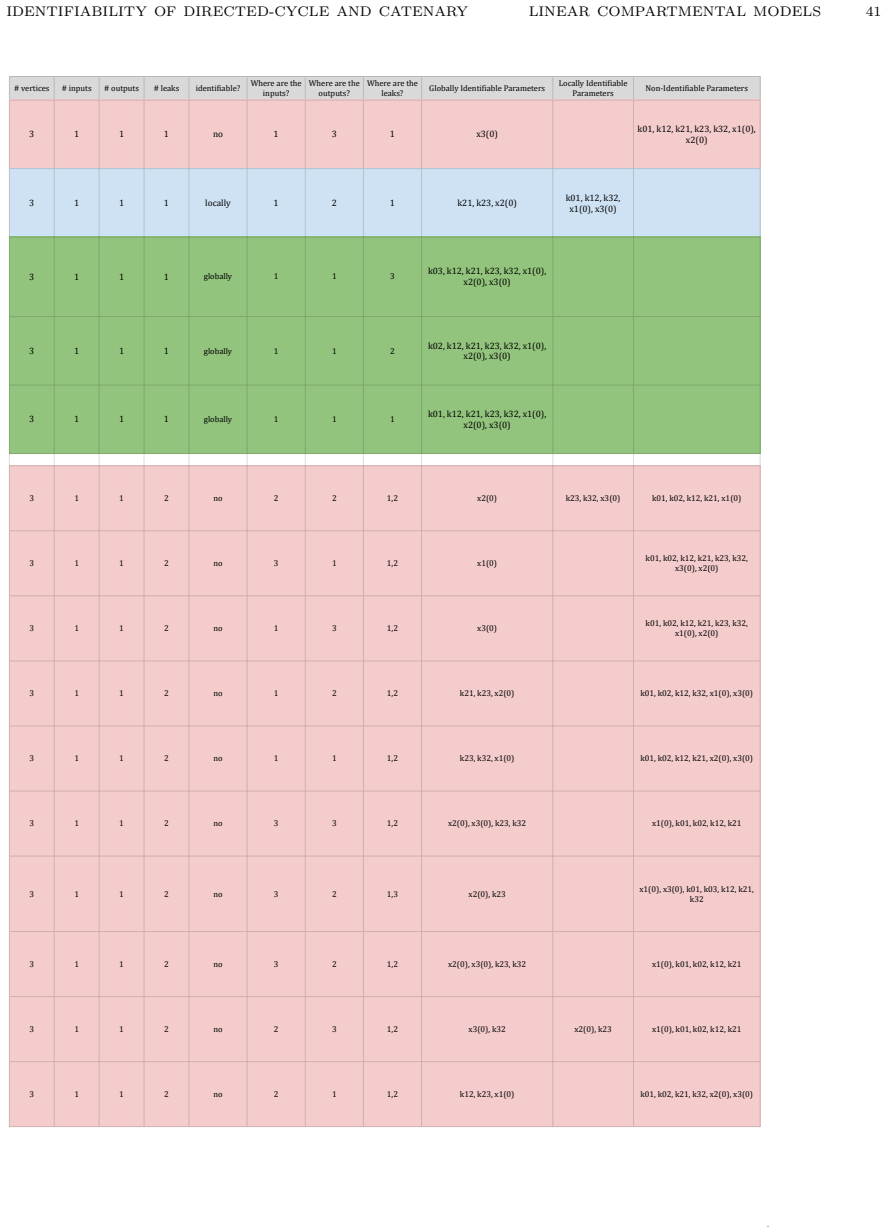
- [Appendix A] Several rows of the database tables in Appendix A appear garbled or truncated in the typeset version, with parameter lists cut off mid-sentence. The authors should check the final typeset tables for completeness.
Circularity Check
No circularity: the leak-interlacing theorem is a new combinatorial rank proof; prior self-citations are parameter-free lemmas, not the conclusion.
full rationale
The central claim (Theorem 3.6) is a combinatorial equivalence: a directed-cycle model is generically locally identifiable iff its leaks interlace with inputs/outputs. Leak-interlacing is defined without reference to identifiability or coefficient maps, and the proof establishes full rank of the coefficient-map Jacobian via linear algebra. The imported ingredients—the rank criterion (Proposition 2.16, from [19,21]), the one-input/one-output coefficient-map formula (Lemma 3.10, from [12]), and the known tree and at-most-one-leak cycle classifications (Propositions 2.21 and 2.22, from [2,12])—are stated parameter-free with assumptions that do not include the full classification, and the paper derives the multi-input/output and multi-leak cases from them rather than assuming them. The citation of [12, proof of Theorem 3.10] in Lemma 3.19 and of [2, Theorem 3.1] in Lemma 5.5 is normal use of prior theorems; although some authors overlap with the present paper, these are published results, not an unverified self-supporting chain. The only substantive concern in the manuscript is an internal indexing/gap issue in Proposition 3.25 when an input segment contains no output (j_s=0), which is a correctness matter, not circularity: it does not make the theorem an input to itself. No fitted parameter is renamed as a prediction, and no equation is equivalent to its input by construction. Accordingly, no circular step is present.
Assumptions & free parameters
assumptions (8)
- domain assumption Input-output equation formula: det(dI-A)y_i = sum_j (-1)^(i+j) det((dI-A)_{j,i}) u_j (Prop 2.10, from [19, Theorem 2]).
- domain assumption Rank criterion: generic local identifiability is equivalent to generic full rank of the coefficient-map Jacobian for strongly connected models with at least one input (Prop 2.16, from [19, Prop 2] and [21, Main Result 3]).
- domain assumption Coefficient-map formula for one-input/one-output directed-cycle models with leaks: c = (e1,...,e_{n-1}, e_n-Pi, kappa, e*_1 kappa, ..., e*_{n-p} kappa) (Lemma 3.10, from [12, Prop 3.8]).
- domain assumption Classification of directed-cycle models with at most one leak, and of the In={i}, Out={i-1} configuration (Prop 2.22, from [12]).
- domain assumption Adding inputs or outputs preserves identifiability (Prop 2.20, from [14]).
- domain assumption Spanning-incoming-forest formula for input-output equation coefficients (Lemma 5.5, from [2, Theorem 3.1], corrected in Remark 5.6).
- domain assumption Assumption 2.2: every model has at least one input and one output, and models considered are strongly connected.
- standard math Algebraic independence of elementary symmetric polynomials (Lemma 2.26(1), from [18]).
Cite this review
Pith. "Pith review of Identifiability of directed-cycle and catenary linear compartment models." pith.science (2026). https://pith.science/paper/56PZZMRT
@misc{pith2026241205283,
  author       = {Pith},
  title        = {Pith review of: Identifiability of directed-cycle and catenary linear compartment models},
  year         = {2026},
  howpublished = {\url{https://pith.science/paper/56PZZMRT}},
  note         = {Machine review of arXiv:2412.05283}
}
read the original abstract
A parameter of a mathematical model is structurally identifiable if it can be determined from noiseless experimental data. Here, we examine the identifiability properties of two important classes of linear compartmental models: directed-cycle models and catenary models (models for which the underlying graph is a directed cycle or a bidirected path, respectively). Our main result is a complete characterization of the directed-cycle models for which every parameter is (generically locally) identifiable. Additionally, for catenary models, we give a formula for their input-output equations. Such equations are used to analyze identifiability, so we expect our formula to support future analyses into the identifiability of catenary models. Our proofs rely on prior results on input-output equations, and we also use techniques from linear algebra and graph theory.
Figures


Figures from the paper (9 more)




Forward citations
Cited by 1 Pith paper
-
Structural Identifiability of Compartmental Models: Recent Progress and Future Directions
A survey of recent theory and applications of structural identifiability in compartmental models, including identifiable reparametrizations and graph-based criteria.
Reference graph
Works this paper leans on
-
[1]
Villaverde
Xabier Rey Barreiro and Alejandro F. Villaverde. On the origins and rarity of locally but not globally identifiable parameters in biological modeling. IEEE Access, 11:65457–65467, 2023
2023
-
[2]
Identifiability of linear compartmental tree models and a general formula for input-output equations
Cashous Bortner, Elizabeth Gross, Nicolette Meshkat, Anne Shiu, and Seth Sullivant. Identifiability of linear compartmental tree models and a general formula for input-output equations. Adv. in Appl. Math., 146:102490, 2023
2023
-
[3]
Identifiable paths and cycles in linear compartmental models
Cashous Bortner and Nicolette Meshkat. Identifiable paths and cycles in linear compartmental models. Bull. Math. Biol., 84(5):Paper No. 53, 43, 2022
2022
-
[4]
Graph-based sufficient conditions for indistinguishability of linear compartmental models
Cashous Bortner and Nicolette Meshkat. Graph-based sufficient conditions for indistinguishability of linear compartmental models. SIAM J. Appl. Dyn. Syst., 23(3):2179–2207, 2024
work page 2024
-
[5]
Identifiability of linear compart- mental models: The impact of removing leaks and edges
Patrick Chan, Katherine Johnston, Anne Shiu, Aleksandra Sobieska, and Clare Spinner. Identifiability of linear compart- mental models: The impact of removing leaks and edges. Preprint, arXiv:2102.04417, 2021
arXiv 2021
-
[6]
Nguyen Phong Chau. Linear n-compartment catenary models: Formulas to describe tracer amount in any compartment and identification of parameters from a concentration-time curve. Math. Biosci., 76(2):185–206, 1985
work page 1985
-
[7]
Compartmental analysis of dynamic nuclear medicine data: models and identifiability
Fabrice Delbary, Sara Garbarino, and Valentina Vivaldi. Compartmental analysis of dynamic nuclear medicine data: models and identifiability. Inverse Probl., 32(12):125010, 2016
work page 2016
-
[8]
Ruiwen Dong, Christian Goodbrake, Heather A. Harrington, and Gleb Pogudin. Differential elimination for dynamical models via projections with applications to structural identifiability. SIAM Journal on Applied Algebra and Geometry, 7(1):194–235, 2023
work page 2023
Show all 23 references
-
[9]
Apolarity and canonical forms for homogeneous polynomials
Richard Ehrenborg and Gian-Carlo Rota. Apolarity and canonical forms for homogeneous polynomials. Eur. J. Combin., 14(3):157–181, 1993
1993
-
[10]
A confidence building exercise in data and identifiability: Modeling cancer chemotherapy as a case study
Marisa C Eisenberg and Harsh V Jain. A confidence building exercise in data and identifiability: Modeling cancer chemotherapy as a case study. J. Theor. Biol., 431:63–78, 2017
2017
-
[11]
Identifiability of directed cycle and catenary linear compartmental models github repo
Odalys Garcia-Lopez. Identifiability of directed cycle and catenary linear compartmental models github repo. https://github.com/odalys-garcia/Identifiability-of-Directed-Cycle-and-Catenary-Linear-Compartmental- Models
-
[12]
Identifiability of linear compartmental models: the effect of moving inputs, outputs, and leaks
Seth Gerberding, Nida Obatake, and Anne Shiu. Identifiability of linear compartmental models: the effect of moving inputs, outputs, and leaks. Linear Multilinear A., 70(14):2782–2803, 2020. 32 AHMED, CREPEAU, DESSAUER, EDOZIE, GARCIA-LOPEZ, GRIMSLEY, LOPEZ, NERI, AND SHIU
2020
-
[13]
Database for identifiability properties of linear compartmental models
Natali Gogishvili. Database for identifiability properties of linear compartmental models. Preprint, arXiv:2406.16132, 2024
2024 arXiv
-
[14]
Linear compartmental models: input-output equations and operations that preserve identifiability
Elizabeth Gross, Heather Harrington, Nicolette Meshkat, and Anne Shiu. Linear compartmental models: input-output equations and operations that preserve identifiability. SIAM J. Appl. Math., 79(4):1423–1447, 2019
2019
-
[15]
Identifiability of linear compartmental models: The singular locus
Elizabeth Gross, Nicolette Meshkat, and Anne Shiu. Identifiability of linear compartmental models: The singular locus. Adv. Appl. Math., 133(C), 2022
2022
-
[16]
Global identifiability of differential models
Hoon Hong, Alexey Ovchinnikov, Gleb Pogudin, and Chee Yap. Global identifiability of differential models. Comm. Pure Appl. Math., 73(9):1831 – 1879, 2018
2018
-
[17]
SIAN: software for structural identifiability analysis of ode models
Hoon Hong, Alexey Ovchinnikov, Gleb Pogudin, and Chee Yap. SIAN: software for structural identifiability analysis of ode models. Bioinformatics, 35(16):2873–2874, 2019
2019
-
[18]
I. G. Macdonald. Symmetric Functions and Hall Polynomials. Oxford University Press, 1995
1995
-
[19]
Identifiability results for several classes of linear compartment models
Nicolette Meshkat, Seth Sullivant, and Marisa Eisenberg. Identifiability results for several classes of linear compartment models. B. Math. Biol., 77(8):1620–1651, 2015
2015
-
[20]
An investigation of the sources of nonuniqueness in deterministic identifiability
JP Norton. An investigation of the sources of nonuniqueness in deterministic identifiability. Math. Biosci., 60(1):89–108, 1982
1982
-
[21]
Input-output equations and identifiability of linear ode models
Alexey Ovchinnikov, Gleb Pogudin, and Peter Thompson. Input-output equations and identifiability of linear ode models. IEEE T. Automat. Contr., 68(2):812–824, 2023
2023
-
[22]
A physiology-based para- metric imaging method for FDG–PET data
Mara Scussolini, Sara Garbarino, Gianmario Sambuceti, Giacomo Caviglia, and Michele Piana. A physiology-based para- metric imaging method for FDG–PET data. Inverse Probl., 33(12):125010, 2017
2017
-
[23]
Identifiability and interval identifiability of mammillary and catenary compartmental models with some known rate constants
Paolo Vicini, Hsiao-Te Su, and Joseph J Distefano III. Identifiability and interval identifiability of mammillary and catenary compartmental models with some known rate constants. Math. Biosci., 167(2):145–161, 2000. IDENTIFIABILITY OF DIRECTED-CYCLE AND CATENARY LINEAR COMPAR...
Reviewed August 12, 2026 · model on record in the stance chip above.
Discussion (0). Continue with ORCID to comment.