REVIEW 4 major objections 4 minor 1 cited by
Learn from What We HAVE: History-Aware VErifier that Reasons about Past Interactions Online
T0 review · 4 major / 4 minor · reviewed 2026-08-05 · deepseek-v4-flash
Pith's one-line read A history-aware verifier that scores action proposals—rather than a generator conditioned on past interactions—drops failure rates by 3–10x in the paper's experiments.
desk verdict A well-engineered generator-verifier pipeline for ambiguous manipulation with a sound but simple theory and consistent empirical gains, though the verifier's deployment accuracy is never measured and the headline numbers use privileged flow. read the letter →
The pith
A machine-rendered reading of the paper's core claim, the machinery that carries it, and where it could break.
The reading
What carries the argument
The carrying mechanism is the history-aware verifier (HAVE): an explicit dot-product attention layer in which the encoded proposed action is the query, the encoded history actions are keys, and encoded observation-flow results (the motion between before/after point clouds) are values, with an unconditional score token as a fallback when no similar history exists. It outputs a score from a small MLP. The theoretical identity doing the work is the expected-reward formula E[Rgt(aw/ver)] = (1-(1-Q)^N) pG pV/Q + (1-Q)^N pG(1-pV)/(1-Q), with Q = P(V(a)=1); simplifying it shows the verifier helps exactly when pV>0.5. The observation encoder uses 3D flow between consecutive observations (ground-trut
What would settle it
Measure the verifier's per-action accuracy pV on the deployment-time distribution—the same generator proposals, the same estimated flow tracker, unseen objects—using simulator ground-truth rewards. If pV is at or below 0.5 (or pV1+pV0 ≤ 1 in the dependent case) and HAVE still outperforms the generator alone, then the theorem's mechanism is not what is driving the gain; if pV exceeds 0.5, the theorem predicts HAVE must beat single-sample generation. A second check: compare HAVE's failure rate against the oracle verifier and generator-only curves in Fig. 6; if HAVE falls outside the interval bet
Extended reading notes
Core claim
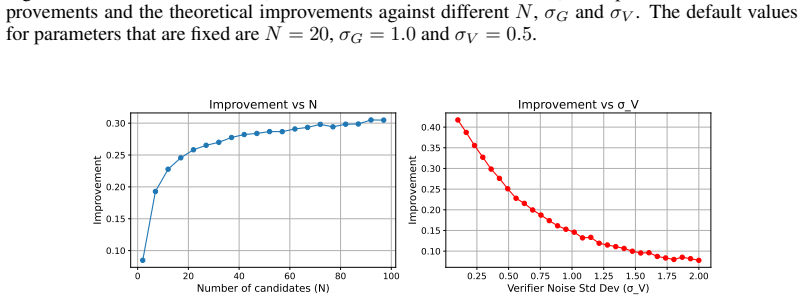
HAVE trains a verifier that takes an action proposal plus the history of (observation, action, outcome) triples and outputs a score in [-1,1]. At run time an unconditional diffusion generator proposes N actions, the verifier scores them, and the robot executes the top-scoring one. Theorem A states that for binary rewards with generator quality pG in (0,1), N>1, and verifier accuracy pV, verifier selection strictly improves expected reward over single-sample generation if and only if pV>0.5; the dependent-accuracy extension replaces this with pV1+pV0>1. The continuous-reward extension predicts gains growing roughly as sqrt(2 ln N) with a prefactor that grows with reward spread and shrinks wit
Load-bearing premise
The load-bearing premise is that the verifier, trained on privileged simulator-derived labels, remains better than random at scoring the actual distribution of generator proposals and estimated observation flows encountered at run time; the paper never measures verifier accuracy directly and reports no error bars on the main failure-rate tables.
Editorial extensions
If this is right
- If a verifier is only slightly better than chance (pV just above 0.5), selecting among N sampled actions already beats the generator alone; at pG=0.9, pV=0.9, N=2, failure rate drops from 10% to 3%.
- The generator does not need to be conditioned on history at all: an unconditional diffusion generator plus the verifier outperforms a history-conditioned diffusion generator (20% to 2% failure on articulated objects).
- Sampling efficiency is high: with the verifier, 5 proposals capture most of the benefit; failure rate continues to fall as N grows, at roughly linear compute cost per extra proposal.
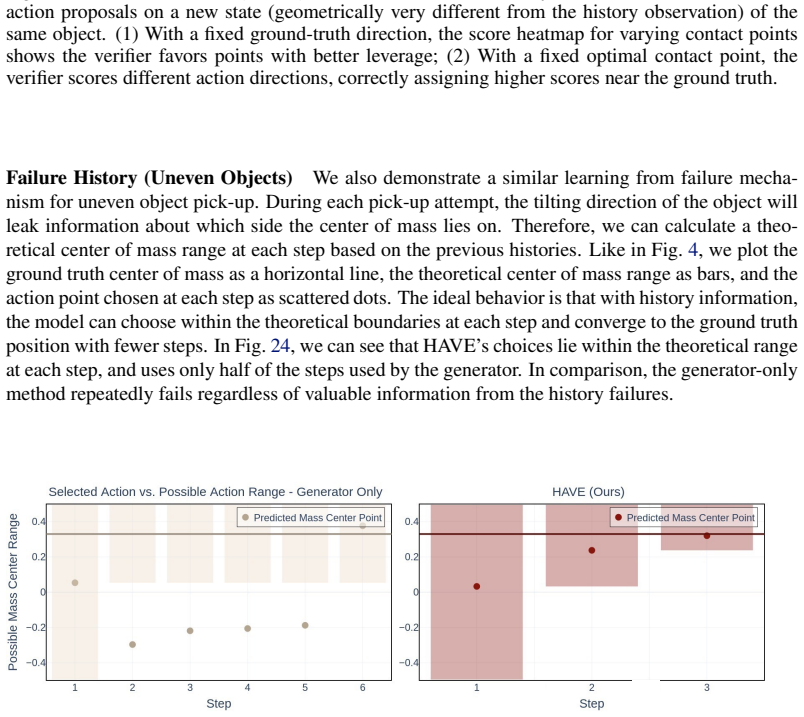
- The verifier suppresses previously failed modes: with one-step failure history, the selected action avoids the failed mode in 99.79% of trials on the multi-modal door dataset.
- The generation-verification split transfers to other ambiguous manipulation settings (uneven-mass pick-up) and to hierarchical sub-goal selection in benchmark tabletop tasks where the verifier selects among high-level sub-goal predictions.
Reading between the lines
- Because Theorem A only requires better-than-chance scoring, HAVE's logic should transfer to any POMDP with hidden state and observable outcome—not just mechanical ambiguity; the same generator-verifier split could be used for any policy family with sampled candidates.
- The paper's own limitation—that the verifier inherits privileged simulator labels—suggests a direct test: train the verifier with only the observed outcome signal (e.g., door angle change or tilt) and re-measure whether pV stays above 0.5.
- The oracle-verifier experiments in the paper indicate the remaining bottleneck is the generator's proposal distribution, so an inference-time loop that regenerates proposals conditioned on verifier scores could push failure rates toward the oracle level; the paper does not implement this.
- The explicit-attention design, where the proposal acts as query over history-action keys and outcome-flow values, is a template for making learned verifiers robust to noisy observation estimates; the paper's robustness comparison supports that, but only within its environments.
Editorial analysis
A structured set of objections, weighed in public.
Referee Report
Summary. The paper proposes HAVE, a history-aware verifier that scores action proposals produced by an unconditional diffusion generator, using past observations and actions to disambiguate manipulation outcomes. The central claim is twofold: (i) theoretically, selecting among N generator samples with a verifier whose per-action accuracy exceeds 0.5 improves expected action quality over single-sample generation (Theorem A, Sec. 4.2); (ii) empirically, a learned verifier outperforms history-conditioned generative baselines and prior methods on articulated objects, multimodal doors, uneven object pick-up, and a real door, reducing failure rates substantially (e.g., Table 1). The paper also includes held-out category experiments, ablations, sample-count analysis, classifier-guidance comparison, and a hierarchical policy extension in Appendix D.4.
Significance. If the central claim holds, the work makes a useful contribution: it provides a simple, explicit proof that a better-than-random verifier improves generator output, and it demonstrates a practical architecture for history-aware verification in ambiguous manipulation. The theoretical part is clean and the appendix contains a careful dependent-case extension (Theorem A') and a continuous-reward extension. The experimental scope is broad: three simulation domains, a real-robot door, held-out categories, and multiple ablations. The authors are also transparent in reporting the estimated-flow variant of their method and in stating limitations in Sec. 8. However, the theoretical guarantee is conditional on an unmeasured verifier accuracy, and the headline empirical gains rely on privileged ground-truth observation flow. Under deployment-time flow estimation, the advantage over the strongest baseline largely disappears in the articulated-object domain. These issues are load-bearing for the paper's main claims and need to be addressed before the paper can be recommended for acceptance.
major comments (4)
- [Sec. 4.2 (Theorem A), Sec. 5.1/B.2, Table 1] The theorem's improvement condition is pV > 0.5 on the actions being selected, but pV is never measured on the deployment proposal distribution. The verifier is trained on ground-truth/random/history action proposals (Sec. B.2), while at inference it scores actions sampled from a diffusion generator as 3D articulation flows converted to dense action fields (Sec. B.1). These are different distributions, so training accuracy need not transfer. Please report the verifier's accuracy, ranking accuracy, or a calibration curve on held-out generator proposals, and verify that pV > 0.5 (or pV1+pV0 > 1 in the dependent case) actually holds at deployment.
- [Sec. 6.1.1, Table 1; Sec. D.1, Table 3] The headline failure-rate reductions (6x, 10x, 3x) are for 'HAVE (Ours) + GT obs flow', which uses privileged ground-truth flow from the simulator. The deployable variant, 'HAVE (Ours) + Estimated obs flow', achieves A VGc = 6.7 on general articulated objects, which is not better than FlowBotHD w/CC (6.2). On held-out categories (Table 3), HAVE+DELTA (21.5) is also worse than FlowBotHD w/CC (14.8). Since the estimated-flow setting is the actual deployment condition, the central empirical claim is not established there. The estimated-flow results should be the primary metric, or the paper should clearly separate and discuss the gap.
- [Tables 1–3 and Appendix C.1] The main failure-rate tables report single numbers per category with no error bars, confidence intervals, or repeated-seed variance. Given the stochasticity of the diffusion generator and the fact that each object is tested only 5 times (or 3 for unseen uneven objects), differences such as 2.5 vs. 6.2 or 16.9 vs. 14.8 could be within sampling variation. Please provide standard errors or confidence intervals, and for the 'Oracle Verifier' and 'Oracle Sampler' rows specify the number of runs. This is needed to assess the robustness of the empirical advantage.
- [Appendix A.2 (Theorem A') and Sec. 8] The dependent-case extension relaxes independence but still assumes verifier accuracies pV1 and pV0 are uniform over actions and the reward is binary. The actual verifier is trained on a mixture of proposal types and scores real-valued dense action fields, so the theoretical guarantee does not directly certify the deployed system even if pV1+pV0 > 1 on the training mixture. The paper's own Limitations (Sec. 8) correctly notes the reliance on privileged supervision and the generator's expressiveness bound; a direct measurement of verifier accuracy on the deployment distribution would connect the theory to practice.
minor comments (4)
- [Abstract/Introduction] The abstract and introduction describe the generator as 'unconditional diffusion-based', but the generator in Fig. 12 and Sec. B.1 conditions on the current observation point cloud. Please clarify that it is unconditional with respect to history, not unconditional with respect to observation.
- [Sec. C.5] The text says the conditional diffusion baseline uses 'the vanilla transformer architecture in Appendix D.3'; this appears to be a typo for Appendix C.4. Please correct the cross-reference.
- [Sec. 5.3] The dense action field equation is described verbally; please give the explicit formula for the point-cloud channels, e.g., {d_i = d * exp(-c * ||p_i - p||^2)}. The scaling constant c is never specified or ablated. Since c is a free parameter and affects the representation, a value or sensitivity study would help.
- [Appendix E.1, Table 5] The 'Valid Rate' metric is useful, but it only measures avoidance of repeated failure modes; it does not quantify whether the verifier's score is well-calibrated or whether pV > 0.5. A short statement connecting this analysis to Theorem A's condition would improve the paper.
Circularity Check
No circularity found: the theory is a conditional proof from explicit assumptions, and the empirical comparisons are benchmarked independently of the derivation.
full rationale
The paper's central theoretical result (Theorem A, Sec. 4.2 and Appendix A.1-A.2) is a conditional mathematical statement: under explicit assumptions (independence of generator and verifier errors, pG in (0,1), and pV > 0.5, or the dependent-case condition pV1 + pV0 > 1), selecting the verifier's highest-scored among N proposals has higher expected binary reward than one sample from the generator. The proof derives the improvement algebraically and proves the equivalence in both directions; neither the assumptions nor the conclusion are fitted to the paper's experimental outcomes, and the conclusion is not assumed. The continuous-reward extension in Appendix A.3 is likewise an analytic approximation with stated distributional assumptions. The empirical claims (Tables 1-3, Figures 2-6) compare the trained HAVE verifier against baselines on unseen instances and held-out categories using the same success/failure metric for all methods; these results are independent of the theorem and are not constructed from its parameters. The only self-citations ([30], [31]) are to the authors' prior systems used as building blocks (the action generator, 3D articulation flow representation) and as baselines; they do not carry the load-bearing argument that a verifier improves selection. The paper's own Limitations section acknowledges that the verifier is bounded by generator expressiveness and that training requires privileged ground-truth labels, which is a scope limitation rather than a circular step. The skeptic's concern that pV is never directly measured on the deployment-time proposal distribution is a legitimate empirical-validation gap, but the absence of such a measurement is not a case of a 'prediction' reducing to a fitted input, a self-definition, or a self-citation chain. The theorem's resemblance to well-known best-of-N selection properties is a novelty/positioning issue, not circularity. Therefore no significant circularity is found.
Assumptions & free parameters
free parameters (3)
- N (number of action proposals per timestep) =
30 for articulated objects, 20 for uneven pick-up, 5 for MimicGen
- c (dense action field scaling constant) =
not stated numerically in text
- Max history length K at inference =
varies across experiments (1-30; 5 used for timing)
assumptions (4)
- domain assumption The environment is a distribution over POMDPs with unknown transition function T sampled from PT (Sec 2).
- ad hoc to paper Generator and verifier accuracies are independent, and pV is uniform over actions (Sec 4.2, Assumptions 1-3).
- ad hoc to paper In the continuous case, verifier score Y = X + epsilon with epsilon ~ N(0, sigma_V^2) independent of X (Appendix A.3, Assumption 2).
- domain assumption Privileged simulator knowledge (ground-truth action and per-task reward) is available to label training data (Sec 5.1 and Limitations).
Cite this review
Pith. "Pith review of Learn from What We HAVE: History-Aware VErifier that Reasons about Past Interactions Online." pith.science (2026). https://pith.science/paper/5742JHMB
@misc{pith2026250900271,
  author       = {Pith},
  title        = {Pith review of: Learn from What We HAVE: History-Aware VErifier that Reasons about Past Interactions Online},
  year         = {2026},
  howpublished = {\url{https://pith.science/paper/5742JHMB}},
  note         = {Machine review of arXiv:2509.00271}
}
read the original abstract
We introduce a novel History-Aware VErifier (HAVE) to disambiguate uncertain scenarios online by leveraging past interactions. Robots frequently encounter visually ambiguous objects whose manipulation outcomes remain uncertain until physically interacted with. While generative models alone could theoretically adapt to such ambiguity, in practice they obtain suboptimal performance in ambiguous cases, even when conditioned on action history. To address this, we propose explicitly decoupling action generation from verification: we use an unconditional diffusion-based generator to propose multiple candidate actions and employ our history-aware verifier to select the most promising action by reasoning about past interactions. Through theoretical analysis, we demonstrate that employing a verifier significantly improves expected action quality. Empirical evaluations and analysis across multiple simulated and real-world environments including articulated objects, multi-modal doors, and uneven object pick-up confirm the effectiveness of our method and improvements over baselines. Our project website is available at: https://liy1shu.github.io/HAVE_CoRL25/
Figures


Figures from the paper (26 more)






Forward citations
Cited by 1 Pith paper
-
EVE: A Generator-Verifier System for Generative Policies
Zero-shot VLM verifiers, ensembled and fused via guided diffusion, improve frozen generative robot policies' success rates by 1-2 percentage points on simulated manipulation tasks.
Reference graph
Works this paper leans on
- [1]
-
[2]
J. Bohg, K. Hausman, B. Sankaran, O. Brock, D. Kragic, S. Schaal, and G. S. Sukhatme. Inter- active perception: Leveraging action in perception and perception in action.IEEE Transactions on Robotics, 33(6):1273–1291, 2017
work page 2017
- [3]
-
[4]
D. Katz and O. Brock. Manipulating articulated objects with interactive perception. In 2008 IEEE International Conference on Robotics and Automation , pages 272–277, 2008. doi:10. 1109/ROBOT.2008.4543220
-
[5]
Z. Weng, P. Zhou, H. Yin, A. Kravberg, A. Varava, D. Navarro-Alarcon, and D. Kragic. Inter- active perception for deformable object manipulation. IEEE Robotics and Automation Letters, 2024
work page 2024
-
[6]
A. Allevato, E. S. Short, M. Pryor, and A. Thomaz. Tunenet: One-shot residual tuning for system identification and sim-to-real robot task transfer. In Conference on Robot Learning , pages 445–455. PMLR, 2020
work page 2020
-
[7]
M. Xu, Y . Shen, S. Zhang, Y . Lu, D. Zhao, J. Tenenbaum, and C. Gan. Prompting decision transformer for few-shot policy generalization. In international conference on machine learn- ing, pages 24631–24645. PMLR, 2022
work page 2022
- [8]
Show all 41 references
-
[9]
Y . Wang, X. Zhang, R. Wu, Y . Li, Y . Shen, M. Wu, Z. He, Y . Wang, and H. Dong. Adamanip: Adaptive articulated object manipulation environments and policy learning. arXiv preprint arXiv:2502.11124, 2025
2025 arXiv
-
[10]
Zhang, S
X. Zhang, S. Liu, P. Huang, W. J. Han, Y . Lyu, M. Xu, and D. Zhao. Dynamics as prompts: In- context learning for sim-to-real system identifications. IEEE Robotics and Automation Letters, 2025. 10
2025
-
[11]
Goodfellow, J
I. Goodfellow, J. Pouget-Abadie, M. Mirza, B. Xu, D. Warde-Farley, S. Ozair, A. Courville, and Y . Bengio. Generative adversarial networks. Communications of the ACM , 63(11):139– 144, 2020
2020
-
[12]
P. F. Christiano, J. Leike, T. Brown, M. Martic, S. Legg, and D. Amodei. Deep reinforcement learning from human preferences. Advances in neural information processing systems , 30, 2017
2017
-
[13]
Y . Bai, A. Jones, K. Ndousse, A. Askell, A. Chen, N. DasSarma, D. Drain, S. Fort, D. Ganguli, T. Henighan, et al. Training a helpful and harmless assistant with reinforcement learning from human feedback. arXiv preprint arXiv:2204.05862, 2022
2022 arXiv
-
[14]
Ouyang, J
L. Ouyang, J. Wu, X. Jiang, D. Almeida, C. Wainwright, P. Mishkin, C. Zhang, S. Agarwal, K. Slama, A. Ray, et al. Training language models to follow instructions with human feedback. Advances in neural information processing systems, 35:27730–27744, 2022
2022
-
[15]
Swamy, S
G. Swamy, S. Choudhury, W. Sun, Z. S. Wu, and J. A. Bagnell. All roads lead to likelihood: The value of reinforcement learning in fine-tuning. arXiv preprint arXiv:2503.01067, 2025
2025
-
[16]
Cobbe, V
K. Cobbe, V . Kosaraju, M. Bavarian, M. Chen, H. Jun, L. Kaiser, M. Plappert, J. Tworek, J. Hilton, R. Nakano, et al. Training verifiers to solve math word problems. arXiv preprint arXiv:2110.14168, 2021
2021 arXiv
-
[17]
Setlur, C
A. Setlur, C. Nagpal, A. Fisch, X. Geng, J. Eisenstein, R. Agarwal, A. Agarwal, J. Berant, and A. Kumar. Rewarding progress: Scaling automated process verifiers for llm reasoning. arXiv preprint arXiv:2410.08146, 2024
2024 arXiv
-
[18]
Hosseini, X
A. Hosseini, X. Yuan, N. Malkin, A. Courville, A. Sordoni, and R. Agarwal. V-star: Training verifiers for self-taught reasoners. arXiv preprint arXiv:2402.06457, 2024
2024 arXiv
-
[19]
Rafailov, A
R. Rafailov, A. Sharma, E. Mitchell, C. D. Manning, S. Ermon, and C. Finn. Direct pref- erence optimization: Your language model is secretly a reward model. Advances in Neural Information Processing Systems, 36:53728–53741, 2023
2023
-
[20]
Singh, J
A. Singh, J. D. Co-Reyes, R. Agarwal, A. Anand, P. Patil, X. Garcia, P. J. Liu, J. Harrison, J. Lee, K. Xu, et al. Beyond human data: Scaling self-training for problem-solving with language models. arXiv preprint arXiv:2312.06585, 2023
2023 arXiv
-
[21]
Y . Song, H. Zhang, C. Eisenach, S. Kakade, D. Foster, and U. Ghai. Mind the gap: Examining the self-improvement capabilities of large language models. arXiv preprint arXiv:2412.02674, 2024
2024 arXiv
-
[22]
A. D. Ames, S. Coogan, M. Egerstedt, G. Notomista, K. Sreenath, and P. Tabuada. Control barrier functions: Theory and applications. In 2019 18th European control conference (ECC), pages 3420–3431. Ieee, 2019
2019
-
[23]
Y . Wang, L. Wang, Y . Du, B. Sundaralingam, X. Yang, Y .-W. Chao, C. Perez-D’Arpino, D. Fox, and J. Shah. Inference-time policy steering through human interactions.arXiv preprint arXiv:2411.16627, 2024
2024 arXiv
-
[24]
H. J. Jeong, R. Chen, and A. Bajcsy. Robots that suggest safe alternatives. arXiv preprint arXiv:2409.09883, 2024
2024 arXiv
-
[25]
Nakamura, L
K. Nakamura, L. Peters, and A. Bajcsy. Generalizing safety beyond collision-avoidance via latent-space reachability analysis. arXiv preprint arXiv:2502.00935, 2025
2025
-
[26]
Y . Wu, R. Tian, G. Swamy, and A. Bajcsy. From foresight to forethought: Vlm-in-the-loop policy steering via latent alignment. arXiv preprint arXiv:2502.01828, 2025. 11
2025 arXiv
-
[27]
Borquez, L
J. Borquez, L. Raus, Y . U. Ciftci, and S. Bansal. Dualguard mppi: Safe and performant optimal control by combining sampling-based mpc and hamilton-jacobi reachability. arXiv preprint arXiv:2502.01924, 2025
2025 arXiv
-
[28]
C. R. Qi, L. Yi, H. Su, and L. J. Guibas. Pointnet++: Deep hierarchical feature learning on point sets in a metric space. In I. Guyon, U. V . Luxburg, S. Bengio, H. Wallach, R. Fergus, S. Vishwanathan, and R. Garnett, editors,Advances in Neural Information Processing Systems, ...
2017
-
[29]
T. D. Ngo, P. Zhuang, C. Gan, E. Kalogerakis, S. Tulyakov, H.-Y . Lee, and C. Wang. Delta: Dense efficient long-range 3d tracking for any video. arXiv preprint arXiv:2410.24211, 2024
2024 arXiv
-
[30]
Y . Li, W. H. Leng, Y . Fang, B. Eisner, and D. Held. FlowbotHD: History-aware diffuser handling ambiguities in articulated objects manipulation. In 8th Annual Conference on Robot Learning, 2024
2024
-
[31]
Eisner, H
B. Eisner, H. Zhang, and D. Held. Flowbot3d: Learning 3d articulation flow to manipulate articulated objects. arXiv preprint arXiv:2205.04382, 2022
2022 arXiv
-
[32]
Ho and T
J. Ho and T. Salimans. Classifier-free diffusion guidance. arXiv preprint arXiv:2207.12598, 2022
2022 arXiv
-
[33]
M. R. Leadbetter, G. Lindgren, and H. Rootz ´en. Extremes and related properties of random sequences and processes. Springer Science & Business Media, 2012
2012
-
[34]
DasGupta, S
A. DasGupta, S. Lahiri, and J. Stoyanov. Sharp fixed n bounds and asymptotic expansions for the mean and the median of a gaussian sample maximum, and applications to the donoho–jin model. Statistical Methodology, 20:40–62, 2014
2014
-
[35]
Peebles and S
W. Peebles and S. Xie. Scalable diffusion models with transformers. In Proceedings of the IEEE/CVF International Conference on Computer Vision, pages 4195–4205, 2023
2023
-
[36]
Xiang, Y
F. Xiang, Y . Qin, K. Mo, Y . Xia, H. Zhu, F. Liu, M. Liu, H. Jiang, Y . Yuan, H. Wang, et al. Sapien: A simulated part-based interactive environment. In Proceedings of the IEEE/CVF conference on computer vision and pattern recognition, pages 11097–11107, 2020
2020
-
[37]
Mandlekar, S
A. Mandlekar, S. Nasiriany, B. Wen, I. Akinola, Y . Narang, L. Fan, Y . Zhu, and D. Fox. Mimicgen: A data generation system for scalable robot learning using human demonstrations. In 7th Annual Conference on Robot Learning, 2023
2023
-
[38]
E. Cai, O. Donca, B. Eisner, and D. Held. Non-rigid relative placement through 3d dense diffusion. In 8th Annual Conference on Robot Learning, 2024. URL https://arxiv.org/ abs/2410.19247
2024 arXiv
-
[39]
Y . Ze, G. Zhang, K. Zhang, C. Hu, M. Wang, and H. Xu. 3d diffusion policy: Generalizable visuomotor policy learning via simple 3d representations. InProceedings of Robotics: Science and Systems (RSS), 2024
2024
-
[40]
J. Su, M. Ahmed, Y . Lu, S. Pan, W. Bo, and Y . Liu. Roformer: Enhanced transformer with rotary position embedding. Neurocomputing, 568:127063, 2024
2024
-
[41]
pick-up flow
P. Dhariwal and A. Nichol. Diffusion models beat gans on image synthesis.Advances in neural information processing systems, 34:8780–8794, 2021. 12 Appendix Table of Contents A Theoretical Motivation 13 A.1 Discrete Reward with Independent Generator Verifier Accuracies . . . . ...
2021
Reviewed August 5, 2026 · model on record in the stance chip above.
Discussion (0). Sign in to comment.