REVIEW 4 major objections 4 minor 15 references
Macroscopic Stability of a Rapidly Rotating Theta Pinch
T0 review · 4 major / 4 minor · reviewed 2026-08-14 · deepseek-v4-flash
Pith's one-line read The paper claims that a sufficiently short, supersonically rotating mirror device with an angular velocity profile peaking off the magnetic axis could be stable to macroscopic ideal-MHD modes.
desk verdict Solid 1D ideal-MHD stability analysis with a useful qualitative result, but the quantitative mirror-device claims rest on an approximate artificial-gravity mapping that a 2D check should validate. read the letter →
The pith
A machine-rendered reading of the paper's core claim, the machinery that carries it, and where it could break.
The reading
What carries the argument
The load-bearing object is the eigenmode equation (2.34) for $\xi(\hat r)$, the radial component of the Lagrangian fluid displacement, derived in the appendix for an arbitrary angular velocity profile $\hat\Omega_\theta(\hat r)$. The equation is closed by three ingredients: an artificial gravity $\hat g = 8/\hat L^2$ that mimics the average bad curvature of a mirror field line using the approximate parabolic shape $r = 4 r_0 z(L-z)/L^2$; a family of rigid-rotator equilibria generalized to sheared rotation and to vortex flow that peaks off the magnetic axis; and boundary conditions of a perfectly conducting wall at $\hat r = \hat b$ and end plates that quantize $\hat k = l\pi/\hat L$. The analysis restricts attention to the n=0, l=1, m=1 and m=2 modes, which are the most dangerous macroscopic modes, and solves the radial eigenvalue problem numerically by shooting from the magnetic axis to the wall.
What would settle it
Run a two-dimensional ideal-MHD stability code for the actual mirror equilibrium and measure the growth rates of the m=1 and m=2 modes as a function of rotation speed and length: the central claim is wrong if the critical length for stabilization does not decrease to a minimum near sonic rotation and increase again at supersonic rotation, or if a short supersonic vortex-flow mirror is found unstable.
Extended reading notes
Core claim
The central claim is that, in the rotating theta pinch model with artificial gravity, the n=0, m=1, l=1 and the n=0, m=2, l=1 ideal-MHD modes are stable below a critical normalized length, and that this critical length is a non-monotonic function of the plasma rotation: it decreases as rotation increases, bottoms out near sonic rotation, and rises again for supersonic rotation. The paper states outright that 'a sufficiently short (in the axial direction) supersonically rotating mirror device with an angular velocity profile that peaks off axis could be stable to macroscopic ideal-MHD modes.' It also finds that the value of the rotation off the magnetic axis has a substantially stronger effect on stability than the value on the axis, so vortex flow in which rotation peaks off axis is the most favorable configuration.
Load-bearing premise
The quantitative stability thresholds rest on replacing a real two-dimensional mirror by a one-dimensional $\theta$ pinch whose artificial gravity $\hat g = 8/\hat L^2$ comes from an approximate parabolic field-line shape, together with perfectly conducting end plates and a wall at $\hat b = 3.0$; if the actual curvature or line-tying is weaker or stronger than modelled, the predicted critical lengths shift.
Editorial extensions
If this is right
- A compact high-field mirror of normalized length $\hat L \simeq 10$ with rigid rotation is stable to the m=1 mode for $\hat\Omega_\theta \lesssim 0.9$ and to the m=2 mode for $\hat\Omega_\theta \lesssim 0.5$.
- The critical length's minimum near sonic rotation means there is an optimum spin rate for minimizing the device length required for stability, so short devices can be stable at modest rotation speeds.
- At supersonic rotation the critical length rises again, so a sufficiently short, supersonically rotating mirror can regain macroscopic stability.
- Because off-axis rotation matters more than on-axis rotation, vortex-flow profiles that peak off the magnetic axis are the most effective at stabilizing the m=1 and m=2 modes.
- Ion diamagnetic effects are unlikely to stabilize robustly growing modes ($\hat\gamma_r \sim 1$) in these configurations, so the predicted stability windows rest on the MHD mechanism itself.
Reading between the lines
- The non-monotonic critical length implies that a device spun up from rest would cross from a stable to an unstable to a stable window, so the rotation ramp should pass quickly through the unstable band or target a supersonic operating point.
- The quantitative thresholds are tied to the one-dimensional artificial-gravity approximation, the specific equilibrium profile, and the wall at $\hat b = 3.0$, so real two-dimensional mirrors are likely to have shifted, though not necessarily erased, stability windows.
- A natural experimental test would be to bias the outer flux tubes of a short mirror to create vortex flow and measure the m=1 and m=2 fluctuation amplitudes as functions of rotation speed and length.
- The same eigenmode machinery could be extended to nonuniform temperature or anisotropic pressure, which would be needed to assess whether the predicted windows survive in a real finite-beta mirror.
Editorial analysis
A structured set of objections, weighed in public.
Referee Report
Summary. The paper analyzes the macroscopic ideal-MHD stability of an axisymmetric mirror device by replacing the mirror equilibrium with a one-dimensional rotating theta pinch in which the unfavorable field-line curvature is represented by a uniform artificial gravity g_hat = 8/L_hat^2 (Eq. 2.20). A linear eigenmode equation (2.34) is derived from stated single-fluid ideal-MHD equations for arbitrary radial angular-velocity profiles, subject to regularity on axis, a perfectly conducting wall at r_hat = b_hat = 3.0, and end-plate boundary conditions enforced through k_hat = l*pi/L_hat (Eq. 2.40). The stability of the n=0, l=1, m=1 and m=2 modes is computed by numerical shooting for rigid rotation (Sect. 3), sheared rotation with an on-axis maximum (Sect. 4), and a claimed vortex flow peaking off axis (Sect. 5). The central results are that the critical length below which the modes are stabilized is non-monotonic in rotation, with a minimum near sonic rotation, and that off-axis rotation has a stronger stabilizing influence than on-axis rotation. For WHAM-like parameters (L_hat about 10), the paper finds stability for Omega_hat less than about 0.9 (m=1) and less than about 0.5 (m=2), and concludes that a sufficiently short, supersonically rotating mirror with an off-axis-peaked rotation profile could be stable to macroscopic ideal-MHD modes.
Significance. The derivation is essentially self-contained: the eigenmode equation generalizes the Freidberg-Wesson result to arbitrary rotation profiles and to the artificial-gravity term, the equilibria are exact solutions of the stated model equations, and the stability thresholds are computed outputs rather than fitted inputs. The paper therefore produces falsifiable predictions (non-monotonic critical length with a minimum near sonic rotation, stronger stabilizing influence of off-axis rotation, and specific WHAM stability windows) that could be tested with 2D MHD codes or experiment. The derivation steps in Appendix A and the explicit boundary conditions make the model reproducible in character. If the 1D artificial-gravity mapping faithfully represents the mirror curvature drive and line tying, the paper offers a simple and useful design heuristic for rotating mirrors such as WHAM; the quantitative value is, however, contingent on validation of that mapping, because every device-level statement ultimately rests on the single-parameter gravity g_hat = 8/L_hat^2 and on the idealized axial mode structure.
major comments (4)
- [Sect. 2.3, Eqs. (2.18)-(2.20); Sect. 2.5, Eq. (2.40)] The mapping from the two-dimensional mirror equilibrium to the one-dimensional theta pinch with artificial gravity is the sole basis for the device-level conclusions in the abstract and in Section 7, yet the mapping is not validated. Eq. (2.20), g_hat = 8/L_hat^2, is derived only from the midpoint curvature of the parabolic field-line shape (2.18), which the paper itself labels "only approximate"; the resulting uniform, purely radial gravity cannot represent the variation of bad curvature along each field line or with radius, and line tying enters only through k_hat = l*pi/L_hat (Eq. 2.40), which assumes a uniform axial field. Figures 3-6, 8-11, and 13-16, as well as the quantitative WHAM statements (Omega_hat less than about 0.9 for m=1 and less than about 0.5 for m=2 at L_hat=10), are all computed in this 1D model, and the wall radius b_hat=3.0 is arbitrary. The central claim that a sufficiently short rotating mirror would be stable therefore needs either a 2D stability calculation or a systematic sensitivity study (for example over the value of g_hat, the field-line shape, and the wall radius); if such a check is not feasible within the paper's scope, the device-level claims should be explicitly demoted to illustrative consequences of the model.
- [Sect. 5.1, Eq. (5.1)] The vortex-flow profile as printed is internally inconsistent with its description. Eq. (5.1) gives Omega_hat = 2 Omega_hat0 tanh(r_hat/c_hat)/sinh(r_hat/c_hat), which reduces to 2 Omega_hat0 sech(r_hat/c_hat); this profile is maximal on the axis (with value 2 Omega_hat0) and decays monotonically, so it is neither zero on the magnetic axis nor peaked at r_hat = 0.8814 c_hat as stated. The described behavior matches instead Omega_hat = 2 Omega_hat0 tanh(r_hat/c_hat)/cosh(r_hat/c_hat) = 2 sinh(x)/cosh^2(x), whose maximum value is Omega_hat0 at x = asinh(1) = 0.8814. As printed, Section 5's "vortex flow" is simply twice the sheared profile of Eq. (4.7), so the abstract's claim that off-axis rotation has a stronger stabilizing influence is not derivable from the equation as written. Please correct Eq. (5.1) and verify explicitly that Figures 12-16 were computed with the off-axis-peaked profile.
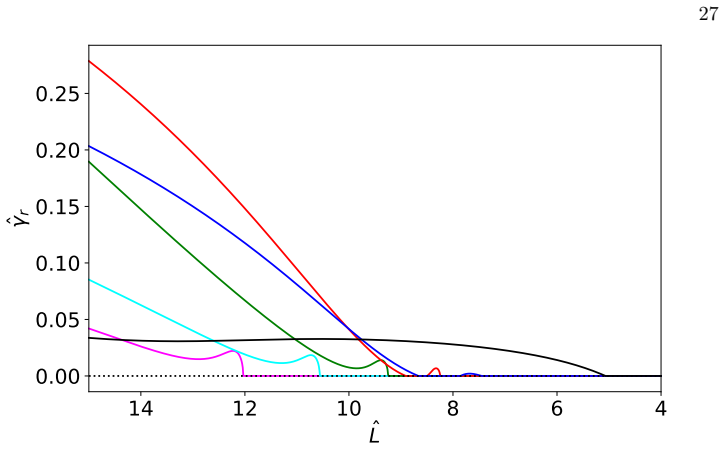
- [Sect. 4.4, Figs. 8 and 10; Sect. 3.4-3.5] The numerical shooting solution of the complex ODE system (4.8)-(4.9) is reported without convergence checks or error estimates. This matters because the growth-rate curves for sheared and vortex rotation are described as "bouncing": they decrease, touch the gamma_r = 0 axis, and then increase again as L_hat is decreased. The paper nevertheless reports a single "critical value of L_hat below which the mode is stabilized," but that quantity is well-defined only if the mode remains stable for all smaller L_hat. If the bounces represent genuine stability windows, the statement that a sufficiently short device is stable requires qualification; if they are artifacts of the shooting procedure, the threshold values need numerical verification. Please report the radial resolution and shooting tolerance used, provide a convergence study, and give a consistent definition of the critical L_hat used to construct the threshold curves, including the claimed minima near Omega_hat approximately 2 (rigid m=1) and Omega_hat approximately 3 (rigid m=2).
- [Sect. 4.3-4.4] The paper states that sheared rotation makes the m=1 and m=2 modes "harder to stabilize" and that the critical length is smaller than in the rigid case, but the comparison mixes different normalizations: for the rigid case the rotation amplitude is the on-axis value Omega_hat, whereas for the sheared profiles (4.7) the same symbol Omega_hat0 denotes the on-axis value, so the qualitative comparison is fair; however, for the vortex profile the natural amplitude is the off-axis peak. The text in Sections 4.3 and 5.3 compares the vortex case to rigid rotation "whose angular velocity matches the peak value," but the peak value of the corrected vortex profile is Omega_hat0 while the on-axis value is zero, and the basis of the comparison (peak angular velocity versus central angular velocity) is only stated verbally. Please state explicitly which angular-velocity quantity is held fixed in each cross-case comparison (Figs. 3 vs 8 vs 13, and 5 vs 10 vs 15), so that the claimed dominance of off-axis rotation is well defined.
minor comments (4)
- [Sect. 3.4 and 3.5 headings] The section headings are incorrect: Section 3.4 is titled "The n=1, m=0, l=1 mode" but its text and figures describe the n=0, m=1, l=1 mode, and Section 3.5 is titled "The n=0, m=1, l=1 mode" but describes the n=0, m=2, l=1 mode. The headings should be swapped.
- [Sect. 5.1, figure callout] The text says "Figure 11 shows an equilibrium with vortex flow," but the vortex-flow equilibrium is shown in Figure 12; Figure 11 shows the sheared-rotation m=2 growth-rate curves. The figure callout should be corrected.
- [Captions of Figures 5 and 10] Each of these captions lists eight colors (black, blue, red, green, cyan, magenta, brown, and orange) but nine angular-velocity values (0.4, 0.6, 0.8, 1.0, 1.2, 1.4, 1.5, 1.8, and 2.0). The captions need one more color or one fewer value.
- [References] The reference list has inconsistencies with the in-text citations: "Freidberg & Pearlstein" is cited in the text as (1978) but the bibliography entry is dated 1987 and spelled "Friedberg"; "Ryutov" is cited as (1990) in the introduction but the bibliography entry is dated 1980. These should be reconciled and the spellings unified.
Circularity Check
No significant circularity: stability thresholds are computed outputs of a stated eigenmode equation; the only self-citation is background and non-load-bearing.
full rationale
The paper's derivation chain is self-contained. The artificial gravity g_hat = 8/L_hat^2 is not fitted to the stability thresholds; it is a modeling approximation derived from the parabolic field-line shape in Eqs. (2.18)-(2.20), which the paper explicitly labels 'only approximate.' The eigenmode equation (2.34) is derived in an appendix from the stated linearized ideal-MHD equations with a stated equilibrium, and the stability diagrams are numerical solutions of that equation under stated boundary conditions: a conducting wall at b_hat = 3.0, regularity on axis, and end-plate quantization k_hat = l*pi/L_hat from Eq. (2.40). The critical-length thresholds, the non-monotonic dependence on rotation, and the stronger influence of off-axis rotation are computed outputs, not fitted inputs. The one self-citation, Fitzpatrick (2026), supports only the background statement that the angular velocity is approximately constant on flux surfaces; it is not invoked as evidence for the stability result, so it is not load-bearing. The paper also explicitly cross-checks its eigenmode equation against Freidberg & Wesson (1970), Freidberg (2014), Bondeson et al. (1987), and Goedbloed (2018), showing it is a derived form of a known equation rather than a renamed result. The 1D theta-pinch approximation with a uniform artificial gravity, the approximate field-line shape, and the chosen wall position are genuine modeling limitations and create correctness risk when extrapolating quantitative thresholds to WHAM or other mirrors, but they are not circular in the sense required by the rubric. No step in the paper reduces a prediction to its own input by construction.
Assumptions & free parameters
free parameters (3)
- Wall radius b_hat =
3.0
- Shear length c_hat for sheared rotation =
0.5
- Shear length c_hat for vortex flow =
0.75
assumptions (6)
- domain assumption Artificial gravity g T N r e_r in the momentum equation represents the average unfavorable curvature of a mirror field line.
- domain assumption The mirror field-line shape is approximately r = 4 r_0 z (L - z) / L^2 and the mean radius of curvature equals the midpoint value.
- domain assumption Perturbations are incompressible, with div(delta V) = 0.
- domain assumption Temperature T is spatially and temporally constant.
- domain assumption The plasma is bounded by perfectly conducting end plates at z = 0 and z = L and by a conducting wall at r = b.
- domain assumption Single-fluid ideal MHD with small ion gyro-radius is valid for the rotation levels considered.
invented entities (1)
-
Artificial gravity term g T N r e_r
Cite this review
Pith. "Pith review of Macroscopic Stability of a Rapidly Rotating Theta Pinch." pith.science (2026). https://pith.science/paper/5AVJFFVF
@misc{pith2026260813485,
  author       = {Pith},
  title        = {Pith review of: Macroscopic Stability of a Rapidly Rotating Theta Pinch},
  year         = {2026},
  howpublished = {\url{https://pith.science/paper/5AVJFFVF}},
  note         = {Machine review of arXiv:2608.13485}
}
read the original abstract
The macroscopic ideal-MHD stability of an axisymmetric mirror device with sonic levels of plasma rotation is analyzed by approximating the plasma equilibrium as a rotating theta pinch possessing an artificial gravity. An eigenmode equation is derived that governs the stability of the equilibrium to small perturbations in the case of an arbitrary plasma angular velocity profile. The stability of the m=1 and m=2 modes is investigated. The plasma is found to be stable to these two modes provided that it is sufficiently short in the axial direction. The critical axial length of the device below which the modes are stabilized first decreases with increasing plasma rotation, attains a minimum value when the rotation is roughly sonic, and then increases with increasing plasma rotation. The value of the plasma rotation off the magnetic axis is found to have a significantly stronger effect on the stability of the modes than the value on the magnetic axis.
Figures


Figures from the paper (13 more)




Reference graph
Works this paper leans on
-
[1]
2004.Magnetohydrodynamic equilibrium and stability of rotating plasma in a mirror geometry, Phys
AydemirA.Y. 2004.Magnetohydrodynamic equilibrium and stability of rotating plasma in a mirror geometry, Phys. Plasmas11,
work page 2004
-
[8]
IoffeM.S.,TelkovskiiV.G.,YushmanovV.K. &SobolevE.I. 1958.Hydromagnetic stability of a high-temperature plasma in a magnetic trap, Proceedings of the Second United Nations International Conference on the Peaceful Uses of Atomic Energy, Geneva, Vol. 32, pp. 799–806. LehnertB. 1971.Rotating plasmas, Nucl. Fusion11,
work page 1958
-
[120]
1980.Mirror devices, Plasma Devices and Operations1,
RyutovD.D. 1980.Mirror devices, Plasma Devices and Operations1,
work page 1980
- [165]
-
[351]
BondesonA.,IaconoR. &BhattacharjeeA. 1987.Local magnetohydrodynamic instabilities of cylindrical plasma with sheared equilibrium flows, Phys. Fluids30,
work page 1987
-
[458]
Equilibrium of a Rapidly Rotating Axisymmetric Magnetic Mirror Machine
FitzpatrickR. 2023.Plasma physics: An introduction, 2nd Ed. (Taylor & Francis Group, CRC Press, Baca Raton FL, 2023). FitzpatrickR. 2026.Equilibrium of a rapidly rotating axisymmetric magnetic mirror machine, arXiv:2607.18203, submitted to J. Plasma Phys. FreidbergJ.P. 2014.Ideal MHD. (Cambridge University Press, Cambridge UK, 2014). FriedbergJ.P. &Pearls...
work page Pith review arXiv 2023
-
[485]
MorseR.L. &FreidbergJ.P. 1970.Rigid drift model of high-temperature plasma containment, Phys. Fluids13,
work page 1970
-
[531]
1987.The magnetic mirror approach to fusion, Nucl
PostR.E. 1987.The magnetic mirror approach to fusion, Nucl. Fusion27,
work page 1987
Show all 15 references
-
[579]
&SoldatkinaE.I
BeklemishevA.D.,BagryanskyP.A.,ChaschinM.A. &SoldatkinaE.I. 2010.Vortex confinement of plasmas in symmetric mirror traps, Fusion Sci. & Technology57,
2010
-
[1117]
2018.The Spectral Web of stationary plasma equilibria
GoedbloedJ.P. 2018.The Spectral Web of stationary plasma equilibria. II. Internal modes, Phys. Plasmas25, 032110. HintonF.L. &WongS.K. 1985.Neoclassical ion transport in rotating axisymmetric plasmas, Phys. Fluids28,
2018
-
[1207]
&WessonJ.A
FreidbergJ.P. &WessonJ.A. 1970.Instability of them= 1mode of a rotatingθpinch, Phys. Fluids13,
1970
-
[1589]
&LongmireC.L
RosenbluthM.N. &LongmireC.L. 1957.Stability of plasmas confined by magnetic fields, Annals of Physics (N.Y.)1,
1957
-
[2057]
&ForestC.B
EndrizziD.,AndersonJ.K.,BrownM.,EgedalJ.,GeigerB.,HarveyR.W.,IalovegaM., KirchJ.,PetersonE.,PetrovY.,PizzoJ.,QianT.,SanwalkaK.,SchmitzO., W allaceJ.,YakovlevD.,YuM. &ForestC.B. 2023.Physics basis for the Wisconsin HTS Axisymmetric Mirror (WHAM), J. Plasma Phys.89, 975890501. F...
2023
-
[2167]
&HainesM.G
BowersE. &HainesM.G. 1971.Application of finite Larmor radius equations for collisionless plasmas to aθpinch, Phys. Fluids14,
1971
-
[3028]
2010.Flute-mode stability of quadrupole-anchored tandem mirror plasmas, Plasma Fusion Research5,
HojoH. 2010.Flute-mode stability of quadrupole-anchored tandem mirror plasmas, Plasma Fusion Research5,
2010
Reviewed August 14, 2026 · model on record in the stance chip above.
Discussion (0). Continue with ORCID to comment.