REVIEW 3 major objections 4 minor 1 cited by
Direct-to-Cell: A First Look into Starlink's Direct Satellite-to-Device Radio Access Network through Crowdsourced Measurements
T0 review · 3 major / 4 minor · reviewed 2026-08-07 · deepseek-v4-flash
Pith's one-line read Using millions of crowdsourced LTE measurements, this paper gives the first measurement study of a deployed satellite-to-device network and estimates Starlink's Direct-to-Cell data service at about 3 Mbps per beam outdoors.
desk verdict First real-world measurement baseline for a deployed satellite-to-phone network; the descriptive findings are solid, but the headline capacity number is conditional on an unvalidated PLMN filter. read the letter →
The pith
A machine-rendered reading of the paper's core claim, the machinery that carries it, and where it could break.
The reading
What carries the argument
The work rests on two filters and one formula. The first filter is the Public Land Mobile Network identifier on each crowdsourced sample: MCC 310 with MNC 830 or 210 labels a measurement as Starlink DS2D, and MNC 260 labels a T-Mobile terrestrial measurement. The second is the SCS share, the ratio of DS2D measurements to all measurements in an area, which turns sparse counts into a spatial indicator of dependence on satellite coverage. The formula is the modified Shannon spectral-efficiency model for LTE, $\eta = \min\{0.51\log_2(1+\mathrm{SINR}/1.25), 4.22\}$ bits/s/Hz, whose fitting coefficients come from an earlier calibration study and whose 4.22 ceiling comes from the 256-QAM channel-quality table of 3GPP TS 36.213. Applying this formula to measured SINR distributions converts the radio observations into concrete per-beam throughput numbers.
What would settle it
Take a phone with a known Starlink beta subscription into an area the paper classifies as DS2D-only, log raw LTE cell parameters at known coordinates, and check whether the PLMN labels and RSRP/SINR distributions match the crowdsourced ones; a mismatch would falsify the identification filter. A complementary check is to compare the paper's cumulative ECI counts against the operator's authorized cell identity plan to test whether observed cells really track satellite launches.
Extended reading notes
Core claim
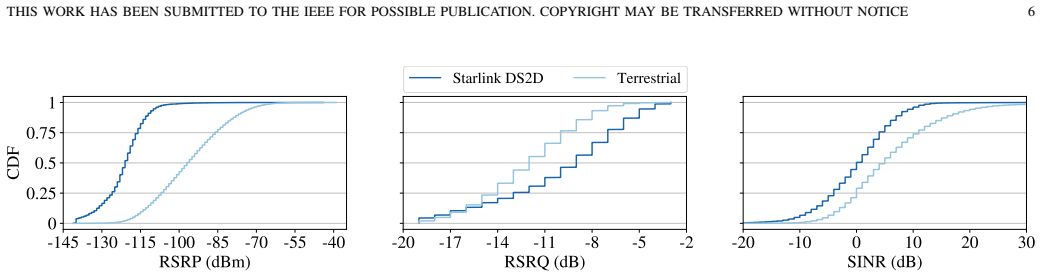
On the paper's own terms, its discovery is that a commercial DS2D network is measurable and that its behavior is consistent with a deliberately deployed, lightly loaded Supplemental Coverage from Space layer: strong spatial correlation with coverage gaps, stable but low reference-signal levels, high reference-signal quality due to near-zero load, and a median SINR of 0 dB that still supports a spectral efficiency of about 0.61 bits/s/Hz. The headline estimate follows from that SINR distribution and the $2\times5$ MHz PCS G Block: about 3.1 Mbps per beam, which the paper treats as an upper bound for a single user occupying the full beam. It further claims that the capacity levers are bandwidth, orbital altitude, transmit power under relaxed out-of-band emission rules, and constellation size, and it quantifies the combined upside at 18.6 Mbps per beam.
Load-bearing premise
The load-bearing assumption is that the mobile-network identifier stamped on each crowdsourced report reliably separates Starlink satellite connections from T-Mobile terrestrial ones—this labeling is never checked against ground truth, and every RAN comparison plus the 3 Mbps estimate inherits it.
Editorial extensions
If this is right
- The initial DS2D data service will come in around 3 Mbps per beam, which is enough for messaging, email, and basic web browsing but well below terrestrial rates, so it will act as a coverage complement rather than a competitor.
- Adding the newly acquired PCS H Block spectrum doubles per-beam capacity to about 6.2 Mbps, and combining all PCS and AWS-4 holdings reaches about 18.6 Mbps per beam once handsets support the NTN band.
- Observed unique cell identifiers track satellite deployment so closely that crowdsourced measurement data can serve as an independent public monitor of DS2D constellation buildout and service footprint.
- The favorable RSRQ and low SINR readings reflect an almost empty SMS-only network, so real data traffic will degrade these quality metrics even if power and bandwidth grow.
- Expected gains from regulatory actions such as the 9.4 dB out-of-band emission relaxation are not clearly visible in the measurements, meaning the network may already have absorbed that headroom.
Reading between the lines
- A natural extension the paper leaves implicit is that the same PLMN-filter method can benchmark other DS2D deployments once they carry data traffic, creating comparable cross-operator RAN statistics.
- Because all measurements come from the SMS-only beta with no data demand, the 3 Mbps figure is an upper-bound view of per-beam throughput; once data users share the beam, per-user rates will be a small fraction of this unless the capacity levers are pulled.
- The strong negative correlation between SCS share and population density suggests that regulators and operators could use crowdsourced SCS share as a low-cost, independent coverage-gap metric for rural and emergency contexts; the paper documents the correlation but does not develop it into a policy tool.
- The capacity-expansion numbers assume SINR scales directly with transmit power and altitude; if real DS2D links turn out to be interference-limited rather than coverage-limited, the predicted 4.2-4.5 Mbps and 18.6 Mbps gains would shrink.
Editorial analysis
A structured set of objections, weighed in public.
Referee Report
Summary. This paper analyzes crowdsourced LTE measurements collected from Android devices in the U.S. between October 2024 and July 2025 to characterize Starlink's Direct-to-Cell (DS2D) network during its SMS-only beta. The authors classify measurements using PLMN codes (310/830 and 310/210 as Starlink, 310/260 as T-Mobile), relate the growth of observed unique cell IDs to satellite deployment, quantify a county-level SCS share against population density, report RSRP/RSRQ/SINR distributions compared with T-Mobile terrestrial cells, and apply a modified Shannon formula to estimate a per-beam downlink data capacity of about 3.1 Mbps, with scenarios up to 18.6 Mbps.
Significance. The subject is timely and the dataset is unusually large for a deployed satellite-to-phone RAN. If the PLMN classification is correct, the paper gives a genuinely first look at the physical-layer behavior of Starlink's Direct-to-Cell service, and the comparison with terrestrial LTE (24 dB lower median RSRP, 3 dB higher RSRQ) is a plausible engineering finding. The authors also ship an open supplementary dataset on DS2D-capable launches, and the methodology is described in enough detail to be replicated by others with access to comparable crowdsourced data. The main weaknesses are that the central quantitative claims are not robust to the unvalidated PLMN filtering, and the capacity extrapolation uses a terrestrial LTE model with an outdoor-conditions qualifier that is not supported by the measurement pipeline.
major comments (3)
- [Section III-A] The PLMN filter is the single most load-bearing step in the paper, yet it is not validated. Every measurement with MCC=310 and MNC=830 or 210 is assigned to Starlink's DS2D network, while MNC=260 is assigned to T-Mobile terrestrial, with no ground-truth check. Public PLMN listings associate 310-210 with T-Mobile terrestrial operation in addition to 310-260, and the manuscript does not explain why 210 is excluded from the terrestrial set or why 830 is uniquely Starlink. Since the RSRP/RSRQ/SINR CDFs in Fig. 6, the SCS share in Fig. 4, and the 3.1 Mbps estimate in Section IV-D all inherit this partition, even a small number of misclassified terrestrial samples would change the SINR distribution and the headline capacity number. I ask for either ground-truth validation (e.g., known Starlink-only time windows, cell IDs from FCC filings, or device-side logs) or a sensitivity analysis that perturbs the classification and reports the effect on the median SINR and the derived capacity.
- [Section III-C and Section IV-D] The 3.1 Mbps per-beam capacity is computed by averaging the Mogensen et al. spectral efficiency formula eta = min{0.51 log2(1+SINR/1.25), 4.22} over the measured SINR distribution, using coefficients (s=0.57, a=0.9, b=1.25) calibrated for terrestrial LTE in a static AWGN channel. Starlink's DS2D payload is a non-3GPP-NTN-compliant proprietary adaptation, and no evidence is provided that this terrestrial model, including its overhead factor and SINR definition, carries over to a satellite eNodeB. In addition, the abstract and Section IV-D state the estimate applies to outdoor conditions, but the methodology does not filter measurements by indoor/outdoor status; Android crowdsourced measurements can be taken indoors, in vehicles, or in other non-line-of-sight situations. At minimum, the paper should state this as a model assumption and provide a sensitivity analysis over s, a, and b and over the SINR uncertainty.
- [Section IV-A, Fig. 1] The abstract and Section IV-A claim a strong correlation between cumulative unique ECI count and cumulative satellites in orbit, but no correlation coefficient is reported, and the two series both increase monotonically over the observation window. A high Pearson correlation between two trending series is expected even under an unrelated null model. Please report the correlation on detrended or differenced series, or provide a statistical test against a null model; otherwise the claim that crowdsourced measurements track constellation deployment is not established by the figure.
minor comments (4)
- [Fig. 6 caption] The caption uses Starlink DSD while the text uses DS2D; please correct the terminology for consistency.
- [Section IV-C] The correlations between RSRP and RSRQ (0.69 for DS2D versus 0.34 for terrestrial) are reported without sample sizes or confidence intervals; these should be added, along with the sample size underlying each CDF in Fig. 6.
- [Section IV-D] The paper refers to the last three months of measurements but does not specify the exact date range or the number of SINR samples used in the capacity calculation; please state these details.
- [Section III-B] The definition of SCS share should specify the geographic unit over which the ratio is computed and clarify whether the denominator includes measurements from operators other than T-Mobile or only the two labeled network sets.
Circularity Check
No significant circularity: the 3 Mbps estimate applies an external LTE spectral-efficiency model to measured SINR; self-citations are not load-bearing.
full rationale
The paper's derivation chain is self-contained against external benchmarks. The central capacity estimate in Section IV-D takes the measured SINR distribution from the crowdsourced RAN dataset and applies the modified Shannon formula of Mogensen et al. [13]: eta = min{0.51 log2(1 + SINR/1.25), 4.22}, then multiplies the averaged spectral efficiency by the 2x5 MHz PCS G Block bandwidth to obtain approximately 3.1 Mbps per beam. All constants (s=0.57, a=0.9, b=1.25, m=4.22) come from an external published model and 3GPP tables; none are fitted to the data being explained. The PLMN filtering assumption in Section III-A (MCC=310 with MNC=830 or 210 as Starlink DS2D, and MNC=260 as T-Mobile terrestrial) is an identification assumption with no ground-truth validation, but it is not circular: the downstream quantities could be invalid if the classification is wrong, yet they are not defined in terms of the conclusion. The self-citations [10] and [12] are not load-bearing: [10] motivates crowdsourced measurement in general, and [12] is an openly published dataset compiled from official SpaceX mission reports. No uniqueness theorem, ansatz, or fitted parameter is imported from the authors' prior work. Therefore, no circular step reduces a prediction to its own inputs; the main caveats are external-validity risks rather than circularity.
Assumptions & free parameters
free parameters (3)
- s (bandwidth efficiency factor) =
0.57
- a (implementation loss coefficient) =
0.9
- b (SINR adjustment factor) =
1.25
assumptions (5)
- domain assumption PLMN filtering correctly identifies Starlink DS2D and T-Mobile terrestrial cells.
- domain assumption The Mogensen modified Shannon formula applies to satellite DS2D links.
- domain assumption SMS-era SINR distribution represents future data-service conditions.
- domain assumption Capacity scales linearly with bandwidth and with assumed power or SINR gains.
- domain assumption Free-space path loss model applies to VLEO altitude gain calculations.
Cite this review
Pith. "Pith review of Direct-to-Cell: A First Look into Starlink's Direct Satellite-to-Device Radio Access Network through Crowdsourced Measurements." pith.science (2026). https://pith.science/paper/5BCGJIH4
@misc{pith2026250600283,
  author       = {Pith},
  title        = {Pith review of: Direct-to-Cell: A First Look into Starlink's Direct Satellite-to-Device Radio Access Network through Crowdsourced Measurements},
  year         = {2026},
  howpublished = {\url{https://pith.science/paper/5BCGJIH4}},
  note         = {Machine review of arXiv:2506.00283}
}
read the original abstract
Low Earth Orbit (LEO) satellite mega-constellations have emerged as a viable access solution for broadband connectivity in underserved areas. In 2024, Starlink, in partnership with T-Mobile, began beta testing an SMS-only Supplemental Coverage from Space (SCS) service. This marks the first large-scale deployment of Direct Satellite-to-Device (DS2D) communications, allowing unmodified smartphones to connect directly to spaceborne base stations. This paper presents the first measurement study of deployed DS2D technologies. Using crowdsourced mobile network data from the U.S. between October 2024 and July 2025, we provide evidence-based insights into the capabilities, limitations, and future evolution of DS2D technologies for extending mobile connectivity. We find a strong correlation between the number of satellites deployed, the number of unique cell identifiers measured, and the volume of measurements, concentrated in accessible areas with poor terrestrial network coverage, such as national parks and sparsely populated counties. Stable physical-layer measurements were observed throughout the period, with a 24-dB lower median RSRP and a 3-dB higher RSRQ compared to terrestrial networks, reflecting the SMS-only usage of the DS2D network during this period. Based on the SINR measurements collected, we estimate the expected performance of the announced DS2D mobile data service to be around 3 Mbps per beam in outdoor conditions. We also discuss strategies to expand this capacity up to 18 Mbps in the future, depending on key regulatory and business decisions, including allowable out-of-band emissions, permitted number of satellites, and availability of spectrum and orbital resources.
Figures


Figures from the paper (3 more)


Forward citations
Cited by 1 Pith paper
-
Assessing Ionospheric Scintillation Risk for Direct-to-Cellular Satellite Communications using Frequency-Scaled GNSS Observations
Frequency-scaled GNSS scintillation data show D2C low-band links see more than twice the strong scintillation of N255/N256, peaking after sunset and at equinoxes.
Reference graph
Works this paper leans on
-
[1]
A Multifaceted Look at Starlink Performance,
N. Mohan, A. E. Ferguson, H. Cech, R. Bose, P. R. Renatin, M. K. Marina, and J. Ott, “A Multifaceted Look at Starlink Performance,” in Proc. of WWW’24. ACM, 2024, pp. 2723–2734
work page 2024
-
[2]
Broadband LEO Satellite Communications: Architectures and Key Technologies,
Y . Su, Y . Liu, Y . Zhou, J. Yuan, H. Cao, and J. Shi, “Broadband LEO Satellite Communications: Architectures and Key Technologies,”IEEE Wireless Communications, vol. 26, no. 2, pp. 55–61, 4 2019
work page 2019
-
[3]
Direct to Cell: First Text Message Sent via Starlink Satellite,
Starlink, “Direct to Cell: First Text Message Sent via Starlink Satellite,” https://www.starlink.com/public-files/DIRECT TO CELL FIRST TEXT UPDATE.pdf, 2024, Accessed: May 2025
work page 2024
-
[4]
S. Ma, Y . C. Chou, H. Zhao, L. Chen, X. Ma, and J. Liu, “Network Characteristics of LEO Satellite Constellations: A Starlink-Based Mea- surement from End Users,” inProc. IEEE INFOCOM, 2023
work page 2023
-
[5]
Laser Intersatellite Links in a Starlink Constellation: A Classification and Analysis,
A. U. Chaudhry and H. Yanikomeroglu, “Laser Intersatellite Links in a Starlink Constellation: A Classification and Analysis,”IEEE V ehicular Technology Magazine, vol. 16, no. 2, pp. 48–56, 6 2021
work page 2021
-
[6]
A Survey on Direct-to-Device Satellite Communications: Advances, Challenges, and Prospects,
H. B. Pasandi, J. A. Fraire, S. Ratnasamy, and H. Rivano, “A Survey on Direct-to-Device Satellite Communications: Advances, Challenges, and Prospects,” inProc. of LEO Networking and Communication. ACM, 2024, pp. 7–12
work page 2024
-
[7]
A First Look at Starlink Performance,
F. Michel, M. Trevisan, D. Giordano, and O. Bonaventure, “A First Look at Starlink Performance,” inProc. of IMC’22. ACM, 2022
work page 2022
-
[8]
Measuring Mobile Starlink Performance: A Comprehensive Look,
D. Laniewski, E. Lanfer, and N. Aschenbruck, “Measuring Mobile Starlink Performance: A Comprehensive Look,”IEEE Open Journal of the Communications Society, 2025
work page 2025
Show all 15 references
-
[9]
Starlink on the Road: A First Look at Mobile Starlink Performance in Central Europe,
D. Laniewski, E. Lanter, S. Beainn, J. Dunker, M. D ¨uckers, and N. Aschenbruck, “Starlink on the Road: A First Look at Mobile Starlink Performance in Central Europe,” inProc. of TMA 2024. IEEE, 2024
2024
-
[10]
Building an Ecosystem for Mobile Broadband Measurement: Methods and Policy Challenges,
Z. Frias, W. Lehr, and V . Stocker, “Building an Ecosystem for Mobile Broadband Measurement: Methods and Policy Challenges,”Telecommu- nications Policy, vol. 49, no. 5, p. 102905, 6 2025
2025
-
[11]
Johnson,Long Term Evolution in Bullets, 2nd ed., 2012
C. Johnson,Long Term Evolution in Bullets, 2nd ed., 2012
2012
-
[12]
Starlink direct-to-cell satellite launches per date (from official SpaceX mission reports),
J. Albert-Smet, J. Garc ´ıa-Cabeza, Z. Fr ´ıas, L. Mendo, and S. A. Azcoitia, “Starlink direct-to-cell satellite launches per date (from official SpaceX mission reports),” 2025. [Online]. Available: https: //dx.doi.org/10.21227/rknd-y219
2025 doi
-
[13]
LTE Capacity Compared to the Shannon Bound,
P. Mogensen, W. Na, I. Z. Kov ´acs, F. Frederiksen, A. Pokhariyal, K. I. Pedersen, T. Kolding, K. Hugl, and M. Kuusela, “LTE Capacity Compared to the Shannon Bound,” inV ehicular Technology Conference, Spring. IEEE, 2007
2007
-
[14]
Evolved Universal Terrestrial Radio Access (E-UTRA); Physical layer procedures (Release 17),
“Evolved Universal Terrestrial Radio Access (E-UTRA); Physical layer procedures (Release 17),” Third Generation Partnership Project, Tech- nical Specification 3GPP TS 36.213 v17.1.0, May 2022
2022
-
[15]
Satellite Swarm-Based Antenna Arrays for 6G Direct-to-Cell Connectivity,
D. Tuzi, T. Delamotte, and A. Knopp, “Satellite Swarm-Based Antenna Arrays for 6G Direct-to-Cell Connectivity,”IEEE Access, vol. 11, 2023. VI. BIOGRAPHYSECTION Jorge Garcia-Cabezais an Industrial Ph.D. candidate at Univ. Polit ´ecnica de Madrid (UPM) and Weplan Analytics. He h...
2023
Reviewed August 7, 2026 · model on record in the stance chip above.
Discussion (0). Sign in to comment.