REVIEW 3 major objections 4 minor 57 references
A phenomenological universal expression for the condensate fraction in strongly-correlated two-dimensional Bose gases
T0 review · 3 major / 4 minor · reviewed 2026-08-05 · deepseek-v4-flash
Pith's one-line read A single universal expression ties the condensate fraction of a 2D Bose gas to two energy observables, independent of the interaction potential.
desk verdict A useful and honest phenomenological bridge between energies and condensate fraction in 2D Bose gases, but a universality claim partly undercut by in-sample fitting and an unproven implicit equation. read the letter →
The pith
A machine-rendered reading of the paper's core claim, the machinery that carries it, and where it could break.
The reading
What carries the argument
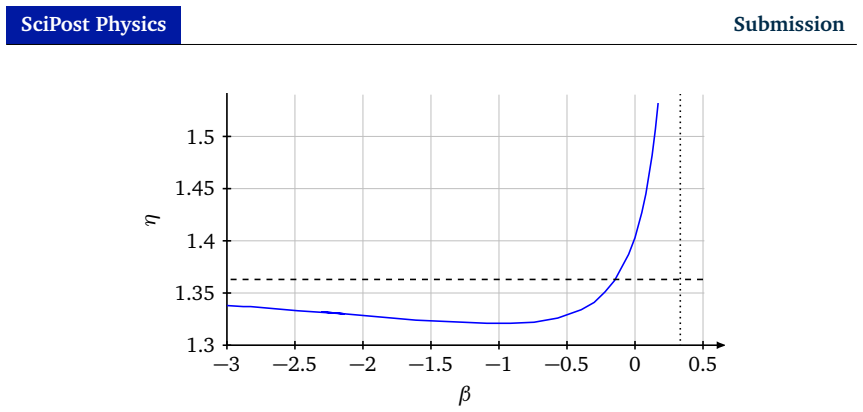
Two constructed quantities carry the argument. The quantum energy E_qnt = E − E_cls subtracts from the total energy the potential energy of the same density arranged in a perfect triangular classical crystal; this removes the slowly-converging long-range contributions that make the ordinary total energy unusable for Coulomb-like potentials. The second is the self-referential decay constant η of Eq. (16), which depends on the condensate fraction itself and on κ = E_qnt/T − 2, the deviation of the kinetic-to-quantum energy ratio from the harmonic-crystal equipartition value T = E_qnt/2. The implicit equation (15-17) must be solved self-consistently for n0/n; its designed endpoints are the Bogo
What would settle it
A decisive check is to apply the same Monte Carlo protocol to an interaction potential outside the fitted set — for instance a pure regularized 1/r Coulomb interaction or a Gaussian core — and see whether residuals against Eqs. (15-17) stay below 0.02 anywhere in the dilute-to-strongly-correlated window; one potential that breaches the bound refutes universality. A complementary experiment would measure the zero-momentum peak of a 2D exciton gas by momentum-resolved photoemission while independently determining T and E_qnt, especially approaching the liquid-gas spinodal, the region the paper i
Extended reading notes
Core claim
The paper's claim is that Eqs. (15-17) are a universal relation among three quantities — the condensate fraction n0/n, the quantum energy E_qnt, and the kinetic energy T — so that the exact shape of the interparticle interaction is irrelevant. The relation is the implicit equation n0/n = exp(−E_qnt/(ηπ)) with η = 2 − (2+κ²)/π [1 − (n0/n)^γ], κ = E_qnt/T − 2, and a single fitted exponent γ ≈ 3.37. It reproduces the Bogoliubov weak-coupling limit as n0/n → 1 and a strong-correlation exponential decay as n0/n → 0, with the kinetic energy supplying the model-specific correction in between. The evidence is diffusion Monte Carlo data for eight very different potentials, plus a test on 2D liquid he
Load-bearing premise
The load-bearing premise is that the implicit equation (15-17) defines one well-behaved condensate fraction for every pair of kinetic and quantum energies in the claimed window; the paper states at the end of Section 3.3 that the relation implicitly defines n0/n as a function of the two energies, but it never proves that the self-consistent solution exists and is unique.
Editorial extensions
If this is right
- Within the stated density window, the condensate fraction of any zero-temperature 2D Bose gas is fixed by the kinetic energy and the quantum energy, with the interaction potential entering only through those two quantities.
- The formula bridges the dilute perturbative regime and the strongly correlated regime near crystalline order, so it covers territory no single analytic theory currently spans.
- For experimental platforms where momentum distributions are hard to access — indirect excitons in TMDC layers, dipolar gases, 2D ultracold atoms — thermodynamic measurements of E, E_kin, and the classical lattice energy become a route to the condensate fraction.
- The paper's stated applicability limits are the high-density soft-core regime and the region near the liquid-gas transition; inside those limits the residuals stay below 0.02 for all eight potentials tested.
- Because the relation reduces to the known weak-coupling result in the dilute limit, it can serve as a benchmark for theories aiming to describe the crossover to strong correlations.
Reading between the lines
- The fitted exponent γ ≈ 3.37 is not derived; if the universality is real, a microscopic or renormalization argument should be able to produce the interpolation (16), converting a phenomenology into a theory.
- The introduction of the kinetic-energy ratio as a second channel suggests analogous two-energy relations might hold for the condensate (or pairing) fraction in other dimensions and even in Fermi superfluids — a testable extension beyond the paper's 2D Bose focus.
- A practical experiment: in a quasi-2D ultracold gas, measure T from time-of-flight expansion and E_qnt from equation-of-state data, predict n0/n from Eqs. (15-17), and compare with a standard interference measurement; agreement in a trapped, inhomogeneous setting would extend the uniform-box evidence of the paper.
- The implicit equation may possess parameter regions with multiple or no fixed points; if such a region exists, it would mark a sharp boundary (possibly the gas-liquid or gas-crystal transition), a possibility the paper does not explore.
Editorial analysis
A structured set of objections, weighed in public.
Referee Report
Summary. The manuscript proposes a phenomenological universal relation for the zero-temperature condensate fraction n0/n of two-dimensional Bose gases. The central expression is n0/n = exp(-E_qnt/(ηπ)) with η = 2 - (2+κ²)/π [1 - (n0/n)^γ] and κ = E_qnt/T - 2, where E_qnt is the total energy reduced by the classical crystal energy and T is the kinetic energy. The coefficient γ≈3.37 is obtained from a fitting procedure. The authors validate the expression with diffusion Monte Carlo data for seven model potentials (hard-core, dipolar, Lennard-Jones, soft-core, Yukawa, etc.) and for two-dimensional liquid helium, reporting residuals ∆n0/n ≤ 0.02 for the model potentials and good agreement for helium at nσ² ≳ 0.3. Appendices provide harmonic-crystal and anharmonicity arguments for the strong-coupling behavior.
Significance. If the proposed relation is correct, it is a genuinely useful phenomenological tool: it gives a potential-independent route from energetic quantities (quantum and kinetic energies) to the condensate fraction in strongly correlated 2D Bose systems, with possible applications to excitons in TMDC layers and ultracold atoms. The paper has clear strengths: a broad set of interaction potentials, a genuine out-of-sample helium test, explicit statements of the applicability limits, and microscopic rationalizations in the appendices. However, the universal coefficient γ is fitted to the same data that is later used as validation, so the reported residuals are in-sample calibration residuals rather than predictive errors. The helium test is independent but covers only a restricted density window, with the near-spinodal and high-density soft-core regions excluded. The paper would be substantially strengthened by a held-out or cross-validated test and by a uniqueness analysis of the implicit equation.
major comments (3)
- [Sec. 3.3, Eqs. (15)-(17)] The assertion that Eq. (15) 'implicitly defines the condensate fraction as a function of the quantum and kinetic energies' requires existence and uniqueness. With x=n0/n, A=E_qnt/π, B=(2+κ²)/π, Eq. (15) reads x=F(x)=exp(-A/[2-B(1-x^γ)]), γ≈3.37. F is increasing, but F'(x)=F(x) A B γ x^{γ-1}/(2-B(1-x^γ))² can exceed 1 for sufficiently large B (e.g., |κ|≳1.75), so H(x)=x-F(x) need not be monotone. H(0)<0 and H(1)>0 guarantee only that at least one root exists, not uniqueness. Multiple roots would make the 'universal relation' multivalued and the Fig. 4 residuals branch-dependent. Please prove monotonicity/uniqueness on the claimed domain, or specify a physical branch and the numerical root-selection procedure used.
- [Secs. 3.3 and 4, Fig. 4] The coefficient γ≈3.37 is obtained by a fitting procedure applied to the same QMC data that Fig. 4 then displays as 'predictions'. Therefore the reported residuals ∆n0/n≤0.02 for potentials 1-7 are calibration residuals, not independent predictions. The helium comparison in Sec. 4.1 is a genuine out-of-sample test, but it covers only nσ²≳0.3, and the near-spinodal and high-density soft-core domains are explicitly excluded (Sec. 4.2). To support the universality claim, fit γ on a training subset of potentials/densities and test on held-out cases, or provide a cross-validation analysis. In addition, report the QMC statistical uncertainties of n0/n so that the magnitude of the residuals can be meaningfully interpreted.
- [Sec. 3.3, Eqs. (19)-(21)] Substituting Eq. (16) into Eq. (15) gives ηπ = 2π - 2 - κ², so the denominator in Eq. (19) should be 2π - 2 - (E_qnt/(αE_qnt+β)-2)², without the factor 1/π that appears in the printed formula. The expansion in Eq. (20) and the resulting strong-coupling exponent ηℓ in Eq. (21) seem inconsistent with Eqs. (15)-(16) as written. Since this is the derivation used to connect to the strong-coupling limit ηℓ≈1.35, the algebraic factors of π should be carefully checked and corrected.
minor comments (4)
- [Sec. 4, Fig. 4] Please report the number of data points and the statistical uncertainties of the QMC condensate fractions. The statement 'residuals do not exceed 0.02' is difficult to assess without error bars.
- [Abstract and Conclusions] The abstract/conclusions state that the relation is validated across densities spanning the perturbative to strongly correlated regime. Consider explicitly repeating the exclusions (high-density soft-core potentials, near-spinodal liquid helium) so the scope is not overstated.
- [Fig. 3 and Sec. 3.3] The linear fits T=αE_qnt+β are shown only for selected potentials. Since α and β enter Eqs. (19)-(21), please provide the fitted values, fit ranges, and uncertainties in a table or in the text.
- [Appendix A] The bracketed reference 'Table reftab:potentials' appears unresolved. Also, the text should state explicitly that the classical reference energy in Eq. (10) is evaluated on a triangular lattice and briefly discuss the sensitivity of E_qnt to this choice.
Circularity Check
The one free parameter γ of the proposed universal relation is fitted to the same Monte Carlo data that is then displayed as 'predictions'; the gaseous-phase validation residuals are explicitly described as fitting residuals.
-
fitted input called prediction
[Section 3.3 after Eq. (17); Section 4 and Fig. 4]
"The numerical coefficient γ was obtained in a fitting procedure, which led to γ≈3.37. ... The apparent visual agreement observed in Fig. 4 is supported by examination of the data points, which show that for all the potentials fitting residuals ∆n0/n do not exceed 0.02."
The central universal relation (15)-(17) contains a single fitted exponent γ≈3.37. That value is obtained by fitting to the QMC data for the same potentials that are then presented in Fig. 4 as 'predictions' used to validate the relation. The paper itself calls the deviations 'fitting residuals,' confirming that the agreement is an in-sample measure of fit quality, not an independent predictive test. Thus the claim that Eqs. (15)-(17) determine the condensate fraction from E_qnt and T is, for the gaseous-phase data, a fitted input renamed as a prediction. The helium comparison in Sec. 4.1 could provide independent support only if helium data were excluded from the γ fit, but the fitting procedure is not documented in that detail.
full rationale
The proposed relation is a phenomenological interpolation with one genuinely fitted parameter, γ≈3.37, and the validation shown in Fig. 4 uses the same data from which γ was extracted; the residual statistic is explicitly called a 'fitting residual.' This is a real but partial circularity: the functional form involving the kinetic-energy ratio κ=E_qnt/T−2 has independent content, and the helium section offers a potentially out-of-sample check, though the text does not demonstrate that helium was excluded from the fit. The implicit fixed-point structure (n0/n appears on both sides of Eq. (15)-(16)) is not by itself circular, and the absence of an existence/uniqueness proof is a correctness concern rather than circularity. No load-bearing self-citation was found: refs. [13,40,45] provide numerical methodology, not the universal relation itself, and no uniqueness theorem from prior work is invoked. Overall score 6: a central 'prediction' reduces to a fitted parameter, but the paper is not fully circular because the relation compresses the data nontrivially and contains an additional physical variable (kinetic energy).
Assumptions & free parameters
free parameters (3)
- γ (gamma) =
3.37
- ηℓ (strong-correlation decay constant) =
≈1.35
- α, β (per-potential linear coefficients) =
not reported; varies by potential
assumptions (5)
- domain assumption Quantum Monte Carlo with the Jastrow trial wavefunction yields unbiased ground-state energies and condensate fractions.
- domain assumption The condensate fraction can be accurately extracted from the static structure factor via the quantum-hydrodynamic extrapolation of Ref. [40].
- domain assumption The triangular-lattice classical energy is the appropriate reference energy E_cls for all potentials and densities, including 2D liquid helium.
- ad hoc to paper The implicit equation (15-17) has a unique solution n0/n for any (E_qnt, T) in the claimed domain.
- domain assumption The harmonic crystal model (Appendix A) captures the strongly correlated regime and justifies the universal exponent.
Cite this review
Pith. "Pith review of A phenomenological universal expression for the condensate fraction in strongly-correlated two-dimensional Bose gases." pith.science (2026). https://pith.science/paper/5BNMG4MU
@misc{pith2026250819615,
  author       = {Pith},
  title        = {Pith review of: A phenomenological universal expression for the condensate fraction in strongly-correlated two-dimensional Bose gases},
  year         = {2026},
  howpublished = {\url{https://pith.science/paper/5BNMG4MU}},
  note         = {Machine review of arXiv:2508.19615}
}
read the original abstract
We investigate the relation between non-local and energetic properties in 2D quantum systems of zero-temperature bosons. By analyzing numerous interaction potentials across densities spanning from perturbative to strongly correlated regime, we discover a novel high-precision quantum phenomenological universality: the condensate fraction can be expressed through kinetic energy and quantum energy, defined as total energy relative to classical crystal state. Quantum Monte Carlo simulations accurately validate our analytical expression. Furthermore, we test the obtained relation on the fundamental example of a non-perturbative system, namely, the liquid helium. The proposed relation is relevant to experiments with excitons in transition metal dichalcogenides (TMDC) materials, as well as ultracold atoms and other quantum systems in reduced dimensionality.
Figures


Figures from the paper (4 more)



Reference graph
Works this paper leans on
-
[1]
K. B. Davis, M. O. Mewes, M. R. Andrews, N. J. Van Druten, D. S. Durfee, D. M. Kurn and W . Ketterle, Bose-Einstein Condensation in a Gas of Sodium Atoms , Phys. Rev. Lett. 75(22), 3969 (1995), doi:10.1103 /PhysRevLett.75.3969
work page 1995
-
[2]
C. C. Bradley , C. A. Sackett, J. J. Tollett and R. G. Hulet,Evidence of Bose-Einstein Conden- sation in an Atomic Gas with Attractive Interactions, Phys. Rev. Lett. 75(9), 1687 (1995), doi:10.1103/PhysRevLett.75.1687
-
[3]
M. H. Anderson, J. R. Ensher, M. R. Matthews, C. E. Wieman and E. A. Cornell, Obser- vation of Bose-Einstein Condensation in a Dilute Atomic Vapor , Science 269(5221), 198 (1995), doi:10.1126 /science.269.5221.198
work page 1995
-
[4]
L. P . Pitaevskii and S. Stringari,Bose-Einstein Condensation, International Series of Mono- graphs on Physics. Clarendon Press, Oxford, England (2003)
work page 2003
-
[5]
Bogoliubov, Energy levels of the imperfect Bose–Einstein gas, Bull
N. Bogoliubov, Energy levels of the imperfect Bose–Einstein gas, Bull. Moscow State Univ. 7, 43 (1947)
work page 1947
-
[6]
S. Beliaev, Application of the Methods of Quantum Field Theory to a System of Bosons , JETP 7(2), 289 (1958)
work page 1958
-
[7]
Beliaev, Energy-Spectrum of a Non-ideal Bose Gas, JETP 7(2), 299 (1958)
S. Beliaev, Energy-Spectrum of a Non-ideal Bose Gas, JETP 7(2), 299 (1958)
work page 1958
-
[8]
W . Ketterle, D. S. Durfee and D. M. Stamper-Kurn, Making, probing and understanding Bose-Einstein condensates (1999), cond-mat/9904034
arXiv 1999
Show all 57 references
-
[9]
T . D. Lee, K. Huang and C. N. Yang, Eigenvalues and Eigenfunctions of a Bose System of Hard Spheres and Its Low-Temperature Properties , Phys. Rev. 106(6), 1135 (1957), doi:10.1103/PhysRev.106.1135
1957 doi
-
[10]
Schick, Two-Dimensional System of Hard-Core Bosons, Phys
M. Schick, Two-Dimensional System of Hard-Core Bosons, Phys. Rev. A3(3), 1067 (1971), doi:10.1103/PhysRevA.3.1067
1971 doi
-
[11]
Navon, S
N. Navon, S. Piatecki, K. Günter, B. Rem, T . C. Nguyen, F . Chevy , W . Krauth and C. Sa- lomon, Dynamics and Thermodynamics of the Low-Temperature Strongly Interacting Bose Gas, Phys. Rev. Lett. 107(13), 135301 (2011), doi:10.1103 /PhysRevLett.107.135301
2011
-
[12]
Braaten, H.-W
E. Braaten, H.-W . Hammer and S. Hermans,Nonuniversal effects in the homogeneous Bose gas, Phys. Rev. A 63(6), 063609 (2001), doi:10.1103 /PhysRevA.63.063609
2001
-
[13]
G. E. Astrakharchik, J. Boronat, I. L. Kurbakov, Y. E. Lozovik and F . Mazzanti, Low- dimensional weakly interacting Bose gases: Nonuniversal equations of state , Phys. Rev. A 81(1), 013612 (2010), doi:10.1103 /PhysRevA.81.013612
2010
-
[14]
Hines, N
D. Hines, N. Frankel and D. Mitchell, Hard-disc Bose gas, Physics Letters A 68(1), 12 (1978), doi:10.1016 /0375-9601(78)90741-7
1978
-
[15]
Andersen, Ground state pressure and energy density of an interacting homogeneous Bose gas in two dimensions , Eur
J. Andersen, Ground state pressure and energy density of an interacting homogeneous Bose gas in two dimensions , Eur. Phys. J. B 28(4), 389 (2002), doi:10.1140 /epjb/e2002- 00242-6
2002
-
[16]
Pricoupenko, Variational approach for the two-dimensional trapped Bose-Einstein con- densate, Phys
L. Pricoupenko, Variational approach for the two-dimensional trapped Bose-Einstein con- densate, Phys. Rev. A 70(1), 013601 (2004), doi:10.1103 /PhysRevA.70.013601. 16 SciPost Physics Submission
2004
-
[17]
Fabrocini and A
A. Fabrocini and A. Polls, Beyond the Gross-Pitaevskii approximation: Local density ver- sus correlated basis approach for trapped bosons , Phys. Rev. A 60(3), 2319 (1999), doi:10.1103/PhysRevA.60.2319
1999 doi
-
[18]
Boronat, Quantum hard spheres as a model for a homogeneous Bose gas , Physica B: Condensed Matter 284-288, 1 (2000), doi:10.1016 /S0921-4526(99)01940-7
J. Boronat, Quantum hard spheres as a model for a homogeneous Bose gas , Physica B: Condensed Matter 284-288, 1 (2000), doi:10.1016 /S0921-4526(99)01940-7
2000
-
[19]
Pilati, J
S. Pilati, J. Boronat, J. Casulleras and S. Giorgini, Quantum Monte Carlo sim- ulation of a two-dimensional Bose gas , Phys. Rev. A 71(2), 023605 (2005), doi:10.1103/PhysRevA.71.023605
2005 doi
-
[20]
Altmeyer, S
A. Altmeyer, S. Riedl, C. Kohstall, M. J. Wright, R. Geursen, M. Bartenstein, C. Chin, J. H. Denschlag and R. Grimm,Precision Measurements of Collective Oscillations in the BEC-BCS Crossover, Phys. Rev. Lett.98(4), 040401 (2007), doi:10.1103/PhysRevLett.98.040401
2007 doi
-
[21]
A. V . Gorbunov and V . B. Timofeev,Large-scale coherence of the bose condensate of spatially indirect excitons, Jetp Lett. 84(6), 329 (2006), doi:10.1134 /S0021364006180111
2006
-
[22]
A. A. High, J. R. Leonard, A. T . Hammack, M. M. Fogler, L. V . Butov, A. V . Kavokin, K. L. Campman and A. C. Gossard, Spontaneous coherence in a cold exciton gas , Na- ture 483(7391), 584 (2012), doi:10.1038 /nature10903
2012
-
[23]
Alloing, M
M. Alloing, M. Beian, M. Lewenstein, D. Fuster, Y. González, L. González, R. Combescot, M. Combescot and F . Dubin, Evidence for a Bose-Einstein condensate of excitons , EPL 107(1), 10012 (2014), doi:10.1209 /0295-5075/107/10012
2014
-
[24]
M. Lu, N. Q. Burdick, S. H. Youn and B. L. Lev, Strongly Dipolar Bose- Einstein Condensate of Dysprosium , Phys. Rev. Lett. 107(19), 190401 (2011), doi:10.1103/PhysRevLett.107.190401
2011 doi
-
[25]
Müller, J
S. Müller, J. Billy , E. A. L. Henn, H. Kadau, A. Griesmaier, M. Jona-Lasinio, L. Santos and T . Pfau,Stability of a dipolar Bose-Einstein condensate in a one-dimensional lattice, Phys. Rev. A84(5), 053601 (2011), doi:10.1103 /PhysRevA.84.053601
2011
-
[26]
S. O. Demokritov, V . E. Demidov, O. Dzyapko, G. A. Melkov, A. A. Serga, B. Hillebrands and A. N. Slavin, Bose–Einstein condensation of quasi-equilibrium magnons at room tem- perature under pumping, Nature 443(7110), 430 (2006), doi:10.1038 /nature05117
2006
-
[27]
Kasprzak, M
J. Kasprzak, M. Richard, S. Kundermann, A. Baas, P . Jeambrun, J. M. J. Keeling, F . M. Marchetti, M. H. Szyma´nska, R. André, J. L. Staehli, V . Savona, P . B. Littlewood et al., Bose–Einstein condensation of exciton polaritons, Nature 443(7110), 409 (2006), doi:10.1038/nature05131
2006 doi
-
[28]
Balili, V
R. Balili, V . Hartwell, D. Snoke, L. Pfeiffer and K. West, Bose-Einstein Con- densation of Microcavity Polaritons in a Trap , Science 316(5827), 1007 (2007), doi:10.1126/science.1140990
2007 doi
-
[29]
Klaers, J
J. Klaers, J. Schmitt, F . Vewinger and M. Weitz,Bose–Einstein condensation of photons in an optical microcavity, Nature 468(7323), 545 (2010), doi:10.1038 /nature09567
2010
-
[30]
A. K. Geim and I. V . Grigorieva,Van der Waals heterostructures, Nature 499(7459), 419 (2013), doi:10.1038 /nature12385
2013
-
[31]
M. M. Fogler, L. V . Butov and K. S. Novoselov, High-temperature superfluidity with in- direct excitons in van der Waals heterostructures , Nat Commun 5(1), 4555 (2014), doi:10.1038/ncomms5555. 17 SciPost Physics Submission
2014 doi
-
[32]
Combescot, R
M. Combescot, R. Combescot and F . Dubin,Bose–einstein condensation and indirect exci- tons: a review, Reports on Progress in Physics80(6), 066501 (2017), doi:10.1088/1361- 6633/aa50e3
2017 doi
-
[33]
D. W . Snoke, N. P . Proukakis, T . Giamarchi and P . B. Littlewood,Universality and bose- einstein condensation: Perspectives on recent work, In N. Proukakis, D. W . Snoke and P . B. Littlewood, eds., Universal Themes of Bose-Einstein Condensation . Cambridge University Press...
2017
-
[34]
N. P . Proukakis,Universality of Bose-Einstein Condensation and Quenched Formation Dy- namics, In Encyclopedia of Condensed Matter Physics (2023), 2304.09541
2023 arXiv
-
[35]
J. H. Rose, J. R. Smith, F . Guinea and J. Ferrante, Universal features of the equation of state of metals, Phys. Rev. B 29(6), 2963 (1984), doi:10.1103 /PhysRevB.29.2963
1984
-
[36]
Lindemann, About the Calculation of Molecular Own Frequencies , Physical Magazine 11(14), 609 (1910)
F . Lindemann, About the Calculation of Molecular Own Frequencies , Physical Magazine 11(14), 609 (1910)
1910
-
[37]
Bedanov, G
V . Bedanov, G. Gadiyak and Y. Lozovik, On a modified Lindemann-like criterion for 2D melting, Physics Letters A 109(6), 289 (1985), doi:10.1016 /0375-9601(85)90617-6
1985
-
[38]
V . N. Ryzhov, E. E. Tareyeva, Y. D. Fomin and E. N. Tsiok, Complex phase diagrams of systems with isotropic potentials: results of computer simulations , Phys.-Usp. 63, 417 (2020), doi:10.3367 /UFNe.2018.04.038417
2020
-
[39]
B. A. Klumov, Universal structural properties of three-dimensional and two-dimensional melts, Phys.-Usp. 66, 288 (2023), doi:10.3367 /UFNe.2022.09.039237
2023
-
[40]
Y. E. Lozovik, I. L. Kurbakov, G. E. Astrakharchik and J. Boronat, Estimation of the con- densate fraction from the static structure factor , Phys. Rev. B 103(9), 094511 (2021), doi:10.1103/PhysRevB.103.094511
2021 doi
-
[41]
D. A. Godzieba, R. Gamba, D. Radice and S. Bernuzzi, Updated universal relations for tidal deformabilities of neutron stars from phenomenological equations of state, Phys. Rev. D 103(6), 063036 (2021), doi:10.1103 /PhysRevD.103.063036
2021
-
[42]
J. A. Cohen, R. Podgornik, P . L. Hansen and V . A. Parsegian, A Phenomenological One- Parameter Equation of State for Osmotic Pressures of PEG and Other Neutral Flexible Poly- mers in Good Solvents, J. Phys. Chem. B113(12), 3709 (2009), doi:10.1021/jp806893a
2009 doi
-
[43]
R. A. Aziz, V . P . S. Nain, J. S. Carley , W . L. Taylor and G. T . McConville, An accu- rate intermolecular potential for helium , The Journal of Chemical Physics 70(9), 4330 (1979), doi:10.1063/1.438007, https://pubs.aip.org/aip/jcp/article-pdf/70/9/4330/ 18917020/4330_1_online.pdf
1979 doi
-
[44]
Reatto and G
L. Reatto and G. V . Chester,Phonons and the properties of a bose system, Phys. Rev. 155, 88 (1967), doi:10.1103 /PhysRev.155.88
1967
-
[45]
G. E. Astrakharchik, I. L. Kurbakov, D. V . Sychev, A. K. Fedorov and Y. E. Lozovik,Quantum phase transition of a two-dimensional quadrupolar system, Phys. Rev. B103(14), L140101 (2021), doi:10.1103 /PhysRevB.103.L140101
2021
-
[46]
Casulleras and J
J. Casulleras and J. Boronat, Unbiased estimators in quantum monte carlo methods: Ap- plication to liquid he, Phys. Rev. B 52, 36 (1995), doi:10.1103 /PhysRevB.52.3654. 18 SciPost Physics Submission
1995
-
[47]
Y. E. Lozovik, I. L. Kurbakov and G. E. Astrakharchik,Spontaneous formation of Kagom\’e lattice in two-dimensional Rydberg atoms, ArXiv:1912.11033 [cond-mat] (2019)
1912 arXiv
-
[48]
P . A. Whitlock, G. V . Chester and M. H. Kalos,Monte carlo study of 4He in two dimensions, Phys. Rev. B38, 2418 (1988), doi:10.1103 /PhysRevB.38.2418
1988
-
[49]
B. E. Clements, J. L. Epstein, E. Krotscheck and M. Saarela, Structure of boson quantum films, Phys. Rev. B 48, 7450 (1993), doi:10.1103 /PhysRevB.48.7450
1993
-
[50]
Giorgini, J
S. Giorgini, J. Boronat and J. Casulleras, Diffusion monte carlo study of two-dimensional liquid 4He, Phys. Rev. B 54, 6099 (1996), doi:10.1103 /PhysRevB.54.6099
1996
-
[51]
Apaja and M
V . Apaja and M. Saarela, Structure of metastable 2d liquid helium , EPL (Europhysics Letters) 84(4), 40003 (2008), doi:10.1209 /0295-5075/84/40003
2008
-
[52]
A. G. Smart, A liquid ground state for 2d helium-3?, Physics Today 66(1), 16–17 (2012), doi:10.1063/pt.3.1842
2012 doi
-
[53]
Saunders, B
J. Saunders, B. Cowan and J. Nyéki, Atomically layered helium films at ultralow tem- peratures: Model systems for realizing quantum materials , Journal of Low Temperature Physics 201(5–6), 615–633 (2020), doi:10.1007 /s10909-020-02448-9
2020
-
[54]
Varga, C
E. Varga, C. Undershute and J. P . Davis, Surface-dominated finite-size ef- fects in nanoconfined superfluid helium , Phys. Rev. Lett. 129, 145301 (2022), doi:10.1103/PhysRevLett.129.145301
2022 doi
-
[55]
E. A. Kolganova, A. K. Motovilov and W . Sandhas, Scattering length for helium atom- diatom collision, Few-Body Systems 38(2–4), 205–208 (2006), doi:10.1007 /s00601- 005-0137-8
2006
-
[56]
squeezed
D. Jaksch, C. Bruder, J. I. Cirac, C. W . Gardiner and P . Zoller,Cold bosonic atoms in optical lattices, Phys. Rev. Lett. 81, 3108 (1998), doi:10.1103 /PhysRevLett.81.3108. 19 SciPost Physics Submission A Condensate fraction for the strongly correlated regime In a strongly in...
1998
-
[57]
(36) This expression demonstrates the deviations from the equipartition relation
(35) Passing to the normalized energies, we end up with the following relation: T = 1 2E qnt + 1 24 αm ħh2n =E qnt 2 + 1 24 V (iv)m ħh2n ħh2 m2ω2 =E qnt 2 + 1 24 V (iv) V′′ 1 n. (36) This expression demonstrates the deviations from the equipartition relation. Moreover, for a p...
Reviewed August 5, 2026 · model on record in the stance chip above.
Discussion (0). Continue with ORCID to comment.