REVIEW 2 major objections 4 minor 37 references
Evolution of Gaussians in the Hellinger-Kantorovich-Boltzmann gradient flow
T0 review · 2 major / 4 minor · reviewed 2026-08-16 · deepseek-v4-flash
Pith's one-line read The Hellinger–Kantorovich–Boltzmann gradient flow preserves the class of Gaussian measures, and the paper derives the exact finite-dimensional ODEs for their mean, covariance, and mass.
desk verdict Solid reduction of HK-Boltzmann flow to Gaussian ODEs, but Section 5 overstates two results: the slope comparison in Theorem 5.11 is inverted and Theorem 5.8 drops initial-data prefactors. read the letter →
The pith
A machine-rendered reading of the paper's core claim, the machinery that carries it, and where it could break.
The reading
What carries the argument
The load-bearing object is the reduced Onsager operator on the parameter space $P=\mathbb{R}^{d\times d}_{\mathrm{spd}}\times\mathbb{R}^d\times(0,\infty)$. It is obtained by restricting the full HK Onsager operator $K_{\alpha,\beta}(\rho)\xi=-\alpha\,\mathrm{div}(\rho\nabla\xi)+\beta\rho\xi$ (the object that pairs entropic gradients with velocities in the HK metric) to the Gaussian manifold, using the general reduction formula for Onsager operators, which amounts to a Schur complement after Lagrange-multiplier elimination. The reduction is additive, $K^{\mathrm{red}}_{\alpha,\beta}(p)=\alpha K^{\mathrm{red}}_{\mathrm{tr}}(p)+\beta K^{\mathrm{red}}_{\mathrm{He}}(p)$ as in (3.3), and inserting it into $\dot p=-K^{\mathrm{red}}DE(p)$ yields the explicit ODEs (3.6). The argument also uses the natural parametrization $\rho(x)=\exp(c+b\cdot x-\tfrac12 x\cdot Ax)$, in which the flow equations become polynomial, and the evolution of the normalized covariance $B=\Gamma^{-1/2}\Sigma\Gamma^{-1/2}$, whose eigenvalues obey the scalar equations $\dot b_i=-(2\alpha\langle v_i|\Gamma^{-1}v_i\rangle+\beta b_i)(b_i-1)$ obtained by the standard eigenvalue perturbation formula.
What would settle it
Take $d=1$, target $\pi=\mathcal{N}(0,1)$, covariance $\Sigma=s^2$ with $s<1$, and any mean $m\ne0$. Write $g=\int \nabla V\,G\,dx$. The transport slope is $(1-s^2)^2/s^2+g^2$ and the Hellinger slope is $(1-s^2)^2+s^2g^2$. The inequality used in Theorem 5.11 would require $(1-s^2)^2/s^2+g^2 \le s^2((1-s^2)^2+s^2g^2)$, which simplifies to $(1-s^4)((1-s^2)^2+s^2g^2)\le0$, false for every $s<1$. This one-dimensional check falsifies the slope comparison and hence the stated decay rate.
Extended reading notes
Core claim
The central claim is that the relative Boltzmann entropy flow in the $(\alpha,\beta)$-HK geometry preserves scaled Gaussians whenever the reference measure is a scaled Gaussian, and that the restricted flow is exactly the gradient flow of the reduced entropy under the reduced Onsager operator $K^{\mathrm{red}}_{\alpha,\beta}(p)=\alpha K^{\mathrm{red}}_{\mathrm{tr}}(p)+\beta K^{\mathrm{red}}_{\mathrm{He}}(p)$. Consequently the ODEs (3.6) fully describe the infinite-dimensional flow on the Gaussian manifold, not merely a projected approximation. On normalized Gaussians the paper shows that global geodesic $\lambda$-convexity holds only in the pure transport case ($\beta=0$ with $\lambda\le\alpha\nu_{\min}(\Gamma^{-1})$), while a sublevel version of semi-convexity holds in general. For Gaussian targets it proves exponential decay of the relative Boltzmann entropy with explicit rates, the sharpest being $\nu_{\mathrm{cov}}=2\alpha\nu_{\min}(\Gamma^{-1})+\beta$ for the covariance part and $\nu_{\mathrm{m}}=2\alpha\nu_{\min}(\Gamma^{-1})+2\beta$ for the mean part. For non-Gaussian targets that are strongly log-$\lambda$-concave, it claims exponential convergence with rate $\lambda(2\alpha+\beta r_E^{-1})$ obtained from a slope comparison between the transport and Hellinger dissipations.
Load-bearing premise
The load-bearing premise for the non-Gaussian decay theorem is the slope comparison $|\partial_{\mathrm{Otto}}E_1|^2 \le \sigma_{\min}|\partial_{\mathrm{SHe}}E_1|^2$, which direct computation seems to reverse to $|\partial_{\mathrm{Otto}}E_1|^2 \le \sigma_{\min}^{-1}|\partial_{\mathrm{SHe}}E_1|^2$, so the stated rate $\lambda(2\alpha+\beta r_E^{-1})$ is unsupported unless that inequality is repaired.
Editorial extensions
If this is right
- In the pure transport case ($\beta=0$) and the pure Hellinger case ($\alpha=0$) the covariance equation has closed-form solutions, so the HK flow's decay can be compared exactly with its two limiting geometries.
- The additive form of the reduced Onsager operator means the HK flow interpolates between mass-preserving transport and pure mass growth without introducing coupling terms at the metric level, which is what makes the parameter-space analysis tractable.
- For Gaussian targets the refined decay rates are independent of the initial energy level, so the long-time behavior is governed only by $\alpha$, $\beta$, and the smallest eigenvalue of $\Gamma^{-1}$.
- The discrete Algorithm 1 provides a practical Gaussian variational-inference scheme for non-Gaussian targets such as Bayesian logistic regression, alternating transport and Hellinger updates with Monte Carlo estimation; the experiments indicate transport steps dominate far from equilibrium while Hellinger steps converge faster near it.
Reading between the lines
- Beyond the paper, the same reduction should apply to any exponential family whose log-density is quadratic: if the target lies in the family, the HK–Boltzmann flow stays in it, and the finite-dimensional ODEs can be derived by the same algebraic reduction.
- Beyond the paper, if the slope comparison behind Theorem 5.11 is indeed reversed, the exponential-decay conclusion may survive with a different rate; a natural repair is to work with $\sigma_{\min}^{-1}$ or a different sublevel bound, which would change the rate constant but not the qualitative behavior.
- Beyond the paper, the explicit covariance formula in Remark 2.3 offers a sharp numerical test of the PL rates: computing the exact covariance at time $t$ and comparing the exponent with $\nu_{\mathrm{cov}}$ would show whether the prefactor in (5.9) is an artifact of the proof.
- Beyond the paper, a promising extension is a variational (minimizing-movement) discretization of the reduced flow rather than the Euler splitting of Algorithm 1; the additive Onsager structure suggests exact substeps for transport and Hellinger would preserve Gaussianity at every iteration.
Signed reviews
Editorial analysis
A structured set of objections, weighed in public.
Referee Report
Summary. The paper studies the gradient flow of the relative Boltzmann entropy with respect to Gaussian reference measures in Hellinger-Kantorovich (HK) geometry. It proves that the class of scaled Gaussians is invariant under the HK-Boltzmann flow, derives the reduced Onsager operators on the parameter space P=(Sigma,m,kappa), obtains the explicit ODE system (2.4)/(3.6), and shows that this parameter-space system is the exact reduced gradient flow. The paper then analyzes geodesic convexity of the normalized Gaussian system, establishes Polyak-Lojasiewicz-type inequalities and refined eigenvalue-based decay estimates for Gaussian targets, extends the results to strongly log-lambda-concave targets, and reports numerical experiments including Bayesian logistic regression.
Significance. The reduction results are a genuine contribution: the closed-form reduced Onsager operators in Theorem 3.8 and the explicit ODEs in (2.4) give a parameter-free, computationally transparent description of HK-Boltzmann flow on Gaussians. The geodesic-convexity analysis clarifies the loss of global convexity for beta>0 while retaining sublevel semi-convexity, and the PL estimates provide explicit rates in alpha, beta, and Gamma. The numerical experiments complement the theory. However, the non-Gaussian decay theorem in Section 5.3 rests on an inverted slope comparison, so that part of the paper needs correction before the stated results can be accepted.
major comments (2)
- [Section 5.3, slope comparison preceding Theorem 5.11] The displayed inequality |\partial_Otto E_1|^2 <= sigma_min |\partial_SHe E_1|^2 is reversed. Writing A=I-Gamma^{-1}Sigma and g=integral nabla V G dx, the two slopes are |\partial_Otto E_1|^2=tr(A^2 Sigma^{-1})+|g|^2 and |\partial_SHe E_1|^2=tr(A^2)+g^T Sigma g. Since Sigma^{-1} <= sigma_min^{-1} I and |g|^2 <= sigma_min^{-1} g^T Sigma g, the correct comparison is |\partial_Otto E_1|^2 <= sigma_min^{-1}|\partial_SHe E_1|^2. The printed claim already fails for d=1, Gamma=1, Sigma=epsilon in (0,1), g=0, where it would assert (1-epsilon)^2/epsilon <= epsilon(1-epsilon)^2. The Gronwall chain immediately below the display therefore does not follow as written: the valid argument gives dE_1/dt <= -(alpha+beta sigma_min)|\partial_Otto E_1|^2, and with (5.12) this yields a rate of the form lambda(2alpha+2beta r_E^{-1}), not lambda(2alpha+beta r_E^{-1}). The qualitative statement of Theorem 5.11 is repairable, but the theorem as stated is not supported by the displayed computation.
- [Theorem 5.8 and Eqs. (5.9)-(5.10)] The statement of Theorem 5.8 omits the multiplicative prefactors that are part of the estimates proved in (5.9) and (5.10). The theorem displays E_1(p(t)) <= e^{-nu_cov t}H_cov(Sigma(0)) + e^{-nu_m t}H_m(m(0)), whereas (5.9) and (5.10) contain the constants [min{1,b_min(0)}]^{-beta/nu_cov} and [min{1,b_min(0)}]^{-2beta/nu_m}, which can exceed 1 when b_min(0)<1. As printed the theorem is false; either the prefactors must be included in the display or the statement should explicitly say that the bounds hold up to those constants.
minor comments (4)
- [Section 4.2, displayed DE1] The formula DE_1(p)=(2(Gamma^{-1}-Sigma^{-1}), Gamma^{-1}(m-n)) is inconsistent with E_1(p)=H(p|Gamma,n), whose covariance derivative is (1/2)(Gamma^{-1}-Sigma^{-1}); it is also inconsistent with the vector field V(p) displayed immediately below. The downstream formulas in (5.4) appear to use the correct prefactor, so please correct the display.
- [Remark 4.1, Eq. (4.4c)] For the Otto part at kappa=1, the sign of the first term in \dot S_s is opposite to Hamilton's equations (4.3); in the scalar case it should be -2 alpha S_s^2, not +2 alpha S_s^2. Since the remark is declared unused this is not load-bearing, but it should be corrected or the remark removed.
- [Remark 5.9] The parenthetical 'cf. Remark' is a dangling reference; please supply the intended number or delete the parenthetical.
- [Lemma 5.7, Eq. (5.8)] The symbol b_i(t) is used both for the evolving eigenvalue and for the explicit upper/lower bound 1+(b_i(0)-1)e^{-nu_cov t} in the same display; please use a different symbol, such as \bar b_i(t), for the bound.
Circularity Check
No significant circularity: the reduced gradient system is computed directly from the Onsager operators and Gaussian integrals, and the decay rates depend only on explicit parameters.
full rationale
The paper's central derivation is self-contained. The reduced Onsager operator (3.3) is obtained in Lemma 3.6 by direct Gaussian integration of the quadratic ansatz against KOtto and KHe, not by assuming the target ODE. Theorem 3.8 then verifies that p-dot = -Kred DE reproduces the independently derived ODE system (2.4). The Polyak-Lojasiewicz estimates in Propositions 5.3 and 5.5 are explicit inequalities in alpha, beta, and Gamma, with no fitted parameter and no data-dependent constant that is renamed as a prediction. The self-citations present in the paper are not load-bearing in a circular sense: Theorem 3.2 is quoted from [MaM20] but is a general Schur-complement reduction result, and Lemma 3.10 is quoted from [MiZ25] and states a relation between HK and SHK flows whose assumptions do not include Gaussian invariance or the target decay rates. Both results are prior, external support rather than restatements of the paper's conclusion. The only passage that warrants attention is the inequality in Section 5.3 claiming |∂OttoE1|^2 ≤ sigma_min |∂SHeE1|^2, which appears algebraically reversed and would weaken the stated rate in Theorem 5.11; however, that is a correctness or verification issue, not a circularity, because the claimed rate is an output of the argument rather than an input disguised as a result. Overall, the derivation chain does not reduce to its own inputs, so the circularity score is 1.
Assumptions & free parameters
assumptions (4)
- domain assumption The Schur complement reduction formula for Onsager gradient systems (Theorem 3.2)
- domain assumption The equivalence between HK-flow and SHK-flow (Lemma 3.10)
- standard math Hellmann-Feynman theorem for derivatives of eigenvalues
- standard math Geodesic λ-convexity of relative entropy under W2 for log-λ-concave targets
Cite this review
Pith. "Pith review of Evolution of Gaussians in the Hellinger-Kantorovich-Boltzmann gradient flow." pith.science (2026). https://pith.science/paper/5C62KV77
@misc{pith2026250420400,
  author       = {Pith},
  title        = {Pith review of: Evolution of Gaussians in the Hellinger-Kantorovich-Boltzmann gradient flow},
  year         = {2026},
  howpublished = {\url{https://pith.science/paper/5C62KV77}},
  note         = {Machine review of arXiv:2504.20400}
}
read the original abstract
This study leverages the basic insight that the gradient-flow equation associated with the relative Boltzmann entropy, in relation to a Gaussian reference measure within the Hellinger-Kantorovich (HK) geometry, preserves the class of Gaussian measures. This invariance serves as the foundation for constructing a reduced gradient structure on the parameter space characterizing Gaussian densities. We derive explicit ordinary differential equations that govern the evolution of mean, covariance, and mass under the HK-Boltzmann gradient flow. The reduced structure retains the additive form of the HK metric, facilitating a comprehensive analysis of the dynamics involved. We explore the geodesic convexity of the reduced system, revealing that global convexity is confined to the pure transport scenario, while a variant of sublevel semi-convexity is observed in the general case. Furthermore, we demonstrate exponential convergence to equilibrium through Polyak-Lojasiewicz-type inequalities, applicable both globally and on sublevel sets. By monitoring the evolution of covariance eigenvalues, we refine the decay rates associated with convergence. Additionally, we extend our analysis to non-Gaussian targets exhibiting strong log-lambda-concavity, corroborating our theoretical results with numerical experiments that encompass a Gaussian-target gradient flow and a Bayesian logistic regression application.
Figures


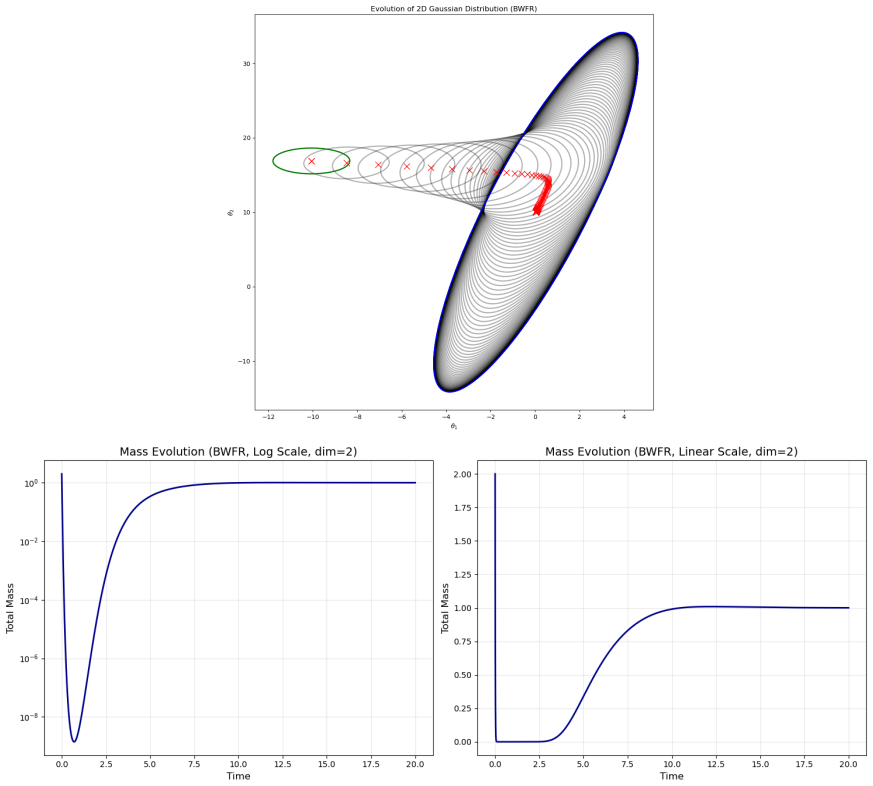
Figures from the paper (3 more)


Reference graph
Works this paper leans on
-
[1]
L. Ambrosio, N. Gigli, and G. Savar \'e . Gradient flows in metric spaces and in the space of probability measures . Lectures in Mathematics ETH Z\"urich. Birkh\"auser Verlag, Basel, 2005
work page 2005
-
[2]
S.-i. Amari . Information geometry. Japanese Journal of Mathematics , 16(1), 1--48, January 2021
work page 2021
-
[3]
S.-i. Amari and H. Nagaoka . Methods of Information Geometry . American Mathematical Soc., 2000
work page 2000
-
[4]
D. Bakry and M. \'E mery . Diffusions hypercontractives. In J. Az \'e ma and M. Yor, editors, S \'e minaire de Probabilit \'e s XIX 1983/84 , volume 1123, pages 177--206. Springer Berlin Heidelberg, Berlin, Heidelberg, 1985
work page 1983
-
[5]
C. Bishop . Pattern recognition and machine learning. Springer google schola , 2, 5--43, 2006
work page 2006
-
[6]
D. M. Blei, A. Kucukelbir, and J. D. McAuliffe . Variational Inference : A Review for Statisticians . Journal of the American Statistical Association , 112(518), 859--877, April 2017
work page 2017
-
[7]
J. A. Carrillo, Y. Chen, D. Z. Huang, J. Huang, and D. Wei . Fisher-rao gradient flow: geodesic convexity and functional inequalities. arXiv preprint arXiv:2407.15693 , 2024
arXiv 2024
-
[8]
Y. Chen, D. Z. Huang, J. Huang, S. Reich, and A. M. Stuart . Gradient Flows for Sampling : Mean-Field Models , Gaussian Approximations and Affine Invariance . Preprint , arXiv:2302.11024, November 2023
arXiv 2023
Show all 37 references
-
[9]
Daneri and G
S. Daneri and G. Savar\'e . Eulerian calculus for the displacement convexity in the W asserstein distance. SIAM J. Math. Analysis , 40, 1104--1122, 2008
2008
-
[10]
Floerchinger and M
S. Floerchinger and M. Schr\"ofl . Relative entropy and mutual information in Gaussian statistical field theory. Ann. Henri Poincar\'e , pages 1--87, 2024
2024
-
[11]
Hellmann
H. Hellmann . Hans Hellmann: Einf \"u hrung in Die Quantenchemie: Mit Biografischen Notizen von Hans Hellmann Jr. Springer-Verlag, 2015
2015
-
[12]
M. I. Jordan, Z. Ghahramani, T. S. Jaakkola, and L. K. Saul . An Introduction to Variational Methods for Graphical Models . Machine Learning , 37(2), 183--233, November 1999
1999
-
[13]
Karimi, J
H. Karimi, J. Nutini, and M. Schmidt . Linear Convergence of Gradient and Proximal-Gradient Methods Under the Polyak- L \ \ ojasiewicz Condition . (arXiv:1608.04636), September 2020
2020 arXiv
-
[14]
Laschos and A
V. Laschos and A. Mielke . Evolutionary Variational Inequalites on the Hellinger-Kantorovich and the spherical Hellinger-Kantorovich spaces. Submitted , 2023. arXiv:2207.09815v3
2023 arXiv
-
[15]
Lambert, S
M. Lambert, S. Chewi, F. Bach, S. Bonnabel, and P. Rigollet . Variational inference via Wasserstein gradient flows. Preprint , arXiv:2205.15902, 2022
2022 arXiv
-
[16]
Liero and A
M. Liero and A. Mielke . Gradient structures and geodesic convexity for reaction-diffusion systems. Phil. Trans. Royal Soc. A , 371(2005), 20120346, 28, 2013
2005
-
[17]
Liero, A
M. Liero, A. Mielke, and G. Savar\'e . Optimal transport in competition with reaction -- the H ellinger-- K antorovich distance and geodesic curves. SIAM J. Math. Analysis , 48(4), 2869--2911, 2016
2016
-
[18]
Liero, A
M. Liero, A. Mielke, and G. Savar\'e . Optimal entropy-transport problems and a new H ellinger-- K antorovich distance between positive measures. Invent. math. , 211, 969--1117, 2018
2018
-
[19]
Liero, A
M. Liero, A. Mielke, and G. Savar\'e . Fine properties of geodesics and geodesic -convexity for the Hellinger--Kantorovich distance. Arch. Rational Mech. Anal. , 247(112), 1--73, 2023
2023
-
[20]
Maas and A
J. Maas and A. Mielke . Modeling of chemical reaction systems with detailed balance using gradient structures. J. Stat. Physics , 181, 2257--2303, 2020
2020
-
[21]
R. H. Martin, Jr. Nonlinear operators and differential equations in B anach spaces . Pure and Applied Mathematics. Wiley-Interscience [John Wiley & Sons], New York-London-Sydney, 1976
1976
-
[22]
R. J. McCann . A convexity principle for interacting gases. Adv. Math. , 128, 153--179, 1997
1997
-
[23]
Mielke and J.-J
A. Mielke and J.-J. Zhu . Hellinger-Kantorovich gradient flows: Global exponential decay of entropy functionals. arXiv preprint arXiv:2501.17049 , 2025
2025 arXiv
-
[24]
K. Modin . Geometry of matrix decompositions seen through optimal transport and information geometry. J. Geom. Mech. , 9(3), 335--390, 2017
2017
-
[25]
Mielke, G
A. Mielke, G. Savar\'e, and O. Tse . Sublevel evi and the gradient flows in the spherical hellinger geometry. In preparation , 2025
2025
-
[26]
Opper and C
M. Opper and C. Archambeau . The variational G aussian approximation revisited. Neural Comput. , 21(3), 786--792, 2009
2009
-
[27]
F. Otto . The geometry of dissipative evolution equations: the porous medium equation. Comm. Partial Diff. Eqns. , 26, 101--174, 2001
2001
-
[28]
Otto and C
F. Otto and C. Villani . Generalization of an inequality by Talagrand and links with the logarithmic Sobolev inequality. J. Funct. Anal. , 173(2), 361--400, 2000
2000
-
[29]
Otto and M
F. Otto and M. Westdickenberg . Eulerian calculus for the contraction in the W asserstein distance. SIAM J. Math. Analysis , 37, 1227--1255, 2005
2005
-
[30]
Pidstrigach and S
J. Pidstrigach and S. Reich . Affine-invariant ensemble transform methods for logistic regression. Found. Comput. Math. , 23(2), 675--708, 2023
2023
-
[31]
S. Sarkka . On unscented kalman filtering for state estimation of continuous-time nonlinear systems. IEEE Transactions on Automatic Control , 52(9), 1631--1641, 2007
2007
-
[32]
A. Takatsu . Wasserstein geometry of Gaussian measures. Osaka J. Math. , 48, 1005--1026, 2011
2011
-
[33]
C. Villani . Topics in optimal transportation , volume 58 of Graduate Studies in Mathematics . American Mathematical Society, Providence, RI, 2003
2003
-
[34]
M. J. Wainwright and M. I. Jordan . Graphical models, exponential families, and variational inference. Foundations and Trends in Machine Learning , 1(1 2), 1--305, 2008
2008
-
[35]
Wibisono
A. Wibisono . Sampling as optimization in the space of measures: The Langevin dynamics as a composite optimization problem. In Proceedings of the 31st Conference On Learning Theory , pages 2093--3027. PMLR, July 2018
2018
-
[36]
A. Zellner . Optimal information processing and bayes's theorem. The American Statistician , 42(4), 278--280, 1988
1988
-
[37]
write newline
" write newline "" before.all 'output.state := FUNCTION fin.entry add.period write newline FUNCTION new.block output.state before.all = 'skip after.block 'output.state := if FUNCTION new.sentence output.state after.block = 'skip output.state before.all = 'skip after.sentence '...
Reviewed August 16, 2026 · model on record in the stance chip above.
Discussion (0). Continue with ORCID to comment.