REVIEW 8 minor 3 references
Some remarks on the direct calculation of Probabilities in Urn Schemes
T0 review · 0 major / 8 minor · reviewed 2026-08-14 · deepseek-v4-flash
Pith's one-line read This paper proves that after transferring $k$ balls between two urns, the next draw's white probability equals $\frac{c}{c+d+k}+\frac{a}{a+b}\frac{k}{c+d+k}$, removing the need to sum over binomial coefficients.
desk verdict Correct but standard: the paper repackages the hypergeometric mean as a new urn formula and overclaims novelty. read the letter →
The pith
A machine-rendered reading of the paper's core claim, the machinery that carries it, and where it could break.
The reading
What carries the argument
The load-bearing identity is the binomial convolution $$\sum_{i=0}^k i\binom{a}{i}\binom{b}{k-i}=\frac{ak}{a+b}\binom{a+b}{k},$$ which follows from the standard convolution $\sum_i \binom{a}{i}\binom{b}{k-i}=\binom{a+b}{k}$. It replaces the combinatorial sum in Formula (5) by one term, so the post-transfer draw probability becomes a weighted average of the source urn's white fraction and the receiving urn's starting composition. In the multi-urn and multitype extensions, applying the same identity to each source urn or each colour produces linear recurrences such as (10).
What would settle it
Take $a=1, b=1, c=1, d=1, k=1$: Formula (6) gives $1/3+(1/2)(1/3)=1/2$. Enumerating the two equally likely transfers gives the same value: if the white ball moves, the target has 2 white and 1 black, so the next draw is white with probability $2/3$; if the black ball moves, that probability is $1/3$; the average is $1/2$. Repeat the enumeration with one source ball weighted twice as heavily as the other, for example black chosen with probability $2/3$; the average becomes $(1/3)(2/3)+(2/3)(1/3)=4/9$, not $1/2$, which would show the formula's uniform-sampling premise is load-bearing.
Extended reading notes
Core claim
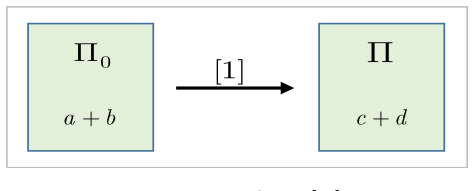
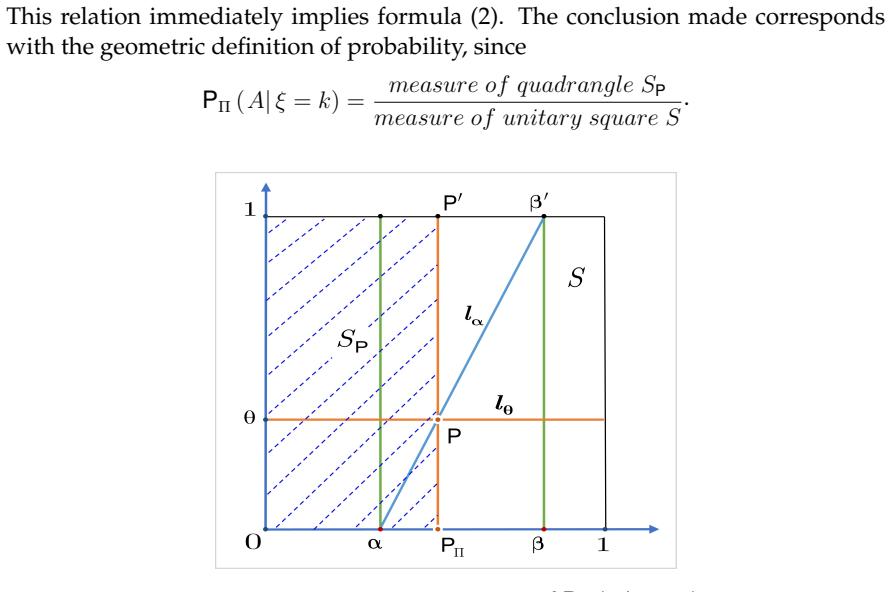
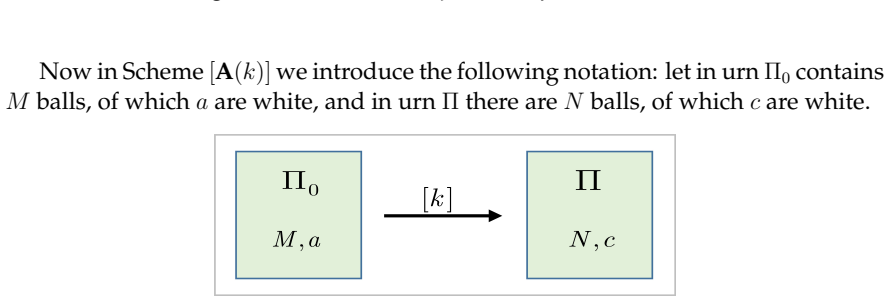
The central claim is Formula (6): in Scheme [A(k)], with a source urn containing $a$ white and $b$ black balls and a receiving urn containing $c$ white and $d$ black balls, if $k$ balls are transferred uniformly without replacement, the probability that a ball drawn afterward from the receiving urn is white is $$P_\Pi(A\mid \xi=k)=\frac{c}{c+d+k}+\frac{a}{a+b}\frac{k}{c+d+k}.$$ Equivalently, when the receiving urn holds $N=c+d$ balls and the source's white fraction is $\theta=a/(a+b)$, this is $(\theta k+c)/(N+k)$. The paper writes this as $\alpha+(\beta-\alpha)\theta$, where $\alpha=c/(c+d+k)$ and $\beta=(c+k)/(c+d+k)$, and proves it by collapsing the sum over the number of white balls actually transferred. Theorems 2--4 extend the same arithmetic to multiple source urns, to chains of urns, and to several ball colours.
Load-bearing premise
The formulas assume that every ball in any urn is equally likely to be selected, both when the balls to be transferred are chosen and when the final draw is made; if sampling is biased or with unequal weights, equations (6)--(8) no longer follow.
Editorial extensions
If this is right
- For a single transfer from one source urn, the probability reduces to $(\theta k+c)/(N+k)$, so no case-by-case sum over how many white balls were transferred is needed.
- Because the formula is written as $\alpha+(\beta-\alpha)\theta$, the final probability lies between $\alpha$ and $\beta$, giving immediate upper and lower bounds.
- With $n$ source urns, the numerator becomes $\theta_1 k_1+\cdots+\theta_n k_n+c$ over $N+k_1+\cdots+k_n$, so the sources' contributions add linearly through their transferred counts.
- In a chain of urns, the one-step formula becomes the recurrence $P_m=\alpha+(\beta-\alpha)P_{m-1}$, so probabilities can be propagated step by step with arithmetic alone.
- For several ball colours, the same calculation applies to each colour separately, and the resulting probabilities sum to 1.
Reading between the lines
- The combinatorial lemma is equivalent to $\mathbb{E}[i\mid k]=k\theta$, where $i$ is the number of white balls transferred, so the formula is a disguised linearity-of-expectation statement; any transfer rule with that conditional expectation would give the same final probability without uniform sampling.
- Formula (10) is an affine recurrence in $P_{m-1}$, and iterating it would yield an explicit closed form for the probability after $m$ transfers, a step the paper leaves implicit.
- Because the answer depends on the source urn only through its white fraction $\theta$, scaling the source urn's contents proportionally leaves the transfer probability unchanged; that invariance is a quick check any implementation of formula (6) should satisfy.
Signed reviews
Editorial analysis
A structured set of objections, weighed in public.
Referee Report
Summary. The paper considers urn schemes with transfers between urns and proposes simplified formulas for the probability of drawing a white ball from a receiving urn after a random sample of k balls is transferred from one or more source urns. The main result, Theorem 1 (formula (4), equivalently (6)), states that this probability is the affine expression alpha + (beta - alpha) theta, where alpha = c/(c+d+k), beta = (c+k)/(c+d+k), and theta = a/(a+b) is the white proportion in the source urn. Theorem 2 rewrites this in terms of total ball counts, Theorem 3 generalizes to n source urns, and Theorem 4 supplies a recurrence for a chain of urns. The proofs use binomial coefficient identities and linearity of expectation, and three worked exercises illustrate the formulas.
Significance. If the results hold, they give a direct, combinatorial-sum-free way to compute probabilities in these urn schemes, which is useful for teaching and for quick calculations. The central formula is parameter-free, explicitly falsifiable, and is derived from elementary binomial identities and linearity of expectation. The paper includes correct worked exercises. The main limitation is that the formulas are straightforward consequences of linearity of expectation and are consistent with standard urn theory, so the novelty is mainly pedagogical rather than an advance in research-level probability.
minor comments (8)
- [Section 1, Theorem 3] The proof of Theorem 3 is omitted with the note that it repeats the proof of Theorem 2; since this is a key generalization, a brief proof (or a reference to a linearity-of-expectation argument) should be included.
- [Section 1, geometric interpretation] In the sentence 'This relation immediately implies formula (2)', the reference is incorrect: the geometric construction leads to formula (4), not the lemma numbered (2).
- [Section 1, proof of Theorem 1] The sentence 'For arbitrary ξ = k, according to standard reasoning PΠ(A|ξ = 2) = ...' should state ξ = k, not ξ = 2; the displayed formula is for general k.
- [Section 1, Theorem 4] In equation (10), the notation αs1 and βs1 is reused for the m-th step after being introduced for the first step in equation (9); using α_sm and β_sm would remove the ambiguity.
- [Introduction and Scheme [A(k)]] The assumption that balls are sampled uniformly without replacement from each urn is not stated explicitly; this is standard for urn models but should be spelled out as a defining condition of the schemes.
- [Lemma] The lemma and its proof divide by a; a separate trivial argument is needed for the case a = 0, although formula (6) remains valid in that case.
- [Exercise 1] The displayed solution is ambiguous: it should be written as ((11850/15000)·10000 + 15800)/27000 = 79/90 rather than as a chain of quotients.
- [Throughout] There are minor grammatical errors, e.g., 'The urn schemes is one of the simplest models' should be 'The urn schemes are one of the simplest models', and 'that be generalization' should be 'that are generalizations'.
Circularity Check
No circularity: the main formulas are derived directly from elementary binomial identities and linearity of expectation, with no fitted parameters or load-bearing self-citations.
full rationale
The paper's central result, formula (4) and equivalently formula (6), is obtained by a fully displayed derivation: the authors start from the combinatorial expression (5) and reduce it using the elementary identities (2), (3), and the standard relation for binomial coefficients. These identities are external mathematical facts, not assumptions of the target formula. Theorem 2 is simply an algebraic restatement of (6) with M and N notation. Theorem 3 extends the same linearity-of-expectation argument to multiple source urns, and the proof is explicitly said to repeat the argument of Theorem 2; this is a legitimate omitted-repetition step rather than a circular one. Theorem 4 gives a recurrence whose base case is Theorem 2 and whose induction step is the same conditioning argument, so no target conclusion is imported. There are no fitted parameters, no empirical inputs, and no claims whose force depends on the authors' own prior work. The only unstated ingredients are the standard assumption of uniform random sampling without replacement and a minor edge case when a = 0 in the lemma, but neither constitutes circularity: the derivation does not assume the probability it is trying to compute, and the formulas are verified against explicit calculations for k = 1 and k = 2. Accordingly, the derivation chain is self-contained and the circularity score is 0.
Assumptions & free parameters
assumptions (3)
- domain assumption Each urn's balls are exchangeable, so every ball has equal probability of being drawn at each step.
- standard math Linearity of expectation holds for the sum of indicators of white balls transferred.
- standard math Vandermonde's identity for binomial coefficients (3) is valid.
Cite this review
Pith. "Pith review of Some remarks on the direct calculation of Probabilities in Urn Schemes." pith.science (2026). https://pith.science/paper/5CFGSAGU
@misc{pith2026190807184,
  author       = {Pith},
  title        = {Pith review of: Some remarks on the direct calculation of Probabilities in Urn Schemes},
  year         = {2026},
  howpublished = {\url{https://pith.science/paper/5CFGSAGU}},
  note         = {Machine review of arXiv:1908.07184}
}
read the original abstract
The paper considers urn schemes in which several urns can be involved. Simplified formulas are proposed that allow direct calculation of probabilities without the use of elements combinatorics.
Figures
Figures from the paper (3 more)


Reference graph
Works this paper leans on
-
[1]
H. M. Mahmoud (2009). P ´olya urn models. CRC Press, Boca Raton, USA
work page 2009
-
[2]
N. H. Bingham (1991). Fluctuation Theory for the Ehrenfest Urn. Advances in Applied Probability. Vol. 23, no. 3, pp. 598–611
work page 1991
-
[3]
N. L. Johnson and S. Kotz (1985). Urn models and their application. John Wiley and Sons Inc, New York, USA. 10
work page 1985
Reviewed August 14, 2026 · model on record in the stance chip above.
Discussion (0). Continue with ORCID to comment.