REVIEW 4 major objections 5 minor 42 references
Halpha emission-line stars in molecular clouds III. Canis Major
T0 review · 4 major / 5 minor · reviewed 2026-08-14 · deepseek-v4-flash
Pith's one-line read The Canis Major star-forming region is pinned at 1185 ± 25 parsecs by Gaia parallaxes of 98 newly catalogued hydrogen-alpha emission stars, settling a long-disputed distance.
desk verdict A solid Hα survey catalog and two new HH objects, but the headline Gaia distance of 1185±25 pc is softer than it looks: the parallax window is post-hoc and the DR2 zero-point is unaddressed. read the letter →
The pith
A machine-rendered reading of the paper's core claim, the machinery that carries it, and where it could break.
The reading
What carries the argument
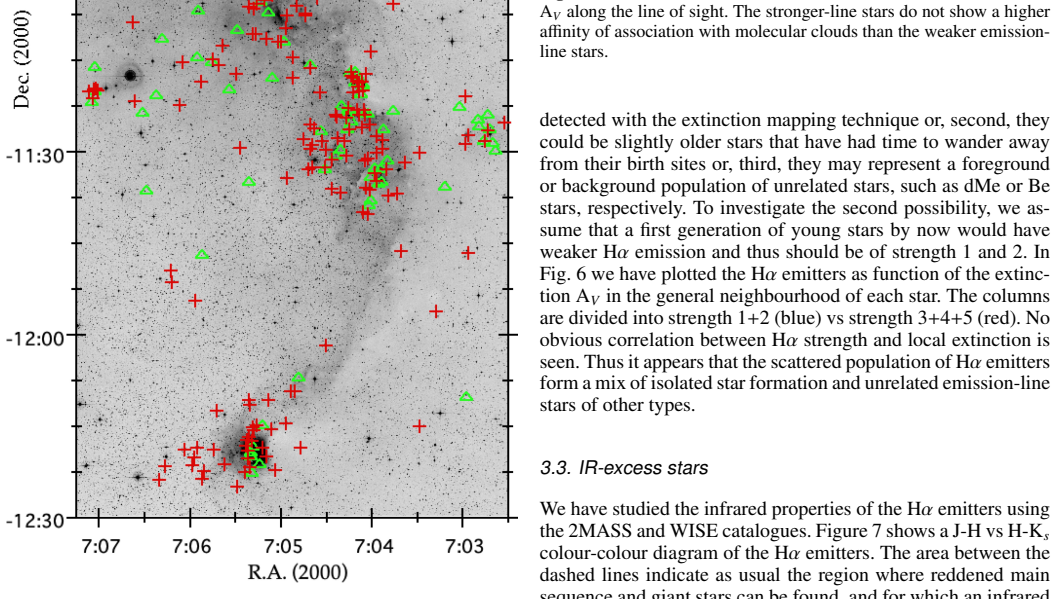
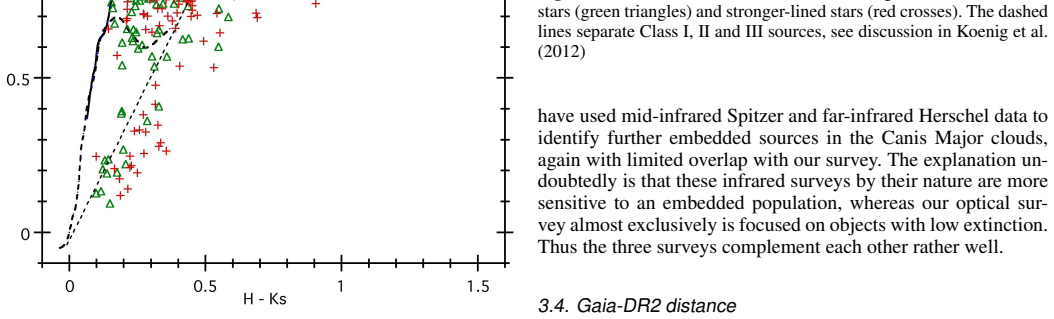
The central mechanism is the distance histogram built from Gaia DR2 parallaxes of objective-prism-selected H$\alpha$ emitters. The survey itself is a photographic objective-prism campaign on a Schmidt telescope: seven films with dispersion of 800 Å per millimetre at H$\alpha$, covering about 14 square degrees, from which 398 emission stars were catalogued at 2MASS positions. The distance result is carried by the 98 members of that sample with parallax errors below 20 per cent and nominal distances between 1050 and 1350 pc, the window drawn around the pronounced peak at 1185 pc; the same window applied to 51 OB stars from the Claría and Shevchenko membership lists provides the independent confirmation. Classification of the sources as mostly Class II young stellar objects rests on WISE colours, using the empirically calibrated Class I/II/III boundaries.
What would settle it
Two checks would settle the claim. First, recompute the median distance using only the roughly 221 stars with WISE colours in the Class II region, where foreground dMe contamination should be negligible, and see whether the median moves by more than 25 pc from 1185 pc. Second, re-derive the distance from Gaia eDR3 or DR3 parallaxes of the same 98 stars, whose individual errors would shrink and whose systematic offsets at 1.18 kpc would become apparent; a persisted shift beyond $\pm 25$ pc would show that the window selection was biasing the answer.
Extended reading notes
Core claim
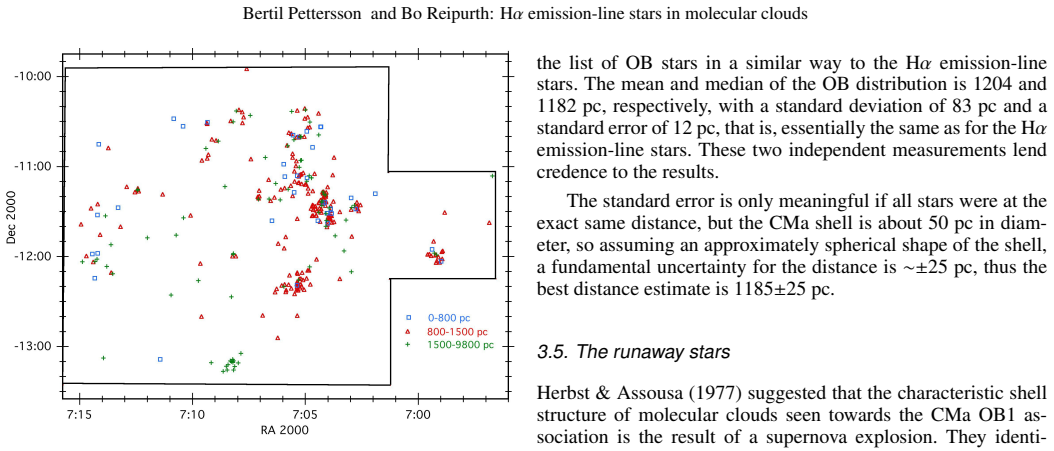
The paper's central claim is that the CMa OB1 association and its surrounding clouds lie at $1185 \pm 25$ pc. From the 398 H$\alpha$ emitters found in the objective-prism survey, the authors take the 98 stars with Gaia DR2 parallax errors under 20 per cent and nominal distances in the 1050 to 1350 pc interval that brackets the histogram peak; this sample has a mean distance of 1184 pc, a median of 1185 pc, and a standard deviation of 70 pc. Applying the same selection to 51 OB stars from earlier membership compilations gives a median of 1182 pc, essentially identical. Because the association's shell spans about 50 pc across, the authors adopt a fundamental uncertainty of $\pm 25$ pc rather than the 7.1 pc standard error of the median, and state flatly that 'the best distance estimate is $1185 \pm 25$ pc'. This places the region at the far end of the earlier 690 to 1150 pc range and agrees with the extinction-based value of $1150 \pm 64$ pc.
Load-bearing premise
The distance claim rests on the assumption that the 98 H$\alpha$ stars inside the 1050 to 1350 pc window, which was drawn around the observed distance peak, are unbiased members of the CMa OB1 association rather than a mix that includes foreground dMe dwarfs and background Be stars whose median happens to fall in that same window.
Editorial extensions
If this is right
- All derived properties of the young stars — luminosities, masses, ages, disc fractions — are anchored to a single distance of $1185 \pm 25$ pc instead of a disputed 690 to 1150 pc range.
- At this distance the association's shell, about 50 pc across, is physically real, supporting the supernova-triggered star formation scenario; both runaway candidates, HD 54662 at 1170 pc and HD 57682 at 1241 pc, are consistent with membership.
- Of the 300 H$\alpha$ emitters with usable WISE photometry, 221 fall in the Class II region, so the survey reveals a dominant population of disc-bearing young stellar objects whose H$\alpha$ strength tracks accretion activity.
- The two new Herbig-Haro objects, HH 1174 and HH 1175, trace ongoing outflow activity inside the L1657 cloud, with HH 1175 only 3 arcsec from its likely embedded driving source.
Reading between the lines
- The same survey series has already mapped H$\alpha$ emission populations in NGC 2264 and the Orion region; with Canis Major added, the three regions can be compared on a homogeneous basis, and the distance ratios between them then depend on Gaia parallax quality rather than on method-dependent photometry.
- The contrast in near-infrared excess fractions, 44 per cent here versus 16 per cent around the Orion Nebula Cluster, suggests that the ambient ultraviolet field erodes discs faster; a testable extension would be to plot the disc fraction of the Canis Major sample against projected distance from the central OB stars and look for a gradient.
- A cheap internal check of the distance assumption would be to test for a correlation between the measured distance of the 98 stars and their H$\alpha$ strength or WISE class; if Class I or strong-line objects sit systematically closer or farther than Class III objects, the window-based median is mixing distinct populations.
Signed reviews
Editorial analysis
A structured set of objections, weighed in public.
Referee Report
Summary. The paper presents a deep objective-prism Hα survey of approximately 14 square degrees toward the Canis Major star-forming region, detecting 398 Hα emitters, of which 353 are new. It provides coordinates from 2MASS, near-IR and WISE photometry, Gaia DR2 cross-matches, and finding charts for all new objects. Using Gaia DR2 parallaxes, the authors estimate the distance to the CMa OB1 association: after selecting 98 Hα emitters with parallax errors below 20% and nominal distances in the interval 1050–1350 pc, they find a median distance of 1185 pc; a similarly selected sample of 51 OB stars gives a median of 1182 pc. The paper concludes that the best distance estimate is 1185±25 pc, two runaway stars are confirmed as association members, and two new Herbig-Haro objects (HH 1174 and HH 1175) are identified with likely driving sources.
Significance. The catalog itself is a solid and useful contribution: it roughly triples the known Hα emitters in the region, provides homogeneous astrometry and photometry in a single table, and offers identification charts for all new sources. The WISE color classification and the detection of two new HH objects add value for future studies of young stellar objects in Canis Major. If the Gaia-based distance of ~1185 pc is correct, it resolves a long-standing discrepancy between photometric distance estimates (690–1150 pc) and places the association at the far end of the previously accepted range. The claim, however, depends on a distance estimate that ignores a known Gaia DR2 systematic and on a selection window chosen around the observed peak; these issues must be addressed before the central result can be considered robust.
major comments (4)
- [Section 3.4] The quoted '1185±25 pc' is derived from Gaia DR2 parallaxes without applying or discussing the known DR2 parallax zero-point offset. At the median parallax of about 0.84 mas, a −0.03 mas offset shifts individual distances by roughly 40–50 pc and moves the median from 1185 pc to approximately 1145 pc. This is a coherent systematic that affects the Hα and OB samples identically, so it is not cancelled by their mutual agreement, and it is not included in the 7.1 pc standard error or the ad hoc ±25 pc uncertainty. Please apply a zero-point correction (or fold the zero-point uncertainty into the reported error budget) and recompute the distance estimate.
- [Section 3.4] The selection of the 1050–1350 pc interval around the observed peak makes the reported median and standard error conditional on that window. The 'standard error of 7.1 pc' is the internal scatter of the selected sample divided by √98 and does not capture the uncertainty introduced by choosing the interval boundaries around the peak. Please quantify the sensitivity of the median to the chosen window (e.g., by varying the boundaries) or provide an a priori justification for the interval, and report the resulting range of median distances.
- [Section 3.4, Conclusion item 8] The OB-star sample is 'culled in a similar way to the Hα emission-line stars,' meaning it is selected using the same 1050–1350 pc distance window. The agreement between the Hα and OB median distances (1185 vs 1182 pc) is therefore partly by construction and cannot be described as a fully independent corroboration of the distance. Please soften this claim or test the OB stars against a differently defined selection (e.g., without imposing the same distance window, or using only OB stars with membership criteria independent of parallax).
- [Table 2 and Section 3.4] The paper refers to 'distances extracted from Gaia-DR2,' but Gaia DR2 provides parallaxes, not distances. If the quoted distances are computed as 1/parallax, the median of such inverse-parallax distances can be biased even at 20% parallax error, and the quoted distance uncertainties are not well defined. Please state explicitly the transformation used, and consider using a probabilistic distance estimate (e.g., Bailer-Jones et al. 2018) or justify quantitatively that the bias is negligible for this sample.
minor comments (5)
- [Abstract and Section 3.4] The phrase 'distances extracted from Gaia-DR2' is imprecise; Gaia DR2 provides parallaxes, and the transformation to distance should be described.
- [Section 3.4] The reasoning behind the 'fundamental uncertainty of ∼±25 pc' from the shell diameter of 50 pc is not fully explained; please clarify the assumed geometry and how the line-of-sight depth is estimated, since the angular diameter alone does not fix the radial depth.
- [References] Given the high-precision distance claim based on Gaia DR2, the paper should cite and discuss the known parallax zero-point studies (e.g., Lindegren et al. 2018; Arenou et al. 2018).
- [Figure 10] Please state the bin width used in the distance histograms and clarify whether the plotted distances are the nominal 1/parallax values or a probability-inferred quantity.
- [Section 3.2] The conclusion that Hα strength does not correlate with extinction would be strengthened by a quantitative measure; as presented it rests on a visual comparison with an extinction map of limited resolution, which should be noted as a caveat.
Circularity Check
No circularity: the Gaia-based distance is an external measurement, not derived from the claimed result.
full rationale
The central distance claim, 1185±25 pc for CMa OB1, is derived from Gaia DR2 parallaxes of 98 H-alpha emission-line stars, with a corroborating median of 1182 pc from 51 OB stars. These are measured catalog quantities, not outputs of a model fitted to the target distance. The H-alpha stars were selected by objective-prism H-alpha emission and spatial concentration toward the molecular clouds, not by distance; the 1050-1350 pc window was chosen after inspecting the distance histogram, which is a selection effect rather than circular reasoning. The median of the truncated sample is still an empirical statistic, and the OB sample, although filtered with the same parallax-error and distance-interval criteria, contributes independent parallax data. No equation in the paper reduces to an input, and no fitted parameter is renamed as a prediction. The self-citations to Papers I and II concern survey technique only and are not load-bearing for the distance result. The paper's own caveat that the 7.1 pc standard error is meaningful only if all stars lie at one distance, and its adoption of ±25 pc from the shell size, is an uncertainty statement, not a circular step. The absence of a Gaia DR2 zero-point correction is a legitimate systematic-error concern, but it does not make the derivation circular. Overall, the derivation is self-contained against external data and no circular step is exhibited.
Assumptions & free parameters
free parameters (2)
- Distance selection window =
1050 to 1350 pc
- Parallax error threshold =
20%
assumptions (5)
- domain assumption Gaia DR2 parallaxes are accurate for these stars, with negligible uncorrected zero-point offset.
- domain assumption The objective-prism H-alpha identification is reliable and the strength classes (1-5) are consistent.
- domain assumption The extinction map of Dobashi et al. (2005) is accurate enough for the correlation analysis in Fig. 6.
- domain assumption WISE Class I/II/III boundaries from Koenig et al. (2012) apply to these sources.
- domain assumption The OB star samples of Claría (1974a) and Shevchenko et al. (1999) are complete and correctly identified.
Cite this review
Pith. "Pith review of Halpha emission-line stars in molecular clouds III. Canis Major." pith.science (2026). https://pith.science/paper/5DRPARVQ
@misc{pith2026190811446,
  author       = {Pith},
  title        = {Pith review of: Halpha emission-line stars in molecular clouds III. Canis Major},
  year         = {2026},
  howpublished = {\url{https://pith.science/paper/5DRPARVQ}},
  note         = {Machine review of arXiv:1908.11446}
}
read the original abstract
A deep objective-prism survey for H-alpha emission stars towards the Canis Major star-forming clouds was performed. A total of 398 Halpha emitters were detected, 353 of which are new detections. There is a strong concentration of these H-alpha emitters towards the molecular clouds surrounding the CMa~OB1 association, and it is likely that these stars are young stellar objects recently born in the clouds. An additional population of H-alpha emitters is scattered all across the region, and probably includes unrelated foreground dMe stars and background Be stars. About 90% of the H-alpha emitters are detected by WISE, of which 75% was detected with usable photometry. When plotted in a WISE colour-colour diagram it appears that the majority are Class II YSOs. Coordinates and finding charts are provided for all the new stars, and coordinates for all the detections. We searched the Gaia-DR2 catalogue and from 334 Halpha emission stars with useful parallaxes, we selected a subset of 98 stars that have parallax errors of less than 20% and nominal distances in the interval 1050 to 1350 pc that surrounds a strong peak at 1185 pc in the distance distribution. Similarly, Gaia distances were obtained for 51 OB-stars located towards Canis Major and selected with the same parallax errors as the H-alpha stars. We find a median distance for the OB stars of 1182 pc, in excellent correspondence with the distance from the H-alpha stars. Two known runaway stars are confirmed as members of the association. Finally, two new Herbig-Haro objects are identified.
Figures


Figures from the paper (8 more)





Reference graph
Works this paper leans on
-
[1]
Ambartsumian, V . A. 1947, Stellar Evolution and Astrophysics (Armenian Acad. of Sci., Yerevan), 12–16
work page 1947
-
[2]
Berghoefer, T. W., Schmitt, J. H. M. M., & Cassinelli, J. P. 1996, A&AS, 118, 481
work page 1996
- [3]
-
[4]
Bessell, M. S. & Brett, J. M. 1988, PASP, 100, 1134
1988
-
[5]
Brand, J., Cesaroni, R., Caselli, P., et al. 1994, A&AS, 103, 541
work page 1994
-
[6]
Carpenter, J. M., Hillenbrand, L. A., & Skrutskie, M. F. 2001, AJ, 121, 3160 Claría, J. J. 1974a, A&A, 37, 229 Claría, J. J. 1974b, AJ, 79, 1022 Comerón, F., Torra, J., & Gomez, A. E. 1998, A&A, 330, 975
work page 2001
-
[7]
M., Hartmann, D., & Thaddeus, P
Dame, T. M., Hartmann, D., & Thaddeus, P. 2001, ApJ, 547, 792
2001
- [8]
Show all 42 references
-
[9]
2005, PASJ, 57, S1
Dobashi, K., Uehara, H., Kandori, R., et al. 2005, PASJ, 57, S1
2005
-
[10]
2013, ApJ, 772, 45
Elia, D., Molinari, S., Fukui, Y ., et al. 2013, ApJ, 772, 45
2013
-
[11]
2015, MNRAS, 448, 119
Fernandes, B., Gregorio-Hetem, J., Montmerle, T., & Rojas, G. 2015, MNRAS, 448, 119
2015
-
[12]
2019, arXiv e-prints, arXiv:1906.00113
Fernandes, B., Montmerle, T., Santos-Silva, T., & Gregorio-Hetem, J. 2019, arXiv e-prints, arXiv:1906.00113
2019 arXiv
-
[13]
J., Padgett, D
Fischer, W. J., Padgett, D. L., Stapelfeldt, K. L., & Sewiło, M. 2016, ApJ, 827, 96 Gaia Collaboration, Clementini, G., Eyer, L., et al. 2017, A&A, 605, A79 Gaia Collaboration, Prusti, T., de Bruijne, J. H. J., et al. 2016, A&A, 595, A1
2016
-
[14]
2008, in Handbook of Star Forming Regions, V olume II, ed
Gregorio-Hetem, J. 2008, in Handbook of Star Forming Regions, V olume II, ed. B. Reipurth (ASP), 1
2008
-
[15]
V ., et al
Gregorio-Hetem, J., Montmerle, T., Rodrigues, C. V ., et al. 2009, A&A, 506, 711
2009
-
[16]
J., Hewett, R., et al
Hartmann, L., Kenyon, S. J., Hewett, R., et al. 1989, ApJ, 338, 1001
1989
-
[17]
Herbig, G. H. 1954, ApJ, 119, 483
1954
-
[18]
Herbig, G. H. 1960, ApJS, 4, 337
1960
-
[19]
Herbig, G. H. 1991, in Low Mass Star Formation in Southern Molecular Clouds , ed. B. Reipurth, V ol. 11 (ESO Scientific Report), 59
1991
-
[20]
Herbig, G. H. 1998, ApJ, 497, 736
1998
-
[21]
Herbig, G. H. & Dahm, S. E. 2006, AJ, 131, 1530
2006
-
[22]
& Assousa, G
Herbst, W. & Assousa, G. E. 1977, ApJ, 217, 473
1977
-
[23]
Kaltcheva, N. T. & Hilditch, R. W. 2000, MNRAS, 312, 753
2000
-
[24]
P., Leisawitz, D
Koenig, X. P., Leisawitz, D. T., Benford, D. J., et al. 2012, ApJ, 744, 130
2012
-
[25]
Lombardi, M., Alves, J., & Lada, C. J. 2011, A&A, 535, A16
2011
-
[26]
K., Ojha, D
Mallick, K. K., Ojha, D. K., Samal, M. R., et al. 2012, ApJ, 759, 48
2012
-
[27]
2018, A&A, 615, A19
Mossoux, E., Mahy, L., & Rauw, G. 2018, A&A, 615, A19
2018
-
[28]
2002, AJ, 123, 2597
Ogura, K., Sugitani, K., & Pickles, A. 2002, AJ, 123, 2597
2002
-
[29]
2014, A&A, 570, A30, (Paper II)
Pettersson, B., Armond, T., & Reipurth, B. 2014, A&A, 570, A30, (Paper II)
2014
-
[30]
M., Johnson, C
Rebull, L. M., Johnson, C. H., Gibbs, J. C., et al. 2013, AJ, 145, 15
2013
-
[31]
Reipurth, B., Pettersson, B., Armond, T., Bally, J., & Vaz, L. P. R. 2004, AJ, 127, 1117, (Paper I)
2004
-
[32]
Rieke, G. H. & Lebofsky, M. J. 1985, ApJ, 288, 618
1985
-
[33]
Schwartz, R. D. 1977, ApJS, 35, 161 Sewiło, M., Whitney, B. A., Yung, B. H. K., et al. 2019, ApJS, 240, 26
1977
-
[34]
S., Ezhkova, O
Shevchenko, V . S., Ezhkova, O. V ., Ibrahimov, M. A., van den Ancker, M. E., & Tjin A Djie, H. R. E. 1999, MNRAS, 310, 210
1999
-
[35]
I., Dzura, A
Slysh, V . I., Dzura, A. M., Val’tts, I. E., & Gerard, E. 1994, A&AS, 106, 87
1994
-
[36]
Soares, J. B. & Bica, E. 2002, A&A, 388, 172
2002
-
[37]
Soares, J. B. & Bica, E. 2003, A&A, 404, 217
2003
-
[38]
Stephenson, C. B. & Sanduleak, N. 1977, ApJS, 33, 459
1977
-
[39]
1995, ApJ, 455, L39 van den Bergh, S
Sugitani, K., Tamura, M., & Ogura, K. 1995, ApJ, 455, L39 van den Bergh, S. 1966, AJ, 71, 990
1995
-
[40]
Wackerling, L. R. 1970, MNRAS, 149, 405
1970
-
[41]
F., Ran, L., Yu, W
Wang, K., Wu, Y . F., Ran, L., Yu, W. T., & Miller, M. 2009, A&A, 507, 369
2009
-
[42]
D., Kogure, T., Nakano, M., & Yoshida, S
Wiramihardja, S. D., Kogure, T., Nakano, M., & Yoshida, S. 1986, PASJ, 38, 395 Article number, page 9 of 13 A&A proofs: manuscript no. aa31578-17 Appendix A: Finding Charts In this appendix we provide finding charts for all of the new Hα emission-line stars presented in this pa...
1986
Reviewed August 14, 2026 · model on record in the stance chip above.
Discussion (0). Continue with ORCID to comment.